Quick Answer
Yes, but not because Instagram is failing. Instagram can create awareness, education, trust, and inquiries. Your website has a different job: helping prospective patients verify treatments, practitioner expertise, reviews, expectations, location, and the consultation process. Med Spa Website is worth the investment when it helps qualified visitors move from social-media interest to informed confidence and measurable consultation activity.
TL;DR: What Should a Med Spa Owner Know?
- Instagram can be an effective acquisition channel without being sufficient as the entire patient decision journey.
- The website should continue the conversation started on Instagram rather than sending every visitor to a generic homepage.
- The most useful diagnostic question is not “Does my website convert?” but “Where do qualified Instagram visitors stop progressing?”
- A high-converting website reduces uncertainty, demonstrates relevant expertise, answers treatment questions, and makes the next step clear.
- There is no universal med spa website conversion rate that can reliably predict your results. Your own source-level data is more useful.
- KG Web Designer’s July 2026 review of 24 public aesthetic clinic and medspa websites found that 92% used generic treatment descriptions, 63% had limited practitioner-authority content, and 75% lacked FAQ or AI-readable content structures.
Instagram Is Already Working. So Why Does the Website Matter?
The website matters because an Instagram lead is not necessarily a consultation-ready patient. So, does a med spa need a website if Instagram is already generating inquiries? In most cases, yes, because the website gives those prospects a place to research, verify, and decide before they commit to a consultation.
A person may discover a treatment through a Reel, save a before-and-after post, follow the clinic, send a DM, or click the profile link without having decided whether the clinic is right for them. Aesthetic treatments can involve cost, provider qualifications, treatment expectations, recovery questions, and concerns about safety or results.
Instagram is excellent at starting that conversation.
The website needs to be capable of continuing it.
The American Med Spa Association says the majority of patients seeking aesthetic procedures start their research journey online and highlights social media as an important source of aesthetic-treatment information. It also notes that patients commonly search for questions about treatments, duration, cost, and other practical considerations.
That creates a simple strategic distinction:
Instagram creates discovery.
The website supports deeper research.
Reviews and Google reinforce verification.
The consultation converts informed intent into a patient conversation.
The website therefore does not compete with Instagram.
It gives the attention Instagram creates somewhere useful to go.
If your clinic already gets Instagram inquiries but you cannot tell what happens after visitors reach the website, start with a patient-journey audit rather than assuming you need more traffic or a complete redesign.
Explore KG Web Designer’s approach to choosing a med spa website design company before treating the website as a simple visual project.
What Is a High-Converting Med Spa Website?
A high-converting med spa website is not simply a website with more booking buttons.
It is a website that helps the right prospective patients move from treatment interest to an informed consultation by reducing uncertainty, demonstrating provider credibility, answering decision-stage questions, and making the next step easy.
That definition is important because many websites optimize for the final action before earning the visitor’s confidence.
A large “Book Now” button cannot compensate for:
- a generic treatment description
- unclear practitioner credentials
- weak differentiation
- missing FAQs
- poor mobile experience
- confusing consultation expectations
- irrelevant landing pages
- an inconvenient booking process
A useful conversion sequence is:
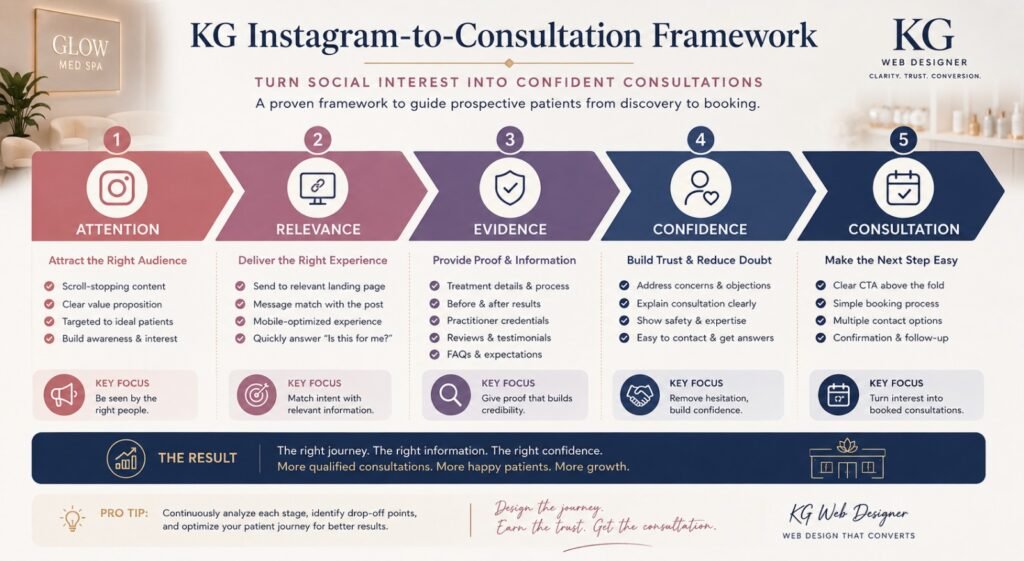
Interest → Relevance → Evidence → Confidence → Consultation
That is different from:
Interest → Book Now
The second assumes the visitor is ready.
The first recognizes how higher-consideration aesthetic decisions actually work.
At KG Web Designer, we have found that the strongest websites do not necessarily ask visitors to book sooner. They make visitors more comfortable deciding when they are ready.
This becomes even more important when an Instagram campaign promotes a treatment available at several clinics. A prospective patient should be able to identify the relevant location, see the appropriate practitioners and services, understand where the treatment is offered, and move into the correct booking path without navigating through the broader brand site. For a deeper look at this architecture, see our guide to structuring a multi-location med spa website.
Expert Insight
Kanika Gupta, Founder, KG Web Designer
“If Instagram is already generating interest, I would not start by telling the clinic to spend more on Instagram or immediately rebuild the website. I would first trace what happens after the click. If qualified visitors are reaching the website but cannot find enough evidence to make a decision, the website is part of the acquisition problem.”
How Should Instagram and Your Website Divide the Patient Journey?
Instagram and the website should perform different jobs within the same acquisition system.
| Instagram is strongest at | Website is strongest at |
|---|---|
| Discovery | Treatment education |
| Visual storytelling | Practitioner credibility |
| Personality | Provider verification |
| Engagement | Decision support |
| Community | Consultation pathways |
| Content distribution | Search visibility |
| Social interaction | Measurement and attribution |
This distinction prevents a common strategic mistake: trying to make Instagram function like a website or expecting the website to generate the same kind of engagement as Instagram.
A Reel can make someone curious about laser resurfacing.
A treatment page can explain what the clinic actually offers.
A practitioner profile can establish relevant expertise.
Reviews can reinforce confidence.
Google can help the patient verify the clinic’s location and reputation.
The consultation page can explain what happens next.
The booking system can capture the action.
The channels work together.
Owned versus platform-controlled experience
There is also a practical difference in control.
Instagram determines how content is distributed and experienced within its platform. Your website gives you much greater control over treatment information, internal journeys, analytics, search visibility, landing-page structure, and conversion architecture.
That does not mean abandoning Instagram.
It means avoiding a situation where the clinic’s entire digital patient journey depends on one platform.
A treatment page should do more than describe a procedure and display a booking button. It needs to answer the questions a prospective patient is likely to have about the treatment, practitioner, results, expectations, and next step. Our guide to Med Spa Treatment Pages Design explains how to structure these pages so they support patient research and move qualified visitors toward consultation.
What Does the Real Patient Journey Look Like?
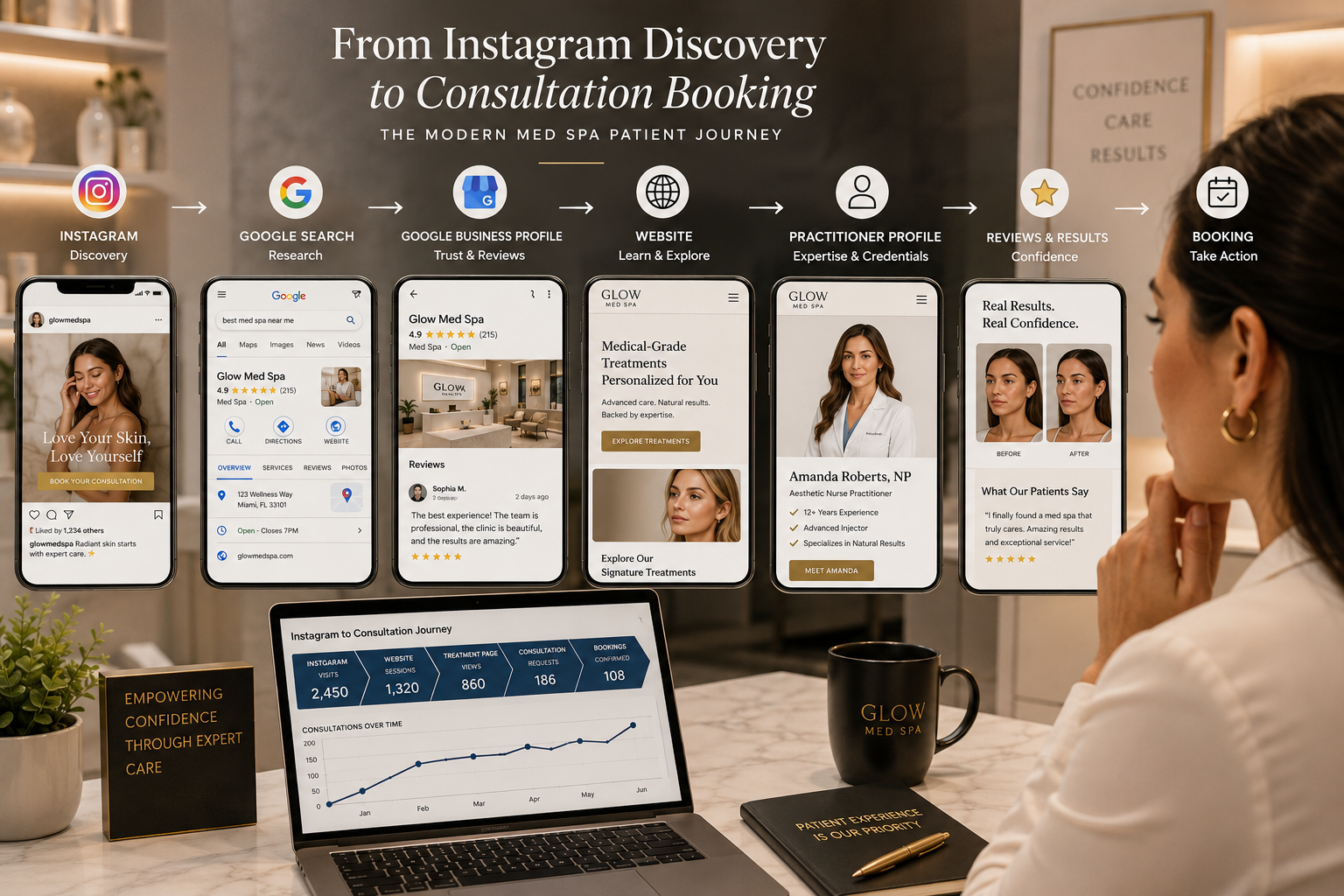
The real journey is usually more complicated than Instagram → website → booking.
A patient may move through several verification points before contacting a clinic.
A realistic journey might be:
Instagram Reel
↓
Clinic profile
↓
Google search for clinic or practitioner
↓
Google Business Profile and reviews
↓
Website treatment page
↓
Practitioner profile
↓
Results, FAQs, and education
↓
Consultation information
↓
Booking
This matters because the website is only one part of the decision ecosystem.
A prospective patient may leave Instagram, search the clinic name, read reviews, compare another provider, return to the website, and only then decide to request a consultation.
The website therefore needs to remain useful even when it is not the first touchpoint.
Google’s current guidance also reinforces the importance of maintaining accurate Business Profile information and making website content easy to discover through internal links and standard SEO foundations.
The goal is not to force every patient through one predetermined path.
The goal is to make every major path credible.
Why Do Instagram Leads Disappear Before Booking?
Instagram leads can disappear for many reasons, and the website is only one possible cause.
That is why “we get lots of engagement but not enough bookings” is not a diagnosis.
It is a symptom.
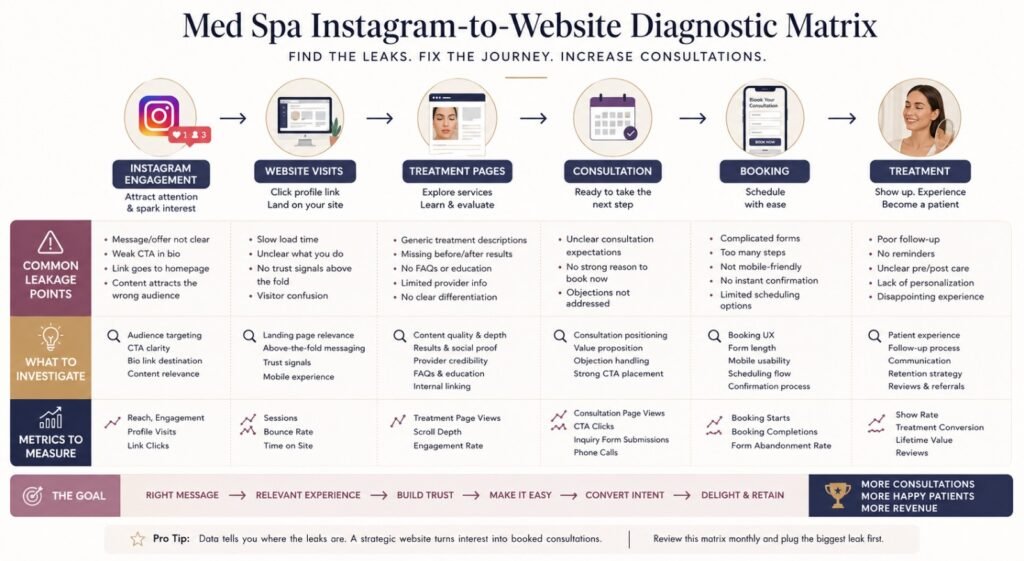
The following matrix is more useful:
| What you’re seeing | Likely problem | What to investigate |
|---|---|---|
| High Instagram engagement, few website visits | Social-to-site transition | Profile link, CTA, content intent |
| Good Instagram traffic, high landing-page exits | Intent mismatch | Landing-page relevance |
| Treatment-page traffic, few consultation visits | Trust or content problem | Credentials, results, FAQs |
| Consultation-page visits, few booking starts | Offer or CTA friction | Consultation positioning |
| Many booking starts, few completions | Booking UX | Forms, mobile experience, scheduling |
| Many inquiries, few qualified leads | Audience or offer problem | Targeting and messaging |
| Good bookings, poor attendance | Post-booking problem | Confirmation and reminders |
| Good consultations, poor treatment conversion | Consultation/sales issue | Intake and consultation process |
This is the key difference between traffic optimization and business diagnosis.
If 1,000 people arrive on your website and 900 leave immediately, you need to understand why.
If 100 qualified visitors arrive and 10 request consultations, that may be a very different situation.
The absolute traffic number does not tell you enough.
The KG Instagram-to-Consultation Diagnostic
At KG Web Designer, we use five checkpoints when reviewing this type of journey:
1. Attention
Did the social content attract the right audience?
2. Relevance
Did the visitor land on information that matches what they clicked?
3. Evidence
Can they verify the treatment, provider, experience, and clinic?
4. Confidence
Have the important questions and objections been addressed?
5. Consultation
Is the next action clear and easy?
This framework keeps the discussion focused on the actual business problem instead of automatically blaming the website.
What Should an Instagram Landing Page Include?
An Instagram visitor should immediately recognize that the page continues the conversation that caused them to click.
If a Reel discusses a specific treatment, sending the visitor to a generic homepage creates unnecessary work.
A strong Instagram landing page should provide:
- Message continuity with the Reel, ad, or post.
- The treatment name immediately.
- The patient concern the treatment addresses.
- Relevant practitioner information.
- Authentic evidence where appropriate.
- Treatment-specific FAQs.
- Clinic location and practical information.
- Consultation expectations.
- A clear next action.
- Fast, usable mobile performance.
For example, imagine an Instagram Reel discussing skin resurfacing.
A weak click path is:
Reel → Homepage → Services → Skin Treatments → Resurfacing → Book
A stronger path is:
Reel → Skin Resurfacing Page → Treatment Information → Provider → Results → FAQs → Consultation → Booking
The second journey preserves intent.
That is the difference between sending traffic to a website and actually designing the Med Spa Website for More Leads to handle that traffic.
What Should a Treatment Page Do Before Asking Someone to Book?
A treatment page should answer enough decision-stage questions that a prospective patient can understand whether continuing toward a consultation makes sense.
It should not attempt to replace a medical consultation.
It should provide accurate, appropriately reviewed educational information.
Treatment pages should explain the service, relevant concerns, who provides it, what the consultation involves, commonly asked questions, and practical expectations. Claims about candidacy, risks, contraindications, recovery, and expected outcomes should be communicated carefully and reviewed according to the clinic’s professional, legal, and regulatory requirements.
This distinction is especially important in aesthetic healthcare.
A website can educate without making individualized medical recommendations.
It can explain what a treatment generally involves without telling a particular visitor that the treatment is right for them.
It can present authentic results without implying that every patient will achieve the same outcome.
That combination of useful education and responsible communication builds more credible trust than aggressive sales copy.
What Role Do Reviews, Results, and Practitioner Profiles Play?
Trust is created through several pieces of evidence working together.
A prospective patient may see a beautiful Instagram feed and still want to know who actually performs the treatment.
They may see excellent results and still want to understand whether those results are relevant to their concern.
They may read a positive review and still compare the practitioner with another clinic.
This is why trust should not be treated as a single website section.
Practitioner credibility
Explain who provides the treatment and what relevant expertise they bring.
Authentic results
Where legally and ethically appropriate, show real results with enough context to avoid misleading impressions.
Reviews
Place relevant patient feedback close to the decision it supports rather than hiding all testimonials on a separate page.
Treatment education
Answer common questions clearly and avoid generic descriptions that could apply to every competing clinic.
Clinic differentiation
Explain what is genuinely distinctive about the practice.
Our July 2026 review of 24 public aesthetic clinic and medspa websites found that 92% used generic treatment descriptions and 63% had limited practitioner-authority content.
That finding is important because the problem is not necessarily a lack of content.
It is a lack of specific evidence.
What Did KG Web Designer Find in Its 2026 Med Spa Website Review?
The 24-site review is one of the strongest first-party assets supporting this article, so it should be treated as original research rather than scattered statistics.
KG Web Designer Med Spa Website Review — July 2026
Sample: 24 publicly accessible aesthetic clinic and medspa websites
Markets: United States, United Kingdom, and Australia
Review period: July 14–16, 2026
Market coverage: 12 US, 7 UK, and 5 Australian clinics
Review areas: Treatment content, practitioner visibility, consultation CTAs, FAQs, trust signals, before-and-after presentation, differentiation, and information architecture
Method: Manual website review conducted by KG Web Designer
Purpose: Identify recurring website gaps that can affect patient research and conversion
Limitation: This is a small observational sample and should not be treated as representative of the entire med spa industry.
What did the review find?
| Finding | Websites observed | Frequency |
|---|---|---|
| Generic treatment descriptions | 22 of 24 | 92% |
| No FAQ or AI-readable content structure | 18 of 24 | 75% |
| Limited practitioner-authority content | 15 of 24 | 63% |
| Poor before-and-after presentation | 15 of 24 | 63% |
| Weak differentiation from competitors | 15 of 24 | 63% |
| Missing trust signals | 10 of 24 | 42% |
| Weak consultation pathways | 5 of 24 | 21% |
The interesting finding is that booking buttons were not the biggest weakness.
79% of the websites had clear consultation CTAs.
The bigger problem was what happened before the visitor reached the CTA.
That is a significant distinction.
A clinic can have a visible booking button and still have a weak conversion journey.
The website may be asking for a consultation before giving the visitor enough reason to want one.
How Much Website Improvement Is Enough?
Not every problem requires a redesign.
In fact, redesigning a website should usually be the second decision, not the first.
You probably do not need a full redesign if:
- mobile performance is acceptable
- the CMS can support treatment-specific landing pages
- practitioner pages can be improved
- analytics can be implemented
- booking UX can be improved
- internal linking can be fixed
- the current brand still represents the clinic
- the site architecture can support new services
A redesign becomes more justified when:
- the information architecture is fundamentally broken
- the mobile templates cannot be fixed efficiently
- the CMS severely restricts content
- tracking cannot be implemented reliably
- technical performance is structurally poor
- new treatments or locations cannot be accommodated
- the current platform prevents meaningful conversion improvements
- the brand positioning has materially changed
This distinction protects the owner from spending money simply because the site looks dated.
Sometimes the right project is a treatment-page rebuild.
Sometimes it is booking UX.
Sometimes it is analytics.
Sometimes it is a complete website.
The diagnosis should determine the investment.
How Do I Know Whether Website Improvements Are Worth the Investment?
Website improvements become easier to evaluate when you connect conversion changes to business economics rather than promising a vague “better website.”
There is no universal med spa conversion rate that can tell you what your clinic should achieve.
Instead, establish your own baseline.
For example, suppose a clinic receives:
500 qualified website visitors per month
Current consultation conversion:
2%
That produces:
10 consultations per month
Now imagine targeted website improvements increase consultation conversion to:
3%
That produces:
15 consultations per month
The improvement is:
5 additional consultation requests per month
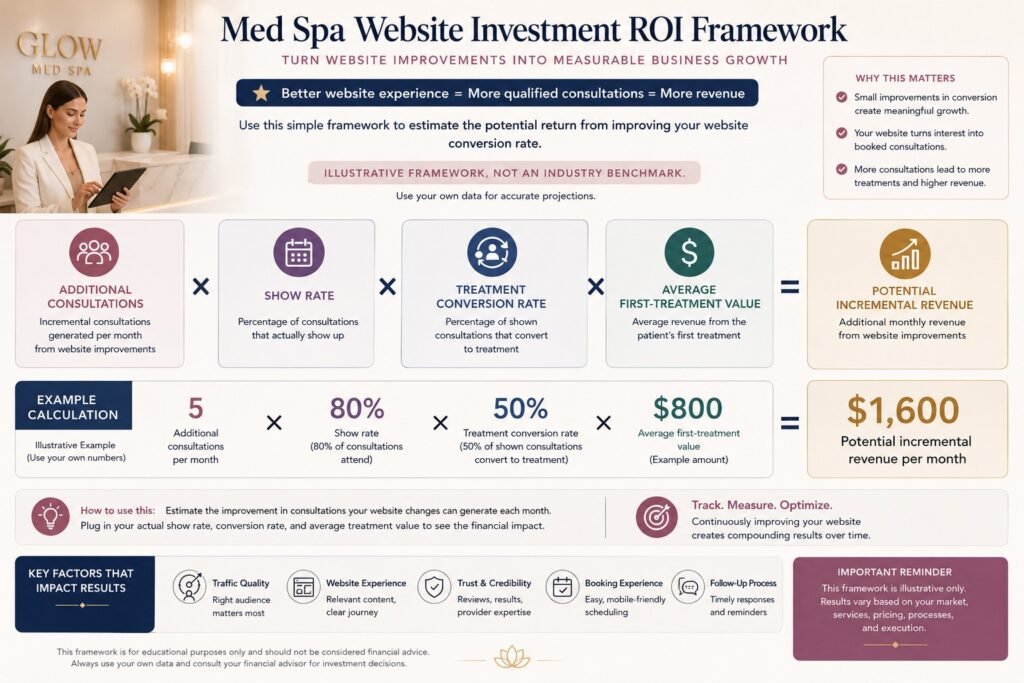
You can then model potential business value:
Additional consultations × show rate × treatment conversion rate × average first-treatment value
Illustrative example
Suppose:
- 5 additional consultations
- 80% show rate
- 50% consultation-to-treatment conversion
- $800 average first-treatment value
Then:
5 × 0.80 × 0.50 × $800 = $1,600 in additional first-treatment revenue per month
This is an illustration, not an industry benchmark or promise.
The actual model should use your clinic’s own numbers.
And it can become more sophisticated by including repeat treatments, packages, memberships, lifetime value, cancellations, acquisition costs, and contribution margin.
The important point is that the website investment can be evaluated as a business system rather than as a design expense.
That is when Med Spa Website becomes a commercial decision.
What should you measure?
Track:
- Instagram sessions
- Google organic sessions
- branded search visits
- treatment-page engagement
- consultation-page visits
- booking starts
- booking completions
- calls
- form submissions
- qualified inquiries
- consultation attendance
- treatment conversion
- revenue where attribution is reliable
The objective is not to create more dashboards.
It is to identify where qualified demand is being lost.
Once an Instagram visitor reaches the website, the next challenge is converting interest into confidence and eventually a consultation. If your clinic is getting website traffic but those visitors are not taking the next step, our guide on med spa website conversion explains how treatment pages, trust signals, practitioner expertise, mobile UX, and booking friction can affect that transition.
Instagram Gets Their Attention. What Converts Their Interest?
A potential patient may discover your med spa through a Reel, treatment result, or recommendation — but discovery is only the beginning. Your website needs to carry that interest forward with credible information, treatment clarity, proof, and an easy path to consultation.
How Important Is Mobile Booking?
Mobile booking is important because a large proportion of social discovery happens on mobile, and prospective patients expect the transition from social content to the next step to feel effortless.
Zenoti’s 2025 benchmark report is based on performance data from US and Canadian businesses using its platform. It reports that 97% of medical spa clients want mobile appointment booking, while the average medspa in its benchmark data booked 11% of appointments online. Zenoti also reports higher online-booking rates among top-earning businesses, but that relationship should be treated as a correlation rather than proof that booking technology alone causes higher revenue.
That distinction matters.
Do not read the statistic as:
“Add online booking and revenue will increase.”
Read it as:
“There is a meaningful gap between consumer preference for mobile booking and actual online-booking adoption, so booking friction deserves investigation.”
Your mobile journey should make it easy to:
- understand the treatment
- identify the practitioner
- read important FAQs
- see relevant proof
- understand the consultation
- find the clinic
- call if preferred
- begin booking
- complete booking without unnecessary friction
How Should Med Spas Track Instagram-to-Consultation Performance?
The simplest approach is to make Instagram traffic identifiable and then track what happens after the visit.
Use appropriate campaign tagging for social campaigns, consistent landing-page URLs, analytics, booking-source fields, and CRM attribution where available.
A useful measurement path is:
→ Website session
→ Treatment page
→ Consultation page
→ Booking start
→ Booking completion
→ Consultation attendance
→ Treatment
The exact implementation depends on the clinic’s technology stack.
Healthcare and aesthetic businesses also need to be careful about what information is collected, transmitted, and associated with health-related inquiries.
Do not assume that every advertising or analytics configuration is appropriate simply because it is technically possible.
Your privacy policy, consent mechanisms, analytics configuration, booking platform, CRM, and advertising setup should be reviewed according to the laws and professional requirements applicable to your market.
The goal is useful attribution without creating unnecessary privacy or compliance risk.
Instagram should not be evaluated in isolation from the rest of the acquisition system. If you are deciding whether the next marketing dollar should go toward paid search, social media, SEO, or improving the website itself, a broader med spa marketing strategy can help you identify which part of the patient acquisition funnel is actually limiting growth.
Why Can a Website Be More Useful Than Instagram for Detailed Patient Education?
A website provides a controlled environment for deeper information.
Instagram is built around rapid consumption, engagement, and algorithmic distribution.
A treatment page can organize information into a logical sequence that remains accessible weeks or months after publication.
That matters because aesthetic information can be confusing.
AmSpa notes that social media can expose prospective patients to misinformation and incomplete understanding, particularly around aesthetic treatments. It recommends evidence-driven education and using provider expertise to address misconceptions.
That creates an important role for the website.
A strong treatment page can provide:
Question → explanation → provider expertise → evidence → FAQs → consultation
rather than forcing the patient to reconstruct the answer from multiple social posts.
This is also why a website can complement social media even when Instagram is the clinic’s strongest acquisition channel.
What Are the Privacy and Compliance Risks of Using Instagram for Med Spa Marketing?
Social media can be powerful for med spas, but marketing medical services creates responsibilities that ordinary consumer marketing does not.
Before-and-after photos, testimonials, treatment claims, patient questions, and staff-created content can create privacy, consent, ownership, and advertising issues.
AmSpa specifically warns medical aesthetic practices about patient consent, advertising rules, ownership of social-media content, and the need for clear internal social-media policies. It also emphasizes that patient photography should not be published without appropriate consent.
The practical lesson is not “stop using Instagram.”
It is to establish a responsible content process.
Before publishing patient imagery or testimonials, confirm that the clinic has obtained the appropriate consent.
Avoid presenting typical-looking results as guaranteed outcomes.
Do not use the website or Instagram to make individualized medical recommendations.
Keep treatment information accurate and appropriately reviewed.
And because requirements vary by jurisdiction, have qualified legal or clinical professionals review claims and consent processes where necessary.
This is another reason a website can be valuable.
It gives the clinic a more structured environment for presenting detailed educational information instead of trying to communicate every important nuance through short social posts.
What Role Does AI Search Play in the Patient Journey?
AI search is adding another discovery layer, which makes the website more important for reasons that go beyond Instagram.
A patient may now discover a clinic through:
Instagram → Google → Google Business Profile → website → AI-assisted research
or:
AI search → clinic comparison → website → reviews → consultation
The American Med Spa Association reported in May 2026 on the Medical Aesthetics AI Visibility Index, which analyzed patient-intent queries across ChatGPT, Claude, Perplexity, and Google AI Overviews. The report described AI platforms as an increasingly important part of medical-aesthetics discovery.
That does not mean med spas should create a separate “AI SEO website.”
Google’s own guidance is clear: there are no additional technical requirements or special optimizations required for AI Overviews or AI Mode. Existing SEO fundamentals remain relevant, including helpful people-first content, crawlability, internal linking, page experience, textual accessibility, and accurate structured data.
Google’s May 2026 generative-AI guidance also specifically warns against chasing unsupported GEO/AEO tricks, excessive keyword variations, or special machine-readable files as supposed shortcuts.
For a med spa, the practical response is simpler:
Make the website genuinely useful.
Explain treatments specifically.
Identify practitioners clearly.
Maintain accurate business information.
Answer real patient questions.
Build strong internal connections between related pages.
Publish original expertise rather than generic treatment copy.
That work benefits patients first and can also make the site easier for search systems to understand.
What Does a Before-and-After Patient Journey Look Like?
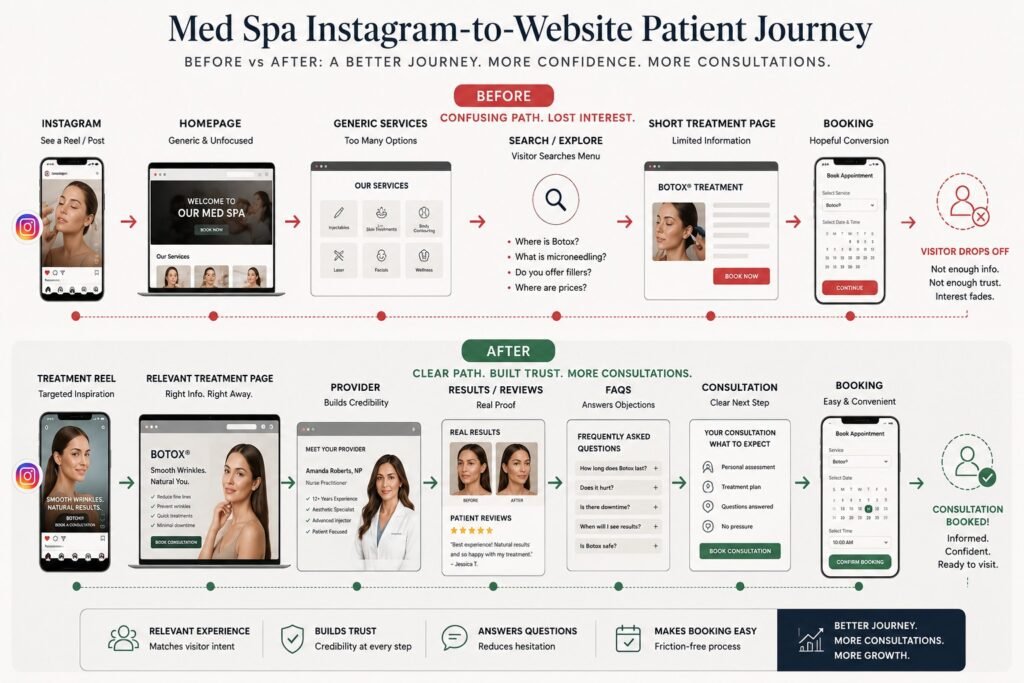
The difference is easier to understand visually.
Before
Instagram Reel
↓
Homepage
↓
Generic Services
↓
Visitor searches the menu
↓
Short treatment page
↓
“Book Now”
↓
Visitor leaves
After
Treatment-specific Instagram content
↓
Relevant treatment page
↓
Treatment explanation
↓
Practitioner expertise
↓
Relevant results and reviews
↓
FAQs and expectations
↓
Consultation information
↓
Booking
The second journey does not guarantee a consultation.
It does something more important.
It removes avoidable uncertainty.
That makes the website a better continuation of the marketing that already brought the person there.
When Should a Med Spa Optimize Its Existing Website Instead of Redesigning?
Optimize the existing website when the foundation is sound and the problems are isolated.
For example, if Instagram visitors consistently land on the wrong page, fix the landing architecture.
If treatment pages are too generic, rewrite or restructure them.
If practitioner credentials are difficult to find, improve provider profiles.
If mobile booking creates friction, fix the booking path.
If analytics cannot distinguish Instagram traffic, implement better attribution.
If reviews are disconnected from treatment decisions, reposition them.
If the clinic’s brand is strong but the site architecture is weak, improve the architecture before replacing the entire platform.
This approach can be faster, less disruptive, and easier to measure.
It also produces a more reliable redesign decision later because you learn which changes actually affect behavior.
When Is a Full Website Redesign Justified?
A full redesign becomes more justified when the existing platform prevents the clinic from implementing the patient journey it needs.
That can happen when:
- the CMS cannot support the required content architecture
- mobile templates are fundamentally restrictive
- the site has major technical-performance problems
- the navigation cannot accommodate expanding services
- the booking system cannot be integrated properly
- analytics cannot be implemented reliably
- the brand positioning has materially changed
- the site architecture is fundamentally confusing
- SEO migration requirements cannot be handled safely without restructuring
- incremental fixes would cost almost as much as rebuilding correctly
A redesign should therefore be the conclusion of a diagnosis.
Not the starting assumption.
Our existing analysis of outdated med spa websites makes the same distinction: a dated appearance can be a problem, but it does not automatically prove that a complete rebuild will increase consultations.
Read the related guide on whether a med spa website redesign can actually increase consultations before deciding that appearance alone justifies a rebuild.
What Should a Med Spa Do Over the Next 30 Days?
A clinic that already receives Instagram leads does not need to wait for a complete redesign to improve its funnel.
Week 1: Establish the baseline
Measure:
- Instagram website traffic
- top landing pages
- treatment-page engagement
- consultation-page visits
- booking starts
- booking completions
- calls
- inquiries
Separate qualified from unqualified inquiries wherever possible.
Week 2: Trace the patient journey
Take your top three Instagram campaigns or content themes.
Follow the journey exactly as a new visitor would.
Ask:
Does the landing page match the post?
Can I understand the treatment?
Can I identify the practitioner?
Can I find evidence?
Can I answer my basic questions?
Do I understand the consultation?
Can I book easily on mobile?
Week 3: Fix the largest leak
Do not fix everything simultaneously.
If the biggest problem is landing-page relevance, fix that first.
If it is practitioner credibility, fix that.
If it is booking friction, fix booking.
If it is low-quality traffic, address the campaign.
Week 4: Measure again
Compare the same funnel stages.
You are looking for movement:
Instagram → website
Website → treatment page
Treatment page → consultation
Consultation → booking
This creates a repeatable optimization process instead of a one-time redesign project.
What If Instagram Is Still My Best Lead Source?
That is completely fine.
The goal is not to force Google or the website to replace Instagram.
If Instagram consistently produces your best qualified leads, keep investing in it.
But make the website strong enough to support those leads.
A clinic with an excellent social presence and a weak website has a marketing asset feeding a weak conversion environment.
A clinic with an excellent social presence and a strong website has a connected acquisition system.
That difference becomes increasingly important as patients use more than one source to research aesthetic providers.
And it gives the clinic more resilience.
If Instagram changes how content is distributed, the website still exists.
If Google produces a new search opportunity, the website is ready.
If AI-assisted discovery sends a prospective patient to the clinic, the website has information available.
If a patient receives a referral and searches the clinic by name, the website can reinforce the recommendation.
The website is not competing for Instagram’s job.
It is supporting the entire ecosystem.
If your clinic already generates attention through Instagram but the website was not designed around the treatment-to-consultation journey, explore KG Web Designer’s aesthetic clinic website design services to see how the website can be structured around patient research, trust, mobile UX, and conversion.
What Does a Real Adjacent-Sector Case Study Tell Us?
A relevant KG Web Designer case study comes from Taruj Skincare in Florida. It was an ecommerce skincare project rather than a med spa engagement, so it should not be presented as evidence of med spa consultation results.
The relevance is the underlying business problem.
The existing Squarespace website limited the brand’s ability to support growth, positioning, mobile experience, conversion, and future marketing initiatives. KG Web Designer rebuilt the platform around WordPress and WooCommerce, improving UX/UI, mobile optimization, conversion structure, SEO foundations, and affiliate functionality.
The outcome was concrete: the new website generated its first sale on launch day, and affiliates began joining within the first week.
The lesson is not:
“A redesign guarantees immediate revenue.”
The lesson is:
Marketing works better when the website infrastructure can support the demand and business model around it.
For med spas, the same principle applies to consultation journeys rather than ecommerce checkout.
What Does This Mean for Your Med Spa?
If Instagram already generates leads, the question is not whether you should replace Instagram with a website.
You should not.
The better question is whether the website is helping those leads make a decision.
A strong system looks like this:
Instagram creates attention.
Google and reviews support verification.
The website provides structured education.
Practitioner pages establish authority.
Treatment pages answer specific questions.
Consultation pages explain the next step.
Booking captures qualified intent.
Analytics show where the journey breaks.
That is the commercial case for a website.
Not “every med spa needs a website.”
Not “Instagram doesn’t work.”
And not “a redesign will automatically increase consultations.”
The stronger argument is evidence-based:
If your existing marketing is already generating qualified interest, your website should be capable of converting that interest into the next measurable step.
Your Instagram Is Performing. But Is Your Website Closing the Confidence Gap?
Prospective patients may already know your treatments, follow your results, and engage with your content. When they visit your website, they are looking for deeper reassurance — practitioner expertise, treatment information, credibility, expectations, and a clear reason to book with you.
Final Thoughts
If Instagram is already generating leads, you have solved one important part of the acquisition problem.
You have attention.
You may also have trust, engagement, referrals, and genuine interest.
The next question is what happens to that interest when the visitor leaves Instagram.
Does the visitor find the treatment they were researching?
Can they understand who provides it?
Can they verify the clinic?
Can they find relevant evidence?
Can they get answers to the questions that are stopping them from booking?
Can they understand what the consultation involves?
Can they complete the next step comfortably on mobile?
Those are the questions that determine whether your website is supporting your marketing or quietly leaking the demand your marketing creates.
Med Spa Website should therefore be evaluated as part of the acquisition system, not as an isolated visual investment.
If this were my website, I would not start by asking whether I need a redesign.
I would start with the diagnostic matrix.
I would trace Instagram visitors through the website.
I would identify the biggest measurable leak.
I would fix that leak.
Then I would decide whether the existing platform can support the next stage.
That approach gives you something a generic website redesign proposal cannot:
a business case based on your own patient journey.
If your med spa is already generating Instagram interest but you are unsure where qualified visitors are dropping out, start a website strategy conversation with KG Web Designer.
FAQs
How many Instagram visitors should book a med spa consultation?
There is no reliable universal benchmark that applies to every med spa. Conversion depends on treatment type, audience quality, geography, price, practitioner reputation, landing-page relevance, consultation offer, and booking experience. Establish your own baseline by tracking Instagram visitors through treatment-page engagement, consultation requests, booking starts, and completed consultations.
Should I link Instagram to my homepage or a treatment page?
If the Instagram content is about a specific treatment, a relevant treatment page is usually the stronger destination. It preserves the visitor’s intent and reduces the number of steps required to find the information that motivated the click. A homepage is more appropriate when the content is about the clinic generally rather than a specific treatment or concern.
Should I put treatment prices on my med spa website?
That depends on the clinic, treatment, market, and pricing strategy. Some clinics benefit from transparent pricing because it filters expectations and reduces unnecessary inquiries. Others prefer consultation-first pricing because treatment recommendations vary. The important point is to avoid making prospective patients search through multiple pages to understand how pricing is approached.
How do I track bookings that came from Instagram?
Use source-level analytics, campaign tagging, landing-page tracking, booking-source fields, and CRM attribution where appropriate. Track the journey beyond the first click: website visit, treatment-page engagement, consultation-page visit, booking start, booking completion, and consultation attendance. In healthcare-related marketing, make sure the tracking approach is consistent with applicable privacy and data-handling requirements.
Should Instagram ads have their own landing pages?
They can be especially useful when an ad promotes a specific treatment, concern, campaign, or audience. A dedicated landing page allows the message, treatment information, evidence, FAQs, consultation expectations, and call to action to remain consistent with the advertisement instead of sending the visitor into a generic website structure.
How can I tell whether my website or Instagram strategy is the problem?
Trace the funnel in stages. If engagement is high but website visits are low, investigate the social-to-site transition. If website traffic is strong but treatment-page engagement is weak, investigate landing-page relevance. If treatment-page engagement is strong but consultations are low, investigate trust, content, and CTA structure. If bookings are started but not completed, investigate booking UX.
Can I improve my website without redesigning everything?
Yes. If your CMS and technical foundation are sound, targeted improvements may be more sensible. Start with the highest-value leak: treatment pages, practitioner information, landing-page relevance, mobile booking, analytics, FAQs, internal linking, or consultation messaging. A redesign becomes more justified when the existing platform prevents these changes from being implemented effectively.
Is a website still important if most of our leads come from referrals and Instagram?
Yes, because referrals and social discovery often create a reason to research the clinic rather than automatically create a booking. The website gives prospective patients a place to verify the recommendation, understand treatments, review provider information, check practical details, and decide whether requesting a consultation makes sense.