
Quick Answer
A boutique consulting firm website can compete with a large consultancy by making its specialist expertise, commercial relevance, and credible proof easier to evaluate. Instead of imitating a global firm’s size, a boutique firm should show which business problems it solves, who leads the work, how its approach differs, and what evidence supports its claims. The objective is to become the most relevant and convincing choice for the right buyer.
TL;DR: Key Takeaways
- Boutique consulting firms compete through specialist relevance and credible expertise, not by pretending to have the resources of a global consultancy.
- Specific positioning helps suitable buyers understand why a firm belongs on their shortlist.
- Case studies, original insights, and transparent engagement processes reduce uncertainty before the first conversation.
- A premium design cannot compensate for vague messaging, weak evidence, or a confusing consultation journey.
- Search visibility and AI-assisted discovery benefit from useful, well-structured information, although no content strategy guarantees citations.
- Website performance should be evaluated through qualified inquiries and commercial relevance, not traffic alone.
What Does the Research Say About How Consulting Buyers Evaluate Firms?
Published B2B research supports a clear strategic direction: give prospective clients enough useful information to evaluate a provider before asking them to speak with someone. This does not mean that every consulting buyer follows the same journey or that a website replaces relationships, referrals, and direct conversations.
In March 2026, Gartner reported that 67% of surveyed B2B buyers preferred a sales-representative-free experience, while 45% had used generative AI during a recent purchase. Its May 2026 research also reported that 69% preferred to validate AI-generated insights with sales representatives. These findings suggest that independent research and human validation can coexist. Gartner, March 2026 and Gartner, May 2026.
The 2024 Edelman-LinkedIn B2B Thought Leadership Impact Study found that 75% of surveyed global B2B decision-makers and C-suite executives said thought leadership had prompted them to research a product or service they had not previously considered. This supports investing in substantive expertise-led content, but it is not a conversion benchmark for boutique consulting websites. Edelman-LinkedIn research.
| Research finding | What it means for a boutique firm | What it does not prove |
|---|---|---|
| 67% preferred a sales-representative-free experience in Gartner’s 2026 survey. | Make essential service and evaluation information accessible online. | That buyers never want a sales conversation. |
| 45% had used generative AI during a recent purchase. | Publish specific, consistent information about expertise and services. | That AI will recommend a particular firm. |
| 69% preferred validating AI-generated insights with sales representatives in Gartner’s May 2026 research. | Make it easy for buyers to move from research to a substantive discussion. | That a website alone can establish buyer confidence. |
| 75% said thought leadership had prompted them to research an unfamiliar offer in the 2024 Edelman-LinkedIn study. | Use original analysis to help buyers understand a problem or opportunity. | That publishing more articles automatically generates leads. |
Why Can a Boutique Consulting Firm Website Compete With a Big-Name Consultancy?
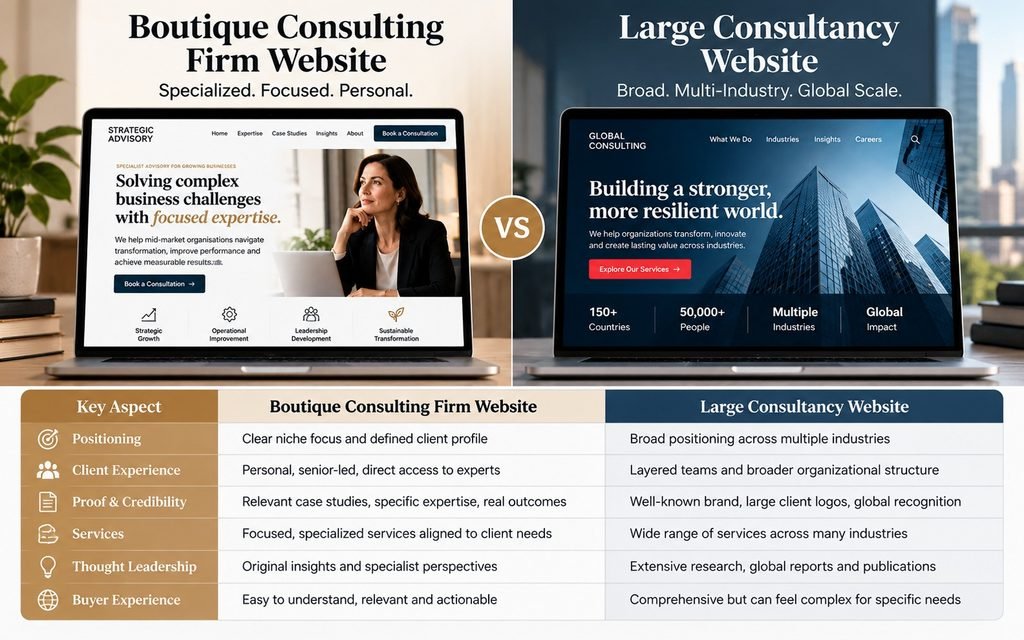
A boutique firm can compete when it demonstrates a closer fit with the buyer’s problem than a broader provider does. Its advantage may come from a narrow specialty, direct access to a senior adviser, a relevant methodology, or experience with a specific business situation. Those advantages must be genuine and supported by evidence.
Large consultancies often benefit from brand recognition, extensive resources, and a broad range of services. A smaller firm should not attempt to reproduce that entire proposition. It should make its own value easier to understand.
Consider the difference between these two positioning statements:
Generic: “We help ambitious organizations navigate change and accelerate growth.”
Specific: “We advise mid-market manufacturers on post-acquisition operating models and commercial integration.”
The second statement identifies a business context, an audience, and a recognizable area of expertise. A suitable buyer can evaluate its relevance much more quickly.
What should the homepage communicate first?
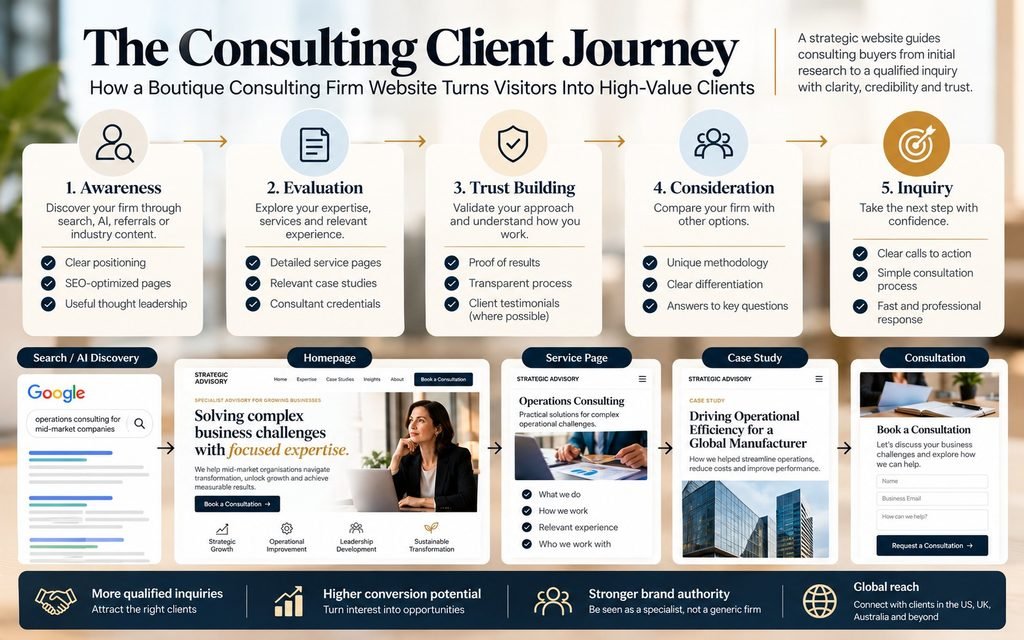
The homepage should tell a qualified visitor who the firm helps, which problems it addresses, and why its expertise is relevant. It should then direct visitors toward the information needed to evaluate the firm’s approach.
A practical homepage sequence is:
- A specific headline and supporting value proposition.
- The business situations or challenges the firm addresses.
- The clients or industries it genuinely serves.
- A clear explanation of its approach.
- Relevant evidence, credentials, or case studies.
- Service pathways and useful thought leadership.
- An appropriate consultation or inquiry CTA.
This structure is a starting point, not a universal template. A solo executive adviser and a multi-practice consulting firm need different information architectures because their services, delivery models, and buying journeys differ.
KG Web Designer approaches professional-services websites as commercial communication systems. The positioning, content, design, and conversion journey should reinforce one another rather than operate as separate tasks.
Your Specialisation Is Your Competitive Advantage. Does Your Website Show It?
Boutique consulting firms don’t need to imitate the scale of global consultancies. They need a website that clearly communicates their expertise, the problems they solve and why clients should trust their approach.
Clarity of purpose.
How Should a Boutique Consulting Firm Website Build Trust Without a Famous Brand Name?
A small consulting firm website can build credibility through contextual evidence, transparent processes, and relevant expertise rather than relying on brand recognition alone. Buyers need to understand not only what the consultant claims to do, but also why that experience matters to their particular situation.
A client logo can establish recognition, but it does not explain the firm’s role in an engagement. Where confidentiality permits, a stronger case study describes the business context, the challenge, the consultant’s responsibilities, the approach taken, and the substantiated outcome.
If a client cannot be named, the firm can describe the engagement anonymously without revealing confidential details. If the outcome was not measured, it should explain the work performed rather than inventing a percentage improvement.
Which trust signals should appear on the website?
The most useful trust signals answer questions that buyers are already asking.
- Relevant experience: Show how previous work relates to the current service.
- Leadership credentials: Explain how the principal’s background informs the firm’s current expertise.
- Engagement clarity: Describe the process, responsibilities, deliverables, and likely next steps.
- Thought leadership: Publish original analysis that demonstrates how the firm evaluates problems.
- Professional validation: Display genuine qualifications, memberships, publications, and client endorsements where applicable.
- Operational transparency: Explain who delivers the work and how communication is handled.
A long biography is not automatically persuasive. A focused explanation of how the consultant’s experience helps solve a relevant business problem is usually more useful to a prospective buyer.
How Should Boutique Consulting Website Design Reflect a Specialist Firm?
Boutique consulting website design should express the firm’s actual business model rather than imitate the architecture of a multinational consultancy. A smaller firm may need fewer pages, but every important page must help a buyer understand the offer, assess credibility, or decide what to do next.
A practical site structure can include:
- Homepage with clear positioning and service pathways.
- Service pages that explain business problems, scope, and approach.
- Industry or client-type pages where distinct expertise justifies them.
- Leadership information connected to the firm’s current work.
- Case studies or relevant evidence.
- Thought leadership and original insights.
- A consultation or inquiry page with clear next steps.
Additional pages are worthwhile when they answer a distinct buyer question. Creating separate pages for minor variations of the same service can make navigation harder and dilute the site’s overall message.
A useful related resource is KG Web Designer’s guide to why consultant websites feel generic. It explores how interchangeable messaging can make experienced professionals appear similar to competitors, even when their actual expertise differs.
How should the website demonstrate the consultant’s point of view?
A buyer evaluating a specialist wants to understand how that person thinks, not simply which services appear on a menu. Original frameworks, diagnostic questions, thoughtful disagreement with conventional approaches, and clear explanations of common problems can make expertise more tangible.
For example, a pricing adviser could explain the signs that a company has outgrown its current pricing model. An operations consultant might publish a framework for diagnosing why post-acquisition integration is stalling. These assets help the reader evaluate the firm’s reasoning before arranging a meeting.
The objective is not to publish articles simply to increase content volume. Each important piece should help the intended buyer understand a decision, assess a risk, or recognize a problem more clearly.
Why Do Consulting Firms Lose High-Value Opportunities Through Generic Messaging?
Consulting firms can weaken their positioning when they use broad language that any competitor could copy without changing its meaning. Phrases such as “strategic growth,” “tailored solutions,” and “measurable impact” may sound professional, but they do not explain why a particular firm is the right choice.
A prospective client is usually trying to answer more specific questions:
- Have you worked with a problem like ours?
- Do you understand our industry and business constraints?
- What would you examine first?
- How does your approach differ from conventional alternatives?
- Who will actually lead the engagement?
- What evidence supports your recommendations?
- What should we expect if we decide to work together?
The answers should appear throughout the website, not only in a sales presentation.
Our article on five website mistakes consultants make that cost them high-value clients examines the risks of weak differentiation, misplaced proof, and unclear conversion pathways.
Why can a visually impressive website still underperform?
A polished interface cannot resolve an unclear offer. If the homepage uses sophisticated imagery but leaves the buyer unsure about the firm’s specialty, the website has improved presentation without resolving the underlying positioning problem.
The same applies to conversion design. A prominent consultation button may be visible, but visitors may still hesitate if they cannot evaluate the firm’s experience, understand its process, or determine whether it serves businesses like theirs.
The appropriate sequence is to clarify the strategy, organize the information, and then design the experience around the buyer’s needs.
What Should a Boutique Consulting Firm Fix First, Second, and Third?
The best improvement plan begins with the factors that influence buyer understanding before moving to visual refinements. This sequence helps a firm avoid paying for a complete rebuild when targeted changes could address the actual problem.
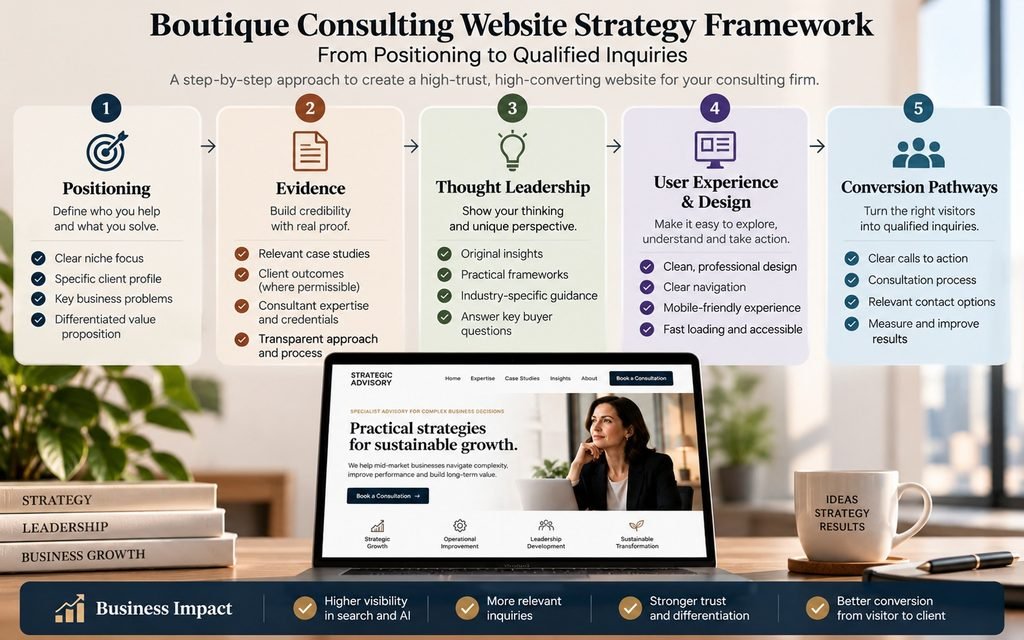
First: Clarify the positioning. Define the target buyer, the business problem, the service offered, and the evidence supporting the firm’s claims. Rewrite the homepage and principal service pages before commissioning extensive visual changes.
Second: Strengthen proof and decision support. Improve case studies, consultant biographies, engagement explanations, and original thought leadership. Give visitors enough information to assess relevance and credibility without forcing them to schedule a call simply to understand the offer.
Third: Improve usability and conversion. Review mobile navigation, page speed, accessibility, forms, and CTA clarity. Measure whether the changes contribute to more relevant inquiries, better-qualified conversations, and fewer avoidable barriers.
A redesign makes sense when the current architecture, technical foundation, or experience cannot support the revised strategy. If those foundations remain sound, focused improvements may be a more proportionate investment.
Would a Prospective Client Trust Your Firm Before Meeting Your Partners?
A boutique consultancy website should help decision-makers understand your specialisation, verify your expertise and see evidence of your approach.
Is it immediately clear which sectors and challenges your firm specialises in?
Can visitors identify the consultants responsible for delivering the work?
Do your examples explain the challenge, approach and substantiated outcomes?
Does your website explain how engagements are structured?
Do your articles demonstrate original insight into your clients’ problems?
Can prospective clients easily discuss a relevant business challenge?
Example Scenario: What If a Boutique Firm Gets Referrals but Few Website Inquiries?
Consider a hypothetical operations consultancy that receives referrals but wants to build a more consistent pipeline of opportunities from the United States and United Kingdom. Its website lists strategy, transformation, and operational improvement, but does not explain the business situations in which the firm is most useful.
The first step would be to define the specialty, explain the types of engagements offered, and provide relevant evidence. The next step would be to make the consultation process clear and ensure that visitors can evaluate the firm’s expertise before making contact.
This scenario illustrates a plausible strategic intervention, not a documented client result. The firm should measure inquiry quality and commercial progress after making changes rather than assuming that a clearer website will automatically generate a particular increase in revenue.
Example From Our Experience: How Should a Website Audit Be Presented Honestly?
A credible website audit separates observed problems from hypotheses about their commercial effects. For example, an audit may identify broad messaging, missing contextual evidence, or an unclear inquiry process, but those observations alone do not prove that they caused a decline in leads.
At KG Web Designer, the useful approach is to connect each finding to a specific buyer question and recommend a proportionate improvement. If a firm has strong referral traffic but weak inquiry quality, the review should investigate positioning, service-page relevance, proof, and conversion friction before assuming that more traffic is required.
A responsible mini case study should document the starting problem, the work completed, and the verified outcome. Where before-and-after data is unavailable, the outcome should be described as a deliverable or qualitative observation, not as a measured conversion improvement.
Problem: Prospective clients cannot quickly identify the firm’s specialty or understand why its approach is relevant.
Solution: Clarify positioning, organize service information, contextualize proof, and simplify the consultation journey.
Outcome: The website becomes easier to evaluate. Any subsequent change in qualified inquiries, conversion rates, or revenue must be measured and reported separately.
This is a diagnostic framework, not a claim that KG Web Designer achieved a specific result for an unnamed client.
How Can Thought Leadership Improve Search and AI-Assisted Discovery?
A specialized consulting firm website should organize its content around the questions buyers research when evaluating a business problem, possible solutions, and potential advisers. This creates a more useful body of information than publishing a large number of articles that repeat general industry advice.
Gartner’s 2026 research confirms that AI is part of many B2B buyers’ research processes, while the Edelman-LinkedIn research indicates that thought leadership can prompt buyers to investigate unfamiliar offers. Together, these findings support a content strategy built around genuine expertise, not a promise of AI visibility.
Useful practices include:
- Write service pages that define the problem, audience, scope, and approach.
- Publish original analysis with clear authorship and relevant supporting evidence.
- Use descriptive headings that reflect real buyer questions.
- Link related articles and service pages where the connection helps the reader.
- Add appropriate structured data that accurately describes the page.
- Keep professional credentials, service descriptions, and business information consistent.
- Review content for accuracy, outdated claims, and unsupported promises.
These practices improve clarity and support discoverability, but no schema markup, keyword count, or article format guarantees a Google AI Overview placement or citation by ChatGPT, Gemini, or Perplexity.
For a deeper strategic perspective, read why consultant website design should prioritize authority over aesthetics. The central principle is that design should make genuine expertise easier to understand, not substitute for it.
How Should a Boutique Consultancy Build Trust With Overseas Buyers?
International buyers need enough information to assess the firm’s expertise and determine whether working together will be practical. A statement that the consultancy serves global clients is rarely sufficient when the prospect has never worked with the firm before.
The website should answer relevant operational questions:
- Who will lead and deliver the engagement?
- How will meetings, workshops, and decisions be handled?
- What communication and reporting arrangements should clients expect?
- How will the scope, responsibilities, and deliverables be defined?
- Which markets does the firm genuinely understand or serve?
- What are the practical arrangements for contracts, invoicing, and time-zone overlap?
The answers should reflect the firm’s real operating model. Do not imply local offices, regional credentials, or market experience that the firm does not have.
International trust is not created by mentioning the United States, United Kingdom, or Australia repeatedly. It comes from making the firm’s expertise, delivery process, and commercial expectations clear to the buyers it wants to serve.
Your Expertise Should Start Conversations — Not Get Buried in a Services Page.
A specialised consulting website can turn valuable insights into a clearer path for prospective clients to discover your firm, evaluate your thinking and make an enquiry.
Relevant Insights
Publish focused perspectives on the challenges your ideal clients are trying to solve.
Specialist Expertise
Connect your insights with partner credentials and relevant experience.
Evidence of Capability
Present case studies, methodologies and credible examples of your work.
Qualified Enquiry
Make it straightforward to discuss a relevant business challenge.
Build a consulting website that helps the right prospects recognise the value of your expertise.
Explore Professional Services Website Design →When Does Professional Website Design Help Make Commercial Sense?
Professional website help is valuable when a firm’s expertise is strong but the website does not communicate that expertise effectively, or when the existing structure prevents the business from supporting its current commercial strategy. The decision should follow an assessment of positioning, content, usability, technical performance, and conversion paths.
Before selecting a designer, ask how the proposed work connects to the firm’s commercial objectives. The proposal should specify the strategic work, content responsibilities, design and development scope, search considerations, timeline, and how performance will be assessed.
For investment context, see consultant website design cost in 2026. The appropriate budget depends on the scope of work, content requirements, functionality, and whether the project involves focused improvements or a broader strategic redesign.
The choice between founder-led and firm-led positioning also deserves attention. Our guide to personal brand versus firm brand websites explains why the right approach depends on whether buyers primarily hire an individual’s expertise or the wider firm’s capabilities.
Is Your Website Communicating Your Consulting Expertise?
If your firm relies on referrals, has evolved into a more specialized practice, or is targeting higher-value engagements, a website review can identify where positioning, proof, and conversion paths need attention.
KG Web Designer can help assess whether your existing website supports the buyers you want to reach and whether focused improvements or a broader redesign are more appropriate. The starting point is a clear diagnosis, not an automatic recommendation to rebuild.
Expert Insight from Kanika Gupta
Kanika Gupta, Founder, KG Web Designer
My view is that a boutique consultancy should not try to look like a smaller version of a global consulting firm. It should make the strengths of its own operating model visible.
If this were my website, I would identify the buyer and business problem where the firm has its strongest credible advantage. I would then make the homepage, service pages, and evidence reinforce that position before spending heavily on visual effects or publishing more content.
I would also resist claims that sound impressive but cannot be substantiated. A smaller firm can establish credibility through specificity, sound reasoning, relevant evidence, and a transparent process. Those are more defensible foundations than borrowed authority.
What This Means for Your Business
Your website influences how prospective clients understand your expertise, compare your firm with alternatives, and decide whether a conversation is worth their time. It cannot guarantee new business, but it can remove avoidable obstacles that make a suitable buyer hesitate.
The commercial opportunity is to connect positioning, evidence, thought leadership, and a clear conversion path. When those elements work together, the website becomes a more useful part of the business development process rather than simply an online company profile.
Success should be evaluated through qualified inquiries, lead relevance, consultation progression, and commercial outcomes. Traffic and rankings matter, but they are supporting indicators rather than proof that the website is attracting the right clients.
Final Thoughts
A boutique consulting firm website does not need to imitate a global consultancy to compete for valuable engagements. It needs a website that makes its specialist expertise, business relevance, credible evidence, and working approach clear to the right buyers.
If I were prioritizing the investment, I would clarify positioning first, strengthen proof second, and refine design and conversion paths around those decisions. This creates a more defensible strategy than starting with visual trends or assuming that a redesign alone will generate better leads.
If your consulting firm has strong expertise but its website is not communicating that value clearly, KG Web Designer can help you assess the positioning, content, and conversion opportunities.
Discuss your consulting website project with KG Web Designer.
Does Your Website Make Your Boutique Firm’s Expertise Impossible to Overlook?
Let’s review how your website communicates your specialisation, presents partner expertise and builds confidence with prospective clients. We’ll identify practical opportunities to improve positioning, credibility and the enquiry experience.
What We’ll Review
Website Strategist
Frequently Asked Questions
How can a boutique consulting firm compete with McKinsey, BCG, or Bain online?
A boutique firm can compete by demonstrating specialist relevance, credible experience, and a clear understanding of a defined business problem. It does not need to reproduce a large consultancy’s size or breadth. It needs to show why its expertise fits the buyer’s situation and provide enough evidence for the buyer to evaluate that fit.
What pages should a boutique consulting website include?
Most firms need a homepage, service pages, leadership information, relevant evidence, thought leadership, and a consultation page. Additional industry or case study pages are worthwhile when they help buyers evaluate a meaningful distinction. The final structure should reflect the firm’s actual services, target clients, and buying journey.
How much should a boutique consulting firm invest in its website?
The investment depends on the existing site’s condition, the amount of strategic work required, the number of pages, content development, and technical functionality. A firm with sound architecture may need targeted improvements, while a business changing its market position may need a larger redesign. Compare proposals by scope and commercial purpose, not price alone.
Should a consulting firm focus on the founder’s personal brand or the firm brand?
The choice depends on why clients hire the business. If buyers primarily select the founder’s judgment and reputation, the website should make that expertise prominent. If engagements depend on a team, a repeatable methodology, or multiple service lines, the firm brand needs greater emphasis. Many boutique firms benefit from combining founder credibility with organizational authority.
Does thought leadership help boutique consulting firms win clients?
Thought leadership can help buyers understand a firm’s perspective, recognize a problem, and assess its expertise before initiating a conversation. In the 2024 Edelman-LinkedIn study, 75% of surveyed global B2B decision-makers and C-suite executives said thought leadership had prompted them to research a product or service they had not previously considered. This demonstrates influence, not a guarantee of consulting leads.
How can a boutique consulting firm improve its visibility in AI search?
Publish useful content that clearly explains the firm’s expertise, services, methodology, and relevant experience. Use descriptive headings, accurate authorship, contextual internal links, and appropriate structured data. Keep claims verifiable and business information consistent. These practices support clarity and discoverability, but cannot guarantee a citation or recommendation from any AI platform.
Should a boutique consulting firm redesign its website or improve the existing one?
Start with an audit of positioning, content, technical performance, mobile usability, and conversion paths. If the existing site can support the revised strategy, targeted improvements may be sufficient. A redesign makes more sense when the architecture, technical foundation, or overall experience prevents the firm from communicating its current offer effectively.