Quick Answer
If your med spa website gets traffic but few consultation requests, the problem is usually somewhere between visitor intent and the decision to contact you. Med Spa Website Conversion depends on treatment-page clarity, practitioner credibility, trust signals, mobile UX, booking friction, and measurement. Before buying more traffic or rebuilding everything, identify the exact point where qualified visitors stop moving toward a consultation.
TL;DR / Key Takeaways
- Traffic does not automatically produce consultations if visitors cannot quickly understand the treatment, provider, trust signals, and next step.
- A 2026 review of 24 public aesthetic clinic and medspa websites found that 92% used generic treatment descriptions and 21% had weak consultation pathways.
- Treatment pages should answer patient questions before asking visitors to book.
- Trust, practitioner authority, mobile UX, booking friction, and page performance should be audited before approving a complete redesign.
- The right first investment depends on whether the bottleneck is traffic quality, website conversion, booking, or follow-up.
- More traffic can increase wasted opportunities when the underlying patient journey is already leaking qualified visitors.
Where Is the Consultation Funnel Actually Breaking?
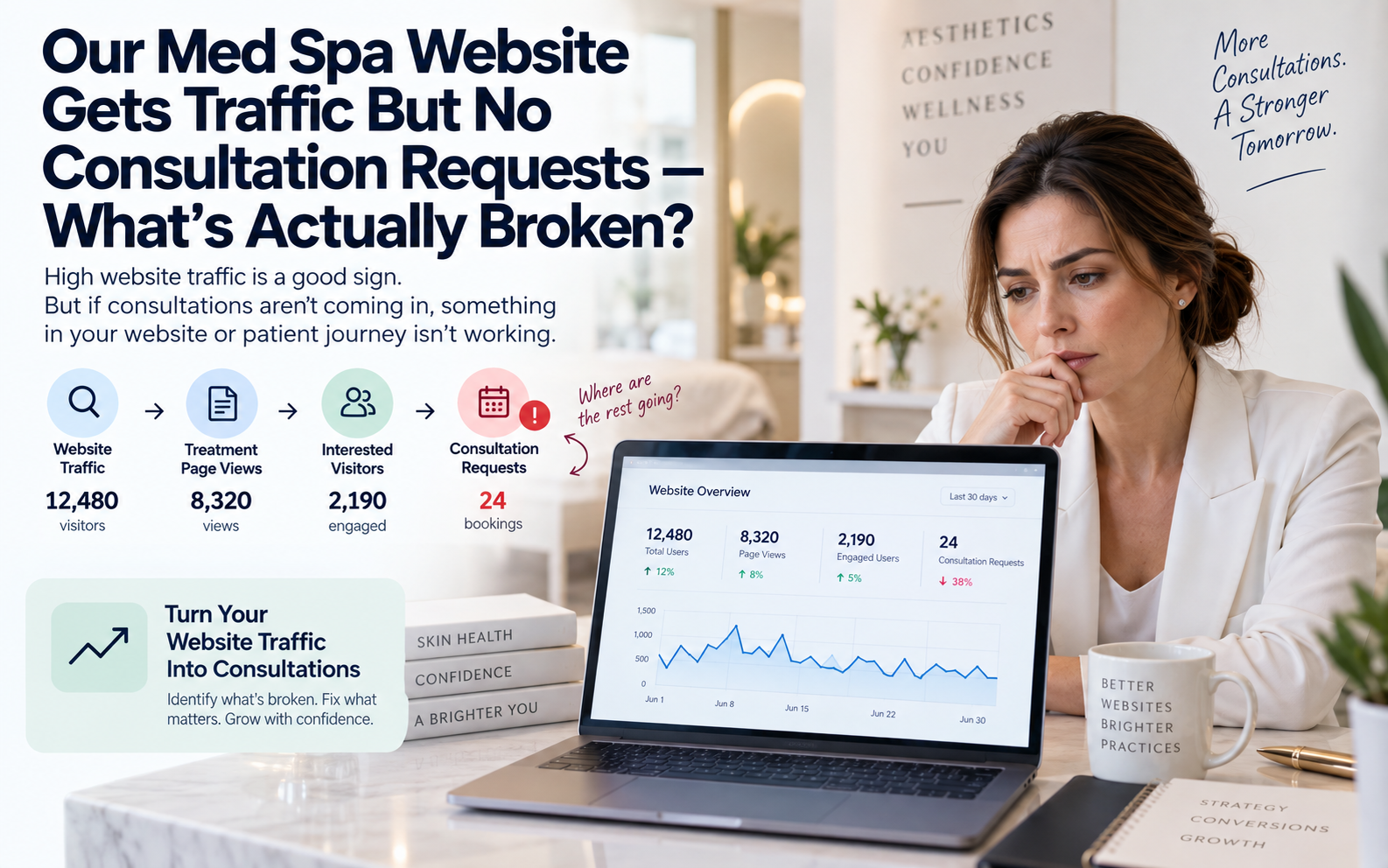
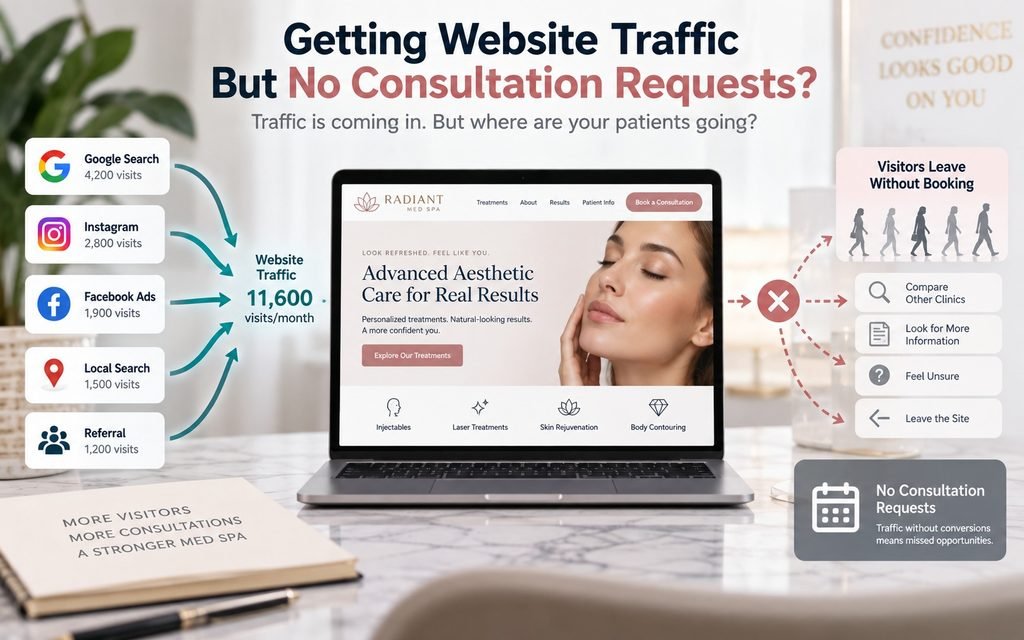
If you are searching for answers because your med spa website traffic but no leads situation is becoming frustrating, the first step is to identify where qualified visitors stop progressing toward a consultation. A website can receive substantial traffic and still perform poorly if visitors arrive on the wrong page, cannot establish trust, or encounter too much friction when they are ready to act.
A visitor may arrive from Google, Instagram, paid advertising, a referral, or an existing patient recommendation. Each source creates a slightly different starting point, but the website eventually needs to answer the same core questions: Is this the right clinic? Is this treatment relevant? Can I trust the provider? What happens next?
Conversion Leak Diagnostic
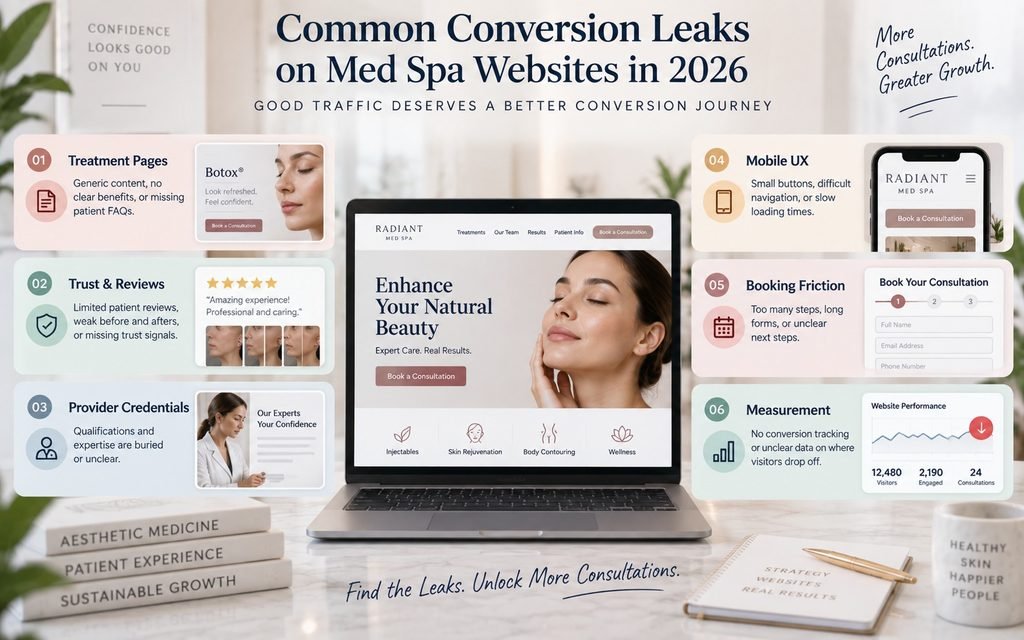
| Website area | Warning sign | What the visitor may think | Priority |
|---|---|---|---|
| Traffic quality | High visits, low engagement | “This is not what I expected.” | High |
| Treatment page | Generic description | “I still do not know if this is right for me.” | Very high |
| Provider authority | Credentials buried | “Who will actually treat me?” | Very high |
| Trust | Limited proof | “Can I trust this clinic?” | Very high |
| Mobile UX | Difficult navigation | “This is too much work.” | Very high |
| Booking | Too many steps | “I will come back later.” | Very high |
| Pricing context | No explanation | “I cannot judge the commitment.” | Medium |
| Measurement | No event tracking | “We do not know where people drop.” | Very high |
This is a diagnostic framework rather than a universal conversion benchmark.
A 2026 review of 24 public aesthetic clinic and medspa websites across the United States, United Kingdom, and Australia found that 92% had generic treatment descriptions, 63% had limited practitioner authority content, 42% were missing important trust signals, and 21% had weak consultation pathways.
The review also found that visual quality was rarely the central weakness. That is important because owners often notice visual problems before they notice information or conversion problems.
Standalone fact: A visually attractive med spa website can still lose qualified consultations when treatment information, trust, and the next action are unclear.
Within the first 500 words, it is also important to clarify what the business behind this strategy does. KG Web Designer is a conversion-focused website design studio specializing in custom websites for clinics, professional services, manufacturers, and growing businesses.
What Does the 2026 Audit Tell Us About Med Spa Websites?
The strongest lesson from our 2026 audit is that visual polish and commercial readiness are not the same thing. The review covered 24 public aesthetic clinic and medspa websites between July 14 and 16, 2026, using an eight-point checklist covering consultation pathways, treatment specificity, practitioner authority, before-and-after presentation, trust signals, AI-readable structure, differentiation, and mobile considerations.
The sample included 12 US, 7 UK, and 5 Australian clinics. Because the sites were identified through “best of” searches, the sample should not be treated as a statistically representative benchmark for the entire med spa industry.
Original Data Callout
Across the 24-site review, only 5 websites, or 21%, were classified as having weak consultation pathways.
That does not mean the remaining websites were highly optimized. The more important observation was that other weaknesses appeared more frequently, particularly generic treatment descriptions, limited practitioner authority, weak differentiation, missing trust signals, and poor AI-readable structure.
This changes the diagnosis.
If a clinic already has visitors but the treatment page does not answer the questions those visitors have, increasing traffic is unlikely to solve the fundamental problem.
You’re Getting Traffic. So Where Are Potential Patients Dropping Off?
More visitors won’t necessarily solve a conversion problem. First identify what stops qualified patients from moving toward a consultation.
Diagnose the leak before investing in more traffic, more ads or a complete website redesign.
Review My Conversion Gaps →Why Are Treatment Pages Often the Biggest Conversion Leak?
Treatment pages are often where high-intent visitors make their decision about whether to continue researching a clinic. A person searching for Botox, laser resurfacing, body contouring, injectables, or another specific treatment usually needs more than a definition of the procedure.
At KG Web Designer, we frequently see treatment pages that explain what a treatment is but fail to explain the decision around it.
A stronger treatment page should help the visitor understand:
- What concern the treatment addresses
- Who may be an appropriate candidate
- Who performs the treatment
- What relevant qualifications or experience the provider has
- What the treatment process involves
- What patients can reasonably expect
- What recovery or downtime may involve
- What questions should be discussed during consultation
- What the next step actually looks like
This is where Med Spa Website Conversion Rate becomes more meaningful as a business metric. Instead of searching for one universal percentage, measure whether qualified visitors consistently move from treatment research toward meaningful consultation actions.
For a deeper treatment-page framework, see our guide on designing effective med spa treatment pages.
What Trust Signals Should a Med Spa Show Before Asking for a Consultation?
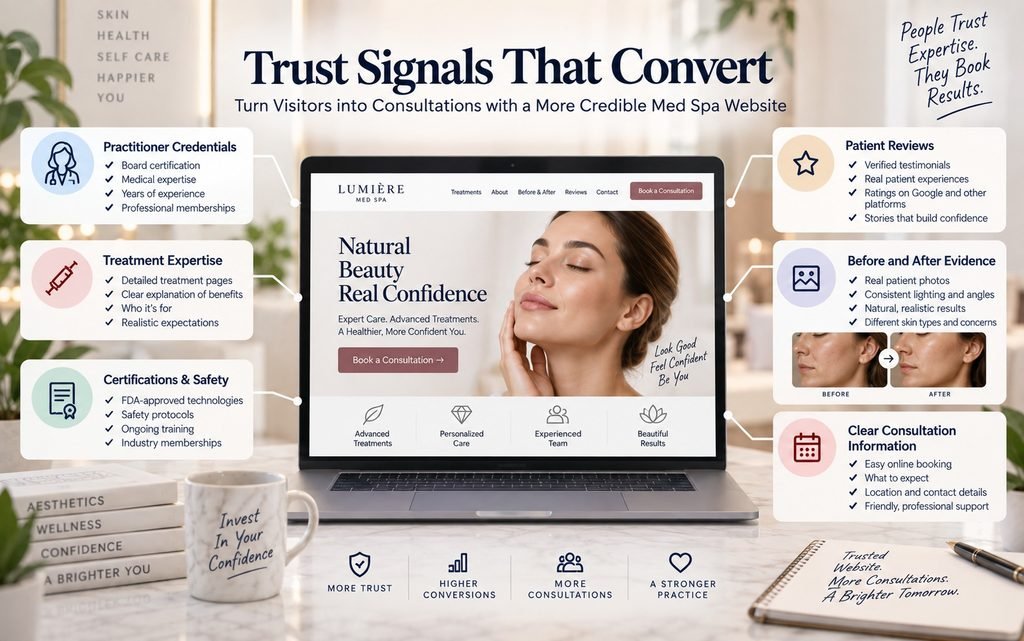
Trust signals should appear before the consultation request because patients evaluating aesthetic treatments need enough evidence to decide whether the clinic deserves further consideration. Credentials buried several clicks away do little for a visitor who is still deciding between multiple providers.
The 2026 review found that 63% of the sites assessed had limited practitioner authority content and 42% were missing important trust signals.
Useful trust elements include:
- Practitioner credentials
- Relevant professional experience
- Treatment-specific expertise
- Authentic patient reviews
- Appropriate before-and-after presentation
- Verifiable professional recognition
- Clear clinic information
- Treatment education
- Consultation expectations
- Patient resources
The objective is not to cover every page with badges and testimonials.
The objective is to place credible evidence next to the decision the visitor is being asked to make.
That is the foundation of Med Spa Website Trust.
Does the Booking Process Create Too Much Friction?
Yes, a complicated or unclear booking process can cause qualified visitors to abandon the journey even after they have developed enough interest to consider a consultation. The important question is whether the booking system collects useful information without creating unnecessary work.
Audit the complete path from CTA click to confirmation.
Look for:
- Too many required fields
- Repeated questions
- Unnecessary account creation
- Poor mobile form behavior
- Unclear availability
- Unexpected redirects
- A booking system that looks unrelated to the website
- No confirmation message
- No explanation of what happens next
The CTA itself also matters.
“Contact Us” is often weaker than an action that tells the visitor what will happen, such as requesting a consultation or discussing treatment options.
A Med Spa Consultation Booking journey should feel like a continuation of the website experience, not a sudden technical interruption.
Are You Losing High-Intent Visitors on Mobile?
Mobile UX should be audited independently because a responsive desktop design does not automatically create a good mobile conversion experience. Many prospective patients discover aesthetic treatments through search and social media on a phone, so the mobile experience may be the first serious evaluation of the clinic.
Review:
- Primary treatment messaging above the fold
- CTA visibility
- Button size
- Treatment-page readability
- Provider information
- Review visibility
- Form length
- Phone and booking actions
- Page stability
- Loading performance
Google recommends monitoring Core Web Vitals including LCP, INP, and CLS as part of page experience. Its current “good” thresholds are LCP within 2.5 seconds, INP under 200 milliseconds, and CLS under 0.1 at the 75th percentile.
These technical thresholds do not guarantee more consultations. They simply help establish whether technical performance is creating an additional obstacle.
How Can You Tell Whether Traffic Quality or Conversion Is the Problem?
This is also why Med Spa Marketing Strategy should be evaluated alongside website conversion. The goal is not simply to generate more traffic, but to understand which channels attract qualified prospects and whether the website is prepared to convert that demand into meaningful consultation opportunities.
Start with:
- Organic landing pages
- Paid-search landing pages
- Social traffic
- Referral traffic
- Direct traffic
- Treatment-page engagement
- Consultation CTA clicks
- Booking starts
- Completed bookings
- Qualified inquiries
Then ask what happens between each stage.
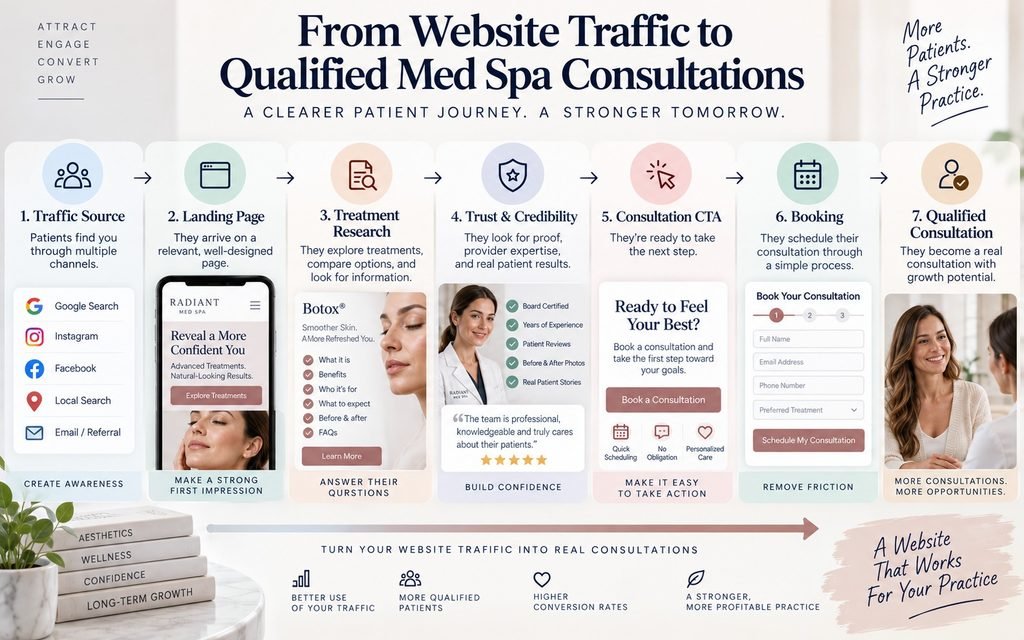
Traffic source → Landing page → Engagement → Treatment research → CTA → Booking → Qualified consultation
That sequence provides much more useful information than a traffic graph alone.
This is also where Med Spa Lead Generation becomes measurable. The objective is not simply to generate more leads, but to understand which sources and pages generate the right prospects.
“Would I Book Here?”
That’s the question your website needs to help a prospective patient answer with confidence.
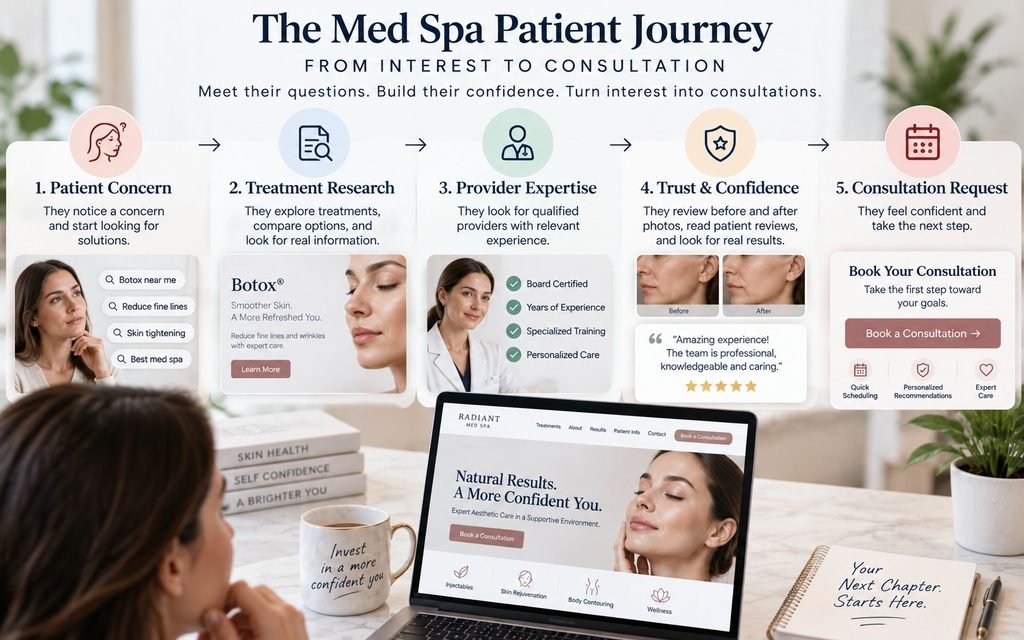
Traffic Creates an Opportunity. Confidence Creates the Consultation.
Patients considering aesthetic treatments often need more than a treatment description. They need enough evidence and clarity to feel comfortable taking the next step.
Example Scenario
Imagine a med spa in Sydney receives 12,000 monthly website visits.
Traffic has increased steadily, but consultation requests have barely changed.
The owner assumes the website needs a complete redesign.
A better first step would be to examine the three highest-traffic treatment pages and compare them with consultation behavior.
Suppose the audit reveals:
- High traffic to treatment pages
- Strong organic visibility
- Low CTA interaction
- Weak provider information
- Generic treatment descriptions
- Long mobile booking forms
The solution is not necessarily a complete redesign.
The first project could instead focus on treatment-page architecture, practitioner authority, trust placement, mobile UX, and booking friction.
If this were my website, I would fix the highest-intent treatment pages and consultation path before spending more on traffic acquisition.
What Does a Real Website Project Teach Us About Conversion?
A real project is useful only when its results are represented accurately. For that reason, an ecommerce project should not be presented as a med spa case study or used to invent consultation statistics.
Taruj Skincare is a useful supporting example because it shows how a website can become a constraint when a business is preparing for its next stage of growth.
The original project involved a Florida-based skincare brand whose existing Squarespace site was becoming restrictive for premium positioning, product presentation, mobile experience, future marketing, affiliate activity, and SEO growth.
KG Web Designer moved the project to WordPress and WooCommerce, redesigned the experience, improved product presentation and conversion considerations, strengthened mobile UX, and prepared the platform for future growth.
The published case study reports that the first order arrived on launch day, affiliate activity began during the first week, and the client subsequently commissioned ongoing SEO work.
Those are ecommerce results, not med spa consultation results.
The transferable lesson is the important part: a website should be designed around the business’s next commercial stage rather than simply its current appearance.
For the full project context, see the Taruj Skincare website redesign case study.
Why Most Businesses Get This Wrong
Most businesses get this wrong because they select a solution before identifying the problem. A clinic sees competitors advertising on Instagram, notices that Google Ads are generating clicks, or decides that its website looks dated, and then chooses an investment based on perception.
The most common mistakes are:
- Increasing advertising before fixing a weak landing page
- Sending every campaign to the homepage
- Treating Instagram engagement as equivalent to consultations
- Redesigning without reviewing analytics
- Measuring leads without measuring lead quality
- Ignoring phone inquiries
- Tracking bookings without attendance
- Creating generic treatment pages
- Hiding practitioner expertise
- Making the consultation CTA prominent without building enough confidence first
- Assuming premium visual design automatically means premium conversion performance
The central problem is fragmented thinking.
Marketing creates attention.
The website creates context.
Trust creates confidence.
The consultation process creates commitment.
Follow-up creates momentum.
The treatment experience creates retention.
A successful med spa needs those pieces to work together.
What Should You Fix First, Second, and Third?
If Instagram is an important acquisition channel, the website should be treated as the next stage of that journey rather than a separate marketing asset. Our guide on turning med spa Instagram leads into website conversions explains how the transition from social discovery to website evaluation can be structured to reduce friction and improve the opportunity for a consultation.
First: Fix Measurement
Track:
- Consultation CTA clicks
- Booking starts
- Completed bookings
- Form submissions
- Phone clicks
- Treatment-page engagement
- Lead source
- Qualified inquiries
Second: Fix Treatment Pages
Improve the pages receiving qualified traffic.
Make them useful enough for a prospective patient to understand the treatment, provider, expectations, and next step.
Third: Fix Trust
Bring relevant practitioner expertise, authentic reviews, treatment-specific evidence, and clinic information closer to the decision point.
Fourth: Fix Mobile UX
Test the actual journey on a phone from landing page to booking confirmation.
Fifth: Fix Performance
Review Core Web Vitals, image weight, scripts, hosting, and third-party booking systems.
Sixth: Decide Whether a Redesign Is Necessary
If the platform cannot support the required UX, architecture, content, measurement, or performance improvements, a redesign may be justified.
This is the difference between Med Spa Website Conversion Optimization as a diagnosis-led process and a redesign undertaken simply because the website looks old.
Don’t Diagnose the Problem at the Bottom of the Funnel
If consultation requests are low, look at every decision a prospective patient has to make before reaching the booking stage.
When Does Professional Help Make Sense?
Professional help makes sense when the problem crosses strategy, UX, content, technology, and measurement. A developer may fix a technical problem, while a marketer may adjust an advertising campaign, but the patient journey often crosses both areas.
Professional website strategy becomes particularly useful when:
- Traffic is healthy but qualified consultations are weak.
- Treatment pages receive relevant traffic but generate little action.
- The website looks premium but feels difficult to use.
- Provider expertise is difficult to verify.
- Booking requires too many steps.
- Mobile performance is weak.
- Analytics cannot show where visitors drop.
- The current CMS prevents meaningful improvements.
- The clinic is expanding treatments or locations.
A High-Converting Med Spa Website should not simply look expensive. It should make the patient’s decision easier while giving the clinic a measurable path from discovery to consultation.
Before You Invest in More Traffic, Audit the Conversion Path
If your med spa is already getting relevant website traffic, do not assume you need more visitors. First determine whether those visitors are reaching the right treatment pages, finding enough trust signals, understanding the next step, and completing the consultation journey.
KG Web Designer can review the key conversion paths across your treatment pages, mobile experience, trust signals, calls to action, and booking process to identify where qualified visitors may be dropping out.
If the problem can be fixed without a redesign, we will identify the areas to optimize. If the existing website is limiting what can be improved, we can outline what a strategic redesign would need to accomplish.
What Does This Mean For Your Business?
If your website already attracts relevant visitors, the next growth opportunity may be conversion efficiency rather than additional traffic. Improving the experience can help the clinic make better use of existing acquisition spend, strengthen trust, improve lead quality, and reduce avoidable abandonment.
There is also a positioning benefit.
A clinic that clearly communicates treatment expertise, practitioner authority, patient expectations, evidence, and consultation processes gives prospective patients more reasons to continue researching the practice instead of moving to another provider.
The financial implication is straightforward: every qualified visitor has acquisition value.
If the website loses that visitor after the click, the clinic may have to spend again to reach another prospect.
That is why Med Spa Website UX should be considered part of the clinic’s marketing economics rather than simply a design concern.
Expert Insight from Kanika Gupta
Kanika Gupta, Founder, KG Web Designer
“If this were my website, I would not start by redesigning the homepage. I would follow one high-value treatment from discovery to consultation and identify exactly where the visitor loses confidence, encounters friction, or stops understanding what to do next.”
That is the judgment I believe generic website advice often misses.
A website should not be redesigned because it feels old.
It should be changed because a diagnosed business problem requires a different experience, structure, or technical foundation.
At KG Web Designer, we look at visual design alongside treatment architecture, patient psychology, trust, mobile UX, search intent, and measurable business actions.
What Should a Med Spa Do Over the Next 30 Days?
The next 30 days should establish a baseline, identify the biggest leak, make targeted improvements, and then determine whether more acquisition investment makes sense.
Days 1–7: Measure
Record:
- Traffic by source
- Treatment-page visits
- Consultation-page visits
- Calls
- Forms
- Booking starts
- Completed bookings
- Qualified inquiries
- Consultation attendance
Days 8–14: Audit
Review the three most important acquisition journeys.
For each one, ask:
- Where does the visitor land?
- Does the page match the original intent?
- Is the treatment clearly explained?
- Is the provider credible?
- Is relevant proof visible?
- Are important objections answered?
- Is the consultation process clear?
- Can the visitor act easily on mobile?
Days 15–21: Fix
Fix the single biggest measurable problem first.
Do not redesign the entire website simply because one page is weak.
Do not increase advertising simply because traffic is available.
Do not create more social content if the existing traffic has nowhere useful to go.
Days 22–30: Re-measure
Compare:
Traffic → Engagement → Consultation → Booking → Attendance → Treatment
This gives the clinic a much stronger basis for the next investment decision.
Final Thoughts
A med spa can have substantial traffic and still lose consultation opportunities if the website does not help prospective patients make a confident decision.
The most useful question is not “How do we get more visitors?”
It is:
“What happens after the right visitor arrives?”
The 2026 audit shows why that question matters. Generic treatment content, limited practitioner authority, weak differentiation, missing trust signals, and consultation friction can exist even on visually polished websites.
Before investing in more traffic or approving a complete redesign, diagnose the leak.
Fix the highest-intent treatment pages.
Strengthen trust.
Simplify consultation pathways.
Improve mobile UX and performance.
Measure the complete patient journey.
If the existing platform cannot support those changes, then a strategic redesign can become an investment in revenue infrastructure rather than a cosmetic expense.
Med Spa Website Conversion should ultimately be evaluated through the complete journey from qualified visitor to consultation, not through traffic alone.
If you want an independent assessment of whether your next priority should be conversion optimization, treatment-page improvements, or a complete website redesign, KG Web Designer can review the current experience and recommend the appropriate next step.
Your Website Has Traffic. Let’s Find Out What’s Stopping the Consultation.
I’ll help you look beyond visitor numbers and review the experience prospective patients have after they arrive — where confidence builds, where uncertainty appears and where the journey may be breaking down.

Frequently Asked Questions
How can I tell if my website problem is serious enough to require professional help?
Start with evidence rather than appearance. If relevant traffic is reaching important treatment pages but consultation actions remain weak, or if the booking journey, mobile experience, trust architecture, and measurement are difficult to diagnose internally, professional help can shorten the process. The objective should be identifying the commercial bottleneck before recommending a large project.
What should I show on a treatment page before asking visitors to book?
A treatment page should explain the concern or goal the treatment addresses, relevant provider expertise, what the treatment involves, realistic expectations, important patient questions, and what happens during the consultation. The page should then offer a clear next step that matches the visitor’s intent rather than forcing every visitor through the same generic contact path.
Should a med spa redesign its website if traffic is already strong?
Not necessarily. Strong traffic can be a reason to optimize the existing experience before rebuilding it. A redesign becomes more compelling when the current platform, information architecture, mobile UX, content structure, performance, or booking integration prevents the clinic from implementing the improvements required to convert qualified visitors.
What is more important, website design or treatment-page content?
Neither should be considered independently. Visual design establishes positioning and usability, while treatment-page content helps visitors understand whether a service and provider are relevant to them. A visually polished website with generic treatment information can still lose high-intent visitors, while excellent content presented through a confusing interface can create a different conversion problem.
How should a med spa measure the success of website improvements?
Measure actions further down the funnel rather than relying only on traffic. Useful indicators include consultation CTA interactions, booking starts, completed bookings, qualified inquiries, phone calls, consultation attendance, lead source, and eventual treatment outcomes where reliable attribution is possible. The right measurement framework depends on the clinic’s technology and patient journey.
When should a med spa spend more on advertising?
Additional advertising makes more sense when the clinic has enough capacity, the targeting is producing relevant visitors, and the website and booking experience can convert that demand effectively. If qualified traffic is already arriving but consultations remain weak, fixing the website or booking journey may deserve attention before increasing acquisition spend.
How often should a med spa audit its website conversion journey?
A practical approach is to review conversion performance continuously through analytics and conduct a deeper UX and content audit at least quarterly or after major changes. Re-audit after launching important treatments, changing booking software, redesigning key pages, expanding locations, or significantly changing paid acquisition campaigns.