Quick Answer
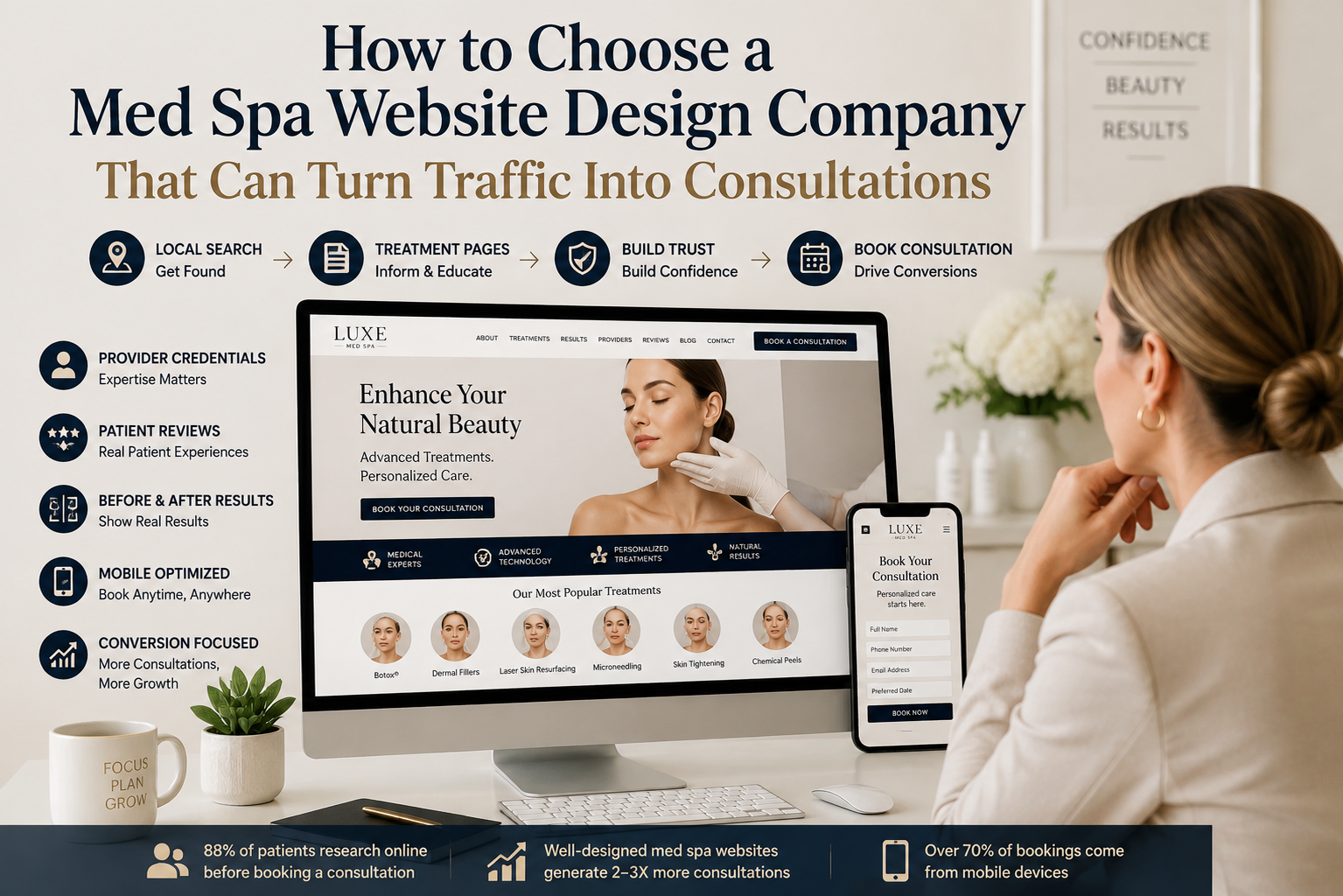
The right med spa website design company should first determine why existing traffic is not becoming consultations before recommending a redesign. Look for expertise in treatment-page architecture, mobile booking UX, local search, practitioner credibility, patient reviews, and conversion tracking. A premium-looking website is not enough. The agency should be able to connect search intent, treatment education, trust, and the consultation journey into one measurable experience.
TL;DR: What Should a Med Spa Owner Look For?
- A med spa website should be evaluated by consultation performance, not visual appearance alone.
- Treatment-specific pages should answer patient questions and provide a clear path toward consultation.
- Google says local results are primarily influenced by relevance, distance, and prominence.
- Mobile UX, practitioner credibility, reviews, treatment information, and booking friction can influence whether existing traffic becomes an inquiry.
- More advertising is not automatically the answer when the website is already attracting qualified visitors.
- A strong agency should diagnose the website before deciding whether SEO, CRO, PPC, optimization, or a full redesign is appropriate.
If Your Med Spa Gets Traffic but Not Consultations, What Is Probably Wrong?
If qualified traffic is reaching your website but consultation requests remain weak, the problem is likely somewhere in the conversion journey rather than visibility alone. If traffic itself is weak, the diagnosis should expand to search visibility, local SEO, content architecture, and digital authority.
That distinction matters financially.
A clinic can spend more on Google Ads, social media, or SEO and still produce disappointing results if the website does not help visitors move from treatment research to confidence and action.
A useful first diagnosis looks like this:
| What you are seeing | Likely problem | What to inspect first |
|---|---|---|
| High traffic, few consultations | Conversion friction | Treatment pages, CTAs, booking flow |
| Good rankings, weak inquiries | Intent mismatch | Search-to-page relevance |
| Strong social traffic, weak action | Trust or landing-page problem | Mobile UX and credibility |
| Low local visibility | Local SEO weakness | Business Profile + website relevance |
| Treatment pages receive traffic but few actions | Treatment-page UX | Content, proof, CTA placement |
| Website looks outdated and is structurally weak | Strategic redesign | Architecture and technology |
| Paid clicks but few leads | Landing-page conversion | Ad-to-page message match |
| Website performs adequately | No major intervention needed | Measurement first |
Google’s current guidance says local rankings are mainly based on relevance, distance, and prominence. Google also notes that complete and accurate Business Profile information helps it understand whether a business is relevant to a search.
So “we need more SEO” is not always the correct answer.
Sometimes the clinic already has enough qualified visitors.
The website simply fails to give those visitors enough information, confidence, or convenience to take the next step.
The larger question is what the clinic should invest in next. More traffic is not always the answer, and neither is a website redesign. Before choosing between paid acquisition, social media, SEO, conversion optimization, or a website rebuild, it helps to evaluate the entire med spa marketing strategy against the clinic’s current bottleneck, budget, and growth objective.
Your Treatments Feel Premium. Does Your Website?
Patients form an impression of your clinic before they ever step through the door. A refined digital experience can communicate expertise, quality, safety, and attention to detail while attracting clients who value what you offer.
Explore Aesthetic Clinic Website Design →What Are Med Spa Owners Usually Complaining About?
The most useful clues often come from the language clinic owners use when describing the problem.
You may hear:
- “We’re getting traffic, but not enough consultations.”
- “People keep asking questions that are already answered on the website.”
- “Instagram gets attention, but people don’t book.”
- “Our website looks premium, but it doesn’t feel like our clinic.”
- “Google Ads generate clicks, but not enough inquiries.”
- “Our competitors rank for treatments we also offer.”
- “Our website works on desktop, but mobile feels awkward.”
- “We have excellent reviews, but nobody seems to see them.”
- “Our treatment pages don’t seem to generate anything.”
- “We don’t know whether the problem is SEO or the website.”
These are not all the same problem.
If a clinic gets strong traffic to a Botox page but visitors rarely proceed toward consultation, publishing another general blog article may not solve the issue.
I would inspect the Botox page itself.
Can the visitor immediately understand the treatment? Can they determine whether it is relevant to them? Can they understand who provides it? Can they find credible proof? Can they understand what happens during a consultation? Can they take the next step without unnecessary friction?
That is the difference between traffic analysis and conversion diagnosis.
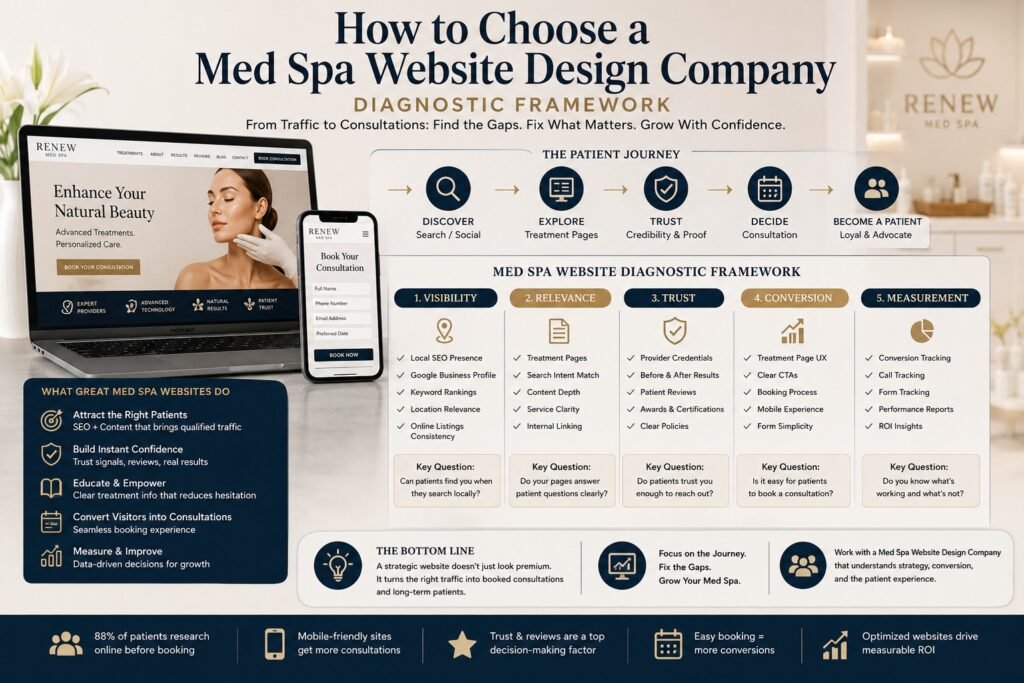
How Should a Med Spa Website Be Diagnosed Before You Redesign It?
A website should be diagnosed by tracing the patient journey from discovery to consultation, not by starting with the homepage.
At KG Web Designer, I would inspect five connected areas first.
1. Search intent
Does the page actually answer the query that brought the visitor there?
Someone searching for “Botox near me” has a different intent from someone searching for “How long does Botox last?”
The landing experience should reflect that difference.
2. Treatment architecture
A serious treatment page should help the visitor understand:
- What the treatment addresses
- Who it may be suitable for
- What the consultation involves
- What to expect
- Who provides the treatment
- What makes the clinic credible
- Relevant questions
- Appropriate proof
- The next action
3. Trust architecture
Trust should not be hidden on an About page.
Provider credentials, clinic information, reviews, treatment education, appropriate results presentation, and transparent expectations should appear where they help the decision.
4. Booking UX
The booking pathway deserves its own audit.
How many steps are required?
Is the CTA obvious on mobile?
Does the visitor know what happens after submitting the form?
Are consultation actions being tracked?
Can a high-intent visitor call or book without searching through the website?
5. Technical experience
Technical performance should be reviewed alongside conversion behavior.
A technically healthy site does not automatically convert, but slow pages, broken interactions, confusing navigation, or poor mobile layouts can create unnecessary friction.
Standalone fact: A technically fast med spa website can still underperform if its treatment pages do not answer the visitor’s decision questions.
When evaluating a potential website design partner, look closely at how they approach treatment pages rather than judging the agency only by homepage aesthetics. A strong treatment page should connect treatment education, practitioner credibility, relevant proof, patient questions, and the consultation pathway. Our detailed guide to Med Spa Treatment Pages Design explains what this architecture should accomplish and where many treatment pages lose conversion opportunities.
Where Does Aesthetic Clinic Website Strategy Fit Into the Bigger Picture?
A med spa website has to communicate two things simultaneously: premium experience and professional credibility.
That is why the structure matters as much as the visual style.
For clinics offering injectables, laser treatments, skin treatments, body treatments, or multiple aesthetic services, the website needs a coherent hierarchy between the clinic, practitioners, treatments, locations, proof, and consultation pathways.
A strategically structured skin and aesthetic clinic website design approach can help connect those elements instead of treating every page as an isolated design exercise.
The commercial objective is straightforward.
A visitor should not have to assemble the case for choosing the clinic themselves.
The website should progressively answer the questions that stand between “This treatment interests me” and “I am comfortable requesting a consultation.”
What Should a High-Converting Med Spa Treatment Page Include?
A treatment page should reduce uncertainty before asking the visitor to book.
That does not mean writing an enormous medical article.
It means providing the information necessary for a prospective patient to evaluate relevance, credibility, expectations, and next steps.
A strong treatment page can include:
- A clear explanation of the treatment.
- The concern or goal it addresses.
- Who may be a suitable candidate.
- What the consultation involves.
- What the treatment experience is like.
- Relevant practitioner information.
- Appropriate patient results or visual evidence.
- Reviews or testimonials where appropriate.
- Frequently asked questions.
- A clear consultation pathway.
This is where treatment page UX becomes commercially important.
The page should feel like a useful answer to the patient’s questions, not an advertisement interrupted by a “Book Now” button.
Current industry guidance similarly emphasizes dedicated treatment pages, provider information, reviews, booking functionality, and local search as important components of med spa websites.
The important distinction is that those elements need to work together.
How Important Is Local SEO for a Med Spa?
Local SEO is important because med spa searches are strongly connected to physical location and treatment relevance. Google states that local results are primarily determined by relevance, distance, and prominence, and that reviews and information from across the web can contribute to prominence.
A sound local strategy therefore needs more than repeating a city name across pages.
It should connect:
- Google Business Profile information
- Clinic location
- Treatment relevance
- Service pages
- Location context
- Reviews
- Practitioner information
- Internal linking
- Relevant external references
- Consistent business information
That is the foundation of local SEO med spa strategy.
Google also explains that information displayed in local search can come from the business itself, publicly available web content, third parties, users, and other sources.
This makes consistency important.
Your website, Business Profile, external references, and patient-facing information should not tell conflicting stories about who you are, where you operate, or what you offer.
What Do Patients See Before They Decide to Book?
Your website has seconds to establish confidence. If patients cannot quickly see your expertise, treatment quality, results, and credibility, they may continue comparing clinics instead of requesting a consultation.
Make every stage of the patient journey work harder.
See Aesthetic Website Solutions →What Does a Med Spa Website Project Actually Need to Solve?
The right scope depends on the problem.
A visual refresh, conversion optimization project, SEO restructuring, and complete website rebuild are not interchangeable.
| Business situation | Better first move |
|---|---|
| Website looks dated but converts well | Visual refinement |
| Traffic exists but consultations are weak | Conversion audit |
| Treatment architecture is poor | Content + UX restructuring |
| Local visibility is weak | SEO/local search work |
| Mobile journey is frustrating | Mobile UX optimization |
| Multiple structural problems exist | Strategic redesign |
| Paid traffic converts poorly | Landing-page/CRO audit |
| Website platform restricts necessary improvements | Platform/website rebuild |
| No meaningful evidence of a problem | Measure before changing |
Before comparing project prices, it is useful to understand what actually determines the scope of an aesthetic clinic website project. The aesthetic clinic website design cost guide for 2026 explains how strategy, content architecture, SEO, functionality, integrations, and conversion requirements can affect the investment.
That distinction can prevent an expensive mistake: paying for a redesign when a smaller, more targeted intervention would address the real problem.
If this were my website, I would audit the existing traffic, treatment pages, mobile experience, trust signals, and consultation pathway before approving a full redesign.
I would want evidence showing that the existing structure cannot support the required improvements.
Expert Insight from Kanika Gupta
“A med spa website should not try to convince every visitor to book immediately. It should give each visitor the right evidence at the right point in their decision process.”
One of the biggest problems I see in aesthetic websites is that important information is disconnected.
The practitioner is presented on one page.
The treatment is on another.
Reviews are somewhere else.
The consultation CTA appears at the bottom.
The visitor has to assemble the entire argument for choosing the clinic.
That is unnecessary friction.
A stronger website connects expertise, treatment relevance, proof, expectations, and action.
What Are Three Med Spa Website Problems I Would Inspect First?
There are three patterns I would pay particular attention to during a clinic website audit.
Observation 1: The homepage often receives too much strategic attention
Many clinics spend most of their effort making the homepage look impressive while individual treatment pages remain generic.
That can create a mismatch between how the website is designed and how people actually discover the clinic.
If a visitor searches for a specific treatment, the treatment page should do the heavy lifting.
Observation 2: Premium design is confused with premium positioning
A beautiful color palette and sophisticated photography can create a polished appearance.
But premium positioning also requires specificity.
The visitor should understand who the clinic serves, what it specializes in, who performs treatments, what experience they can expect, and why the clinic deserves consideration.
Observation 3: Booking is treated as a button instead of a journey
A “Book Now” button cannot compensate for unanswered questions.
If someone is unsure about treatment suitability, practitioner credentials, expected experience, or what happens during a consultation, adding another CTA does not remove that uncertainty.
The surrounding page has to do that work.
What Should You Ask Before Hiring a Website Agency?
The best agency evaluation questions are strategic rather than purely visual.
Ask:
- How do you audit an existing website?
- How do you determine whether a redesign is necessary?
- How do you structure treatment pages?
- How do you approach local search?
- How do you measure consultation conversions?
- How do you improve mobile booking?
- How do you preserve SEO during migration?
- How do you incorporate practitioner credibility?
- How do you use reviews appropriately?
- How do you evaluate whether paid traffic is being wasted?
- What happens after launch?
The answer matters more than the agency’s sales presentation.
A good agency should be able to explain the reasoning behind its recommendations.
It should also be comfortable telling you when not to redesign.
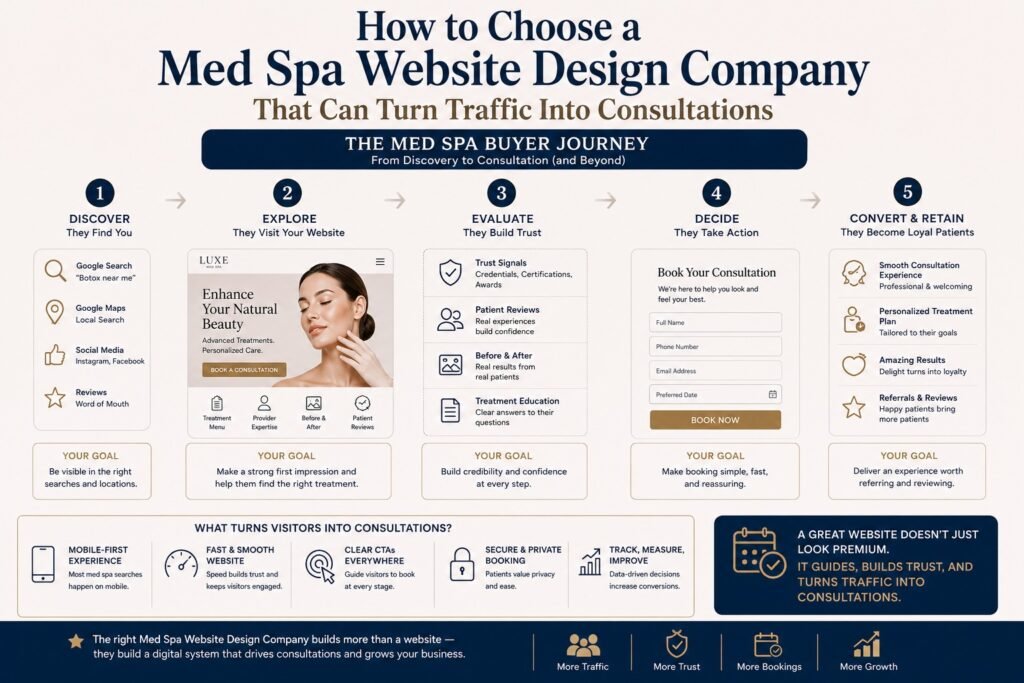
Why Do Some Aesthetic Clinic Websites Convert Better?
Some aesthetic websites convert better because they are structured around the patient’s decision process rather than the clinic’s internal organizational structure.
A service menu might make perfect sense to the clinic owner.
It may not make sense to a prospective patient.
The visitor may be thinking:
“Can you help with my concern?”
“Who performs this?”
“Will I be a good candidate?”
“What should I expect?”
“Can I trust this clinic?”
“What happens if I request a consultation?”
The website needs to answer those questions in a logical sequence.
Our analysis of why some aesthetic clinic websites convert better goes deeper into treatment structure, trust, mobile experience, and the way patient decision-making should influence page architecture.
That is where conversion strategy becomes more valuable than simply adding more content.

Your Clinic May Be Premium. Is Your Website Communicating It?
If your website is attracting visitors but not enough high-quality consultation enquiries, the problem may be positioning, trust, or the patient journey. Let’s identify what could be improved.
Book Your Free 30-Minute Website Review →Example Scenario: A Med Spa Has Traffic but Few Consultations
Imagine a med spa receives traffic from Google, Instagram, referrals, and paid campaigns.
The owner sees the analytics and concludes:
“We need more traffic.”
But an audit reveals something different.
The highest-visited treatment page has limited practitioner information.
Reviews are buried.
The mobile CTA is difficult to find.
The consultation form asks for too much information.
The page does not clearly explain what happens during the consultation.
The clinic may not have a traffic problem.
It may have a confidence and friction problem.
The better sequence would be:
Treatment relevance → Trust → Evidence → Expectation setting → Consultation CTA → Measurement
Only after that journey is functioning should additional acquisition spend be considered.
If Instagram is already generating attention but you are unsure what happens after someone clicks through to your website, our guide on how med spas can turn Instagram leads into website conversions breaks down the journey from social discovery to treatment-page engagement, consultation, and booking. It is particularly useful when you are trying to determine whether you need a new website, better conversion optimization, or simply a clearer path between Instagram and your existing website.
Example From Our Experience: Taruj Skincare
The Taruj Skincare website redesign case study illustrates why a website project should be treated as a broader business-system decision rather than a cosmetic exercise.
Problem
Taruj Skincare had an existing Squarespace website that no longer aligned with the brand’s growth plans.
The project required more than a new visual appearance.
Solution
The project addressed website strategy, UX/UI, WordPress and WooCommerce development, conversion considerations, mobile experience, product presentation, and SEO foundations.
The platform was migrated from Squarespace to WordPress and WooCommerce to provide greater flexibility for the brand’s future plans.
Outcome
The published case study reports that the first order arrived on launch day and affiliates began joining during the first week.
That result should not be presented as a guaranteed outcome for every clinic.
The useful lesson is different: website strategy should connect positioning, user experience, trust, functionality, and commercial action rather than treating design as an isolated deliverable.
What Does This Mean For Your Med Spa?
Your website should make every marketing channel more valuable.
If someone discovers the clinic through Google, the website should help them evaluate it.
If they arrive from Instagram, the website should provide credibility and context.
If they click a paid advertisement, the landing page should continue the promise that generated the click.
If they already know the clinic, the booking process should be easy.
That means med spa lead generation should be evaluated alongside the website’s ability to convert appropriate visitors.
More traffic is not automatically better.
More qualified traffic reaching a clear, credible, low-friction consultation pathway is more commercially meaningful.
What Role Will AI Search Play in Med Spa Discovery?
AI-powered search creates another reason to build clear relationships between treatments, practitioners, expertise, location, and patient questions.
A clinic should not approach this as a separate trick for “ranking in AI.”
The underlying requirement is stronger digital clarity.
The website should clearly communicate:
- Who the clinic is
- Where it operates
- What treatments it provides
- Who provides those treatments
- What expertise exists
- Which patient concerns are addressed
- What questions the clinic answers
- How visitors can take the next step
Our guide on how AI search recommends skin clinics explores this relationship between structured expertise, treatment information, practitioner credibility, educational content, and AI-powered discovery.
The broader principle is simple:
Make the business easy for both people and search systems to understand.
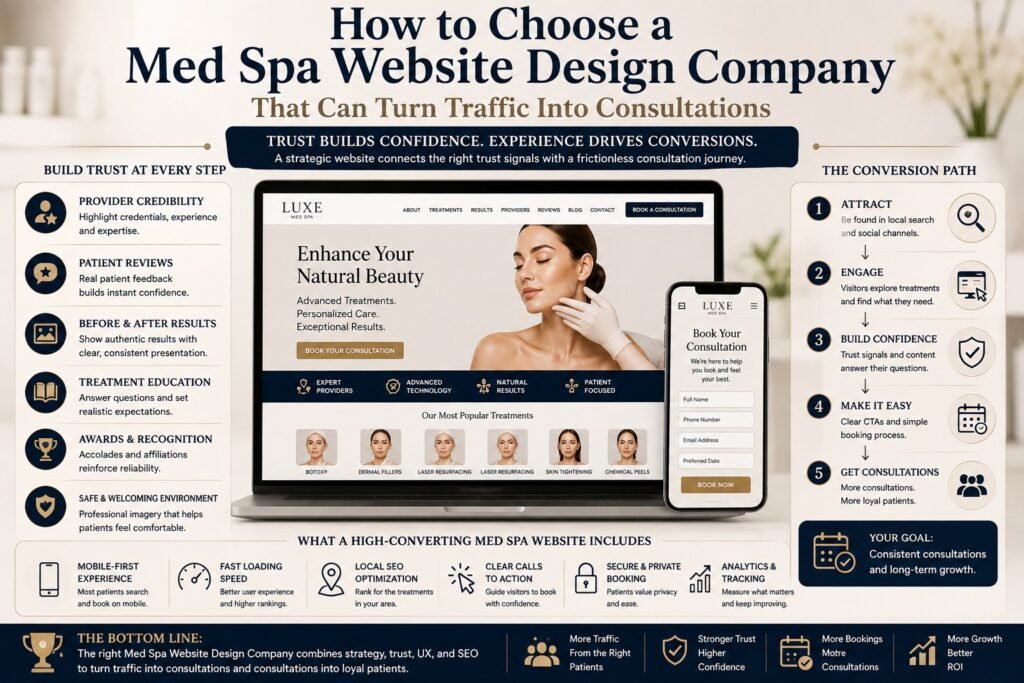
What Should You Not Do When Choosing an Agency?
Do not choose an agency solely because its portfolio looks attractive.
A visually impressive website can still have weak treatment architecture, poor mobile UX, unclear positioning, or a frustrating booking journey.
Do not automatically approve a full redesign because someone says the current website “looks old.”
Do not assume more blogs will solve a treatment-page conversion problem.
Do not increase paid traffic before checking whether the landing experience deserves the additional traffic.
And do not accept guaranteed rankings or guaranteed lead volumes as proof of expertise.
Google explicitly says there is no way to request or pay for a better local ranking, and that its ranking systems remain confidential.
The agency should explain what it can improve and measure rather than promise outcomes it cannot control.
Turn Patient Interest Into High-Value Consultations
Your website should make patients feel confident about your expertise before they ever speak with your team. Discover where stronger positioning, proof, and user experience could improve your consultation enquiries.
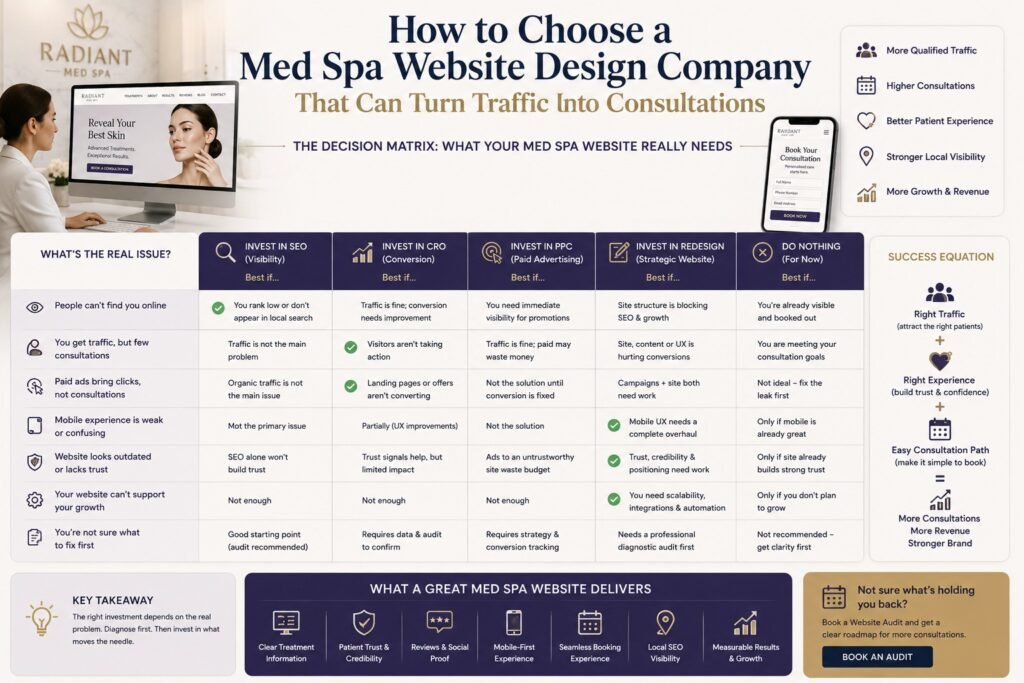
Should You Invest in SEO, CRO, PPC, or a Redesign?
The correct investment depends on where the patient journey is breaking.
Choose SEO when:
- Relevant searches are not reaching the website.
- Treatment pages are missing.
- Local visibility is weak.
- Competitors have stronger topical coverage.
- The website does not clearly communicate services and location.
Choose CRO when:
- Qualified traffic already exists.
- Important treatment pages receive visitors.
- Consultation actions are disproportionately low.
- Mobile or booking friction is visible.
- Trust information is difficult to find.
Choose PPC when:
- The clinic has a clear commercial offer.
- Landing pages match the advertising intent.
- Conversion tracking is reliable.
- The clinic can handle additional inquiries.
- The underlying website experience is strong enough to support paid acquisition.
Choose redesign when:
- The existing architecture prevents meaningful improvement.
- The mobile experience is fundamentally poor.
- The CMS restricts necessary functionality.
- Positioning and content structure are outdated.
- Multiple technical, SEO, UX, and conversion problems need to be addressed together.
Do nothing when:
- The website performs well.
- The conversion journey is healthy.
- Analytics do not identify a meaningful problem.
- The proposed redesign is based only on subjective preferences.
The most expensive mistake is sometimes not hiring the wrong agency.
It is solving the wrong problem.
What Should a Premium Clinic Website Actually Communicate?
A premium clinic website should communicate confidence without becoming vague or overly luxurious.
The visitor should be able to understand:
- What the clinic specializes in.
- Which treatments are available.
- Who provides them.
- What makes the clinic credible.
- What the patient experience looks like.
- What evidence supports the clinic’s claims.
- What happens during consultation.
- How to take the next step.
This is where visual design and conversion strategy have to work together.
A website can look luxurious while still making the visitor work too hard.
A genuinely strong premium clinic website makes the experience feel considered because information appears when the visitor needs it.
That is a much more useful definition of premium than simply using expensive-looking imagery.
When Does Professional Help Make Sense?
Professional help makes sense when the clinic cannot clearly identify why qualified visitors are failing to become consultations.
An audit becomes especially valuable when:
- Traffic is increasing but consultations are not.
- Paid campaigns generate clicks but weak inquiries.
- Treatment pages receive visits but few actions.
- Mobile users behave differently from desktop users.
- Local rankings are inconsistent.
- The clinic is introducing higher-value treatments.
- The existing website cannot support the required content structure.
- The owner is considering a redesign but has no evidence that a redesign is necessary.
At KG Web Designer, the approach should begin with diagnosis rather than assuming the answer is a new website.
The objective is to identify the highest-value problem.
If the existing site can be improved, improve it.
If the architecture is preventing meaningful progress, redesign it.
That distinction protects the clinic from spending heavily on a prettier version of the same problem.
Premium Treatments Deserve a Premium Patient Experience
Your website should reassure patients before they ever contact your clinic. From treatment information and practitioner expertise to results and booking flow, every detail should make choosing your clinic feel easier.
Is Your Website Losing Consultations?
If your med spa already receives traffic but the consultation calendar does not reflect that investment, do not automatically increase your advertising budget or commission a complete redesign.
Start by identifying where qualified visitors are dropping out.
Request a med spa website audit to evaluate treatment pages, mobile UX, trust signals, local search structure, CTAs, and the consultation pathway before deciding what needs to change.
Request a Med Spa Website Audit
What Would I Fix First If This Were My Website?
I would not begin with the homepage.
I would select the five treatments that matter most commercially and trace each visitor journey from discovery to consultation.
For every treatment, I would examine:
Search → Landing page → Relevance → Trust → Proof → Questions → Consultation → Booking
Then I would compare that journey with actual analytics.
If the biggest loss occurs on treatment pages, fix treatment-page architecture.
If visitors hesitate at the booking stage, fix booking UX.
If qualified searches are not reaching the clinic, investigate SEO and local visibility.
If the entire architecture prevents improvement, then redesign.
That sequence is more commercially responsible than treating every outdated website as a redesign opportunity.
Why Most Med Spas Get This Wrong
Most med spas get this wrong because they evaluate the website as a visual asset instead of a commercial system.
The owner sees an outdated design and thinks:
“We need a new website.”
The marketing manager sees weak traffic and thinks:
“We need more SEO.”
The advertising agency sees low conversion and thinks:
“We need more traffic.”
Each recommendation could be correct.
But none should be made before diagnosis.
The better sequence is:
Measure → Diagnose → Prioritize → Fix → Redesign only when necessary.
This reduces wasted investment because each change is connected to a specific business problem.
It also gives the clinic a much clearer way to evaluate agency proposals.
How Should You Evaluate the Agencies You Are Considering?
The best med spa website design company is not necessarily the biggest agency or the one with the most elaborate portfolio.
It is the team that can explain how it would diagnose the patient journey and improve the relationship between visibility, trust, treatment discovery, and consultation.
I would evaluate five areas:
| Evaluation area | What you should look for |
|---|---|
| Industry understanding | Can they explain the med spa buyer journey? |
| Conversion thinking | Can they diagnose why traffic does not convert? |
| SEO capability | Can they connect treatment and local search intent? |
| Technical capability | Can they improve mobile UX, tracking, integrations and performance? |
| Strategic judgment | Can they tell you when a redesign is unnecessary? |
Ask the agency to explain the reasoning behind its recommendations.
Do not settle for screenshots.
Ask what problem the website solved.
Ask what was changed.
Ask what was measured.
Ask what they would do differently today.
That tells you far more than a portfolio grid.
What Should You Look For in a Med Spa Website Partner in 2026?
The strongest agency partner should combine design, SEO, conversion strategy, UX, and business understanding.
You should be able to have one conversation about:
- Treatment architecture
- Local search
- Practitioner credibility
- Patient psychology
- Mobile UX
- Consultation conversion
- Analytics
- Technical performance
- Content
- Website migration
- AI search visibility
The point is not to turn one agency into every marketing department.
The point is to ensure the website itself is strategically sound.
KG Web Designer approaches website projects from that perspective: the website is not simply the destination of marketing activity. It is part of the mechanism that turns attention into a business conversation.
Where Are Potential Patients Dropping Off?
A patient may love your results but still hesitate if your website does not clearly communicate expertise, safety, treatment expectations, or the next step. Small gaps in the journey can mean lost consultations.
Explore Aesthetic Clinic Website Design →Review your website from a potential patient’s perspective.
Book Free Website Audit →Final Thoughts
Choosing a med spa website design company should be a business decision, not simply a design purchase.
The right partner should be able to answer a harder question than:
“Can you build us a beautiful website?”
It should be able to answer:
“Why are qualified visitors not becoming consultations, and what should we fix first?”
That requires a combination of treatment-page strategy, conversion optimization, local search, technical performance, trust architecture, mobile UX, patient psychology, and measurable booking pathways.
If your clinic is already getting traffic but your consultation calendar does not reflect that investment, start with diagnosis.
Do not automatically buy more traffic.
Do not automatically approve a complete redesign.
Find the point where the patient journey breaks, then fix that point.
If you want a commercially focused assessment of your current website, request a med spa website audit before committing to a larger redesign project.
Request a Website Audit / Strategy Review
Frequently Asked Questions
What should I look for in a med spa website agency?
Look for an agency that can demonstrate expertise in treatment-page architecture, mobile UX, local SEO, practitioner credibility, patient trust, consultation pathways, and conversion measurement. Ask how the agency diagnoses an existing website before proposing a rebuild. A strong partner should be able to explain the business reason behind its major design and content recommendations.
How can I tell whether my med spa has a traffic problem or a conversion problem?
Compare qualified website traffic with consultation actions. If relevant visitors are reaching treatment pages but few call, submit forms, or book, investigate conversion friction before buying more traffic. If visibility and qualified traffic are both weak, SEO and local search may need attention alongside conversion improvements.
Should I redesign my med spa website or improve SEO first?
Start with diagnosis. If qualified traffic is already reaching the website but consultation activity is weak, CRO and UX may deserve priority. If the website converts well but lacks visibility, SEO may be the better investment. A full redesign makes more sense when architecture, technology, mobile UX, content, and conversion problems are interconnected.
How important are treatment pages for a med spa website?
Treatment pages are important because they allow the website to address specific services and patient questions rather than forcing every visitor through the homepage. A strong treatment page should explain the treatment, establish credibility, answer relevant questions, provide appropriate proof, and offer a clear path toward consultation.
Does a premium-looking website automatically generate more consultations?
No. Visual quality can influence perceived professionalism, but consultation performance also depends on relevance, trust, treatment information, mobile usability, calls to action, and booking friction. A premium website should make the clinic feel credible while also making the patient’s decision easier.
Is local SEO enough to generate med spa leads?
No. Local visibility can help qualified patients discover a clinic, but the website still has to convert that attention. Google says local rankings are mainly influenced by relevance, distance, and prominence. Once visitors arrive, treatment-page relevance, trust, mobile UX, and consultation pathways determine what happens next.
Can AI search help patients discover a med spa?
AI-powered discovery is becoming another research channel, but it should not be treated as a replacement for traditional SEO. Clear treatment information, practitioner expertise, educational content, consistent business information, and strong entity relationships can make a clinic easier for search systems to understand. The underlying goal remains the same: make the clinic clear and useful to the person researching it.