Quick Answer
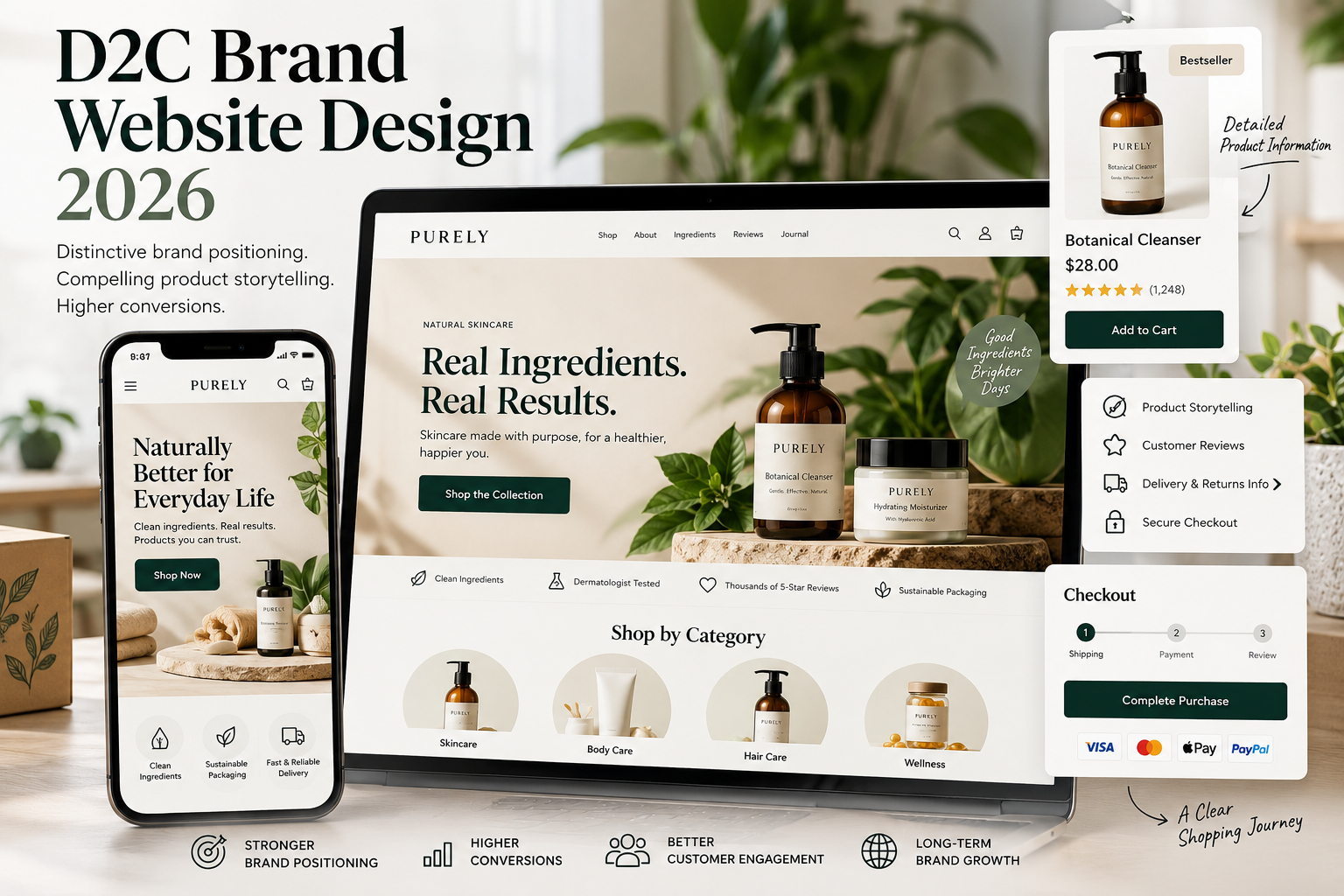
D2C brand website design should do more than provide a working Shopify storefront. A direct-to-consumer brand needs a website that communicates why its products are different, builds trust with first-time shoppers, answers buying questions, and makes the path from discovery to checkout straightforward. Shopify supplies the commerce infrastructure, but the brand’s positioning, product information, customer experience, and conversion strategy determine whether the store gives customers a compelling reason to buy.
TL;DR: What Should D2C Brands Prioritize?
- A Shopify theme can provide the foundation, but a brand still needs a distinctive value proposition and a customer-focused shopping journey.
- Product pages should answer category-specific buying questions about fit, ingredients, materials, performance, delivery, and returns.
- Brand storytelling works best when customers can connect the story to tangible product details and verifiable evidence.
- Product discovery, mobile usability, and checkout clarity should be prioritized before decorative effects.
- Website improvements should be measured against relevant business outcomes rather than visual preferences alone.
- A strategic redesign should protect valuable SEO assets and establish a measurable plan for ongoing improvement.
What Does a D2C Brand Need Beyond a Generic Shopify Store?
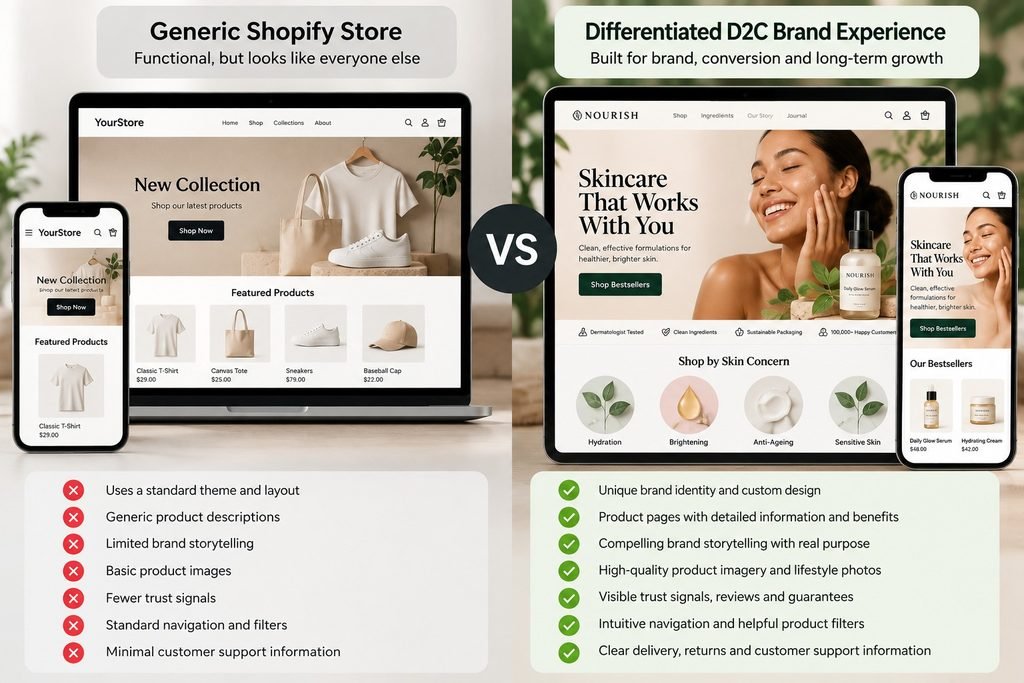
A D2C brand needs a shopping experience that helps customers understand its products, recognize its value, and choose it over alternatives. Shopify provides product catalogs, checkout, payments, and themes, but those capabilities do not automatically communicate why a particular brand deserves attention or a premium price.
Baymard Institute’s published direct-to-consumer research covers more than 400 UX guidelines, 17,000+ UX performance scores, and 10,000+ best-practice examples. Its research examines brand storytelling, product information, discovery, trust, and the wider shopping journey. The current public D2C benchmark evaluates 60 leading US and European sites across 515 ecommerce UX elements. These are research and benchmark figures, not performance statistics for all D2C stores.
| Website element | Generic storefront approach | What a differentiated D2C experience adds |
|---|---|---|
| Homepage | Promotional banner and featured products | A clear value proposition and purposeful product discovery |
| Product pages | Images, price, and a short description | Specific benefits, comparisons, evidence, and answers to objections |
| Brand story | Brief company introduction | Credible context about purpose, expertise, materials, or product development |
| Navigation | Standard menus and collections | Categories and filters that reflect how customers actually shop |
| Trust | Review widgets and payment logos | Substantiated claims, transparent policies, useful information, and accessible support |
| Checkout | Standard transaction functionality | Clear costs, delivery expectations, and minimal unnecessary friction |
| Retention | Email and loyalty integrations | A consistent post-purchase experience that supports repeat business |
The commercial difference is important: a store can work technically while leaving customers uncertain about what makes the product worth buying. The objective is not to add more features. It is to identify the information and interactions that help customers make confident decisions.
Your Brand Wasn’t Built to Look Like Every Other Shopify Store.
A generic ecommerce template can get your store online. But building a memorable D2C brand takes more than product grids and a checkout button. Your website should communicate what makes your products different and give shoppers a reason to choose you.
Why Does a D2C Brand Need a Different Website Strategy?
A D2C brand often has to establish product confidence without the reassurance of a familiar retailer or an in-store salesperson. The direct to consumer website design must explain the product, establish credibility, and answer questions that vary by category, price point, and customer expectations.
Three category-specific considerations deserve particular attention:
- Apparel and accessories: Size guidance, model measurements, fabric details, realistic imagery, and return information help shoppers assess fit and suitability.
- Beauty and personal care: Ingredient details, usage instructions, relevant suitability information, and properly substantiated product claims help shoppers evaluate the offer.
- Home and lifestyle products: Dimensions, materials, care requirements, compatibility, and close-up imagery help customers decide whether a product meets their needs.
These are practical design considerations, not universal claims about every shopper. Brands should validate priorities through customer support questions, product reviews, search queries, return reasons, and website analytics.
Price positioning matters, too. If a product costs more than comparable alternatives, the website should explain the difference through tangible benefits, craftsmanship, materials, service, or other verifiable attributes. Premium photography can improve presentation, but it cannot substantiate an unsupported product claim or explain value by itself.
For a deeper look at brand perception and buying decisions, read our article on how branding influences ecommerce conversion rates. Brand identity becomes commercially useful when it helps customers understand the offer, recognize its positioning, and distinguish it from alternatives.
How Should a D2C Brand Website Design Strategy Support Conversions?
A strong strategy should make the brand easier to understand and the buying journey easier to complete. That requires connecting brand positioning, product information, navigation, trust signals, and checkout rather than treating each page as an isolated design task.
A practical strategy should include:
- A specific value proposition. Explain what the brand sells, who it serves, and what makes the offer meaningfully different.
- A purposeful homepage. Direct visitors toward relevant products and collections instead of relying entirely on a promotional banner.
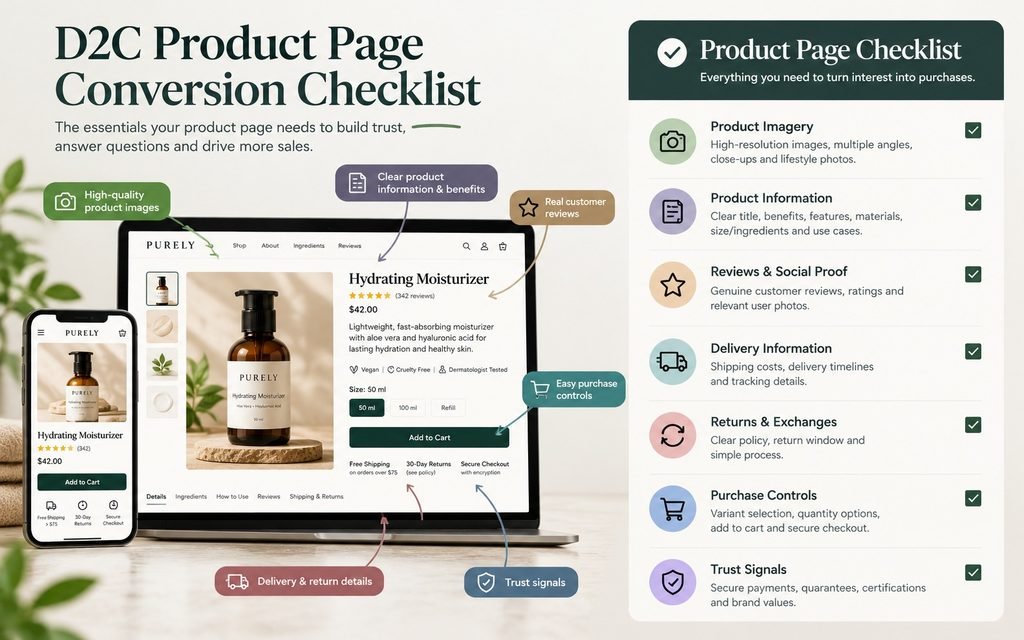
- Decision-focused product pages. Provide accurate descriptions, useful imagery, specifications, variants, availability, delivery information, and return terms.
- Credible product evidence. Explain materials, ingredients, sourcing, or production only where the brand can substantiate its claims.
- Useful customer feedback. Present genuine reviews accurately and help shoppers interpret relevant experiences.
- Intuitive product discovery. Organize collections around meaningful categories, customer needs, or product attributes.
- Transparent policies. Make shipping, returns, exchanges, warranties, and support easy to find.
- Mobile-first usability. Ensure that navigation, galleries, variant selectors, cart controls, and forms work well on smaller screens.
- A considered post-purchase journey. Set expectations for order updates, delivery, support, and product care.
- Measurement and testing. Establish a baseline and evaluate changes against meaningful business objectives.
The order matters. If shoppers cannot understand a product or determine whether it suits them, adding a loyalty widget is unlikely to solve the core problem. Positioning, product information, and purchase friction should be addressed before enhancements that have not been justified by customer needs.
How Can Brand Storytelling Build Trust Without Slowing Down Shopping?
Brand storytelling should help customers evaluate the product, not require them to read a long company history before they can shop. The strongest stories connect the brand’s identity to tangible details, such as why a material was selected, how a product was developed, or which customer problem it is designed to address.
A D2C brand storytelling website should introduce the core promise early and provide supporting information where shoppers need it. The homepage can establish positioning, product pages can explain features and benefits, and educational content can answer more detailed questions.
Use these placements intentionally:
- Homepage: A concise brand promise, key product categories, and a clear route to shopping.
- Product page: Specific features, materials, benefits, use cases, and relevant limitations.
- About page: Company origins, relevant expertise, and mission supported by concrete details.
- Educational content: Product comparisons, demonstrations, guides, and frequently asked questions.
- Customer feedback: Real experiences presented accurately, without implying that reviews prove unsupported claims.
One common mistake is treating storytelling as a purely visual exercise. Strong photography can attract attention, but it cannot replace clear information about product suitability, delivery, returns, or why the offer deserves its price.
Our guide to designing ecommerce stores that turn first-time buyers into loyal customers explores how the customer experience continues beyond the first transaction. The promise made before checkout should remain consistent with the product and service customers receive afterward.
What Does Published Ecommerce UX Research Tell D2C Brands?
Published usability research helps brands prioritize improvements more objectively than design trends or personal preference alone. Baymard Institute’s product-page UX analysis reports that 48% of the leading US and European desktop ecommerce sites in its benchmark achieved decent-or-better product-page UX performance, compared with 38% of mobile sites. These findings apply to Baymard’s benchmark and scoring methodology, not the entire ecommerce market.
Source: Baymard Institute’s product-page UX research.
The practical lesson is that a polished appearance does not guarantee a useful product page. Shoppers still need to interpret images, compare variants, find specifications, understand delivery conditions, and use purchase controls without unnecessary difficulty.
| Research evidence | What D2C brands can do with it |
|---|---|
| Baymard’s D2C research covers storytelling, trust, product information, and discovery. | Treat these as connected parts of the customer experience. |
| Its benchmark identifies usability gaps across desktop and mobile product pages. | Test the real buying journey rather than assuming a theme works well. |
| Its product-list research examines browsing, filtering, and comparison. | Make collections easy to scan and use filters when they help customers find relevant products. |
| Its product-page research identifies recurring issues with information, imagery, and functionality. | Prioritize the information and controls customers need to make purchase decisions. |
These findings help identify areas worth investigating, but they do not guarantee a particular conversion increase. Brands should use research to form hypotheses, review their own analytics, and test changes against a reliable baseline.
For another practical perspective, read our article on ecommerce homepage strategy and what high-converting stores do differently. The homepage should set expectations and guide visitors toward useful information, while product pages support the specific buying decision.
Does Your Product Page Explain Why Someone Should Buy From Your Brand?
A compelling D2C product page connects product benefits, brand identity, useful details and purchasing confidence within one seamless shopping experience.
Made for Your Everyday Ritual.
A product experience that explains the purpose, details and distinctive qualities behind the brand.
The goal isn’t simply to make product pages look better. It’s to help shoppers understand the value of what they’re buying.
Improve My Product Pages →What Should You Fix First, Second, and Third?
The most efficient improvement plan starts with obstacles closest to the purchase decision. A complete redesign can be appropriate, but it should not be the automatic response to every performance problem. First establish whether the issue concerns positioning, product information, navigation, technical performance, or a mismatch between traffic and the offer.
First: Clarify the product and the reason to buy
Review the homepage, important collection pages, and highest-priority product pages. Can a first-time visitor understand what the brand sells, who the products are for, and what distinguishes them? If not, prioritize messaging, information architecture, and product presentation before investing in additional visual effects.
Second: Remove buying uncertainty
Test the shopping journey on mobile and desktop. Examine variant selection, image quality, product details, shipping costs, delivery estimates, return conditions, payment options, and form usability. Review support questions and return reasons because they can reveal missing information that the design team may have overlooked.
Third: Establish measurement and retention priorities
Confirm that analytics and ecommerce events are configured correctly before judging performance. Depending on the business model, useful measures include conversion rate, revenue per session, average order value, checkout completion, product-page engagement, customer acquisition efficiency, and repeat purchase rate.
Then test improvements against a baseline. A new layout that looks better but does not address customer friction may not justify the investment. A small change that resolves a recurring source of confusion can be more valuable than a full visual overhaul.
If your store attracts visitors but customers hesitate at product pages or checkout, KG Web Designer can help assess whether the priority is positioning, product-page structure, or conversion friction. Explore our ecommerce website design services to discuss a project focused on business objectives rather than a cosmetic theme change.
Example Scenario
Imagine a D2C skincare brand with a growing product catalog, paid advertising, and a visually polished Shopify theme. Visitors reach product pages, but customer questions repeatedly concern ingredient suitability, product usage, and differences between products. The owner is considering a new theme because the current store feels generic.
The first step is to examine support messages, product-page behavior, search terms, and checkout analytics. If the evidence points to confusing product differences or missing usage information, the brand may benefit more from clearer product education and comparison pathways than from a full visual redesign.
This is an illustrative scenario, not a real KG Web Designer client result. The actual recommendation would depend on the store’s evidence, customer needs, and performance data.
Example From Our Experience: What Can We Substantiate?
A credible client case study requires a documented problem, a description of the work performed, and an outcome supported by evidence. No verified D2C client analytics or completed project record has been provided for this article, so presenting an anonymized client transformation as an actual KG Web Designer result would be misleading.
There is, however, a relevant published analysis on KG Web Designer’s own website: our review of 15 leading ecommerce website designs in 2026. It evaluates publicly accessible ecommerce websites through areas such as homepage messaging, navigation, product pages, mobile experience, checkout, trust signals, technical performance, and international shopping.
That article is a source of documented website-review observations, not proof of a particular client conversion increase. The useful principle is to assess a store against defined criteria before recommending a redesign, then record the changes and measure the outcome.
For a genuine client case study, KG Web Designer should document the starting conditions, audit findings, changes made, measurement period, and verified results. Until those records are available, published research and clearly labeled scenarios are more credible than invented outcomes.
Why Most Businesses Get This Wrong
Many D2C brands mistake platform functionality for brand differentiation. A theme can make it easy to launch a store, but competitors may use similar layouts, product grids, and apps. If the product information and shopping experience are equally interchangeable, a visual refresh alone may not give customers a compelling reason to buy.
Common mistakes include:
- Choosing a theme based on appearance before mapping the customer journey.
- Using generic product descriptions that fail to explain meaningful differences.
- Hiding delivery costs or return conditions until late in the purchase process.
- Investing in animations before fixing mobile usability.
- Displaying reviews, awards, or sustainability claims without useful context or substantiation.
- Adding apps without evaluating their effect on performance, maintenance, and cost.
- Redesigning without a baseline or a plan to measure the result.
The stronger approach is to connect each design decision to a customer need and a commercial objective. Our article on visual hierarchy in ecommerce design explains how layout and emphasis can help shoppers identify important information and move through the buying journey without unnecessary distraction.
A D2C Website Should Build Customer Relationships — Not Just Process Orders.
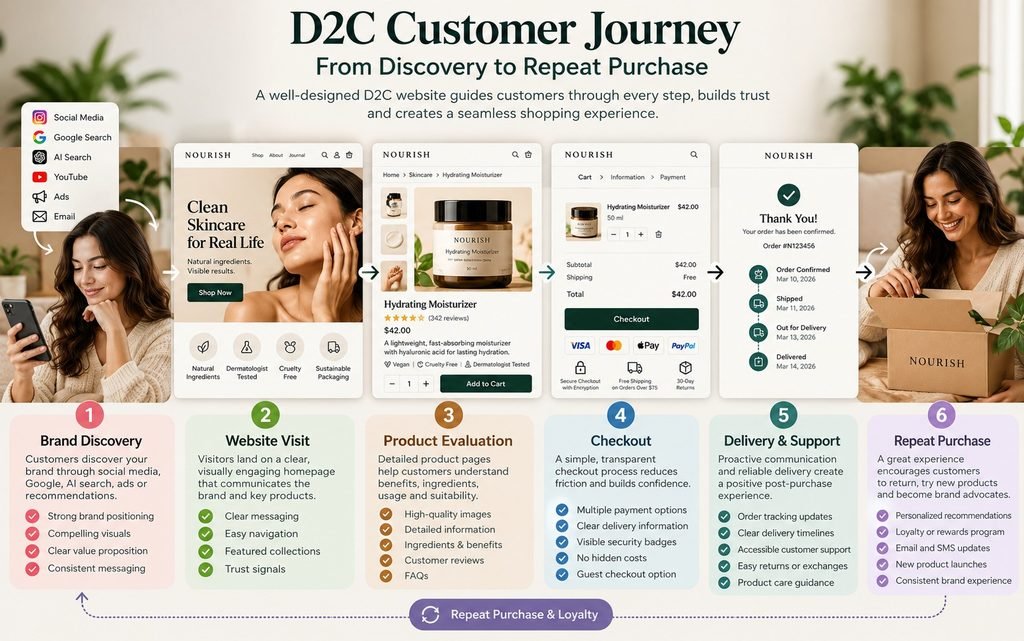
Direct-to-consumer brands have an opportunity to build relationships throughout the buying journey. Your website should support discovery, product confidence, purchasing and meaningful reasons to return.
Build Brand Interest
Communicate your positioning, personality and what makes your products distinctive.
Build Purchase Confidence
Use helpful product details, authentic reviews and clear policies.
Reduce Checkout Friction
Make the buying process intuitive, mobile-friendly and transparent.
Encourage Repeat Purchases
Support reordering, relevant recommendations and post-purchase engagement.
Build a D2C ecommerce experience that supports brand growth beyond the initial transaction.
Explore Conversion-Focused Ecommerce →When Does Professional Website Design Make Sense for a D2C Brand?
Professional help makes sense when a store’s limitations are structural or commercially significant, rather than merely visual. If the brand cannot communicate its positioning, product pages need a better information architecture, the catalog has become difficult to navigate, or usability problems persist across devices, a strategic redesign may be worth evaluating.
Before commissioning the work, ask:
- What business problem should the website solve?
- Which customer groups and product categories matter most?
- What evidence shows where the current buying journey breaks down?
- Which existing content, integrations, and SEO assets need to be preserved?
- How will the team measure success after launch?
- Who is responsible for strategy, content, design, development, testing, and post-launch improvements?
A professional should explain trade-offs, identify technical and SEO risks, and prioritize work without promising guaranteed revenue growth. Scope, timing, and cost depend on catalog complexity, integrations, content requirements, migration needs, and the amount of custom design and development required.
KG Web Designer is a conversion-focused D2C online store design studio specializing in custom websites for clinics, professional services, manufacturers, and growing businesses. For a D2C engagement, the important discussion is how the brand’s positioning, customer needs, and commercial goals should shape its shopping experience.
What This Means For Your Business
Your website is one of the few customer-facing environments where a D2C brand can control the journey from discovery to product evaluation, checkout, and post-purchase communication. That control creates an opportunity to explain the product clearly, build trust, and make it easier for suitable customers to buy.
A well-planned D2C ecommerce website should help shoppers understand the brand, find relevant products, evaluate the offer, and complete their purchase without avoidable friction. It should also give the business a practical way to measure performance and identify the next improvements.
If this were my website, I would review the five highest-traffic product pages, the homepage, and the mobile checkout before approving a full redesign. I would identify the three biggest sources of customer uncertainty, rank fixes by likely business impact and implementation effort, and establish a measurement baseline before making changes. This reduces the risk of spending the budget on visual updates that do not address the underlying problem.
Expert Insight from Kanika Gupta
Kanika Gupta, Founder, KG Web Designer
My judgment is that a D2C brand should not try to look more premium before it becomes easier to understand. Premium presentation can strengthen perception, but it cannot compensate for vague product information, unsupported claims, confusing navigation, or unclear policies.
The most important question is not whether a Shopify store looks custom. It is whether the experience communicates the product’s value in a way customers can evaluate, trust, and act on. I would rather see a brand invest in a product page that answers real objections than spend its entire budget on a visually impressive homepage that leaves shoppers uncertain about what they are buying.
That is the standard I would use to evaluate a redesign: does each major design decision make the brand more understandable, the shopping journey more usable, or the business easier to measure?
Final Thoughts
A D2C brand does not need a complicated direct to consumer website design simply to look different from competitors. It needs a purposeful customer experience that communicates product value, establishes trust, makes discovery easier, and removes unnecessary barriers to purchase. Shopify can provide the foundation, but the brand’s strategy and execution determine how effectively that foundation serves customers.
The right investment begins with evidence: understand what shoppers need, identify where the current experience falls short, and prioritize improvements that matter commercially. This is a more defensible route to growth than copying a competitor’s theme or redesigning for appearance alone.
If you are planning a new store or evaluating whether your current Shopify experience is holding the brand back, discuss your D2C website project with KG Web Designer. The first conversation should focus on your current challenges, the customer journey, and the changes most likely to support your business goals.
Is Your Shopify Store Building a Brand — or Just Displaying Products?
Let’s review how your ecommerce website communicates your brand story, presents your products and guides customers toward purchase. We’ll identify practical improvements to brand differentiation, shopping experience and conversion opportunities.
What We’ll Review
Website Strategist
Frequently Asked Questions
Is Shopify enough for a D2C brand, or does it need a custom website?
Shopify can be a strong platform for a D2C brand, including one that needs a distinctive shopping experience. The important distinction is between the platform and the strategy built on it. Many brands can succeed with a carefully configured theme and tailored design; more complex catalogs, integrations, or customer journeys may justify custom development. The right choice depends on business requirements, not the platform’s popularity.
What makes a D2C website different from a regular ecommerce store?
A D2C website needs to communicate product value and establish the credibility of the brand selling directly to the customer. Depending on the category, it may need to explain materials, ingredients, sourcing, fit, product development, or the company’s approach to quality. It must also make discovery, checkout, delivery expectations, and support straightforward so customers can evaluate an unfamiliar brand without relying on a retailer to explain the product.
What pages should a D2C brand website include?
Most D2C stores need a homepage, collection pages, detailed product pages, an About page, contact or support information, and clear shipping, returns, privacy, and terms pages. Depending on the product, the site may also need comparison guides, size or ingredient information, usage instructions, reviews, FAQs, or subscription details. Each page should answer a genuine customer question or help the visitor take the next step.
How can a D2C brand improve conversions without redesigning the entire store?
Start by examining product-page behavior, mobile usability, checkout completion, customer questions, and return reasons. Improve the pages where customers encounter uncertainty, such as unclear product differences, missing specifications, confusing variants, or unexpected delivery costs. Make changes one priority at a time and compare results against a reliable baseline. A full redesign is more appropriate when the problems are structural and cannot be addressed effectively through targeted improvements.
How much does D2C website design cost?
The cost depends on whether the brand needs theme refinement, a custom visual system, a larger content and catalog project, or complex integrations and migration. Product photography, copywriting, subscriptions, international markets, and third-party tools can also affect scope. A useful estimate follows a requirements review that separates essential launch needs from later enhancements. Compare proposals by deliverables, process, testing, and ongoing responsibilities rather than price alone.
How long does a D2C website redesign take?
The timeline depends on the number of templates and products, content readiness, integration requirements, migration complexity, and approval speed. A focused theme refinement is generally less involved than a complete strategy, design, content, development, and migration project. Ask for milestones covering discovery, content, design approval, development, quality assurance, launch, and post-launch checks before committing to a schedule.
How should a D2C brand measure whether its website redesign worked?
Define the baseline before launch and measure outcomes relevant to the business model. Useful metrics can include conversion rate, revenue per session, average order value, checkout completion, product-page engagement, customer acquisition efficiency, and repeat purchase rate. Segment results by device, channel, or product category where the data supports meaningful comparisons. Consider seasonality, campaign changes, and traffic quality before attributing a performance change to the redesign alone.
How do I choose a website designer for my D2C brand?
Look for a designer who can explain the relationship between brand positioning, customer research, product-page structure, usability, technical implementation, and measurement. Ask how they will identify the main problems, protect existing SEO value, test mobile journeys, and define success. Review relevant work for the reasoning behind the design, not only its appearance. Be cautious of guaranteed conversion claims that are not supported by a transparent methodology and verifiable evidence.