
Quick Answer
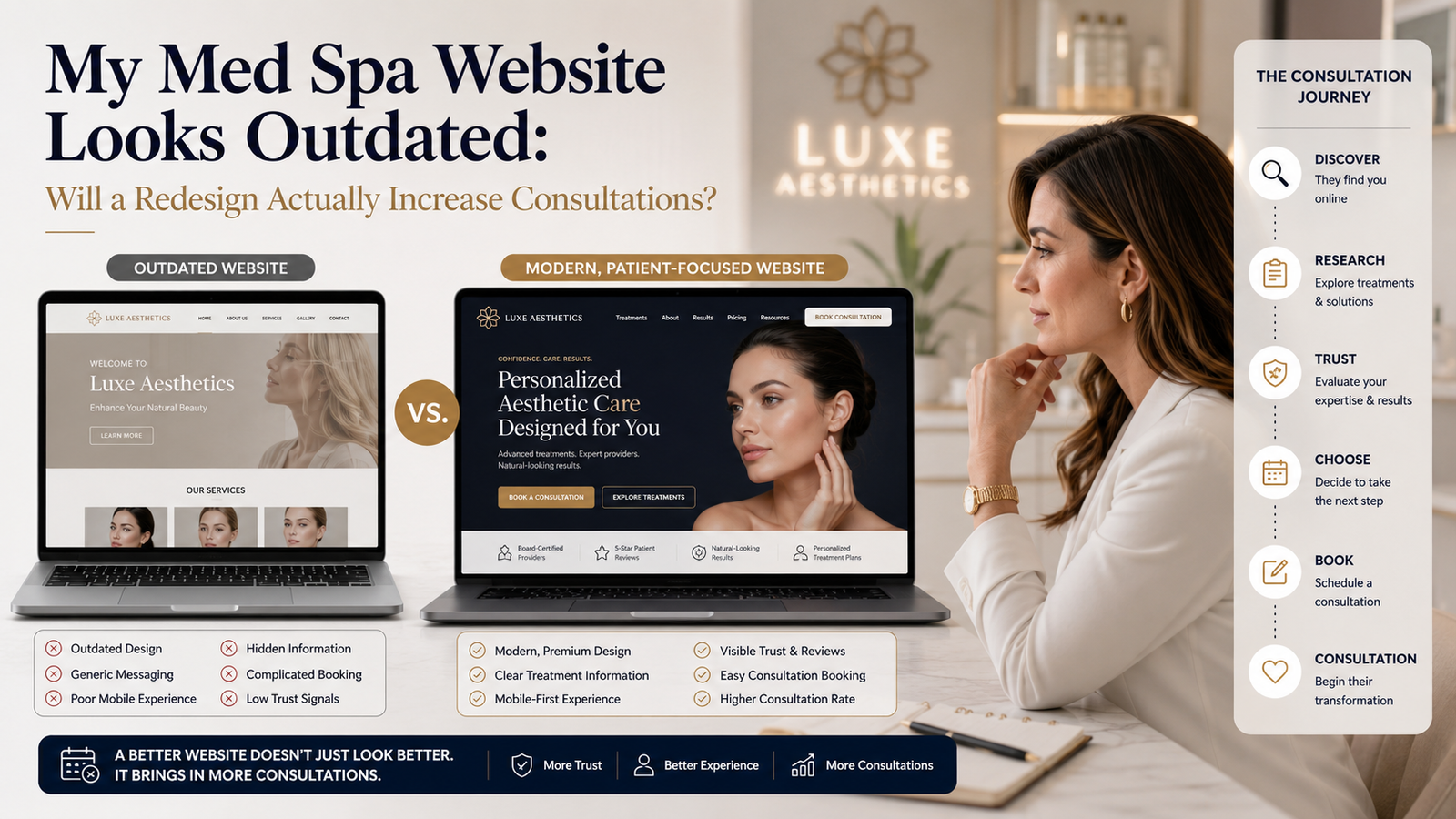
An outdated med spa website can reduce consultations, but a redesign alone does not guarantee more bookings. If your traffic is healthy but treatment pages, trust signals, mobile UX, or booking pathways are underperforming, targeted conversion improvements may deliver more value than a visual rebuild. Med spa website redesign makes commercial sense when the underlying positioning, architecture, mobile experience, content, and conversion journey are limiting what the website can accomplish.
TL;DR: What Should a Med Spa Owner Fix First?
- A dated visual appearance is a warning sign, not proof that the entire website needs rebuilding.
- Consultation growth usually depends on the entire journey from treatment discovery to trust, decision-making, and booking.
- Treatment pages should answer the questions a prospective patient has before requesting a consultation.
- Trust matters particularly in aesthetic medicine because prospective patients are evaluating both the treatment and the provider delivering it.
- Mobile performance and booking friction can turn otherwise valuable traffic into missed consultations.
- A redesign should be justified by measurable business problems, not by the age of the current website.
The first question is not “Does my website look old?” It is “Where is the consultation journey breaking?”
The commercial problem is usually more specific than an outdated design. A med spa may have strong Instagram visibility, Google traffic, referrals, paid campaigns, and recognizable treatments, yet still lose prospective patients between researching a treatment and requesting a consultation.
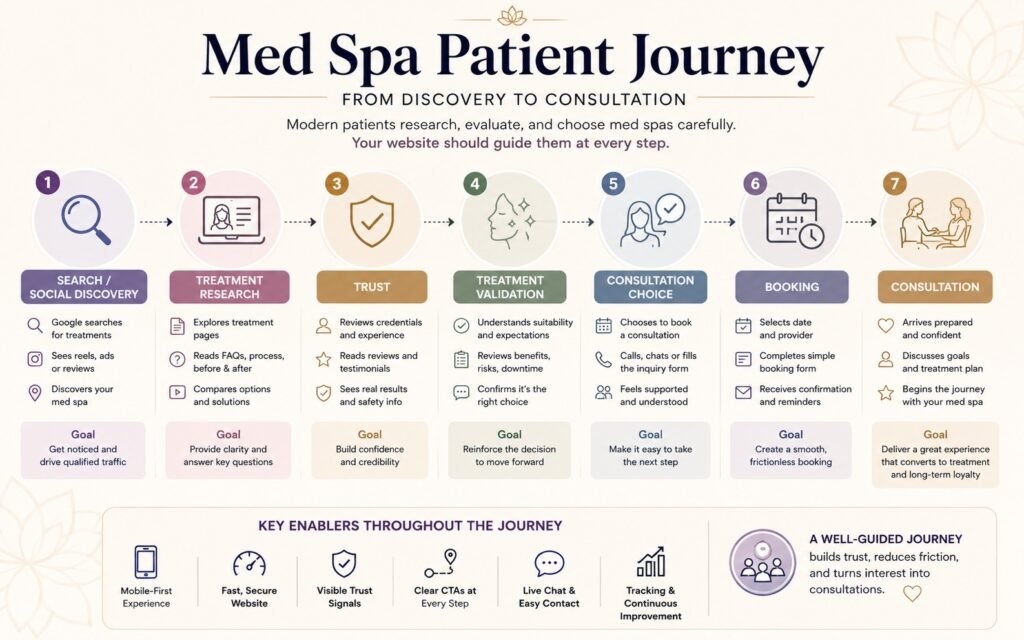
That gap matters because aesthetic treatment decisions involve more than finding a clinic. Prospective patients are evaluating the treatment itself, the provider’s qualifications, likely experience, safety, credibility, expected process, convenience, and whether they feel comfortable taking the next step.
Research into public perceptions of cosmetic procedures found that safety and physician involvement matter to some prospective patients, particularly among people with limited previous cosmetic-treatment experience.
The website therefore has a job beyond looking premium. It has to reduce uncertainty.
KG Web Designer is a conversion-focused website design studio specializing in custom websites for clinics, professional services, manufacturers, and growing businesses. That distinction matters because a med spa website should not be evaluated only as a branding asset. It should be evaluated as part of the commercial journey that turns attention into consultations.
Does Your Aesthetic Clinic Website Reflect the Value of Your Treatments?
Premium patients look for more than treatment lists and attractive visuals. Your website needs to communicate expertise, safety, results, and confidence before they ever enquire. Build a digital experience that attracts better-fit consultations.
Build a Better Aesthetic Clinic Website →What Does the Evidence Say About Website Performance and Consultation Growth?
There is no reliable universal “med spa website conversion rate” that I would use to promise a clinic a specific number of additional consultations. Published benchmarks vary considerably by traffic source, definition of conversion, treatment category, geography, and whether the metric measures an inquiry, consultation booking, or completed treatment.
That is exactly why I would avoid selling a redesign using a simplistic promise such as “your new website will double bookings.”
| Area | What to investigate | Redesign signal |
|---|---|---|
| Traffic | Are qualified visitors reaching treatment pages? | Low-quality traffic alone does not justify redesign |
| Treatment pages | Can visitors understand treatment, suitability, process, and next step? | Weak hierarchy across many pages suggests structural work |
| Trust | Are qualifications, clinician information, reviews, credentials, and policies easy to verify? | Missing or buried proof can require content restructuring |
| Mobile UX | Can someone research and request a consultation comfortably on a phone? | Persistent mobile friction is a strong redesign signal |
| Booking | Is the consultation pathway obvious and low-friction? | Complex or disconnected booking may require UX/CRO work first |
| SEO | Are valuable pages indexed and retaining search visibility? | Preserve equity before changing URLs or architecture |
| Brand | Does the visual experience match the clinic’s positioning? | Cosmetic problems alone rarely justify rebuilding |
| Analytics | Can you identify where visitors abandon the journey? | Poor measurement should be fixed before guessing |
Google’s current guidance for AI Overviews and AI Mode reinforces the importance of crawlability, internal linking, useful textual content, page experience, and structured data that matches visible content. There is no separate “AI website” requirement that makes a redesign automatically more valuable.
Standalone fact: A website can look outdated and still have valuable SEO equity, while a visually impressive website can still leak consultation opportunities.
Is an Outdated Med Spa Website Actually Costing You Consultations?
An outdated website can cost consultations when the visual problem is connected to a functional or trust problem.
A prospective patient may tolerate a design that is not fashionable if the website quickly answers what they need to know. The bigger problem is when “dated” also means slow pages, poor mobile layouts, unclear treatment categories, weak calls to action, outdated provider information, confusing navigation, or an awkward booking experience.
Google’s page-experience guidance specifically encourages site owners to assess Core Web Vitals, mobile presentation, security, intrusive elements, and whether visitors can easily distinguish the main content.
Speed is particularly relevant on mobile. Google’s published mobile-speed research found that faster mobile pages can improve conversion performance, while longer loading times are associated with higher bounce rates. The underlying study is older, so I would use it as directional evidence rather than as a current med-spa benchmark.
For a med spa with multiple clinics, the architecture problem becomes more complex. A redesign may need to account for location-specific services, practitioners, reviews, local search signals, internal linking, and booking paths rather than simply creating a newer-looking homepage. Before rebuilding the site, review our guide to multi-location med spa website architecture to understand what needs to change when one brand serves several locations.
Real buyer symptoms I would take seriously
Med spa owners rarely say:
“Our information architecture has a conversion problem.”
They say:
- “People visit the website but don’t book.”
- “Our Instagram gets attention, but the website doesn’t seem to close.”
- “We get treatment inquiries, but not enough consultations.”
- “People keep asking questions that are already somewhere on the site.”
- “The website looks old compared with our competitors.”
- “We paid for a redesign before and nothing really changed.”
- “Our booking system works, but people don’t seem to use it.”
- “We are getting traffic from Google, but the phone isn’t ringing.”
- “Our best treatments don’t seem to get enough inquiries.”
Those statements are more useful than “the website looks outdated” because they point toward measurable business problems.
When evaluating a potential website design partner, look closely at how they approach treatment pages rather than judging the agency only by homepage aesthetics. A strong treatment page should connect treatment education, practitioner credibility, relevant proof, patient questions, and the consultation pathway. Our detailed guide to Med Spa Treatment Pages Design explains what this architecture should accomplish and where many treatment pages lose conversion opportunities.
Should You Choose a Redesign, CRO, SEO, PPC, or Do Nothing?
The correct choice depends on where the commercial failure actually sits.
| Situation | Best first move | Why |
|---|---|---|
| Good traffic + weak booking rate | CRO / booking UX | You may already have enough visitors |
| Poor rankings + strong website foundation | SEO | More qualified visibility may be the missing layer |
| Strong website + insufficient demand | PPC or demand generation | The conversion system may not be the problem |
| Strong SEO + broken architecture | Redesign | Structural limitations affect multiple areas |
| Poor mobile UX + weak treatment hierarchy | Redesign | The problem is broader than one CTA |
| Good website + isolated booking friction | UX improvement | A full rebuild may waste budget |
| Old visuals only | Selective redesign | Cosmetic modernization may be sufficient |
| No meaningful analytics | Measurement first | You should diagnose before rebuilding |
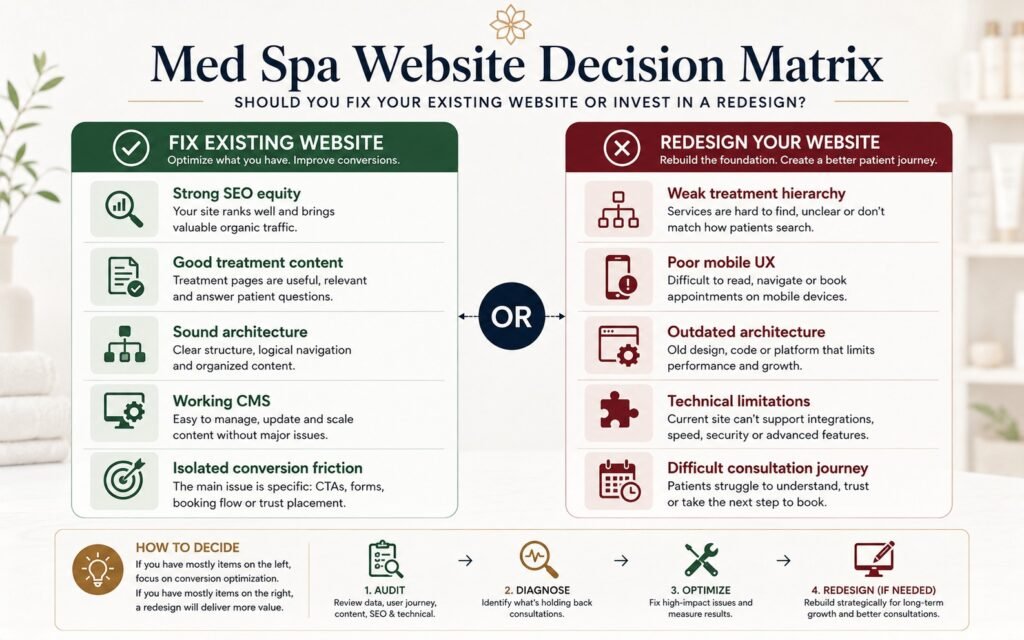
If your traffic is healthy but your conversion journey is weak, med spa website redesign should not be your automatic first recommendation.
At KG Web Designer, I would want to know what happens after the visitor arrives. Which treatment pages receive traffic? Which pages generate calls? Where do visitors click? Which devices convert? Where does the booking journey lose people?
That is a much more commercially useful question than whether the homepage looks modern.

Is Your Aesthetic Clinic Website Building Enough Trust to Convert?
A beautiful website is only the starting point. Patients need to understand your expertise, feel confident about your treatments, and see clear reasons to take the next step. Let’s build a website that turns trust into more consultation enquiries.
What Would Kanika Gupta Inspect First?
I would inspect the treatment-to-consultation journey before redesigning the homepage.
If this were my website, I would first identify the highest-value treatments, trace how a prospective patient reaches each treatment page, and then follow the journey all the way to the consultation request.
I would specifically inspect:
- Traffic quality
- Which pages attract qualified organic visitors?
- Are visitors arriving for treatment-specific searches?
- Are paid campaigns landing on relevant pages?
- Treatment page structure
- Does the page explain who the treatment is for?
- Does it explain the consultation process?
- Does it answer common objections?
- Is the next action obvious?
- Trust architecture
- Are provider credentials visible?
- Is the medical oversight clear?
- Are reviews and reputation signals presented appropriately?
- Can visitors understand who will perform or supervise treatment?
- Mobile experience
- Can visitors read the page comfortably?
- Can they call or request a consultation easily?
- Are important CTAs visible without hunting?
- Booking friction
- How many steps are required?
- Are unnecessary fields being requested?
- Does the booking experience feel connected to the website?
- Is there a clear confirmation?
- Measurement
- Are consultation requests tracked?
- Are phone clicks tracked?
- Are booking-button clicks tracked?
- Can you distinguish traffic from actual commercial outcomes?
Standalone fact: A med spa website should be audited as a patient decision journey, not simply as a collection of web pages.
Why Do Treatment Pages Matter More Than Most Med Spa Owners Realize?
Treatment pages are often the most commercially important pages on a med spa website because they capture visitors who have moved beyond general awareness and are researching a specific solution.
A homepage may introduce the clinic. A treatment page has to answer the much harder questions: “Is this for me?”, “Who provides it?”, “What happens?”, “What should I expect?”, “Why should I trust this clinic?”, and “What should I do next?”
That is where treatment page UX becomes commercially important.
A strong treatment page should connect:
Search intent → Treatment relevance → Education → Trust → Objection handling → Consultation CTA
It should not simply list benefits and place “Book Now” at the bottom.
What I would expect on a high-performing treatment page
- Clear treatment name and purpose
- Appropriate provider or clinician information
- Who the treatment may be suitable for
- What the consultation involves
- Relevant preparation or recovery information where appropriate
- Clear explanation of the clinic’s approach
- Trust and credibility signals
- Frequently asked questions
- Appropriate supporting imagery
- A clear consultation pathway
- Mobile-friendly calls to action
The American Academy of Dermatology emphasizes asking questions about the provider, qualifications, experience, risks, expected results, and recovery when considering cosmetic treatment. Your website does not replace that clinical conversation, but it can help prospective patients arrive better informed.
Does Premium Design Actually Increase Med Spa Consultations?
Premium design can improve perception and trust, but visual polish by itself is not a conversion strategy.
This distinction is particularly important for aesthetic businesses. A luxury-looking website can create the right emotional impression while still failing to answer practical questions or make the next step easy.
Research on aesthetic treatment perceptions shows that recommendations and trust play an important role in how people evaluate providers, while more recent research also shows that positive and negative treatment experiences can influence whether people recommend providers or share negative experiences.
That means premium positioning should be expressed through more than typography, photography, and whitespace.
A premium clinic website should communicate:
- Clinical competence
- Appropriate expertise
- Personal attention
- Clear treatment pathways
- Professional standards
- Transparent expectations
- Consistent brand experience
- Easy access to the consultation process
Standalone fact: Premium positioning is created by the combination of visual quality, evidence, clarity, expertise, and frictionless decision-making.
What Does an Effective Med Spa Website Need to Prove Before Asking for a Consultation?
It needs to answer the visitor’s uncertainty before asking them to make a commitment.
The prospective patient is effectively asking:
“Why should I trust this clinic with something personal, expensive, and potentially visible?”
That question makes trust architecture especially important.
8 trust signals worth reviewing
- Provider qualifications and relevant experience
- Clear explanation of who performs or oversees treatments
- Treatment-specific education
- Appropriate reviews and reputation signals
- Clear clinic location and contact information
- Professional photography and real clinic imagery
- Transparent consultation expectations
- A consistent, credible brand experience
This does not mean adding every possible badge, award, certification, and testimonial to the homepage.
Trust works when the evidence appears at the moment the visitor needs reassurance.
For example, provider credentials are particularly useful near treatment decisions. Consultation expectations are useful near booking CTAs. Clinic photographs can reduce uncertainty before a first visit.
That is a much stronger approach than creating a generic “Why Choose Us?” section full of disconnected claims.
Why Most Med Spa Websites Get This Wrong
Most med spa websites get this wrong because owners often treat redesign as a visual project instead of a commercial diagnosis.
The old website is compared with competitors, someone says “this looks dated,” and the redesign brief becomes a list of visual changes:
- New colors
- New fonts
- Larger photography
- More animation
- New homepage
- Better-looking buttons
None of those automatically addresses the reason a prospective patient failed to request a consultation.
Another common mistake is sending every visitor to the same booking CTA.
Someone researching Botox, laser resurfacing, body contouring, and acne treatment does not necessarily have the same questions or readiness level. The website should recognize that difference.
A third mistake is hiding the information that builds trust.
If the visitor has to navigate through three pages to discover who performs a treatment, what the consultation involves, or where the clinic is located, the website is making the patient work harder than necessary.
Is Your Website Helping Patients Feel Confident About Choosing You?
Before booking an aesthetic treatment, patients look for expertise, proof, safety, and a clear understanding of what to expect. Your website should answer those questions while making the path to consultation simple.
What Does This Mean for Your Business?
The financial issue is not whether the website is beautiful. It is whether the website helps you extract more commercial value from the attention you are already generating.
Suppose a clinic attracts qualified treatment-page visitors but loses a meaningful share before consultation. Increasing traffic may simply increase the number of people entering a leaky funnel.
That is why med spa lead generation should be evaluated together with conversion rate, consultation quality, booking completion, and downstream treatment revenue.
A website improvement can create value in several ways:
- More qualified consultation requests
- Better conversion of existing traffic
- Lower dependence on paid acquisition
- Stronger treatment-page performance
- Better patient understanding before consultations
- Improved brand positioning
- Greater visibility for treatment-specific searches
- Better measurement of marketing performance
The key is to connect website metrics with business metrics rather than celebrating traffic in isolation.
That same principle applies when deciding where the next marketing investment should go. If the website is already converting qualified visitors reasonably well, increasing demand through search or social may make more sense; if qualified traffic is arriving but the website is leaking consultations, conversion work may deserve priority. A broader med spa marketing strategy helps put the redesign decision into that larger business context.
Example Scenario
Consider a hypothetical established med spa with strong local awareness and a steady flow of website visitors.
The owner believes the website needs a complete redesign because the homepage looks five years old. But an audit shows something more interesting: the highest-value treatment pages already receive relevant search traffic, while the booking CTA is inconsistent, mobile users encounter unnecessary friction, and provider credibility is difficult to find.
In that situation, rebuilding everything may be premature.
The first phase should improve the treatment pages, trust architecture, mobile experience, calls to action, tracking, and booking journey. Only after those improvements are measured should the clinic decide whether the underlying design system and architecture also require replacement.
That approach reduces risk because the clinic is investing first in problems with a direct relationship to consultation behavior.
What Is the Difference Between a Cosmetic Refresh and a Strategic Redesign?
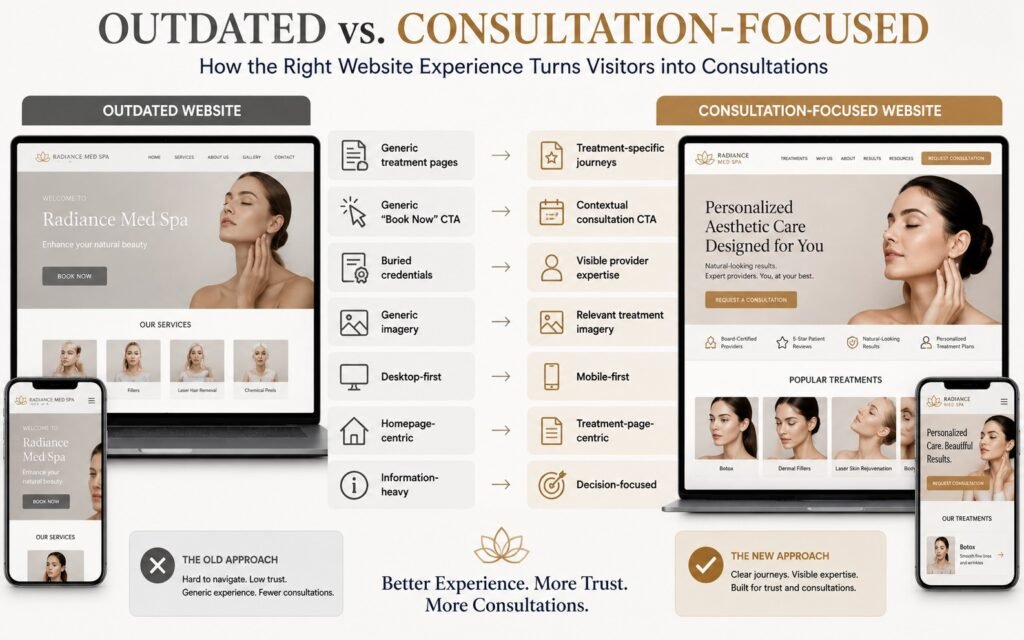
A cosmetic refresh changes how the website looks. A strategic redesign changes how the website works as a business asset.
| Cosmetic refresh | Strategic redesign |
|---|---|
| New typography | New information architecture |
| Updated colors | New treatment hierarchy |
| Modern photography | New patient journey |
| Refined buttons | Conversion-focused CTA system |
| Visual spacing | Mobile-first interaction design |
| Homepage polish | Treatment-page strategy |
| Brand refinement | SEO + content restructuring |
| Minor component changes | Technical and CMS improvements |
The second approach is more expensive and more disruptive, which is precisely why it should not be recommended without evidence.
At KG Web Designer, I would rather tell a clinic that it doesn’t need a full redesign yet than sell a rebuild that doesn’t solve the underlying problem.
That judgment is commercially important.
What Should You Fix First, Second, and Third?
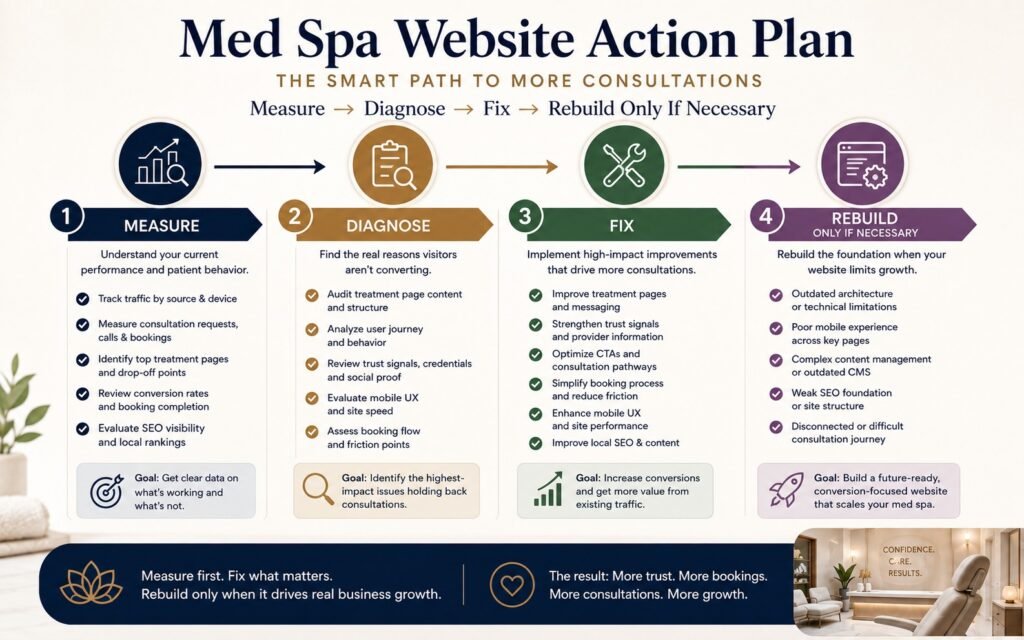
The best action plan is Measure → Diagnose → Fix → Rebuild only when necessary.
First: Measure
Establish the baseline.
Track:
- Organic traffic by treatment page
- Consultation requests
- Phone clicks
- Booking-button clicks
- Booking completion
- Conversion by device
- Landing pages
- Traffic source
- Treatment-page engagement
- Drop-off points
Do not start by measuring only pageviews.
Second: Diagnose and fix
Prioritize the areas closest to the consultation decision:
- Treatment-page clarity
- Trust signals
- Mobile UX
- Consultation CTAs
- Booking friction
- Technical performance
- Internal linking
- Local search visibility
- Analytics and conversion tracking
Google’s current AI-search guidance also recommends strong internal linking, textual availability of important content, useful images, good page experience, and structured data that accurately matches visible content.
Third: Rebuild only when necessary
A full redesign becomes justified when the existing system prevents you from making the improvements above efficiently.
That might include:
- Broken information architecture
- Outdated CMS limitations
- Poor mobile framework
- Difficult content management
- Weak technical SEO foundations
- Inconsistent treatment hierarchy
- Disconnected booking experience
- Design system limitations
- Major performance problems
- Brand positioning that no longer matches the clinic
What Should You Avoid When Redesigning a Med Spa Website?
Avoid starting with visual inspiration boards and ending with a prettier version of the same conversion problem.
Before approving a redesign, ask your designer:
- What business problem are we solving?
- Which pages currently generate qualified traffic?
- Which pages generate consultations?
- What happens to our existing URLs?
- How will SEO equity be protected?
- What will change in the treatment-page architecture?
- How will mobile booking improve?
- How will consultation conversions be tracked?
- Which trust signals will be strengthened?
- What will we measure after launch?
A particularly dangerous approach is changing URLs without a migration plan.
Google’s current Search guidance emphasizes technical eligibility, crawlability, internal links, page experience, and maintaining strong search fundamentals. A redesign that destroys useful search equity in pursuit of visual improvement can create a commercially negative outcome.
What Does AI Search Change About Your Med Spa Website?
AI search makes useful, distinctive content more important, not less important.
Google says AI Overviews and AI Mode continue to rely on foundational Search systems and that there are no special technical requirements or special schema needed specifically for inclusion in those AI features. Google also emphasizes original, valuable, non-commodity content and first-hand expertise.
For a med spa, this means treatment pages should not simply repeat generic descriptions that appear on hundreds of competing websites.
A stronger page can explain:
- What the treatment is designed to address
- How the clinic approaches consultation
- What questions patients commonly ask
- What factors influence suitability
- What the patient should discuss with the provider
- What makes the clinic’s process different
- What happens before and after the appointment
That type of information gives both humans and search systems a clearer understanding of the entity relationship between clinic → provider → treatment → patient question → consultation.
If your website receives search visibility but fails to turn that attention into inquiries, the larger issue may be the relationship between traffic and conversion rather than traffic itself.
For that reason, I would also review the AI Overview traffic and citation framework when diagnosing a site that gets attention but fails to produce enough commercial action.
Expert Insight from Kanika Gupta
Kanika Gupta, Founder, KG Web Designer
My strongest judgment is simple: I would never recommend a med spa redesign simply because the website looks old.
I would recommend a redesign when the website has become incapable of communicating the clinic’s value, expertise, treatments, trust signals, and consultation pathway in a way that matches how prospective patients actually make decisions.
There is also a subtle distinction between “premium” and “expensive-looking.” A website can use luxury photography and sophisticated typography while still feeling generic because every competitor is using the same visual language.
A genuinely premium clinic website gives the visitor confidence that the business understands the treatment, the patient journey, and the decision they are about to make.
That is the standard I would use.
Original Observation: Where Med Spa Websites Commonly Leak Value
Across conversion-focused website work, one recurring pattern is that clinic owners often concentrate on the homepage because it is the page they see most often.
Prospective patients do not necessarily behave that way.
They may enter through a treatment page from Google, arrive from an Instagram link, open a specific procedure from a referral, or search directly for a provider. Their first meaningful interaction with the brand may therefore happen several clicks away from the homepage.
That creates three practical observations:
First, treatment pages can function as landing pages even when they were never designed that way.
Second, trust needs to be distributed throughout the journey rather than concentrated on one “About” page.
Third, the booking CTA should reflect the visitor’s context instead of appearing as a generic instruction repeated everywhere.
These are not cosmetic issues. They influence how much value the clinic extracts from traffic it has already earned.
Instagram traffic creates a particularly useful test case for this diagnosis. Before deciding that the entire website needs to be redesigned, read our guide on how med spas can turn Instagram leads into consultations through better website conversion. It shows how to identify leakage between Instagram engagement, website visits, treatment pages, consultation requests, and booking, which can help determine whether the right solution is optimization or a broader redesign.
Is Your Website Reflecting the Quality of Your Aesthetic Practice?
Premium patients make decisions based on more than treatment options. They look for expertise, credibility, results, and an experience that feels as professional as the clinic itself. Let’s create a website that builds confidence and encourages more qualified consultations.
Example From Our Experience
Problem
A common audit pattern we encounter is a clinic with a professionally branded website, good photography, and recognizable treatments, but weak connections between treatment research and consultation.
The website looks credible at first glance, yet the visitor has to work too hard to answer basic decision questions.
A relevant example from our work is Taruj Skincare, a Florida-based skincare brand whose existing Squarespace website was no longer aligned with its growth ambitions. The project involved more than changing the visual design. We redesigned the experience, migrated the site to WordPress and WooCommerce, improved the mobile experience, strengthened the SEO foundation, and introduced conversion optimization. The lesson is important for aesthetic and med spa businesses: a redesign becomes commercially valuable when it improves the relationship between brand perception, user experience, trust, and the next business action.
You can see the full Taruj Skincare website redesign case study to understand how we approached the transition from an existing website to a more scalable, conversion-focused digital experience.
Solution
The recommended approach is to map the patient journey by treatment rather than redesigning every page simultaneously.
We would review the treatment hierarchy, treatment-page content, provider credibility, trust placement, mobile experience, CTA placement, booking flow, internal linking, and measurement before deciding how much of the existing site needs to be rebuilt.
Outcome
The immediate outcome of this approach is not a promised percentage increase. It is a clearer understanding of where the commercial leak actually exists.
That distinction matters because an evidence-led redesign gives the clinic a defensible reason to spend money and a measurable baseline against which post-launch performance can be evaluated.
When Does a Med Spa Actually Need Professional Website Help?
Professional help makes sense when the problem crosses several disciplines at once: strategy, SEO, content, UX, conversion, technical implementation, and brand positioning.
If the only problem is outdated typography, a visual refresh may be sufficient.
If the website has strong traffic but weak consultation performance, you may need conversion analysis.
If treatment pages have weak search visibility, SEO and content architecture may be more important.
If the CMS prevents meaningful changes, mobile UX is poor, URLs are structurally weak, and the treatment hierarchy no longer reflects the business, then a strategic med spa website redesign becomes much easier to justify.
The right provider should be able to explain not only what they want to redesign, but why each change should improve the commercial journey.
How Should a Med Spa Choose the Right Website Design Partner?
Choose a partner who can connect design decisions to patient behavior, search visibility, trust, and consultation outcomes.
A strong partner should be able to discuss:
- Treatment-page architecture
- Local search
- Technical SEO
- Mobile UX
- Conversion tracking
- Booking systems
- Content strategy
- Trust architecture
- Provider positioning
- Redirect and migration planning
- Analytics
- Post-launch measurement
A designer who only talks about colors, animations, and visual trends is solving only one part of the problem.
For clinics positioning themselves at the premium end of the market, the website needs to support the same level of confidence that the physical clinic is trying to create.
If your current website requires a strategic assessment rather than another cosmetic patch, skin and aesthetic clinic website design can be approached around the clinic’s treatments, positioning, patient journey, SEO structure, and consultation goals rather than a generic template.
Why Should High-End Med Spa Websites Feel Different From Ordinary Clinic Websites?
High-end positioning requires more than premium imagery because affluent or highly selective clients are often evaluating the quality of the entire experience before they commit.
A premium clinic website should make the clinic’s expertise easy to understand without becoming boastful. It should make the treatment journey feel considered, the information easy to navigate, and the consultation step natural.
This is also where the difference between “luxury design” and “premium communication” becomes important.
A site can look luxurious but communicate like a discount directory.
A genuinely premium website communicates restraint, expertise, clarity, relevance, and confidence.
For a deeper look at this issue, you can naturally connect this article with our discussion of what high-end clients expect from an aesthetic clinic website.
How Can Treatment Pages Support More Consultation Requests?
Treatment pages support consultations when they answer decision-stage questions instead of functioning as short service descriptions.
The strongest pages are structured around what the prospective patient needs to know before taking action.
That usually means moving through a sequence such as:
Problem → Treatment → Suitability → Expertise → Expectations → Trust → Questions → Consultation
This is also why a clinic’s treatment architecture should reflect how patients search rather than how the business internally categorizes its services.
For example, the treatment page should not force a prospective patient to understand internal clinical terminology before they can find the relevant service.
Our guide on how aesthetic clinic websites should present services to increase consultation requests explores that service-page problem in greater depth.
What Should You Do Before Paying for a Complete Redesign?
Before approving a redesign, complete a four-stage audit.
1. Measure
Identify where traffic, inquiries, calls, and booking actions currently come from.
2. Diagnose
Separate traffic problems from conversion problems.
3. Fix
Improve the highest-friction treatment pages, trust signals, mobile UX, CTAs, and booking pathway.
4. Rebuild
Only rebuild the broader system when the existing architecture, technology, or design framework prevents those improvements.
This sequence protects the clinic from the most expensive mistake: spending heavily on a new website without understanding why the old one was underperforming.
Is Your Website Actually Losing Consultations?
If your med spa is getting traffic but the consultation pipeline feels weaker than it should, the next step is not automatically another redesign quote.
Start with a commercial website diagnosis that identifies where visitors lose confidence, where treatment pages fail to answer decision-stage questions, and where booking friction is reducing opportunities.
Request a website diagnosis from KG Web Designer
Frequently Asked Questions
Should I redesign my med spa website if it looks outdated?
Not necessarily. If the website has strong SEO equity, useful treatment content, good mobile performance, and a functioning booking journey, a targeted visual and conversion refresh may be enough. A full redesign becomes more appropriate when outdated design is accompanied by structural problems, poor mobile UX, weak treatment architecture, technical limitations, or a disconnected consultation journey.
Will a new med spa website automatically increase consultations?
No. A redesign can improve the conditions that support consultation growth, but it cannot guarantee more bookings. Results depend on traffic quality, treatment demand, local competition, reputation, pricing, trust, treatment-page quality, booking friction, and follow-up. The strongest redesigns begin with measurable problems and establish baseline conversion data before launch.
What should I fix first on my med spa website?
Start with the pages and interactions closest to the consultation decision. Review treatment-page clarity, trust signals, mobile usability, consultation CTAs, booking friction, page speed, and conversion tracking. If those elements are already strong, investigate SEO visibility and traffic quality before investing in a broader redesign.
How important are treatment pages for med spa SEO?
Treatment pages are important because they can match specific search intent more closely than a generic homepage. A useful treatment page should explain the treatment, address relevant patient questions, establish appropriate provider and clinic credibility, and provide a clear next step. Strong internal linking and technically accessible content also help search engines understand the site’s structure.
Should I spend more on PPC instead of redesigning my med spa website?
Only if the website can already convert the additional traffic effectively. Sending more paid traffic to a weak treatment page or difficult booking experience can increase acquisition costs without solving the underlying problem. If existing visitors are engaging but failing to request consultations, conversion improvements may deserve attention before scaling paid acquisition.
How do I know whether my website problem is SEO or conversion?
Look at both traffic and behavior. If relevant treatment pages receive little qualified search traffic, SEO may be the primary problem. If qualified visitors reach those pages but rarely call, click the consultation CTA, submit a form, or complete booking, conversion UX is more likely to be the immediate problem. Many clinics have both issues, but they should be diagnosed separately.
How long does a med spa website redesign take?
The timeline depends on the number of treatments, content requirements, integrations, CMS, SEO migration needs, booking system, and approval process. A simple visual refresh can be substantially faster than a strategic rebuild involving new information architecture, treatment content, technical SEO, custom functionality, and migration. The scope should be defined before a reliable timeline is promised.
Final Thoughts
A dated med spa website is not automatically a bad website.
The better question is whether the website still performs the commercial job your clinic needs it to perform.
Can prospective patients understand the treatments? Can they evaluate your expertise? Can they find credible information? Can they trust the clinic? Can they move naturally toward a consultation? Can you measure what happens along the way?
If the answer is yes, improve what is already working.
If the answer is no across several parts of the journey, med spa website redesign becomes a strategic investment rather than a cosmetic expense.
My recommendation is simple: measure first, diagnose second, fix the highest-value friction third, and rebuild only when the existing system prevents meaningful improvement.
That is how I would approach the decision at KG Web Designer.
Tell KG Web Designer what is happening with your current website