Quick Answer
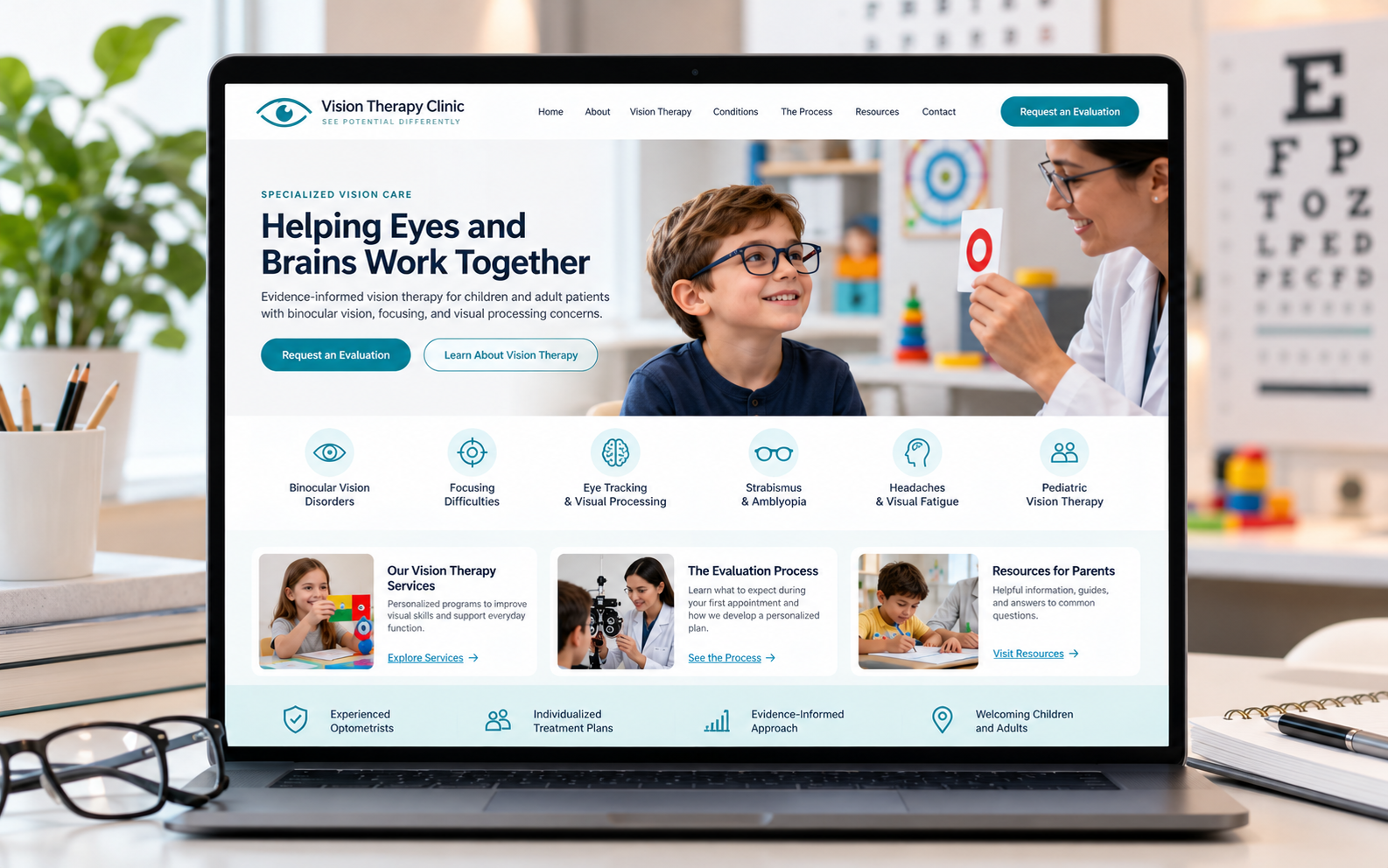
Vision therapy clinic website design needs a different strategy from a standard optometry website because prospective patients need to understand specialized services, the evaluation process, the clinician’s qualifications, and what happens after an appointment. A generic eye care template may prioritize eye exams, glasses, and contact lenses while leaving these questions unanswered. A specialist website should explain the clinic’s actual services, establish appropriate trust, and make it easier for suitable patients to request an evaluation.
TL;DR: What Clinic Owners Need to Know
- A specialized clinic website should explain the services offered and the patient journey, not simply list vision therapy as another service.
- Parents and adult patients need clear information about evaluations, clinician qualifications, appointment commitments, and how to ask about fees.
- Clinical content should distinguish evidence-supported uses of therapy from claims that lack adequate evidence.
- Dedicated service pages, accessible navigation, useful FAQs, and a clear inquiry process can reduce uncertainty before a patient contacts the clinic.
- Website improvements should be prioritized according to patient barriers and measured outcomes, not visual preferences alone.
- A redesign should protect existing search visibility while improving the quality of relevant inquiries and appointment requests.
Why Does a Vision Therapy Clinic Need a Different Website Strategy?
A vision therapy practice needs a website that explains its specialized services and helps visitors decide whether to request an evaluation. A standard optometry template is often structured around routine eye exams, eyewear, contact lenses, and general appointment booking. That structure may not give enough prominence to the questions families ask when they are researching a specific vision concern.
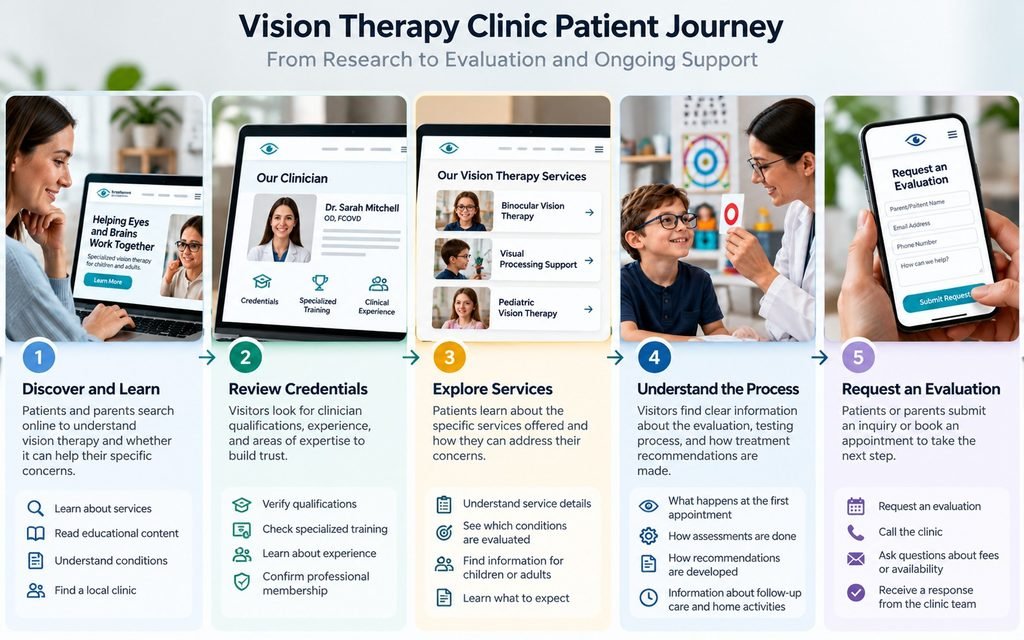
The difference is not merely visual. A parent considering a specialized evaluation may want to know what the clinician assesses, what the first appointment involves, whether recommendations depend on individual findings, and how the clinic communicates with families. A visitor who cannot find these answers may leave without making an inquiry, even when the clinic offers a relevant service.
This creates a positioning problem. If the homepage gives equal weight to every service, the practice’s specialist expertise can become difficult to recognize. A website should help the intended patient understand the clinic’s role without suggesting that every person with a reading difficulty, headache, or visual complaint needs vision therapy.
A stronger structure also makes the business easier to evaluate. Prospective patients can review the clinician’s credentials, understand the service pathway, and identify the next step before contacting the office. That can improve the relevance of inquiries, although the effect needs to be measured rather than assumed.
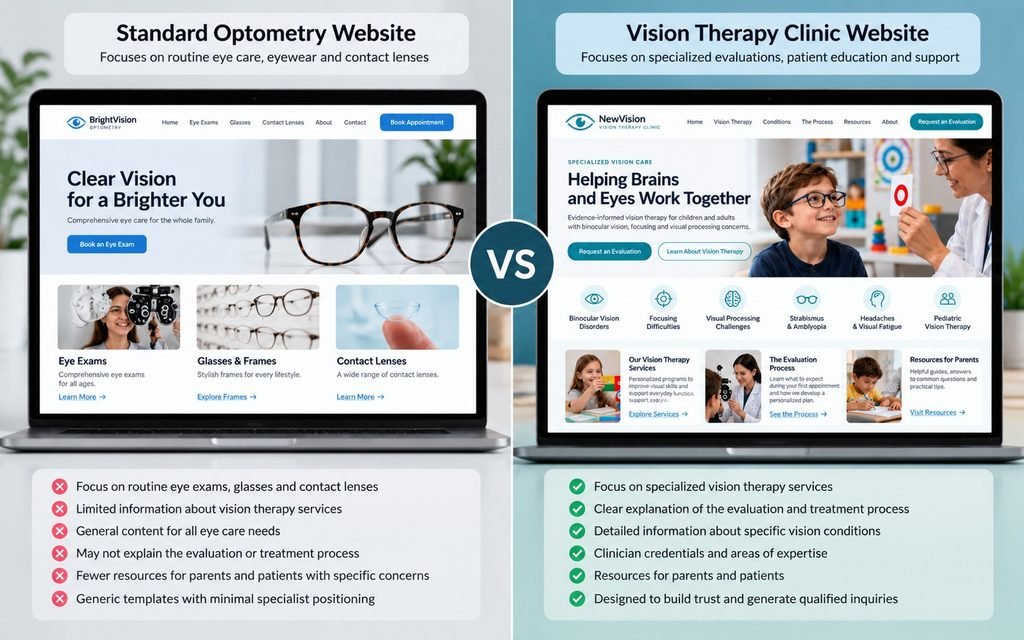
Vision Therapy Isn’t a Routine Eye Exam. Your Website Should Make That Clear.
A standard optometry website often prioritises eye exams, glasses and contact lenses. Vision therapy clinics may need more space to explain specialised assessments, treatment approaches and patient expectations.
Routine Eye Care Journey
Specialised Evaluation Journey
What Questions Must a Specialist Website Answer Before a Patient Books?
A specialist website should answer the practical questions that influence whether a visitor feels ready to contact the clinic. These questions often concern suitability, trust, logistics, and the process of getting started rather than the appearance of the website itself.
At a minimum, visitors should be able to find answers to the following:
- Which concerns and conditions does the clinic evaluate?
- Which services does the clinician actually provide?
- Who conducts the assessment, and what relevant qualifications do they hold?
- What might happen during the first appointment?
- How are recommendations made after the evaluation?
- Could the care plan involve follow-up visits or home activities?
- How can patients ask about fees, insurance, or appointment availability?
- What information should a parent or adult patient prepare?
These answers should be written in plain language and placed where visitors naturally look for them. A clinic should not force someone to read several blog posts or call the office just to discover whether the practice offers a particular service.
Business implication: Clearer service information helps visitors self-select. It may reduce inquiries that do not match the clinic’s services and help suitable patients take the next step with more confidence.
What Does Clinical Evidence Mean for a Vision Therapy Website?
A clinic website should describe clinical services accurately and avoid promises that go beyond the available evidence. This matters because prospective patients may encounter conflicting claims about vision therapy, particularly when researching children’s reading, learning, attention, or developmental concerns.
The American Association for Pediatric Ophthalmology and Strabismus explains that orthoptic exercises can help with certain eye movement problems, including some cases of convergence insufficiency. It also states that scientific evidence does not show that behavioral or perceptual vision therapy improves learning outcomes for children with learning disabilities or treats myopia. https://www.aapos.org/glossary/vision-therapy. Read the AAPOS vision therapy guidance.
An American Academy of Ophthalmology review examined home- and office-based vergence and accommodative therapies for convergence insufficiency in children and young adults. The review found evidence that office-based therapy improves certain motor outcomes in children with symptomatic convergence insufficiency, but results for symptom relief were inconsistent and evidence for home-based therapies was insufficient to reach a firm conclusion. https://pubmed.ncbi.nlm.nih.gov/34172337/. Read the published review on PubMed.
These findings do not mean that a clinic should avoid explaining its services. They mean that the content should distinguish the specific condition being addressed, the intervention being offered, and the outcomes supported by evidence.
| Website content | What to communicate | What to avoid |
|---|---|---|
| Service descriptions | The service offered and the concerns it is intended to address | Suggesting every patient is suitable |
| Treatment explanations | How recommendations depend on clinical assessment | Guaranteed outcomes or universal timelines |
| Parent education | Evidence-based explanations and practical next steps | Unsupported claims about learning or academic improvement |
| Clinician profile | Verifiable qualifications, training, and professional experience | Unsubstantiated claims of being the best provider |
| FAQs | Appointment steps, preparation, and fee information | Diagnosing visitors through website copy |
| Testimonials | Genuine experiences presented in appropriate context | Treating individual experiences as clinical proof |
For a clinic owner, this is both a clinical and a commercial issue. Accurate content supports credibility, helps visitors understand the practice’s scope, and reduces the risk of attracting inquiries based on unrealistic expectations.
Clinical content should be reviewed by the qualified professional responsible for the services. Website designers can organize and communicate that information, but they should not independently establish clinical claims.
How Should You Structure a Website for Behavioral Optometry Services?
A specialist clinic website should organize pages around the services offered and the questions patients need answered. The right architecture helps visitors move from understanding a concern to learning about the evaluation process and deciding whether to contact the clinic.
A practical structure may include:
- Homepage: Identify the clinic’s specialty, location, intended patient groups, and main next step.
- Main service page: Explain the services the clinic provides and what patients can expect.
- Relevant condition pages: Create separate pages when a topic warrants a substantial, accurate explanation.
- Evaluation process: Explain what happens at the first appointment and how recommendations are developed.
- Parent and caregiver resources: Answer questions about preparation, scheduling, communication, and practical considerations.
- Clinician profile: Present relevant qualifications, training, and professional experience.
- Appointments and fees: Explain scheduling, availability, and how to obtain accurate fee information.
- FAQs and educational resources: Address common questions without replacing a professional assessment.
Not every clinic needs eight separate sections or a large resource library. The final architecture should reflect the clinic’s actual services, capacity, and patient needs. Creating thin pages for every possible condition simply to target search terms can make the site harder to maintain without adding meaningful value.
A well-structured behavioral optometry website should also distinguish routine eye care from specialized services when both are offered. Visitors should not have to guess which appointment type to select or whether the clinic provides the service they are researching.
Local relevance matters as well. A clinic serving patients in New York, London, or Sydney should use accurate location details, relevant terminology, clear service-area information, and realistic appointment information. It should not publish location pages for places it does not genuinely serve.
Which Pages Should You Improve First if You Cannot Redesign Everything?
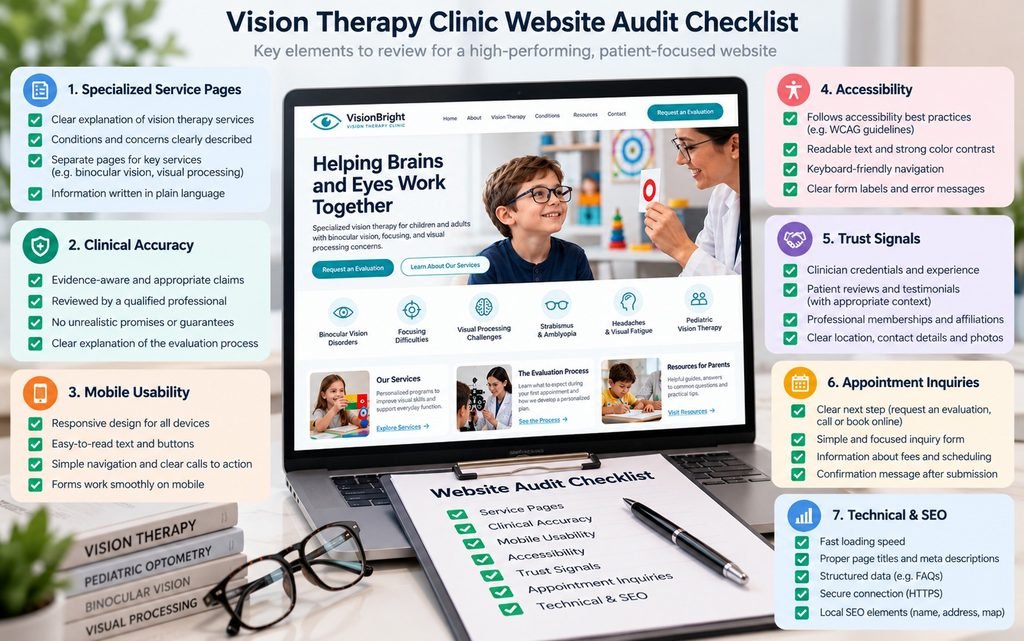
Start with the pages closest to a patient’s decision: the homepage, main service page, evaluation information, clinician profile, and appointment pathway. Each should answer three questions quickly: Is this clinic relevant to my concern? Why should I trust this provider? What should I do next?
Accessibility belongs in this first round of improvements. The World Wide Web Consortium’s Web Content Accessibility Guidelines provide recognized guidance for making web content more perceivable, operable, understandable, and robust. For a clinic, that means readable text, predictable navigation, accessible forms, clear labels, and an experience that works on mobile devices and with assistive technology.
KG Web Designer is a conversion-focused website design studio specializing in custom websites for clinics, professional services, manufacturers, and growing businesses. For a specialist practice, the goal is to connect service information, trust signals, navigation, and inquiry paths to the decisions patients need to make.
A useful next step is to review how to make an eye clinic website accessible and patient-friendly. Accessibility improvements should be evaluated alongside the clarity of the content and the ease of booking, not treated as a cosmetic checklist.
If your current website presents specialized vision services as a small item in a general eye care menu, begin with a focused review of service-page clarity, the patient journey, and inquiry barriers. Discuss your clinic website requirements with KG Web Designer.
Which Features Make a Specialist Clinic Website More Useful?
The most valuable website features help visitors understand the clinic, assess its credibility, and take an appropriate next step. A polished design can support trust, but it cannot compensate for unclear service information, inaccessible navigation, or a confusing booking process.
Prioritize these features:
- Specific homepage messaging: State the specialty, intended patient groups, location, and next step.
- Dedicated service pages: Explain the actual services the clinician provides.
- An evaluation guide: Describe the first appointment and how recommendations are determined.
- A credible clinician profile: Make relevant qualifications and experience easy to verify.
- Mobile-friendly navigation: Ensure text, menus, buttons, and forms work on smaller screens.
- Practical appointment information: Explain how to schedule and ask about fees.
- Accessible content: Support keyboard navigation, readable text, clear form labels, and understandable errors.
- A focused inquiry form: Collect only information needed to respond appropriately.
- Clear privacy information: Explain how personal information is handled and configure booking and analytics tools for applicable privacy requirements.
- Meaningful measurement: Track qualified inquiries, calls, appointment requests, and completed forms.
For healthcare websites, privacy should be considered before adding third-party booking tools, advertising pixels, chat widgets, or analytics integrations. Applicable obligations differ by market and the type of information collected. Clinics should obtain appropriate legal and technical advice rather than assume that a standard website form automatically meets every privacy requirement.
A useful specialist website should also make its next step obvious. Depending on the practice, that may be requesting an evaluation, calling the office, or asking a question about appointment availability. The primary call to action should reflect what the clinic can actually provide. Read the guide what makes a vision care website stand out in competitive cities to understand more.
The right features are those that solve a documented problem. If visitors cannot understand the service, improve the content. If they struggle to book, investigate the form and scheduling pathway. If the clinic attracts the wrong inquiries, clarify the intended patient groups and service scope before increasing advertising spend.
Visual presentation also influences how quickly patients understand a clinic’s services and feel comfortable exploring them. However, visuals should support clinical information rather than replace it. Our guide to visual-first web design for eye clinics explains how clinics can use imagery, visual hierarchy, and clear page layouts to make important information easier to understand and help visitors navigate toward an appropriate next step.
How Can You Improve Your Existing Website Without Wasting Money?
The most cost-effective approach is to identify the biggest barrier first and invest in changes that address it. A complete redesign may be justified when the architecture, content, mobile experience, and technical foundation all need work. Targeted improvements may be more appropriate when the existing site is technically sound.
First, fix clarity and trust. Review the homepage message, service descriptions, clinician profile, evaluation information, and primary call to action. Remove unsupported claims and make the clinic’s actual services easier to understand.
Second, fix the patient journey. Test the website on a phone and follow the booking process from start to finish. Check whether visitors can find appointment information, understand what happens next, and complete the inquiry form without unnecessary steps.
Third, strengthen search visibility and measurement. Review page titles, internal links, local business information, accessibility, page performance, and relevant service content. Record the current baseline before making changes so you can assess whether performance improves.
A focused vision therapy website design strategy should connect each improvement to a specific user problem. If visitors cannot understand the service, clarify the content before investing in animations or decorative effects. If visitors reach the booking page but do not complete it, investigate the scheduling experience before spending more to attract traffic.
Parents and Patients Need Answers Before They’re Ready to Book an Evaluation.
Visitors may arrive with questions about eye coordination, focusing difficulties or visual discomfort. A well-structured website can help them understand when further professional assessment may be useful.
Understand the Concern
Explain relevant visual symptoms and why different concerns may require different assessments.
Explore the Approach
Describe the clinic’s evaluation process and the conditions it assesses.
Review Clinical Expertise
Present practitioner credentials and balanced information about treatment options.
Request an Evaluation
Make it easy to contact the clinic and understand the next steps.
Create a website that supports patient understanding and encourages informed conversations with your clinic.
Explore Eye Clinic Website Design →What Should You Measure After Making Website Changes?
Measure actions that indicate genuine patient interest. Traffic and search impressions help explain visibility, but they do not establish whether the website is attracting suitable inquiries or helping visitors complete the next step.
Track the following where reliable measurement is available:
- Qualified inquiry submissions.
- Completed appointment requests.
- Calls originating from important service pages.
- Form completion and abandonment rates.
- Organic impressions and clicks for relevant searches.
- Engagement with evaluation, appointment, and fee information.
- The proportion of inquiries that match the clinic’s services and location.
Record a baseline before making changes. Review performance over a meaningful period and account for seasonality, advertising changes, appointment availability, and other factors that may affect demand.
Do not attribute every improvement in bookings to website design alone. A credible assessment separates observed results from assumptions and acknowledges other influences.
What Do Website Reviews Reveal About Common Optometry Problems?
Website reviews can reveal usability and trust issues, but their conclusions should match the evidence actually collected. KG Web Designer’s published 2026 review of optometrist website mistakes provides a framework for assessing navigation, booking usability, trust signals, accessibility, local SEO, technical performance, and AI readiness.
That framework is relevant to vision therapy clinics, but a broader optometry review should not be represented as a dedicated study of behavioral optometry websites. Nor should a website review be treated as proof that a particular design choice caused a change in bookings unless conversion data supports that conclusion.
Original qualitative observation: A specialized clinic can lose clarity when its website architecture is inherited from a general optometry template. The homepage may give similar prominence to routine eye exams, eyewear, contact lenses, and specialist services even when the clinic’s business strategy depends on attracting patients for a more specialized evaluation. Read the original qualitative observation section references the audit framework.
This is a qualitative observation, not a measured industry statistic. To determine whether it affects a particular clinic, review its service-page traffic, search queries, inquiry quality, booking behavior, and the questions patients ask the front desk.
Example From Our Experience: How Should a Clinic Validate an Improvement?
A credible case study must distinguish a verified client result from a hypothetical scenario. The information available for this article does not establish a specific vision therapy clinic project with documented before-and-after booking data, so the following example is explicitly hypothetical.
Problem: A behavioral optometry practice uses a general eye care website. The homepage emphasizes routine eye exams and eyewear, while specialized service information is brief and difficult to find. Parents have to contact the office to understand the evaluation process.
Solution: The clinic reviews its information architecture, improves the main service page, explains the evaluation process, strengthens the clinician profile, and simplifies the appointment inquiry pathway. The qualified clinical team reviews the revised content for accuracy.
Outcome to measure: The clinic compares qualified inquiries, appointment requests, form completion, and relevant search queries with a pre-launch baseline. It reviews results over a meaningful period and accounts for other factors that may influence demand.
This example shows how a clinic could validate an investment without assuming success in advance. It is not a claim that KG Web Designer has completed this exact project or achieved a particular booking increase.
For stronger first-hand evidence, this section should eventually be replaced or supplemented with a real anonymized project, audit date, actual findings, the changes made, and verified results. That would add more credibility than an invented percentage or an unsupported testimonial.
Why Do Clinics Get Specialized Website Design Wrong?
Clinics often get this wrong when they treat a specialized service as a small addition to a generic optometry website rather than a distinct patient decision. Someone looking for glasses or a routine eye exam has different questions from a parent researching a specialized evaluation, and the website should reflect that difference.
Common mistakes include:
- Using a generic homepage headline that does not identify the specialty.
- Hiding specialized services beneath a broad navigation menu.
- Using clinical terminology without explaining it in plain language.
- Suggesting that every patient will receive the same program or outcome.
- Making broad claims about learning, reading, or developmental benefits without adequate evidence.
- Relying on testimonials instead of explaining the assessment process.
- Requiring visitors to call for basic appointment information.
- Redesigning the appearance while ignoring mobile usability and form completion.
- Publishing thin pages for many conditions without meaningful information.
- Measuring success through traffic alone rather than qualified inquiries.
The solution is to begin with the clinic’s actual scope of practice and the questions patients need answered. Design, SEO, and conversion optimization should support accurate information instead of distracting from it.
Clinics serving children should be reassuring without pressuring parents or implying that a particular treatment is necessary before an appropriate professional assessment. Balanced explanations protect credibility and help families make better-informed decisions.
Does Your Website Explain Your Vision Therapy Services Clearly Enough?
A specialised clinic website should help prospective patients understand what the practice assesses, who provides care and what an evaluation involves.
Can visitors distinguish vision therapy services from routine optometry?
Are relevant visual concerns explained accurately without overpromising outcomes?
Do patients understand what an assessment may involve?
Are qualifications, relevant training and experience easy to verify?
Are treatment approaches and limitations communicated responsibly?
Can visitors easily ask questions or request an appropriate assessment?
Your website should communicate the depth of your practice without making visitors work to understand what you offer.
Review My Clinic Website →What Does This Mean for Your Clinic’s Growth?
A specialized website can support growth by making the right services easier to discover, understand, and inquire about. Its value is not simply that it looks different from a competitor’s website; it is that it helps suitable patients recognize the clinic’s relevance and understand how to take the next step.
There are three important business opportunities.
More qualified inquiries: Clear service pages help prospective patients determine whether the clinic offers the evaluation they are seeking. This may reduce inquiries that do not match the practice’s services.
Stronger trust before the first appointment: Transparent clinician information, careful explanations, and a clear evaluation pathway can answer practical questions before a family contacts the office.
Better use of marketing investment: If the clinic already attracts relevant visitors, improving service clarity and booking usability may be more appropriate than simply increasing advertising spend. The effect should be measured rather than assumed.
For clinics investing in vision therapy clinic marketing, the website should act as the central destination for education, credibility, local discovery, and inquiry generation. Search, referrals, paid campaigns, and educational content can direct visitors to the site, but the website still needs to explain the service accurately and make the next action clear.
KG Web Designer’s approach is to connect content strategy, page structure, search visibility, accessibility, and conversion measurement rather than treating them as separate tasks. The right scope depends on the clinic’s starting point, so a targeted improvement plan may be more appropriate than a complete rebuild.
When Does Professional Website Help Make Sense?
Professional help makes sense when the website no longer reflects the clinic’s specialized services, visitors struggle to understand the evaluation process, or the team cannot identify why relevant traffic fails to generate inquiries. It may also be worthwhile when important pages are missing, the site is difficult to maintain, or technical limitations prevent meaningful improvements.
Before commissioning a redesign, ask a prospective designer to explain:
- How the website structure will reflect the clinic’s services and patient journey.
- How clinical content will be reviewed and approved.
- How accessibility and mobile usability will be addressed.
- How existing URLs and search visibility will be protected during migration.
- Which conversion events will be measured after launch.
- What the project includes and what requires ongoing support.
- How privacy, booking integrations, and sensitive information will be handled.
The right partner should explain the reasoning behind the recommended structure, not simply present a visual mockup. They should distinguish deliverables they control, such as page architecture and form usability, from business outcomes influenced by traffic quality, clinic capacity, clinical fit, and other factors.
For a clinic serving patients in the United States, United Kingdom, Australia, or another overseas market, ask how the project will handle local search intent, terminology, accessibility expectations, privacy considerations, and any existing booking software. These requirements should be established during discovery rather than added as expensive corrections after launch.
If your clinic needs a website built around specialized services rather than a general optometry template, discuss your clinic website requirements with KG Web Designer. Start with the current website, the services you want to grow, and the barriers that prevent suitable patients from making an inquiry.
Expert Insight from Kanika Gupta
Kanika Gupta, Founder, KG Web Designer
My view is that a specialized healthcare website should be judged by the quality of the decisions it helps visitors make, not by the amount of content or the number of visual effects it contains. Parents researching a child’s vision concerns need clear information, a credible clinician, and an understandable next step. They should not have to interpret vague marketing language or search several pages to discover what the clinic actually does.
If this were my website, I would first make the distinction between routine optometry and the clinic’s specialized evaluation pathway unmistakable. I would then review the main service page, clinician credentials, appointment process, and mobile inquiry journey before approving a full redesign. I would also ask the clinical team to verify every treatment claim before publishing it.
I would measure success by whether the website attracts more relevant inquiries and makes it easier for suitable patients to take the next step, not by whether the new homepage looks more modern. If the current site already works well technically, I would fix the biggest content or conversion barrier before replacing the entire platform.
That sequence matters because a polished website cannot compensate for unclear positioning. A clinic earns trust when its digital experience reflects the same care, precision, and professional judgment that patients expect from the clinical experience itself.
Final Thoughts
A behavioral optometry practice should not have to squeeze its specialized services into a website designed primarily for routine eye exams and eyewear. A stronger structure explains the clinic’s actual services, gives patients useful information, establishes professional credibility, and makes the next step clear without promising a particular clinical outcome.
The best specialist vision therapy clinic website design begins with the patient journey and the clinic’s scope of practice. From there, service architecture, accessible design, search visibility, and conversion measurement can work together to support qualified inquiries and sustainable growth.
If your website does not clearly communicate your specialized services or help suitable patients understand how to get started, request a clinic website strategy discussion with KG Web Designer.
Your Vision Therapy Clinic Deserves More Than a Standard Optometry Website.
Let’s review whether your website clearly explains your specialised services, presents practitioner expertise and helps parents and patients navigate the evaluation process. We’ll identify practical opportunities to improve the website experience.
What We’ll Review
Website Strategist
Frequently Asked Questions
How is a vision therapy clinic website different from a regular optometry website?
A vision therapy clinic website needs to explain specialized evaluations, relevant services, clinician qualifications, and what patients can expect from the assessment process. A general optometry website often focuses on eye exams, glasses, and contact lenses. The right structure depends on the clinic’s actual scope of practice and the questions prospective patients need answered.
What pages should a vision therapy clinic include?
Most specialized clinics should consider a homepage, dedicated service pages, an explanation of the evaluation process, clinician profiles, appointment information, and relevant FAQs. Parent-focused resources may also help when children are a major patient group. Add pages only when they provide useful, accurate information rather than creating thin pages for every possible condition.
How can a clinic attract more qualified vision therapy inquiries?
Start by making the clinic’s specialty, services, and evaluation process clear. Then improve relevant service pages, local search information, clinician credibility, mobile usability, and the inquiry pathway. Track qualified inquiries and completed appointment requests so you can assess whether the changes help attract suitable patients.
Should a vision therapy clinic publish treatment prices online?
If the clinic can publish accurate fees or meaningful price ranges, doing so may help prospective patients understand the financial commitment before contacting the office. If costs depend on an evaluation or individualized plan, explain what determines the fee and how patients can obtain details. Avoid publishing a misleading flat price for a service whose scope varies.
How should a clinic explain vision therapy without making unrealistic promises?
Describe the specific services offered, the concerns they are intended to address, and how a qualified clinician determines whether an approach is appropriate. Distinguish evidence-supported findings from areas where evidence is limited, and avoid guaranteeing results. Clinical content should be reviewed by the relevant professional and encourage appropriate assessment rather than attempt to diagnose a visitor.
Can a clinic improve its existing website without a complete redesign?
Yes. If the website’s technical foundation is sound, improvements to service content, navigation, clinician profiles, mobile booking, accessibility, and calls to action may address the most important barriers. A redesign becomes more compelling when the existing structure cannot support the clinic’s services or technical limitations make targeted changes impractical.
How long does a specialized clinic website redesign take?
The timeline depends on the number of pages, content readiness, clinical review, booking integrations, and the complexity of the existing website. A focused improvement project may be quicker than rebuilding the site architecture and migrating content. Ask for a project plan with clear milestones, responsibilities, review periods, and launch checks rather than relying on a generic deadline.
What should I look for when hiring a designer for a vision therapy clinic?
Look for a designer who can explain how they will structure specialist services, communicate clinical information clearly, support accessibility, preserve SEO foundations, and measure inquiry behavior. Ask how clinical claims will be reviewed and how the project will protect existing URLs and search visibility. A strong proposal should connect design decisions to patient needs and business objectives.