Quick Answer
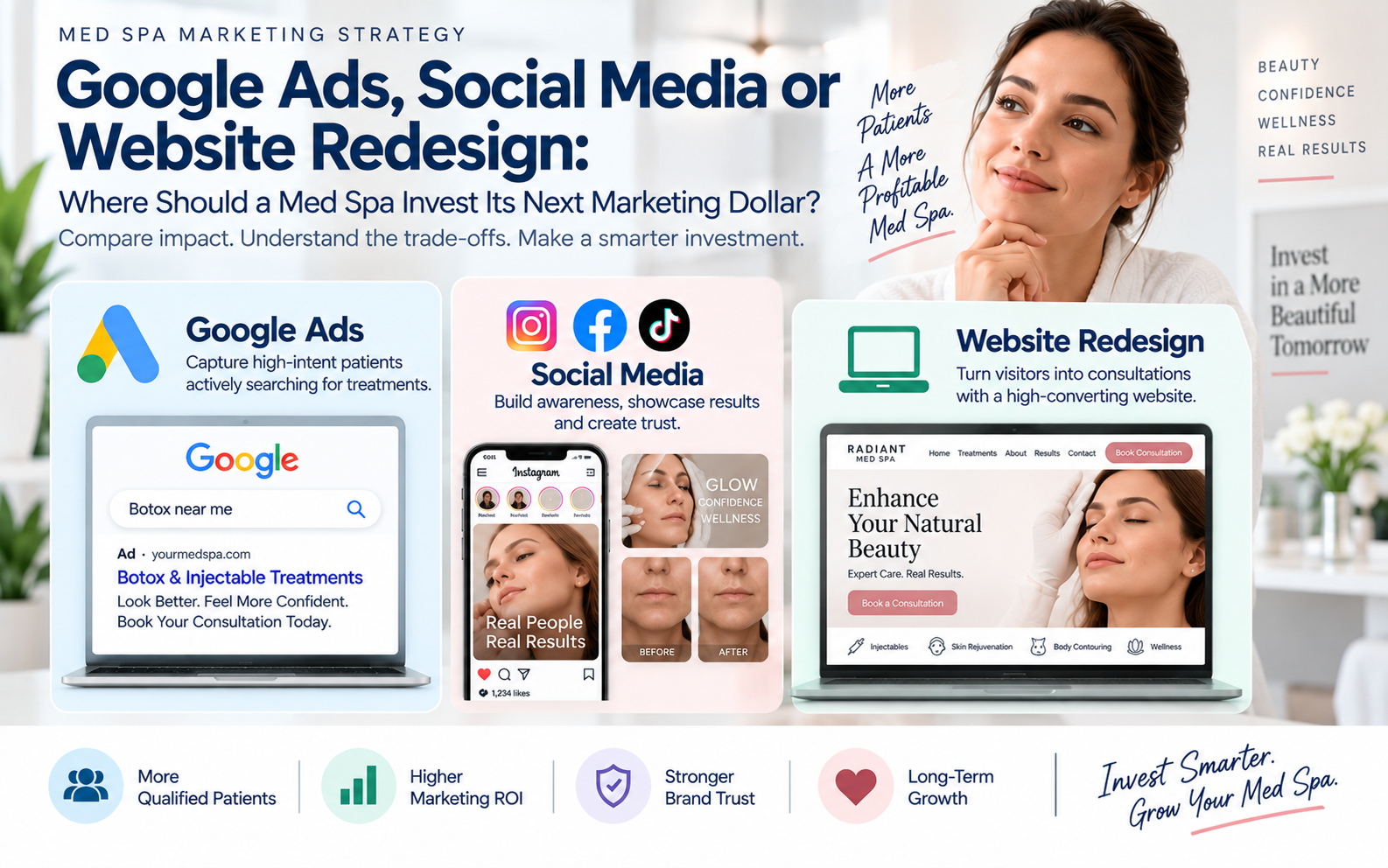
The best Med Spa Marketing Strategy depends on where your patient acquisition funnel is losing qualified opportunities. Google Ads can capture high-intent demand, social media can create awareness and trust, and a website redesign can improve conversion. Before spending more, identify whether your actual problem is traffic, targeting, trust, website conversion, booking friction, or follow-up.
TL;DR: What Should a Med Spa Owner Know?
- Google Ads is strongest when prospective patients are already searching for a treatment or provider.
- Social media is valuable for visual discovery, education, credibility, and repeated exposure, but engagement does not automatically equal consultations.
- A website redesign makes commercial sense when the existing website prevents the clinic from converting qualified traffic or supporting its marketing strategy.
- The most useful marketing metric is not simply cost per lead. Qualified consultations, attendance, treatment conversion, and revenue provide a stronger picture.
- Increasing ad spend before fixing a weak landing page can increase wasted spend rather than increase profitable patient acquisition.
- The right investment should follow the biggest measurable bottleneck in the patient journey.
Why Should a Med Spa Invest in the Funnel Bottleneck First?
The next marketing dollar should go toward the part of the acquisition journey that is preventing the clinic from turning qualified attention into revenue. If the clinic has almost no relevant traffic, improving conversion will have limited impact. If thousands of qualified visitors are already arriving but few request consultations, buying more traffic may simply make the existing problem more expensive.
This distinction matters because med spa owners often evaluate Google Ads, Instagram, SEO, and website design as separate activities. In reality, they are connected parts of the same patient journey.
A prospective patient may discover a treatment through Instagram, search for the clinic on Google, read reviews, visit a treatment page, compare practitioners, return later, and finally request a consultation. A problem at any point can reduce the commercial value of the marketing investment that came before it.
The medical aesthetics market itself is substantial. The American Med Spa Association’s 2026 industry report says the sector has surpassed $17 billion in industry revenue and is growing by more than $1 billion annually.
That growth makes the question more important, not less.
The objective is not to be present on every channel.
It is to build a patient acquisition system in which each channel has a clear job.
Standalone fact: A med spa should increase marketing spend only after identifying which stage of the patient journey is limiting qualified consultation growth.
At KG Web Designer, we approach this as a diagnosis problem first and a marketing-channel problem second.
What Should a Med Spa Marketing Strategy Prioritize?
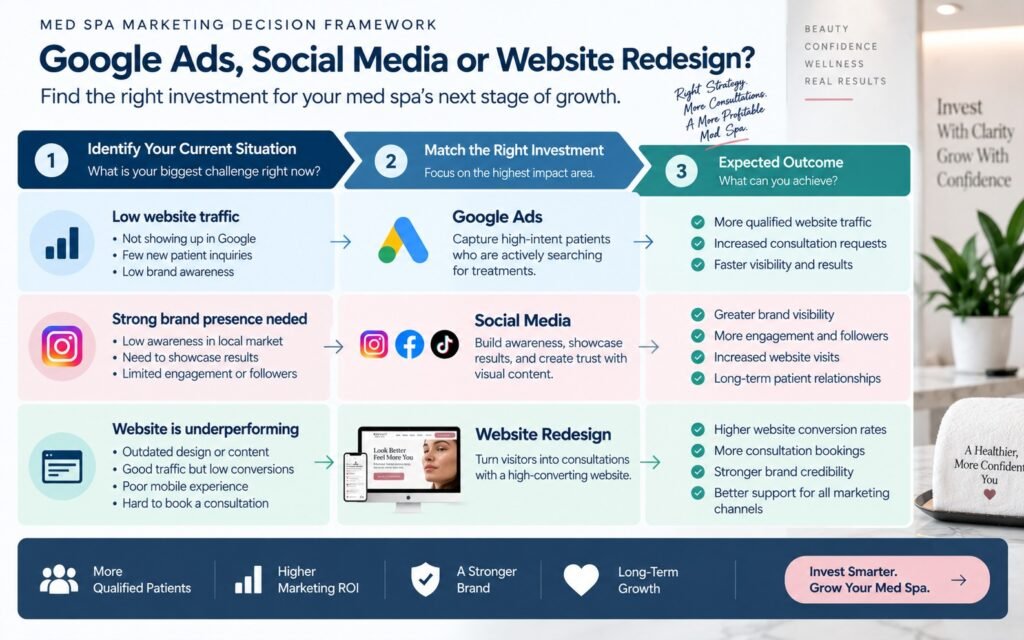
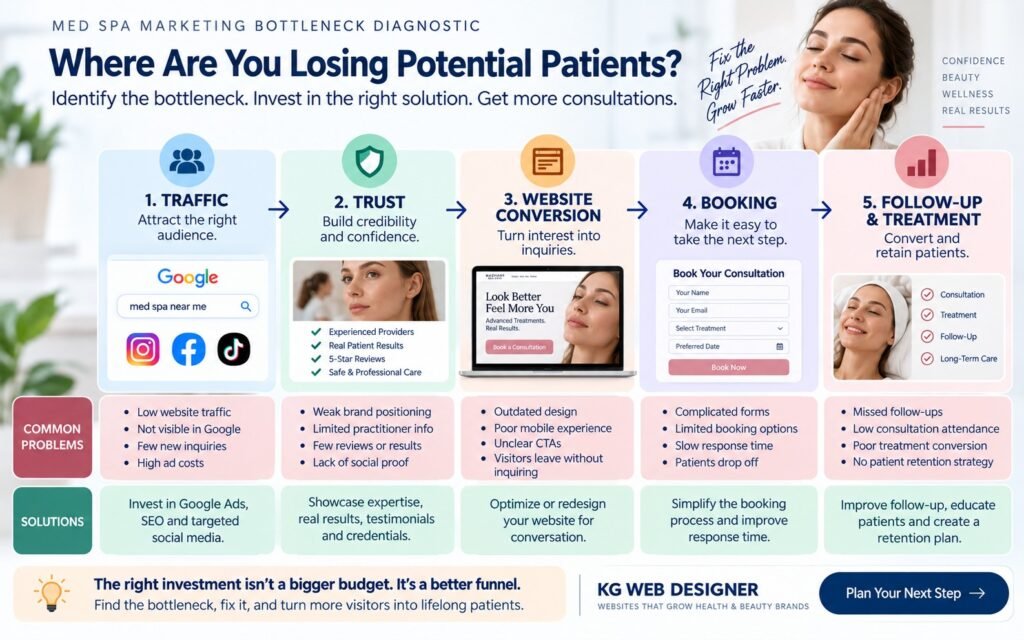
A Med Spa Marketing Strategy should prioritize the largest measurable constraint in the patient acquisition funnel, whether that is visibility, search intent, trust, landing-page conversion, booking friction, or follow-up. There is no responsible universal answer that says every med spa should spend its next dollar on Google Ads, Instagram, SEO, or a redesign.
Use this diagnostic before increasing spend:
| What you are seeing | Most likely bottleneck | First thing to investigate |
|---|---|---|
| Very little qualified traffic | Visibility or targeting | Search, local SEO, audience strategy |
| Good Google traffic, few inquiries | Conversion | Treatment pages and landing UX |
| Strong Instagram engagement, few website visits | Social-to-site journey | Profile CTA and landing destination |
| Lots of ad clicks, few consultations | Intent or landing page | Campaign-to-page relevance |
| Many inquiries, poor lead quality | Targeting or offer | Audience and messaging |
| Good website traffic, weak mobile conversion | Mobile UX | Mobile navigation, CTA, forms |
| Many bookings, poor attendance | Follow-up | Confirmation and reminders |
| Good consultations, weak treatment conversion | Consultation process | Sales, education, offer, follow-up |
This table is more useful than a generic “best marketing channel” ranking because it connects investment with an observed business problem.
Google Ads can be excellent when demand exists.
Social can be excellent when discovery and education matter.
A redesign can be excellent when the website is limiting everything else.
The mistake is assuming one of them must always come first.
Are Google Ads Worth It for Med Spas?
Google Ads can be highly useful for med spas because search captures people who are already expressing intent, but the economics depend on treatment, geography, competition, landing-page quality, and conversion performance. A campaign can generate clicks without producing enough qualified consultations to justify the spend.
Current 2026 industry benchmarks illustrate why owners should be careful with generic averages. One med spa-specific benchmark published in August 2026 estimates treatment-keyword CPCs ranging from roughly $2.50 to $20 depending on treatment and market, while its estimated paid landing-page conversion range is approximately 5% to 9%. These are third-party estimates, not universal industry standards.
Google’s own documentation makes the underlying principle clearer. A landing page contributes to the overall landing-page experience, and Google evaluates factors including relevance, usefulness, navigation, and whether the page meets the expectations created by the ad.
That means a med spa cannot evaluate paid search in isolation.
Consider a search for:
“Botox near me”
If the visitor lands on a generic homepage with no obvious Botox information, no practitioner context, weak proof, and a confusing consultation path, the advertising campaign may be doing its job while the website is not.
The result is a misleading conclusion:
“Google Ads don’t work.”
The more accurate conclusion may be:
“The campaign generated demand, but the landing experience failed to capture it.”
What Should You Measure From Google Ads?
Track:
- Qualified inquiries
- Consultation requests
- Calls
- Booking starts
- Completed bookings
- Consultation attendance
- Treatment conversion
- Cost per qualified consultation
- Revenue where attribution is reliable
Google provides conversion tracking for website actions and phone-related actions, allowing advertisers to measure more than clicks.
Med Spa Google Ads should therefore be judged by the quality and commercial progression of the patients it helps acquire, not simply by click volume.
Before You Spend More on Marketing, Find Out Where You’re Losing Patients
More Google Ads or social media traffic won’t solve a website conversion problem. Let’s review your patient journey, treatment pages, trust signals, calls to action, and consultation flow to identify what may be limiting your marketing ROI.
Request Your Free Website Audit →Is Instagram or Google Better for Med Spa Marketing?
Google and Instagram serve different stages of the patient journey, so neither is automatically better. Google is generally stronger for capturing existing search intent, while Instagram can be powerful for discovery, education, visual proof, personality, and repeated exposure.
This distinction is particularly important in aesthetic medicine because prospective patients often research before contacting a clinic. The American Med Spa Association notes that patients increasingly use online sources for aesthetic information and that social media can influence how patients understand treatments. It also warns that social platforms can expose patients to incomplete or inaccurate information.
That creates two different jobs.
Google answers:
“I am looking for this treatment. Who should I consider?”
Instagram can answer:
“I am interested in this treatment. What does this clinic look like, and do I trust its approach?”
The website then needs to answer:
“Why should I consider this particular provider?”
That is why Med Spa Social Media Marketing should not be judged only by likes, followers, or reach.
The more useful question is whether social attention creates relevant website visits, inquiries, consultations, and ultimately valuable patient relationships.
A 2026 American Med Spa Association article comparing Google and Meta makes the same broader point: the platforms operate differently and should be evaluated according to how they influence discovery, evaluation, and booking rather than treated as identical acquisition channels.
Should You Redesign Your Med Spa Website Before Running More Ads?
Yes, you should consider a redesign before increasing advertising when the existing website is clearly preventing qualified visitors from understanding the treatment, trusting the provider, or taking the next step. You should not redesign merely because the website looks older than a competitor.
This distinction can save a med spa a significant amount of unnecessary spending.
Before approving a redesign, examine:
- Do treatment pages match the services you are advertising?
- Can prospective patients quickly identify the practitioner?
- Are credentials and relevant experience easy to find?
- Are treatment questions answered clearly?
- Does the mobile experience work properly?
- Is the consultation CTA visible at the right moments?
- Can visitors understand what happens after they inquire?
- Is the booking process unnecessarily complicated?
- Can analytics identify where visitors are dropping out?
- Can the existing CMS support the improvements?
Google specifically recommends evaluating landing-page performance, mobile optimization, speed, and the relevance of the experience created after an ad click.
That makes the website part of the advertising equation.
Med Spa Website Redesign should therefore be treated as a conversion and infrastructure decision, not simply a visual upgrade.
At KG Web Designer, we frequently see clinics focus on the homepage because it is the page the owner sees most often. Prospective patients may enter through a treatment page, Google result, Instagram link, referral, or campaign landing page instead. The commercial experience therefore has to work beyond the homepage. Here you can see how we evaluate whether a med spa website actually needs a redesign.
The strongest redesign decisions usually come after identifying a structural problem such as weak treatment architecture, disconnected booking, poor mobile UX, outdated positioning, weak trust signals, or technical limitations.
What Should You Fix Before Spending More on Ads?
You should fix the biggest conversion leak before increasing traffic acquisition. In many cases, the first improvement is not a new campaign or a complete redesign. It is a more relevant landing page, stronger trust architecture, simpler consultation UX, or better tracking.
Use this order:
1. Confirm the audience
Make sure the people arriving actually resemble the patients you want.
2. Match the landing page to the intent
A treatment-specific search should normally lead to information about that treatment rather than a generic homepage.
3. Strengthen trust
Make practitioner credentials, treatment expertise, authentic reviews, relevant results, and clinic information easy to verify.
4. Improve treatment education
Answer practical questions without making unsupported medical claims or promising individual outcomes.
5. Reduce conversion friction
Make calling, requesting a consultation, or beginning the booking process straightforward on mobile.
6. Fix attribution
Track the source of inquiries and, where possible, the quality and downstream outcome of those inquiries.
7. Improve follow-up
A strong acquisition campaign can still underperform if inquiries are handled slowly or inconsistently.
Google’s conversion tools allow advertisers to track website actions and other conversion events, which makes it possible to connect advertising activity with meaningful actions rather than stopping at traffic metrics.
Standalone fact: Increasing traffic before fixing a known conversion problem can increase the number of lost opportunities as well as the number of visitors.
What Does Current Med Spa Marketing Data Actually Show?
Current data supports a more nuanced decision than “Google wins” or “Instagram wins.” Different studies use different methodologies, markets, and definitions of a lead, so med spa owners should use benchmarks as directional context rather than promises.
| Data point | 2026 evidence | What it means |
|---|---|---|
| Medical aesthetics industry revenue | $17B+ | The market is large and competitive |
| Industry annual growth | $1B+ | Demand is expanding |
| Med spa Google Ads CPC | Treatment and market dependent | Search intent can be valuable but expensive |
| Paid med spa landing conversion | Third-party estimates around 5% to 9% | Landing experience matters materially |
| Website conversion | No universal reliable benchmark | Your own source-level baseline is more useful |
| Marketing success | Consultation and treatment outcomes | Lead volume alone is incomplete |
The American Med Spa Association reports the industry at more than $17 billion and growing by more than $1 billion annually.
A separate 2026 med spa benchmark report estimates paid-search performance by treatment and market and emphasizes that landing-page conversion and speed-to-lead influence the economics of paid acquisition. Because those figures are provider-generated benchmarks rather than an industry census, they should be treated as directional.
The safest conclusion is therefore not a universal CPL target.
It is this:
Your own qualified consultation economics matter more than a generic industry benchmark.
Example Scenario: What If Your Med Spa Gets Clicks but Few Consultations?
Imagine a clinic is spending $4,000 per month on Google Ads and another $1,500 creating social content and paid social campaigns.
Traffic is increasing.
The owner is pleased with the reach.
But consultations are not increasing at the same rate.
The first reaction is usually:
“We need more leads.”
That may be wrong.
Suppose the campaign traffic is relevant, but visitors are landing on generic service pages. The treatment information is thin, practitioner expertise is difficult to find, the mobile CTA is buried, and the consultation form requires too much information.
Adding another $2,000 to advertising does not solve those problems.
It increases the amount of traffic entering the same weak experience.
The better sequence is:
Diagnose → Fix → Measure → Scale
If this were my website, I would trace one high-value treatment from the original ad or social post through the exact landing page, consultation action, booking process, and follow-up before increasing the budget.
That gives the owner a specific answer instead of another opinion about which channel is “best.”
The Right Marketing Investment Depends on Where Your Patient Journey Is Breaking
If awareness is the problem, you may need more visibility. If qualified prospects are already reaching your website but aren’t progressing toward a consultation, spending more to generate traffic may not be the first priority. The key is diagnosing the bottleneck before choosing the channel.
Meet Kanika Gupta →What Does a Real KG Web Designer Case Study Show?
The clearest way to understand the difference between a website redesign and a growth-focused website is to look at real projects. While the following aesthetic clinic example is directly relevant to med spa conversion, another KG Web Designer project, Taruj Skincare, shows the same investment principle from an ecommerce perspective: the website should be built around the business’s next stage of growth, not simply its current needs.
The project involved:
- Reorganizing services around patient concerns
- Implementing progressive consultation forms
- Restructuring before-and-after galleries
- Simplifying mobile consultation flows
- Increasing practitioner visibility
- Reducing visual clutter
The published case study reports that within 90 days, consultation requests increased by 41% and mobile engagement improved by 57%. It also reports stronger high-ticket treatment inquiries and lower consultation abandonment.
Those are project-specific results, not industry benchmarks or guarantees.
That distinction matters.
The lesson is not that every med spa redesign will increase consultations by 41%.
The lesson is that the clinic already had an acquisition opportunity. The project focused on improving the experience between visitor interest and consultation.
At KG Web Designer, that is the type of distinction we look for before recommending additional acquisition spend.
Supporting Example: What Taruj Skincare Teaches About Website Investment
Taruj Skincare was not a med spa project, but the business problem is highly relevant to med spa owners deciding whether a website deserves part of their next marketing investment. The Florida-based skincare brand already had quality products, existing customers, and clear growth ambitions, but its Squarespace website was limiting the digital experience and future marketing opportunities.
The problem: The existing website did not communicate the premium nature of the brand strongly enough, product pages lacked persuasive trust and education elements, the mobile experience needed improvement, and the platform was becoming restrictive for planned affiliate marketing, influencer partnerships, expanded products, and future SEO growth.
The solution: KG Web Designer moved the business to WordPress and WooCommerce, redesigned the brand experience, improved product presentation and trust signals, optimized the mobile journey, strengthened conversion paths, and prepared the platform for affiliate marketing and future growth.
The outcome: The new store generated its first order on launch day. The affiliate program was enabled through GoAffPro, the new platform removed technical barriers to future marketing initiatives, and the client subsequently commissioned an ongoing SEO engagement.
The lesson for a med spa is not that a website redesign guarantees immediate revenue. It is that marketing works harder when the website is capable of supporting the next stage of growth. If paid ads, social media, SEO, referrals, and other channels all send prospects to a weak digital experience, increasing traffic can simply increase the number of people who leave without converting.
You can see the full project in the Taruj Skincare website redesign case study.
What Is the Best Way to Allocate a Med Spa Marketing Budget?
The best allocation is determined by capacity, treatment economics, current demand, conversion performance, and the clinic’s growth constraint. A percentage split copied from another med spa is less useful than a budget model connected to measurable outcomes.
A practical decision framework is:
| If your primary problem is… | Consider prioritizing… |
|---|---|
| Not enough high-intent traffic | Google Ads and SEO |
| Strong search demand but weak conversion | Landing pages and CRO |
| Strong Instagram attention but weak website progression | Social-to-website experience |
| Weak differentiation | Positioning and website content |
| Poor mobile performance | UX and technical improvements |
| High inquiry volume but low quality | Audience and offer refinement |
| Slow inquiry response | Follow-up and intake process |
| Platform limitations | Website redesign |
Your Med Spa Marketing Budget should therefore not be divided equally simply to maintain activity on every platform.
The better question is:
“Which investment has the highest probability of improving qualified patient economics?”
That may be Google Ads this quarter.
It may be a website improvement project next quarter.
It may be better follow-up the month after that.
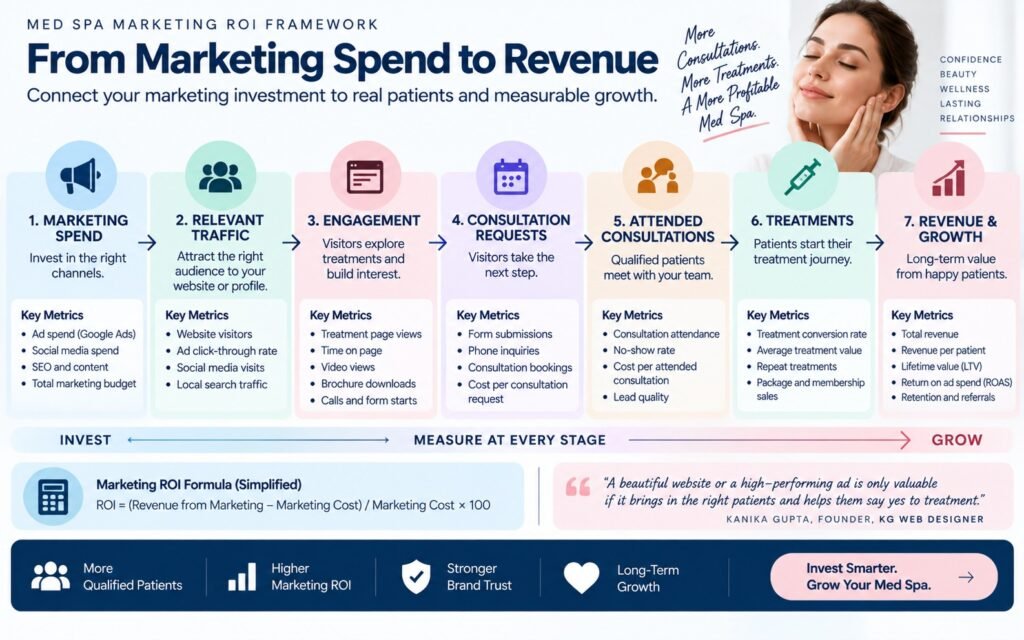
How Should You Measure Med Spa Marketing ROI?
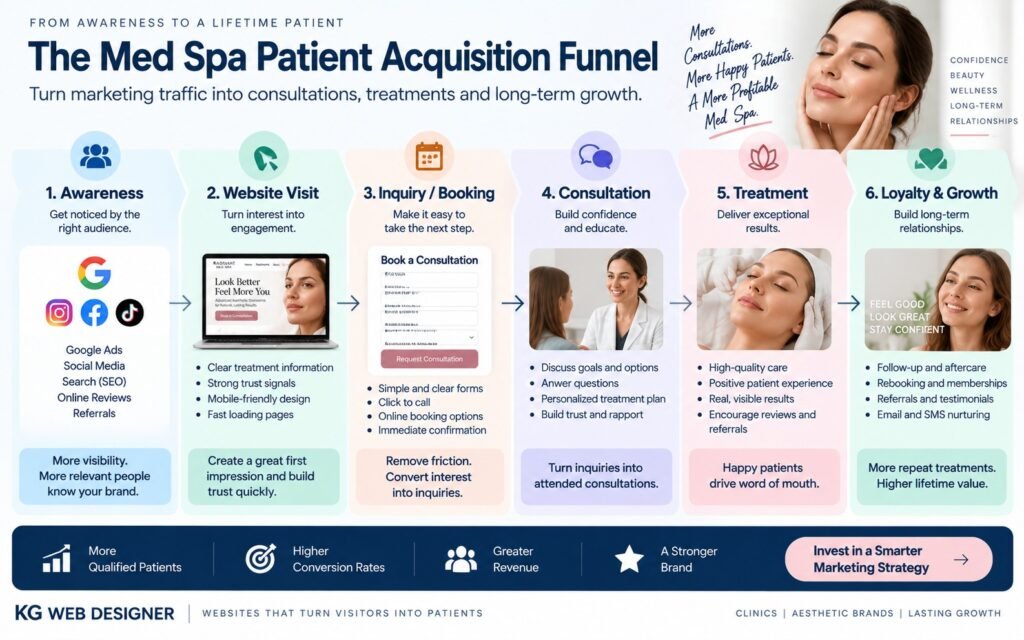
The strongest measurement framework follows the patient beyond the first lead. A campaign that produces inexpensive forms but poor consultations can be less valuable than a more expensive campaign that consistently generates qualified patients.
Track the funnel:
Marketing spend
↓
Relevant traffic
↓
Treatment engagement
↓
Consultation request
↓
Qualified lead
↓
Booked consultation
↓
Attended consultation
↓
Treatment
↓
Revenue
This is more useful than reporting:
- Impressions
- Followers
- Likes
- Clicks
- Raw form submissions
- Cost per lead alone
Google’s documentation supports conversion tracking for website actions and explains how conversion measurement helps evaluate interactions that occur after advertising engagement.
For a med spa, the most important number may therefore be closer to:
Cost per qualified attended consultation
rather than:
Cost per lead
That distinction is particularly important when treatment values differ substantially.
Why Most Businesses Get This Wrong
Most businesses get this wrong because they choose a channel before diagnosing the problem. They see a competitor running Instagram ads, hear that Google Ads are expensive, notice that their website looks dated, and make an investment based on perception rather than evidence.
There are several recurring mistakes:
- Increasing ad spend because clicks are available.
- Treating social engagement as equivalent to patient acquisition.
- Sending every campaign to the homepage.
- Redesigning without reviewing analytics.
- Measuring lead volume without lead quality.
- Ignoring phone inquiries because they are harder to attribute.
- Tracking bookings without tracking attendance.
- Assuming a cheap lead is a valuable patient.
- Creating generic treatment pages that look similar to competitors.
- Making the booking CTA prominent without building enough confidence before it.
- Assuming a visually premium website is automatically a commercially effective website.
The common problem is fragmented thinking.
Marketing creates attention.
The website creates context.
The consultation process creates confidence.
Follow-up creates momentum.
The treatment experience creates retention.
A successful clinic needs those pieces to work together.
Don’t Pay for More Clicks Until Your Website Is Ready to Convert Them
Your Google Ads, Instagram content, and referrals eventually lead prospects somewhere. A conversion-focused med spa website helps turn that attention into confidence through stronger treatment pages, practitioner credibility, patient proof, and a clearer consultation journey.
What Does This Mean For Your Business?
The right marketing investment is the one that removes the biggest commercially important constraint in your patient journey. If you lack qualified demand, invest in acquisition. If demand exists but consultations are weak, improve conversion. If your website cannot support the journey, redesign it.
Your Med Spa Marketing ROI should therefore be evaluated against business outcomes, not just platform metrics.
Ask:
- Are we reaching the right patients?
- Are they landing on relevant pages?
- Can they understand the treatment?
- Can they verify the provider?
- Do they trust the clinic?
- Can they easily request a consultation?
- Are inquiries qualified?
- Do consultations happen?
- Do consultations convert?
- What is the value of the patients acquired?
This also changes how you think about Med Spa Patient Acquisition.
Patient acquisition is not complete when somebody clicks an ad.
It is not complete when somebody submits a form.
It is not complete when somebody books.
The commercial outcome is further down the journey.
That is why a conversion-focused website can influence the economics of multiple marketing channels simultaneously.
What Should a Med Spa Do Over the Next 30 Days?
The first 30 days should be used to establish a baseline, diagnose the biggest leak, make targeted improvements, and then decide whether additional traffic is justified. Do not attempt to optimize every channel simultaneously.
Days 1–7: Measure
Record:
- Traffic by source
- Paid search spend
- Social traffic
- Treatment-page visits
- Consultation-page visits
- Calls
- Forms
- Booking starts
- Completed bookings
- Qualified inquiries
- Consultation attendance
Days 8–14: Audit
Review the three most important acquisition journeys.
For each one, ask:
- Where does the visitor land?
- Does the page match the original intent?
- Is the treatment explained?
- Is the practitioner credible?
- Is relevant proof visible?
- Are important objections answered?
- Is the consultation process clear?
- Can the visitor act easily on mobile?
Days 15–21: Fix
Fix the single biggest measurable problem first.
Do not redesign the entire website simply because one treatment page is weak.
Do not increase Google Ads because one campaign is underperforming.
Do not create more Instagram content if the existing traffic has nowhere useful to go.
Days 22–30: Re-measure
Compare:
Traffic → Engagement → Consultation → Booking → Attendance → Treatment
This produces a much better basis for the next investment decision.
Your Med Spa Lead Generation program should become more intelligent every month because the clinic learns which sources generate the right patients and which website experiences convert them. For clinics that want more qualified inquiries rather than simply more website traffic, conversion-focused aesthetic clinic website design services can address the website layer of that journey.
When Does Professional Help Make Sense?
Professional help makes sense when you can see that something in the acquisition system is underperforming but cannot confidently determine whether the answer is advertising, conversion optimization, content, UX, analytics, or a full redesign.
A good strategic review should answer:
- Is the clinic’s problem traffic or conversion?
- Are paid campaigns reaching the right intent?
- Are landing pages aligned with treatment searches?
- Does the website communicate practitioner authority?
- Are treatment pages strong enough for decision-stage visitors?
- Is mobile UX creating friction?
- Is the booking process unnecessarily difficult?
- Is the analytics setup adequate?
- Can the current platform support the required improvements?
- What should be fixed before more money is spent on acquisition?
The right professional should not begin by selling the largest possible project.
They should begin by identifying the business constraint. Our guide to choosing a med spa website design company explains how to evaluate expertise, conversion thinking, treatment architecture, mobile UX, and patient trust before hiring a partner.
At KG Web Designer, we prefer to diagnose whether the business needs a new website, targeted CRO work, stronger treatment pages, better landing pages, or a combination of improvements.
Expert Insight from Kanika Gupta
Kanika Gupta, Founder, KG Web Designer
My strongest judgment is simple: do not spend your next marketing dollar on the channel that is easiest to justify. Spend it on the bottleneck that is easiest to prove.
I would rather see a med spa fix a weak treatment page before increasing an expensive advertising campaign. I would rather see a clinic simplify mobile consultation friction before producing another month of social content. And I would rather see an owner measure qualified consultations than celebrate a low cost per lead that produces poor-fit inquiries.
The most valuable marketing decision is often the least exciting one.
It is diagnostic.
If this were my website, I would trace one high-value treatment from first discovery to consultation, identify exactly where confidence or intent drops, fix that point, and then decide where the next dollar should go.
That approach reduces risk because every investment has a specific business reason behind it.
Final Thoughts
The right answer is rarely “put everything into Google Ads,” “post more on Instagram,” or “redesign the website.”
Your next investment should follow evidence.
If qualified demand is missing, improve acquisition.
If qualified visitors are arriving but consultations are weak, improve conversion.
If the website is structurally limiting the marketing system, redesign it.
If leads are arriving but not progressing, examine the consultation and follow-up process.
The strongest Med Spa Marketing Strategy is therefore not a fixed channel mix. It is a repeatable process of identifying the bottleneck, investing against it, measuring the result, and then deciding what deserves the next dollar.
The goal is not more clicks.
It is more qualified patient demand, stronger consultation conversion, better treatment economics, and a digital system that becomes more valuable as the clinic grows.
If you want an independent assessment of whether your next investment should go toward advertising, conversion optimization, or a website redesign, request a website strategy review from KG Web Designer.
Google Ads, Social Media or Your Website — Where Should Your Next Dollar Go?
Let’s look at how patients currently discover your med spa, what happens after they click, and where they’re dropping off. You’ll get a clearer view of whether your next priority should be generating more traffic or converting more of the attention you already have.
Book Your Free 30-Minute Call →30 minutes · Practical recommendations · No obligation
FAQs
Should a med spa use both Google Ads and social media?
Yes, if each channel has a defined role and the clinic can measure the resulting patient journey. Search can capture existing treatment intent while social can support discovery, education, and familiarity. The important point is not to maintain both channels simply because competitors do. Each should have a measurable purpose and a defined role in acquisition.
How do I know whether my website or advertising is the problem?
Start by comparing traffic quality with conversion behavior. If relevant visitors are arriving but treatment pages, consultation requests, or booking completions are weak, the website may be the constraint. If traffic is irrelevant or insufficient, acquisition may be the bigger issue. Review source-level data before assuming either one is responsible.
Should every paid campaign have its own landing page?
Not necessarily, but the destination should closely match the intent of the campaign. A dedicated landing page can be useful for a high-value treatment because it removes distractions and allows the content, proof, FAQs, and CTA to match the specific search or advertising promise. An existing treatment page can work if it already performs that role effectively.
What should I track if my med spa gets leads through Instagram DMs?
Track the number of relevant inquiries, the treatment requested, whether the person moves to a consultation, whether the appointment occurs, and the eventual outcome where appropriate. The objective is to connect social activity with qualified patient progression rather than treating every DM as an equivalent lead.
Is a website redesign better than improving an existing website?
Not automatically. Targeted improvements can be more efficient when the existing platform, architecture, SEO foundation, and mobile experience are sound. A redesign becomes more compelling when structural limitations prevent the clinic from implementing the content, UX, measurement, booking, or positioning improvements it needs.
How long should a med spa wait before judging a marketing change?
The answer depends on the change and the amount of traffic available. Paid campaigns can generate directional data quickly, while SEO and larger website changes require longer observation. Establish a baseline first and compare the same funnel stages after the change rather than judging success from impressions or traffic alone.
What is the most important marketing metric for a growing med spa?
There is no single metric that works for every clinic, but qualified attended consultations and downstream treatment economics are usually more useful than raw lead volume. A low-cost lead has little value if the person is not qualified, does not attend, or never becomes a patient.