Quick Answer
A single-location med spa can usually use a relatively simple structure centered on its treatments, practitioners, location, and booking journey. Multi-Location Med Spa Website Design requires a more deliberate architecture, with dedicated location pages, location-specific information, clear internal linking, appropriate local signals, and booking paths that reduce confusion. The goal is not to create more pages. It is to create the right pages for how patients actually choose between locations, treatments, and providers.
TL;DR: What Should a Med Spa Owner Know?
- A single clinic can often organize its website around treatments, practitioners, patient information, and one primary location.
- A multi-location practice needs dedicated location architecture so patients can identify the correct clinic, services, providers, hours, and booking options.
- Each location page should contain genuinely useful local information rather than simply replacing the city name in duplicated copy.
- Google allows eligible businesses with multiple physical locations to maintain profiles for individual locations, subject to its Business Profile guidelines.
- Multi-location SEO should support both discoverability and patient decision-making, not simply create more URLs.
- A scalable architecture should make adding the fifth, tenth, or twentieth location easier without rebuilding the website.
Single Clinic vs Multi-Location: What Actually Changes?
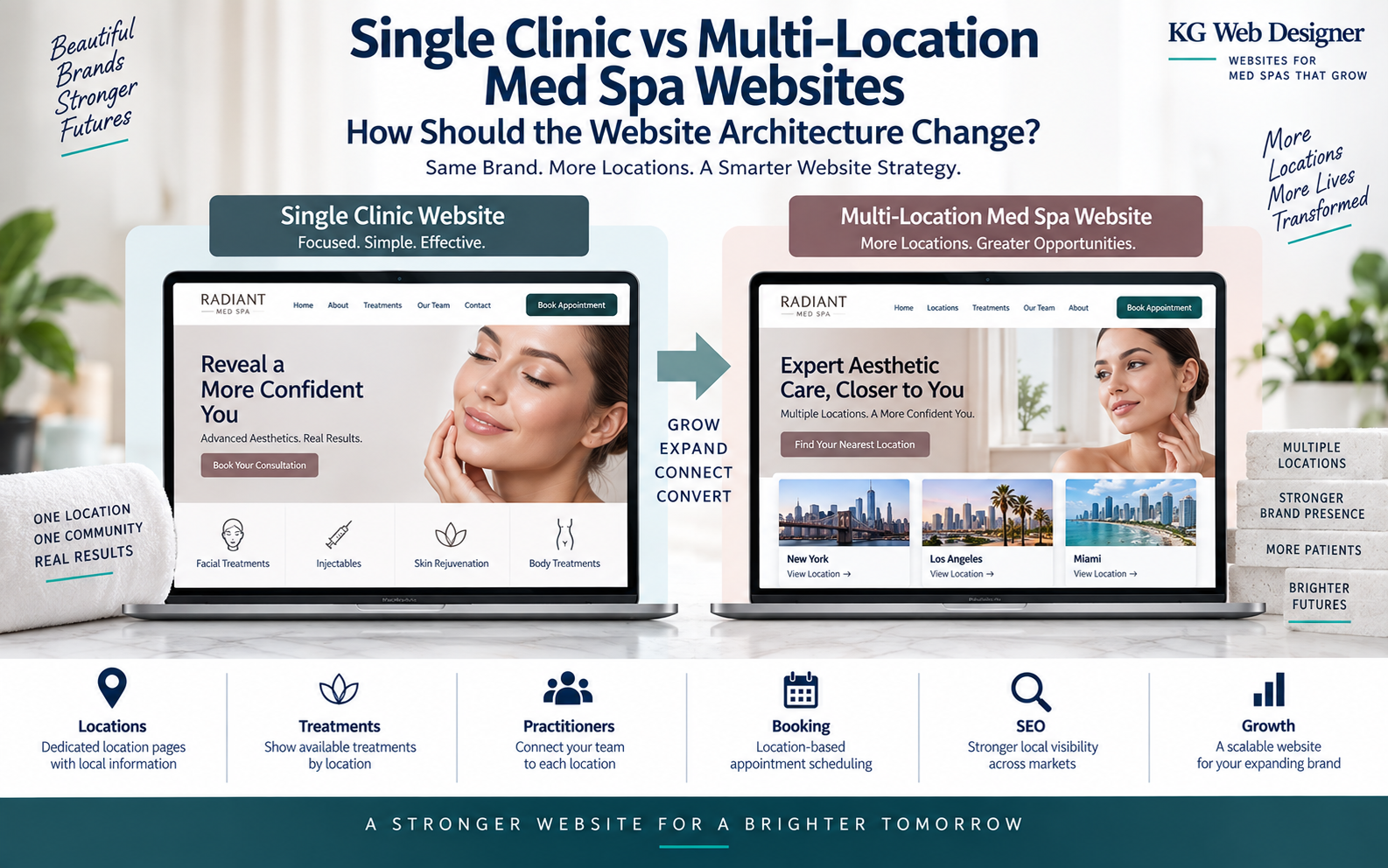
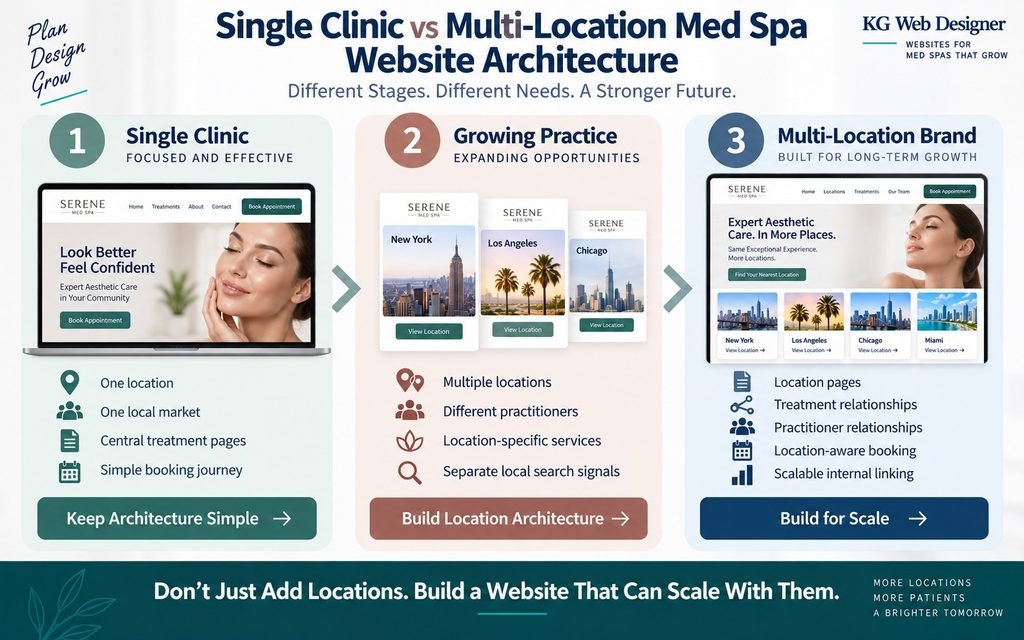
The biggest difference is not the number of locations. It is the number of patient decisions the website has to support.
A single clinic generally has one physical destination, one local reputation ecosystem, one primary set of hours, and a relatively straightforward booking path. A multi-location med spa introduces additional decisions: which location is closest, which location offers a treatment, which practitioner works there, whether the treatment is available on the requested date, and whether the patient should book at one location rather than another.
| Website Requirement | Single Clinic | Multi-Location Practice |
|---|---|---|
| Homepage | Brand + primary location | Brand + location discovery |
| Location page | Usually one core location section/page | Dedicated page for each location |
| Treatment pages | Shared treatment architecture | Shared treatments linked to relevant locations |
| Practitioner profiles | Centralized profiles | Profiles connected to locations |
| Booking | One primary location | Location-aware booking |
| Reviews | One primary reputation set | Location-specific reputation |
| Local SEO | One geographic market | Multiple geographic markets |
| Google Business Profile | One eligible profile | Eligible physical locations can have individual profiles |
| Navigation | Relatively simple | Requires location selector or location hierarchy |
| Scalability | Low complexity | Architecture must support expansion |
Google’s current Business Profile guidance says businesses with different physical locations can have profiles for those locations when they meet the eligibility requirements. Google also states that businesses should not create more than one Business Profile page for each physical location.
This distinction matters because your website architecture and your Google Business Profile architecture should describe the same real-world business. If the website says a clinic has five locations but the patient cannot clearly determine where each service is provided, the digital experience becomes harder to trust.
Why Does Multi-Location Med Spa Website Design Require a Different Architecture?
Multi-Location Med Spa Website Design requires a location-aware information architecture because patients are not simply choosing a treatment. They are choosing a treatment, provider, place, time, and level of confidence at the same time.
A single-location practice can place its address, map, phone number, hours, and booking CTA consistently across the site. A multi-location organization cannot safely assume that the same information applies everywhere. One location may have a different practitioner team, treatment availability, hours, parking instructions, or consultation process.
That creates several architecture requirements:
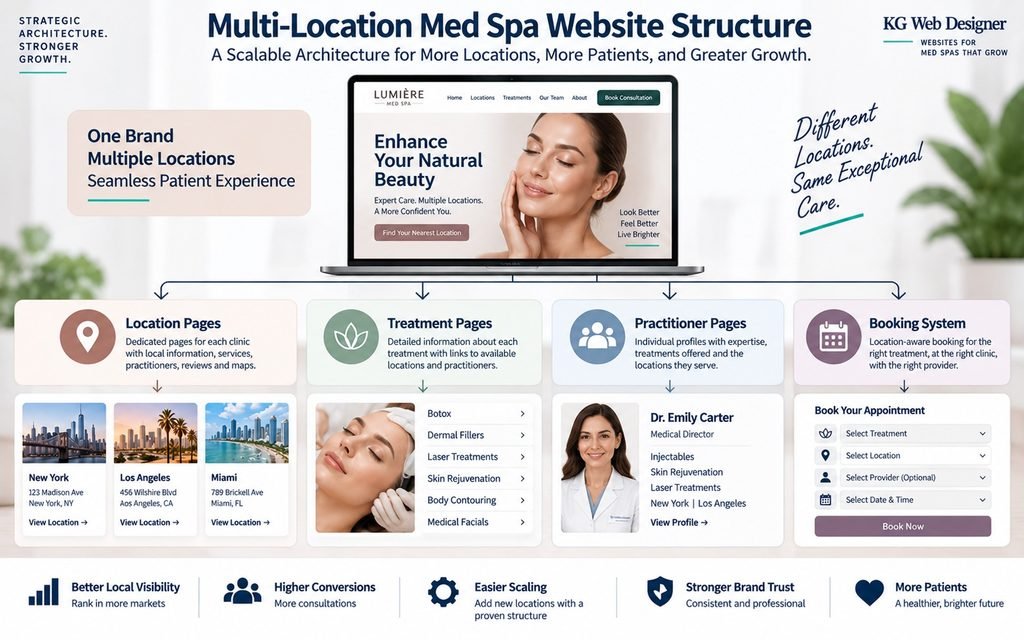
- A central brand layer explains who the organization is.
- A treatment layer explains what the practice offers.
- A location layer explains where each service is delivered.
- A practitioner layer explains who performs or oversees treatments.
- A booking layer connects the patient to the correct location.
- A proof layer reinforces reviews, expertise, results, and reputation.
- An internal-linking layer connects treatments, practitioners, and locations without creating a confusing maze.
Google’s structured data guidance also supports clearly communicating business information through LocalBusiness structured data, including business details and other relevant attributes.
The architecture therefore needs to represent the actual organization, not just its keyword strategy.
What Should the Website Structure Look Like for Multiple Locations?
The strongest structure is usually hierarchical rather than flat.
A scalable example could look like this:
Homepage
→ Locations
→ Location A
→ Location B
→ Location C
→ Treatments
→ Treatment A
→ Treatment B
→ Treatment C
→ Practitioners
→ Practitioner A
→ Practitioner B
→ About / Brand
→ Patient Resources
→ Contact / Consultation
The exact URL structure can vary, but the conceptual relationship should remain clear.
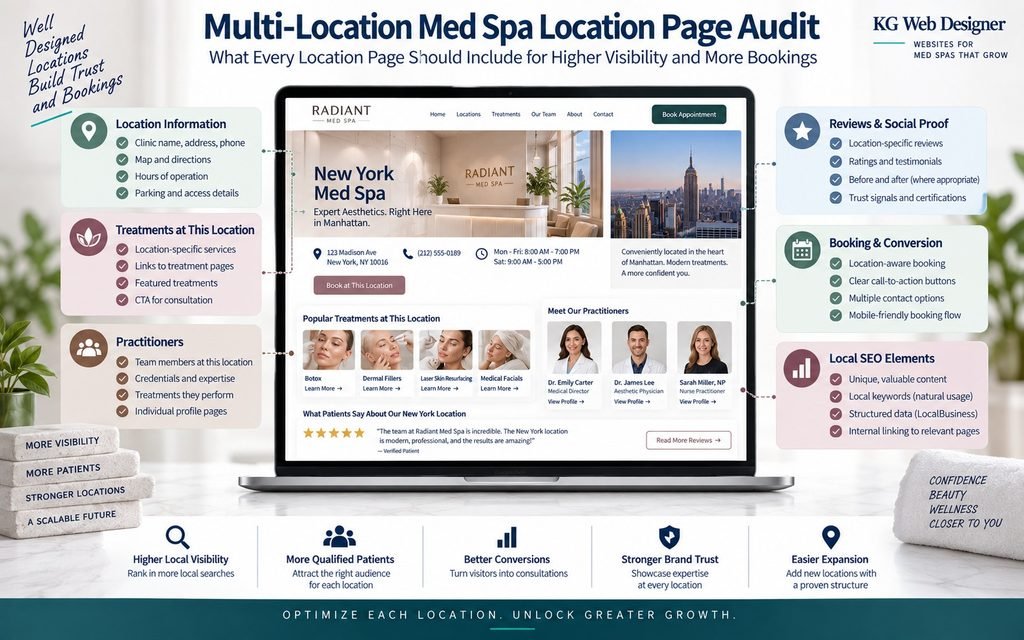
For example, a location page might contain:
- Location name
- Address
- Phone number
- Hours
- Parking or access information
- Embedded map
- Available treatments
- Practitioners based there
- Location-specific photos
- Reviews or testimonials where appropriate
- Booking options
- Frequently asked location questions
- Links to relevant treatment pages
The important point is that the location page should not be treated as a city-specific landing page created only for search engines.
Google explicitly warns against creating large numbers of pages primarily to manipulate search rankings. Its current spam guidance describes scaled content abuse as creating many pages with little original value, including pages generated primarily around keywords.
That is especially important for multi-location med spas.
One Med Spa Location and Five Locations Shouldn’t Use the Same Website Structure
As your clinic footprint grows, patients need clearer paths to the right location, treatment, practitioner and booking experience.
Your architecture should make a growing clinic network easier for patients to navigate — not more complicated.
Explore Med Spa Website Design →Should Every Location Have Its Own Page?
Yes, when each location represents a genuine patient-facing clinic with information that matters to patients.
A dedicated location page becomes commercially useful when patients need to know where the clinic is, what is offered there, who works there, how to get there, and how to schedule an appointment. It also gives search engines a clearer representation of the relationship between the business and its physical locations.
However, creating a page for every neighborhood served is a different strategy.
For example, if a clinic has a real location in Manhattan and patients travel from nearby neighborhoods, it does not automatically follow that the business needs separate pages for every neighborhood. A useful location page can naturally explain the areas it serves without creating dozens of thin pages.
Google’s guidance emphasizes that content should serve users rather than being produced at scale simply to capture search variations.
This is one of the places where architecture and SEO strategy need to work together.
A location page should exist because the location matters to the patient, not simply because the location name has search volume.
How Should Treatment Pages Work Across Multiple Locations?
Treatment pages should normally remain centralized when the treatment is substantially the same across locations, with clear connections to the locations where that treatment is actually offered.
For example:
Botox
→ Available at New York
→ Available at Brooklyn
→ Available at Westchester
This prevents the website from creating three nearly identical Botox pages simply because the business operates in three markets.
There are exceptions. A genuinely location-specific treatment page can make sense when the treatment differs materially by location, the provider expertise differs, the patient journey is different, or the service is marketed and delivered in a meaningfully different way.
The decision should therefore be based on information architecture and patient intent, not a blanket rule that every treatment must have a city variation.
A useful architecture separates shared treatment knowledge from location-specific delivery information.
That gives the patient both pieces of information without forcing the business to maintain dozens of near-duplicate pages.
How Should Practitioners Be Connected to Locations?
Practitioner profiles should show both expertise and location relationships when those relationships are meaningful to patients.
A prospective patient researching an injectable treatment may want to know who performs it. A patient choosing between two locations may also want to know whether the practitioner they prefer works at the closer clinic.
A useful practitioner profile can include:
- Name and professional credentials
- Role
- Areas of expertise
- Relevant treatments
- Locations served
- Professional philosophy
- Appropriate experience information
- Consultation approach
- Links to relevant treatment pages
- Booking options
The profile should then link back to the relevant locations.
This creates a useful three-way relationship:
Treatment → Practitioner → Location
That relationship is much stronger than keeping all practitioner information isolated on an “Our Team” page.
For a multi-location organization, the website should help patients answer a simple question: Who can help me, where can I see them, and what should I do next?
What Does the Data Say About Multi-Location Med Spa Growth?
The commercial case for scalable architecture becomes stronger as the organization grows because location expansion increases the amount of operational and marketing information that must remain consistent.
Zenoti’s 2026 Beauty and Wellness Benchmark Report found that medspa location count grew 18% in 2025, while total revenue grew 8%. It also reported that new guest visits declined 11%, making retention and re-engagement increasingly important for sustainable growth.
The same report found a substantial difference in online booking rates between medspa operators at different performance levels: 32% at the 90th percentile compared with 13% at the median. Zenoti notes that medspas are consultation-driven, so the metric should be interpreted in that context.
This matters for architecture because adding locations does not automatically solve acquisition problems.
If the website makes it difficult to determine which clinic provides a treatment or how to book the correct location, expansion can increase complexity without improving the patient journey.
More locations create more opportunities only when the digital system can clearly represent those locations.
What Does Multi-Location Local SEO Need From the Website?
Multi-Location Med Spa SEO works best when each physical location is represented accurately and supported by genuinely useful local information.
Google’s Business Profile guidelines require businesses to represent real-world locations accurately and provide information that connects users to the individual location. Google also says that eligible businesses with separate locations and appropriate staff can maintain profiles for those locations.
The website should reinforce this structure through:
- Location-specific pages
- Accurate name, address, and phone information
- Consistent location details
- Links between location pages and relevant treatments
- Location-specific practitioner information
- Local reviews and reputation signals
- Clear directions and accessibility information
- Relevant structured data
- Consistent booking paths
BrightLocal’s 2026 research found that 84% of consumers had searched online for a local business in the previous three months. Its research also found that 23% had used AI during their most recent local search, while many AI users continued to verify information through Google and other channels.
That makes consistency increasingly important.
If an AI system, Google Search, Google Maps, and the website provide conflicting information about a location, the patient has more reason to hesitate.
A strong content ecosystem should connect your location architecture with your wider patient-acquisition strategy. For example, your article about med spa marketing strategy can support the broader discussion of how SEO, social media, reputation, and the website work together rather than treating the location page as an isolated asset.
Can Patients Find the Right Clinic Without Thinking About It?
A multi-location med spa website should quickly connect each patient with the right clinic, available treatments, practitioners and booking journey.
What Should Multi-Location Booking Look Like?
Multi-Location Appointment Booking should reduce the number of decisions a patient has to make rather than forcing the patient to understand the organization’s internal structure.
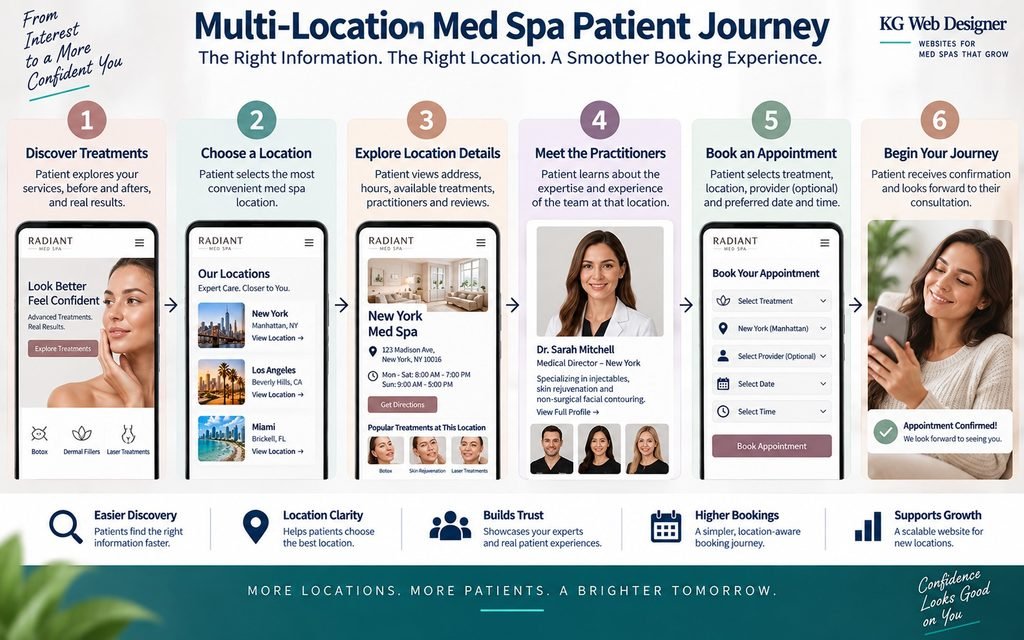
A good booking journey might begin with:
Choose Treatment
→ Choose Location
→ Choose Practitioner, if relevant
→ Choose Date and Time
→ Confirm
Alternatively, when a patient starts from a location page:
Location
→ Available Treatments
→ Choose Treatment
→ Book
The correct flow depends on how the business actually operates.
The important thing is to avoid situations where a patient selects a treatment, reaches a generic booking system, and then has to start over to find the correct clinic.
Zenoti’s 2026 benchmark data shows why online booking deserves attention. Medspa online booking was 13% at the median and 32% at the 90th percentile in its North American dataset.
That does not mean every med spa should target 32%.
It means booking behavior should be measured as part of the wider patient journey.
Example Scenario
Consider a med spa operating one clinic in New York.
Its website can use a relatively straightforward structure:
Home → Treatments → Practitioners → About → Book
Now imagine the same organization opens locations in Brooklyn, Long Island, and New Jersey.
The old architecture starts creating problems.
The homepage has to explain four locations. The booking system has to distinguish between them. Practitioners may work at different clinics. Some treatments may be available only at specific locations. Reviews become location-specific. Local search visibility becomes more complex.
At that point, the correct solution is not simply adding four addresses to the footer.
The architecture should evolve:
Home → Locations → Individual Location Pages
with treatments, practitioners, and booking pathways connected to the relevant location.
The business has not merely added four pages.
It has created a clearer representation of how the business actually operates.
Example From Our Experience
A relevant KG Web Designer project is the Taruj Skincare redesign, a Florida-based natural and organic skincare brand. The project involved moving from Squarespace to WordPress and WooCommerce, with work across website strategy, UX/UI, conversion optimization, mobile experience, and SEO foundations.
The important lesson for a multi-location med spa is not that skincare ecommerce and medical aesthetics are identical. They are not.
The useful lesson is architectural.
During the Taruj project, the discovery process looked beyond visual appearance and examined customer journey, product discovery, trust factors, mobile usability, purchase friction, brand perception, and future marketing requirements. The project ultimately treated the website as a growth platform rather than simply a redesign.
For a multi-location med spa, the same principle applies.
Problem: The organization grows faster than the original website structure.
Solution: Rebuild the information architecture around the actual patient journey, locations, services, practitioners, trust signals, and conversion paths.
Outcome: A scalable website structure that can support future growth without repeatedly rebuilding the navigation and page relationships.
This is also why I would not recommend starting a multi-location project by asking, “How many pages do we need?” I would start by asking, “What decisions does a patient need to make before booking?”
What Should You Avoid When Building Location Pages?
Avoid building a multi-location website that looks technically sophisticated but gives patients almost no useful local information.
Common mistakes include:
- Copying the same location page repeatedly.
Changing only the city name creates weak differentiation and increases maintenance without necessarily improving the patient experience. - Putting every location under one generic page.
This can make it harder for patients to find location-specific details and can weaken the relationship between the website and individual local profiles. - Creating treatment-location duplication without a reason.
Not every treatment needs a separate page for every clinic. - Using one generic booking CTA everywhere.
A patient should understand where the booking will occur before submitting an appointment request. - Ignoring practitioner-location relationships.
If practitioners work at different clinics, the architecture should make that understandable. - Treating local SEO as separate from UX.
A page that ranks but creates confusion is not a successful commercial asset. - Creating pages for every nearby neighborhood.
Local relevance should come from genuine business relationships and useful information, not mass-produced location variations.
Google’s current Search guidance specifically warns against producing large quantities of low-value pages for search manipulation.
Every Location Needs More Than a City Name Swapped Into the Same Page
Location Relevance
Useful information specific to that clinic and local patient.
Treatment Mapping
Make it clear which services are actually available at each location.
Local Trust
Practitioners, reviews and evidence relevant to the selected clinic.
Booking Route
Send patients directly to the correct clinic’s consultation flow.
Strong multi-location architecture should support search visibility without creating repetitive, low-value location pages.
Improve Your Med Spa Website →Why Most Businesses Get This Wrong
Most businesses get this wrong because they think multi-location SEO means creating more location pages.
The real challenge is creating better relationships between pages.
A location page without relevant treatment information is incomplete. A treatment page without location information can leave a patient uncertain about availability. A practitioner page without location information makes it harder to decide where to book. A booking system without location context creates friction at the most commercially important point.
Another common problem is allowing every location to evolve independently.
One clinic adds a treatment. Another changes its hours. A third uses different terminology. A fourth has a different booking link. Over time, the website becomes inconsistent even though the brand appears unified.
Google’s Business Profile guidance emphasizes consistent names and categories across locations for chains and brands, while allowing location-specific information where appropriate.
The strongest multi-location websites therefore use centralized standards with controlled local flexibility.
What Does This Mean For Your Business?
The business impact of good architecture appears in several places.
First, patients can find the correct clinic faster. That reduces uncertainty and prevents unnecessary calls or abandoned booking journeys.
Second, search engines have a clearer understanding of the relationship between the organization, its locations, services, and practitioners.
Third, the organization becomes easier to scale.
A website built for one clinic can become increasingly expensive to maintain when the business reaches five, ten, or twenty locations. A properly planned architecture makes future additions more predictable because new locations can follow an established template and information model without becoming carbon copies.
This is where Multi-Location Med Spa SEO planning becomes a strategic investment rather than simply an SEO exercise.
The architecture also affects the quality of marketing traffic.
Paid campaigns, social media, local search, referrals, and AI-generated recommendations all eventually need a destination where patients can verify the business and decide what to do next. BrightLocal’s 2026 research shows that local search behavior increasingly spans multiple channels, with many consumers using more than one source before making a decision.
Expert Insight from Kanika Gupta
Kanika Gupta, Founder, KG Web Designer
If this were my website, I would not begin a multi-location project by creating location pages. I would first map the relationship between locations, treatments, practitioners, reviews, booking systems, and patient questions.
That distinction matters.
A website can have 50 well-designed pages and still have poor architecture if those pages do not help a patient understand what is available, where it is available, who provides it, and how to take the next step.
I also would not create separate treatment pages for every location unless there is a genuine reason for the content to differ. Shared treatment knowledge should remain centralized where possible, while location pages should add the local information patients actually need.
That approach is easier to maintain, easier to scale, and usually more useful to the person making the appointment.
A Practical Action Plan: What Should You Fix First?
If you are moving from one clinic to multiple locations, the order of work matters.
First: Map the real business structure
Document:
- Every physical location
- Treatments offered at each location
- Practitioners at each location
- Location-specific hours
- Booking systems
- Phone numbers
- Reviews
- Local service differences
- Unique patient questions
Do this before designing new pages.
Second: Build the information architecture
Create the relationship between:
Locations ↔ Treatments ↔ Practitioners ↔ Booking
Then decide which content belongs centrally and which content belongs locally.
Third: Build useful location pages
Each location should answer the questions a real patient has about that clinic.
Fourth: Connect local search signals
Review Google Business Profile information, local citations, location URLs, structured data, internal links, and on-site consistency. Google’s Business Profile guidance requires accurate representation of real-world locations and supports bulk management for businesses with 10 or more locations.
Fifth: Test the patient journey
Test the site on mobile.
Ask:
- Can I find the closest clinic?
- Can I see whether my treatment is offered there?
- Can I identify the relevant practitioner?
- Can I understand the consultation process?
- Can I book without restarting the journey?
Sixth: Measure location-level performance
Track:
- Organic traffic by location
- Local search visibility
- Calls
- Appointment requests
- Booking completion
- Treatment-level conversions
- Location-level conversion rates
- New patient acquisition
- Cost per qualified inquiry
A multi-location website should be managed as a commercial system, not just a collection of pages.
When Does Professional Help Make Sense?
Professional help makes sense when the architecture has become difficult to manage, the business is expanding rapidly, location pages are competing with each other, booking paths are inconsistent, or the existing CMS cannot represent the organization’s structure cleanly.
It is particularly important before a major redesign or migration.
Changing URLs, navigation, templates, internal links, structured data, and booking systems simultaneously can create unnecessary SEO and conversion risk if the project is approached as a visual redesign alone.
KG Web Designer is a conversion-focused website design studio specializing in custom websites for clinics, professional services, manufacturers, and growing businesses. For a multi-location med spa, the work should begin with business and patient-journey architecture before visual design decisions are finalized.
If you are planning a redesign, expansion, or migration, the relevant service is not simply a prettier website. It is a scalable digital structure that can support the way your organization intends to grow.
When evaluating the broader patient acquisition system, it is useful to consider how social discovery connects with website conversion. KG Web Designer’s analysis of med spas receiving Instagram inquiries explains why social media can create initial interest while the website must provide the deeper information, trust, and decision support needed before consultation.
A Stronger Multi-Location Website Starts With the Patient Journey
A Med Spa Website Design strategy should make the business easier to understand, easier to find, and easier to book.
The best architecture does not create the maximum number of pages. It creates the minimum structure necessary to accurately represent the organization and answer the questions patients have at each stage of their decision.
A single clinic may need simplicity.
A growing med spa needs scalability.
A mature multi-location organization needs governance, consistency, local relevance, strong conversion paths, and an architecture that can continue expanding without becoming chaotic.
That is the difference between adding locations to a website and building a website that is actually ready for multi-location growth.
A separate KG Web Designer article on Read the med spa website redesign analysis examines why a dated visual appearance is not, by itself, sufficient evidence that a full rebuild is necessary. That distinction is particularly relevant when a multi-location practice is deciding whether to restructure its existing site or start again.
Final Thoughts
The right architecture for a multi-location med spa is not simply a larger version of a single-clinic website.
It needs to represent the relationships between locations, treatments, practitioners, patient questions, reviews, local search signals, and booking paths. When those relationships are clear, the website becomes easier for patients to use, easier for teams to manage, and easier to scale.
Multi-Location Med Spa Website Design should therefore be treated as a business architecture decision before it becomes a visual design project.
If you are expanding locations, restructuring an existing website, or planning a redesign, KG Web Designer can help you map the architecture around your actual patient journey, services, locations, and growth plans.
Plan a Med Spa Website Strategy with KG Web Designer

Your Website Architecture Should Be Ready to Grow With Your Med Spa
If you’re moving from one clinic to multiple locations, let’s review how your website should handle location pages, treatments, practitioners, local search visibility and booking without creating unnecessary complexity.
FAQs
When should a med spa move from a simple website to a location-based architecture?
A med spa should consider a location-based architecture when it has multiple patient-facing clinics, different location information, location-specific practitioners, different treatment availability, or separate local booking requirements. The transition is especially important when patients are beginning to search for individual clinics rather than only the overall brand.
How can a med spa keep its website manageable as it adds locations?
Use a standardized location template supported by structured content fields rather than manually designing every page from scratch. Centralize information that is genuinely shared, while allowing location-specific details such as practitioners, hours, services, directions, photos, and booking links to remain editable for each clinic.
Should a multi-location med spa use one website or several websites?
One website is often more manageable when the brand, services, and operating model are substantially shared across locations. Separate websites may make sense when brands, markets, services, ownership structures, or patient journeys are genuinely different. The decision should be based on business structure and user experience rather than simply the number of locations.
How should reviews be displayed across multiple med spa locations?
Reviews should be associated with the correct business location wherever the platform and website implementation support that distinction. Patients evaluating a clinic generally benefit from seeing evidence relevant to the location they are considering rather than being shown an undifferentiated collection of reviews from every branch.
How can a multi-location med spa prevent location pages from becoming duplicate content?
Keep shared treatment education centralized and make each location page genuinely useful with unique local information. Include the clinic’s practitioners, services, hours, directions, photos, local experience, booking options, and other details that help a patient make a location-specific decision.
What should a med spa measure after launching new location pages?
Measure more than organic traffic. Review calls, appointment requests, booking completion, treatment-level conversions, local search visibility, engagement with location pages, and new-patient acquisition by location. The goal is to determine whether the new architecture is producing commercially useful patient activity.
How should AI search be considered in multi-location website architecture?
AI search should be treated as another reason to make business information clear, accurate, structured, and consistent. BrightLocal’s 2026 research shows that AI is increasingly being used for local business recommendations, while many users still verify information through Google and other channels.