Quick Answer
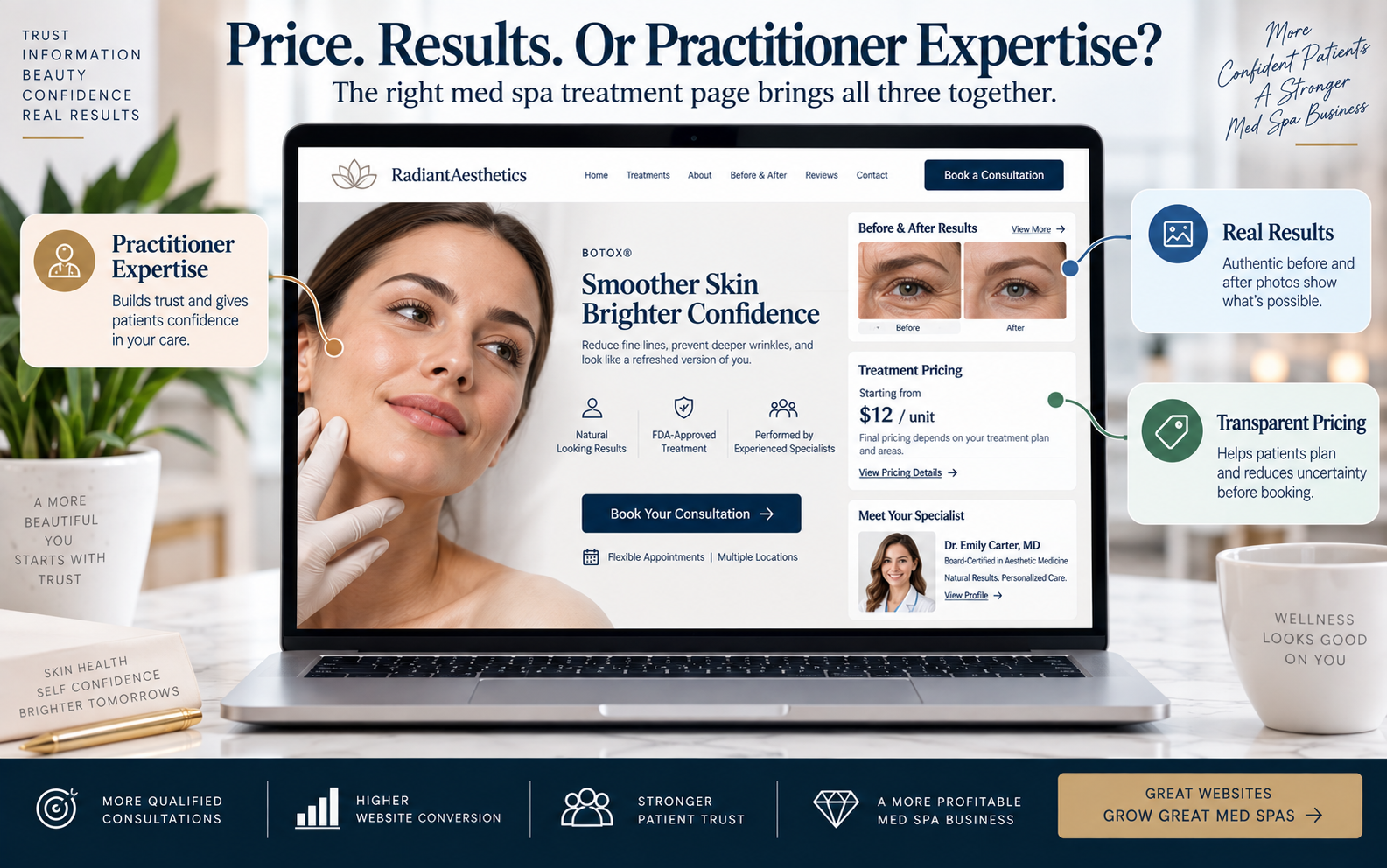
Med Spa Treatment Pages Design should lead with the treatment outcome and practitioner credibility, while making pricing visible enough to reduce uncertainty. Prospective patients need to understand what the treatment does, who performs it, what results may realistically look like, and what the next step involves. Price matters, but leading with price alone can make a medically informed aesthetic decision feel like a commodity purchase.
Key Takeaways
- Treatment pages should establish relevance, credibility, expected outcomes, and the next action before pushing a booking decision.
- Practitioner qualifications are particularly important because patients are evaluating both the treatment and the person delivering it.
- Pricing should be transparent enough to reduce uncertainty without becoming the dominant message on the page.
- Before-and-after galleries can support confidence when they are authentic, appropriately contextualized, and compliant with applicable advertising requirements.
- A strong treatment page should function as a decision-making asset, not simply as an SEO landing page.
- The best page hierarchy depends on treatment complexity, price, patient risk perception, provider expertise, and consultation requirements.
What Should Come First: Price, Results or Practitioner Expertise?
The answer is usually practitioner expertise and treatment relevance first, followed quickly by credible results and pricing context.
This does not mean hiding the price. It means understanding the psychology of the visitor. Someone researching Botox, dermal fillers, laser resurfacing, body contouring, or another aesthetic procedure is rarely asking only, “How much does this cost?” They are also asking, “Is this appropriate for me?”, “Who is going to perform it?”, “Can I trust them?”, “What could I realistically expect?”, and “What happens if I decide to proceed?”
That distinction is commercially important.
The American Society of Plastic Surgeons reported more than 28.5 million minimally invasive cosmetic procedures in 2024, including 9.88 million neuromodulator injections and 5.33 million hyaluronic-acid filler procedures. Aesthetic demand is therefore substantial, but competition for patient attention is also substantial.
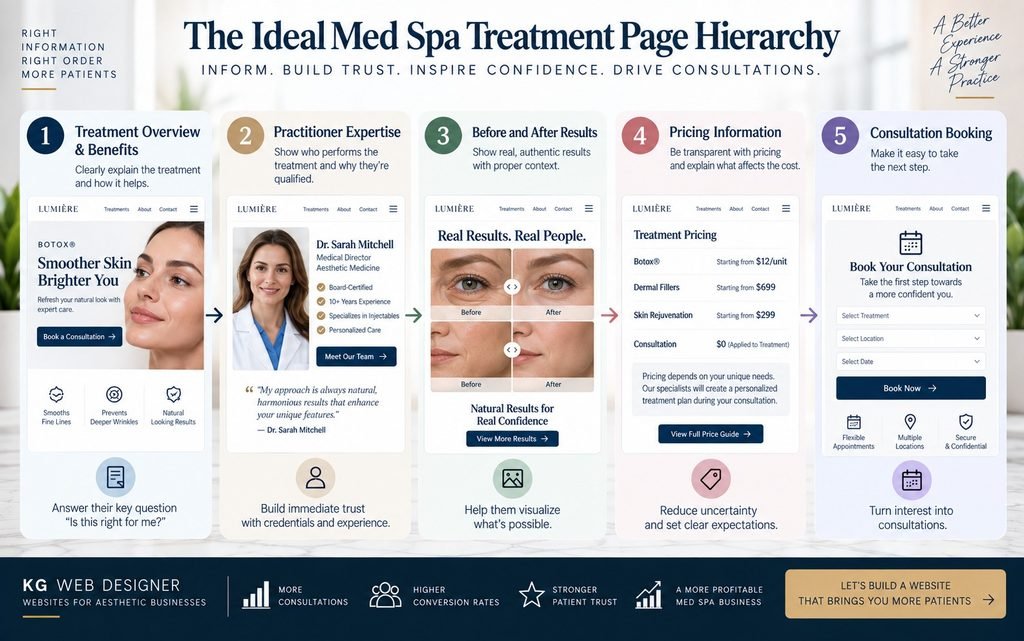
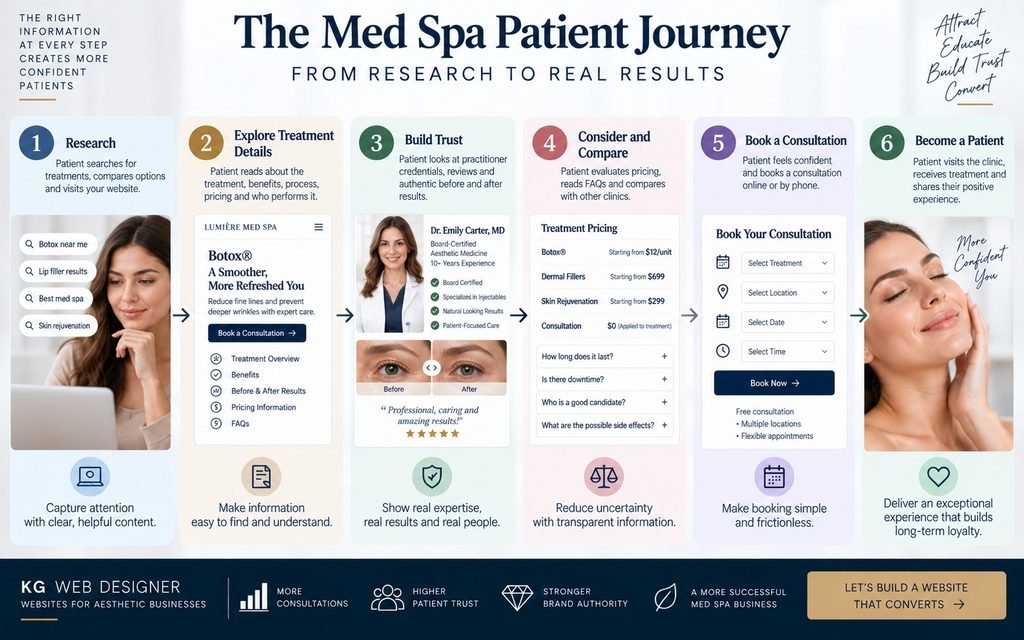
For a treatment page, the objective should not be to force every visitor into an immediate booking. The objective is to move the right visitor from interest → relevance → credibility → confidence → consultation.
A practical treatment-page hierarchy
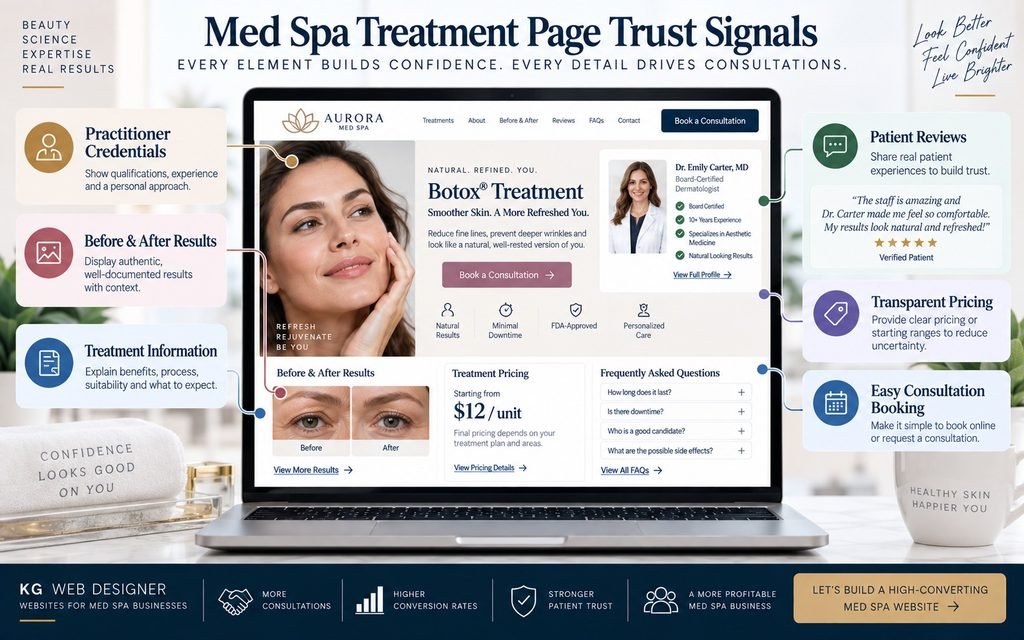
| Page element | Primary job | Recommended priority |
|---|---|---|
| Treatment relevance | Confirm the visitor is in the right place | Very high |
| Practitioner expertise | Establish credibility and safety | Very high |
| Treatment benefits | Explain why the treatment may matter | Very high |
| Before-and-after evidence | Demonstrate experience and possible outcomes | High |
| Pricing information | Reduce financial uncertainty | High |
| Consultation CTA | Give qualified visitors a next step | High |
| FAQs | Remove remaining objections | High |
| Technical details | Support informed decision-making | Medium to high |
The exact order can change by treatment. A straightforward treatment with standardized pricing can introduce price earlier. A complex treatment requiring assessment should place more emphasis on practitioner expertise, suitability, consultation, and realistic outcomes.
Why Does Practitioner Expertise Deserve Such Prominent Placement?
Yes, practitioner expertise should be highly visible because aesthetic patients are evaluating the provider as much as the treatment.
This is supported by research rather than just design preference. A global Cosmetic Injectable Patient Experience Exploratory Study surveyed 1,488 respondents across 75 countries and found that qualifications and training ranked first among factors influencing trust in a cosmetic injector, followed by practitioner reputation and the amount of time spent with the patient.
That finding changes how a treatment page should be structured.
A practitioner profile buried three clicks away does little to reduce uncertainty at the moment a prospective patient is deciding whether to continue. The treatment page should connect the procedure with the relevant practitioner, credentials, experience, areas of expertise, and approach to patient assessment.
Another study examining how patients choose plastic surgery providers found that experience and board certification were particularly important when patients decided who should perform their cosmetic procedure.
For that reason, Med Spa Website Design should not treat practitioner information as an About-page exercise. It should be part of the conversion architecture.
A strong treatment page can introduce the practitioner close to the treatment explanation:
- Who performs the treatment?
- What qualifications do they hold?
- How long have they performed it?
- What types of patients do they commonly treat?
- What approach do they take?
- What happens during the consultation?
- When might they recommend against the treatment?
That last point is particularly powerful. A practitioner who explains when a treatment is not appropriate can appear more credible than one who appears willing to recommend everything.
Should Price Appear Before Results and Expertise?
No, price should not automatically be the first major message on an aesthetic treatment page.
Price is important because financial uncertainty can stop a prospective patient from progressing. But making price the dominant headline can unintentionally shift the visitor’s comparison from expertise and suitability to cost alone.
The better approach is contextual transparency.
For example, a treatment page might present:
Treatment: Dermal Fillers
Typical investment: Starting from $X
What affects cost: Treatment area, product selection, amount required, and individualized treatment plan
Next step: Consultation to determine suitability and exact treatment plan
This is more useful than simply displaying a number without context.
The goal of Med Spa Treatment Pricing is not merely to disclose a fee. It is to help a qualified visitor understand the financial commitment without pretending that every patient receives an identical treatment.
Pricing can also qualify leads.
If your minimum treatment investment is outside someone’s budget, transparent information may prevent an unproductive enquiry. That is not necessarily a lost conversion. It can be a more efficient conversion system because the enquiries reaching your team are more commercially qualified.
At the same time, clinics should avoid making unsupported claims such as “the cheapest in the city,” “best value,” or guaranteed financial outcomes. Treatment advertising involves health-related claims, and the FTC states that health-related advertising claims should have appropriate substantiation.
What Should Your Treatment Page Lead With?
The answer depends on what prospective patients need to understand before they feel confident enough to book.
Is cost one of the biggest questions patients need answered before considering treatment?
Do patients need to visualize realistic outcomes before they become interested?
Does practitioner experience play a major role in building confidence in the procedure?
Let’s identify where your treatment pages may be creating uncertainty or losing potential consultations.
Request a Website Audit →Do Before-and-After Results Build More Trust Than Pricing?
Yes, authentic before-and-after evidence can be extremely useful, but it should support practitioner credibility rather than replace it.
Prospective patients want evidence because aesthetic treatments are visual and outcome-oriented. A carefully presented gallery can help someone understand the type of change a clinic has experience producing.
However, a gallery without context can create another problem. Visitors may assume that a particular result is guaranteed for them.
That is why Med Spa Before and After Results should be presented with appropriate context, including the treatment performed, relevant patient information where permitted, realistic expectations, and appropriate disclaimers or consent practices.
The research supports the importance of previous work in cosmetic decision-making, but qualifications and training still ranked higher in the global cosmetic-injectables trust study.
In other words:
Results demonstrate experience. Credentials establish authority. Context makes both credible.
The gallery should therefore not dominate the page at the expense of the practitioner.
A stronger structure is:
- Treatment relevance
- Practitioner credibility
- Treatment explanation
- Appropriate results evidence
- Pricing context
- Consultation pathway
- FAQs and practical information
The FTC also warns that testimonials and endorsements can communicate implied health claims, meaning clinics should not assume that a patient testimonial is automatically safe simply because it reflects that patient’s experience. Claims communicated through testimonials still need appropriate substantiation.
What Should a Treatment Page Actually Explain Before Asking Someone to Book?
Yes, a treatment page should answer the practical questions that a prospective patient is likely to have before presenting the consultation as the next logical step.
A treatment page should explain enough for the visitor to determine whether further conversation is worthwhile.
The essential information includes:
- What the treatment is
- What concerns it is intended to address
- Who may be a suitable candidate
- Who may not be suitable
- How the treatment works at a high level
- What the appointment involves
- Expected downtime or recovery considerations
- When results may become visible
- How long results may last, where appropriate
- Potential risks and relevant considerations
- Practitioner credentials
- Before-and-after evidence where appropriate
- Pricing or starting investment
- Frequently asked questions
- Consultation or booking options
- Location and accessibility information
This is where Med Spa Website Content becomes commercially important.
Content should not be written simply to make the page longer or to insert keywords. It should exist because it answers a real decision question.
Baymard’s extensive ecommerce UX research is relevant here even though its research is not specific to medical aesthetics. Its studies consistently show that users rely heavily on product-page information when deciding whether to proceed, and that insufficient information can lead to abandonment. Its current benchmark also reports substantial room for improvement in product-page UX.
The same principle applies to treatment pages: missing decision information creates friction.
What Happens When Treatment Pages Lead With the Wrong Message?
No, there is no single universal first element that works for every treatment, but leading with the wrong message can create unnecessary conversion friction.
A treatment page that opens with a large discount may attract price-sensitive traffic but fail to communicate expertise. A page that opens with a huge before-and-after gallery may create interest but leave visitors uncertain about who performs the procedure. A page dominated by credentials may establish authority but fail to explain why the treatment is relevant.
The commercial problem is not simply poor design. It is message hierarchy.
Three common mistakes
1. Price-first pages
The visitor immediately sees a number but has little reason to believe the clinic is worth that investment.
2. Results-first pages
The visitor sees dramatic outcomes but receives insufficient context about suitability, provider expertise, or realistic expectations.
3. Credentials-only pages
The clinic establishes authority but fails to answer the visitor’s practical questions about the treatment itself.
The strongest pages connect all three.
At KG Web Designer, we approach treatment pages as conversion systems rather than isolated content pages. The question is not simply, “What should be above the fold?” It is, “What does this visitor need to know next to become more confident?”
For clinics that are also relying heavily on social media, this distinction becomes even more important. Your existing analysis on whether a med spa really needs a website when Instagram already generates leads makes the same strategic point: social media can create attention, while the website should help turn that attention into informed action.
How Should the Page Change for Botox, Fillers, Lasers and Complex Treatments?
Yes, the page hierarchy should change according to treatment complexity, risk perception, personalization, and the level of patient education required.
A simple, familiar treatment may need a concise explanation, clear pricing context, provider information, results, and an easy consultation pathway.
A more complex treatment may require considerably more education before the CTA becomes persuasive.
For injectables
Prioritize:
- Practitioner expertise
- Treatment areas
- Product information where appropriate
- Expected outcomes
- Before-and-after evidence
- Risks and considerations
- Pricing or starting investment
- Consultation
For laser treatments
Prioritize:
- Skin concerns treated
- Technology or treatment method
- Suitability
- Number of sessions
- Downtime
- Expected progression
- Practitioner expertise
- Results
- Pricing structure
For combination treatments
Prioritize:
- The patient’s underlying concern
- Why treatments may be combined
- Treatment sequencing
- Expected timeline
- Total investment range
- Practitioner assessment
- Consultation
This is why a templated approach often fails. Two treatment pages may use the same CMS template while requiring very different information architectures.
A good Med Spa Treatment Pages Design system should be flexible enough to accommodate those differences while keeping navigation, branding, CTAs, trust elements, and technical SEO consistent.
Don’t Decide Page Order Based on What the Clinic Wants to Say First
Build the page around what a prospective patient needs to know next. The strongest treatment pages reduce uncertainty progressively instead of overwhelming visitors with information.
What Should You Fix First If Treatment Pages Get Traffic but Few Consultations?
Yes, you should diagnose the treatment page before automatically increasing advertising or publishing more content.
If qualified visitors are already reaching the page, the first question should be where they stop progressing.
Review these areas in order:
- Search intent: Does the page actually match the query that brought the visitor?
- Treatment clarity: Can the visitor understand the treatment quickly?
- Practitioner credibility: Is the person delivering the treatment clearly identified?
- Evidence: Are results, reviews, credentials, and supporting proof easy to find?
- Price clarity: Does the visitor understand the likely financial commitment?
- Mobile UX: Can the page be comfortably researched on a phone?
- CTA relevance: Does the CTA match the visitor’s level of readiness?
- Booking friction: Can someone easily request a consultation without unnecessary steps?
- Measurement: Can you distinguish treatment-page visits from genuine consultation activity?
Our broader med spa website research reinforces this approach. In KG Web Designer’s July 2026 review of 24 public aesthetic clinic and medspa websites, 92% used generic treatment descriptions, 63% had limited practitioner-authority content, and 75% lacked FAQ or AI-readable content structures.
That is a useful proprietary observation because it identifies a recurring structural problem rather than claiming that every clinic needs a redesign.
If your treatment pages have traffic but weak consultation activity, I would inspect the page architecture and patient journey before increasing traffic acquisition.
If Your Treatment Pages Are Not Turning Interest Into Consultations
If the problem is treatment-page structure rather than traffic volume, a focused website strategy can be more valuable than simply adding another marketing channel. The right approach is to map treatment intent, practitioner credibility, evidence, pricing, FAQs, mobile experience, and consultation actions into one journey rather than treating each element independently.
KG Web Designer works with health, beauty, and aesthetic businesses on conversion-focused website strategy, treatment-page architecture, UX, and website redesign.
What Should a Med Spa Learn From a Real Beauty-Sector Website Project?
Yes, an adjacent skincare ecommerce project demonstrates an important lesson for aesthetic businesses: better visual design is not enough if the digital experience does not create confidence.
Taruj Skincare, a Florida-based skincare brand, approached KG Web Designer with an existing Squarespace website that was no longer supporting its growth plans. The project involved a redesign and migration to WordPress and WooCommerce, with work across product presentation, trust signals, mobile experience, conversion optimization, and future marketing infrastructure.
The project is not a med spa case study, so it should not be presented as one. It is relevant because skincare and aesthetic businesses share a critical digital challenge: customers need confidence before they commit.
Problem
The existing site had quality products and an existing customer base, but the digital experience did not fully communicate the premium positioning or provide enough persuasive product information.
Solution
KG Web Designer focused on:
- Premium visual positioning
- Stronger product presentation
- Trust signals
- Mobile UX
- Conversion-focused layouts
- Scalable ecommerce infrastructure
Outcome
The new WordPress and WooCommerce store received its first order on launch day. The affiliate system was also enabled, and the client subsequently commissioned an ongoing SEO engagement. These are documented outcomes from the project rather than projected performance claims.
The lesson for med spas is straightforward: the page should make the visitor more confident before asking them to take a commercially meaningful action.
Why Do Most Med Spa Treatment Pages Get This Wrong?
No, the problem is usually not that clinic owners do not care about conversion; it is that treatment pages are often built around the clinic’s priorities instead of the patient’s decision sequence.
A clinic may naturally want to lead with the treatment name, promotional price, booking button, or impressive result.
The prospective patient may instead be thinking:
- Is this treatment right for my concern?
- Who will perform it?
- What qualifications do they have?
- What will I realistically look like afterward?
- How much will this cost?
- How many sessions might I need?
- Is there downtime?
- What happens during the consultation?
- Can I trust these photos?
- What happens if I am not a candidate?
The difference between those two perspectives is where many conversion problems begin.
At KG Web Designer, one of the patterns we frequently see is that businesses invest heavily in visual polish while under-investing in decision architecture. A page can look premium and still make the patient work too hard to answer basic questions.
That is why Med Spa Website Conversion should be treated as an information and journey problem, not just a button-placement problem.
Turn Treatment Pages Into Patient Decision Pages
A strong treatment page should do more than explain a procedure. It should connect patient concerns with realistic results, practitioner credibility, useful pricing information and a clear path to consultation.
Explore Med Spa Website Design →Expert Insight from Kanika Gupta
Yes, I would put practitioner credibility ahead of price whenever the treatment involves meaningful clinical judgment or patient uncertainty.
Kanika Gupta, Founder, KG Web Designer
“If this were my website, I would not make the visitor choose between price, results, and expertise. I would make the page answer all three in the right sequence.
First, tell me why this treatment may be relevant. Then show me who is qualified to perform it. Then show me credible evidence of the type of results the clinic achieves. Give me enough pricing information to understand the investment. Then make the consultation feel like the natural next step.
That sequence sells confidence, not just a procedure.”
That is also consistent with the published cosmetic-injectables research. Qualifications and training ranked as the strongest trust factor in the 1,488-person global survey, while practitioner online presence ranked much lower.
This is an important distinction for website strategy. A polished Instagram presence can create familiarity, but it does not replace clear evidence of qualifications, treatment expertise, and patient-centered communication.
What Does This Mean for Your Med Spa?
Yes, the financial opportunity is to make every treatment page work harder before asking your marketing channels to deliver more traffic.
A high-quality treatment page can contribute to:
- Better-qualified consultation requests
- Stronger trust before the first conversation
- Lower uncertainty around treatment investment
- Better alignment between search intent and landing-page content
- Stronger practitioner positioning
- More useful organic search visibility
- Better mobile conversion paths
- More informed prospective patients
- Fewer repetitive questions for front-desk staff
The goal is not to make every visitor book.
The goal is to help the right visitor decide that your clinic deserves a consultation.
That is a very different conversion philosophy.
For clinics considering a broader redesign, the question should therefore be bigger than “Does our website look dated?” Your guide to choosing a med spa website design company explains why the agency should be able to diagnose treatment-page architecture, booking UX, credibility, local visibility, and conversion problems before recommending a redesign.
When Does Professional Website Help Make Sense?
Yes, professional help makes sense when your treatment pages are becoming a revenue bottleneck rather than simply a branding concern.
You should consider a strategic review when several of these conditions exist:
- Treatment pages receive organic or paid traffic but generate few enquiries.
- Visitors repeatedly ask questions that should already be answered online.
- Practitioner credentials are difficult to find.
- Before-and-after evidence is poorly organized.
- Pricing is either completely hidden or presented without context.
- Mobile visitors struggle to book.
- Different treatments have identical page structures despite different patient needs.
- Your analytics cannot show which treatments generate consultation activity.
- Your website looks premium but does not clearly communicate why your clinic is different.
This is also where the broader question of Med Spa Patient Trust becomes commercially important.
A website cannot manufacture clinical credibility. It can, however, make genuine credibility easier to discover, understand, and verify.
That is the role of good website strategy.
A Practical Three-Step Action Plan
Yes, you can improve treatment-page performance systematically without immediately rebuilding the entire website.
Step 1: Audit the existing treatment journey
Identify your highest-value treatments and review:
- Organic traffic
- Paid traffic
- Page engagement
- CTA clicks
- Consultation requests
- Mobile behavior
- Booking completion
- Search queries
- Frequently asked questions
Do not start by redesigning everything.
Step 2: Rebuild the information hierarchy
For each priority treatment, establish:
Relevance → Practitioner → Treatment → Evidence → Price → Expectations → FAQs → Consultation
Adjust the order where treatment complexity requires it.
Step 3: Measure consultation quality
Do not measure success only by pageviews.
Track:
- Consultation requests
- Qualified consultations
- Treatment-specific enquiries
- Booking completion
- Lead source
- Treatment interest
- Consultation-to-treatment progression where your systems permit
That creates a much stronger commercial feedback loop.
Final Thoughts
Med Spa Treatment Pages Design should be treated as a patient decision system, not simply a page template.
Price matters. Results matter. Practitioner expertise matters. But they do not carry equal weight at every point in the journey.
For higher-consideration aesthetic treatments, I would lead with treatment relevance and practitioner credibility, provide credible results evidence, make pricing sufficiently transparent, answer practical questions, and then make consultation the obvious next step.
The strongest treatment pages do not pressure visitors into booking. They remove enough uncertainty that the right visitors feel comfortable taking the next step.
If your treatment pages attract traffic but fail to generate the quality of consultations you expect, KG Web Designer can review the treatment-page architecture, patient journey, content hierarchy, mobile UX, trust signals, and conversion paths before recommending whether you need targeted optimization or a broader redesign.
Explore a conversion-focused website strategy for your med spa.
Not Sure What Your Treatment Pages Should Lead With?
Let’s look at your current pages from a prospective patient’s perspective and identify what needs to appear earlier, what needs more context and where the consultation journey can be clearer.
No pitch · No pressure · A focused discussion about your website
Frequently Asked Questions
Can one treatment page target several closely related patient concerns?
Yes. One treatment page can address several closely related concerns when they share the same treatment pathway and search intent. The page should use clear sections rather than creating multiple near-identical URLs simply to target minor keyword variations. Separate pages become more useful when the concerns, treatment protocols, practitioner expertise, or patient questions differ substantially.
Should the practitioner be introduced more than once on a treatment page?
Yes. A concise practitioner introduction near the treatment explanation can establish credibility, while a fuller practitioner profile or credentials section later can provide deeper evidence. Repeating the same biography word for word is unnecessary, but connecting the treatment with the person delivering it is often useful for decision-stage visitors.
Can treatment FAQs improve the patient experience without making pages too long?
Yes. FAQs can make a treatment page more useful when they answer genuine patient questions that are not adequately addressed in the main content. Baymard’s UX research has also found FAQ and Q&A content useful for addressing detailed information needs on product pages. The same information-design principle applies to treatment research.
Should every treatment page use the same CTA wording?
No. A visitor researching a treatment for the first time may respond better to “Discuss Your Options” or “Schedule a Consultation,” while a returning visitor who already understands the procedure may be ready for a more direct booking action. CTA wording should reflect the visitor’s stage of decision-making.
Can a treatment page build trust without showing dozens of testimonials?
Yes. Trust can come from multiple evidence types, including practitioner credentials, treatment experience, appropriate reviews, authentic results, clear expectations, transparent policies, and professional communication. A large testimonial wall is not a substitute for credible evidence. In some cases, a smaller amount of highly relevant proof is more persuasive.
Should med spa treatment pages include medical disclaimers?
Yes. Appropriate disclosures and patient-safety information should be included where relevant, but they should be written clearly rather than presented as a wall of legal text. The exact requirements vary by jurisdiction, practitioner type, treatment, and advertising rules, so clinics should have healthcare counsel or their relevant regulatory authority review claims and disclosures where necessary.
Can a treatment page rank well without publishing extremely long content?
Yes. Length alone does not determine whether a page is useful or competitive. A focused page that comprehensively answers treatment-specific questions, demonstrates expertise, matches search intent, and provides a strong patient journey can be more valuable than a longer page filled with repetitive text. Google explicitly emphasizes helpful, reliable, people-first content and original value rather than content created primarily to manipulate rankings.