Quick Answer
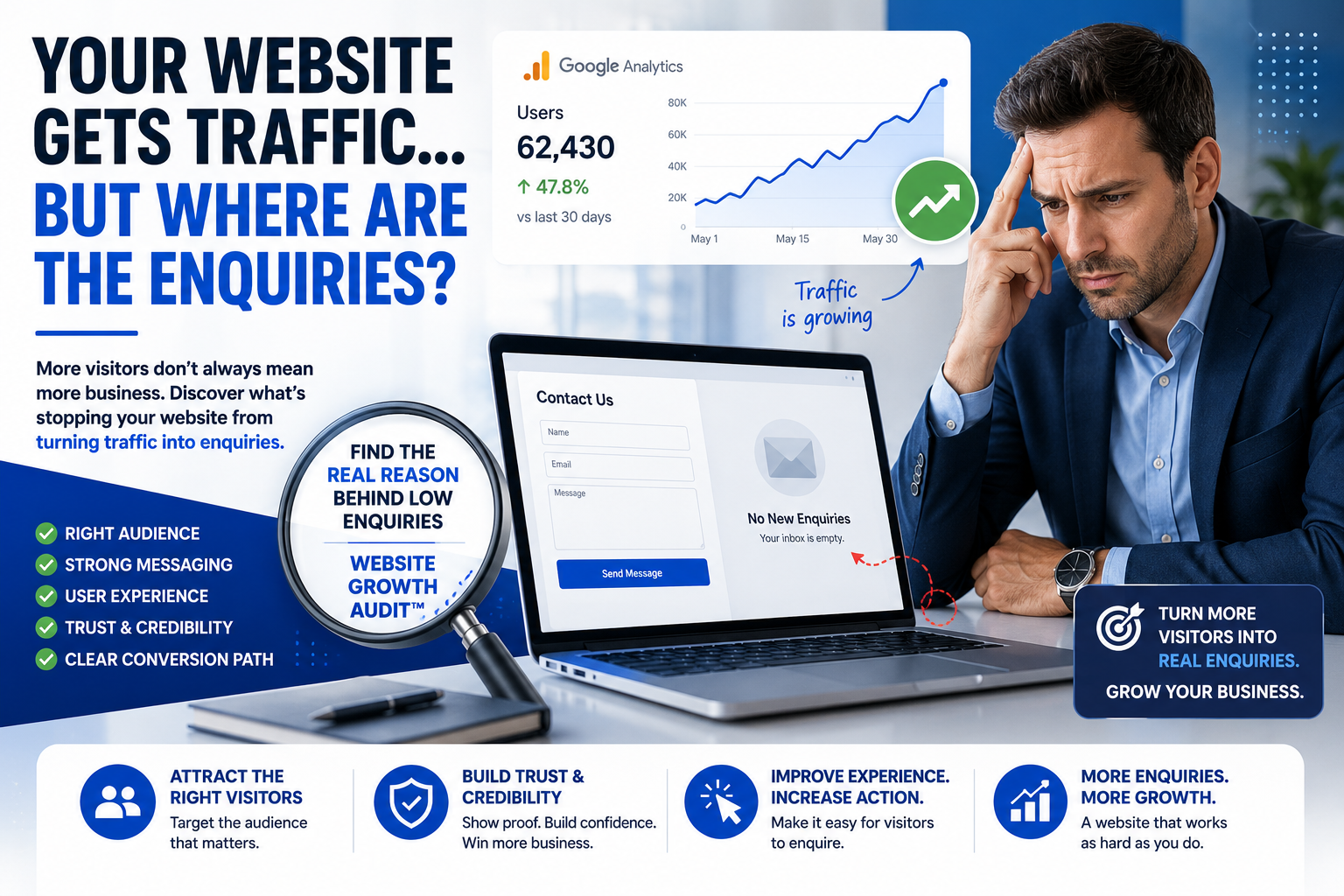
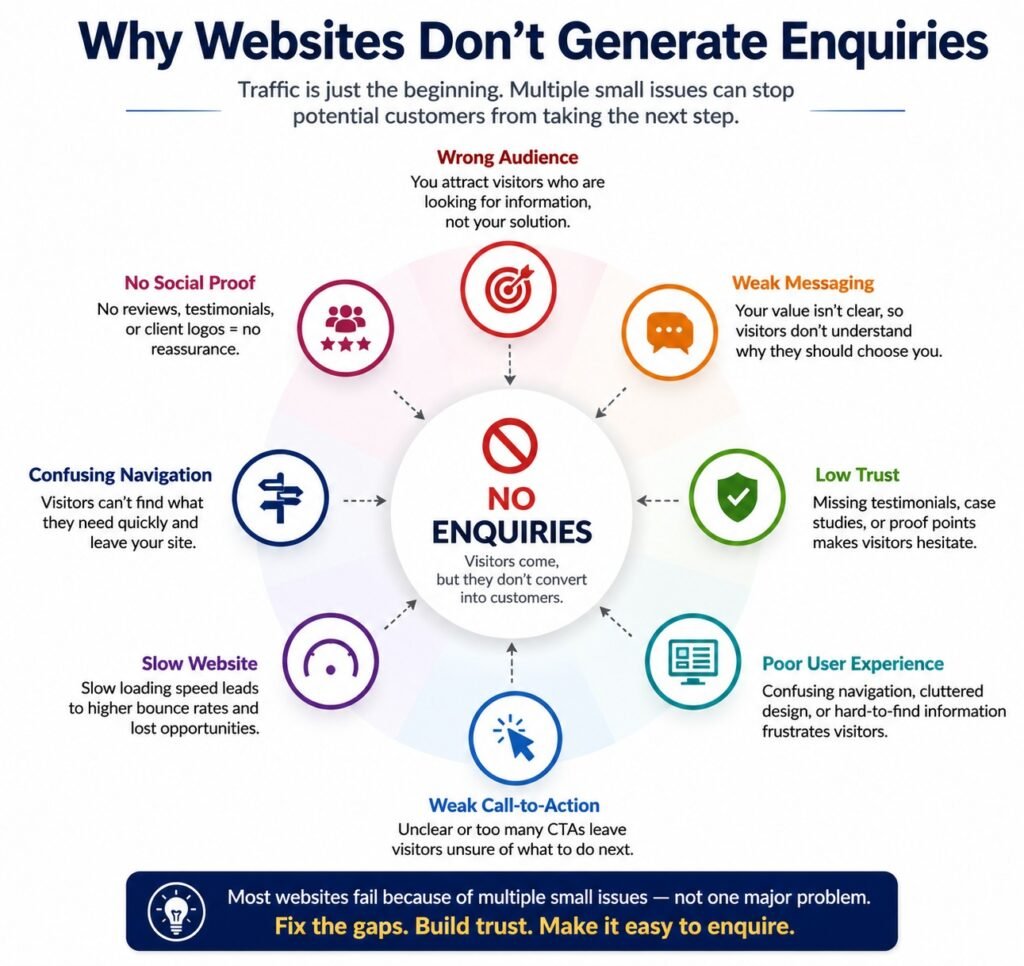
If your website gets traffic but no enquiries, increasing your marketing budget is rarely the first solution. In my experience, businesses usually face one or more of these problems:
- The wrong audience is finding the website.
- Visitors don’t develop enough trust to make contact.
- The customer journey doesn’t encourage enquiries.
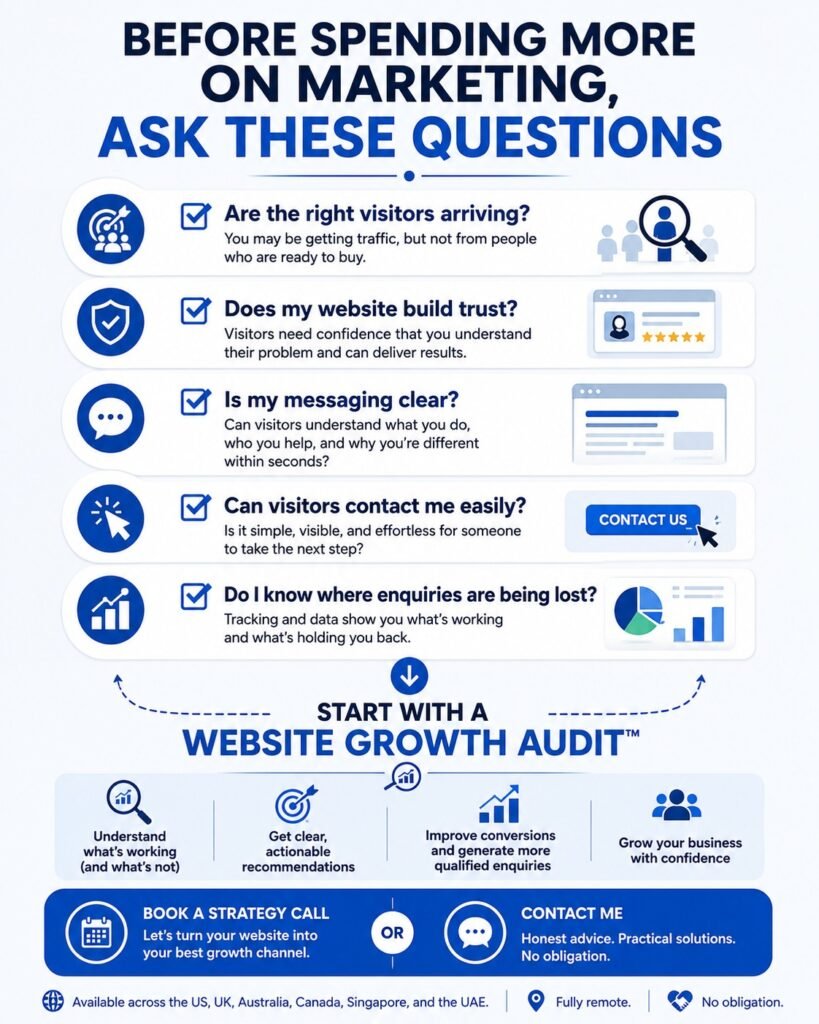
Before recommending SEO, Google Ads, or a website redesign, I conduct a Website Growth Audit to identify exactly where the customer journey breaks. That ensures every future marketing decision is based on evidence rather than assumptions.
TL;DR
- More traffic does not automatically generate more enquiries.
- Ranking for informational searches is different from attracting commercial buyers.
- Trust, messaging, UX, and positioning influence enquiries as much as SEO.
- Increasing your Google Ads budget won’t fix a broken customer journey.
- A Website Growth Audit™ identifies whether you need SEO, a redesign, better messaging, or conversion optimization.
- Diagnose first. Invest second.
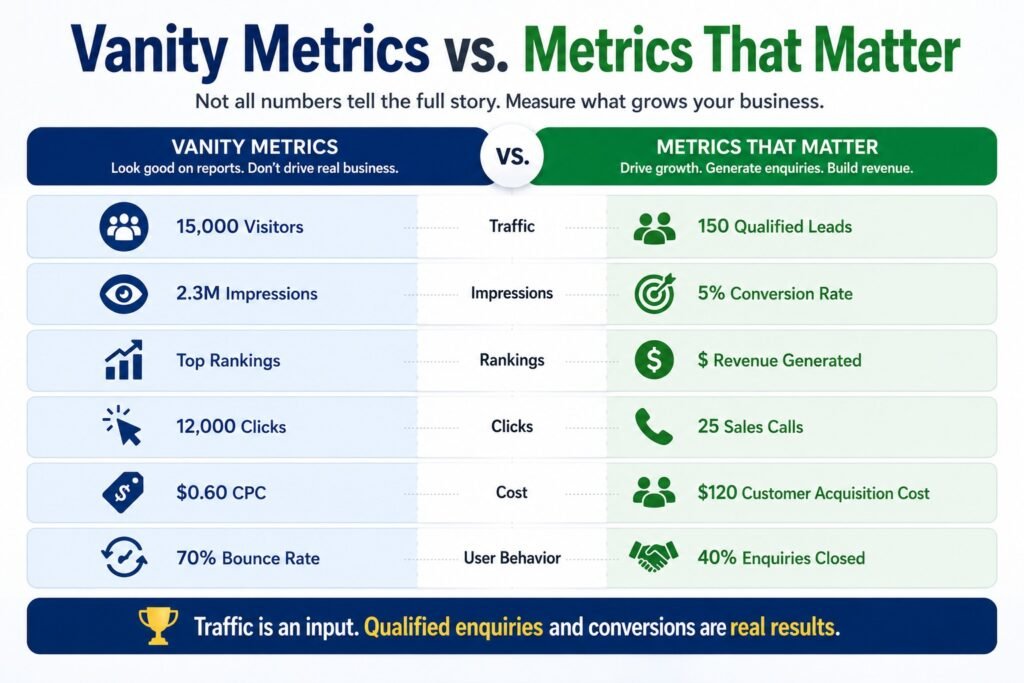
Website Metrics vs. Business Growth
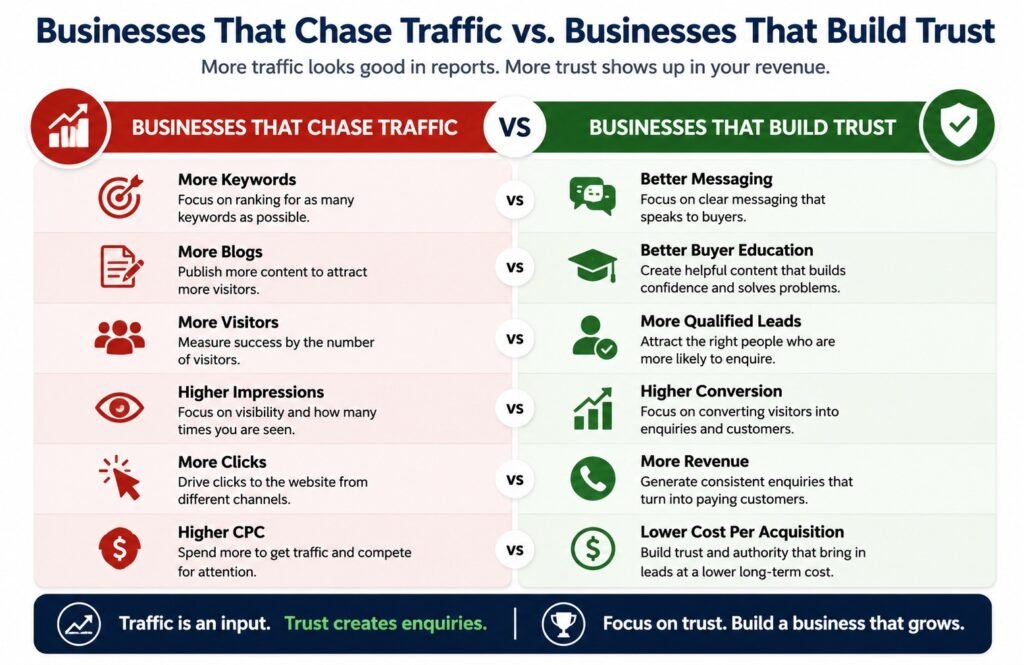
| Vanity Metrics | Business Growth Metrics |
|---|---|
| More traffic | More qualified enquiries |
| Higher impressions | Better conversion rates |
| More keyword rankings | Higher-value customers |
| Lower CPC | Lower cost per acquisition |
| More page views | More consultations and sales |
| More blog readers | More paying clients |
The difference is simple.
Traffic measures visibility.
Enquiries measure business growth.
Why Does My Website Get Traffic but No Enquiries?
This is one of the most common questions business owners ask after investing in SEO or Google Ads.
They’ve done everything they were told to do.
The website has been redesigned.
Content is published regularly.
Google Search Console shows healthy impressions.
Traffic continues growing.
Yet the phone barely rings.
The contact form receives only a handful of enquiries.
The business owner begins wondering whether they need another SEO agency, another advertising campaign, or another website redesign.
In many cases, none of those are the real problem.
The problem is that visitors arrive but never develop enough confidence to become customers.
Expert Advice from Kanika Gupta
“One of the biggest mistakes I see businesses make is assuming they have a traffic problem when they actually have a trust problem. Before increasing your SEO budget, Google Ads spend, or investing in a website redesign, identify exactly where potential customers lose confidence. The businesses that grow consistently aren’t always the ones with the most visitors. They’re the ones with the strongest customer journey.”
Kanika Gupta
Founder, KG Web Designer
One Last Thing Before You Continue…
At the end of this guide, I’ll share the exact AI Citation Scorecard I use during client audits to decide whether a page deserves a rewrite, should simply earn citations, or isn’t worth investing time in at all.
A Conversation I Hear Almost Every Week
A few weeks ago, a business owner booked a strategy call with me.
The conversation felt strangely familiar.
“Kanika, could you take a quick look at our website?”
“Of course.”
“We’ve invested in SEO for years.”
“Okay.”
“Traffic keeps increasing.”
“That’s encouraging.”
“Google Ads are running too.”
“Good.”
Then came the sentence I hear more often than almost anything else.
“…but we’re still not getting enquiries.”
I asked a few more questions.
“Are you publishing blog articles?”
Yes.
“Has the website been redesigned recently?”
Yes.
“Does your SEO agency send monthly reports?”
Every month.
On paper, everything looked healthy.
Traffic.
Rankings.
Impressions.
Blog content.
Advertising.
Everything seemed to be moving in the right direction.
Everything except the one metric that actually mattered.
New business.
This Isn’t an Isolated Problem
I’ve had almost the same conversation with:
- Manufacturing companies
- Consulting firms
- Healthcare providers
- Law firms
- Accountants
- Professional service businesses
- eCommerce brands
Different industries.
Different countries.
Different marketing agencies.
Exactly the same frustration.
“If our traffic keeps increasing, why aren’t our enquiries?”
That question eventually changed the way I evaluate websites.
Today, I rarely begin by talking about SEO.
I don’t immediately recommend Google Ads.
And I certainly don’t suggest a redesign before understanding what is actually happening.
Instead, I ask a different question.
“Where exactly does your customer journey break?”
That single question has shaped every website strategy I’ve developed since.
Original Observation From My Website Audits
After reviewing websites across multiple industries, I’ve noticed something surprisingly consistent.
Businesses rarely lack traffic.
They lack clarity.
Many websites successfully attract visitors but fail to answer the questions buyers ask before making contact.
Visitors arrive.
They browse a few pages.
They compare services.
Then they leave because nothing on the website gives them enough confidence to continue.
The businesses generating the strongest enquiries don’t necessarily attract the most visitors.
They create the least uncertainty.
That distinction changes everything.
Why Most Businesses Start Fixing the Wrong Problem
When enquiries begin slowing down, businesses usually react quickly.
Someone recommends increasing the Google Ads budget.
Someone else says SEO isn’t working.
The developer suggests rebuilding the website.
The marketing agency recommends publishing more content.
The business owner receives five different opinions.
Nobody has evidence.
Unfortunately, panic often becomes the strategy.
Over the years, I’ve seen businesses:
- Replace SEO agencies without understanding the original problem.
- Spend thousands on redesigns that changed very little.
- Double advertising budgets while conversion rates remained unchanged.
- Publish hundreds of AI-generated articles simply to increase traffic.
- Focus on rankings while enquiries continued falling.
Months later, they find themselves exactly where they started.
Not because those tactics never work.
Because they were solving a problem nobody had actually diagnosed.
Want Us to Run This Audit on Your Website?
We’ll show you exactly which pages are losing clicks to AI Overview—and which ones are genuinely worth rewriting.
Kanika’s Insight
One of the biggest misconceptions in digital marketing is believing that more traffic automatically creates more business.
It doesn’t.
Over the past eighteen years, I’ve audited websites receiving thousands of monthly visitors while generating very few genuine enquiries.
In most cases, the issue wasn’t visibility.
It was confidence.
The website wasn’t giving qualified visitors enough reasons to trust the business and take the next step.
Before You Continue…
From My Website Growth Audit
Before recommending SEO, Google Ads, or a complete redesign, I work through a structured Website Growth Audit™ that identifies where the customer journey breaks.
Sometimes the solution is SEO.
Sometimes it’s messaging.
Sometimes it’s user experience.
Sometimes it’s trust.
By the end of this guide, you’ll understand exactly how that audit works—and why it has saved businesses from investing thousands of dollars in the wrong marketing strategy.
The First Thing I Do Is Not Open Your Homepage
This usually surprises clients.
When someone tells me,
“Our website gets traffic but no enquiries.”
I don’t begin by reviewing the homepage.
I don’t test the enquiry form.
I don’t even start with PageSpeed scores.
The first thing I open is Google Search Console.
Because before I care how your website looks, I want to understand how Google sees it.
And that’s where unexpected patterns often emerge.
Sometimes 70% of the traffic comes from a single informational blog while service pages receive very little visibility.
Sometimes visitors come from countries the business doesn’t serve.
Sometimes the website attracts people looking for free information rather than professional services.
Sometimes search traffic looks impressive, but almost none of it reflects genuine buying intent.
That’s the moment I stop focusing on vanity metrics and begin investigating something much more valuable:
The customer journey.
Because that’s where the real answers are usually hiding.
I’ve seen this happen repeatedly after the rollout of AI Overview, where businesses continue ranking well but receive significantly fewer clicks because Google answers the question before users visit the website.
Not Sure Why Your Website Isn’t Generating Enquiries?
I’ll personally review your website, Google Search Console data, messaging, user journey, and conversion opportunities to identify where potential customers lose confidence.
Instead of guessing whether you need SEO, Google Ads, or a redesign, you’ll receive practical recommendations based on evidence—not assumptions.
Book Your Website Growth Audit → https://kgwebdesigner.com/contact-me/
One Client Completely Changed How I Think About Website Growth
A few years ago, a business owner contacted me after investing heavily in digital marketing.
Traffic wasn’t the problem.
Google Ads weren’t the problem either.
The website wasn’t technically broken.
On paper, everything looked healthy.
Yet enquiries remained disappointingly low.
Instead of asking,
“How can we get you more traffic?”
I asked a different question.
“Where exactly are potential customers losing confidence?”
That conversation changed how I evaluate every website.
It became the foundation of what I now call the KG Website Growth Audit™.
Before recommending SEO.
Before recommending Google Ads.
Before suggesting a redesign.
I follow the same structured investigation every time.
A Real Website Audit That Changed My Thinking
One of the projects that shaped this approach was Sojo Spa & Wellness in Australia.
When the owner first contacted me, she wasn’t struggling because nobody knew about her business.
People were already finding her online.
Google Ads were generating visitors.
The website received regular traffic.
Phone enquiries were coming in.
Everything appeared positive.
But there was one growing concern.
The cost of acquiring every new customer kept increasing.
The business had become dependent on advertising.
The owner wanted a website that generated enquiries because people trusted the business—not because they clicked an advert.
That completely changed where we focused our attention.
The Problem Wasn’t Google Ads
Many businesses assume that expensive advertising means the campaign is failing.
Sometimes that’s true.
In this case, it wasn’t.
Google Ads were bringing qualified visitors.
The real issue appeared after people landed on the website.
The spa delivered a premium customer experience.
The website didn’t communicate that experience.
Imagine booking a luxury spa treatment after seeing a website that feels ordinary.
Something doesn’t feel right.
Visitors start questioning quality.
Not because the business lacks expertise.
Because the website doesn’t reflect it.
That gap quietly destroys confidence.
No advertising campaign can fix that.
Kanika Insight
I’ve learned one lesson repeatedly over the years.
People rarely spend thousands of dollars with businesses that look inexpensive online.
Your website creates expectations long before anyone speaks to your team.
If your online experience doesn’t reflect the quality of your service, visitors are forced to make a leap of faith.
Most won’t.
So We Didn’t Start With SEO
Most businesses expect recommendations like:
- Publish more blogs.
- Build more backlinks.
- Increase Google Ads.
- Improve keyword rankings.
Instead, we focused on something much more fundamental.
We rebuilt trust.
Every design decision answered one question.
“Would this make a first-time visitor feel confident enough to enquire?”
That changed everything.
We Repositioned the Entire Website Around Customer Confidence
The goal wasn’t simply improving search rankings.
The goal was making the website feel like the business customers would eventually experience in person.
We refined:
- Positioning
- Messaging
- Visual hierarchy
- Photography
- Navigation
- Service descriptions
- Calls to action
Every element needed to communicate quality within seconds.
Because visitors make trust decisions long before they compare prices.
Then We Changed Something Most SEO Campaigns Never Address
Once the website reflected the quality of the business, we shifted our attention to content.
This is where many SEO strategies quietly fail.
Most agencies measure success using:
- Rankings
- Impressions
- Organic traffic
- Number of published articles
Those metrics matter.
But they don’t answer the most important question.
Did the content help the right visitor become a customer?
That’s a completely different objective.
Instead of publishing articles simply to increase traffic, we built content around customer intent.
Approximately:
| Content Type | Purpose |
|---|---|
| 40% Commercial | Help buyers choose the business |
| 40% Educational | Remove hesitation and answer genuine questions |
| 20% Authority & Brand | Build credibility and long-term trust |
The educational articles weren’t written just to rank.
They were written to reduce uncertainty.
Questions like:
- Which treatment is right for me?
- What happens during my first appointment?
- How often should I visit?
- Is this service suitable for my needs?
Every article became another opportunity to build confidence instead of becoming the final destination.
Related Reading
A successful content strategy goes beyond publishing regular blog posts. Businesses that consistently earn qualified traffic also build structured knowledge resources that demonstrate expertise across an entire topic. Our guide, Building a Thought-Leadership Hub: How Corporate Website Design Builds AI Authority & Earns Backlinks in 2026, explains how an organized Insights Hub helps businesses strengthen topical authority, improve AI visibility, and support every stage of the buyer journey.
The Results Didn’t Come From One Single Change
Business owners often ask me,
“Which one improvement made the biggest difference?”
There wasn’t one.
Growth came from multiple improvements working together.
A stronger website.
Clearer messaging.
Better internal linking.
Helpful content.
More trust.
Clear calls to action.
A customer journey that finally made sense.
Over the following months:
- Visitors stayed longer.
- More people viewed service pages.
- Booking enquiries increased.
- Customer acquisition became less dependent on advertising.
- Organic traffic became more valuable because it attracted buyers instead of casual readers.
That experience reinforced something I’ve seen repeatedly across industries.
The websites generating the best results don’t necessarily have the most traffic.
They create the most confidence.
Why Traffic Doesn’t Pay the Bills
Let’s compare two businesses.
| Business A | Business B |
|---|---|
| 15,000 monthly visitors | 900 monthly visitors |
| Excellent rankings | Moderate rankings |
| High impressions | Lower impressions |
| Few enquiries | Consistent enquiries |
| Low conversion | High conversion |
| Constant advertising spend | Sustainable organic growth |
Which business would you rather own?
Almost everyone chooses Business B.
Because traffic has never been the goal.
Business growth has.
Original Framework: The Website Growth Pyramid
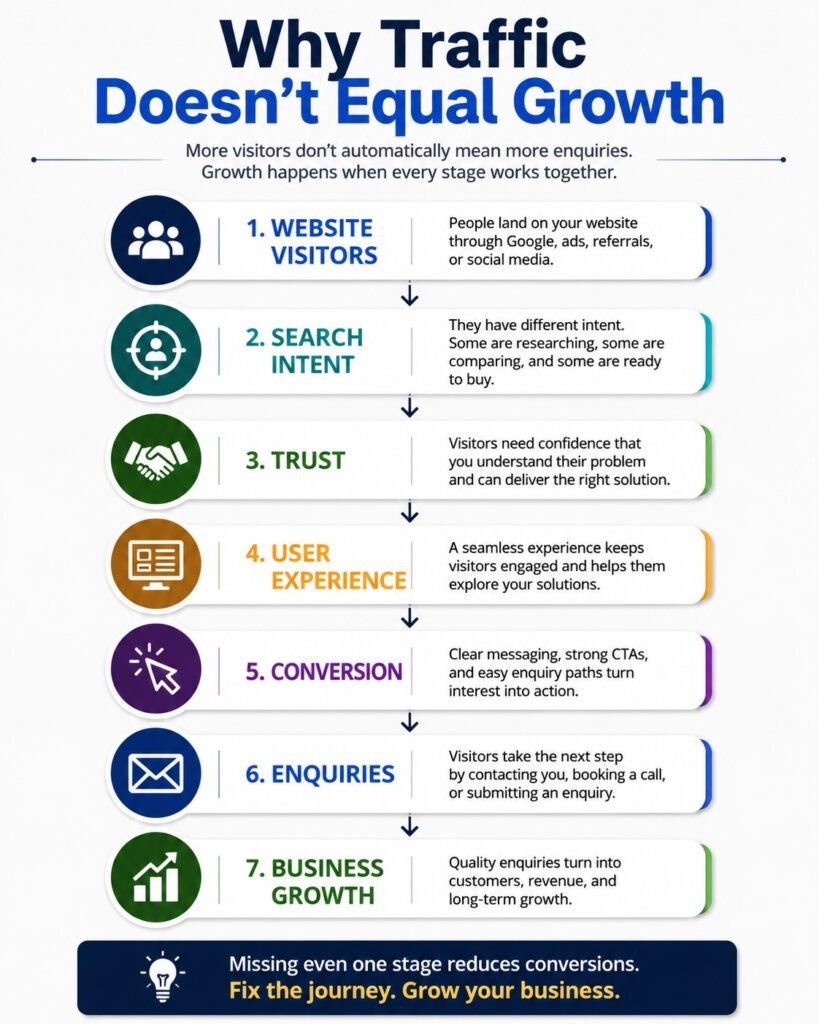
Every successful website I’ve audited follows the same progression.
| Stage | Key Question | Primary Focus |
|---|---|---|
| Visibility | Can potential customers find you? | SEO, Local SEO, AI Search |
| Relevance | Are the right people arriving? | Search intent and audience targeting |
| Trust | Do visitors believe you’re the right choice? | Messaging, authority, credibility |
| Conversion | Is taking the next step effortless? | UX, CTAs, enquiry flow |
| Growth | Are enquiries increasing consistently? | Measurement, optimization, refinement |
Notice something interesting.
SEO sits at the bottom of the pyramid.
Many businesses begin there.
Successful businesses work through every layer.
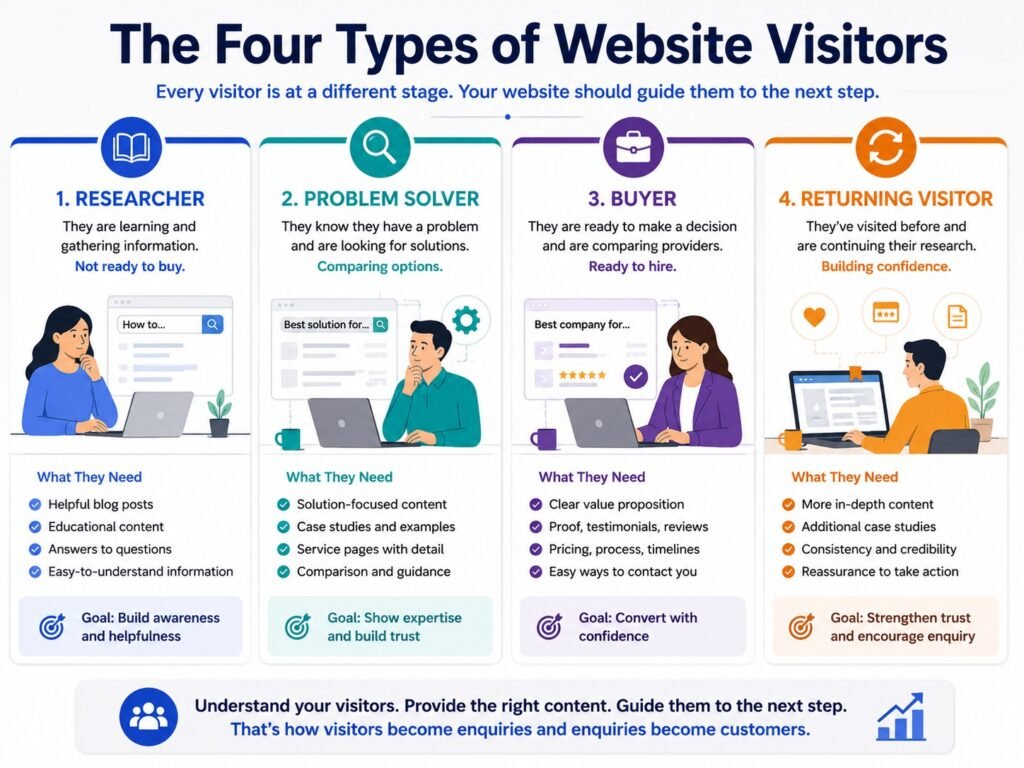
The Four Types of Website Visitors I Look For
Once I understand how people arrive on a website, I separate visitors into four groups.
1. The Researcher
They’re learning.
Comparing.
Exploring.
They’re not ready to buy.
2. The Problem Solver
They know something isn’t working.
They’re actively looking for a solution.
These visitors often become customers if the website builds enough trust.
3. The Buyer
They’ve already decided to invest.
Now they’re comparing providers.
This visitor should never struggle to understand why your business is the better choice.
4. The Returning Visitor
This is one of the most valuable audiences.
People rarely hire a consultant, manufacturer, healthcare provider, or premium service business during their first visit.
They return.
Read another article.
Review your services.
Visit your About page.
Compare your experience.
Only then do they enquire.
That’s why trust-building content matters.
AI Overview Summary
If your website gets traffic but no enquiries, don’t assume you need more SEO.
Most businesses face one of three challenges:
- They’re attracting the wrong audience.
- Their website doesn’t build enough trust.
- Their customer journey creates friction before visitors enquire.
A structured Website Growth Audit identifies where the journey breaks before you invest more money in SEO, Google Ads, or another redesign.
Already Getting Traffic but Still Waiting for More Enquiries?
I’ll review your website, Google Search Console, messaging, user journey, and conversion opportunities to identify exactly where potential customers lose confidence.
You’ll receive practical recommendations based on evidence—not assumptions or generic marketing advice.
Book Your Website Growth Audit →
https://kgwebdesigner.com/contact-me/
Related Reading
Even the best SEO campaign can underperform if your website messaging doesn’t immediately communicate value. In The Consulting Website Design Formula: Messaging That Converts Decision-Makers in 10 Seconds, I explain how strategic messaging helps visitors quickly understand why they should choose your business instead of continuing their search.
The KG Website Growth Audit Framework
Every website I review follows the same structured investigation.
Not because every business is identical.
But because buyers, regardless of industry, move through remarkably similar decision-making stages.
The audit isn’t designed to prove whether your SEO agency, Google Ads campaign, or website is right or wrong.
It’s designed to answer one simple question:
“What’s actually preventing qualified visitors from becoming customers?”
Only after answering that question do I recommend where your marketing budget should go.
Stage 1: Visibility
Can the Right People Find You?
Many businesses believe that ranking for more keywords automatically means they’re attracting more customers.
That’s rarely true.
The first stage of the audit looks at:
- Organic search visibility
- Google Search Console performance
- Local SEO visibility
- AI search presence
- Commercial keyword rankings
- Geographic relevance
A website ranking for hundreds of informational searches may still generate very few enquiries if none of those visitors are actively looking to hire a business.
Visibility should always attract qualified buyers, not simply increase visitor numbers.
Stage 2: Relevance
Are You Attracting Buyers or Just Readers?
Once people arrive, the next question becomes:
Did they come looking for information or a solution?
Search intent matters.
Someone searching:
“What is conversion rate optimization?”
is researching.
Someone searching:
“Website conversion optimization agency”
is looking to hire.
Both searches have value.
But they represent completely different stages of the buying journey.
One of the biggest reasons websites fail to generate enquiries is because they attract educational traffic without providing a natural path toward commercial pages.
That’s why every successful content strategy balances informational articles with service pages, comparison guides, buyer resources, and trust-building content.
Stage 3: Trust
Does Your Website Give Visitors Enough Confidence?
This is where most websites quietly lose potential customers.
Visitors ask questions like:
- Have they worked with businesses like mine?
- Can I trust their expertise?
- Do they understand my industry?
- Will they communicate clearly?
- Are they worth contacting?
If those questions remain unanswered, visitors leave.
Even when your pricing is competitive.
Even when your services are excellent.
Trust is built through dozens of small details working together.
Examples include:
- Client success stories
- Expert insights
- Helpful educational content
- Industry experience
- Clear service pages
- Transparent processes
- Testimonials
- Strong visual presentation
- Easy-to-find contact information
People don’t enquire because they understand what you do.
They enquire because they believe you’re the right business to help them.
Stage 4: Conversion
Is Taking the Next Step Easy?
Once visitors trust you, the next question becomes surprisingly simple.
Can they contact you without friction?
Many businesses unintentionally create barriers.
Examples include:
- Hidden contact forms
- Confusing navigation
- Weak calls to action
- Slow mobile experiences
- Long enquiry forms
- Too many competing choices
Good conversion optimization doesn’t pressure visitors.
It removes uncertainty.
Every page should naturally answer:
“What should I do next?”
Stage 5: Growth
Are You Learning From Your Data?
Growth isn’t a one-time project.
It’s an ongoing process.
After implementing improvements, I monitor:
- Qualified enquiries
- Conversion rates
- Search intent
- User behavior
- Landing page performance
- Content engagement
- Customer acquisition costs
The goal isn’t simply increasing website traffic.
It’s creating predictable business growth. One metric I now monitor closely is whether a page continues earning clicks after appearing in AI-generated answers.
What This Means For Your Business
If your website attracts visitors but fails to generate enquiries, resist the temptation to immediately increase your marketing budget.
Instead, investigate whether your existing website:
- attracts qualified buyers,
- builds confidence,
- communicates value clearly,
- and makes taking the next step effortless.
Businesses often discover they don’t need another SEO campaign.
They need a better customer journey.
Once visitors trust your business, every marketing channel becomes more effective.
Why Most Businesses Get This Wrong
Most businesses measure success using:
- Traffic
- Rankings
- Impressions
- Clicks
- Cost per click
Those metrics matter.
But customers never buy rankings.
They buy confidence.
I’ve seen websites with fewer than one thousand monthly visitors consistently outperform competitors receiving twenty times more traffic.
Why?
Because every visitor arrived with genuine buying intent.
Every page built trust.
Every step reduced hesitation.
Business growth comes from qualified visitors who become customers, not simply larger traffic reports.
Kanika’s Final Insight
One question has guided almost every successful website project I’ve worked on.
“Would I contact this business if I knew nothing about them?”
If the answer isn’t an immediate yes, neither will your visitors.
The objective of a website isn’t to impress search engines.
It’s to give real people enough confidence to begin a conversation.
When you achieve that, SEO, Google Ads, referrals, AI-powered search, and every other marketing channel become significantly more effective.
Get Cited Instead of Replaced
This is the exact process we ran for Anandam Yoga School. If your content is being answered instead of clicked, we can tell you honestly which pages are worth saving—and rewrite them to become citation-worthy.
Frequently Asked Questions
Why does my website get traffic but no enquiries?
The most common reasons include attracting informational visitors instead of buyers, weak trust signals, unclear messaging, poor user experience, or a customer journey that doesn’t encourage visitors to make contact.
Should I invest more in SEO if my website isn’t generating leads?
Not necessarily. If qualified visitors are already reaching your website, improving trust, messaging, and conversion optimization often delivers better results than simply increasing traffic.
Can a website redesign improve enquiries?
Yes, but only if the redesign addresses the real problems. A redesign focused solely on visual improvements rarely increases enquiries without stronger messaging, clearer positioning, and a better customer journey.
How do I know whether I need SEO, Google Ads, or a redesign?
Start with a Website Growth Audit. Understanding where your customer journey breaks allows you to invest in the solution your business actually needs instead of relying on assumptions.
Why do businesses rank well but still struggle to generate enquiries?
High rankings improve visibility, but they don’t automatically build trust. If visitors can’t quickly understand your expertise, differentiate your business, or find a clear next step, they’ll continue comparing competitors.
Does AI-generated content affect website enquiries?
AI can help streamline content creation, but generic articles rarely establish authority. Businesses that combine AI with original expertise, practical experience, and genuine customer insights are more likely to build trust with both readers and AI-powered search engines.
How important is website messaging?
Messaging is often the difference between a visitor leaving and becoming a customer. Clear headlines, customer-focused language, and strong value propositions help visitors understand why they should choose your business.
Is website traffic still an important metric?
Yes, but traffic should always be evaluated alongside enquiry quality, conversion rates, and business growth. A smaller audience of qualified buyers is usually more valuable than a large audience with little purchase intent.
Final Thoughts
If you’ve read this far, you’re probably not looking for another marketing tactic.
You’re looking for clarity.
That’s exactly why I developed the KG Website Growth Audit.
Instead of recommending SEO because traffic looks low, or suggesting a redesign because a website feels outdated, I begin by understanding what your customers experience from the moment they discover your business until the moment they decide whether to contact you.
Sometimes the answer is SEO.
Sometimes it’s better messaging.
Sometimes it’s stronger trust signals.
Sometimes it’s improving conversion paths.
Every recommendation starts with evidence, not assumptions.
When you understand why visitors aren’t becoming customers, every future marketing decision becomes more confident and more effective.
If your rankings have remained stable but traffic has suddenly declined, my AI Overview Rewrite Framework explains why traditional SEO reports often miss what’s actually happening.
Ready to Discover What’s Really Costing You Enquiries?
If your website receives traffic but isn’t generating the enquiries your business deserves, I’d be happy to review it.
During a Website Growth Audit, I’ll analyze:
- Google Search Console data
- Website messaging
- Customer journey
- Trust signals
- Conversion opportunities
- Content strategy
- Search intent
- Overall website performance
You’ll receive practical, honest recommendations tailored to your business-not a generic sales pitch or unnecessary services. I’ve also shared the trust elements I look for while reviewing professional websites in my CA Firm Website Checklist, where I explain how credibility influences both conversions and AI trust.
Book a Strategy Call:
https://calendly.com/kanika-kgwebdesigner/30min
Or Contact Me:
https://kgwebdesigner.com/contact-me/
Available across the US, UK, Australia, Canada, Singapore, and the UAE. Fully remote. No obligation