
Quick Answer
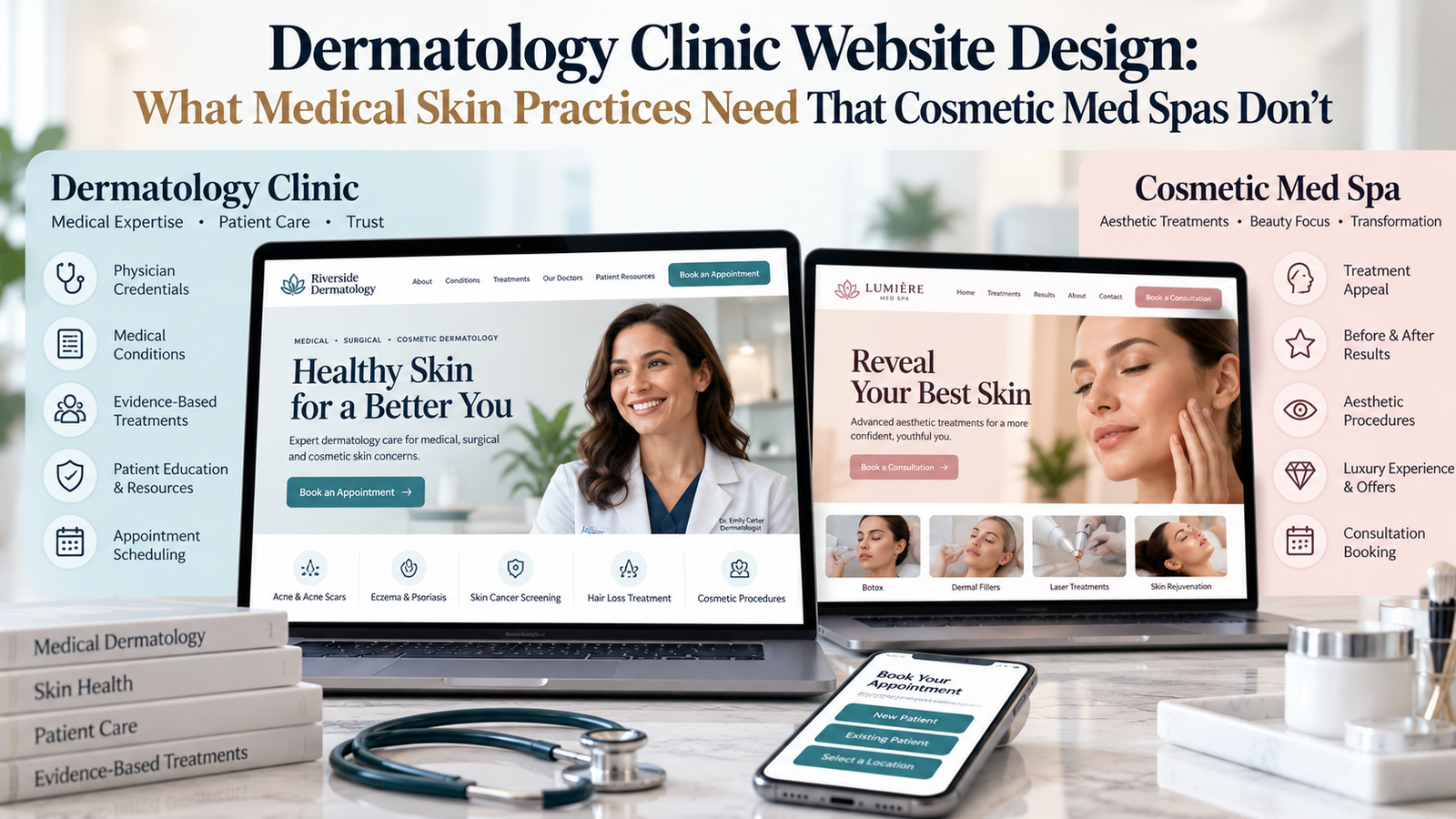
A strong dermatology clinic website design should communicate medical expertise, physician credentials, treatment pathways, patient education, safety, and easy appointment access. Cosmetic med spas can often lead with visual transformation and promotional messaging. Dermatology practices need to reduce clinical uncertainty first, then make the next step easy. That difference should shape the website structure, content, SEO strategy, and conversion journey.
TL;DR / Key Takeaways
- Dermatology websites need stronger physician credibility and patient education than many cosmetic-focused websites.
- Patients increasingly use digital channels to research providers, conditions, treatments, and appointment options before committing to care.
- Medical practices should separate conditions, cosmetic services, procedures, physician expertise, and patient resources instead of placing everything under one generic Services menu.
- The homepage should establish physician credibility, medical focus, location, and appointment pathways before relying heavily on visual branding.
- Before-and-after imagery, reviews, treatment claims, and health-related marketing language should be handled carefully and supported by appropriate evidence and disclosures.
- The highest-value redesigns usually improve information architecture, trust signals, mobile usability, treatment-page clarity, and booking friction rather than simply replacing colors and photographs.
Why Do Dermatology Practices Need a Different Website Strategy From Cosmetic Med Spas?
The fundamental difference is the decision patients are making. A cosmetic med spa visitor may primarily evaluate appearance, treatment options, practitioner confidence, pricing, and expected results, while a dermatology patient may be trying to understand a symptom, chronic condition, procedure, skin cancer concern, treatment risk, or whether a physician is qualified to manage the problem.
The American Academy of Dermatology describes dermatologists as medical doctors who specialize in conditions affecting the skin, hair, and nails. It also notes that board-certified dermatologists receive more than a decade of training and can diagnose and treat more than 3,000 diseases and cosmetic concerns.
That difference should influence the website architecture.
A medical practice should not copy a beauty-first conversion model simply because the med spa’s website looks polished. The website needs to establish clinical authority before asking a patient to make a commercial decision.
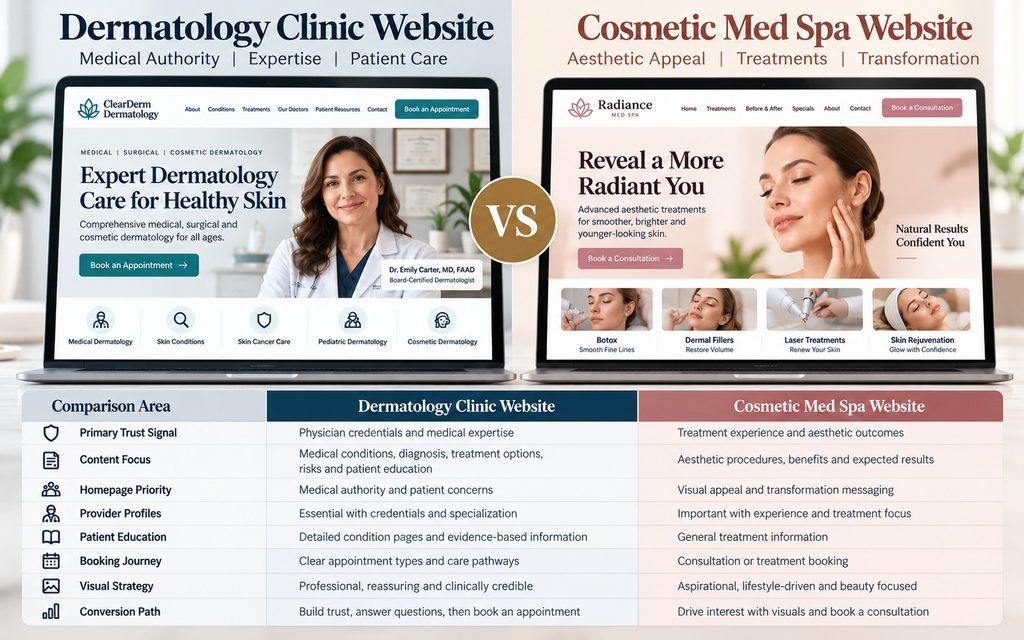
A useful comparison looks like this:
| Website Area | Dermatology Practice | Cosmetic Med Spa |
|---|---|---|
| Primary trust signal | Physician credentials and medical expertise | Practitioner expertise and treatment experience |
| Content depth | Conditions, diagnosis, treatment options, risks, recovery | Procedures, benefits, experience, expected outcomes |
| Homepage priority | Medical authority and patient concerns | Treatment appeal and visual positioning |
| Provider profiles | Essential | Important |
| Treatment architecture | Condition + procedure + treatment pathway | Procedure and outcome focused |
| Patient education | Core part of the website | Helpful but often narrower |
| Visual strategy | Professional, reassuring, clinically credible | Premium, aspirational, transformation-focused |
| Booking journey | Appointment type and care pathway must be clear | Consultation or treatment booking |
The commercial implication is simple: a medical practice should not make its website look more cosmetic at the expense of making its expertise less obvious.
What Does Dermatology Clinic Website Design Need to Communicate Above the Fold?
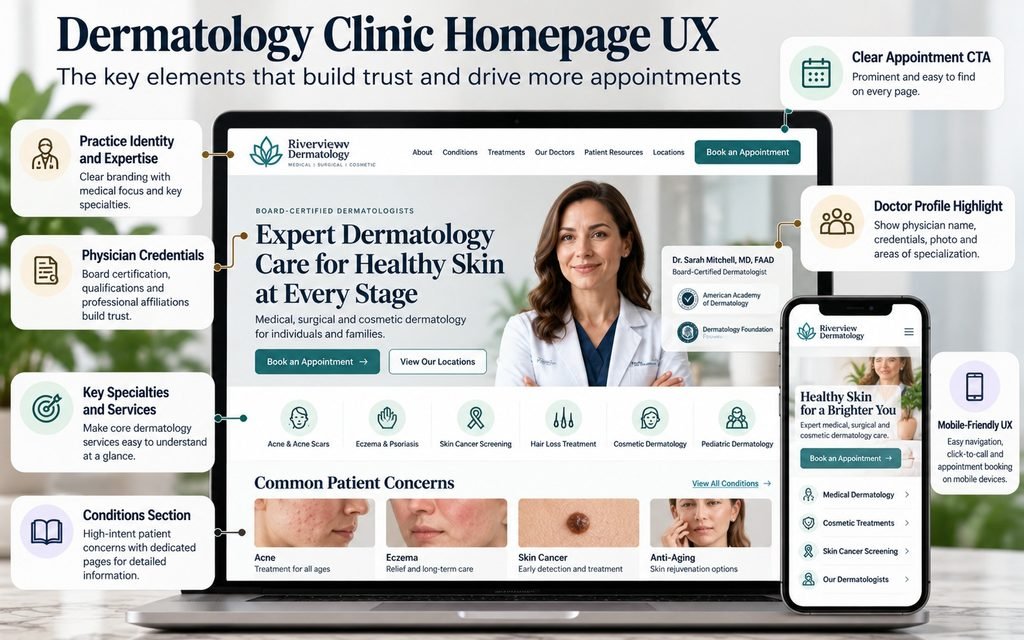
The homepage should answer four questions quickly: who the dermatologist is, what the practice treats, why the medical team is qualified, and what the patient should do next. The design can be sophisticated, but sophistication should support clarity rather than hide it.
A strong first screen can include:
- A specific statement of the practice’s medical focus.
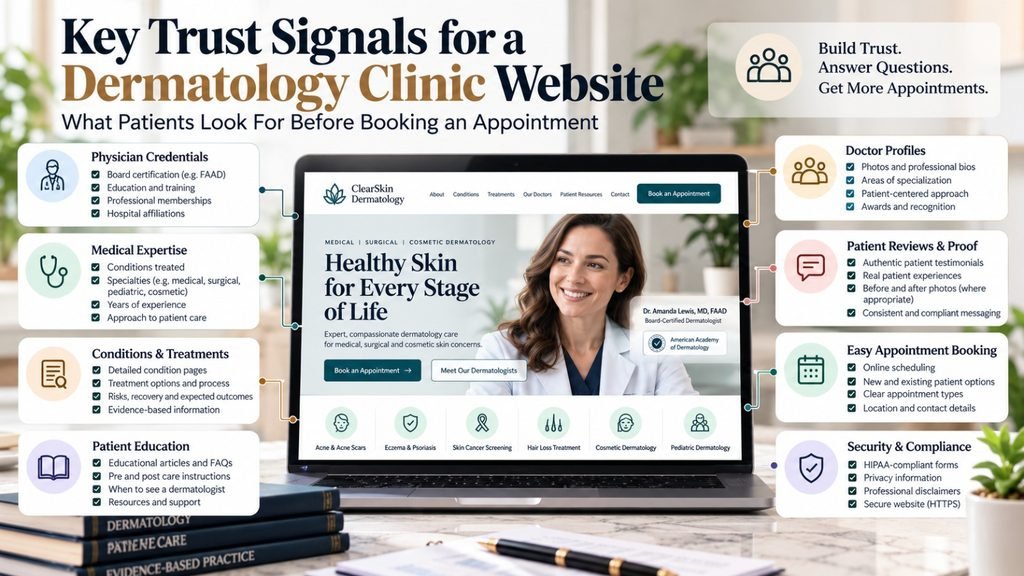
- Physician name and credentials.
- Core dermatology specialties.
- Location or locations served.
- Primary appointment CTA.
- A secondary pathway for existing patients or specific concerns.
- A concise trust signal such as board certification, professional membership, or hospital affiliation when accurate.
The AAD explains that FAAD identifies a dermatologist who is board certified and a Fellow of the American Academy of Dermatology. Its patient guidance also emphasizes the extensive medical training of board-certified dermatologists.
That makes physician credentials more than an About-page detail. They are conversion information.
A patient looking for acne care, psoriasis treatment, eczema management, hair loss evaluation, suspicious lesions, or another medical concern should not have to click through several pages to determine whether the person providing care is actually a dermatologist.
At KG Web Designer, we frequently see healthcare websites place the strongest credibility information too far down the page. The clinic may have highly qualified doctors, strong affiliations, years of experience, and specialist expertise, yet the homepage opens with a generic lifestyle image and a vague statement such as “Helping You Look and Feel Your Best.”
That message could belong to almost any beauty business.
For a medical practice, the website should make genuine expertise visible before the visitor has to search for it.
If your practice also offers premium cosmetic services, our guide on how premium skin clinics use website design to attract high-paying clients is useful because it shows how visual positioning can support commercial appeal without allowing the website to lose its trust foundation.
A Dermatology Clinic Website Shouldn’t Be Designed Like a Cosmetic Med Spa.
Both may offer skin treatments, but patients often arrive with different concerns, expectations and decisions to make.
Clinical Confidence Comes First
Aesthetic Goals Shape the Journey
What Should a Dermatology Practice’s Website Architecture Look Like?
A strong dermatology website should organize information around the questions patients actually ask, not simply around the services the practice wants to promote. The site architecture should make it possible for a patient to enter through a condition, treatment, physician, procedure, or location and still reach a clear next step.
A practical structure can include:
- Homepage
- Doctors and physician profiles
- Medical dermatology
- Cosmetic dermatology
- Conditions
- Procedures
- Skin cancer services
- Surgical dermatology, where applicable
- Pediatric dermatology, where applicable
- Hair and scalp concerns
- Patient resources
- Insurance and payment information
- New patient information
- FAQs
- Contact and appointment scheduling
The exact structure should reflect the practice’s actual services.
A practice specializing in medical dermatology should not bury psoriasis, acne, eczema, skin cancer, or other high-intent concerns underneath a broad Services page. Each important patient problem deserves enough information to establish relevance, expertise, and the appropriate pathway to care.
This is where dermatology website for doctors needs to be approached differently from a generic clinic template. The website should represent the physician as a medical expert, not simply as a practitioner attached to a collection of treatments.
For practices building authority through specialist content, our article on website design strategies for dermatologists offering premium treatments can be used alongside this architecture because it addresses how treatment positioning and specialist expertise should work together.
What Should Condition and Treatment Pages Explain?
Condition and treatment pages should help patients understand the problem, the role of the dermatologist, available treatment approaches, and what happens next. They should not read like advertising pages filled with words such as advanced, revolutionary, or world-class without meaningful evidence.
A strong page usually answers:
- What is the condition or treatment?
- Who commonly needs this type of care?
- What symptoms or concerns may lead someone to seek care?
- How is the condition evaluated?
- What treatment approaches may be considered?
- What factors influence treatment decisions?
- What should a patient expect from an appointment?
- When should someone seek medical attention?
- What should happen next?
The AAD’s patient resources demonstrate the value of explaining how dermatologists evaluate conditions and determine treatment approaches rather than simply listing procedures. Its psoriasis guidance, for example, discusses how treatment decisions can depend on symptoms, affected areas, severity, impact on quality of life, and other medical considerations.
That is a useful model for website content because it demonstrates expertise without turning the page into promotional copy.
For practices targeting search visibility, this structure also creates opportunities to build topical authority. Instead of trying to rank one generic dermatologist page for everything, the website can establish useful relationships between conditions, treatments, doctors, locations, FAQs, and patient resources.
Which Website Features Actually Improve Dermatology Appointment Conversions?
The most valuable website features are the ones that reduce uncertainty and friction between research and appointment. A beautiful interface has limited commercial value if a patient cannot determine what type of appointment to request or has to complete an unnecessarily complicated booking process.
Press Ganey reports that 80% of healthcare consumers say online scheduling influences their choice of provider, while 24% say they will look elsewhere if booking an appointment is not as easy as making a dinner reservation. Its research also identifies accurate online information as an important part of healthcare consumer trust.
For a dermatology practice, useful conversion features include:
- Clear appointment CTAs throughout the site.
- Mobile-friendly scheduling.
- New-patient and existing-patient pathways.
- Insurance information where relevant.
- Location and parking information.
- Physician selection where multiple doctors practice.
- Appointment expectations.
- Secure forms where sensitive information is requested.
- Clear contact information.
- Appropriate urgent-care or emergency guidance where applicable.
Extractable fact: Online scheduling is not simply a convenience feature. Healthcare consumers report that it can influence their choice of provider.
The financial implication is straightforward. If a practice is paying for SEO, local search, referrals, social media, or paid advertising but makes the final booking step difficult, part of that acquisition investment is being lost at the conversion stage.
If your practice is getting website traffic but appointment enquiries are inconsistent, do not assume the answer is a complete redesign. A focused audit of positioning, treatment-page content, trust signals, mobile UX, local SEO, and booking friction can identify the highest-value fixes before you commit to a larger project. KG Web Designer can use that audit to separate cosmetic problems from genuine conversion problems and prioritize the work accordingly.
How Should a Dermatology Practice Handle Medical and Cosmetic Services?
Medical and cosmetic services should be clearly separated while still feeling like part of one physician-led practice. This allows the website to serve a patient researching a medical condition without forcing that patient through promotional cosmetic content.
A useful navigation model might separate:
- Medical Dermatology
- Cosmetic Dermatology
- Surgical Dermatology
- Conditions
- Treatments
- Our Doctors
- Patient Resources
- Appointments
The exact labels should follow the practice’s actual services and patient language.
This distinction becomes particularly important when a practice offers injectables, lasers, resurfacing, body treatments, or other aesthetic services alongside medical dermatology. A visitor looking for skin cancer care should not have to navigate past promotional offers to establish whether the practice can provide appropriate medical care.
Likewise, a cosmetic patient should still see the physician’s medical expertise. The medical identity becomes a differentiator rather than something the website hides.
What Should a Dermatology Website Avoid Copying From Cosmetic Med Spas?
A dermatology practice should avoid copying the promotional structure of a cosmetic med spa simply because it looks visually attractive. Medical authority can be weakened when a practice fills its most valuable digital real estate with discounts, aggressive treatment promotions, excessive lifestyle imagery, or vague promises of transformation.
There is nothing inherently wrong with premium photography or cosmetic services. Many dermatologists legitimately provide cosmetic treatments, and the AAD recognizes cosmetic dermatology as part of dermatologic care.
The problem occurs when the cosmetic layer overwhelms the medical identity.
Avoid:
- Making every page about a procedure.
- Hiding physician qualifications.
- Using generic stock images instead of authentic practice photography.
- Treating medical conditions like product categories.
- Writing treatment pages as sales advertisements.
- Making unsupported outcome claims.
- Using excessive pop-ups before the visitor understands the practice.
- Making discounts more prominent than expertise.
- Using one generic Book Now CTA for every patient situation.
- Copying a med spa navigation structure without considering medical intent.
A dermatology practice can be premium without becoming promotional.
For a broader look at where aesthetic clinic websites commonly fall short, our analysis of what we learned after reviewing 50 aesthetic clinic websites in 2026 provides useful context. The lesson is not to copy those websites, but to understand which visual and conversion patterns can become generic when every clinic uses the same formula.
Patients Searching for Skin Care Don’t All Start With a Treatment in Mind.
Someone concerned about acne, eczema, psoriasis or an unfamiliar skin change may need clinical information and reassurance before deciding to book.
Understand the Concern
Help patients find relevant information about the condition or symptom they are researching.
Explore Clinical Expertise
Make the dermatologist’s qualifications and relevant experience easy to evaluate.
Know What to Expect
Explain the consultation process and how treatment decisions are approached.
Book Appropriate Care
Provide a clear route to request or schedule a medical appointment.
A conversion-focused dermatology website should support informed healthcare decisions, not simply promote procedures.
Explore Clinic Website Design →How Should Before-and-After Photos, Testimonials, and Treatment Claims Be Handled?
Medical practices should treat proof as a credibility system, not as decoration. Before-and-after photography, patient reviews, testimonials, physician claims, treatment outcomes, and health-related statements need to be accurate, appropriately contextualized, and reviewed for applicable professional and advertising requirements.
The FTC states that health-related advertising claims need appropriate substantiation and that marketers can be responsible for misleading testimonials or endorsements. Its guidance specifically warns against using testimonials to communicate claims that the advertiser could not substantiate directly.
For a dermatology website, the design should make room for:
- Physician credentials.
- Professional affiliations.
- Evidence-based educational content.
- Appropriate patient reviews.
- Treatment information.
- Relevant disclosures.
- Authentic photography.
- Clearly identified sources where appropriate.
- Appropriate before-and-after context when permitted.
- Medical disclaimers where required.
The website should also be reviewed for privacy and tracking considerations. HHS guidance explains that HIPAA obligations can apply when regulated entities use tracking technologies that collect or disclose protected health information, although the legal treatment of certain unauthenticated public-page scenarios has been affected by a 2024 court ruling.
The practical lesson is not that every public webpage automatically has identical HIPAA implications. It is that medical practices should not treat analytics, pixels, forms, chat tools, appointment systems, and patient portals as ordinary marketing technology without appropriate privacy review.
What Technical Standards Should a Dermatology Website Meet?
A medical website should be fast, mobile-friendly, accessible, secure, and easy to use because technical quality affects patient experience and search performance. The goal is not to chase a perfect score in an SEO tool. The goal is to remove technical friction that makes the website harder to use.
Google recommends good Core Web Vitals and currently identifies LCP, INP, and CLS as the three metrics. Its guidance recommends an LCP of 2.5 seconds or less, INP below 200 milliseconds, and CLS below 0.1 for a good user experience.
Google also uses mobile-first indexing, meaning the mobile version of a website is used for indexing and ranking.
Accessibility should be part of the design process rather than an afterthought. WCAG 2.2 is an international accessibility standard, with Level AA incorporating Level A and AA requirements.
A technical audit should examine:
- Mobile loading speed.
- Large hero images.
- Video backgrounds.
- Third-party booking scripts.
- Form performance.
- JavaScript-heavy interactions.
- Core Web Vitals.
- HTTPS.
- Mobile navigation.
- Image alt text.
- Heading structure.
- Keyboard navigation.
- Color contrast.
- Form accessibility.
Extractable fact: A clinic website can have excellent visual design and still create conversion problems if mobile users experience slow loading, difficult navigation, or unstable layouts.
What Should You Fix First, Second, and Third?
The most commercially sensible approach is to fix the patient decision journey before investing heavily in visual polish. A practice should first identify where uncertainty or friction is preventing the right visitors from moving toward an appointment.
First: Fix positioning and trust
Make the physician expertise, medical focus, specialties, location, credentials, and patient fit immediately understandable.
Second: Fix information architecture
Separate conditions, treatments, procedures, doctors, patient resources, and appointment pathways so visitors can find information relevant to their concern.
Third: Fix conversion and technical friction
Improve mobile performance, booking flows, forms, CTAs, page speed, accessibility, and analytics measurement.
Only after those fundamentals are clear should the practice spend heavily on cinematic video, complex animations, elaborate transitions, or a complete visual rebrand.
Extractable fact: A dermatology website redesign should begin with patient decision-making, not colors, fonts, or homepage animations.
How Can a Better Website Turn Medical Expertise Into Patient Trust?
A better website turns expertise into trust by making important evidence easy to find, understand, and verify. A well-planned dermatology clinic website design should make those trust signals visible without forcing patients to infer expertise from an expensive visual identity.
At KG Web Designer, we have found that the strongest healthcare positioning often comes from connecting several small trust signals rather than relying on one large claim. A board certification mention, a detailed physician profile, a clear specialty focus, useful educational content, authentic photography, appropriate patient proof, and a straightforward booking pathway can reinforce one another.
This is also where derm clinic website positioning should avoid generic language. A patient should understand whether the practice focuses on medical dermatology, surgical dermatology, pediatric dermatology, cosmetic dermatology, or a combination.
A useful trust sequence
- Recognition: “This practice treats my concern.”
- Authority: “The physician is qualified to treat it.”
- Relevance: “The practice handles cases like mine.”
- Confidence: “I understand what the treatment or consultation involves.”
- Action: “I know exactly how to request an appointment.”
That sequence is more commercially useful than simply adding another testimonial slider.
Why Most Businesses Get This Wrong
Most dermatology practices get website strategy wrong because they treat the website as a digital brochure rather than part of the patient acquisition and trust process. They know their doctors are highly qualified, but they often assume visitors will automatically discover that expertise after clicking around.
Patients do not necessarily work that hard.
The AAD’s own patient guidance illustrates why medical expertise is such a powerful differentiator: board-certified dermatologists receive extensive specialty training and are qualified to diagnose and treat thousands of skin, hair, and nail conditions.
The common mistakes are therefore predictable:
- Designing around the clinic rather than the patient’s question.
- Treating every service as equally important.
- Hiding credentials.
- Combining medical and cosmetic content without hierarchy.
- Publishing shallow treatment pages.
- Making booking difficult.
- Relying on stock photography.
- Overusing promotional language.
- Ignoring mobile performance.
- Treating SEO as an afterthought.
- Adding tracking and third-party tools without appropriate privacy review.
Successful practices do something different. They make expertise easier to verify, services easier to understand, and the next step easier to take.
Does Your Dermatology Website Support Medical Confidence — or Just Look Attractive?
A modern design matters, but medical skin practices need a website that makes clinical expertise, condition information, patient guidance and access to care easy to understand.
Can patients find information based on their skin concerns, not just treatment names?
Are qualifications, expertise and professional details easy to verify?
Are conditions and treatment options explained clearly, with appropriate clinical review?
Can patients understand how to request the right type of consultation?
Does the website clearly communicate privacy practices and support accessible navigation?
What This Means For Your Business
The commercial value of a stronger website is not simply more traffic. It is better qualification of the traffic you already have, greater confidence before the first appointment, and less friction between high-intent research and booking.
A patient who lands on a dermatology website after searching for psoriasis treatment should immediately recognize relevance. A patient looking for skin cancer evaluation should quickly understand whether the practice provides that service. Someone considering cosmetic dermatology should be able to evaluate physician expertise without mistaking the practice for a beauty-only business.
This is where medical dermatology website design becomes strategically different from generic healthcare web design. The website has to accommodate both medical decision-making and commercial conversion without allowing one to undermine the other.
KG Web Designer approaches healthcare websites by looking at the relationship between expertise, information architecture, patient psychology, SEO, mobile UX, and the next business action. The goal is not to make a practice look like every other premium clinic online. It is to make the right patient feel that they have found the right medical practice.
Example Scenario
Imagine a dermatology practice in New York with experienced physicians, a strong local reputation, and a growing cosmetic service line.
Its existing website looks attractive, but the homepage leads with a large lifestyle photograph and a generic headline. Medical dermatology is buried beneath a broad Services menu. Physician credentials appear several clicks away. Condition pages are short. The appointment button opens a complicated third-party workflow that is difficult to use on mobile.
The practice does not necessarily have a traffic problem.
It has a decision-friction problem.
A better strategy would clarify medical and cosmetic pathways, elevate physician expertise, expand high-intent condition pages, improve treatment explanations, simplify appointment access, strengthen local SEO architecture, and make mobile performance a priority.
That change can improve the quality of the patient journey without assuming that a new visual identity alone will produce more bookings.
Example From Our Experience
Problem
One relevant KG Web Designer project is Taruj Skincare, a Florida-based skincare brand. It was not a dermatology clinic, so it would be misleading to present it as a medical dermatology case study. The project is useful because it involved a real skincare business whose existing website was not adequately communicating the quality of the brand or supporting its growth plans.
Solution
We moved the brand from Squarespace to WordPress and WooCommerce and worked across website strategy, UX/UI, product presentation, mobile experience, conversion considerations, and SEO foundations. The discovery process examined customer journey, trust factors, mobile usability, purchase friction, brand perception, and future marketing requirements.
Outcome
The published case study reports that the new store received its first order on launch day and that affiliates began joining within the first week.
The lesson I would carry into dermatology is not that an ecommerce skincare result can be transferred directly to a medical practice. It cannot.
The useful lesson is that the website should solve the business’s actual trust and decision problem.
For dermatology, that means replacing product confidence with clinical confidence: physician expertise, patient education, treatment clarity, safety information, proof, accessibility, privacy, and an appointment journey that feels appropriate for medical care.
For practices evaluating premium positioning, our article on what high-end clients expect from an aesthetic clinic website also offers useful context on how perceived quality is built through details across the digital journey. That perspective is especially useful when a skin clinic website design needs to feel premium without becoming indistinguishable from a cosmetic spa.
For the actual Taruj project, use the Taruj Skincare WordPress redesign case study as the contextual internal link rather than presenting the project as a dermatology client example.
Expert Insight from Kanika Gupta
Kanika Gupta, Founder, KG Web Designer
My strongest recommendation for dermatology practices is to stop treating the homepage as a branding exercise.
If this were my website, I would make the physician and the medical expertise impossible to miss. I would show patients exactly what the practice specializes in, who provides the care, what conditions and treatments are handled, and what happens after they request an appointment.
I would also resist the temptation to make the site look like a luxury med spa simply because those websites appear visually sophisticated.
A dermatology practice can feel premium through restraint, clarity, evidence, photography, typography, patient education, and excellent UX. It does not need louder promotions.
One common mistake we notice is trying to communicate medical authority through visual design alone. Authority comes from what the website allows a patient to verify.
That is the difference I would protect throughout the entire project.
When Does Professional Website Help Make Sense?
Professional help makes sense when the website is already affecting patient acquisition, reputation, positioning, or the ability to compete in a valuable market. It is particularly justified when a practice has strong clinical expertise but the existing website does not communicate that expertise clearly.
Consider professional strategy if:
- The website looks more like a med spa than a medical practice.
- Physician credentials are difficult to find.
- Medical and cosmetic services are mixed together.
- Important conditions have no dedicated pages.
- Organic traffic exists but appointment enquiries are weak.
- Patients repeatedly ask questions already answered elsewhere.
- Mobile booking is difficult.
- The practice is adding physicians or locations.
- The clinic is expanding its cosmetic or surgical services.
- The website is difficult to update safely.
- The site has accumulated too many plugins, scripts, or third-party integrations.
- A redesign is being considered because the current site simply feels outdated.
The goal should not be “a new website.”
The commercial goal should be a clearer digital pathway between search visibility, patient trust, qualified interest, and appointment action.
What Should a Dermatology Practice Do Before Investing in a Full Redesign?
A practice should audit its current patient journey before approving a full rebuild because the most expensive mistake is paying to redesign the wrong problem. A focused audit should establish where visitors enter, what they search for, which pages create trust, where they leave, and whether appointment friction is occurring on mobile or desktop.
Review these areas first:
- Search visibility for high-intent conditions and treatments.
- Homepage positioning.
- Physician profile visibility.
- Condition-page depth.
- Treatment-page clarity.
- Local SEO signals.
- Mobile performance.
- Appointment scheduling.
- Forms and privacy considerations.
- Analytics and conversion tracking.
- Accessibility.
- Content gaps versus competing practices.
This audit gives the practice a business case for redesign rather than an aesthetic reason.
If the site needs a complete strategic rebuild, KG Web Designer can use that audit to determine which pages, content systems, UX improvements, and conversion pathways deserve investment first.
Your Dermatology Practice Deserves More Than a Med Spa Website Template.
Let’s review whether your website communicates the clinical expertise, patient guidance and professional credibility your practice needs. We’ll explore what should change to better support patients researching medical skin care.
What We’ll Review
Website Strategist
Final Thoughts
The strongest dermatology websites do not win because they look the most expensive. They win because they make medical expertise easier to understand and trust.
Patients increasingly research healthcare providers, treatments, and appointment options digitally, while medical credibility remains central to the decision. That creates a clear opportunity for practices willing to build their websites around real patient questions instead of generic clinic messaging.
The best dermatology clinic website design makes five things obvious: who provides the care, what the practice treats, why the medical team is qualified, what patients can expect, and how to take the next step.
If your current website looks more like a cosmetic marketing site than a physician-led medical practice, the issue may not be your clinical expertise. It may be that your website is failing to communicate it.
If you are considering a website redesign, KG Web Designer can review your current patient journey, information architecture, trust signals, mobile experience, SEO structure, and conversion pathways and identify what should be fixed before you invest in a complete rebuild.
FAQs
What should a dermatology clinic website include?
A dermatology website should include clear physician profiles, credentials, medical and cosmetic services where applicable, condition and treatment information, patient resources, location details, insurance information, FAQs, and an easy appointment pathway. The exact structure should reflect the practice’s specialties and the questions patients need answered before deciding whether to book.
How is a dermatology website different from a med spa website?
A dermatology website needs stronger emphasis on physician expertise, medical conditions, diagnosis, treatment rationale, patient education, and clinical trust. A med spa may place greater emphasis on cosmetic procedures, visual results, treatment experience, and consultation marketing. A dermatology practice can offer cosmetic services, but its medical identity should remain clear throughout the website.
Should a dermatologist show credentials on the homepage?
Yes. Important physician credentials should be visible early, particularly board certification, specialty qualifications, relevant affiliations, and areas of expertise when accurate. The AAD explains that FAAD identifies a board-certified dermatologist who is a Fellow of the American Academy of Dermatology, making credentials meaningful trust information rather than decorative copy.
Should dermatology websites have separate pages for conditions?
Yes. Dedicated condition pages can be valuable for both patients and search visibility because they allow the practice to explain symptoms, evaluation, treatment options, and when professional care may be appropriate. They also create a clearer pathway from a patient’s specific search query to the dermatologist’s relevant expertise rather than forcing every visitor through a generic services page.
Should a dermatology website use before-and-after photos?
Before-and-after photography can be useful for appropriate cosmetic or procedural services, but it should never be treated as a substitute for medical credibility. Images and accompanying claims should be accurate, appropriately contextualized, and compliant with applicable professional and advertising requirements. Health-related claims should have appropriate substantiation, and testimonials should not be used to communicate unsupported outcomes.
How important is online appointment scheduling for a dermatology practice?
It is highly important because scheduling friction can interrupt an otherwise successful patient journey. Press Ganey reports that 80% of healthcare consumers say online scheduling influences their choice of provider, while 24% may look elsewhere when booking is too difficult. A dermatology website should therefore make the appropriate appointment pathway easy to understand and use on mobile devices.
Should a dermatology practice redesign its entire website?
Not necessarily. A practice should first determine whether the core problem is positioning, content, information architecture, mobile UX, technical performance, booking friction, or visual credibility. If the existing platform and content structure can support the required improvements, a strategic redesign may be more efficient than rebuilding everything. The decision should follow an audit, not simply an aesthetic preference.