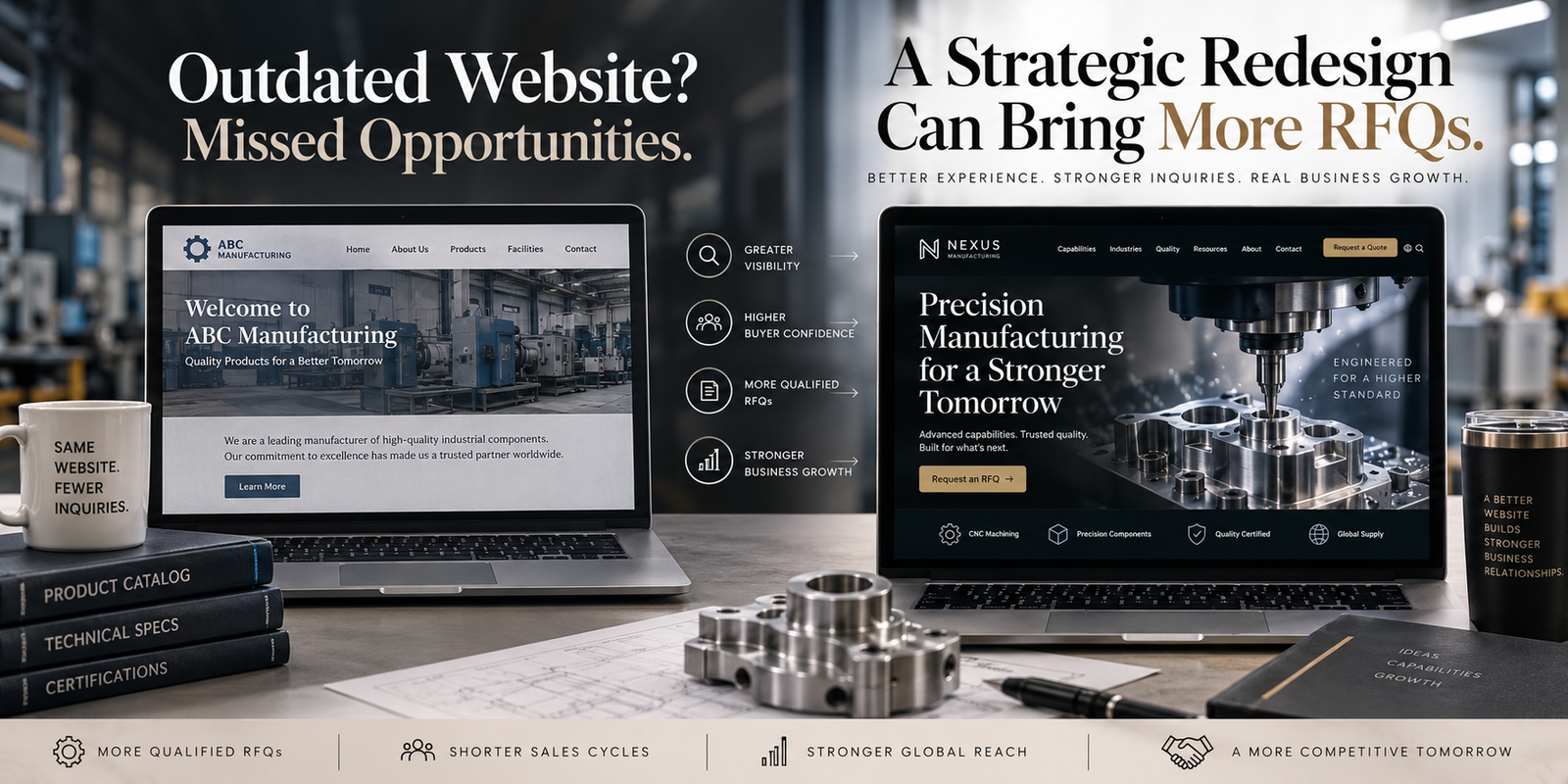
Quick Answer
Yes. A Manufacturing Website Redesign can generate more qualified RFQs when it fixes genuine buyer friction rather than simply making the website look newer. The strongest redesigns improve capability discovery, technical proof, trust signals, mobile usability, SEO, and the RFQ journey. Current industrial buyer research shows that most buyers evaluate suppliers digitally before speaking with sales, making the website an important part of supplier selection.
TL;DR: What Manufacturing Leaders Should Know
- 71% of North American industrial buyers surveyed by Kula Partners in July 2026 had shortlisted at least one supplier before any live conversation.
- 28% said missing relevant certifications or compliance documentation was the most likely pre-contact reason to eliminate a supplier.
- 85% of surveyed industrial buyers considered supplier website pricing at least a meaningful advantage, while 19% considered it critical to engagement.
- Gartner found that 67% of B2B buyers preferred a sales-rep-free experience and 70% preferred a completely digital self-service buying experience.
- 45% of B2B buyers surveyed by Gartner had used generative AI during a recent purchase, making clear technical and structured website content increasingly important.
- A redesign should be judged by buyer qualification, RFQ quality, conversion, search visibility, and sales efficiency, not by visual improvement alone.
What does current manufacturing buyer data tell us about websites and RFQs?
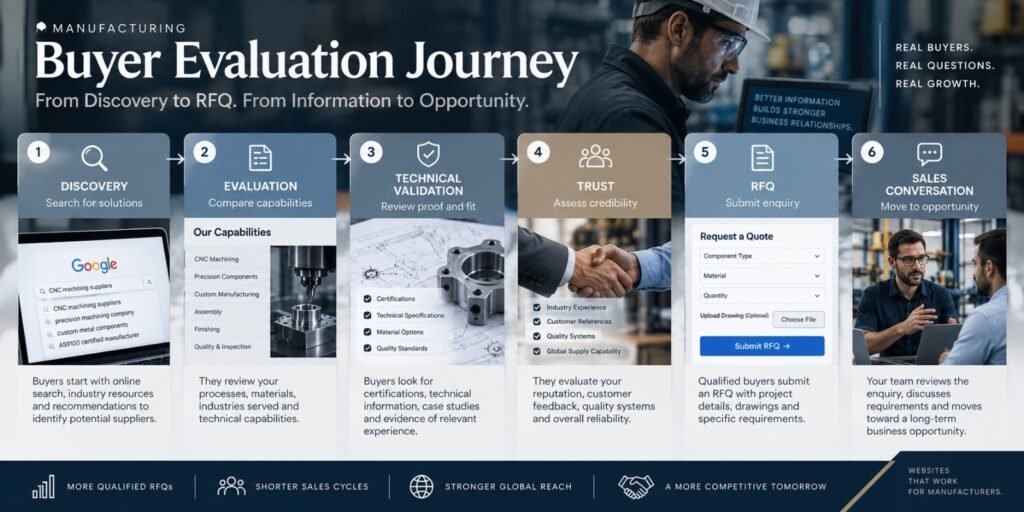
The current data shows that industrial buyers are doing more supplier evaluation before they ever become a lead, which means your website can influence an RFQ long before a form is submitted.
Kula Partners’ Summer 2026 Industrial Buyer Pulse surveyed 280 senior North American industrial decision-makers in July 2026. Seventy-one percent said they had placed at least one supplier on a shortlist before having a live conversation. Among C-level and VP buyers, that figure rose to 86%, compared with 55% among managers.
The same study found that 28% of buyers considered missing relevant certifications or compliance documentation the most likely reason to eliminate a supplier before contact. Negative reviews or reputation followed at 23%, while a slow or generic response to an initial inquiry accounted for 18%. Only 6% selected an outdated or thin website as the primary pre-contact disqualifier.
That last number is important.
It means manufacturers should not assume that an old-looking website automatically causes poor performance. The commercial problem may be deeper: the website might not communicate certifications, technical capabilities, relevant experience, pricing information, applications, or proof effectively enough.
There is another important number from the same research. Eighty-five percent of respondents said having pricing information, even ballpark or starting-at pricing, was at least a meaningful advantage for suppliers that provide it, while 19% considered it critical to whether they would engage.
Standalone fact: A manufacturing website can influence supplier selection before a buyer ever submits an RFQ.
Gartner’s 2026 B2B research reinforces this shift. In a survey of 645 B2B buyers, 67% preferred a sales-rep-free experience, 70% preferred a completely digital self-service buying experience, and 45% had used generative AI during a recent purchase. Buyers also reported using an average of seven information sources.
For manufacturers, that changes the job of the website.
It is no longer enough for the website to establish that the company exists. It needs to help buyers determine whether the company deserves to remain on the shortlist.
Manufacturing website performance indicators worth watching
| Metric | Current finding | Why it matters |
|---|---|---|
| Industrial buyers shortlisting before live contact | 71% | Buyers may evaluate you before sales knows about the opportunity |
| C-level/VP buyers shortlisting before contact | 86% | Senior decision-makers research independently |
| Manager buyers shortlisting before contact | 55% | Digital evaluation affects multiple buying levels |
| Missing certifications as pre-contact disqualifier | 28% | Proof can matter more than visual polish |
| Negative reviews/reputation as disqualifier | 23% | Trust directly affects consideration |
| Slow/generic inquiry response as disqualifier | 18% | Lead handling affects supplier perception |
| Outdated/thin website as disqualifier | 6% | A dated look alone is not the complete problem |
| Pricing information as a meaningful advantage | 85% | Transparency can support engagement |
| Pricing information considered critical | 19% | Withholding information can create friction |
| Buyers comfortable placing $50K+ online | 35% | High-value self-service buying is increasingly normal |
Source: Kula Partners / InnovateMR, Summer 2026 Industrial Buyer Pulse, n=280.
Technical content should also be treated as part of the RFQ strategy rather than as supporting material that sits somewhere in a resource library. Detailed capability information, specifications, engineering resources, certifications, and application-specific content can help buyers validate supplier fit before contacting sales. Our guide on manufacturing lead generation through technical content explains how manufacturers can use technical information to attract qualified buyers, build authority, and create stronger paths toward RFQ conversion.
How do you know if your website actually needs a redesign?
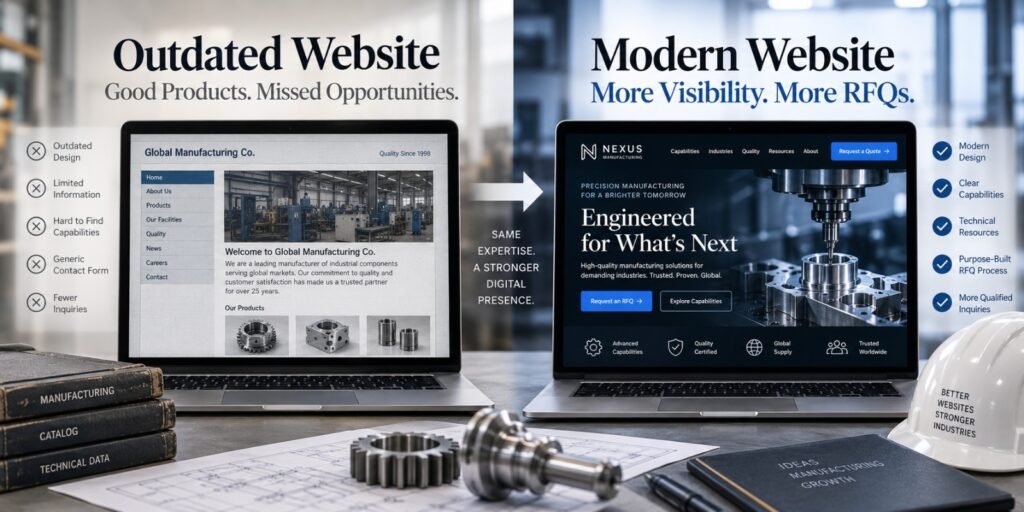
You need a redesign when the current website prevents qualified buyers from understanding, validating, or acting on your capabilities efficiently, not simply because the design looks several years old.
That distinction can save a manufacturer a substantial amount of unnecessary spending.
At KG Web Designer, we frequently see manufacturing companies with far more technical expertise than their websites communicate. The company may have advanced machinery, experienced engineers, strong quality systems, certifications, specialist materials, and impressive project experience, but the website may organize those strengths around the company’s internal structure rather than the buyer’s decision process.
A typical old website might present:
- About Us
- Products
- Services
- Facilities
- Quality
- Contact
But the buyer is thinking:
- Can you manufacture what I need?
- Can you work with my material?
- Do you have the required process?
- Can you meet the specification?
- Do you have the necessary certifications?
- Have you handled similar applications?
- What information do you need for an RFQ?
- How quickly will someone respond?
That is a structural problem, not simply a visual one.
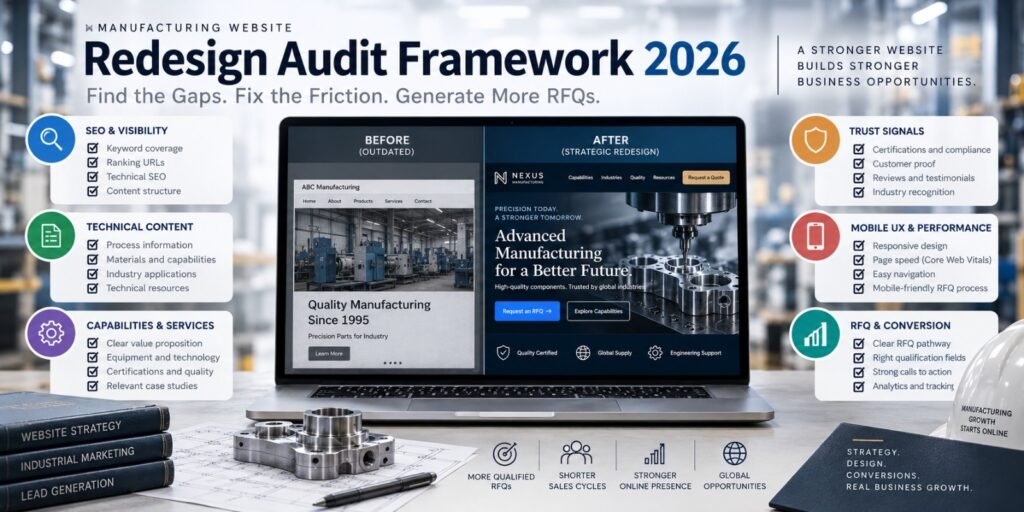
What should you audit before approving a redesign?
Review these areas first:
- Organic search traffic
- High-value landing pages
- Search Console queries
- Existing rankings
- Backlinks
- Capability pages
- Technical documentation
- Certifications
- Industry/application pages
- Mobile usability
- Page speed
- RFQ conversion rate
- RFQ abandonment
- Form completion quality
- Sales qualification time
- Lead-to-opportunity rate
- Qualified-RFQ-to-opportunity rate
This is where Manufacturing Website Design becomes a commercial exercise rather than a purely visual one.
Google recommends monitoring Core Web Vitals as part of page experience. Its current guidance identifies a good target of LCP at 2.5 seconds or less, INP below 200 milliseconds, and low CLS for a stable page experience.
These metrics do not guarantee RFQs. They help remove technical friction that can interfere with the buyer experience.
Original KG Web Designer observation: In manufacturing website audits, one recurring issue is that the company has the information required to establish supplier credibility, but that information is fragmented across navigation, PDFs, old pages, and downloadable documents.
The redesign opportunity is therefore often information architecture first and visual design second.
A website redesign should also be viewed as part of the manufacturer’s broader digital growth system rather than as an isolated design project. If SEO, content, paid acquisition, conversion optimization, and sales enablement are working toward different goals, a redesigned website may still struggle to generate qualified opportunities. Our guide to Manufacturing Digital Marketing Strategy explains how manufacturers can prioritize these investments based on visibility, buyer intent, website conversion, and sales requirements.
Is Your Website Making Buyers Work Too Hard to Request a Quote?
If procurement teams and technical buyers cannot quickly understand your capabilities, certifications, industries served, or how to request a quote, your website may be creating unnecessary friction. A focused audit can reveal where qualified RFQ opportunities are being lost.
Request a Free Website Audit →What should manufacturers fix before rebuilding everything?
Manufacturers should first identify whether the problem is traffic, relevance, trust, information architecture, conversion, or technology before commissioning a complete rebuild.
A useful diagnostic sequence is:
Search visibility → Relevant landing page → Capability understanding → Technical proof → Trust → RFQ → Sales qualification
If qualified visitors are not reaching the website, SEO and targeting may be the first priority.
If they are arriving but landing on irrelevant pages, the content architecture may be the problem.
If they find the right capability but cannot verify technical fit, technical content is the priority.
If they understand the company but do not submit an RFQ, conversion friction may be the issue.
If the platform prevents you from fixing these problems efficiently, then a rebuild may make sense.
Kula Partners’ Q1 2026 research found that 76% of surveyed industrial buyers had shortlisted at least one supplier before a live interaction. It also found that 55% said their organization’s approval bar had increased compared with the previous year.
That second metric is commercially important.
If buyers require more proof before approving suppliers, a website that simply looks modern is not enough. It needs to make the business case easier to validate.
Our guide on how to approach a manufacturing website redesign or decide whether to fix the existing site explores this distinction in more detail.
A practical diagnosis
| What you see | Likely problem | First intervention |
|---|---|---|
| Strong rankings, few RFQs | Conversion friction | CRO and landing-page review |
| Good traffic, poor lead quality | Search-intent mismatch | SEO and messaging restructuring |
| Strong capabilities, weak presentation | Information architecture | Strategic redesign |
| Poor mobile engagement | UX friction | Responsive UX improvement |
| Weak technical information | Content gap | Capability and technical content |
| Weak RFQ submissions | Qualification problem | RFQ form restructuring |
| Severe technical debt | Platform limitation | Rebuild |
| Good rankings and qualified RFQs | Website may not be fundamentally broken | Optimize selectively |
What should a modern manufacturing website help buyers verify?
A modern manufacturing website should allow a qualified buyer to establish supplier fit without requiring a sales conversation for information that could reasonably be provided online.
The 2026 B2B Manufacturing Buying Journey research from Automation.com and RH Blake surveyed 121 manufacturing and industrial leaders, with 66% holding significant or final decision authority. The research found that 81% had already formed a supplier shortlist before contacting a vendor, while 83% involved five or more evaluators in the purchasing process.
That means the website has to serve more than one person.
Geographic targeting becomes even more important when a manufacturer is actively pursuing overseas procurement opportunities. The website may need regional landing pages, market-specific applications, localized terminology, export experience, relevant certifications, and clear geographic coverage without creating thin or repetitive SEO pages. Our guide to international manufacturing website design explores how manufacturers can adapt their websites for international buyers while protecting the underlying SEO structure.
Engineers may need:
- Manufacturing processes
- Materials
- Tolerances
- Equipment
- Technical specifications
- CAD or drawing information
- Testing capabilities
- Applications
- Engineering resources
- Technical FAQs
Procurement teams may need:
- Certifications
- Compliance documentation
- Production capacity
- Geographic coverage
- Relevant supplier experience
- Lead-time information
- Quality systems
- Commercial information
- RFQ instructions
Executives may need:
- Supplier differentiation
- Business stability
- Relevant industry experience
- Reliability evidence
- Capacity
- Quality credentials
- Strategic fit
That is why Manufacturing Company Website Design must support different buying roles without turning the website into a technical document repository.
The site should help each stakeholder answer the questions that matter to them and then move naturally toward the next stage of evaluation.
Can better website architecture improve RFQ quality?
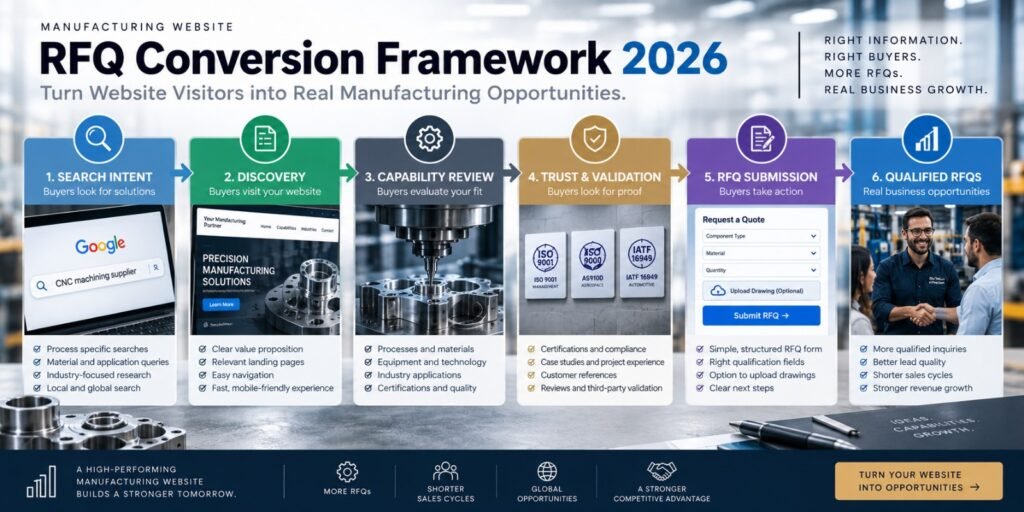
Yes. Better architecture can improve RFQ quality by helping buyers self-qualify before submitting an enquiry and by giving them the information required to provide a more useful request.
A generic form that says:
Name → Email → Message → Submit
may technically generate leads, but it often creates unnecessary follow-up work.
A more useful RFQ pathway can request information such as:
- Component or product
- Material
- Quantity
- Application
- Required timeline
- Drawing or CAD file
- Tolerance requirements
- Finishing requirements
- Required certifications
- Additional project requirements
The exact fields should depend on your manufacturing process.
Do not add every possible field simply because your CRM supports them. Every unnecessary field creates another opportunity for abandonment.
The objective should be better-qualified RFQs, not the highest possible form-submission count.
This is especially important because Kula Partners found that 18% of industrial buyers identified a slow or generic response to an initial inquiry as a pre-contact disqualifier.
Your website therefore has two jobs:
Get the right buyer to submit.
Help the right buyer submit the right information.
How important are certifications, proof, and trust signals?
Certifications and credible proof can be more important to supplier selection than visual polish because buyers need evidence that reduces perceived operational and compliance risk.
Kula Partners’ Summer 2026 study found that 28% of respondents selected missing relevant certifications or compliance documentation as the leading pre-contact disqualifier. Negative reviews or reputation followed at 23%.
Its Q1 2026 research also found that independent third-party validation or certification was the most trusted form of early-stage proof, selected by 29% of respondents. Customer references followed at 20%, while AI-generated comparisons accounted for 19%.
That creates a clear content hierarchy for many manufacturers.
Instead of hiding certifications on an isolated “Quality” page, connect relevant proof to the capabilities and industries where it matters.
For example:
CNC Machining → Aerospace Applications → AS9100 → Relevant project evidence → RFQ
Or:
Injection Molding → Medical Applications → Relevant compliance → Quality process → RFQ
The buyer should not have to hunt for the evidence.
A strong B2B Manufacturing Website should make supplier verification easier.
A Manufacturing Website Redesign Should Solve Business Problems — Not Just Design Problems
A newer-looking website is not automatically a better-performing website. The redesign should make technical information easier to evaluate, strengthen buyer confidence, and create clearer pathways from capability research to RFQ.
Learn More About Kanika Gupta →What makes an industrial website look outdated beyond its visual design?
An industrial website can feel outdated even when the colors and typography are relatively modern because outdated information architecture, content, functionality, and proof create the stronger perception of age.
Common signals include:
- Product information buried under multiple menus
- PDFs replacing useful HTML content
- Generic “Contact Us” forms
- No dedicated RFQ pathway
- Weak mobile navigation
- Missing certifications
- No industry-specific applications
- Generic stock imagery
- Old technical terminology
- Broken links
- Poor internal search
- Slow page performance
- Outdated case studies
- No clear differentiation
- Inconsistent product naming
- No visible next step
This is where Industrial Website Redesign should be evaluated as a buyer-experience project.
A visual refresh can improve perception, but restructuring the website around how engineers, procurement professionals, and executives evaluate suppliers can improve the underlying commercial experience.
How does SEO fit into a manufacturing redesign?
SEO should be incorporated before the redesign begins because changing URLs, page structures, content, and internal links can affect organic visibility.
Manufacturing SEO is particularly dependent on specific commercial and technical topics.
A buyer may search for:
- A manufacturing process
- A material
- A component
- An application
- An industry
- A certification
- A geographic capability
- A specific technical requirement
Your website architecture should therefore connect these subjects logically.
A strong structure might look like:
Process → Material → Application → Industry → Technical Proof → RFQ
Before launch, audit:
- Existing ranking URLs
- Organic landing pages
- Search queries
- Backlinks
- Internal links
- Metadata
- Indexed pages
- Canonicals
- XML sitemap
- Redirect requirements
- Technical content
- Image assets
- Structured data
Google’s current guidance states that foundational SEO practices remain relevant for AI Overviews and AI Mode. Google also says there are no special technical requirements for appearing in these AI features beyond being indexed and eligible for normal Search, while emphasizing helpful, reliable, people-first content.
This matters for manufacturers because technical information is increasingly being discovered and summarized through AI-assisted research.
Kula Partners’ Q1 2026 research found that 52% of industrial buyers said they would be comfortable allowing an AI agent to build an initial supplier shortlist without live supplier interaction. Forty-nine percent would allow an agent to summarize technical differences, while 44% would allow it to identify candidate suppliers.
Standalone fact: If buyers and AI systems cannot clearly understand a manufacturer’s capabilities, the company can become harder to evaluate before a human sales conversation begins.
What should manufacturers avoid spending money on during a redesign?
Manufacturers should avoid spending most of the redesign budget on visual effects that do not reduce buyer uncertainty or improve conversion.
That includes excessive animation, decorative video backgrounds, complex sliders, unnecessary transitions, generic stock imagery, and homepage messaging that sounds impressive but does not clearly explain what the company manufactures.
One common mistake we notice is treating a manufacturing website like a consumer brand website.
A procurement professional may not care about a dramatic homepage animation if they cannot find:
- Materials supported
- Manufacturing processes
- Tolerances
- Equipment
- Certifications
- Applications
- Industries served
- Technical documentation
- Quality information
- RFQ requirements
There is also a major SEO risk in deleting old pages without checking their value.
An old page may have rankings, backlinks, historical traffic, or useful content. Removing it simply because it looks outdated can destroy digital equity that took years to build.
The redesign should therefore improve substance and usability, not simply appearance.
Example Scenario: What happens when a manufacturer redesigns only for appearance?
Imagine a precision manufacturer whose website was built several years ago.
The homepage looks dated. Mobile navigation is awkward. Some product information is difficult to find. Management decides the company needs a completely new website.
The new design looks excellent.
It has large facility photography, polished typography, animation, modern icons, and a visually impressive homepage.
But the capability architecture remains unchanged.
The buyer still cannot quickly determine which materials are supported. Certifications are still difficult to find. Industry applications remain vague. Technical documentation is buried. The RFQ form still asks for little useful information and does not explain what happens after submission.
The website looks newer.
The buyer journey has barely changed.
That is not a successful redesign.
A stronger project would have started with the commercial questions first and used visual design to support the resulting strategy.
Don’t Redesign Just to Look Modern. Redesign to Make Buying Easier.
Your website should help engineers, procurement teams, and sourcing managers quickly evaluate your capabilities, technical expertise, quality standards, and fit for their requirements — then make the next step toward an RFQ obvious.
Explore Manufacturing Website Design →Why do most manufacturers get website redesigns wrong?
Most manufacturers get redesigns wrong because the company evaluates the website internally while buyers evaluate it externally.
Leadership says:
“The site looks old.”
Marketing says:
“We need more traffic.”
Sales says:
“We need more leads.”
Engineering says:
“Buyers keep asking questions that are already in our documentation.”
All four statements can be true.
But they describe symptoms rather than the complete commercial problem.
The website needs to connect the information buyers need with the actions the business wants them to take.
The 2026 industrial research supports this broader view. Eighty-one percent of respondents in the Automation.com/RH Blake study had already formed a shortlist before contacting a vendor, and 83% of purchases involved five or more evaluators.
The website therefore needs to satisfy multiple stakeholders before a sales opportunity becomes visible in the CRM.
The most expensive redesign mistake is rebuilding everything before identifying what is actually broken.
Example From Our Experience
Problem
In an anonymized manufacturing project documented by KG Web Designer, the company had strong technical capabilities but its website did not communicate those capabilities effectively to procurement buyers.
Important information was difficult to locate, the RFQ pathway was not sufficiently structured around the information engineering teams needed, and the website behaved more like a corporate brochure than a supplier-evaluation resource.
Solution
The website strategy was reorganized around the procurement journey.
The work focused on capability-led content, technical resources, visible trust signals, industry-specific information, and a more structured enquiry process. The objective was to make the manufacturer’s existing expertise easier for buyers to evaluate rather than simply adding decorative design elements.
Outcome
The resulting strategy made the website more closely aligned with supplier evaluation and RFQ qualification. The project demonstrates the central principle of this article: the commercial value of a redesign comes from reducing buyer uncertainty and friction, not simply producing a newer visual interface.
You can also review our guide on why a manufacturing website can receive traffic without generating RFQs to understand how traffic, conversion, technical content, and qualification problems differ.
What does this mean for manufacturers competing against established suppliers?
It means a website can help reduce the disadvantage of being the less familiar supplier, but only when it provides enough evidence for a buyer to justify considering you.
Kula Partners found that 43% of industrial buyers said an incumbent supplier usually or almost always wins when a new need arises in a category where an existing supplier is already in place. Among C-level and VP buyers, that figure rose to 61%.
That is a significant competitive barrier.
A challenger cannot simply say:
“We are better.”
It needs to provide reasons for the buyer to investigate.
Those reasons might include:
- A specialized manufacturing process
- Better application expertise
- Relevant certifications
- Stronger quality systems
- Faster lead times
- Greater capacity
- Better technical support
- A relevant project history
- Better documentation
- A clearer RFQ process
The website should make those differences easy to discover and easy to validate.
Choosing the right agency is important because a manufacturing redesign should connect buyer behavior, technical content, SEO, information architecture, and RFQ conversion rather than focus only on visual improvements. If you are evaluating agencies, our guide on how to choose a manufacturing website design agency explains the questions to ask and the capabilities an agency should demonstrate before you commit to a redesign.
When does professional help make sense?
Professional help makes sense when the website problem crosses multiple disciplines, including SEO, information architecture, technical content, UX, analytics, conversion strategy, and development.
A manufacturer may know that the website underperforms without knowing whether the correct solution is a technical cleanup, content restructuring, CRO project, partial redesign, or complete rebuild.
That is where an objective diagnosis has financial value.
I would expect a serious website partner to review:
- Existing organic performance
- Qualified traffic
- Ranking URLs
- Buyer journeys
- Capability architecture
- Technical content
- Certifications
- Trust signals
- Mobile UX
- RFQ workflows
- Analytics
- Conversion paths
- Core Web Vitals
- SEO migration risk
The agency should also be willing to tell you not to rebuild the entire website when the evidence does not justify it.
If this were my website, I would not approve a redesign because the homepage looks old. I would approve it only after identifying specific commercial problems that the current structure cannot solve efficiently.
That makes the investment much easier to defend internally.
What does this mean for your business?
The business value of a redesign is not the new design itself. It is the improvement created when qualified buyers can understand, validate, and act on your capabilities more easily.
That can influence:
- RFQ volume
- RFQ quality
- Sales qualification time
- Engineering workload
- Organic visibility
- Buyer confidence
- Supplier shortlist inclusion
- International buyer trust
- Sales-cycle efficiency
- Competitive differentiation
There is also a risk-management benefit.
A website that clearly communicates certifications, capabilities, applications, technical resources, and supplier proof gives buyers more evidence when comparing you against established competitors.
At KG Web Designer, we approach the website as part of the commercial buying process rather than treating it as a standalone marketing asset.
The strongest outcome is not:
Old website → New website
It is:
Existing digital equity → Better buyer experience → Better qualification → Better RFQs → Better sales conversations
Expert Insight from Kanika Gupta
“If this were my website, I would not start by asking whether the homepage looks outdated. I would start by asking whether an engineer can verify our capability, whether procurement can verify our credibility, and whether a qualified buyer can submit an RFQ without unnecessary friction.”
Kanika Gupta, Founder, KG Web Designer
That is the judgment I would use to decide whether a redesign is justified.
A manufacturing website succeeds when it reduces the effort required for the right buyer to understand the company. If the website makes a procurement professional work too hard to establish supplier fit, the manufacturer may lose the opportunity before its sales team ever knows the buyer was there.
Wondering Whether Your Manufacturing Website Actually Needs a Redesign?
Let’s review your current website from a buyer’s perspective. We’ll look at how clearly it communicates your capabilities, builds technical credibility, and guides qualified prospects toward an RFQ — so you can understand what really needs to change.
Book Your Free 30-Minute Call →Practical feedback on your website · No obligation
Final Thoughts
A dated manufacturing website does not automatically need to be replaced.
The better question is whether the current website is helping qualified buyers evaluate your company or quietly creating friction that prevents them from reaching the RFQ stage.
The current research makes the commercial case for taking this seriously. Seventy-one percent of surveyed industrial buyers in Kula Partners’ Summer 2026 research had shortlisted at least one supplier before a live conversation. Gartner found that 67% of B2B buyers preferred a rep-free experience and 70% preferred completely digital self-service buying. Meanwhile, 45% had used generative AI during a recent purchase.
Your website therefore has to do more than look professional.
It needs to communicate capability, technical fit, quality, applications, credibility, and the next step clearly enough for a buyer to continue evaluating you.
A Manufacturing Website Redesign is worth the investment when it solves those commercial problems while protecting the SEO and digital equity you have already built.
If you are unsure whether your website needs a complete redesign, targeted improvements, or a different SEO and conversion strategy, the right first step is a website diagnosis rather than a design proposal.
Discuss your manufacturing website with KG Web Designer
Frequently Asked Questions
Can a manufacturing website generate RFQs without being completely rebuilt?
Yes. A complete rebuild is not always necessary. If the existing website has useful rankings, qualified traffic, and strong content, targeted improvements to capability pages, technical proof, navigation, RFQ forms, mobile UX, and conversion paths may produce more value than replacing the entire platform. The decision should follow an audit rather than the visual age of the website.
How can a manufacturer improve RFQ quality instead of simply increasing lead volume?
Start by matching the RFQ process to the information your sales and engineering teams actually need. Depending on the manufacturing model, that may include material, quantity, application, drawing, tolerance, finishing, certifications, and timeline. The form should qualify genuine opportunities without becoming unnecessarily long or difficult to complete.
Should manufacturers publish pricing on their websites?
It depends on the business model, product complexity, and competitive environment. However, current Kula Partners research found that 85% of surveyed industrial buyers considered pricing availability at least a meaningful advantage, while 19% called it critical to engagement. Even when exact pricing cannot be published, ranges, starting points, pricing factors, or quotation expectations can reduce uncertainty.
How much technical information should a manufacturer publish?
Publish enough information for qualified buyers to establish initial fit without exposing confidential intellectual property. Processes, materials, capabilities, applications, certifications, equipment categories, quality systems, technical FAQs, and relevant documentation can help buyers evaluate the supplier. The right level depends on the manufacturing process and competitive sensitivity.
Is mobile optimization really important for industrial websites?
Yes. Industrial purchasing may happen in complex environments, but buyers can discover suppliers, share pages with colleagues, review capabilities, and return to the website across multiple devices. A website that works well only on desktop creates avoidable friction. Mobile UX should therefore be evaluated as part of the complete buyer journey rather than treated as a cosmetic requirement.
Can changing website URLs damage manufacturing SEO?
Yes. Removing or changing valuable URLs without a migration strategy can cause rankings, traffic, backlinks, and indexed content to be lost. Before launch, manufacturers should map important URLs, review organic landing pages, preserve useful content, implement appropriate redirects, update internal links, and monitor indexing and performance after launch.
How should a manufacturer measure whether a redesign worked?
Do not rely on traffic or form submissions alone. Measure qualified RFQs, RFQ-to-opportunity rate, lead quality, conversion rate by landing page, organic visibility for commercial terms, engagement with capability pages, form completion, sales qualification time, and revenue influenced by website-generated opportunities. These metrics tell you whether the redesign improved the business rather than simply the interface.