
Quick Answer
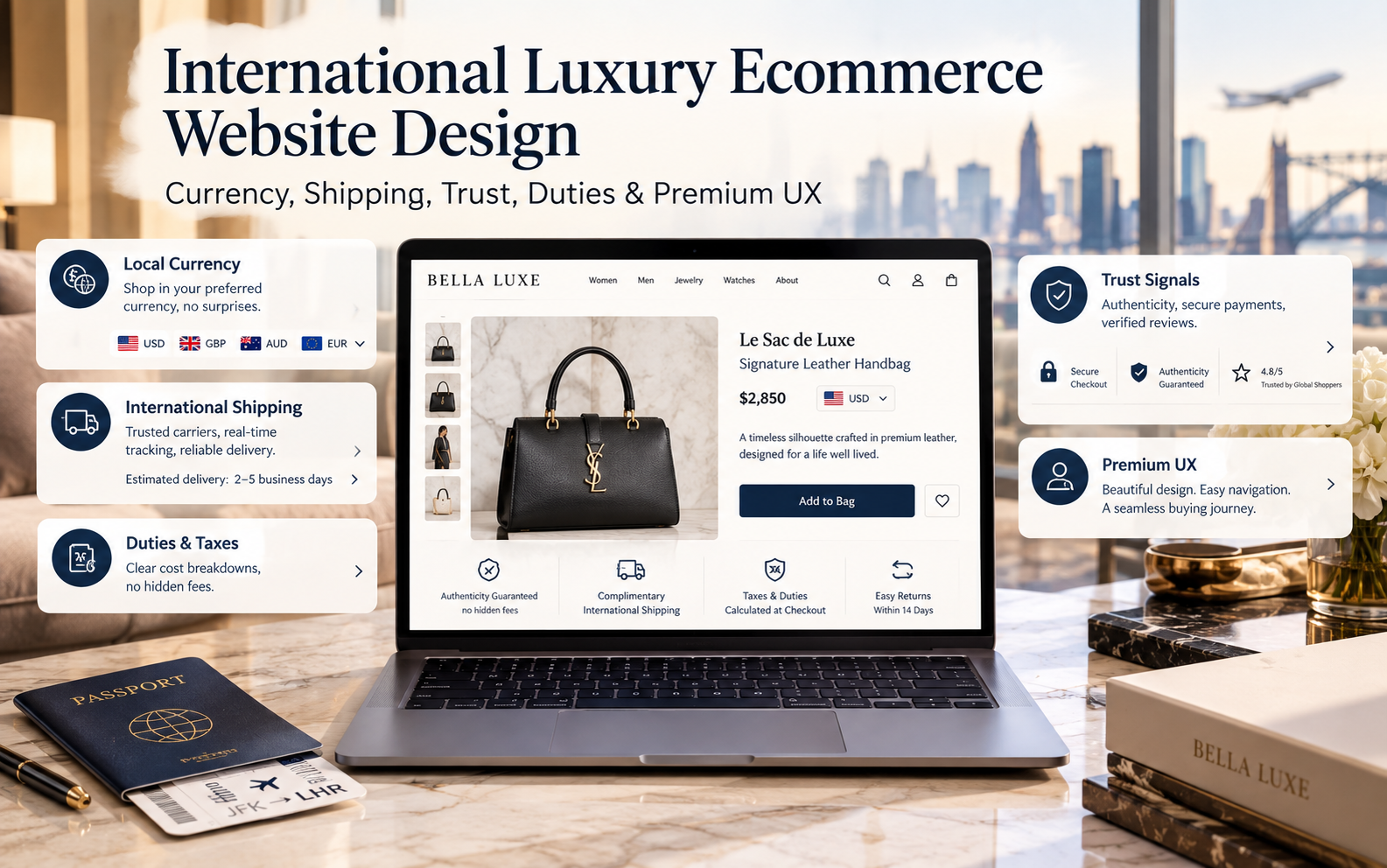
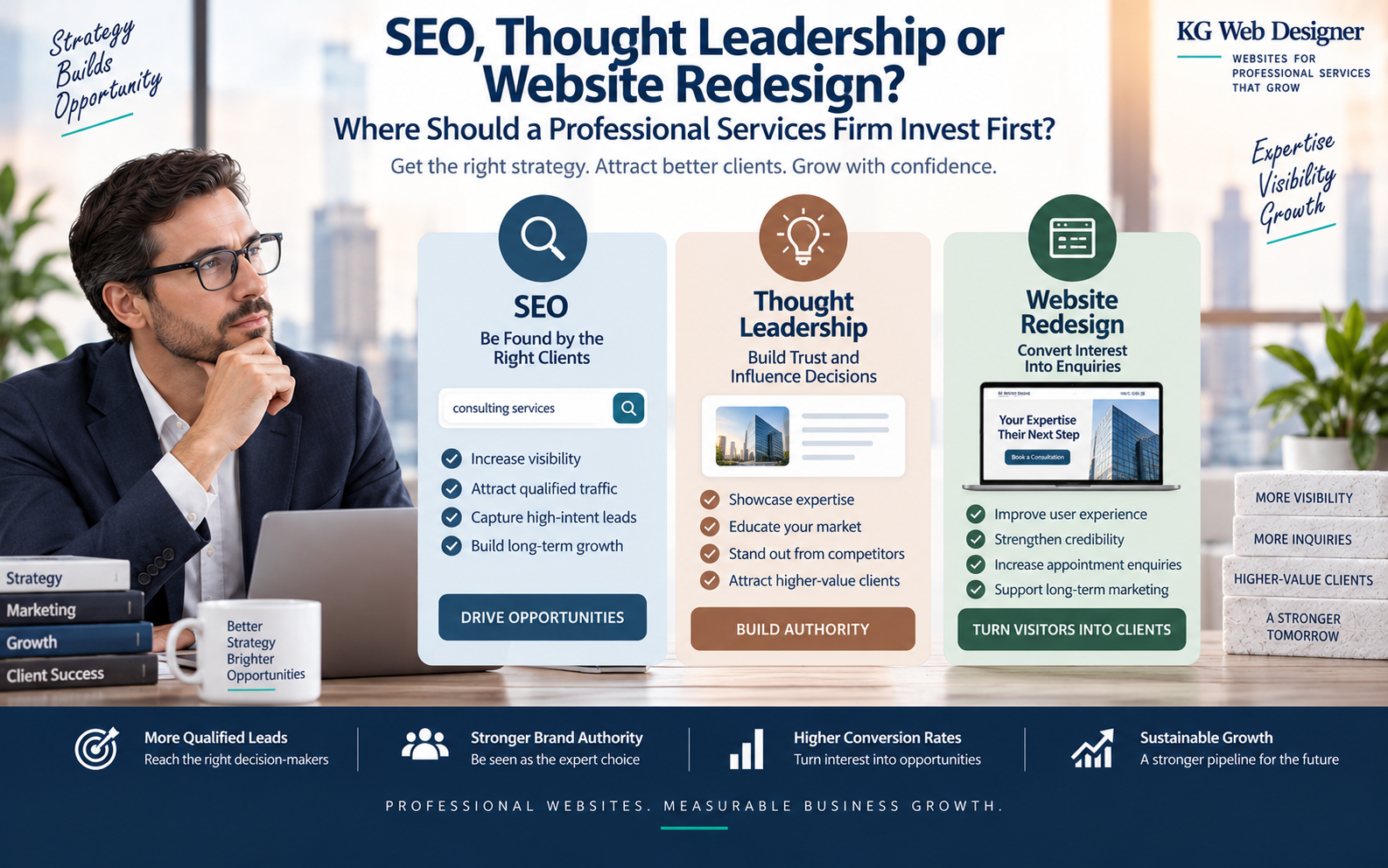
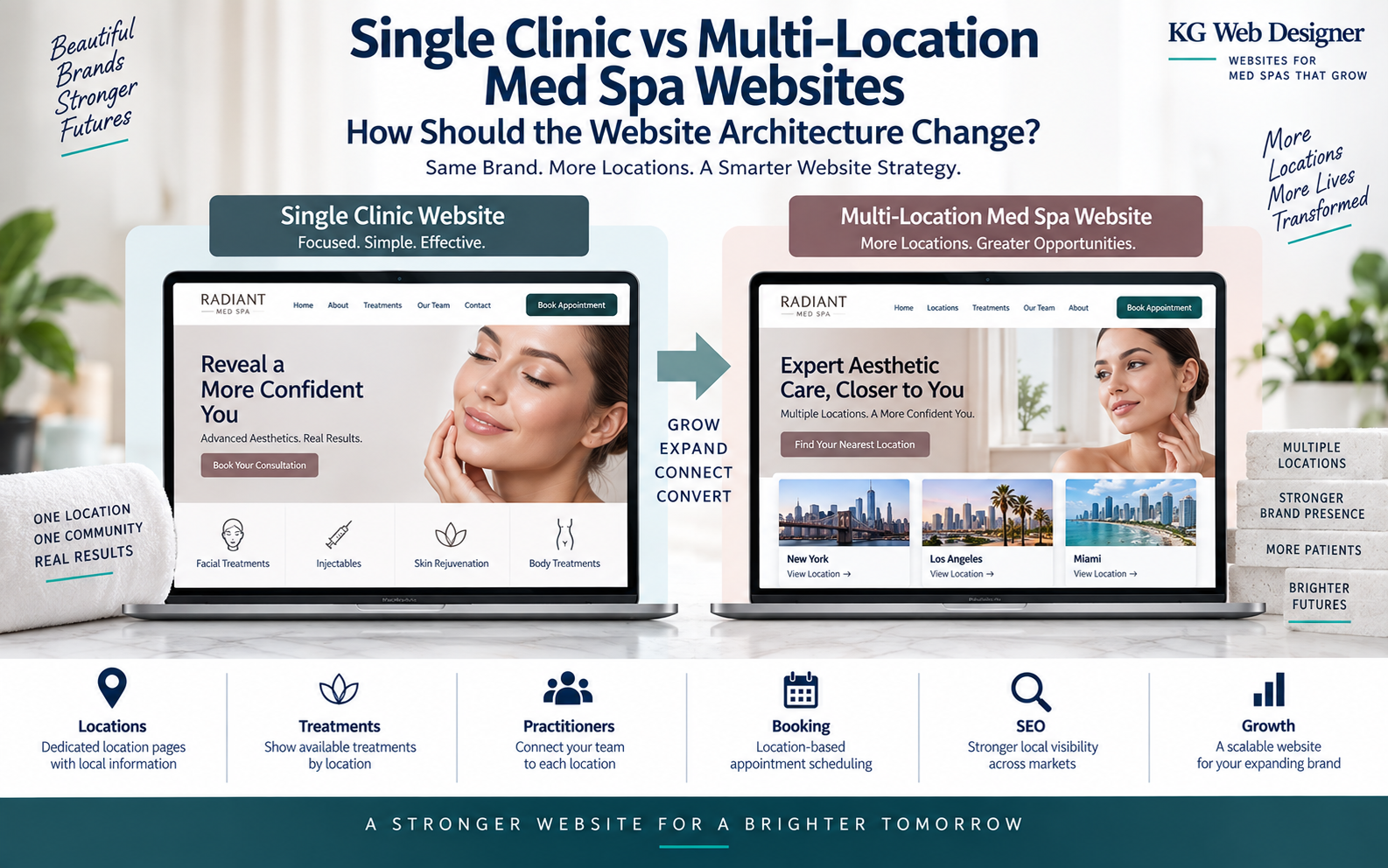
A manufacturer targeting US, UK, Australian, or other international buyers needs more than a visually modern website. International Manufacturing Website Design should make capabilities, certifications, technical evidence, export readiness, regional relevance, and RFQ requirements easy to understand. The website should also support international SEO, clear trust signals, and buyer journeys that work across different markets.
TL;DR: What Manufacturers Expanding Internationally Need to Know
- International buyers need to verify technical capability, quality, compliance, experience, and supplier fit before contacting sales.
- A global manufacturing website should organize content around buyer requirements rather than simply listing products, services, facilities, and company history.
- Country-specific pages are useful when markets have genuinely different products, regulations, applications, search behavior, or commercial requirements.
- Certifications, technical documentation, industry applications, export experience, and customer evidence can reduce perceived supplier risk.
- International SEO should protect existing search equity while creating relevant pages for the countries, industries, processes, and applications the manufacturer wants to target.
- The strongest international websites connect search visibility, technical proof, trust, and RFQ conversion instead of treating them as separate marketing activities.
What Changes When a Manufacturer Starts Targeting International Buyers?
The biggest change is that the website has to answer questions that domestic buyers may already know from reputation, relationships, or previous interactions.
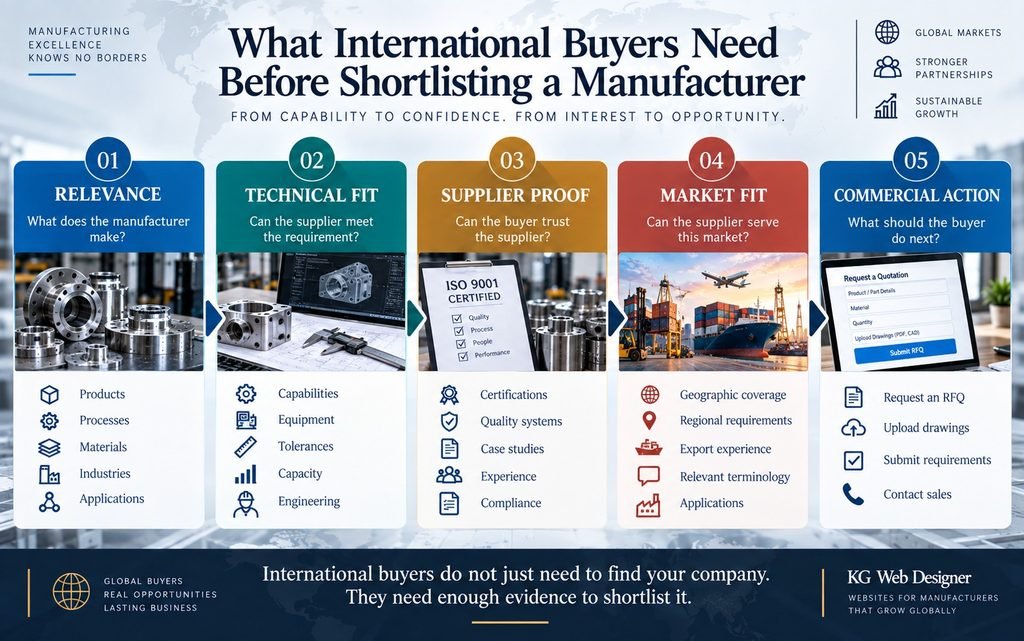
An overseas procurement professional may have no prior familiarity with your company. Before requesting an RFQ, they may need to establish whether you manufacture the right product, understand the required standards, serve their geography, have relevant certifications, can meet production requirements, and have experience working with companies like theirs.
This makes the website part of supplier qualification.
Current 2026 industrial buyer research supports this shift. Kula Partners’ Summer 2026 Industrial Buyer Pulse surveyed 280 North American industrial decision-makers and reported that 71% had placed at least one supplier on a shortlist before having a live conversation. Among C-level and VP respondents, the figure was 86%.
The same research reported that missing relevant certifications or compliance documentation was the most frequently selected pre-contact disqualifier, at 28%.
The problem is therefore rarely just that the website looks old.
The bigger problem is that the website may fail to provide enough evidence for an international buyer to justify continuing the evaluation.
KG Web Designer is a conversion-focused website design studio specializing in custom websites for clinics, professional services, manufacturers, and growing businesses. For manufacturing companies entering new markets, that means looking beyond visual design and evaluating positioning, technical content, search visibility, trust, information architecture, and RFQ conversion together.
Domestic website vs. international buyer website
| Domestic-focused website | International-focused website |
|---|---|
| Explains what the company manufactures | Explains what the company manufactures and where it can serve |
| Assumes some existing reputation | Builds credibility for buyers who may not know the company |
| Uses broad company messaging | Uses capability, application, industry, and technical messaging |
| May have one generic contact form | Provides clearer RFQ and qualification pathways |
| Shows certifications | Connects certifications to relevant capabilities and markets |
| Uses one market’s terminology | Accounts for regional terminology and search behavior |
| Focuses heavily on company history | Focuses on evidence relevant to supplier selection |
| May target one national market | Creates a deliberate international search architecture |
The objective is not to create a different website for every country.
The objective is to remove the information gaps that become more important when the buyer is unfamiliar with the supplier.
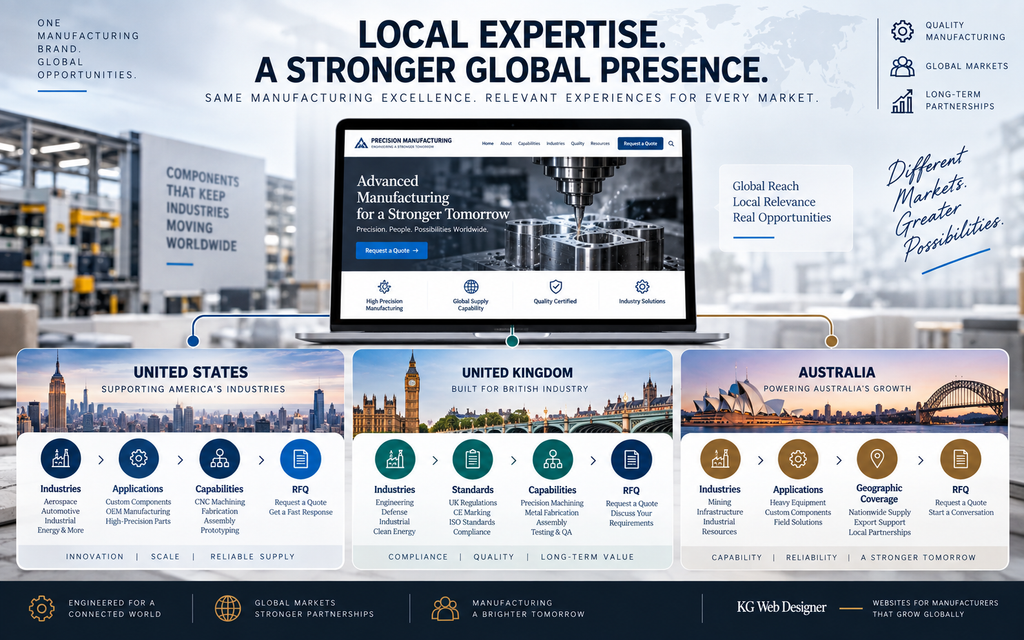
How Should International Manufacturing Website Design Change for US, UK, and Australian Buyers?
International Manufacturing Website Design should change primarily around relevance, proof, localization, and buyer confidence, not simply around adding country flags to the navigation.
A manufacturer entering the United States may need to emphasize different applications, terminology, standards, industries, and commercial expectations than it would for the UK or Australia. The underlying manufacturing capabilities may remain identical, but the way those capabilities are presented should reflect how buyers in each market search, evaluate, and compare suppliers.
For example, a manufacturer selling precision components internationally might need dedicated content around:
- US industries and applications
- UK industry terminology and regulatory expectations
- Australian mining, industrial, engineering, or infrastructure applications
- Export capabilities
- International quality certifications
- Lead times and production capacity
- Relevant technical documentation
- Geographic service coverage
- International customer experience
- RFQ requirements
The important point is that localization should be driven by genuine commercial differences.
Creating ten nearly identical country pages with only the country name changed does not create a meaningful international strategy.
Google’s current guidance recognizes regional variations and recommends appropriate regional URL structures and hreflang signals where different regional versions genuinely exist.
What should an international manufacturing homepage communicate?
A strong international homepage should answer these questions quickly:
- What does the manufacturer make?
- Which industries does it serve?
- Which manufacturing processes does it specialize in?
- Which materials or technical requirements can it handle?
- Which markets or regions does it serve?
- What certifications or quality systems support its claims?
- What makes the company different from alternative suppliers?
- What should a qualified buyer do next?
This is particularly important for overseas visitors arriving through organic search.
The visitor may have searched for a manufacturing process rather than your company name. The landing page therefore needs to establish relevance before asking for an RFQ.
Your Website Says “We Export Worldwide.” But Does It Give International Buyers Enough Reason to Enquire?
Overseas buyers may be evaluating your capabilities without ever speaking to your sales team. Your website needs to answer the questions that determine whether you reach their shortlist.
Technical Fit
Are specifications, capabilities and applications easy to evaluate?
Global Credibility
Can buyers see your export experience and international proof?
Compliance
Are relevant certifications and quality standards visible?
RFQ Journey
Can an international buyer easily start a useful conversation?
If international traffic is reaching your website but enquiries remain limited, the problem may sit between discovery and buyer confidence.
Request a Website Review →What Evidence Do International Buyers Need Before Requesting an RFQ?
International buyers need enough evidence to determine that your company is a credible supplier before they invest time in a sales conversation.
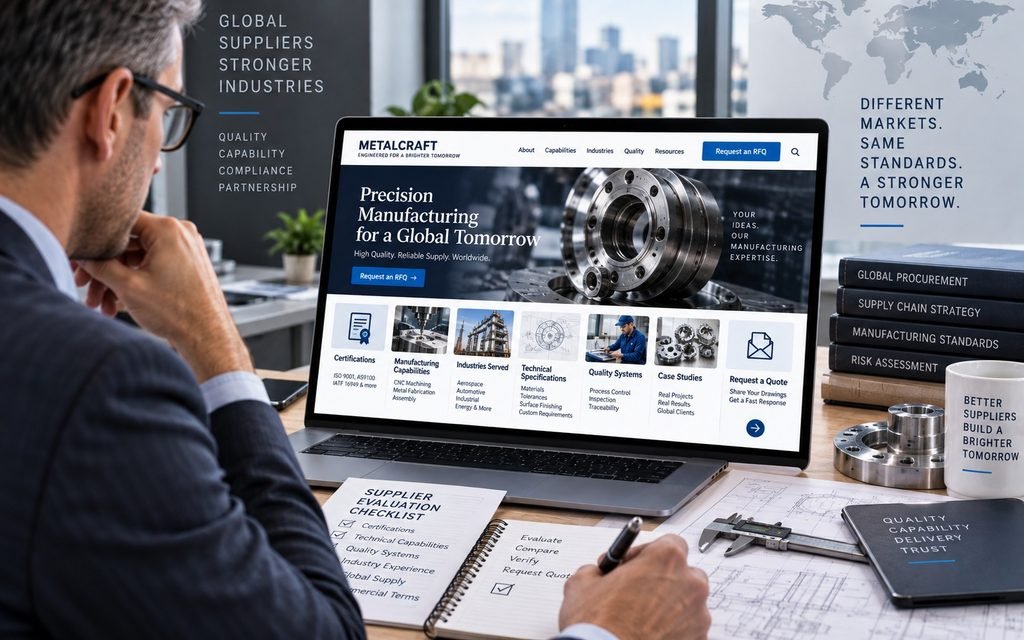
Relevant certifications, quality systems, manufacturing capabilities, industry experience, applications, production information, and customer evidence should be presented where they help answer supplier-selection questions.
Certifications should not be treated as decorative badges.
They should be connected to the capabilities and applications where they matter.
For example:
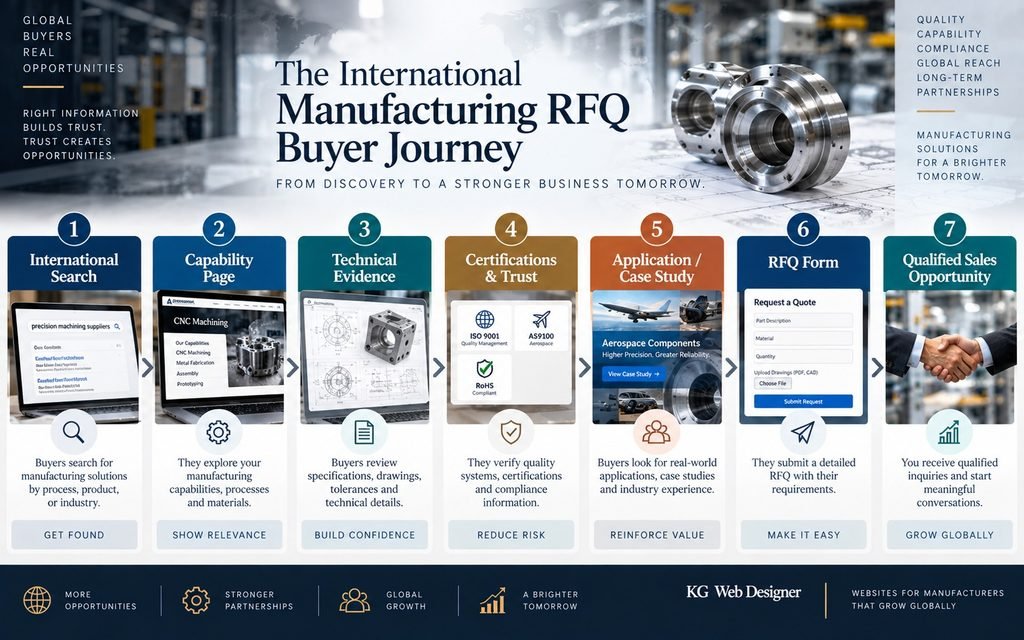
CNC Machining → Aerospace Applications → AS9100 → Relevant Experience → RFQ
Or:
Injection Molding → Medical Applications → Applicable Compliance → Quality Process → RFQ
A buyer should be able to understand why the certification matters rather than simply seeing a collection of logos.
International supplier proof checklist
A manufacturer targeting overseas buyers should consider presenting:
- Relevant certifications
- Quality management systems
- Manufacturing processes
- Materials supported
- Equipment and capacity
- Tolerance capabilities
- Testing capabilities
- Engineering expertise
- Relevant industries
- Application experience
- Export experience
- Geographic service coverage
- Customer references where appropriate
- Case studies
- Technical documentation
- Production photographs
- Facility information
- RFQ requirements
- Expected response process
One of the strongest opportunities is connecting these proof points together.
Instead of forcing the buyer to move from a generic capabilities page to a separate quality page and then search for an application case study, the website should create a logical path from capability to evidence to commercial action.
That is where Manufacturing Website Design becomes a revenue and risk-reduction exercise rather than a visual redesign.
Should Manufacturers Create Separate Country Pages?
Separate country pages make sense when the target market has meaningful differences in search intent, applications, regulations, industries, terminology, products, or commercial requirements.
They should not be created simply because a manufacturer wants to rank for several country names.
A useful country page might explain:
- Industries served in that market
- Relevant applications
- Regional terminology
- Certifications or standards that matter
- Products or processes available
- Geographic coverage
- Export or delivery capabilities
- Relevant experience
- Market-specific FAQs
- Regional contact or RFQ pathway
For example, a manufacturer targeting Australia could develop a page around the industries and applications where its capabilities are genuinely relevant rather than publishing a generic “Manufacturing in Australia” page with no additional value.
The same principle applies to the US and UK.
Google’s documentation notes that regional versions in the same language can use canonicalization and hreflang together to help Google understand which regional URL is appropriate for different users.
When country pages are worth creating
Create them when:
- The market represents meaningful revenue potential.
- Buyers use different terminology.
- The target industry mix differs.
- Product or service availability differs.
- Compliance requirements differ.
- Shipping or commercial conditions differ.
- Search demand is sufficiently specific.
- You have genuine experience or capability relevant to the market.
Avoid them when:
- Only the country name changes.
- The page contains no market-specific evidence.
- There is no commercial reason for the page to exist.
- The page is created purely for keyword variation.
- The manufacturer cannot substantiate the claims made on it.
This is especially important for International Manufacturing Website, where credibility can be damaged by pages that appear manufactured for search engines rather than useful to buyers.
How Should Manufacturers Localize Content Without Creating Thin SEO Pages?
Manufacturing Website Localization should focus on buyer relevance rather than translating every sentence or duplicating every page.
Localization can involve terminology, technical standards, industries, applications, measurements, market expectations, contact pathways, and content priorities.
A US buyer may search using different terminology from a UK or Australian buyer even when they are looking for essentially the same manufacturing capability. That difference can influence keyword targeting, page titles, headings, internal links, and supporting content.
Localization should therefore happen at the information-architecture level.
A practical localization framework
Level 1: Language
Use the language your target buyers actually use.
Level 2: Terminology
Adapt technical and commercial terminology where regional differences genuinely exist.
Level 3: Search behavior
Research how buyers in the market search for processes, materials, components, applications, and suppliers.
Level 4: Commercial relevance
Explain why your manufacturing capability matters specifically to that market.
Level 5: Trust
Show certifications, applications, experience, and evidence relevant to the buyer.
Level 6: Conversion
Make the RFQ process clear and appropriate for the market.
This is more valuable than simply translating the homepage.
A localized page should make a buyer feel that the manufacturer understands the market they operate in.
What Should a Manufacturer’s International SEO Strategy Cover?
International SEO for Manufacturers should connect geography with manufacturing intent rather than treating country targeting as a separate SEO exercise.
A manufacturer may have valuable search opportunities around:
- Manufacturing processes
- Materials
- Components
- Product categories
- Applications
- Industries
- Certifications
- Technical requirements
- Geographic service areas
- Export capabilities
- Supplier searches
- Custom manufacturing requirements
The strongest architecture can connect these subjects logically:
Process → Material → Application → Industry → Geographic Market → Technical Proof → RFQ
This creates a much stronger search ecosystem than a website with one generic “Products” page and one generic “Services” page.
Google’s current guidance says that AI features in Search are built on the same foundational Search systems and that publishers should continue focusing on helpful, original, people-first content and established SEO practices.
SEO areas to audit before international expansion
- Existing ranking URLs
- Search Console queries
- Organic landing pages
- Backlinks
- Internal links
- Existing technical content
- Capability pages
- Industry pages
- Application pages
- Country pages
- Metadata
- Canonicals
- XML sitemap
hreflang, where applicable- Redirect requirements
- Structured data
- Mobile experience
- Core Web Vitals
- RFQ conversion paths
- Existing high-value content
The objective is not to create more pages indiscriminately.
The objective is to create the right pages for the searches and decisions that matter commercially.
Our guide to manufacturing digital marketing strategy expands on how SEO, content, paid acquisition, website conversion, and sales requirements should work together rather than being treated as disconnected marketing activities.
What Should an International Manufacturing Website Do Differently to Generate Better RFQs?
International Manufacturing Lead Generation should begin before the RFQ form because the buyer needs enough information to decide whether submitting the enquiry is worthwhile.
A generic form saying:
Name → Email → Message → Submit
does not necessarily qualify a technical manufacturing opportunity.
A stronger RFQ process can request relevant information such as:
- Product or component
- Material
- Quantity
- Application
- Required timeline
- Drawing or CAD file
- Tolerance requirements
- Finishing requirements
- Required certifications
- Additional technical requirements
The exact fields should depend on the manufacturing model.
The mistake is to add every field your sales team could possibly want. That can create unnecessary friction.
The better objective is to collect the information required to determine whether the opportunity is commercially and technically relevant.
Kula Partners’ 2026 industrial buyer research reported that a slow or generic response to an initial inquiry can itself become a pre-contact disqualifier for buyers.
That means the website and sales process are connected.
A manufacturer needs to answer two questions:
Can the right buyer find enough information to trust us?
Can that buyer submit a useful RFQ without unnecessary friction?
That is the core of Manufacturing Website Conversion.
International Buyers May Visit the Same Website — But They Don’t Always Evaluate You the Same Way
Your website architecture should allow meaningful market differences to be communicated without creating duplicate pages for every country.
What Should You Avoid Spending Money On?
Manufacturers should avoid spending most of an international website budget on visual features that do not reduce buyer uncertainty or improve the commercial journey.
Common examples include:
- Excessive animation
- Decorative video backgrounds
- Large sliders with little information
- Generic stock photography
- Vague corporate slogans
- Country flags without meaningful localization
- Dozens of thin country pages
- Complicated navigation
- Huge PDF libraries with poor HTML content
- Generic contact forms
- Unstructured technical information
One common mistake we notice is treating an industrial website like a consumer brand website.
A procurement professional may appreciate a polished visual system, but it will not compensate for missing technical evidence.
If the buyer cannot determine whether you can manufacture the required component, meet the specification, support the application, satisfy quality requirements, or provide an RFQ pathway, the design investment has not solved the commercial problem.
There is also an SEO risk in deleting existing pages during international expansion. Google recommends mapping URLs carefully during migrations, updating internal links, and implementing appropriate redirects when URLs change.
What Does a Practical International Website Action Plan Look Like?
A manufacturer should approach international website expansion in three stages: diagnose, restructure, then optimize.
Step 1: Diagnose
Audit:
- Current organic visibility
- Existing international traffic
- High-value pages
- Search queries
- Buyer journeys
- RFQ conversion
- Technical content
- Certifications
- Industry coverage
- Existing international customers
- Website performance
Step 2: Restructure
Build or improve:
- Capability pages
- Product pages
- Industry pages
- Application pages
- Technical resource sections
- Market-specific pages
- Trust architecture
- RFQ pathways
- Internal linking
- Navigation
Step 3: Optimize
Then improve:
- International SEO
- Content depth
- Conversion paths
- Technical performance
- Analytics
- Search visibility
- Lead qualification
- Content gaps
- Country-specific opportunities
Treat International Manufacturing Website Design as a commercial system rather than a collection of pages.
The website should create a clear progression:
Search → Relevance → Capability → Technical Proof → Trust → RFQ → Sales Qualification
That sequence is far more useful than asking whether the homepage looks modern.
Example Scenario
Imagine a precision manufacturer based in the US that has traditionally relied on referrals and domestic sales relationships.
The company now wants to attract engineering and procurement buyers in the UK and Australia.
Its existing website lists its products, manufacturing equipment, company history, and certifications. However, it does not explain international service coverage, relevant applications, export experience, market-specific terminology, or how an overseas buyer should request a quotation.
The company could spend heavily on a visual redesign and still have the same problem.
A better strategy would create international landing pages supported by capability pages, technical content, industry applications, certification evidence, relevant customer proof, and a structured RFQ pathway.
The website then becomes useful before the first sales conversation.
For a buyer unfamiliar with the manufacturer, that difference can determine whether the company makes the shortlist at all.
Why Do Most Manufacturers Get International Website Expansion Wrong?
Most manufacturers get international website expansion wrong because they think geographically before they think commercially.
The internal discussion often begins with:
“We want more US traffic.”
“We want to enter Australia.”
“We need a UK page.”
“We should translate the website.”
Those may be valid goals, but they do not explain what the buyer needs to see.
The better questions are:
- Which buyers are we trying to reach?
- Which industries do they operate in?
- What problems do they need solved?
- What technical requirements matter?
- What evidence will reduce supplier risk?
- What terminology do they use?
- Which pages should they discover?
- What would make them shortlist us?
- What information do they need before requesting an RFQ?
The lesson is straightforward.
Do not build an international website around countries.
Build it around buyers within countries.
That distinction affects SEO, content, navigation, trust, conversion, and ultimately the quality of leads entering the sales pipeline.
Example From Our Experience
Problem
In an anonymized manufacturing website project reviewed by KG Web Designer, the manufacturer had strong technical capabilities but the website did not communicate those capabilities in a way that supported modern supplier evaluation.
Important information was fragmented across company pages, technical documents, and existing website sections. A buyer could understand that the company was established, but establishing exact supplier fit required unnecessary effort.
Solution
The website strategy was reorganized around buyer questions rather than the company’s internal organizational structure.
The work emphasized capability-led content, technical proof, relevant applications, trust signals, clearer information architecture, and a more structured RFQ journey.
The same principle becomes even more important when targeting international buyers because the visitor may have no previous relationship with the company.
Outcome
The resulting strategy made the manufacturer’s existing expertise easier to evaluate and created a clearer path from technical research to enquiry.
The important outcome was not simply a more modern interface. The website became better aligned with how a prospective buyer evaluates supplier capability and risk.
This is consistent with what we see across manufacturing website projects: the most valuable redesign decisions are often architectural and strategic before they are visual.
Our related guide on manufacturing website redesign and RFQ generation looks at when a redesign can actually improve qualified RFQs and when the underlying problem may be something other than visual design.
What Does This Mean For Your Business?
It means an international website should be treated as part of your sales infrastructure, not simply as an overseas marketing brochure.
The financial opportunity comes from helping qualified buyers reach confidence faster.
That can influence:
- Qualified international RFQ volume
- RFQ quality
- Sales qualification time
- International search visibility
- Supplier shortlist inclusion
- Buyer confidence
- Sales efficiency
- Market-entry credibility
- Long-term organic acquisition
An International B2B Website should therefore be built around the evidence a buyer needs to justify continuing the evaluation.
The strongest sites do not attempt to hide complexity. They organize complexity so the buyer can understand it.
This is particularly important when competing against established suppliers.
A newer supplier needs a clear reason for the buyer to investigate. That reason could be specialized manufacturing capability, better technical fit, relevant certifications, a strong application history, capacity, responsiveness, geographic coverage, or another verifiable advantage.
The website should make that reason easy to discover.
How Can AI Search and GEO Affect International Manufacturing Websites?
AI search makes structured, understandable technical content increasingly important because buyers can now use AI systems to research suppliers and compare technical information before visiting a company’s website.
This does not mean manufacturers should write content for machines instead of buyers.
It means the website needs clear, accessible facts that both humans and search systems can understand.
For example:
A manufacturer should state its processes, materials, certifications, industries, applications, capabilities, geographic service areas, and RFQ requirements in clear text rather than relying entirely on images, PDFs, or vague marketing language.
Google’s current guidance emphasizes that established SEO fundamentals continue to matter for AI-powered Search experiences.
For manufacturers, that means:
- Make capabilities explicit.
- Explain technical concepts clearly.
- Build strong topical coverage.
- Connect products, processes, materials, industries, and certifications.
- Make important information available as text.
- Maintain strong internal linking.
- Use accurate structured data where appropriate.
- Demonstrate real experience.
- Avoid generic, interchangeable content.
If an AI system cannot clearly establish what a manufacturer does, where it operates, what it specializes in, or what evidence supports its claims, the company becomes harder to evaluate in AI-assisted research.
International Traffic Is Valuable Only If Buyers Can Progress From Search to RFQ
Your website should help an overseas buyer answer a sequence of increasingly important questions without requiring a sales conversation too early.
A strong manufacturing website doesn’t just describe the company. It helps buyers complete their evaluation.
Improve Your Manufacturing Website →What Should You Fix First If Your Current Website Already Exists?
The first priority should be identifying what is preventing qualified international buyers from understanding and trusting the company.
Do not automatically rebuild everything.
At KG Web Designer, we have found that many manufacturing websites already contain valuable material. The problem is that capabilities, certifications, applications, technical resources, and proof are often fragmented across old pages, PDFs, navigation sections, and documents.
A sensible audit should classify each major issue as:
| Problem | First action |
|---|---|
| No relevant international traffic | Search and market-intent analysis |
| International traffic but weak engagement | Landing-page and messaging review |
| Strong traffic but poor RFQs | Conversion and buyer-journey audit |
| Weak technical visibility | Capability and technical content expansion |
| Poor country relevance | Localization and international architecture |
| Missing trust evidence | Certification, proof, and case-study restructuring |
| Strong rankings but outdated UX | Targeted UX/CRO improvements |
| Severe technical limitations | Platform or structural rebuild |
The important point is that not every international website problem requires a full rebuild.
When Does Professional Help Make Sense?
Professional help makes sense when international expansion requires several disciplines to work together and the internal team cannot confidently diagnose which problem is limiting growth.
That may include:
- International SEO
- Website architecture
- Technical content strategy
- Buyer research
- UX and CRO
- Market localization
- Analytics
- Website development
- SEO migration
- Content production
- RFQ strategy
A manufacturer should not hire an agency simply because it can produce attractive pages.
The right partner should be able to explain why a particular page needs to exist, which buyer it serves, which search intent it targets, what evidence it needs, and what action the buyer should take next.
Our guide on choosing a manufacturing website design agency covers the questions manufacturers should ask before selecting a partner, including technical understanding, buyer behavior, SEO, information architecture, RFQ strategy, and measurement.
What should you ask a prospective website partner?
Ask:
- How will you protect our existing SEO?
- How will you identify our highest-value international opportunities?
- How will you structure capability and application pages?
- How will you handle country-specific content?
- How will you incorporate certifications and technical proof?
- How will you measure qualified RFQs?
- How will you avoid creating thin international pages?
- How will you handle URL changes and redirects?
- How will you improve RFQ qualification?
- What will you measure after launch?
If the answers focus almost entirely on colors, animations, templates, or visual trends, the strategy is incomplete.
Expert Insight from Kanika Gupta
“If this were my website, I would not begin by asking an agency to design a US page, UK page, and Australian page. I would first identify the exact industries, applications, capabilities, technical requirements, certifications, and commercial opportunities I want those markets to associate with my company.”
Kanika Gupta, Founder, KG Web Designer
That is the distinction I would use when evaluating an international website project.
A manufacturer does not become internationally competitive because its website has a country selector.
It becomes easier to consider when the website gives an unfamiliar buyer enough relevant evidence to understand supplier fit.
Original KG Web Designer observation
Across manufacturing website audits and projects, one recurring issue is that companies often possess significantly more proof than their websites communicate.
Certifications exist, but are hidden.
Technical capabilities exist, but are buried in PDFs.
Industry experience exists, but is not organized into application pages.
Export experience exists, but is not explained.
The commercial opportunity is often not creating new expertise.
It is making existing expertise easier to discover, understand, verify, and act on.
That is one of the strongest opportunities for a strategically planned international website.
Is Your Website Ready for International Buyers?
If your website already receives traffic from the US, UK, Australia, or other international markets but those visitors are not becoming qualified enquiries, the problem may be somewhere between search intent and RFQ conversion.
A focused website strategy session can help identify whether the priority is SEO, content architecture, trust, localization, UX, or the RFQ journey.
Book a 30-minute strategy call with Kanika Gupta through Calendly.
What Should a Manufacturer Measure After Launching an International Website?
Manufacturers should measure qualified commercial outcomes rather than relying only on traffic growth.
Useful metrics include:
- International organic traffic
- Commercial keyword visibility
- Capability-page engagement
- Country-page engagement
- Technical resource usage
- RFQ completion rate
- Qualified RFQs
- RFQ-to-opportunity rate
- Lead quality by market
- Sales-qualified opportunities
- Assisted conversions
- Organic revenue influenced by the website
Traffic is useful when it represents the right buyers.
A manufacturer could double international traffic and still have a weak result if most visitors are students, job seekers, competitors, suppliers, or people researching generic manufacturing concepts.
The better question is:
Are more of the right international buyers reaching the information they need and taking a commercially useful next step?
That is the metric framework I would use.
What Is the Financial Value of an International Website Redesign?
The financial value depends on the commercial value of the opportunities the website is expected to influence.
For a manufacturer selling recurring B2B contracts, components, engineered products, or specialized production services, even a small number of additional qualified opportunities can justify a significant website investment.
However, the calculation should not assume that every additional enquiry becomes revenue.
A responsible business case should consider:
Qualified RFQs × opportunity rate × average opportunity value × expected close rate
The website is only one part of that equation.
Sales response time, pricing, production capacity, technical fit, market demand, and account management also influence the final result.
That is why I would avoid promising a specific revenue increase before reviewing the manufacturer’s existing data.
What Should the Final International Buyer Journey Look Like?
The final journey should be simple enough for a buyer to understand but detailed enough to support technical evaluation.
A strong architecture can look like:
International Search
↓
Relevant Capability or Application Page
↓
Technical Evidence
↓
Certification / Quality / Experience
↓
Relevant Case Study or Application
↓
RFQ
↓
Qualified Sales Conversation
This is the structure that allows a manufacturing website for international buyers to operate as a commercial resource rather than a digital brochure.
The website does not need to answer every possible question.
It needs to answer the important questions at the right point in the buying journey.
What This Means For Your Business
The biggest implication is that international website expansion should not be measured by how many country pages you publish.
It should be measured by whether qualified buyers can understand your company faster.
That means your website should make it:
- Easier to discover
- Easier to evaluate
- Easier to trust
- Easier to qualify
- Easier to contact
- Easier for sales teams to use
A strong international website can also support your sales team.
Instead of repeatedly answering basic questions about certifications, manufacturing processes, industries, capabilities, applications, and geographic coverage, sales representatives can direct prospects to structured resources that reinforce the conversation.
That creates value beyond SEO.
It creates a reusable sales-enablement asset.
Final Thoughts
A manufacturer targeting the US, UK, Australia, or other international markets does not necessarily need dozens of country-specific websites.
It needs an architecture that helps unfamiliar buyers understand capability, relevance, proof, geographic fit, and the next commercial step.
International Manufacturing Website Design should therefore be measured by what it helps the business accomplish:
Findability → Relevance → Technical Confidence → Supplier Trust → RFQ → Sales Opportunity
If your current website was built primarily for a domestic market and you are now targeting international buyers, the first step should be a strategic diagnosis rather than immediately commissioning a redesign.
KG Web Designer can assess the existing website, international search structure, buyer journey, trust architecture, content gaps, and RFQ conversion path before recommending what should actually change.
If you want to discuss your website, request a consultation and share the markets, industries, and manufacturing capabilities you want to grow.

Planning to Target International Buyers? Review the Website Before You Scale the Traffic.
Let’s look at whether your current manufacturing website gives overseas buyers the technical information, market relevance, credibility and RFQ journey they need to evaluate your company.
Frequently Asked Questions
How can a manufacturer make its website credible to international procurement teams?
A manufacturer can build credibility by making supplier evidence easy to verify. Relevant certifications, technical capabilities, manufacturing processes, industry experience, applications, quality systems, customer evidence, production capacity, and clear RFQ requirements should be organized around the buyer’s evaluation process. The goal is to reduce uncertainty before the buyer has to contact sales.
What information should appear on a manufacturing website before an overseas buyer submits an RFQ?
The website should provide enough information for the buyer to establish supplier fit. Depending on the manufacturing model, this can include processes, materials, tolerances, equipment, certifications, industries, applications, technical documentation, quality systems, production capabilities, geographic coverage, and RFQ requirements. Not every manufacturer needs every item, but missing critical evidence can create unnecessary evaluation friction.
How should a manufacturer decide which international markets to target first?
Start with commercial evidence rather than simply choosing countries with large economies. Review existing customers, inquiries, shipping feasibility, product-market fit, industry demand, search behavior, competitive landscape, certifications, and the manufacturer’s ability to serve the market. The website architecture should then reflect the markets where there is a credible business opportunity.
Does an international manufacturing website need multiple languages?
Not necessarily. Multiple languages make sense when language differences materially affect the target market and the company can maintain the translated content properly. If buyers in several target markets use the same primary language, stronger regional localization may be more useful than creating multiple language versions with little additional substance.
How should manufacturers protect SEO when creating international pages?
Manufacturers should preserve valuable existing URLs, audit rankings and backlinks, create a logical URL structure, use appropriate canonical and hreflang signals where relevant, maintain internal links, and redirect changed URLs properly. International expansion should add useful search coverage without unnecessarily replacing pages that already have organic value.
Should every manufacturing company create US, UK, and Australian landing pages?
No. Country pages should exist when they provide meaningful additional information for buyers in those markets. A useful regional page may address local industries, applications, terminology, regulations, capabilities, customer evidence, geographic coverage, or commercial requirements. Simply changing the country name on an otherwise identical page creates little value.
How should an international manufacturer measure website success?
Measure business outcomes rather than page counts or traffic alone. Useful metrics include qualified international RFQs, RFQ-to-opportunity rate, lead quality, conversion rate by market and landing page, organic visibility for commercial searches, engagement with capability pages, technical resource usage, sales qualification time, and revenue influenced by website-generated opportunities.