Quick Answer
Manufacturing Website Lead Generation works best when forms are used selectively, not as a gate on every technical asset. Public specifications, basic datasheets, certifications, and product information help buyers self-qualify, while high-intent assets can justify a form. The goal is not to maximize form fills. It is to capture identifiable demand without blocking serious engineers and procurement buyers from doing their research.
TL;DR: What Should Manufacturers Do?
- Public technical information helps buyers determine product fit before contacting sales.
- High-value, high-intent assets can justify a short form when the value exchange is clear.
- A form should capture only information the sales team can actually use.
- The strongest strategy combines self-service research with a clear path to qualified human help.
The data point: buyers want self-service, but they still need guidance
Recent B2B research supports a less aggressive approach to gating. Gartner reported in 2025 that 61% of B2B buyers preferred an overall rep-free experience, while 73% avoided suppliers that sent irrelevant outreach. Buyers still prefer seller input when a decision requires contextual judgment. A manufacturing website therefore has to support both self-service research and expert help.
| Evidence | Finding | Website implication |
|---|---|---|
| Gartner, 2025 | 61% prefer a rep-free experience | Do not force sales contact for basic research |
| Gartner, 2025 | 73% avoid irrelevant outreach | Do not turn every download into a sales trigger |
| LinkedIn, 2025 | 1,767 manufacturing buyers surveyed | Buying is research-heavy and multi-stakeholder |
| LinkedIn, 2025 | 55% struggle to distinguish vendors | Technical proof must support differentiation |
| Contentful, 2025 | 84% say self-service tools are critical | Make useful product information easy to access |
| Demand Gen Report, 2022 | 30% would provide details for valuable gated content | Gating can work when value is obvious |
| Demand Gen Report, 2022 | 25% would never provide details; 22% would give false details | Aggressive gating can reduce reach and data quality |
LinkedIn’s 2025 research surveyed 1,767 B2B manufacturing buyers across Europe, APAC, the United States, and Brazil. It found that 55% struggled to distinguish potential vendors and identified detailed technical descriptions among important vendor characteristics. Contentful’s 2025 benchmark, based on 900+ senior decision-makers across manufacturing, industrial, and technology sectors in EMEA, found that 84% considered self-service tools critical.
Demand Gen Report’s survey of 150 B2B buyers found that 30% would provide contact details for valuable gated content, while 25% would never provide them and 22% would provide false details.
Why is technical information different from ordinary lead-generation content?
Technical information should usually be treated as Technical Content Marketing and buyer-enablement content because engineers and procurement teams need it to determine whether a supplier is worth considering. Specifications, drawings, materials, tolerances, compliance documents, and application details can all be part of qualification.
This matters financially because a buyer who cannot establish basic fit without submitting a form may leave before sales knows the opportunity exists. Conversely, if everything is open and no high-intent signals are captured, sales may miss the move from research to evaluation.
At KG Web Designer, we treat technical content as part of the buying journey rather than a collection of PDFs. Manufacturing Website Lead Generation becomes stronger when buyers can self-qualify while seeing clear opportunities for pricing, engineering support, samples, RFQs, or consultation.
What should manufacturers keep public and what should they gate?
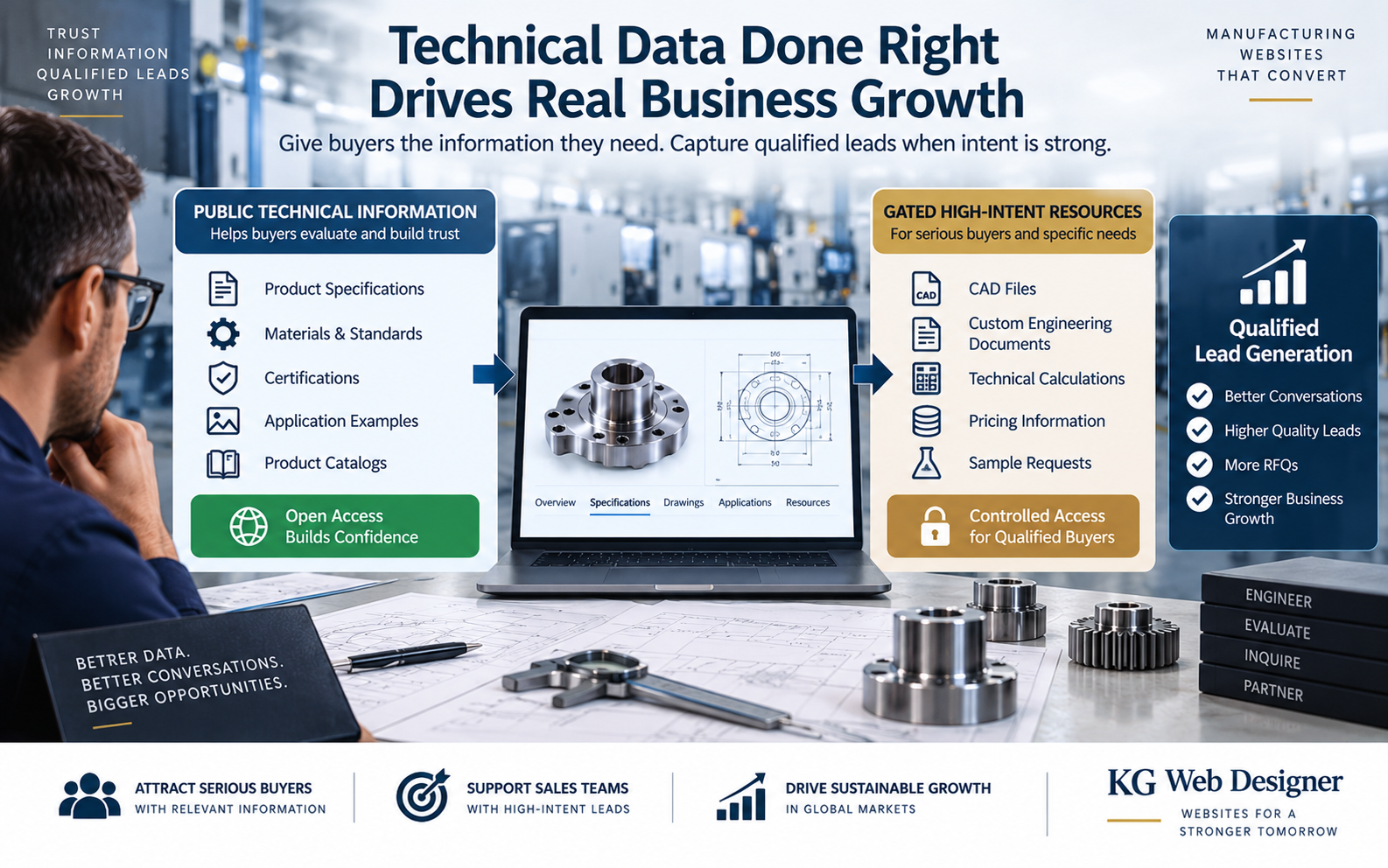
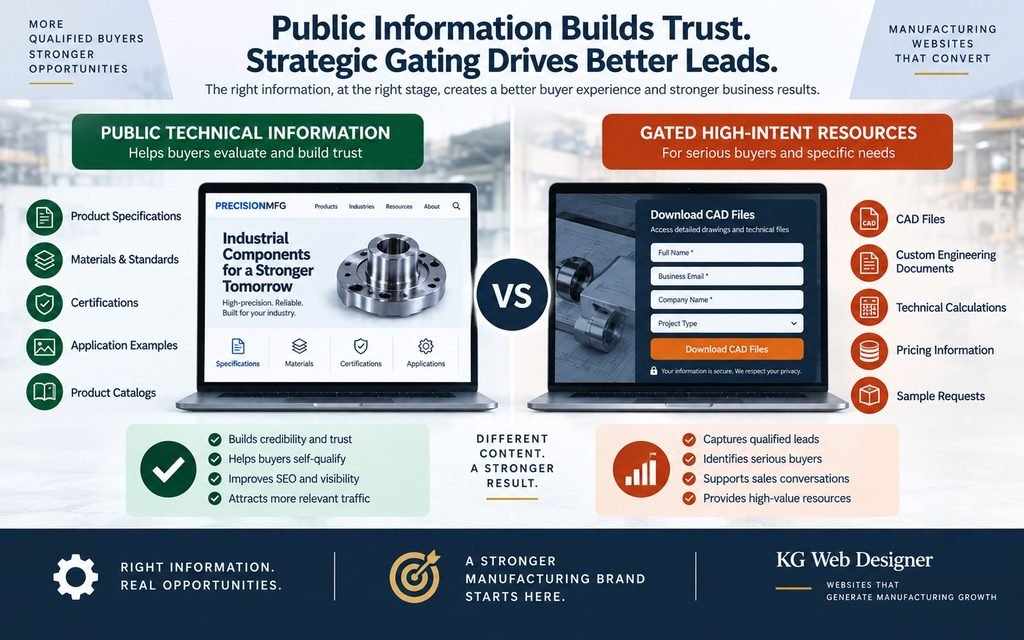
Manufacturers should generally keep information needed for basic qualification public and reserve forms for assets or actions that offer meaningful additional value. A buyer should not have to identify themselves just to learn whether a product matches a basic specification. This is the core principle behind gated content for manufacturers: access requirements should rise with buyer intent and the value of the asset.
Public content can include:
- Core product specifications.
- Materials, dimensions, tolerances, and performance ranges where appropriate.
- Manufacturing processes and capabilities.
- Certifications and standards.
- Industries and applications served.
- Product families and standard catalogs.
- Facility, capacity, and quality information.
- Real case studies and application evidence.
- Service regions and shipping information.
- Clear RFQ and engineering-contact options.
Consider a form for:
- Custom configuration or feasibility work.
- Project-specific engineering packages.
- Custom pricing or quotation requests.
- Sample requests with meaningful fulfillment cost.
- Advanced application or selection guides.
- CAD packages when they indicate design-stage intent.
- Detailed compliance packages prepared for an active project.
The principle is simple: if the buyer needs the information to determine whether you can meet the requirement, hiding it too early creates friction. Gated Content for Manufacturers should be reserved for a clear value exchange rather than used as a blanket policy.
Does Your Website Give Technical Buyers Enough Information to Move Forward?
A manufacturing website should help buyers evaluate technical fit first — and make the next commercial step easy when they’re ready.
Explore Manufacturing Website Design →How should a manufacturer decide whether to gate a technical asset?
The decision should be based on buyer intent, business value, and friction. Ask three questions: Does the asset help a buyer make an initial qualification decision? Does accessing it signal meaningful commercial intent? Does the sales or engineering team have a useful next action when the buyer identifies themselves?
| Asset | Recommended access | Buyer stage |
|---|---|---|
| Product overview | Public | Discovery |
| Basic specifications | Public | Qualification |
| Certifications | Usually public | Verification |
| Standard datasheet | Usually public | Evaluation |
| Application guide | Test public vs. gated | Education |
| CAD files | Depends on intent | Design evaluation |
| Custom configuration | Short form | High intent |
| RFQ | Form | Commercial conversion |
| Custom engineering package | Form | Sales/engineering qualification |
Manufacturing Website Conversion improves when each asset has a defined job in the buying journey. A public specification page can attract search demand and support AI-assisted discovery, while a carefully designed RFQ can capture a buyer once the business case is strong enough.
The form should also explain what happens next. A buyer who submits an RFQ should know what information is required, who reviews it, and when a response is likely.
If your manufacturing website has technical content but you are unsure what should be public, what should be gated, and where the RFQ path should begin, a website strategy review can identify the friction before you invest in more forms or a full redesign. KG Web Designer focuses on technical clarity, buyer journeys, trust, and conversion.
What should a high-performing technical download form ask?
A strong set of B2B Lead Capture Forms should ask only for information that changes what happens next. If the sales team does not use a field for routing, qualification, personalization, or follow-up, there is a good reason to remove it.
For a high-intent request, useful fields may include:
- Name and business email.
- Company and buyer function.
- Product or part of interest.
- Application, project stage, or volume when relevant.
- Technical requirement that determines fit.
- Country or region when routing depends on territory.
Do not automatically ask for phone number, full address, revenue, company size, and a long free-text explanation because your CRM supports those fields. HubSpot’s analysis of more than 40,000 landing pages found that some field types were associated with lower conversion, including phone and geographic information.
Do not collect maximum information. Collect enough to make the next interaction useful.
Why does Manufacturing Lead Generation fail when forms come before buyer confidence?
Manufacturing Lead Generation suffers when the website asks for personal information before it has earned enough trust. A buyer may identify themselves after seeing technical competence, relevant applications, certifications, clear capabilities, and evidence that the supplier understands the problem. They are less likely to do so when the first meaningful interaction is a generic download followed by a long form.
This is especially important for manufacturers selling complex products internationally. Protecting the Manufacturing Buyer Experience matters because an engineer may be comparing suppliers, checking materials, confirming tolerances, evaluating compliance, and consulting colleagues before anyone is authorized to request a quote.
LinkedIn’s manufacturing research found that buying groups are becoming larger and more senior, while buyers also report difficulty distinguishing potential vendors. Clear technical evidence reduces uncertainty before a sales conversation begins.
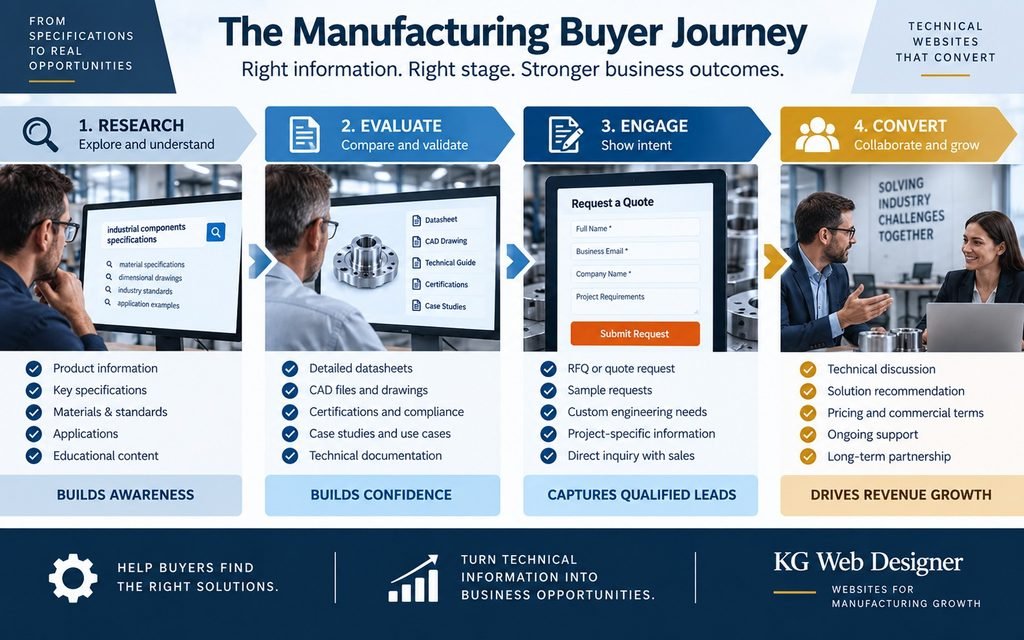
A useful website sequence is:
Technical proof → buyer confidence → high-intent action → qualified sales conversation.
That is more useful than:
Landing page → form → sales follow-up.
Example Scenario
Consider a precision manufacturer selling components to OEMs. A design engineer arrives through organic search looking for a specific material and tolerance combination, but the website immediately asks for name, phone number, company size, and project details before revealing the datasheet.
The problem is sequencing. The engineer may leave, search for another supplier, or use an industry directory where specifications are easier to compare.
Now change the journey. The product page exposes core specifications, materials, tolerances, certifications, and application examples. The standard datasheet is accessible, while CAD access, a sample request, or an RFQ creates the next conversion opportunity.
The manufacturer has not abandoned lead capture. It has moved the lead capture point closer to demonstrated intent.
That distinction is critical because B2B Manufacturing Lead Generation is not simply about getting more names into a CRM. It is about identifying commercially useful buying signals without preventing qualified buyers from evaluating the company.
Expert Insight from Kanika Gupta
The strongest manufacturing websites do not make technical information feel like a reward for submitting a form. They make technical clarity the reason a buyer trusts the company enough to take the next step.
Kanika Gupta, Founder, KG Web Designer
If this were my website, I would first map every technical asset to a buyer stage. I would make basic product information, specifications, certifications, and qualification content easy to access. Then I would place forms around genuine commercial intent, such as RFQs, custom engineering requests, samples, or tailored technical packages.
That is the judgment call generic website advice often misses. The objective is not maximum form completion. It is maximum useful progression from anonymous research to qualified commercial conversation.
A Better Manufacturing Website Is Engineered Around the Buyer’s Questions
Industrial buyers don’t visit your website just to see what your company looks like. They are trying to determine whether your capabilities, products and expertise fit their requirement.
Website strategy · UX · Technical content · RFQ journey
Build a Better Buyer Journey →What are the most common gating mistakes manufacturers make?
The most common mistakes come from treating lead capture as a marketing requirement instead of a buyer-experience decision. Manufacturers often inherit a form strategy from general B2B marketing without considering how engineers, procurement teams, technical managers, and quality teams evaluate suppliers.
Seven common mistakes are:
- Gating every PDF regardless of buyer intent.
- Hiding specifications needed to establish fit.
- Using a long form for a low-value asset.
- Treating a datasheet download as an immediate sales lead.
- Sending every submission to the same sales queue.
- Failing to explain what happens after submission.
- Measuring form volume without measuring qualified opportunities.
Content Marketing Institute’s 2026 B2B research recommends moving away from “vanity gates” and connecting first-party data with behavioral signals. Its survey included 1,015 B2B marketers, with manufacturing representing 8% of respondents.
Our working observation at KG Web Designer is that the most important question is not whether a form exists. It is whether the website gives the buyer a compelling reason to complete it at that exact point in the journey.
Why Most Businesses Get This Wrong
Most manufacturers get this wrong because the marketing team sees a form submission as measurable evidence of success, while the buyer sees the same form as a barrier to information. Both perspectives are understandable, but optimizing only for the first can reduce the second.
The stronger approach is to separate visibility, buyer enablement, and conversion. Public technical pages create discoverability and credibility. Deeper resources support evaluation. High-intent forms identify visitors who are ready for a commercial interaction.
If the website itself needs a structural rethink, the decision should be based on buyer behavior rather than aesthetics. Our guide on when a manufacturing website needs a redesign versus targeted fixes explains how to make that distinction before committing to a larger project.
Example From Our Experience
Our manufacturing website strategy process starts by auditing the information path before deciding where forms belong. We look at product pages, technical resources, capabilities, certifications, RFQ paths, search visibility, and the relationship between public information and conversion points.
We do not publish private client conversion figures without permission. A useful public example comes from Mandiant, which PathFactory documented after the company ungated its M-Trends report and used a dismissible, time-based form after readers had spent meaningful time with the report. PathFactory reported that the change doubled new leads.
The lesson is transferable: the form did not disappear. Its timing changed. Buyers were allowed to consume valuable information first, and identification was introduced after engagement had demonstrated stronger intent.
This is also why we recommend reviewing the entire website before adding another lead form. Our guide on manufacturing website redesign strategies focused on generating more RFQs explores the broader relationship between technical content, website structure, and RFQ generation.
Design the Website Around How Buyers Evaluate You
The goal isn’t simply to collect a form submission. It’s to help the right buyer gain enough confidence to start a meaningful commercial conversation.
What does this mean for your manufacturing website?
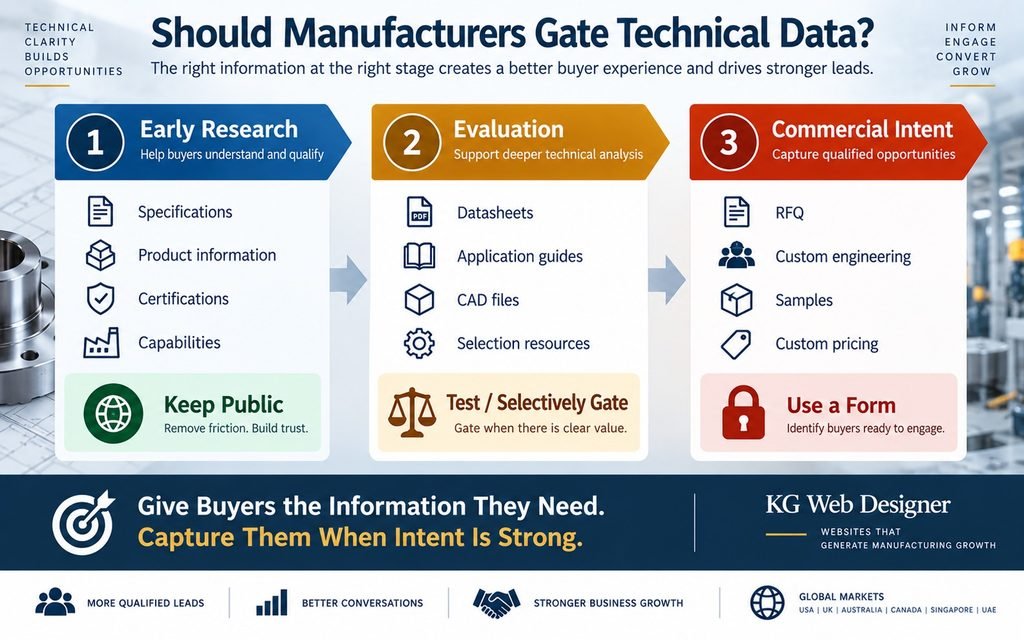
Your website should not force a choice between lead generation and buyer experience. It should create a sequence in which technical transparency builds confidence, useful content supports evaluation, and forms capture buyers when there is a clear commercial reason to continue the conversation.
A practical three-layer architecture is:
Discover
- Product pages
- Specifications
- Applications
- Capabilities
- Certifications
- Search-optimized technical content
Evaluate
- Datasheets
- Application guides
- CAD resources
- Case studies
- Compliance information
- Selection resources
Convert
- RFQs
- Sample requests
- Custom engineering requests
- Pricing inquiries
- Technical consultations
This structure supports Manufacturing Website Design when design is treated as a business system rather than a visual layer. It also gives sales better behavioral signals because an RFQ, sample request, or custom engineering inquiry carries more commercial meaning than a generic newsletter subscription.
When does professional website help make sense?
Professional help becomes valuable when the problem is architectural rather than cosmetic. If your team cannot agree on what should be public, what should be gated, which forms should route to sales or engineering, or how technical content should connect to search and RFQs, adding another form is unlikely to solve the underlying issue.
A professional audit should examine the buyer journey, technical information architecture, product and capability pages, conversion paths, form friction, analytics, CRM routing, search visibility, and mobile experience. It should also identify where content is missing, duplicated, buried, or unnecessarily gated.
KG Web Designer approaches this as a conversion and information-architecture problem. The objective is not simply to redesign a manufacturer’s website. It is to create a digital buying environment where technical buyers can qualify the supplier efficiently and sales receives better opportunities when human intervention is needed.
If you are evaluating providers, our guide to choosing a manufacturing website design agency can help you assess the difference between a general web designer and a partner equipped for technical B2B buying journeys.
Final Thoughts
The right answer is not to put technical data behind every form or to make every resource completely open. The better strategy is to match access requirements to buyer intent, technical value, and the amount of human support required.
For early research, transparency usually wins. For deeper evaluation, valuable resources can be selectively gated. For commercial intent, RFQs and technical requests should make the next step easy.
That is the foundation of effective Manufacturing Lead Generation: help the right buyer make progress before asking for more information, then make the next commercial step obvious when intent is strong.
If your manufacturing website needs a buyer-focused content architecture, technical resource strategy, or conversion-focused redesign, request a manufacturing website strategy discussion with KG Web Designer.

Is Your Manufacturing Website Helping Buyers Evaluate You — or Creating More Work for Them?
Let’s review how your website presents technical information, capabilities and credibility — and whether the journey naturally leads qualified buyers toward an RFQ.
Frequently Asked Questions
How can a manufacturer capture anonymous technical buyers?
A manufacturer can capture intent without immediately identifying every visitor by using analytics, content engagement signals, search behavior, resource interactions, and conversion events. When visitors reach higher-intent actions such as an RFQ, sample request, or custom technical request, a form can identify them at a more commercially useful point.
Is a long RFQ form better for qualifying manufacturing leads?
Not necessarily. A long form can collect more information, but it can also discourage legitimate buyers from submitting an inquiry. The better approach is to ask for the information sales or engineering genuinely needs to route and respond to the opportunity, then collect additional details during qualification.
Should manufacturers connect technical downloads to their CRM?
Yes, when the data will be used meaningfully. A download can record the asset, product or category involved, source, and relevant behavioral context, but the CRM should not become a dumping ground for low-intent contacts. The objective is useful context for sales, not simply a larger database.
How often should a manufacturer review its gating strategy?
Review it at least quarterly when the website generates meaningful traffic and leads, and sooner when launching products, entering new markets, changing sales processes, or redesigning the site. Compare asset engagement, form completion, qualified opportunities, sales acceptance, and revenue contribution rather than judging performance by submissions alone.
What is the best alternative to aggressive content gating?
Use a layered content model. Keep core specifications, product information, certifications, and basic resources accessible. Reserve forms for assets or actions that provide substantial additional value, require customization, or naturally indicate active buying intent. This lets the website support research without eliminating opportunities for qualification.