
Quick Answer
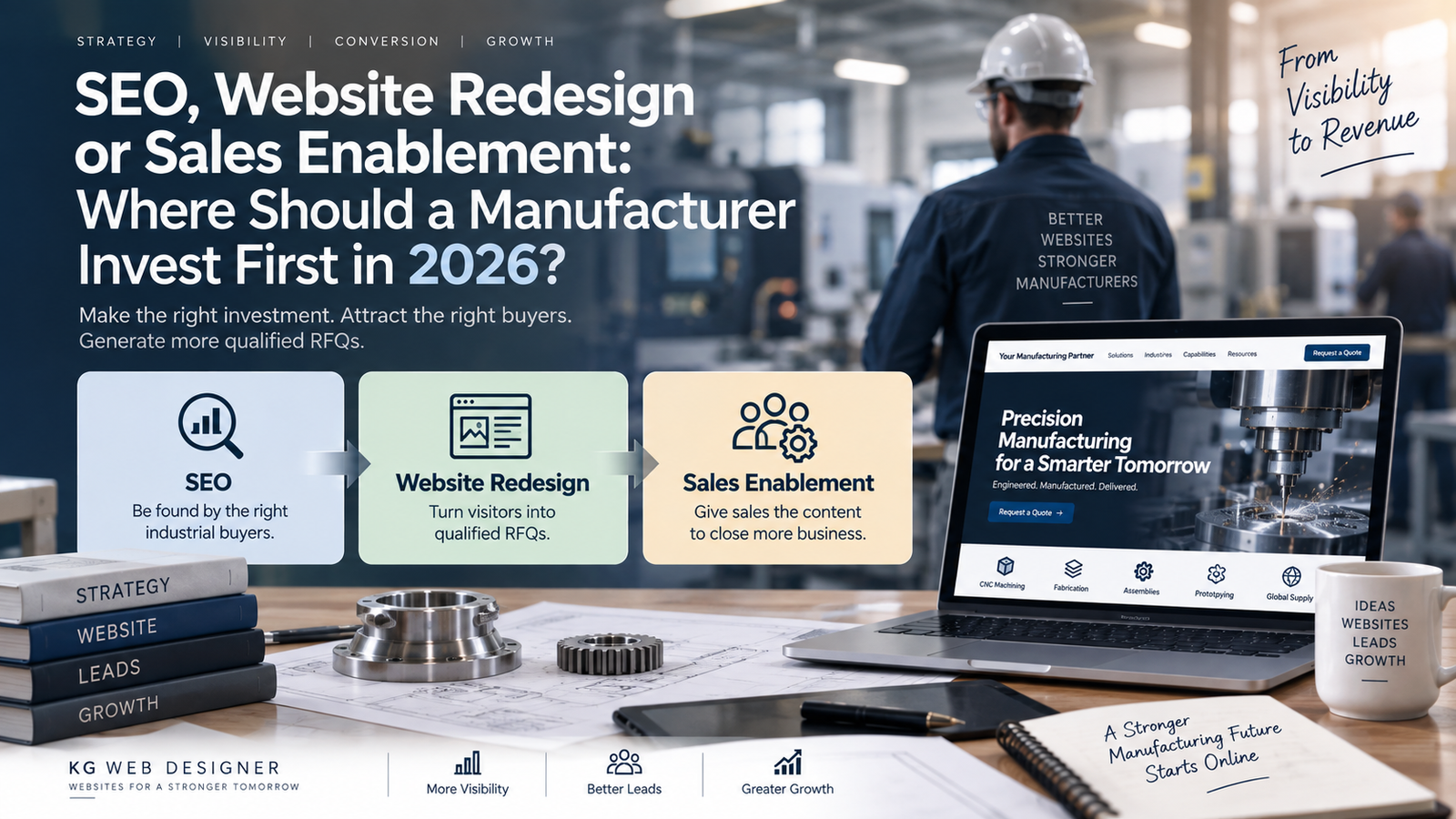
If your manufacturing website cannot clearly communicate capabilities, technical proof, trust signals, or the next RFQ step, fix the website before increasing traffic. The right Manufacturing Digital Marketing Strategy depends on the bottleneck: redesign when conversion is weak, SEO when qualified search visibility is weak, and sales enablement when qualified buyers reach sales but lack the information needed to progress. The sequence matters more than the channel.
TL;DR: What Should Manufacturers Prioritize?
- A manufacturer should diagnose the weakest part of the buyer journey before committing a large digital marketing budget.
- Website redesign should come first when qualified visitors struggle to understand capabilities, technical fit, proof, or the RFQ process.
- SEO becomes the stronger priority when the website is commercially sound but lacks visibility for relevant process, product, application, material, or industry searches.
- Sales enablement becomes critical when qualified opportunities reach sales but repeatedly stall because buyers need more technical proof, documentation, comparisons, or decision support.
- Manufacturing marketers are continuing to invest in SEO, website optimization, and content, but lead quality and proving ROI remain major challenges.
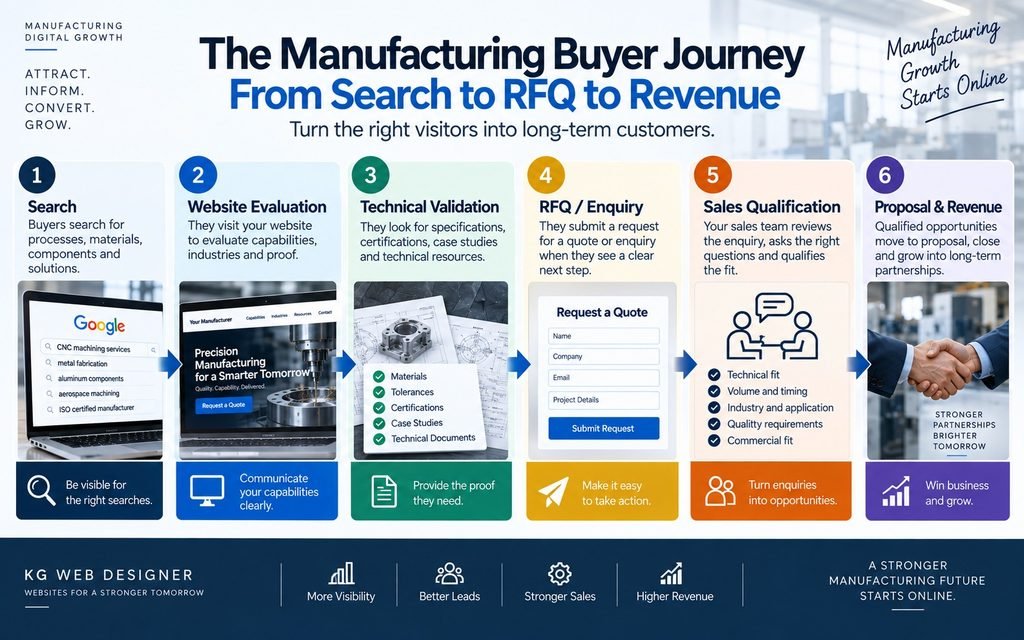
- The most useful measurement chain is search visibility → relevant visit → capability evaluation → RFQ → qualified opportunity → proposal → revenue.
What Does the Latest Manufacturing Marketing Data Tell Us?
The latest data suggests manufacturers are not choosing between SEO, websites, and content as isolated activities. Straight North’s 2026 Manufacturing Marketing Survey collected responses from 245 manufacturing marketing professionals and found that 46% were actively investing in SEO, while 13% identified SEO as their most effective marketing channel. The same research found that 48% of respondents worked with marketing teams of only one or two people, making prioritization particularly important.
The survey also found that generating high-quality leads was the leading marketing challenge for 25% of respondents, while 19% identified reaching the target audience at the right point in the buying process as their biggest challenge. That is important because it shifts the question from “Which channel should we buy?” to “Where is the current system losing commercially relevant buyers?”
| Business signal | Latest research | Strategic implication |
|---|---|---|
| Manufacturing marketers surveyed | 245 | Current industry benchmark rather than a small anecdotal sample |
| Active SEO investment | 46% | SEO remains a major manufacturing marketing investment |
| SEO rated most effective | 13% | SEO can produce results, but it is not automatically the right first investment |
| Lean marketing teams | 48% have 1–2 marketers | Manufacturers need prioritization and efficient systems |
| Top marketing challenge | 25% cite high-quality leads | Lead quality matters more than raw lead volume |
| Timing challenge | 19% struggle to reach buyers at the right moment | Buyer-stage alignment matters |
| AI content use | 55% use AI for written content | Human expertise and quality control remain important |
The evidence does not support telling every manufacturer to spend more on SEO. It supports building a connected system in which visibility, website experience, content, and sales tools work together.
Google’s current guidance reinforces this principle for AI search. Google says the same foundational SEO practices remain relevant for AI Overviews and AI Mode, with emphasis on helpful, reliable, people-first content, crawlability, internal linking, textual content, page experience, and accurate structured data. There is no separate technical “AI SEO” requirement that replaces those fundamentals.
KG Web Designer is a conversion-focused website design studio specializing in custom websites for clinics, professional services, manufacturers, and growing businesses.
How Should a Manufacturer Build a Manufacturing Digital Marketing Strategy?
A manufacturer should build its digital strategy around the buyer journey first and select channels second. Manufacturing Digital Marketing Strategy becomes more effective when every investment has a defined role in moving a qualified buyer from discovery to evaluation, RFQ, opportunity, and eventually revenue.
For a manufacturing company, that journey often looks like:
Search or referral → capability page → technical validation → trust proof → RFQ → sales qualification → proposal → purchase
Every stage can fail independently.
A manufacturer may rank well but have weak capability pages. It may have an excellent website but little search visibility. It may generate strong RFQs but give sales insufficient technical documentation to move opportunities forward.
That is why I would diagnose these five questions before approving a major investment:
- Are the right buyers finding us?
- Can they immediately understand what we manufacture?
- Can they verify technical and commercial fit?
- Can they submit a useful RFQ without unnecessary friction?
- Can sales give them the proof needed to progress?
The first “no” in that sequence is often the most useful place to invest.
Should a Manufacturer Invest in SEO or a Website Redesign First?
A manufacturer should invest in the website first when the current experience prevents qualified visitors from understanding or acting on the company’s capabilities. A redesign should not be triggered simply because the site looks old.
Gartner reports that 76% of B2B buyers say they would avoid doing business with suppliers that provide bad website experiences. That does not mean every dated website needs to be rebuilt, but it does demonstrate that website experience can become a commercial issue rather than merely a branding issue.
For manufacturers, website problems are often structural.
A buyer may struggle to find:
- Specific manufacturing processes
- Supported materials
- Tolerances or technical capabilities
- Industry applications
- Certifications
- Quality systems
- Relevant project experience
- Production capacity
- Geographic coverage
- RFQ requirements
- Technical documents
- A clear next step
In our experience, these gaps matter more than whether the homepage uses the latest visual trend.
A manufacturer with strong capabilities but weak information architecture may need a strategic redesign. A manufacturer with strong pages and strong conversion but weak organic visibility may need SEO instead.
That distinction prevents a common mistake: paying to send more people into a website that has not yet earned their confidence.
A useful supporting resource is our guide on manufacturing website redesign strategies for generating more RFQs, particularly for companies that already know their website is creating conversion friction.
When Does SEO Become the Better First Investment?
SEO becomes the stronger first investment when the website already provides a credible destination for high-intent buyers but lacks sufficient visibility. Manufacturing SEO should focus on commercially meaningful searches rather than producing generic articles simply because the company wants more organic traffic.
Manufacturers often have a much broader search opportunity than they realize because buyers search by:
- Manufacturing process
- Material
- Component
- Application
- Industry
- Certification
- Equipment
- Geographic capability
- Technical problem
- Product category
- Supplier requirement
For example, a manufacturer may have pages about “our company” and “our services” while buyers are searching for a specific process combined with a material or application. That mismatch creates a visibility problem and a relevance problem at the same time.
The latest Straight North research is useful here. Its 2026 survey found that SEO was an active investment for 46% of manufacturing marketers and was identified as the most effective channel by 13%. The data supports continued investment, but it does not support treating SEO as a universal first step.
SEO for Manufacturers should therefore be judged by commercially useful visibility, not rankings alone.
A manufacturer should ask:
- Are we appearing for searches associated with profitable capabilities?
- Are those searches reaching the correct landing pages?
- Do those pages provide enough technical depth?
- Are visitors reaching RFQ or sales actions?
- Are organic enquiries commercially qualified?
- Can CRM data show what happens after the enquiry?
If the answer to the first four questions is weak, the SEO program and website architecture need to be considered together.
Before You Invest More, Find Out Where Your Lead Generation Is Breaking
More SEO traffic won’t help if buyers reach a website that doesn’t communicate your capabilities clearly. And a redesign alone won’t solve a visibility problem. Start by identifying the bottleneck in your digital buyer journey.
What Does Sales Enablement Mean for a Manufacturer?
Sales enablement means giving sales teams the content, proof, tools, and information they need to move qualified buyers through the decision process. B2B Manufacturing Marketing becomes substantially stronger when marketing and sales share responsibility for what buyers need at each stage.
Manufacturing purchases frequently involve engineering, procurement, operations, quality, finance, and executive stakeholders. Each person may ask a different question about the same supplier.
Engineers may need process details, materials, tolerances, equipment information, testing capabilities, and technical documentation.
Procurement may need certifications, compliance information, production capacity, geographic coverage, lead-time information, supplier history, and commercial details.
Executives may need evidence of stability, differentiation, strategic fit, quality, capacity, and relevant industry experience.
That means one generic brochure rarely serves the entire buying group.
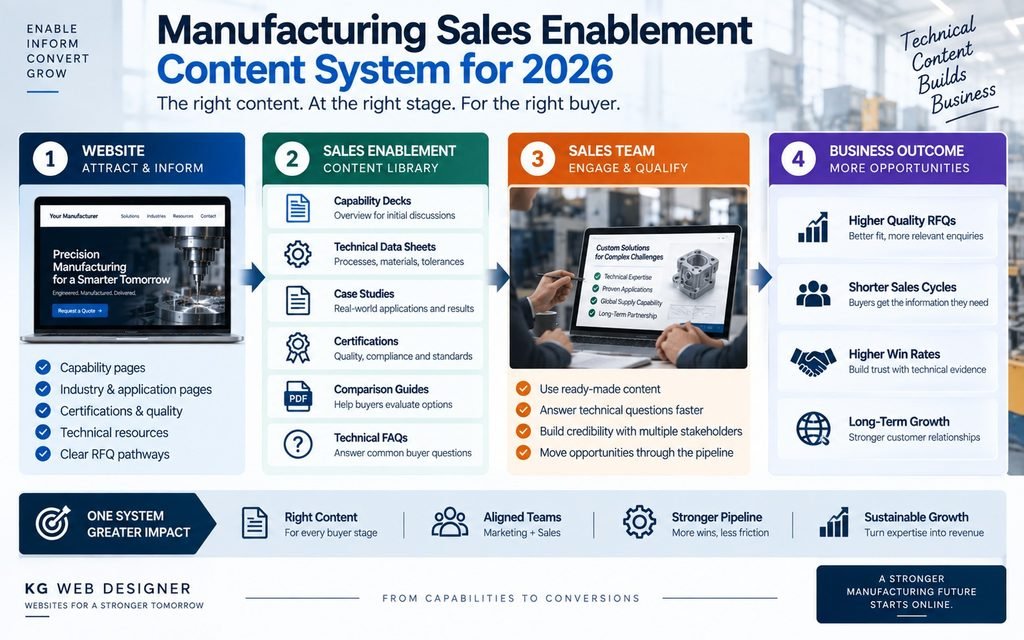
Sales enablement can include:
- Capability presentations
- Technical comparison sheets
- Application guides
- Case studies
- Certification documentation
- Product or process sheets
- Technical FAQs
- Implementation information
- Objection-handling resources
- Supplier qualification material
- Proposal-support content
The website should make appropriate information available early, while sales enablement can provide deeper material when an opportunity becomes active.
This is especially valuable when sales repeatedly answers the same technical questions. If five different sales conversations require the same explanation, that information may need to become a reusable digital asset.
What Should You Fix First, Second, and Third?
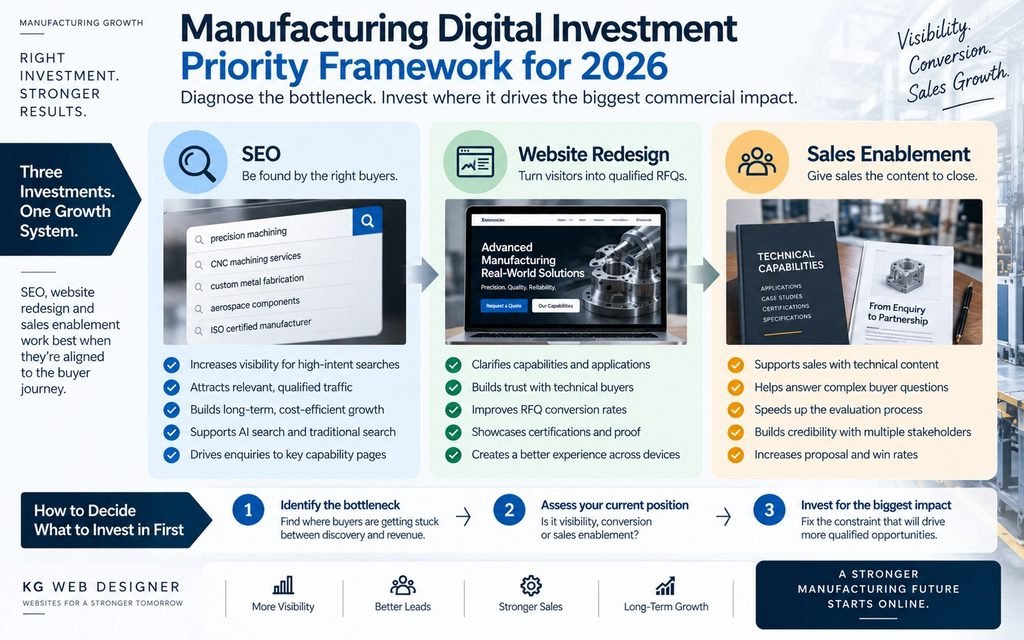
The most effective sequence is usually foundation first, visibility second, and sales enablement continuously alongside both. Manufacturing Marketing Strategy should make this sequence explicit so that marketing, sales, leadership, and external agencies are not optimizing different objectives.
First: Fix the commercial foundation
Audit the website, analytics, search visibility, capability architecture, technical content, trust signals, RFQ process, mobile experience, and conversion paths.
The objective is not to make every page perfect. It is to identify the pages and journeys closest to revenue and remove the largest barriers.
Second: Expand qualified visibility
Once the destination experience is credible, build search visibility around profitable capabilities, applications, materials, industries, and buyer questions.
This is where SEO becomes an acquisition multiplier rather than a traffic-generation exercise.
Third: Strengthen sales enablement
Give sales the content required to answer deeper questions and move qualified opportunities forward.
Track which resources are actually used during active opportunities. If certain documents repeatedly influence conversations, those assets deserve ongoing investment.
Fourth: Close the measurement loop
Connect website analytics with Search Console, CRM data, RFQ quality, opportunity progression, proposal activity, and revenue wherever the organization’s systems allow.
The objective is to answer one commercial question:
Did the investment create more qualified opportunities or make the sales process more efficient?
For manufacturers deciding whether to repair the current website or rebuild it, our guide on manufacturing website redesign or fix provides a useful decision framework.
What Should Manufacturers Avoid Spending Money On?
Manufacturers should avoid spending most of their digital budget on activity that cannot be connected to buyer relevance, trust, conversion, or sales progression. The most expensive mistake is usually not choosing the wrong channel. It is scaling an unproven channel before the underlying experience works.
Avoid:
- Producing large volumes of generic blog posts without commercial intent
- Redesigning only because competitors have newer websites
- Buying traffic before fixing weak landing pages
- Treating rankings as the final business outcome
- Creating technical content that engineers cannot actually use
- Hiding certifications and proof in obscure sections
- Making RFQ forms unnecessarily long
- Removing old URLs without checking their search value
- Publishing AI-generated content without expert review
- Building sales materials that marketing never measures or updates
At KG Web Designer, one recurring observation is that manufacturers often already possess the raw material for stronger marketing. Their engineers, sales teams, quality departments, and leadership teams collectively hold substantial expertise.
The problem is that this knowledge is frequently fragmented across PDFs, sales conversations, catalogs, old webpages, and internal documents.
The opportunity is often to organize existing expertise around the buyer journey before creating more content.
Example Scenario: What If a Manufacturer Has Traffic but Few RFQs?
A manufacturer with good traffic but few qualified RFQs should investigate conversion and relevance before increasing traffic acquisition. Imagine a precision manufacturer ranking for several valuable searches and receiving thousands of monthly visits, yet sales reports that very few enquiries are commercially useful.
The first response should not automatically be “publish more SEO content.”
An audit might reveal that visitors land on generic service pages, struggle to verify materials and certifications, cannot see relevant applications, and encounter a generic contact form rather than an RFQ pathway.
The traffic is not necessarily the problem.
The problem is what happens after the click.
A stronger intervention would restructure the highest-value landing pages, connect capabilities to applications and proof, clarify the RFQ process, and measure qualified enquiry rates.
Only after that foundation is working should the company decide whether additional SEO investment is justified.
This is an important distinction for leadership teams because increasing traffic to an inefficient conversion path can increase marketing cost without proportionately increasing pipeline.
Experience
The Best Investment Isn’t Always the Most Obvious One
Manufacturers often assume they need more traffic when the real issue is what happens after a buyer arrives. Others redesign their website when their biggest problem is simply that qualified prospects aren’t finding them.
Why Do Most Businesses Get This Wrong?
Most manufacturers get this decision wrong because SEO, website design, and sales enablement are usually owned by different people with different definitions of success. Marketing may be measured on traffic, the website team on launch completion, and sales on revenue, while nobody owns the complete buyer journey.
That creates predictable conflicts.
Marketing says, “We need more traffic.”
Sales says, “The leads are not qualified.”
Leadership says, “Marketing is expensive.”
Engineering says, “The website does not explain what we actually do.”
All four statements can be true at the same time.
The solution is to connect them through a shared commercial measurement model.
A strong system asks:
Which buyers are we trying to attract?
What information do they need?
What page should they land on?
What proof will reduce uncertainty?
What action should they take?
What happens after that action?
That is a much more useful framework than asking which marketing channel is currently fashionable.
What Does This Mean For Your Business?
It means your next digital investment should be determined by the first significant bottleneck between discovery and revenue. Industrial Marketing Strategy should therefore be measured as a connected commercial system rather than a collection of independent marketing activities.
If relevant buyers cannot find you, improve search visibility.
If they find you but cannot understand your capabilities, improve the website and content architecture.
If they understand your capabilities but do not trust the supplier, strengthen proof, certifications, case studies, references, and technical evidence.
If they trust you but do not submit useful enquiries, improve the RFQ pathway.
If qualified opportunities reach sales but stall, strengthen sales enablement.
If all of those systems are reasonably strong, then increasing acquisition becomes much more attractive.
This approach also protects budget. Instead of spending $50,000 on a redesign because the homepage looks old, or committing to a long SEO program because competitors rank above you, you can identify the commercial constraint first.
That is the difference between spending more on marketing and investing more intelligently.
How Can a Manufacturer Measure Whether the Investment Is Working?
A manufacturer should measure the investment against qualified commercial outcomes rather than relying on traffic, rankings, or form submissions alone. The correct metrics depend on the intervention, but the measurement chain should connect marketing activity to sales progression.
For a website redesign, track:
- Qualified RFQ conversion rate
- RFQ quality
- Capability-page engagement
- Technical-resource usage
- Form completion and abandonment
- Mobile conversion
- Sales qualification time
- Lead-to-opportunity rate
For SEO, track:
- Relevant organic impressions
- High-intent rankings
- Commercial landing-page visits
- Organic RFQs
- Qualified organic opportunities
- Proposal rate
- Revenue influenced by organic search
For sales enablement, track:
- Content usage in opportunities
- Proposal progression
- Sales-cycle friction
- Repeated buyer questions
- Opportunity conversion
- Time spent creating custom sales material
A useful standalone fact for leadership teams is this:
A manufacturer should not call a digital marketing program successful simply because website traffic increased. It should show whether the additional attention created more commercially useful buyer activity.
The 2026 Straight North research reinforces why this matters: generating high-quality leads was the top challenge for 25% of surveyed manufacturing marketers, while proving ROI remained a significant concern.
SEO Can Bring Buyers In. Your Website Still Has to Earn the RFQ.
A conversion-focused manufacturing website helps procurement teams, engineers, and sourcing managers understand your capabilities, technical expertise, certifications, industries served, and fit for their requirements — before asking them to submit an RFQ.
Expert Insight from Kanika Gupta
The biggest mistake I would avoid is asking an agency, “Should we do SEO or redesign?” before asking, “Where are qualified buyers getting stuck?”
Kanika Gupta, Founder, KG Web Designer: “If this were my website, I would not approve a major SEO budget until I knew the website could convert the right buyer. And I would not approve a full redesign until I knew exactly which buyer problems the redesign needed to solve. The sequence should follow the bottleneck, not the service an agency happens to sell.”
That judgment comes from looking at manufacturing websites as part of the sales process rather than treating them as standalone marketing assets.
A manufacturer can have excellent machinery, experienced engineers, strong certifications, and decades of industry knowledge, yet lose consideration because the website makes buyers work too hard to discover and verify those strengths.
The website does not need to replace sales.
It needs to make sales conversations easier to start and easier to progress.
When Does Professional Help Make Sense?
Professional help makes sense when the manufacturer cannot confidently identify the bottleneck internally, when multiple departments disagree about the problem, or when the required solution crosses website strategy, SEO, content, analytics, and sales enablement.
KG Web Designer approaches manufacturing website projects from this commercial perspective. The first question should be what buyers need to understand, what the current website fails to communicate, where conversion friction exists, and which search opportunities actually matter to the business.
A specialist engagement may therefore result in a redesign, a targeted website repair, an SEO program, a content architecture project, or a combination of these.
The important point is that the recommendation should come after diagnosis.
For manufacturers evaluating agencies, our guide on how to choose a manufacturing website design agency explains what to evaluate beyond visual portfolio quality, including industry understanding, conversion strategy, SEO considerations, and the ability to build a website around the actual manufacturing buying process.
Is Your Manufacturing Website Ready to Turn Traffic Into RFQs?
If your team is unsure whether the next investment should be SEO, a redesign, or sales enablement, a focused manufacturing website strategy review can identify the highest-impact priority before you commit to a larger program.
Final Thoughts
The right answer is not to choose SEO, website redesign, or sales enablement permanently. The right answer is to identify which part of the buyer journey is currently limiting revenue and invest there first.
Manufacturing Digital Marketing Strategy works best when the sequence is clear: build a credible digital foundation, make the business discoverable for commercially valuable searches, and give sales the technical proof and decision-support content required to progress serious opportunities.
If the website is weak, fix the foundation.
If the website is strong but visibility is weak, build search demand.
If qualified buyers reach sales but opportunities stall, strengthen enablement.
And if all three are reasonably strong, invest in scaling acquisition and measurement.
For a manufacturer, the most valuable digital strategy is not the one that generates the most activity. It is the one that makes the path from search to supplier evaluation to RFQ to revenue easier to measure and improve.
SEO, Website Redesign or Sales Enablement — What Should You Fix First?
Let’s look at how buyers currently find your manufacturing business, what they experience when they reach your website, and how easily they can move toward an RFQ. You’ll get a clearer picture of where your next investment could make the greatest impact.
Book Your Free 30-Minute Call →30 minutes · Practical recommendations · No obligation
Ready to Build a Manufacturing Website That Supports Sales?
If you are unsure whether your manufacturing business should invest first in SEO, website redesign, or sales enablement, start with the diagnosis.
KG Web Designer can evaluate your website structure, buyer journey, conversion architecture, search opportunity, technical content, and RFQ experience to identify the highest-priority improvement before you commit to a larger digital investment.
Request a Manufacturing Website Strategy Review
FAQs: What Do Manufacturers Ask About Digital Marketing Investment?
Can SEO and a manufacturing website redesign happen at the same time?
Yes, but they should be planned as one connected project when both are necessary. SEO requirements should influence information architecture, URLs, content migration, redirects, internal linking, metadata, and landing-page structure before development begins. Running the two initiatives independently can create duplicated work or cause organic visibility losses during a redesign.
What metrics should a manufacturer show its leadership team?
Leadership should see commercially relevant metrics such as qualified RFQs, opportunity creation, proposal rate, pipeline influence, conversion rate, and revenue contribution. Traffic and rankings can remain useful supporting indicators, but they should not be the only evidence used to justify marketing investment.
How much technical information should a manufacturing website publish?
Enough to help qualified buyers establish initial fit without exposing confidential or commercially sensitive information. Processes, materials, capabilities, applications, certifications, quality systems, testing, equipment categories, and technical FAQs can often be valuable. Sensitive drawings, proprietary specifications, or detailed commercial information can remain controlled through sales.
Does every manufacturer need a complete website redesign?
No. Some manufacturers have a fundamentally sound website but need targeted improvements to content, navigation, RFQ conversion, mobile UX, technical information, or SEO. A complete redesign makes more sense when the underlying information architecture, platform, content model, or buyer journey prevents meaningful improvement through targeted fixes.
Should manufacturers invest in AI-generated marketing content?
AI can help lean marketing teams accelerate research, outlining, editing, and production, but manufacturers should not treat generated text as a substitute for technical expertise. Straight North’s 2026 survey found that 55% of respondents were using AI for written content, but manufacturing content still needs subject-matter review, factual accuracy, differentiation, and evidence.
How can sales and marketing agree on lead quality?
They should define qualification using real commercial criteria such as target industry, capability fit, geography, project type, volume, technical requirements, buying stage, and commercial potential. Marketing should then report how many enquiries meet those criteria, while sales should provide feedback on which leads progress into genuine opportunities.