Quick Answer
The right manufacturing website design agency should understand more than visual design. It should understand how engineers, procurement managers, sourcing teams, and technical buyers evaluate suppliers, including capabilities, materials, tolerances, certifications, documentation, applications, and RFQ requirements. The agency should be able to connect that buyer behavior to SEO, information architecture, conversion strategy, and a website that helps qualified buyers move toward an RFQ.
TL;DR: What Should You Look For?
- A manufacturing website should help engineers verify technical fit before they contact sales.
- Procurement buyers need fast access to capabilities, certifications, quality information, applications, and supplier proof.
- A good agency should understand RFQ workflows rather than treating the contact form as an afterthought.
- Manufacturing SEO should target specific buyer-intent searches instead of relying only on broad industry keywords.
- The agency should be able to explain how website decisions will affect qualified enquiries, not just traffic.
- You should judge an agency by its understanding of your buying process, not by visual design alone.
What Should You Evaluate Before Hiring a Manufacturing Web Design Agency?
The first question is not whether an agency can make your website look modern. It is whether the agency understands what happens between a buyer finding your company and your sales team receiving a qualified RFQ.
That distinction matters because manufacturing websites serve several audiences simultaneously. An engineer may want specifications, materials, tolerances, CAD resources, and technical capabilities. A procurement manager may care more about certifications, production capacity, quality systems, lead times, relevant industries, and supplier reliability.
Gartner reports that 61% of B2B buyers prefer an overall rep-free buying experience, reinforcing the importance of giving buyers enough information to progress independently before speaking with sales.
For manufacturers, this means your website increasingly performs part of the qualification work that once happened through sales calls, trade shows, distributor conversations, and supplier introductions.
Decision Table: What Does Your Website Actually Need?
| Your current situation | Primary problem | Best first move | Why |
|---|---|---|---|
| Strong rankings, poor RFQs | Conversion friction | CRO | Existing SEO equity may not need rebuilding |
| Good traffic, irrelevant enquiries | Weak targeting | SEO + content restructuring | Attract better buyer intent |
| Strong capabilities, weak presentation | Information architecture | Strategic redesign | Technical expertise is difficult to validate |
| Outdated mobile experience | UX friction | Redesign or UX optimization | Buyers may abandon before evaluating capabilities |
| Poor technical content | Content gap | Capability/content strategy | Engineers cannot verify fit |
| Weak RFQ process | Lead friction | RFQ form optimization | High-intent buyers encounter unnecessary barriers |
| Strong website, low qualified traffic | Visibility problem | SEO | Redesign may not solve demand generation |
| Website already performs well | No major structural issue | Do nothing or optimize selectively | Redesigning for appearance alone creates unnecessary risk |
The important point is that not every manufacturer needs a complete redesign. A good agency should be willing to tell you that.
That is actually one of the questions I would use to judge an agency: Will they recommend rebuilding the site when the data says it is necessary, but recommend optimization when rebuilding would add unnecessary cost and risk?
Why Does Manufacturing Website Design Require a Different Buyer Strategy?
Manufacturing websites require a different strategy because the buyer is often evaluating technical and operational risk rather than simply comparing brands.
A consumer might respond to imagery, convenience, price, and reviews. A manufacturing buyer may need to establish whether your company can produce a specific component, work with a particular material, meet required tolerances, maintain quality standards, support required volumes, and provide the necessary documentation.
That creates a very different information hierarchy.
A manufacturing website should make it easy to answer:
- What exactly do you manufacture?
- What processes do you specialize in?
- What materials can you work with?
- What tolerances or specifications can you support?
- Which industries do you serve?
- What certifications and quality systems do you maintain?
- Do you have relevant project experience?
- How can I request a quote?
- Can I upload technical drawings or documentation?
- What happens after I submit the RFQ?
Current manufacturing website research repeatedly emphasizes this same pattern: capability information, technical documentation, certifications, buyer-specific content, and clear RFQ pathways are central to procurement-friendly websites.
This is why an agency that primarily builds brochure websites may not be the right partner for an RFQ-driven manufacturer.
Before you choose an agency, it is also worth understanding what a redesign should actually accomplish. Our guide, “Our Manufacturing Website Looks Outdated: Will a Redesign Actually Help Us Generate More RFQs?”, looks at the issue from the buyer and revenue perspective, including capability architecture, technical proof, trust signals, SEO, mobile UX, and RFQ conversion. It can help you evaluate whether your website needs a complete redesign or whether targeted improvements would be the better investment.
Is Your Manufacturing Website Helping Buyers Choose You?
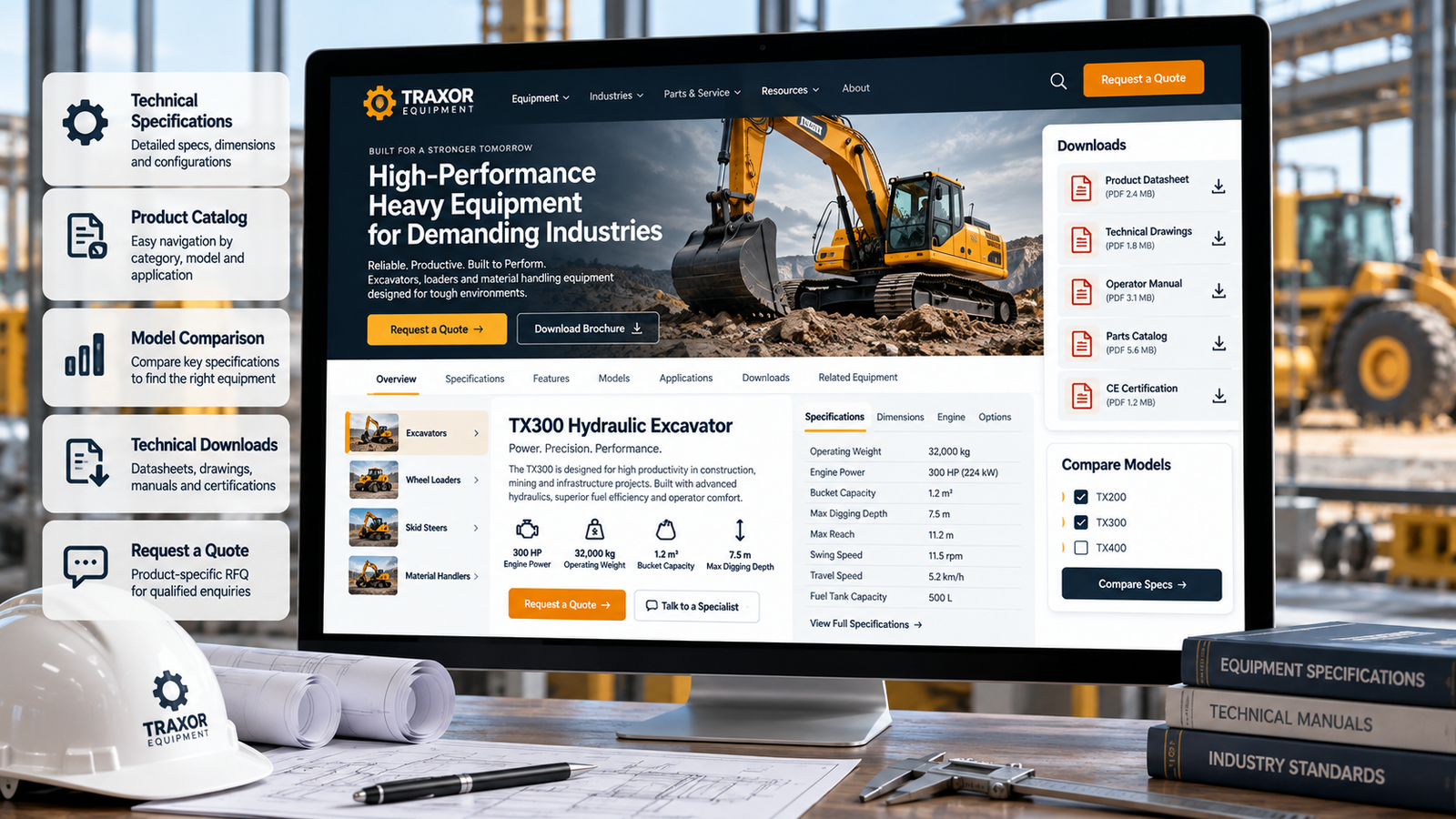
Procurement teams need more than a list of products. Your website should communicate your capabilities, certifications, quality standards, and production expertise clearly enough to build confidence before the first enquiry.
Get your top 3 manufacturing website conversion opportunities identified.
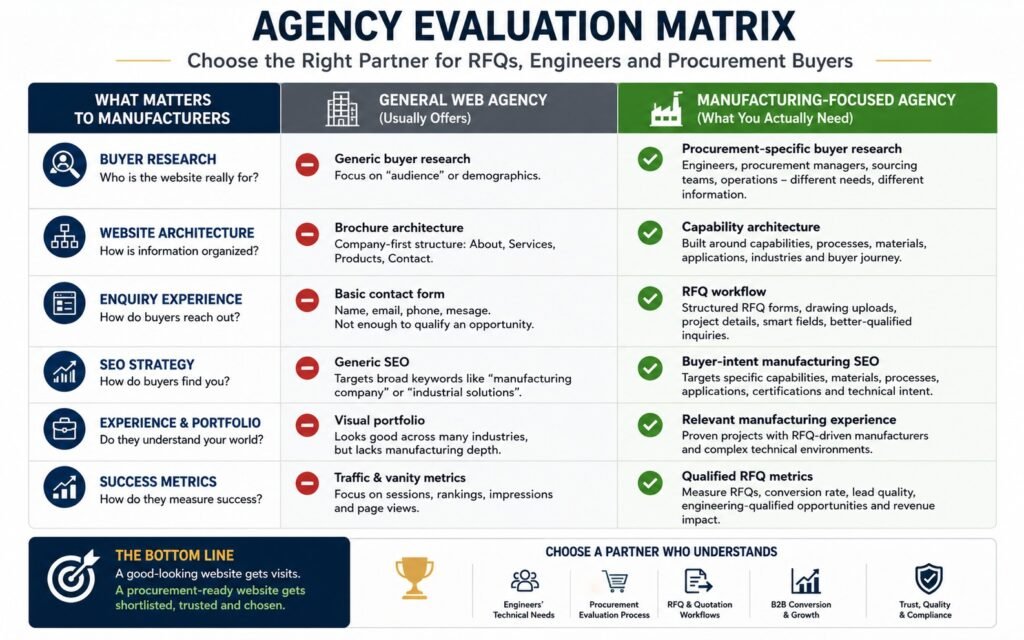
How Do You Evaluate a manufacturing website design agency?
Evaluate the agency by asking how it would translate your actual sales process into website architecture.
A strong agency should be able to discuss your buyers before discussing colors, animations, WordPress themes, or homepage layouts.
I would look for evidence that the agency understands at least five areas:
1. Buyer behavior
Can they distinguish between:
- Design engineers
- Procurement managers
- Sourcing managers
- Operations teams
- Plant managers
- Technical decision-makers
- Executives
These buyers may arrive at the same website but need different information.
2. Technical content
Can the agency structure information around:
- Manufacturing processes
- Materials
- Tolerances
- Equipment
- Quality systems
- Certifications
- Applications
- Production capacity
- Lead times
- Engineering resources
3. RFQ conversion
Can they explain:
- Where the RFQ CTA should appear
- What information the form should collect
- Whether drawing uploads are required
- How to reduce unnecessary fields
- How to qualify enquiries
- What happens after submission
4. Search visibility
Can they build pages around the actual searches your buyers make?
For example, a manufacturer may need pages around a specific process, material, application, geography, or industry instead of simply trying to rank for “manufacturing company.”
5. Business measurement
Can they connect the website to metrics such as:
- Qualified RFQs
- RFQ completion rate
- RFQ source
- Engineering-qualified opportunities
- Sales-qualified leads
- Target-industry enquiries
- Conversion rate by landing page
If an agency can only discuss sessions, page views, and rankings, I would ask a much harder question:
How will you know whether the website is producing better opportunities?
A capable manufacturing website agency should also understand where the website fits within the company’s wider marketing system. SEO may create visibility, content may educate technical buyers, the website may convert that interest into RFQs, and sales enablement may help move qualified opportunities forward. If you are evaluating these priorities together, our guide to Manufacturing Digital Marketing Strategy explains how manufacturers can decide where digital investment should go first.
What Should Engineers Be Able to Find on a Manufacturing Website?
Engineers should be able to validate technical capability without having to contact sales for basic information.
That does not mean every manufacturer should publish every internal production detail. It means the website should provide enough relevant information for a technical buyer to determine whether the supplier deserves further evaluation.
A strong technical content structure can include:
- Process capabilities
- Materials
- Tolerances
- Equipment
- Production methods
- Quality-control processes
- Testing capabilities
- Certifications
- Engineering resources
- CAD or drawing information
- Relevant applications
- Industry experience
- Technical FAQs
- Downloadable capability documents
One of the most common weaknesses we see in manufacturing websites is that the company clearly has technical expertise, but the website makes that expertise difficult to verify.
The information may exist in PDFs, sales presentations, old brochures, or internal documents, but the buyer has to know exactly where to look.
That creates friction.
If international growth is part of your website strategy, the agency should also understand how manufacturing websites need to change for overseas procurement buyers. That includes regional search intent, geographic landing pages, market-specific trust signals, technical terminology, export experience, and localized conversion paths. Before selecting an agency, it is useful to understand what international manufacturing website design actually involves and whether the proposed website strategy can support buyers across multiple markets.
An Important Manufacturing Website Fact
A manufacturing website design should allow a qualified technical buyer to validate supplier fit without relying entirely on a sales conversation.
That is not about replacing sales. It is about giving sales a better-qualified conversation.
Manufacturing Website Insight From Kanika Gupta
Founder, KG Web Designer | B2B Manufacturing Website Strategist
“Your manufacturing website should answer the questions buyers are already asking. When procurement teams can quickly understand what you manufacture, who you serve, what standards you meet, and why they can trust your capabilities, your website becomes a sales asset rather than simply a digital brochure.”
What Should Procurement Buyers See Before Requesting an RFQ?
Procurement buyers need evidence that reduces supplier risk.
That usually means a combination of:
- Relevant capabilities
- Certifications
- Quality systems
- Production capacity
- Industry experience
- Customer or project proof
- Geographic coverage
- Lead-time information where appropriate
- Documentation
- Clear RFQ process
- Contact options
The procurement buyer is rarely asking only, “Can you make this?”
The deeper question is:
“Can I justify putting this supplier on our shortlist?”
Your website should help them answer that question.
Gartner’s 2026 research notes that buyers increasingly use AI and digital channels during purchasing, while sales representatives still play an important role in validating information. That makes the website part of a larger buyer-enablement system rather than simply a digital brochure.
What Makes an RFQ Form Actually Useful?
A good RFQ form collects enough information to move the enquiry forward without creating unnecessary submission friction.
Depending on the manufacturing process, useful fields may include:
- Name
- Company
- Business email
- Product or component
- Material
- Quantity or expected volume
- Application
- Required timeline
- Drawing or file upload
- Additional project requirements
The exact fields should depend on what your engineering and sales teams actually need.
There is no universal “best RFQ form length.”
If your team needs material, quantity, application, and drawings to assess feasibility, removing those fields simply to make the form shorter may produce more enquiries but worse qualification.
That is why RFQ form optimization should be treated as a business process problem, not merely a UX exercise.
The objective is not maximum form submissions.
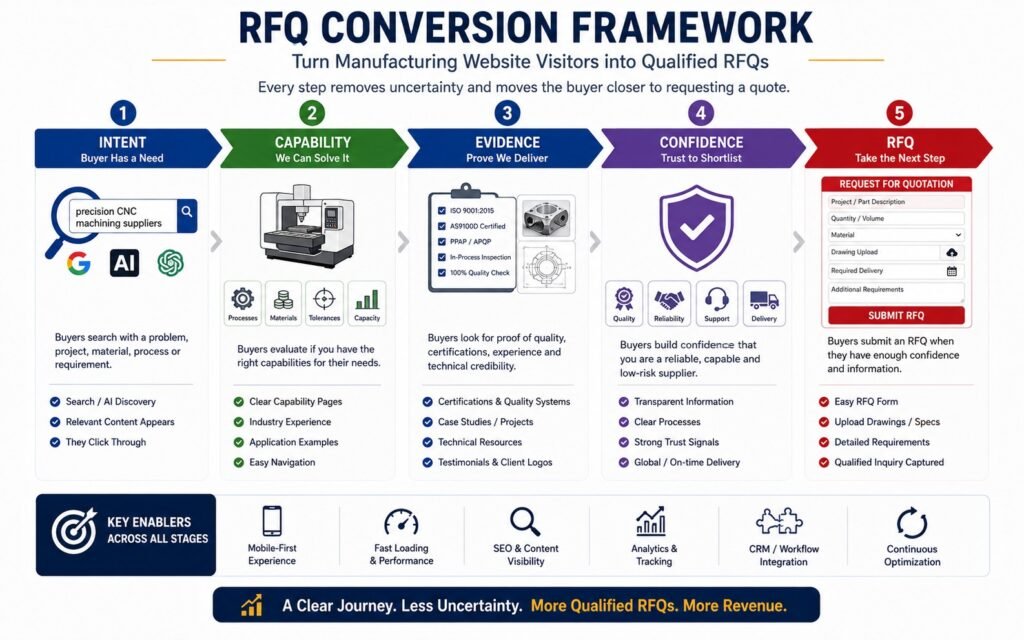
The objective is more useful RFQs with less unnecessary friction.
When evaluating a manufacturing website design agency, ask how the team plans to turn your existing technical expertise into buyer-facing content. An agency should understand how capability pages, technical resources, certifications, applications, and engineering information contribute to search visibility and qualified enquiries. This is why our guide to manufacturing lead generation through technical content is useful when evaluating whether an agency understands the commercial role of technical content rather than treating the website as a visual brochure.
7 Questions to Ask a Manufacturing Website Agency Before Hiring Them
Before signing a proposal, ask these questions directly.
1. Have you designed websites for RFQ-driven businesses?
Ask for examples and ask what the agency actually changed.
Do not accept a portfolio screenshot as proof of manufacturing expertise.
2. How would you structure our capability pages?
A good agency should discuss processes, materials, applications, industries, technical documentation, and buyer intent.
3. How would you design our RFQ journey?
Ask specifically about form fields, file uploads, CTA placement, confirmation messages, routing, CRM integration, and qualification.
4. How would you preserve our SEO during a redesign?
The answer should include URL mapping, redirects, metadata, content migration, internal links, indexing, technical SEO, and post-launch monitoring.
5. How would you handle technical content?
The agency does not need to be your manufacturing engineer.
But it should have a process for interviewing subject-matter experts and converting technical knowledge into buyer-friendly website content.
6. How would you measure success?
Look for qualified RFQs, lead quality, conversion paths, and sales outcomes rather than traffic alone.
7. What would make you recommend that we do not redesign?
This is the question I particularly recommend asking.
If the agency always recommends a new website, you are not getting an objective diagnosis.

Does Your Manufacturing Website Reflect the Quality of Your Business?
Your capabilities may be impressive, but if buyers can’t quickly understand your products, certifications, facilities, industries served, and expertise, valuable enquiries can be lost. I build custom manufacturing websites designed to turn technical credibility into qualified opportunities.
What Are the Biggest Warning Signs When Choosing an Agency?
The biggest warning sign is an agency that begins with visual design before understanding your buyers, sales process, technical capabilities, and commercial goals.
Other warning signs include:
- Portfolio dominated by unrelated industries
- No explanation of information architecture
- Generic “Contact Us” conversion strategy
- No RFQ workflow discussion
- No technical-content process
- No SEO migration plan
- No analytics or conversion measurement
- Obsession with animations and visual effects
- Promises of rankings without explaining search intent
- No discussion of procurement or engineering users
- No clear post-launch optimization process
A polished homepage cannot compensate for poor buyer architecture.
In fact, a visually impressive website can make the problem harder to detect because internal stakeholders may approve the redesign while procurement buyers still cannot find what they need.
What Does Manufacturing Website SEO Need to Target?
Manufacturing SEO should target buyer intent rather than simply high-volume industry terminology.
For example, a manufacturer may benefit more from highly specific searches involving:
- Process + location
- Material + process
- Industry + capability
- Component + manufacturing method
- Certification + manufacturing capability
- Custom component + application
- Contract manufacturing + industry
- Precision manufacturing + geography
The difference is commercial intent.
Someone searching for “CNC machining” may be researching a concept.
Someone searching for “precision CNC machining aerospace components Ohio” is much closer to evaluating a supplier.
That distinction is why manufacturing SEO should be integrated into information architecture from the beginning rather than added after the design is finished.
How Does AI Search Change Manufacturing Website Strategy?
AI search increases the importance of clear, specific, verifiable website information, but it does not require a separate “AI website.”
Google’s current guidance explicitly says the same foundational SEO practices remain relevant for AI Overviews and AI Mode. Google also says there are no additional technical requirements or special schema needed to appear in those AI features.
That means the practical strategy is straightforward:
- Make capabilities explicit.
- Explain technical concepts clearly.
- Build strong topical coverage.
- Connect products, processes, materials, industries, and certifications.
- Make important information available as text.
- Maintain strong internal linking.
- Use accurate structured data where appropriate.
- Demonstrate real experience.
- Avoid generic, interchangeable content.
Google also recommends putting important information in text rather than relying on graphics alone.
For manufacturers, that is particularly important because technical specifications hidden inside images or inaccessible documents are harder for both users and search systems to interpret.
Expert Insight from Kanika Gupta
Kanika Gupta, Founder, KG Web Designer
“If this were my website, I would not start by asking whether the homepage looks outdated. I would start by asking whether an engineer can verify our capability, whether procurement can verify our credibility, and whether a qualified buyer can submit an RFQ without unnecessary friction.”
That distinction changes the entire redesign process.
At KG Web Designer, we have found that manufacturing websites often do not have a capability problem. They have a communication and qualification problem.
The manufacturer may have excellent machinery, experienced engineers, strong certifications, and years of project experience. The website simply fails to organize those strengths around the questions buyers actually ask.
That is where an industry-specific strategy becomes valuable.
Original KG Web Designer Observation: Where Manufacturing Websites Commonly Break
Across manufacturing website reviews, one recurring pattern stands out: companies often organize websites around their internal structure rather than the buyer’s evaluation process.
The navigation may say:
About → Products → Services → Facilities → Contact
But the buyer is thinking:
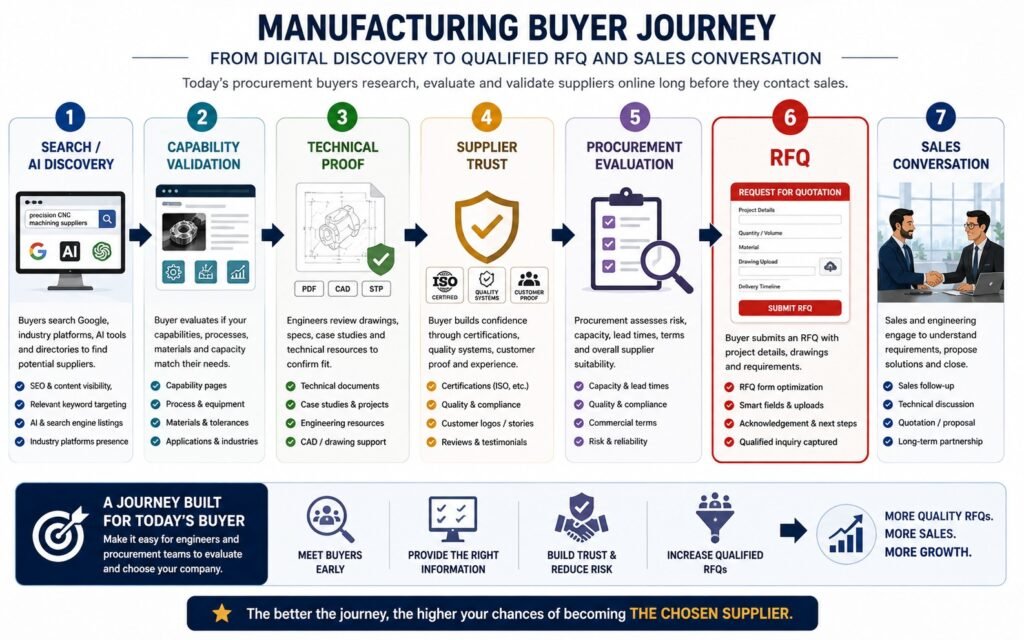
Can you make this? → Have you made it before? → Can you meet our requirements? → Can you prove quality? → How do I request a quote?
That mismatch creates unnecessary cognitive work.
A stronger architecture connects capabilities, applications, industries, technical evidence, proof, and RFQ pathways.
This is one reason the website should be treated as part of the sales process rather than as a separate marketing asset.
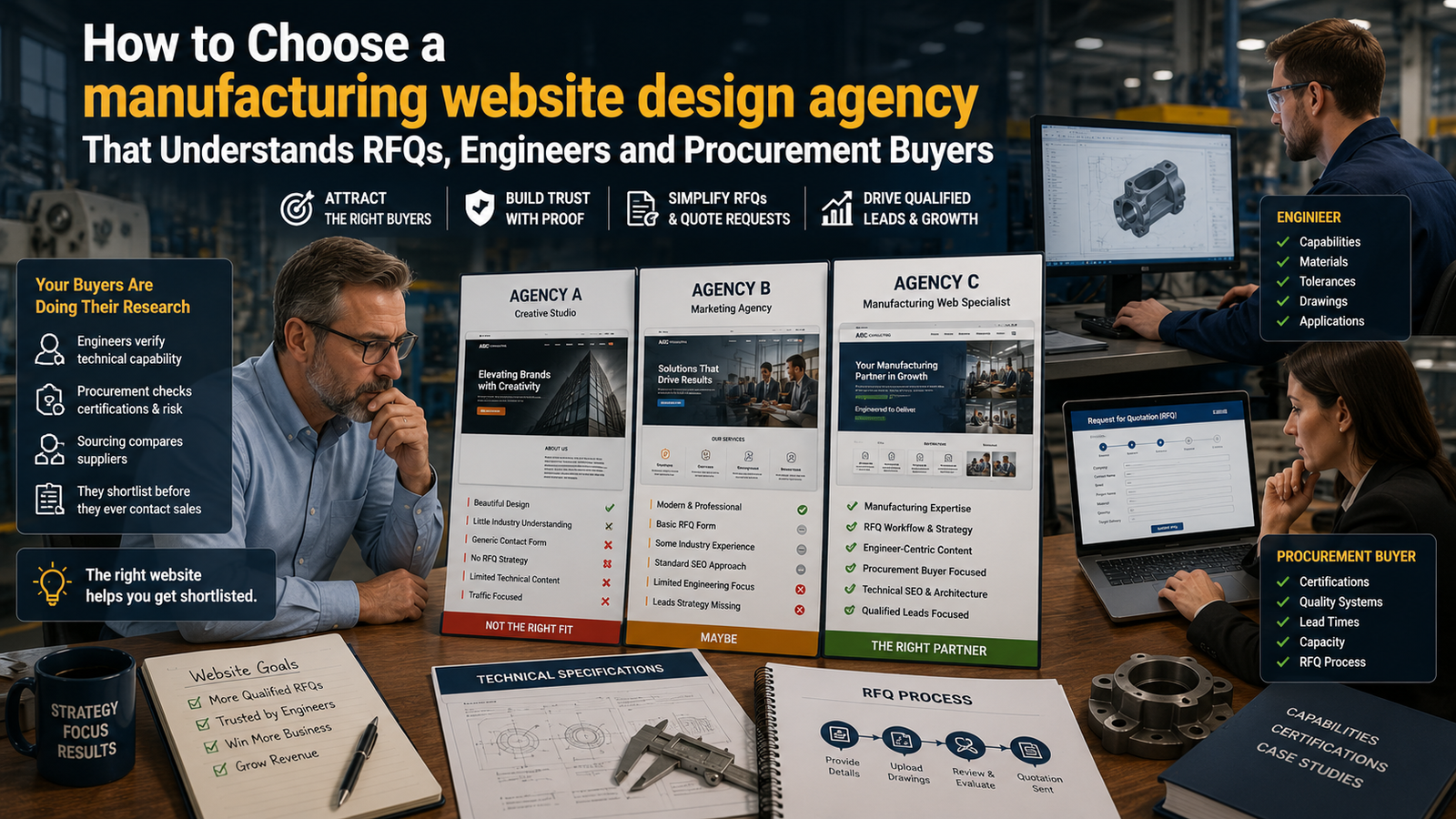
Example Scenario: A Manufacturer Choosing Between Two Agencies
Imagine a precision manufacturer looking for an agency to rebuild its website.
Agency A presents an attractive portfolio, talks about modern animations, promises a responsive WordPress website, and proposes a six-page structure.
Agency B begins by asking:
- Who are your highest-value buyers?
- Which industries do you want to grow?
- Which capabilities produce the highest-margin work?
- What information do engineers request before an RFQ?
- Which certifications influence supplier selection?
- What information does your sales team repeatedly send manually?
- What makes an enquiry qualified?
- What percentage of RFQs currently require follow-up before engineering can assess them?
Agency B is already thinking about the business problem.
That does not automatically make Agency B the better agency. But it gives you a much better basis for evaluating whether the proposed website will support your commercial goals.
Manufacturers should also understand why technically capable companies can still struggle to generate enquiries. Our analysis of why manufacturing websites fail to generate B2B leads focuses on the gaps between website traffic, buyer confidence, and qualified enquiries.
Expert Perspective on Manufacturing Websites
Founder, KG Web Designer | Manufacturing Website Strategist
“A manufacturing website should make the buyer’s evaluation process easier, not create more questions. When technical capabilities, certifications, production processes, industries served, and compliance information are presented clearly, procurement teams can assess your company faster and enter sales conversations with greater confidence.”
Example From Our Experience
Problem
In one manufacturing project described by KG Web Designer, the company had strong technical capabilities but its website did not communicate those capabilities effectively to procurement buyers.
Important information was difficult to locate, RFQ requirements were not structured around the information engineering teams needed, and the website functioned more like a company brochure than a procurement resource.
Solution
The website strategy was reorganized around the procurement journey.
The work included capability-focused pages, technical resources, visible certifications, stronger trust signals, industry-specific content, and a more structured RFQ process.
Outcome
The website became easier for procurement teams to use as a supplier-evaluation resource, while the RFQ process became better aligned with the information required for quotation.
The lesson is important: the redesign was not primarily about making the website look newer. It was about making the manufacturer’s expertise easier to evaluate.
What Should a Manufacturing Website Agency Deliver Beyond Design?
A strong engagement should normally include more than homepage design and development.
Depending on your business, the scope should address:
Strategy
- Buyer research
- Competitor analysis
- Buyer-intent mapping
- Commercial objectives
- Conversion goals
Information Architecture
- Product architecture
- Capability architecture
- Industry pathways
- Technical resource structure
- Internal linking
Content
- Capability pages
- Process pages
- Application pages
- Industry pages
- Technical resources
- Certification content
- Case studies
Conversion
- RFQ CTAs
- RFQ forms
- Drawing uploads
- Qualification fields
- Confirmation workflows
- Contact routing
SEO
- Keyword mapping
- URL architecture
- Metadata
- Internal links
- Redirect strategy
- Technical SEO
- Search-intent alignment
Measurement
- Form submissions
- Qualified RFQs
- Conversion rates
- Landing-page performance
- Lead sources
- Buyer behavior
The agency does not necessarily need to provide every item internally. But someone on the project should own each of these decisions.
If you are still evaluating what procurement buyers actually expect, KG Web Designer has already examined this issue from the buyer’s perspective. Our guide on what purchasing managers actually look for on a manufacturing website explains the technical, trust, certification, and RFQ information that can influence supplier evaluation.
Where Does industrial website design Fit Into the Strategy?
Industrial website design should translate operational credibility into a digital experience that buyers can understand and verify.
That means the visual layer should reinforce the technical story rather than compete with it.
Real manufacturing photography, equipment images, production environments, quality-control processes, technical diagrams, certifications, and project examples can all strengthen credibility when used in the right context.
The mistake is treating these elements as decoration.
A photograph of a CNC machine means very little by itself.
A photograph accompanied by the process, material, capability, application, and relevant technical information becomes evidence.
That is the difference between showing that you own equipment and demonstrating why that equipment matters to the buyer.
Why Most Businesses Get This Wrong
Most manufacturers get agency selection wrong because they evaluate the website as a marketing asset instead of evaluating it as a buyer-enablement system.
The agency presents three homepage concepts.
Internal stakeholders choose the one they like.
The development begins.
The website launches.
Then the manufacturer discovers that:
- Important technical content was never planned.
- Capability pages are too thin.
- Product architecture does not match search behavior.
- RFQ forms collect the wrong information.
- Certifications remain buried.
- Old URLs disappear.
- Sales teams still answer the same basic questions manually.
- Traffic increases without qualified RFQs increasing.
The better approach is to define the buyer journey before approving the visual direction.
What This Means For Your Business
The financial question is simple: what is one qualified manufacturing opportunity worth to your business?
If a single new OEM relationship, recurring supply agreement, or high-value contract is commercially significant, then a website that helps procurement buyers evaluate your company deserves to be treated as a revenue asset.
That does not mean every manufacturer needs an expensive rebuild.
It means the website investment should be proportional to the commercial opportunity and the cost of buyer friction.
Your objective should be to make the website:
- Easier to discover
- Easier to evaluate
- Easier to trust
- Easier to qualify
- Easier to contact
- Easier for sales teams to use
That is a much better definition of website success than simply “the new site looks professional.”
Where Should You Learn More Before Choosing an Agency?
If cost is one of the questions your leadership team needs to answer before selecting an agency, our manufacturing website design cost guide for 2026 can help frame the investment around scope rather than simply comparing agency quotes.
Expert Advice from Kanika Gupta
Founder, KG Web Designer
Kanika Gupta works with businesses that need websites to support real commercial decisions rather than function as digital brochures. Her approach combines website strategy, UX, SEO, conversion architecture, and industry-specific content planning, with particular attention to how technical and professional-service buyers evaluate businesses online.
“For a manufacturer, the best website is not the one that wins the design award. It is the one that helps the right buyer say, ‘They can make this, they understand our requirements, they have the proof, and I know exactly how to request a quote.’”
When Does Professional Help Make Sense?
Professional help makes sense when the website has become too commercially important to treat as a simple design project.
You should consider specialist help when:
- Your website attracts relevant visitors but few RFQs.
- Engineers cannot quickly find technical information.
- Procurement buyers repeatedly ask for information already contained in your business.
- Your capabilities have expanded beyond the current website structure.
- You are entering new industries or geographic markets.
- Your existing website is difficult to update.
- Your SEO architecture is holding back growth.
- Your RFQ process creates unnecessary sales-team workload.
- You are redesigning and cannot afford to lose existing organic visibility.
This is where manufacturing website leads become a strategic issue rather than merely a marketing metric.
The goal is not to produce more forms.
The goal is to create a better path from relevant search → technical validation → trust → RFQ → sales conversation.
How Do You Decide Whether an Agency Is Actually Right for You?
Use this final checklist before signing.
| Question | Yes/No |
|---|---|
| Does the agency understand RFQ-driven businesses? | |
| Can it explain how engineers use the website? | |
| Can it explain how procurement buyers use the website? | |
| Does it understand technical content architecture? | |
| Can it design a qualified RFQ workflow? | |
| Does it have an SEO migration process? | |
| Can it map buyer intent to website pages? | |
| Does it understand international B2B buyers? | |
| Can it measure qualified enquiries? | |
| Can it explain what it would not redesign? | |
| Can it show relevant experience? | |
| Can it explain how the website supports sales? |
If several answers are “no,” I would not choose the agency based on portfolio quality alone.
Mid-Article Decision: What Should You Do First?
If your current website already has strong rankings, useful technical content, and sound architecture, do not assume a complete rebuild is the answer.
Start with an audit.
If the architecture is fundamentally wrong, your positioning has changed, the mobile experience is poor, technical information is difficult to access, or the RFQ journey is broken, then a strategic redesign may be justified.
The important word is strategic.
A manufacturing website should not be rebuilt simply because the design looks five years old.
It should be rebuilt when the current digital experience is preventing the business from communicating, qualifying, or converting the opportunities it wants.
Is Your Website Making It Easy for Buyers to Choose You?
Strong manufacturing capabilities can get overlooked when a website makes buyers search for basic information. Your website should make it easy to understand what you manufacture, where you add value, and why procurement teams can trust your company.
Make Your Capabilities Easy to Verify
Showcase products, specifications, machinery, certifications, facilities, and production capabilities where buyers can find them quickly.
Turn Interest Into RFQs
Place clear enquiry and RFQ pathways across product, service, and industry pages so interested buyers always know what to do next.
Build Confidence Before Contact
Use industry expertise, quality standards, case studies, certifications, and technical content to answer buyer concerns before the sales conversation.
Final Thoughts
Choosing a manufacturing website design agency should be treated as a business decision, not simply a design purchase.
The right agency should understand how engineers validate capability, how procurement evaluates supplier risk, how technical information should be structured, how RFQs should work, and how SEO and conversion strategy connect to qualified pipeline.
At KG Web Designer, the objective is not to create another attractive manufacturing website. It is to create a website that helps technical buyers understand what you can manufacture, why they should trust you, and what they should do next.
If this were my website, I would choose the agency that asks the hardest questions about my buyers and sales process before showing me a homepage concept.
If your manufacturing website is attracting the wrong enquiries, losing qualified RFQs, or making procurement buyers work too hard to evaluate your capabilities, a strategic website review is the right place to start.
Discuss your manufacturing website strategy with KG Web Designer
Frequently Asked Questions
What should I look for in a manufacturing website design agency?
Look for an agency that understands technical buyers, procurement behavior, manufacturing SEO, capability-page architecture, RFQ conversion, and technical content. Portfolio quality matters, but it should not be the only criterion. The agency should be able to explain how its website decisions will help engineers and procurement teams evaluate your company and how success will be measured through qualified enquiries rather than traffic alone.
Should a manufacturing website agency understand engineering?
The agency does not need to replace your engineering team, but it should understand how engineers use websites to evaluate suppliers. It should have a process for extracting technical knowledge from subject-matter experts and turning it into clear capability pages, specifications, applications, resources, and buyer-focused content.
How important are RFQs on a manufacturing website?
RFQs are often the primary conversion action for manufacturers selling customized, engineered, or volume-based products. The website should make the RFQ path easy to find while collecting enough information for the sales or engineering team to assess the opportunity. A well-designed RFQ process balances submission simplicity with useful qualification.
Should I choose a manufacturing specialist or a general web design agency?
A manufacturing specialist can be advantageous when your website depends heavily on technical content, procurement behavior, complex product architecture, or RFQ conversion. A general agency can still be appropriate if it demonstrates strong B2B strategy and understands your industry. The deciding factor should be demonstrated understanding of your buyer and sales process, not the agency’s label.
How can I tell whether an agency understands procurement buyers?
Ask the agency to describe what an engineer and procurement manager need from the same website. A strong answer should include technical capabilities, specifications, certifications, quality evidence, applications, production information, relevant experience, and a clear RFQ pathway. If the answer focuses mainly on branding, colors, animations, and homepage design, dig deeper before hiring.
Should a manufacturing website focus on SEO or RFQ conversion?
It should do both, but the order depends on the problem. If relevant buyers already reach your website but do not enquire, conversion improvements may have greater immediate value. If the website has little relevant organic visibility, SEO and information architecture become more important. The best strategy connects search intent to the right technical landing page and then to a clear RFQ journey.
How does AI search affect manufacturing websites?
AI search makes clear, specific, authoritative information even more important, but Google says there are no special technical requirements or separate AI-only optimization needed for AI Overviews or AI Mode. Strong foundational SEO, useful original content, accessible text, internal linking, and accurate structured data remain important.
What should a manufacturing website redesign cost?
There is no useful single price because the scope can range from a focused UX and conversion project to a complete rebuild involving dozens of capability, industry, product, and technical-resource pages. The right question is what the business needs to fix, what SEO equity must be protected, what integrations are required, and how much technical content must be created or restructured.