Quick Answer
Industrial equipment website design needs to organize technical specifications, operating capabilities, product variants, applications, documentation, and quotation pathways around how engineers and procurement teams evaluate machinery. A conventional corporate layout often hides the details buyers need to shortlist a supplier. For complex equipment, the website should function as a product evaluation tool, helping buyers compare models, confirm technical fit, assess supplier credibility, and request the right commercial information.
TL;DR / Key Takeaways
- Heavy machinery buyers need technical specifications and application information before they can evaluate whether a product fits their requirements.
- Product pages should make dimensions, capacity, power requirements, operating conditions, attachments, documentation, and available configurations easy to find.
- Equipment catalogs need filters and comparison tools that reflect technical buying criteria rather than broad marketing categories.
- RFQ forms should collect the information required to qualify a machinery enquiry without making the process unnecessarily difficult.
- Product photography, technical diagrams, downloadable documentation, service information, and manufacturer credentials work together to establish buyer confidence.
- A redesign should prioritize product architecture and technical usability before investing in elaborate animations or visual effects.
Why Do Spec-Heavy Products Need a Different Website Layout?
Industrial equipment needs a different layout because buyers are evaluating technical suitability, operating requirements, ownership implications, and supplier reliability, not simply deciding whether they like a product. A manufacturer selling a conveyor system, hydraulic press, excavator, packaging machine, industrial pump, or material-handling system must help different stakeholders find the information relevant to their decisions.
An engineer may need dimensions, tolerances, throughput, power requirements, or compatibility information. A procurement manager may need model comparisons, delivery information, documentation, warranty terms, and commercial details, while an operations manager may want to understand maintenance access, service availability, and operating conditions.
Thomasnet’s historical industrial purchasing research identified detailed product specifications, applications, catalogs, and equipment lists as important information for industrial buyers. Although this research is older and should not be presented as a current 2026 benchmark, the underlying design lesson remains useful: industrial product information needs to be detailed and logically organized.
| Website Element | Conventional Corporate Layout | Technical Product-Evaluation Layout |
|---|---|---|
| Product navigation | Broad product categories | Equipment types, models, applications, and technical attributes |
| Product pages | Marketing descriptions and images | Specifications, capabilities, configurations, and documentation |
| Comparisons | Minimal or unavailable | Model-by-model technical comparison |
| Downloads | General brochures | Model-specific datasheets, manuals, drawings, and certificates |
| Enquiry process | Generic contact form | Product-aware RFQ with technical project details |
| Visual content | Hero photography | Product images, dimensions, diagrams, and application examples |
| Buyer support | General contact information | Technical support, parts, service, and documentation pathways |
| Search functionality | Keyword-only search | Filters based on relevant technical characteristics |
The difference affects revenue. If a qualified buyer cannot establish whether a machine meets their requirements, they may leave without contacting sales, even when the manufacturer offers a suitable product.
KG Web Designer is a conversion-focused website design studio specializing in custom websites for clinics, professional services, manufacturers, and growing businesses. For industrial manufacturers, that means treating product information architecture as part of the sales process rather than a design detail.
What Should a Heavy Machinery Product Page Show First?
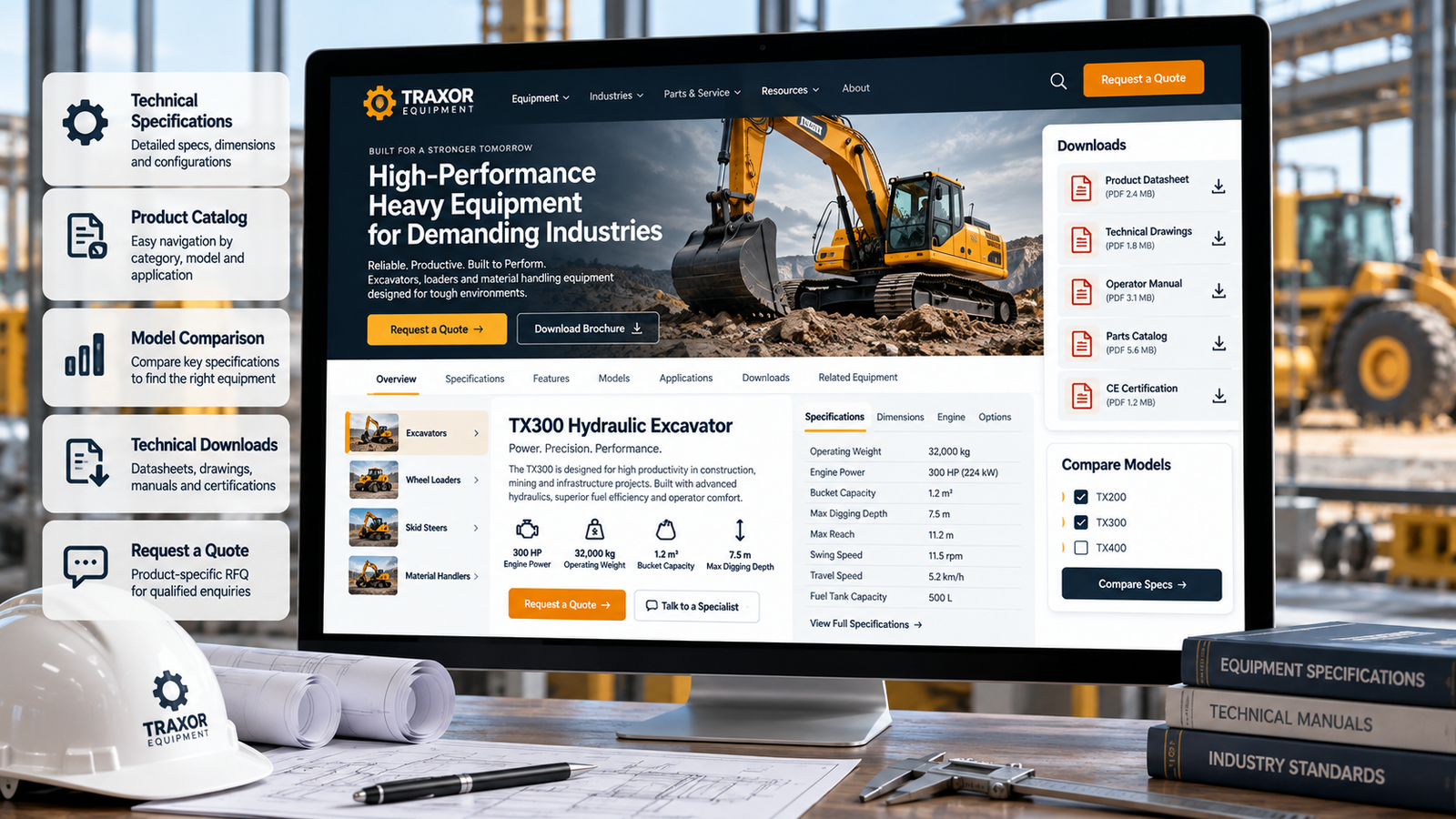
A machinery product page should present the equipment’s purpose, main capabilities, critical specifications, available configurations, and next step before forcing buyers to navigate through lengthy promotional copy. The opening section needs to establish product relevance immediately.
A strong product page should usually include:
- Product name, model number, and equipment category.
- A concise explanation of the machine’s purpose.
- Key specifications and operating capabilities.
- Product images from multiple angles.
- Applications and industries served.
- Available configurations, attachments, or options.
- Downloadable technical documentation.
- Relevant certifications and standards, where applicable.
- Service, parts, warranty, or support information.
- A clear request-for-quotation or technical consultation CTA.
The exact order depends on the product. A large excavator, precision cutting machine, industrial compressor, and automated packaging line do not share the same specification hierarchy.
For example, a buyer evaluating an industrial pump may need flow rate, head, fluid compatibility, materials, seal options, and operating temperature. A buyer comparing excavators may prioritize operating weight, engine power, bucket capacity, digging depth, transport dimensions, and compatible attachments.
The website should make these differences visible rather than forcing every product into the same generic template.
Extractable fact: A technical product page should prioritize the specifications buyers need to determine product suitability, not just the features the marketing team wants to promote.
Can Your Buyers Find the Specifications They Need Without Contacting Sales?
Heavy machinery buyers often need to verify technical compatibility before making an enquiry. Your product pages should make that evaluation easier.
Turn complicated technical information into a product experience that supports faster evaluation and better-qualified enquiries.
Explore Manufacturing Website Design →How Should Technical Specifications Be Organized?
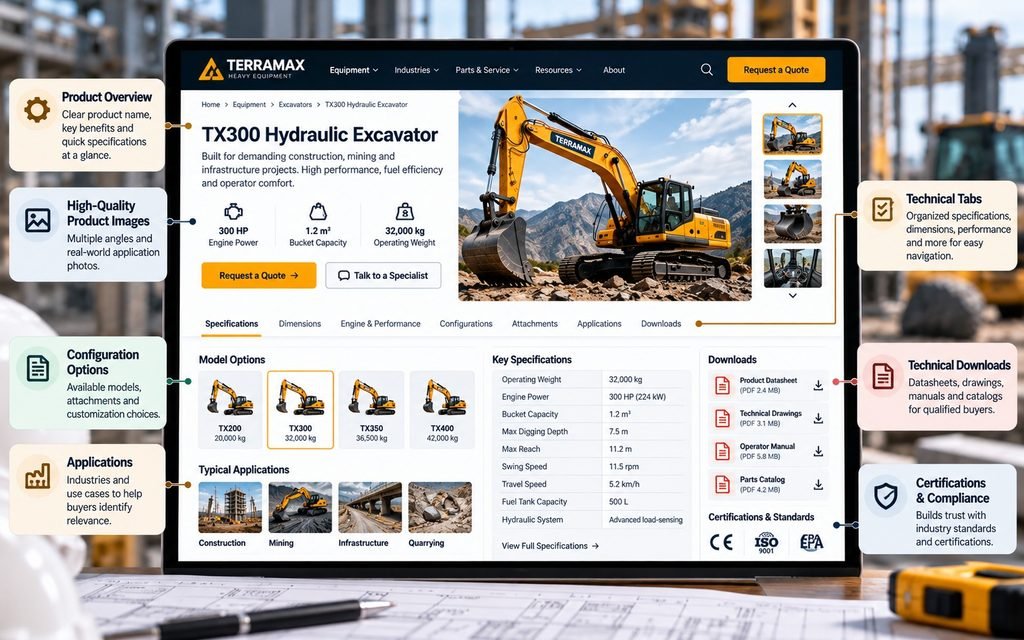
Specifications should be grouped into meaningful categories so buyers can scan, compare, and download the information they need. A long, unstructured list of values creates unnecessary cognitive effort, particularly when equipment models have many variants.
Useful specification groups include:
- Performance: output, throughput, speed, load capacity, pressure, flow rate, or operating range.
- Physical dimensions: height, width, length, weight, clearance, and installation footprint.
- Power and utilities: voltage, current, engine power, fuel requirements, compressed air, or other utility needs.
- Materials and construction: material grades, contact materials, frame construction, and corrosion resistance.
- Operating conditions: temperature, humidity, duty cycle, environmental requirements, and applicable limits.
- Compatibility: attachments, accessories, interfaces, tooling, replacement components, and integration requirements.
- Compliance: applicable standards, certifications, testing documentation, and safety information.
- Commercial details: warranty, lead time, service arrangements, delivery options, and quote availability.
Not every product requires every category. The product team should establish a consistent specification framework that reflects the equipment’s actual engineering requirements.
This is where heavy equipment website design needs to move beyond presenting a large photograph beside a paragraph of marketing text. The layout should make technical facts easy to locate while preserving enough context to help buyers understand what each specification means.
Where model variations are substantial, use comparison tables or structured product attributes. Where configuration is complex, explain which options are standard, optional, or dependent on the customer’s application.
How Should Equipment Catalogs Help Buyers Compare Models?
An equipment catalog should let buyers narrow a large product range using the characteristics that determine technical fit. If a manufacturer offers dozens of models, attachments, sizes, or configurations, a flat grid of product cards can quickly become difficult to use.
Useful catalog features include:
- Equipment category filters.
- Model and part-number search.
- Capacity or performance ranges.
- Dimensions and operating weight.
- Power or fuel type.
- Application and industry filters.
- Configuration and accessory options.
- Downloadable datasheets.
- Side-by-side model comparison.
- Availability or quote-request pathways, where appropriate.
The filtering system should be based on the manufacturer’s real product data. Do not add filters merely because they look sophisticated; every filter should help a buyer reduce the number of technically unsuitable options.
For instance, a manufacturer of material-handling equipment may organize products by load capacity, lifting height, power source, and application. A manufacturer of industrial processing machinery may need filters for throughput, material compatibility, production method, and operating environment.
A well-structured industrial machinery website also needs a consistent relationship between category pages, individual product pages, documentation, and related accessories. If buyers can find a model but cannot identify its compatible attachments or technical documentation, the catalog is not fully supporting their decision.
Product catalogs become more useful when they answer the questions purchasing teams ask before contacting a supplier. Buyers need clear product categories, accessible specifications, application details, and enough information to determine whether a model fits their requirements. Understanding what purchasing managers look for on a manufacturing website helps manufacturers organize product information around actual buying decisions.
What Should a Product Comparison Table Include?
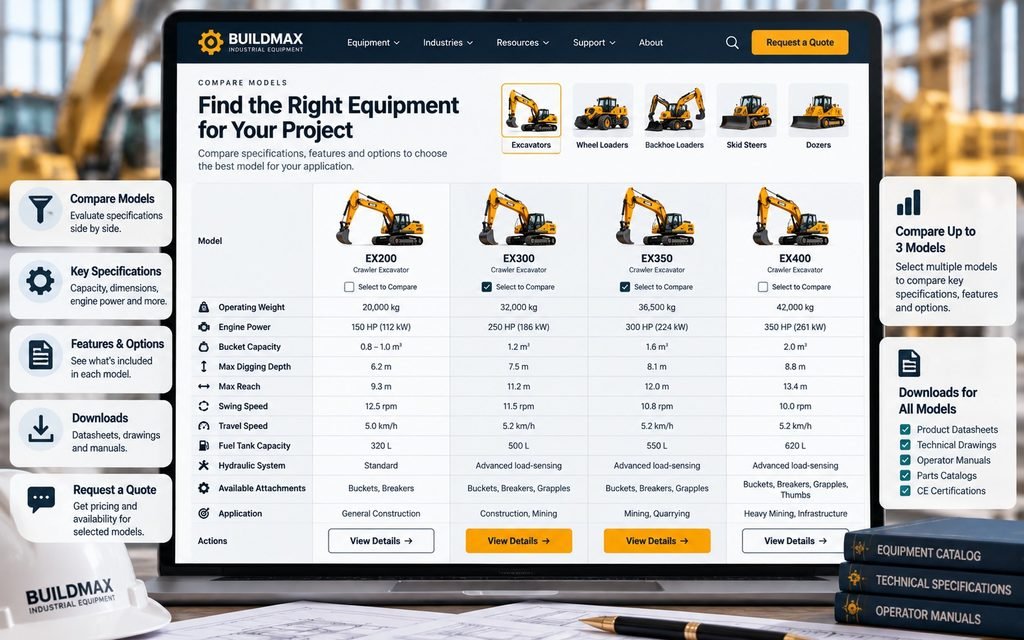
A useful comparison table should focus on the few attributes that most clearly differentiate models, with a path to the complete specifications for each product. It should not attempt to squeeze an entire engineering datasheet into a tiny table.
| Comparison Field | Why It Matters |
|---|---|
| Model number | Prevents confusion between similar products |
| Capacity or output | Helps establish suitability for the application |
| Dimensions and weight | Supports site planning, transport, and installation |
| Power requirements | Helps verify utilities and operating constraints |
| Operating range | Clarifies the conditions the equipment is designed for |
| Configuration options | Shows which features vary by model |
| Documentation | Provides access to detailed technical verification |
| Quote action | Helps the buyer move forward with the correct model |
For complex products, the comparison table should summarize key differences and link to the complete technical details. This is more useful than forcing buyers to open multiple tabs and manually compare separate PDF files.
What Technical Documents Should Manufacturers Make Available?
Manufacturers should make relevant, current, model-specific documentation easy to find without requiring a buyer to submit a sales enquiry for every basic specification. The exact documents depend on product complexity, safety requirements, intellectual property, and the manufacturer’s commercial process.
Potential resources include:
- Technical datasheets.
- Product catalogs.
- Installation requirements.
- Operating manuals.
- Maintenance documentation.
- Dimensional drawings.
- CAD files, where appropriate.
- Compatibility guides.
- Safety documentation.
- Certification and compliance documents.
- Spare-parts information.
- Service and maintenance schedules.
Some documents should be publicly accessible, while others may reasonably require registration or an approved customer account. The key is to avoid unnecessary barriers around information that buyers need for initial product evaluation.
Document management also matters. A product page should not link to an outdated datasheet or leave buyers guessing which configuration a PDF describes. File names, revision dates, model identifiers, and document ownership should be managed consistently.
For manufacturers selling into regulated or safety-sensitive industries, technical documentation should be reviewed by the relevant engineering, quality, or compliance team before publication.
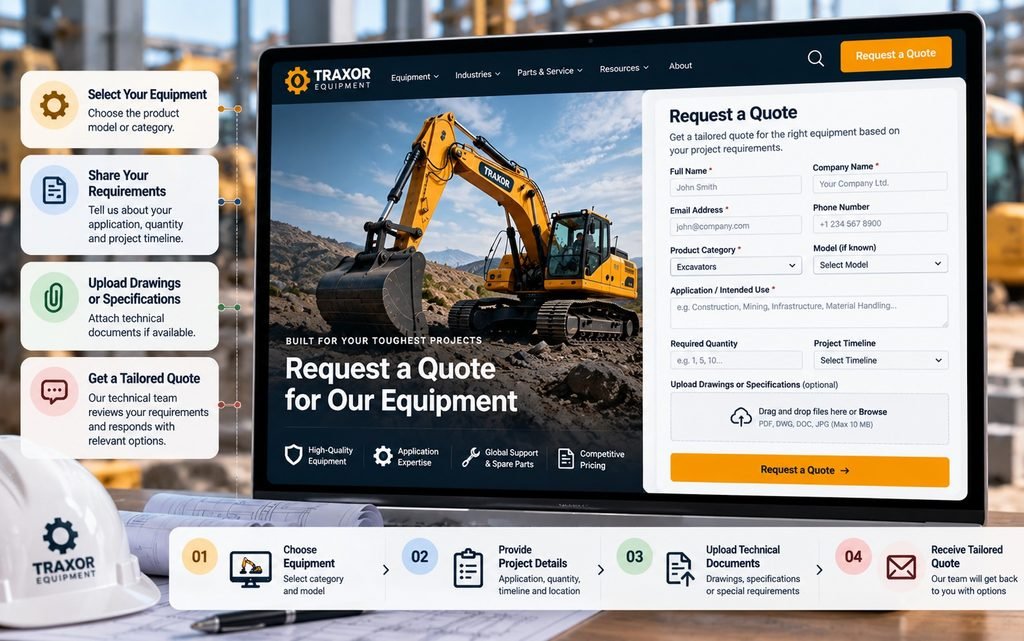
How Should RFQ Forms Work for Industrial Machinery?
A machinery RFQ form should collect enough information to help the sales or engineering team assess the enquiry, without asking every visitor to complete an unnecessarily long questionnaire. The best form reflects the product and the complexity of the purchase.
A useful form might collect:
- Name and business email.
- Company and role.
- Product or model of interest.
- Application or intended use.
- Required capacity or operating conditions.
- Estimated quantity.
- Project timeline.
- Delivery destination.
- Required configuration or accessories.
- Drawing or specification upload, where relevant.
- Additional technical questions.
Not every enquiry needs every field. A visitor requesting a standard replacement part should not face the same process as an engineering team specifying a custom production line.
A practical approach is to use a short initial form with product-specific follow-up fields. Allow buyers to identify the product they are interested in before requesting detailed information, and clearly explain why any required technical details are needed.
A well-designed RFQ process works best when the rest of the website supports it. Clear navigation, technical downloads, product comparison tools, visible contact options, and relevant trust signals help buyers move from research to inquiry with fewer obstacles. Manufacturers can use these essential website features for generating more industrial leads to identify gaps in their current website and prioritize improvements.
Your Buyers Know What They Need. Can Your Website Help Them Find It?
When buyers compare machinery by capacity, application, power requirements and configuration, basic product grids are rarely enough.
A Better Conversion Path for Complex Equipment
The enquiry journey should offer several routes according to buyer intent:
- Early research: Browse equipment categories, applications, and product capabilities.
- Technical evaluation: Compare models, review specifications, and download documentation.
- Commercial consideration: Request pricing, lead times, configuration advice, or a technical consultation.
- Advanced qualification: Submit drawings, detailed operating requirements, or project specifications.
This structure helps both the buyer and the sales team. Buyers can self-educate before contacting the manufacturer, while sales staff receive more context when a serious enquiry arrives.
If your website attracts visitors but produces too many vague or unsuitable enquiries, the issue may be the product architecture or enquiry process rather than traffic volume. A focused audit can identify which technical information and conversion steps need to change before you invest in a complete redesign.
What Should Industrial Equipment Websites Show to Build Trust?
Industrial equipment websites should provide verifiable evidence that the manufacturer understands the application, can deliver the product, and can support the customer after the sale. Large machinery photographs can demonstrate scale, but they do not establish engineering competence by themselves.
Useful trust signals include:
- Clear manufacturer identity and company location.
- Product-specific technical information.
- Relevant certifications and standards.
- Quality assurance and inspection processes.
- Genuine equipment and facility photography.
- Documented applications or project examples.
- Service, spare-parts, and maintenance capabilities.
- Warranty information.
- Technical support availability.
- Installation and commissioning support, where offered.
- Export and logistics information for international buyers.
- Named technical or sales contacts.
These signals should be placed where buyers need them. Certification information belongs near relevant product or quality content, while warranty and service information should be easy to find during commercial evaluation.
At KG Web Designer, we frequently see industrial websites describe their experience in broad terms without demonstrating how that experience applies to a specific product or buyer problem. A stronger page connects each claim to evidence, documentation, an application, a process, or a clear explanation of the manufacturer’s capabilities.
For international buyers, clarity around units of measurement, delivery responsibilities, service coverage, and communication channels can also reduce uncertainty. Avoid claiming certifications, support coverage, or delivery capabilities unless the business can substantiate them.
For a related framework, our article on engineering trust on high-conversion manufacturing websites explains how manufacturers can make technical capability, quality standards, and supplier credibility easier to verify.
What Does Research Tell Us About Technical Information and Website Performance?
Industrial buyers have long needed detailed technical information to evaluate products, and the website must make that information usable rather than simply available. Thomasnet’s historical research highlighted gaps between the specifications and product information buyers wanted and what supplier websites provided, including application details and CAD resources. Because that research dates back to 2005, it should be used as historical context, not as evidence of current buyer percentages.
For current website performance, Google recommends good Core Web Vitals. Its published thresholds are an LCP of 2.5 seconds or less, INP of less than 200 milliseconds, and CLS below 0.1 for a good user experience. These metrics matter when buyers navigate large catalogs, open technical resources, compare models, and submit enquiries. Google’s guidance also makes clear that strong metrics alone do not guarantee high search rankings.
For an industrial website, performance improvements should focus on practical bottlenecks:
- Oversized product and facility images.
- Heavy video backgrounds.
- Slow catalog filters.
- Large PDF previews.
- Third-party configurators.
- Complex product comparison scripts.
- Mobile navigation problems.
- Forms that fail or reset unexpectedly.
Do not remove useful technical functionality simply to chase a performance score. Instead, measure real page performance and improve the elements that make product evaluation slow or frustrating.
Why Most Businesses Get This Wrong
Most industrial equipment websites get this wrong because they are organized around the manufacturer’s internal structure rather than the buyer’s technical decision. The navigation reflects departments, the homepage emphasizes company history, and product pages repeat broad claims without making the specifications or documentation easy to compare.
This can create several costly problems:
- Buyers cannot determine whether a product fits their application.
- Similar models appear interchangeable because their differences are unclear.
- Technical documents are buried in download libraries.
- Product images look impressive but do not explain important features.
- Quote forms fail to collect useful project information.
- Service and spare-parts information is hard to find.
- Mobile users struggle with tables and menus.
- Search engines have limited, repetitive product content to understand.
- Sales teams spend time answering questions the website could have addressed.
The solution is not to make every page longer. It is to make the right information easier to locate, understand, compare, and act on.
A useful framework is to review every major page against four questions:
- Can the buyer identify the relevant product or capability?
- Can the buyer determine whether it fits the application?
- Can the buyer verify the manufacturer’s credibility and support?
- Can the buyer take the appropriate next step?
If a page cannot answer these questions, redesigning its visual style alone is unlikely to solve the underlying problem.
What Should You Fix First, Second, and Third?
The best redesign sequence starts with product data and buyer tasks, followed by navigation and conversion, and only then visual refinement. This reduces the risk of spending money on an attractive interface that still leaves technical buyers struggling to evaluate equipment.
First: Fix the product data structure
Identify the equipment categories, models, configurations, specifications, documents, and accessories that need to be represented consistently. Establish ownership for technical data and make sure each model has accurate, current information.
Second: Fix the buyer journey
Build navigation and filters around product type, application, technical attributes, and buyer intent. Improve comparison tables, document access, related-product pathways, and product-aware RFQ forms.
Third: Fix visual design and performance
Use product photography, technical illustrations, diagrams, typography, and page layouts to make complex information easier to understand. Then test mobile usability, loading performance, accessibility, and enquiry tracking.
This sequence is especially useful when a manufacturer has a large catalog or legacy website. It creates a clear scope, makes content migration easier to plan, and helps prevent technical information from being lost during the redesign.
More Product Information Should Lead to Better Buying Decisions — Not More Confusion.
Industrial buyers need enough technical detail to assess suitability before submitting an enquiry. Your website should connect product research with a clear, relevant RFQ process.
Find the Right Equipment
Navigate by equipment type, application or operational requirement.
Review Technical Fit
Examine specifications, operating parameters and compatibility.
Access Documentation
Review relevant datasheets, certifications and supporting materials.
Request a Relevant Quote
Submit product-specific requirements to the appropriate sales team.
Build a website that helps engineers, procurement teams and decision-makers move from product evaluation to meaningful sales conversations.
Build a Better RFQ Journey →Example Scenario
Imagine a US manufacturer selling industrial packaging machinery with several product families and multiple configurations. Its website has polished equipment photography, but product pages use nearly identical descriptions and provide little information about output, package types, line integration, footprint, or utility requirements.
An engineering buyer researching a production-line upgrade cannot determine which model is suitable. A procurement manager cannot compare the options easily, and the sales team receives enquiries that lack the information needed to prepare a meaningful quotation.
The manufacturer does not necessarily need more traffic. It needs a better technical evaluation journey.
A more effective website would organize machinery by application, provide model-specific specification tables, explain configuration options, offer relevant documentation, and guide qualified buyers toward a structured RFQ. That approach does not guarantee more sales, but it removes avoidable barriers between buyer research and a serious commercial conversation.
Example From Our Experience
Problem
KG Web Designer has published manufacturing website work describing a recurring issue: technically capable manufacturers can struggle to communicate their expertise online when capability details, quality information, and enquiry pathways are difficult to navigate. One documented example is discussed in our manufacturing website redesign analysis, which describes an anonymized manufacturer whose website attracted traffic but did not adequately support supplier evaluation and RFQ qualification.
Solution
The approach described in that work focused on restructuring the website around buyer evaluation: clearer capability architecture, more accessible technical content, visible trust signals, industry-specific information, and a more structured enquiry process.
For an industrial equipment manufacturer, the equivalent approach would also include model-level specifications, product comparison, document access, configuration logic, and product-aware RFQ pathways.
Outcome
The documented case illustrates the strategic principle: the website should make existing technical expertise easier for buyers to evaluate rather than simply adding decorative design elements. It does not establish a quantified result for heavy machinery specifically, so no machinery sales or conversion increase should be inferred from it.
This is how KG Web Designer approaches industrial website strategy: identify the buying friction, map the information buyers need, and then design the page structure and conversion process around those requirements.
When evaluating a manufacturing website, it is useful to look beyond its visual appearance and examine how effectively it communicates technical expertise, product capabilities, and reasons to initiate an inquiry. Reviewing manufacturing website design examples that build trust and generate RFQs can help manufacturers identify practical ways to improve their own product pages, navigation, and conversion paths.
Expert Insight from Kanika Gupta
Kanika Gupta, Founder, KG Web Designer
My strongest recommendation is to stop treating a machinery product page as a brochure with a quotation button attached.
If this were my website, I would begin by listing the technical questions a qualified buyer must answer before choosing a model. I would then build the page around those questions, with the most decision-critical specifications near the top, detailed documentation one step away, and a clear route to technical or commercial assistance.
I would also insist on a consistent product data structure before approving a large catalog redesign. If product specifications are incomplete or inconsistent internally, a new design will simply make that inconsistency look better.
The real advantage comes from making complex equipment easier to evaluate. That is the job of the layout.
When Does Professional Website Help Make Sense?
Professional help makes sense when the current website cannot support the complexity of the product range, the technical evaluation process, or the company’s commercial goals. It is particularly valuable when the manufacturer is expanding its catalog, entering new markets, introducing product configurations, or trying to improve the quality of enquiries.
Consider an audit or redesign if:
- Buyers repeatedly request basic specifications by email.
- Similar models are difficult to compare.
- Product documentation is scattered across the site.
- The catalog is difficult to filter.
- Product pages rely on generic descriptions.
- RFQs arrive without sufficient technical details.
- Service, maintenance, or spare-parts information is hard to find.
- The website is difficult to update without developer support.
- International buyers cannot find relevant delivery or support information.
- The website performs poorly on mobile devices.
- Search traffic is not translating into relevant enquiries.
Before commissioning a complete rebuild, determine whether the core problem is data structure, content, navigation, conversion, or the platform itself. A focused audit can prevent unnecessary spending and provide a prioritized implementation plan.
KG Web Designer can help manufacturers assess product architecture, technical content, UX, SEO, and RFQ pathways before deciding whether targeted improvements or a strategic redesign makes more commercial sense.
What This Means For Your Business
The website for a spec-heavy manufacturer is part of the technical sales process. It should help buyers understand what the equipment does, determine whether it fits their requirements, verify the manufacturer’s credibility, and move toward a meaningful enquiry without unnecessary friction.
The strongest industrial equipment website design makes complex products easier to evaluate through structured specifications, model comparisons, technical documentation, clear trust signals, and a relevant conversion path.
For manufacturers competing in the United States, United Kingdom, Australia, and other international markets, that clarity can help the business communicate technical competence to buyers who may be comparing suppliers before ever speaking to a sales representative.
The objective is not to make the website look more expensive. It is to make the manufacturer’s capabilities easier to understand, verify, and buy.
Final Thoughts
Spec-heavy products need a website layout built around technical evaluation, not simply visual presentation. Buyers need to identify the right equipment, understand its capabilities, compare relevant models, verify documentation, and request the right information without unnecessary friction.
A well-planned industrial equipment website design connects product data, technical content, buyer trust, and conversion into one coherent experience. It also gives sales and engineering teams a stronger digital resource to support the conversations that matter.
If your product pages look impressive but leave buyers searching for specifications, compatibility information, documentation, or the correct RFQ route, it is time to review the architecture rather than simply refresh the design.
KG Web Designer can assess your existing product pages, catalog structure, technical content, and enquiry process to identify the highest-value improvements. Request an industrial website strategy review through KG Web Designer’s contact page to discuss a website built around the way your buyers evaluate and purchase complex equipment.
Does Your Website Make Heavy Machinery Easier to Evaluate — or Harder to Buy?
Let’s review how your website presents technical specifications, organises equipment categories and supports serious B2B buyers. We’ll identify whether targeted UX improvements or a more comprehensive redesign would better support your business goals.
What We’ll Review
Website Strategist
FAQs
What should an industrial equipment website include?
An industrial equipment website should include organized product categories, model-specific specifications, application information, technical documentation, relevant certifications, product imagery, service and support details, and a clear RFQ or consultation pathway. The precise structure depends on the machinery, product range, configuration options, and technical questions buyers must answer before making a purchasing decision.
How should manufacturers display heavy machinery specifications online?
Manufacturers should group specifications into categories such as performance, dimensions, power requirements, operating conditions, materials, compatibility, and compliance. Key decision-making specifications should appear near the top of the product page, while complete datasheets and technical documents should remain easy to access. The values and units should be consistent across models to support reliable comparison.
Should an industrial machinery website include product comparison tools?
Yes, when buyers need to compare multiple models or configurations. Comparison tools should focus on meaningful technical differences such as capacity, dimensions, output, power requirements, operating range, and compatible options. They should use accurate product data and link to full documentation rather than attempting to replace detailed engineering specifications with a simplified table.
What should a machinery RFQ form ask buyers?
A machinery RFQ form should collect the information needed to qualify the specific enquiry, which may include the product or model, application, quantity, operating requirements, project timeline, delivery destination, and relevant drawings or specifications. The form should remain proportionate to the complexity of the purchase, with a shorter path for straightforward enquiries and additional technical fields when necessary.
How can an industrial equipment website generate better-quality enquiries?
A website can support better-quality enquiries by explaining product capabilities clearly, making model selection easier, providing relevant documentation, and collecting useful project information through a product-aware RFQ process. These improvements help buyers assess fit before contacting sales and can reduce avoidable follow-up, although actual results depend on traffic quality, product demand, sales response, and the buying process.
Is SEO important for heavy machinery manufacturers?
Yes. SEO can help buyers discover relevant equipment, applications, technical capabilities, and manufacturer expertise when they search for products or solutions. Effective industrial SEO combines useful product and application pages, descriptive titles, crawlable navigation, accurate technical content, internal links, and good mobile performance. Rankings are not guaranteed, so performance should be evaluated using qualified traffic and relevant enquiries as well as visibility.
Should a manufacturer redesign its entire website or improve existing product pages?
Not every manufacturer needs a complete rebuild. If the current platform can support accurate product data, effective navigation, technical documentation, mobile usability, and a better RFQ journey, targeted improvements may be sufficient. A full redesign is more appropriate when the underlying architecture or platform prevents those changes. An audit should determine the scope before investment is approved.