Quick Answer
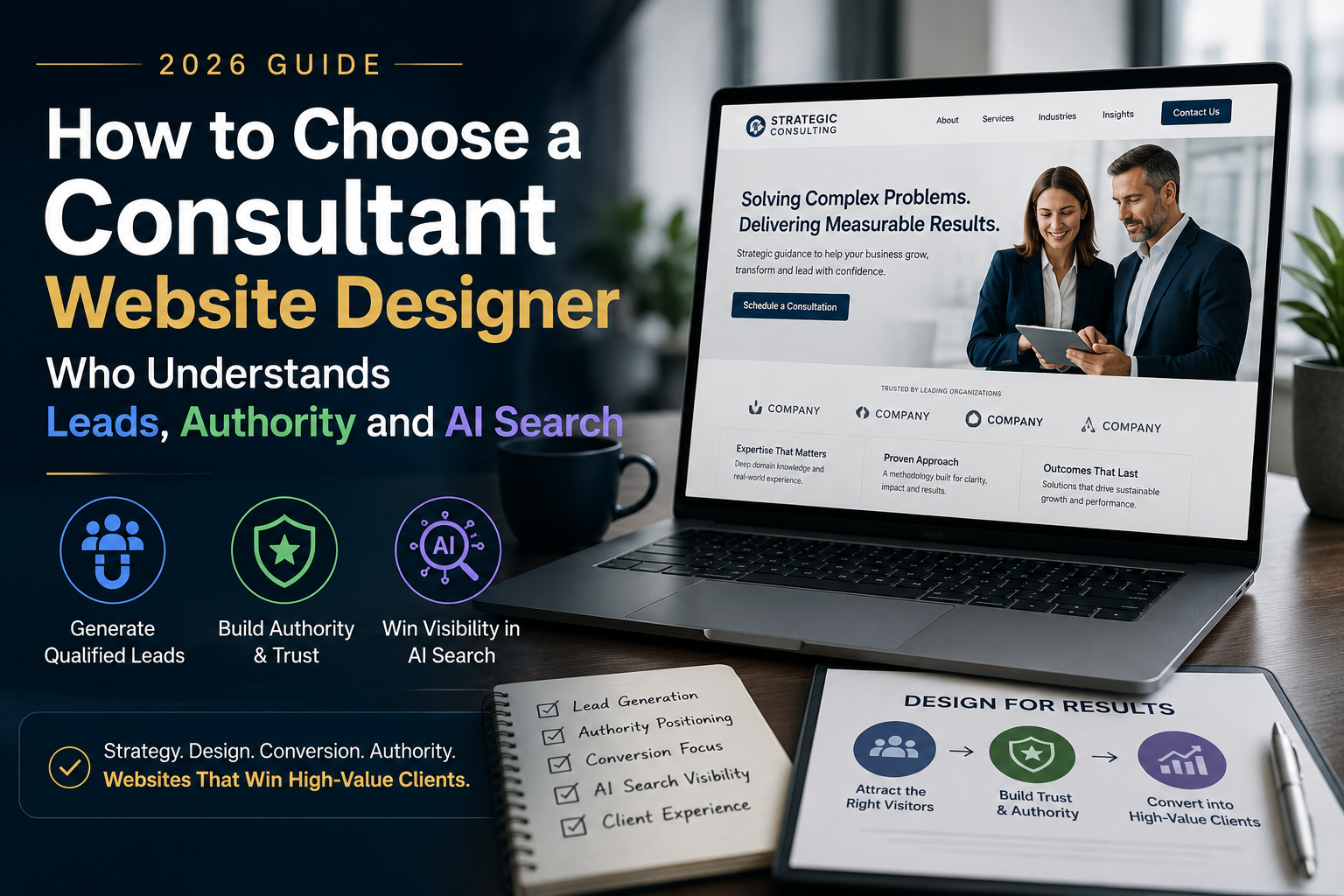
The right consultant website designer should understand more than visual design. They should understand how consulting buyers evaluate expertise, how a website turns qualified visitors into conversations, and how Google and AI search systems discover and interpret authority. Before hiring, evaluate their approach to positioning, messaging, trust, content structure, conversion paths, SEO, AI search visibility, and measurable business outcomes.
TL;DR: What Matters Most
- A consulting website should help a potential client understand your expertise and relevance before asking them to contact you.
- Strong positioning matters because executive buyers need to understand who you serve, what problems you solve, and why they should trust you.
- Search visibility is valuable only when the website converts that visibility into qualified business conversations.
- AI search makes structured expertise, clear entity relationships, original insights, and authoritative content increasingly important.
- A redesign should be driven by a diagnosis of business and conversion problems, not simply by an outdated visual style.
- The right website partner should understand consulting buyer psychology, long sales cycles, authority positioning, and lead generation.
What Is Usually Wrong When a Consulting Website Gets Traffic but Not Enough Leads?
If the website receives relevant traffic but very few inquiries, the likely problem is conversion, positioning, trust, or message clarity rather than traffic alone. If impressions and qualified traffic are both weak, the problem is more likely visibility, content, technical SEO, or search positioning.
This distinction matters because consultants often react to poor lead volume by choosing the wrong solution.
They hire an SEO agency when the website cannot persuade visitors.
They redesign the website when the real problem is weak positioning.
They increase advertising when the landing experience does not establish enough trust.
Or they publish more articles without creating a clear connection between expertise, buyer questions, and commercial intent.
The symptoms sound familiar
Consultants frequently describe the problem in phrases such as:
- “We’re getting traffic, but very few serious inquiries.”
- “People visit the site but don’t seem to understand what we actually do.”
- “Our competitors look less experienced than us, but they seem to get more opportunities.”
- “We have strong credentials, but the website doesn’t communicate them.”
- “We publish content, but it doesn’t generate business.”
- “People find us through Google, then disappear.”
- “We are getting inquiries, but they aren’t from the right type of client.”
These are not all SEO problems.
They are buyer-journey problems.
How Would I Diagnose a Consulting Website Before Recommending a Redesign?
I would first determine where the buying journey is breaking rather than immediately recommending a new website.
At KG Web Designer, the first areas I would inspect are:
- Positioning: Can a visitor immediately understand who the firm serves?
- Homepage messaging: Does the first screen communicate a business outcome rather than a generic consulting promise?
- Service architecture: Are individual services connected to specific client problems?
- Authority: Is expertise demonstrated through evidence rather than simply claimed?
- Trust: Are case studies, credentials, client experience, expertise, and proof easy to find?
- Conversion path: Is there one obvious next step for a qualified buyer?
- Content depth: Does the site answer the questions buyers ask before contacting a consultant?
- Search visibility: Can search engines and AI systems understand the firm’s expertise and topical relationships?
- Analytics: Is the business measuring meaningful actions rather than simply page views?
- Lead quality: Are existing inquiries actually aligned with the firm’s commercial priorities?
If this were my website, I would not start by changing the colors, fonts, animations, or homepage layout. I would first find the point where buyer confidence is being lost.
That diagnosis determines whether you need SEO, CRO, content restructuring, a redesign, paid acquisition, or simply better messaging.
Are the Right Clients Understanding Your Value?
Your consulting website should help potential clients quickly understand who you help, what makes your expertise different, and why you are worth contacting. A strategically structured consultant website can position your expertise more clearly and discourage poor-fit enquiries before they reach your inbox.
What Should You Compare Before Choosing a Consultant Website Designer?
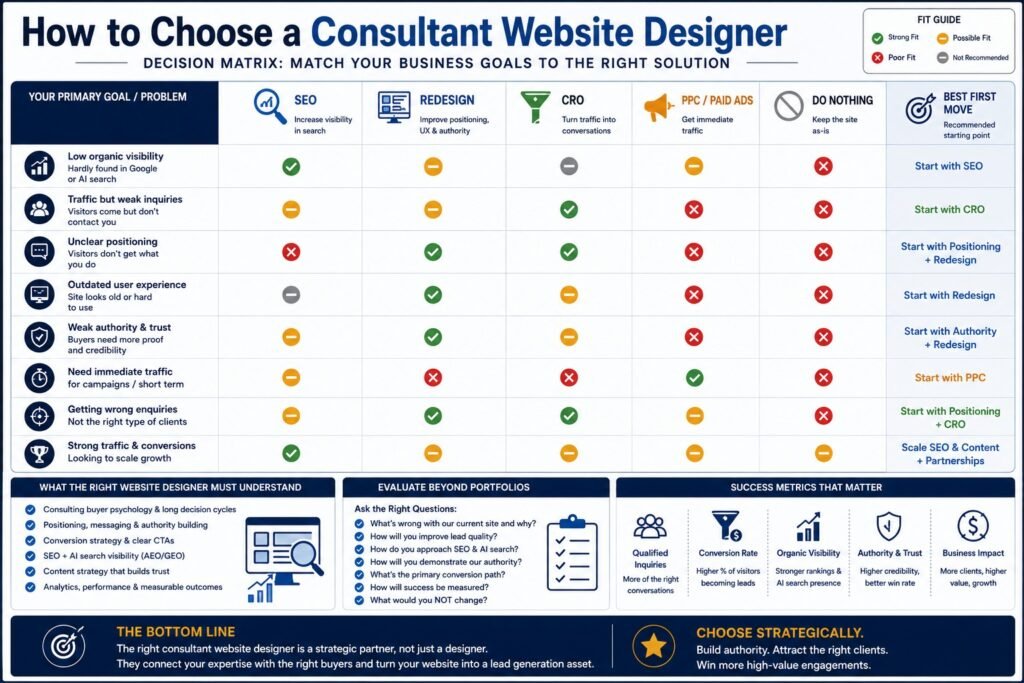
The best choice depends on the problem you are actually trying to solve.
| Problem | SEO | Redesign | CRO | PPC | Do Nothing |
|---|---|---|---|---|---|
| Low organic visibility | Strong fit | Sometimes | Limited | Temporary solution | Poor fit |
| Traffic but weak inquiries | Limited | Possible | Strong fit | Poor fit | Poor fit |
| Weak positioning | Limited | Strong fit | Strong fit | Poor fit | Poor fit |
| Outdated user experience | Limited | Strong fit | Strong fit | Poor fit | Poor fit |
| Weak authority signals | Content support | Strong fit | Moderate | Poor fit | Poor fit |
| Need immediate traffic | Limited | No | No | Strong fit | No |
| Wrong lead quality | Moderate | Strong | Strong | Moderate | No |
| Strong traffic and strong conversion | Growth support | Not necessarily | Optimization | Optional | Possible |
The important point is that these services are not interchangeable.
A consultant with good organic visibility but poor conversion does not necessarily need more traffic.
A consultant with a beautiful website but weak positioning does not necessarily need another visual redesign.
And a firm with strong authority but no clear conversion pathway may need CRO rather than a complete rebuild.
What Should a Consulting Website Communicate Before a Buyer Contacts You?
A consulting website should answer five questions quickly: who you help, what problem you solve, what outcome you create, why your expertise is credible, and what the next step should be.
That evaluation becomes even more important when most of your new business comes through referrals. A referred prospect may already trust the person who recommended you, but they can still visit your website to validate your expertise, relevance, experience, and credibility before making contact. Our guide on how a professional services website validates referrals explains the complete journey from referral to website research, proof, confidence, and consultation.
This is particularly important for consulting firms because the buyer is rarely purchasing a simple commodity.
The prospect may be evaluating:
- Strategic expertise
- Industry experience
- Executive credibility
- Methodology
- Commercial understanding
- Communication ability
- Risk
- Potential return on investment
- Long-term fit
That means your website has to reduce uncertainty.
A homepage that says “We deliver transformational business solutions” does not tell an executive enough.
A stronger positioning statement might explain the type of organization served, the business problem addressed, and the outcome the consultancy is designed to create.
This is where consulting website leads are influenced by more than traffic volume. A relevant visitor still needs a reason to believe that your firm understands their particular problem.
Our detailed guide on how consulting website messaging can convert decision-makers within the first few seconds explores this positioning problem in greater depth. The underlying principle is simple: clarity reduces the amount of interpretation required from an executive buyer.
Why Does Authority Matter More Than a Visually Impressive Website?
Authority matters because consulting buyers are purchasing confidence in your judgment, not simply an attractive digital experience.
A polished website can create an initial impression, but it cannot substitute for evidence.
Strong authority signals can include:
- Specific industry experience
- Named areas of expertise
- Original points of view
- Case studies
- Client outcomes
- Executive biographies
- Research and analysis
- Speaking or media experience
- Thought leadership
- Relevant certifications or professional affiliations
- Detailed service explanations
- Consistent subject-matter expertise
This is where authority positioning becomes commercially important.
A consultant should not simply say, “We have decades of experience.”
The website should demonstrate what that experience means.
For example, a consulting firm specializing in manufacturing transformation could demonstrate its expertise through analysis of operational problems, implementation challenges, industry-specific decision frameworks, and examples of how executives evaluate those issues.
That content creates evidence.
And evidence is more persuasive than adjectives.
How Does AI Search Change What a Consultant’s Website Needs?
AI search makes it increasingly important for consulting websites to demonstrate clear, attributable and well-structured expertise.
A prospective client may now discover a consulting firm through a traditional search result, an AI-generated answer, a conversational recommendation, or a research journey that combines multiple sources.
The website therefore needs to make the firm’s expertise understandable beyond a single homepage.
Important signals include:
- Clear service relationships
- Industry specialization
- Author attribution
- Expert opinions
- Original analysis
- Detailed service pages
- Supporting articles
- Case studies
- Consistent terminology
- Strong internal linking
- Clear business entities and relationships
- Answers to specific buyer questions
This does not mean writing articles specifically for machines.
It means making the firm’s expertise easier for both people and search systems to understand.
Our guide on how clients find consultants through ChatGPT and AI search examines this changing discovery journey and why consultant websites increasingly need to function as authority resources rather than static brochures.
The commercial implication is important: if your website is invisible or difficult to interpret during the research stage, your firm may never enter the buyer’s consideration set.
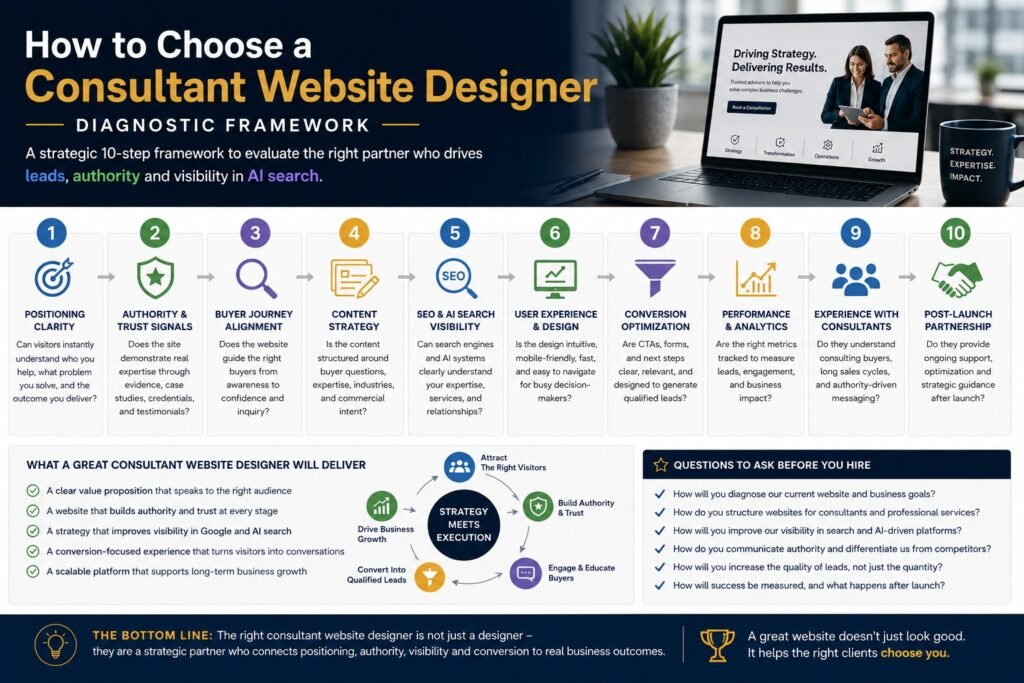
What Should I Look for in a Consultant Website Designer?
I would look for someone who can connect website decisions to business outcomes rather than someone who only presents attractive portfolio screenshots.
A strong evaluation checklist includes:
1. Do they understand consulting buyers?
Consulting buyers often have longer decision cycles and higher perceived risk than typical website visitors. Your designer should understand why a CEO, procurement team, founder, or department head would hesitate before scheduling a conversation.
2. Can they explain their conversion strategy?
They should be able to explain why the homepage has a particular structure, why a service page exists, where trust signals appear, and what action the visitor is expected to take.
3. Do they understand authority?
A consulting website should not look like a generic corporate template with different colors and a new logo.
Your expertise should shape the architecture.
4. Do they understand search?
The designer should understand how content structure, internal linking, technical foundations, service architecture, and topical authority support organic discovery.
5. Do they understand AI search?
They should understand that AI visibility is connected to useful, authoritative content and clear information architecture rather than a collection of artificial “AI SEO” tricks.
6. Can they diagnose before proposing?
This is one of the most important questions.
If every website problem results in the same recommendation to “redesign,” you are not receiving a diagnosis.
You are receiving a sales pitch.
Consulting Websites Need to Sell Confidence Before Expertise
Kanika Gupta · Founder, KG Web Designer · AI Search & Conversion-Focused Website Strategist
“Clients rarely choose a consultant simply because they have years of experience. They choose the consultant who makes them feel confident about the decision. Your website needs to demonstrate that you understand their challenges, have relevant proof, and offer a credible path toward the outcome they want. Build confidence first, and expertise becomes far easier to sell.”
What Does a Strong Professional Services Website Need to Do?
A strong professional services website should act as a qualification and trust-building system, not simply an online company profile.
The site should help the right buyer recognize relevance while allowing poor-fit visitors to self-select out.
That means your website architecture might include:
- Homepage positioning
- Industry pages
- Service pages
- Problem-focused content
- Case studies
- Expert profiles
- Thought leadership
- FAQs
- Process information
- Clear conversion paths
Each section should answer another question in the buyer’s mind.
For example:
Homepage: Are these people relevant to us?
Industry page: Do they understand businesses like ours?
Service page: Can they solve our specific problem?
Case study: Have they handled something similar?
Expert profile: Who would actually advise us?
Thought leadership: Do they understand the issue deeply?
Contact or discovery page: What happens if we talk?
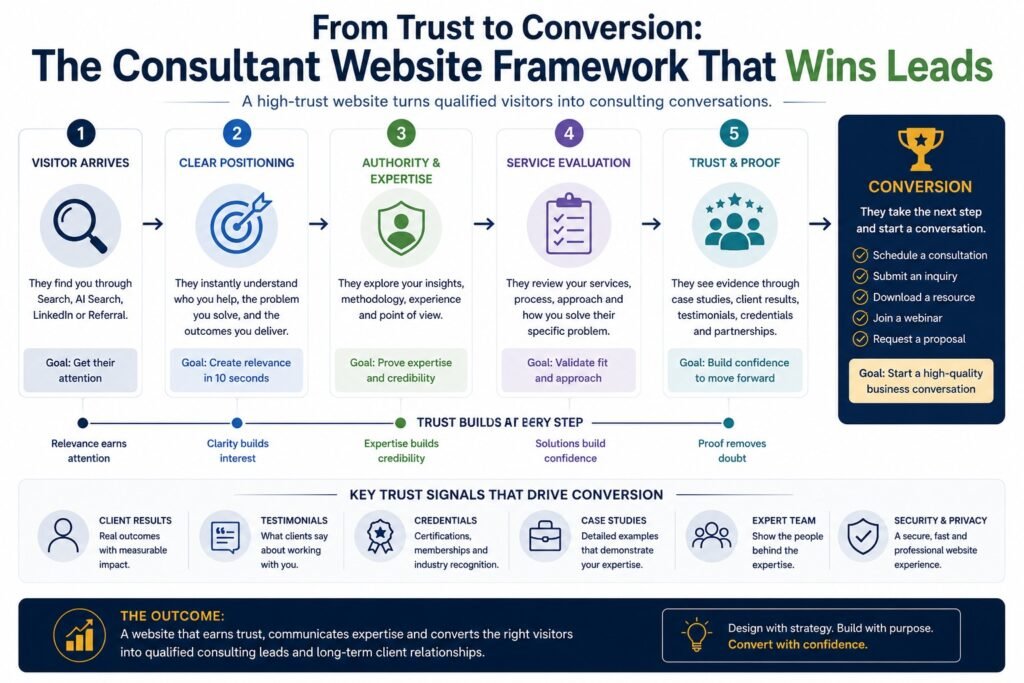
This structure supports consultant website conversion because the website progressively reduces uncertainty instead of asking for trust immediately.
Why Does Website Content Matter for High-Value Consulting Leads?
Content matters because many consulting buyers research extensively before initiating contact.
The content should therefore demonstrate how you think, not simply repeat your service descriptions.
A useful content strategy can cover:
- Industry problems
- Executive questions
- Common mistakes
- Strategic decisions
- Implementation risks
- Regulatory or market changes
- Buyer comparisons
- Cost considerations
- Technology implications
- Practical frameworks
- Original observations
A consultant who publishes generic articles such as “Five Benefits of Business Consulting” does little to demonstrate distinctive expertise.
A consultant who explains how a specific type of executive should evaluate a difficult business decision provides much stronger evidence of expertise.
Our guide on website content strategy for corporate firms and attracting high-value clients goes deeper into how content can support authority, buyer education, and commercial positioning.
This is also why content should not be treated as an isolated SEO activity.
It should connect to the services you sell and the questions your ideal clients ask before they hire you.
What Should I Fix First If My Website Gets Traffic but No Enquiries?
Fix the conversion bottleneck before investing heavily in additional traffic.
A practical sequence is:
First: Diagnose the visitor.
Determine which pages attract qualified visitors and where those visitors leave.
Second: Fix positioning.
Make your audience, problem, expertise, and outcome immediately clear.
Third: Strengthen trust.
Bring relevant evidence closer to the decision point.
Fourth: Improve the conversion path.
Give qualified visitors one clear next step.
Fifth: Build supporting authority.
Create content that answers the questions buyers ask before contacting you.
Sixth: Expand acquisition.
Only after the foundation works should you scale SEO, content distribution, partnerships, or paid acquisition.
This sequence prevents a common mistake: spending more money to send more visitors into the same broken conversion journey.
If you want to understand the relationship between traffic, intent, trust and inquiries, our AI Overview traffic and citation framework provides a useful framework for diagnosing why visibility does not automatically become business.
What Does KG Web Designer Look at During a Website Diagnosis?
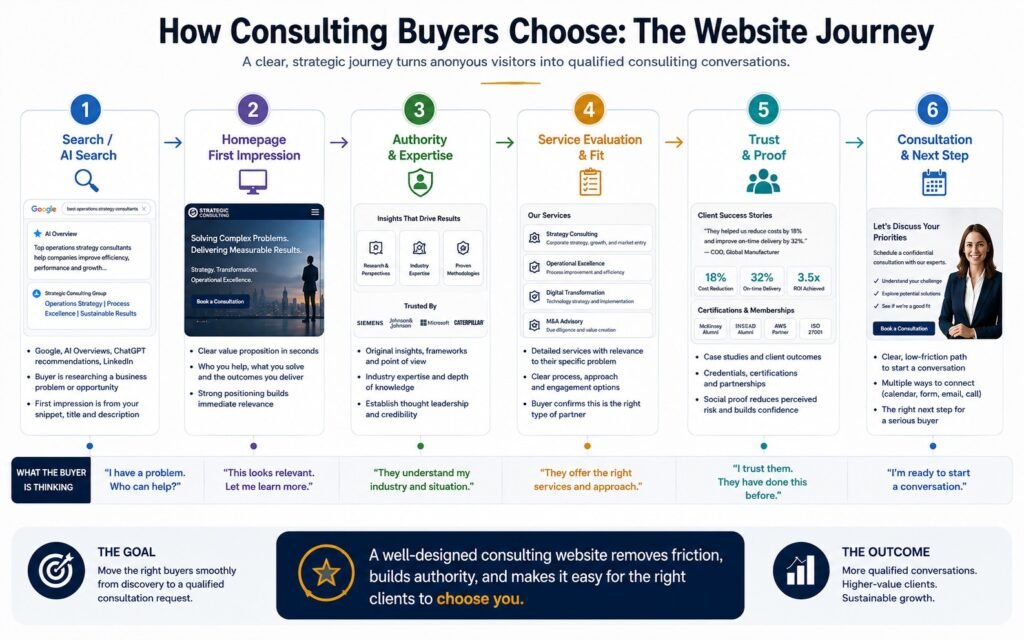
At KG Web Designer, we look at the website as part of the entire buyer journey rather than judging it only as a design artifact.
The questions we ask include:
- Where does the buyer first encounter the firm?
- What does the buyer understand within the first few seconds?
- What evidence supports the firm’s claims?
- Which services are commercially important?
- Which pages attract qualified visitors?
- What questions remain unanswered?
- Where does the buyer encounter friction?
- Is the website attracting the intended geography?
- Does the content demonstrate genuine expertise?
- Can search systems understand the site’s topical relationships?
- Does the CTA match the buyer’s stage?
- Does the website help sales conversations start at a higher level?
This approach is particularly useful for firms that already have expertise and visibility but are not getting enough of the right conversations.
What Are Three Consulting Website Mistakes I See Repeatedly?
Three problems appear repeatedly: vague positioning, expertise without evidence, and content without a commercial pathway.
1. Vague positioning
“We help businesses achieve sustainable growth” could describe thousands of firms.
The buyer still has to figure out whether you are relevant.
2. Expertise without evidence
A website can contain impressive credentials but still leave the visitor asking, “What have they actually done for organizations like mine?”
Credentials need context.
3. Content without commercial architecture
A consulting firm may publish dozens of articles while failing to connect those articles to services, expertise, case studies, and clear next steps.
Traffic without commercial relevance is not the same as demand generation.
Authority Matters More Than Looking Like a Bigger Firm
Kanika Gupta · Founder, KG Web Designer
“A consulting website does not need to make your firm appear larger than it is. It needs to make your expertise unmistakable. When decision-makers quickly understand your specialization, approach, experience, and results, the conversation starts from a position of credibility rather than uncertainty.”
Expert Insight from Kanika Gupta
Kanika Gupta, Founder, KG Web Designer
“When I review a consulting website, I am not asking whether it looks expensive. I am asking whether an executive buyer can understand the firm’s relevance, expertise and credibility without having to work for the answer. If the buyer has to decode the website, compare several services, or search for evidence before understanding why the firm is different, the website is creating unnecessary friction.”
That distinction is important.
A website can be professionally designed and still commercially weak.
The strongest consulting websites make expertise easier to understand, easier to verify, and easier to act on.
Example Scenario
Imagine a boutique strategy consultancy serving mid-market manufacturers in the United States.
The firm has experienced consultants, several successful engagements, and strong referrals. Its website, however, opens with a broad statement about “driving transformation through innovative strategy.”
The services page lists strategy, transformation, leadership, operations, and advisory services.
There are no clear industry-specific case studies near the top of the site.
A potential manufacturing executive visits after searching for help with operational expansion.
The firm may have exactly the right expertise.
But the website does not make that relevance obvious.
A stronger version would immediately identify manufacturing as a core market, explain the business problems addressed, show relevant evidence, and guide the visitor toward a focused consultation.
The expertise has not changed.
The presentation of the expertise has.
Example From Our Experience
One recurring pattern we see during consulting website reviews is a mismatch between the quality of the business and the quality of its digital positioning.
A consultancy may have strong experience, respected professionals, and meaningful client work, yet the website can still look generic because its messaging focuses on broad claims rather than specific buyer problems.
Our approach is to diagnose that gap before recommending a redesign.
We look at positioning, page hierarchy, service architecture, authority signals, content, search visibility, and conversion paths together.
The objective is not to make the company appear larger.
It is to make its actual expertise easier for the right buyers to recognize.
Why Do Most Consulting Firms Get Website Strategy Wrong?
Most firms get it wrong because they treat the website as a marketing brochure instead of a decision-support system.
They often start with:
“What should the website look like?”
The better question is:
“What does our ideal buyer need to understand before they will trust us enough to start a conversation?”
That change in perspective affects everything.
It affects the homepage.
It affects the service pages.
It affects content.
It affects case studies.
It affects calls to action.
It affects SEO.
It affects AI-search visibility.
It also changes how the website is evaluated internally. Instead of asking whether partners like the design, the firm can ask whether the website makes the buying decision easier.
What Does This Mean for Your Business?
It means your website should be treated as part of your business development infrastructure.
If the firm already has expertise, the opportunity may not be to create more expertise. It may be to communicate the expertise more effectively.
If traffic is strong, the opportunity may be conversion.
If traffic is weak, the opportunity may be search visibility.
If the website is visually outdated, the opportunity may be redesign.
If the website looks modern but feels generic, the opportunity may be positioning.
If AI systems and search engines struggle to understand the firm, the opportunity may be information architecture and authority-building content.
The right diagnosis prevents unnecessary spending.
It also creates a more logical path from website investment to business outcome.
Great Consulting Content Should Answer the Next Buyer Question
“Ranking is only part of the job. A high-performing consulting website should progressively remove uncertainty as potential clients explore it. Service pages establish relevance, articles demonstrate thinking, case studies provide proof, and FAQs resolve hesitation.”
The goal is not simply more traffic — it is to become the resource buyers trust before they are ready to speak with you.Author Insight
Kanika Gupta, Founder, KG Web Designer
My strongest recommendation for consulting firms is to stop evaluating websites primarily as visual assets.
Your website should make your expertise easier to understand and your business easier to trust.
If a buyer already has ten consulting firms to compare, another attractive website is not necessarily your competitive advantage.
Clear positioning, credible evidence, useful expertise, strong authority signals, and a well-designed decision path are much harder to substitute.
That is what I would prioritize before approving a redesign.
When Should You Hire a Consultant Website Designer?
You should consider professional help when the website has become an obstacle to how your firm is positioned, discovered, trusted, or contacted.
The strongest reason to hire a specialist is not simply that the website looks old.
It is that the website no longer reflects the quality, specialization, market position, or commercial ambitions of the consultancy.
This is especially relevant when:
- Your firm has moved upmarket.
- Your positioning has changed.
- You are entering new international markets.
- Your services have expanded.
- The website attracts poor-fit inquiries.
- Organic traffic does not translate into conversations.
- Your competitors appear more authoritative online.
- Your content does not demonstrate your expertise.
- Your website is difficult to navigate.
- Your existing site cannot support your SEO and content strategy.
- AI-search visibility has become strategically important.
In these situations, the right consultant website designer should be able to diagnose the business problem first and then translate that diagnosis into website architecture, content, UX, SEO, authority, and conversion decisions.
How Should You Evaluate Proposals From Different Website Designers?
Do not compare proposals only by page count or visual mockups.
Compare the thinking behind the proposal.
Ask each prospective partner:
- What do you believe is wrong with our current website?
- What evidence led you to that conclusion?
- How will you improve lead quality?
- How will you communicate our differentiation?
- How will the website demonstrate authority?
- What is your approach to SEO?
- How will you structure content for modern search and AI discovery?
- What will the primary conversion path be?
- How will success be measured?
- What should we not change?
The last question is surprisingly useful.
A good specialist should be willing to say that certain things do not need changing.
That demonstrates diagnosis rather than simply selling a larger project.
Action: Audit Before You Redesign
Before approving a complete redesign, audit the current website against the buyer journey.
Look at:
- Search visibility
- Qualified traffic
- Homepage clarity
- Service-page relevance
- Authority signals
- Case-study visibility
- Content depth
- Internal linking
- Conversion paths
- CTA performance
- Mobile experience
- Analytics
- Lead quality
If the evidence shows that the website’s core structure is sound, targeted improvements may be more appropriate than a full rebuild.
If the evidence shows structural problems across positioning, UX, content, authority and conversion, a strategic redesign becomes easier to justify.
At KG Web Designer, this is the distinction I would want a prospective client to understand before investing in a major website project.
Does Your Website Make the Right Clients Want to Work With You?
Your consulting website should do more than generate enquiries. It should communicate your expertise, establish authority, answer buyer concerns, and help qualified prospects understand why you are the right choice before they book a call.
Not sure what is limiting your website’s performance?
Book a Free 30-Minute Call → Explore Consultant Website DesignFinal Thoughts
Choosing a consultant website designer should not be a portfolio comparison exercise.
The real question is whether the person you hire understands how consulting buyers discover firms, evaluate authority, assess risk, interpret expertise, and decide whether to start a conversation.
A strong website connects those stages.
It makes positioning clearer.
It makes expertise easier to verify.
It makes authority easier to understand.
It creates a stronger conversion path.
And it gives search engines and AI systems enough useful, structured information to understand what the firm actually knows and who it serves.
If your current website attracts visitors but does not generate the quality of consulting conversations you expect, the first step should be diagnosis rather than another round of cosmetic changes.
If you need a strategic review of your positioning, authority, AI-search visibility, and conversion path, consultant website design services can be evaluated around those business objectives rather than around design alone.
The goal is not simply to have a better-looking consulting website. The goal is to make the right buyer more confident about choosing your firm.
Frequently Asked Questions
Should I redesign my consulting website if it already gets traffic?
Not necessarily. If the website receives relevant traffic but produces few qualified inquiries, the first step should be a conversion and positioning audit. You may need clearer messaging, stronger authority signals, better service architecture, or a more focused CTA rather than a complete redesign. Redesign becomes appropriate when structural problems prevent those improvements from working effectively.
How can I tell whether my website has a lead-generation problem or an SEO problem?
Compare visibility, qualified traffic, engagement, and inquiries. If relevant visitors are arriving but not taking meaningful actions, conversion or trust is likely the issue. If the right audience is rarely discovering the website in the first place, search visibility and content may require attention. Looking at both sides prevents you from spending more on traffic when the real problem is conversion.
What makes a consultant website different from a normal business website?
A consulting website has to sell expertise and reduce perceived risk. Buyers need to understand your specialization, experience, point of view, evidence, and relevance to their business problem. Unlike a transactional website, the conversion may be a discovery call rather than an immediate purchase, so authority and trust have a much larger role in the buying journey.
How important is AI search for consultants in 2026?
AI search is increasingly relevant because potential clients can use conversational tools during research before visiting a firm’s website. Consultants should therefore make their expertise clear through authoritative pages, original analysis, structured content, expert attribution, relevant service relationships, and useful answers to buyer questions. AI visibility should complement, not replace, strong conventional SEO and user-focused content.
What should I ask a website designer before hiring them?
Ask what they believe is wrong with your current website, how they reached that diagnosis, how they will improve lead quality, how they approach authority and search visibility, and how success will be measured. Also ask what they would leave unchanged. A thoughtful answer demonstrates strategic understanding; a proposal focused only on visual improvements may indicate a design-first rather than business-first approach.
How much should I spend on a consulting website?
The appropriate investment depends on the firm’s positioning, number of services and industries, content requirements, integrations, SEO needs, authority strategy, and conversion complexity. A simple brochure-style site and an authority-driven consulting platform have very different requirements. The important question is not simply the project price, but whether the website supports the commercial value of the clients you are trying to win.
Can a website really improve the quality of consulting leads?
Yes, when the website is designed to qualify as well as attract prospects. Clear positioning can discourage poor-fit visitors while making relevant buyers recognize themselves quickly. Strong service pages, evidence, case studies, authority content, and a clear consultation path can also reduce uncertainty before the first sales conversation.