Quick Answer
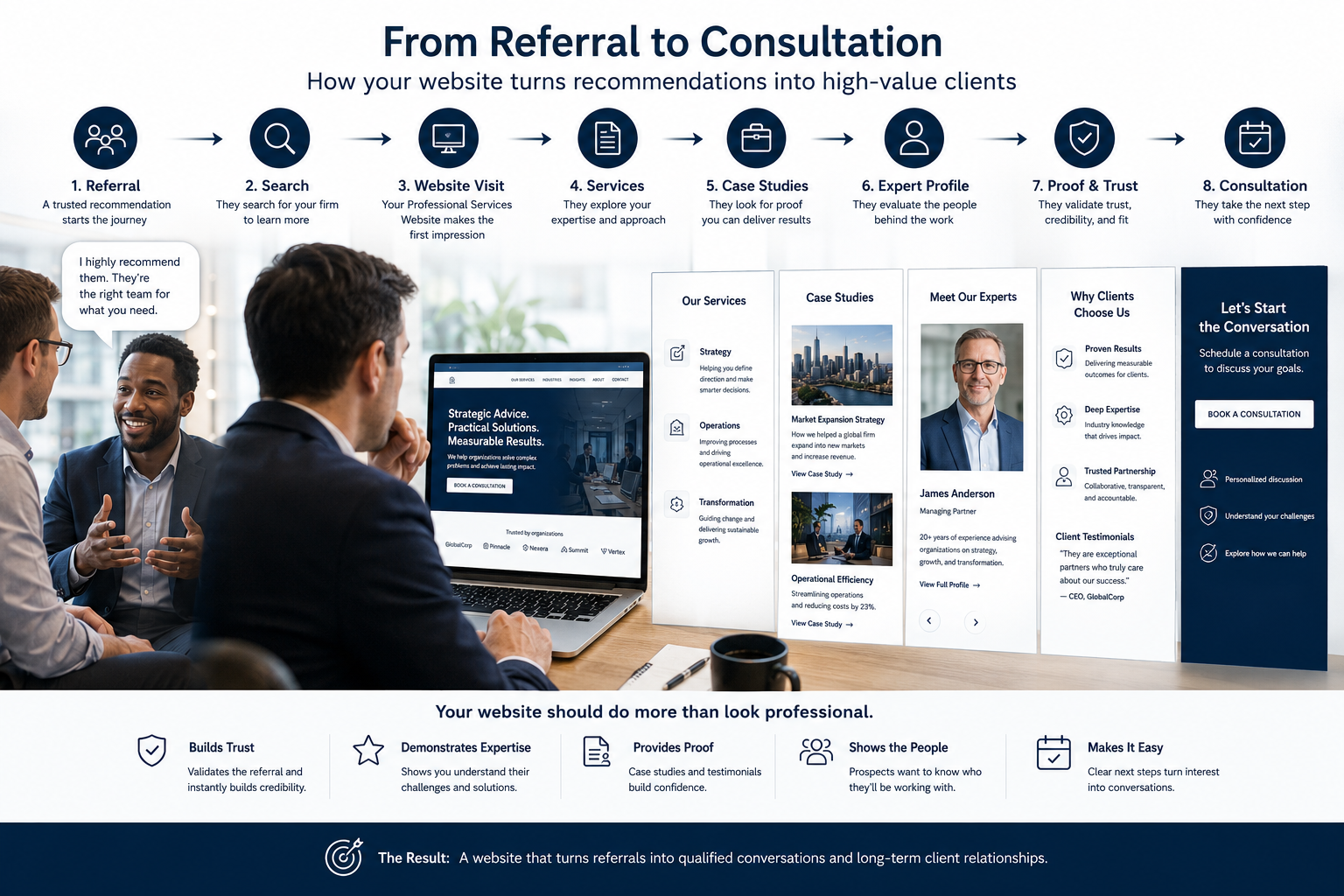
Yes. A referral may introduce your firm, but your Professional Services Website often determines whether the prospect keeps considering you. Hinge research found that 51.9% of buyers had ruled out a referred professional-services firm before speaking with it, while 80.8% said they looked at a firm’s website when evaluating providers. Your website should validate the referral, demonstrate expertise, provide credible proof, and make the next step easy.
TL;DR: What Referral-Driven Firms Need to Know
- Referrals create valuable initial trust, but prospects still independently evaluate professional-services firms before contacting them.
- Hinge found that 51.9% of buyers surveyed had ruled out a referred firm before speaking with it, while 80.8% looked at a firm’s website during evaluation.
- A website does not need to be redesigned simply because it looks dated; positioning, proof, content architecture, usability, SEO, and conversion should be diagnosed first.
- Case studies, expert authority, specialization, relevant client evidence, and clear service explanations are more commercially useful than decorative design alone.
- A referral-driven website should reduce uncertainty between the recommendation and the first serious conversation.
- The right measurement model connects referral traffic with engagement, qualified enquiries, opportunities, and revenue rather than counting traffic alone.
What Does the Data Say About Referrals and Website Evaluation?
The data shows that referrals and websites perform different jobs in the same buying journey.
A referral gives a prospective client a reason to investigate your firm. Your website gives that prospect the information needed to decide whether the recommendation deserves further attention.
Hinge’s referral research found that 51.9% of respondents had ruled out a referred firm before ever speaking with it. Among the reasons were an unimpressive website, poor-quality content, and the firm not appearing when the buyer searched online. The same research reported that 80.8% of buyers looked at a firm’s website when evaluating professional-services providers.
That is a significant finding for firms that believe referrals make website investment unnecessary.
The referral has already created an opportunity. The website can either protect that opportunity or quietly weaken it.
| Buyer behavior | What the referral provides | What the website must provide |
|---|---|---|
| Discovery | A trusted introduction | Immediate relevance |
| Initial confidence | Recommendation from someone known | Professional credibility |
| Research | Firm name and context | Services, expertise, specialization |
| Comparison | A reason to consider the firm | Differentiation and proof |
| Risk evaluation | Transferred trust | Evidence and transparency |
| Decision | Permission to investigate | Clear next step |
Standalone fact: A referral can create a qualified opportunity, but a weak online presence can cause the prospect to eliminate the firm before a sales conversation begins.
This is why the right question is not, “Do we need a website if referrals already work?”
The better question is:
“Is our website helping the referrals we already earned turn into conversations?”
Why Does a Referral-Based Business Still Need a Strong Website?
A strong Professional Services Website should answer the questions a referrer cannot fully answer for you.
A client might tell a colleague, “We worked with them and I highly recommend them.” That is valuable social proof. But the prospect still needs to understand what your firm specializes in, whether you solve problems like theirs, who they would actually work with, and what evidence supports your claims.
That research behavior is becoming even more important as B2B buying becomes more self-directed. Gartner reported in March 2026 that 67% of surveyed B2B buyers preferred a rep-free buying experience, while 45% said they had used AI during a recent purchase.
This does not mean buyers no longer want human interaction.
It means they increasingly want to arrive at that interaction with more of their questions already answered.
For a professional-services firm, the website therefore needs to carry part of the early sales conversation.
It should explain:
- Who the firm is best suited to help
- Which problems it solves
- Which industries or situations it understands
- What its approach looks like
- What evidence supports its expertise
- What outcomes clients have achieved
- Who is behind the work
- What happens after a prospect makes contact
A website that answers these questions well can make the referral more valuable without changing the firm’s referral strategy.
Financial advisory firms experience this referral-validation process particularly strongly because a referred prospect may still research the advisor’s credentials, professional background, services, disclosures, investment approach, and experience before deciding whether to make contact. Our guide to financial advisor website trust signals examines the specific information these prospects may look for before discussing their finances with an advisor.
What Happens After Someone Receives a Referral?
The real referral journey usually continues long after the recommendation is made.
Consider the sequence from the prospect’s perspective:
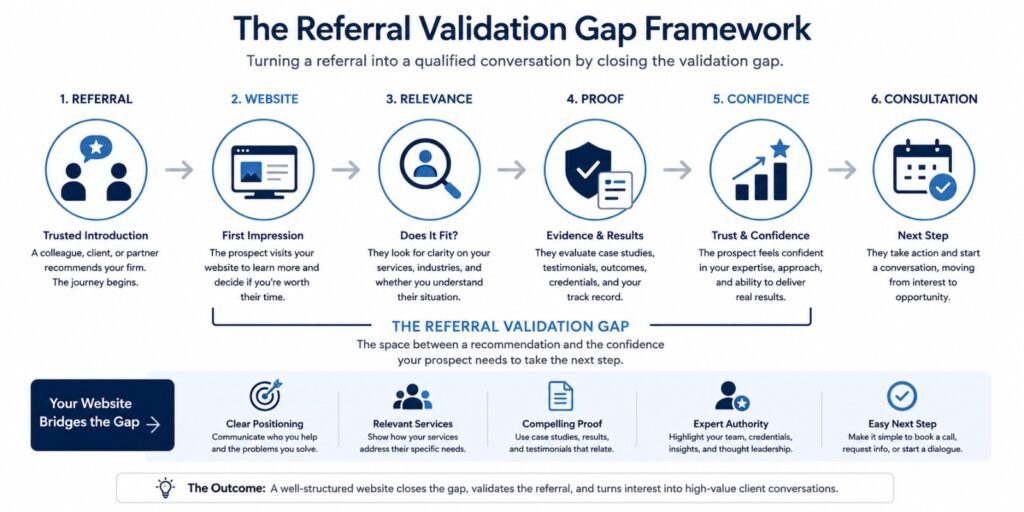
Colleague recommendation → Google search → Website → Service page → Expert profile → Case study → Proof → Contact
The prospect may never tell you that this happened.
They may simply arrive at your website, spend three minutes investigating, compare two alternatives, and make a decision.
This is why professional-services firms should think about a Referral Validation Gap.
The Referral Validation Gap
The Referral Validation Gap is the difference between the confidence created by a personal recommendation and the confidence a prospect needs after independently evaluating the firm online.
A strong website closes that gap.
A weak website widens it.
This is an important distinction because the website does not need to “generate” the referral to have commercial value. It needs to prevent qualified referrals from losing momentum.
At KG Web Designer, we frequently see firms focus heavily on how prospects arrive and very little on what those prospects need to see after they arrive.
That is backwards.
If a referral is already sending the right people, improving the evaluation stage can have more leverage than simply trying to increase traffic.
Do Referred Clients Actually Research a Firm Before Contacting It?
Yes. Referred buyers commonly perform independent research before deciding whether to make contact.
Hinge’s research found that buyers used multiple methods to evaluate professional-services providers. Website research was the most frequently cited method at 80.8%, followed by online search, asking friends or colleagues, social media, and speaking with references.
That matters because a referred prospect is not necessarily ready to call.
They may be interested.
They may be skeptical.
They may be comparing.
Or they may simply want to verify that the firm matches what the referrer told them.
A referred prospect could ask:
- Does this firm really specialize in my situation?
- Have they worked with organizations like ours?
- Are the people behind the firm credible?
- Do they understand our industry?
- Are there actual examples of their work?
- Is their thinking current?
- Does the firm appear capable of handling a high-value engagement?
- What happens if I request a conversation?
Your website should answer those questions before the prospect has to ask your team.
This is also where hidden buying-group influence matters. The 2025 Edelman-LinkedIn B2B Thought Leadership Impact Report, based on nearly 2,000 global professionals, found that less-visible “hidden buyers” actively consume and evaluate thought leadership and can influence whether less familiar providers gain consideration.
For a professional firm, that means your website may be evaluated by people who were not part of the original referral.
A referral-driven firm should also look beyond the website itself and evaluate how its broader marketing investment supports the buyer journey. Search visibility, thought leadership, website conversion, and authority content all influence what happens after a prospect receives the firm’s name. Our guide to professional services marketing strategy provides a broader framework for deciding which marketing bottleneck to address first and how to connect those investments to qualified opportunities.
What Do High-Value Clients Actually Look For?
High-value buyers look for evidence that the firm understands their problem and can be trusted to solve it.
Visual polish contributes to that impression, but it is only one component.
Professional credibility is strengthened when the website combines clear positioning, usable navigation, verifiable information, evidence of expertise, and current content. Stanford’s web credibility research identified professional presentation, usability, verifiability, and evidence of a real organization among important credibility considerations.
In our experience, the strongest professional-services sites make five things obvious:
1. Relevance
The buyer should quickly understand whether the firm works with businesses like theirs.
2. Expertise
The website should demonstrate knowledge rather than repeatedly claiming that the firm is “experienced.”
3. Proof
Case studies, outcomes, client examples, publications, frameworks, and relevant credentials give the buyer something concrete to evaluate.
4. People
Professional services are delivered by people. Strong expert profiles help buyers understand who is actually behind the work.
5. Next step
A qualified prospect should not have to hunt for the consultation or enquiry pathway.
This is the foundation of Website Design for Professional Services Firms: the website should support buyer confidence rather than simply present company information.
Is Your Website Helping — or Hurting — Your Referrals?
Referral prospects often visit your website before making contact. Let’s identify the messaging, credibility, UX, and conversion gaps that could be creating doubt before the first conversation.
Request Your Free Website Audit →How Important Are Case Studies for Professional Services?
Case studies are important because they convert abstract expertise into evidence.
A statement such as “We help companies navigate complex transformation” does not tell a buyer much.
A useful case study can show:
Client context → Business problem → Complexity → Approach → Work delivered → Outcome
The reader can then evaluate whether your experience resembles their own situation.
At KG Web Designer, one recurring problem we identify in professional-services websites is that firms have substantial experience but make that experience difficult to evaluate. A firm may have completed dozens of meaningful engagements, yet its website contains only generic testimonials and short project descriptions.
That creates an evidence gap.
What a strong case study should include
- Client or industry context, where disclosure permits
- Business problem
- Why the problem mattered
- Relevant constraints
- Strategic or technical approach
- Scope of the firm’s involvement
- Outcome or measurable change, where available
- What made the engagement successful
- Related service or expertise
- A relevant next step
If confidentiality prevents naming the client, anonymization can still work when enough useful context is provided.
“Global company” is weak.
“US-based industrial manufacturer with 2,000+ employees preparing for a post-acquisition operating model” gives the reader something to evaluate.
This is also why thought leadership should not be treated as a separate marketing activity. Edelman and LinkedIn’s 2025 research found that thought leadership can influence hidden buyers and help lesser-known providers compete for consideration.
For a professional firm, the website should connect that thinking to services and proof.
The website should provide enough commercial context for the buyer to assess whether the firm is likely to be a fit. Depending on the service model, that could mean starting pricing, a typical engagement range, a minimum engagement, defined packages, or an explanation of what affects the final investment. For a deeper look at when professional firms should publish prices and how pricing can improve lead qualification, see our guide to professional services pricing transparency.
Can an Outdated Website Actually Hurt a Referral?
Yes, but “outdated” should be defined by business performance rather than appearance alone.
A website can look old and still perform adequately.
A visually modern website can also fail commercially.
The more useful warning signs are:
- The firm’s positioning has changed.
- The services no longer reflect the most profitable work.
- Case studies are several years out of date.
- Leadership or team information is inaccurate.
- The firm has developed new expertise that is invisible online.
- The website communicates a broader market than the firm actually wants.
- Mobile navigation creates friction.
- Important pages are thin or difficult to find.
- The site does not provide sufficient evidence for high-value decisions.
- Search visibility has declined because the information architecture is weak.
- The CMS makes necessary changes difficult or risky.
- Consultation pathways are unclear.
One of the most expensive mistakes is redesigning because the website feels old without understanding why it underperforms.
The opposite mistake is equally costly: refusing to change anything because referrals are still coming in.
The correct decision requires diagnosis.
This becomes even more important when referrals cross borders. An international prospect may already have heard about your firm, but the website still has to establish market relevance, explain how the firm works with overseas clients, and reduce concerns about communication, expertise, and delivery. Our guide to international professional services website design looks specifically at how professional services firms can adapt their website strategy when they begin targeting international buyers.
What Should a Referral-Driven Firm Fix First?
The first fix should usually be positioning, followed by proof, followed by conversion friction.
This order matters because design cannot compensate for unclear business positioning.
First: Clarify positioning
Your homepage should quickly communicate:
Who you serve + what problem you solve + why your firm is credible
Avoid vague statements such as “Delivering innovative solutions for a changing world.”
A buyer should understand what the firm actually does.
Second: Strengthen proof
Make your strongest evidence easy to discover.
Prioritize case studies, outcomes, expert profiles, client evidence, credentials, research, and relevant experience.
Third: Improve service pages
A serious buyer should be able to understand the service without scheduling a call simply to learn what it includes.
Fourth: Improve conversion pathways
Use context-specific calls to action.
“Contact us” is functional.
“Discuss your transformation strategy” or “Request a consulting assessment” can communicate a more relevant next step when appropriate to the firm’s actual service.
Fifth: Fix technical friction
Review mobile experience, speed, accessibility, broken links, indexing, forms, analytics, and CMS limitations.
Sixth: Strengthen authority content
Connect insights, services, case studies, industry pages, and expert profiles through internal links and clear information architecture.
Google’s current guidance for AI features reinforces this approach. Google says there are no additional technical requirements or special optimizations required for AI Overviews or AI Mode. Foundational SEO remains important, including useful content, crawlability, internal links, textual content, page experience, and accurate structured data.
What Is the Right Way to Decide Between Optimization and Redesign?
The right choice depends on whether the problems are isolated or structural.
| Situation | Optimize existing website | Consider redesign |
|---|---|---|
| Positioning needs clearer messaging | Yes | Sometimes |
| Case studies are weak | Yes | Not necessarily |
| CTA placement is poor | Yes | Not necessarily |
| Service pages need restructuring | Yes | Sometimes |
| CMS is healthy | Yes | Not necessarily |
| Mobile UX is poor across site | Sometimes | Often |
| Information architecture is fundamentally wrong | Limited | Yes |
| Technology prevents required functionality | Limited | Yes |
| SEO equity is strong | Preserve it | Rebuild carefully |
| Brand positioning has materially changed | Sometimes | Often |
| Site cannot support new content strategy | Limited | Often |
| Conversion issues are systemic | Limited | Yes |
This is where Professional Services Website Redesign should be treated as a strategic decision rather than a visual exercise.
A redesign becomes easier to justify when several systems need to change together: positioning, information architecture, CMS, mobile UX, content model, search structure, conversion paths, and authority presentation.
If the problem is mainly weak messaging, missing proof, poor case studies, or unclear CTAs, a targeted optimization project may create more value with less disruption.
For firms unsure which direction to take, our guide on whether a consulting website should be redesigned or optimized explores that decision from a business rather than purely visual perspective.
Experience Matters When Your Reputation Is on the Line
Your professional services website needs to communicate expertise without looking generic or over-designed. I bring experience from 500+ website projects to create a digital presence that reflects your credibility and supports the way your firm wins business.
See Why Businesses Work With Kanika →How Should a Professional Services Firm Measure Referral Website Performance?
The website should be measured as part of the referral journey, not as an isolated traffic channel.
A useful measurement path is:
Referral source → Website visit → Relevant page → Proof interaction → Enquiry → Qualified opportunity → Client → Revenue
Track, where technically and legally appropriate:
- Referral sessions
- Landing pages
- Engaged sessions
- Service-page visits
- Case-study interactions
- Expert-profile visits
- Consultation requests
- Phone or email enquiries
- Lead source
- Qualified enquiry rate
- Opportunity rate
- Close rate
- Revenue influenced
This gives you a better answer than “our website received 10,000 visitors.”
Suppose a firm receives 100 qualified referrals annually.
If 80% visit the website, that gives 80 website-evaluating prospects.
If 15% become qualified opportunities, that is 12 opportunities.
If stronger positioning and proof raise that to 20%, the same referral engine now produces 16 opportunities.
That is four additional opportunities without acquiring another referral.
If the firm’s average first engagement is $25,000, the illustrative opportunity value is:
4 × $25,000 = $100,000
This is an example for understanding the business model, not an industry benchmark or prediction.
The important point is that website improvement can have economic value even when the website did not create the original lead.
What Does a Referral Validation Audit Look Like?
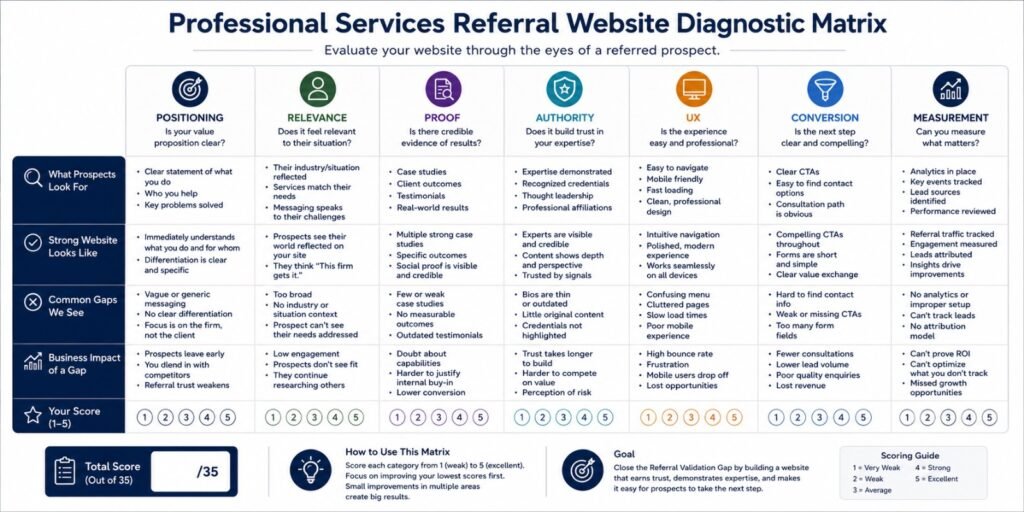
A referral validation audit should reproduce the experience of someone who has just received your firm’s name from a trusted contact.
Start with five recent referral journeys.
For each one, ask:
- What would the prospect search?
- What page would they reach?
- Is the firm’s specialization immediately obvious?
- Can they find a relevant service?
- Can they see evidence of similar work?
- Can they understand who delivers the work?
- Can they find meaningful thought leadership?
- Can they determine what makes the firm different?
- Can they understand what happens after contact?
- Is there anything that could create unnecessary doubt?
Then score each area from 1 to 5.
| Area | 1 means | 5 means |
|---|---|---|
| Positioning | Generic | Highly specific |
| Relevance | Unclear fit | Immediate fit |
| Proof | Mostly claims | Strong evidence |
| Authority | Minimal | Demonstrated expertise |
| Service clarity | Vague | Detailed and useful |
| UX | Friction-heavy | Intuitive |
| Conversion | Unclear next step | Clear next step |
| Content | Commodity | Original and useful |
| Mobile | Difficult | Easy |
| Trust | Limited | Consistent evidence |
This creates a more useful redesign brief than “our website needs to look premium.”
At KG Web Designer, we would use this type of diagnosis to determine whether the appropriate intervention is messaging, content, conversion optimization, technical improvement, restructuring, or a complete website project.
Example Scenario
Imagine a Sydney-based specialist advisory firm that generates approximately 70% of its new business through existing clients, partners, and professional referrals.
The partners believe the website is secondary because referrals are already producing work.
A CFO is referred to the firm by another executive.
The CFO receives the firm’s name and searches for it online.
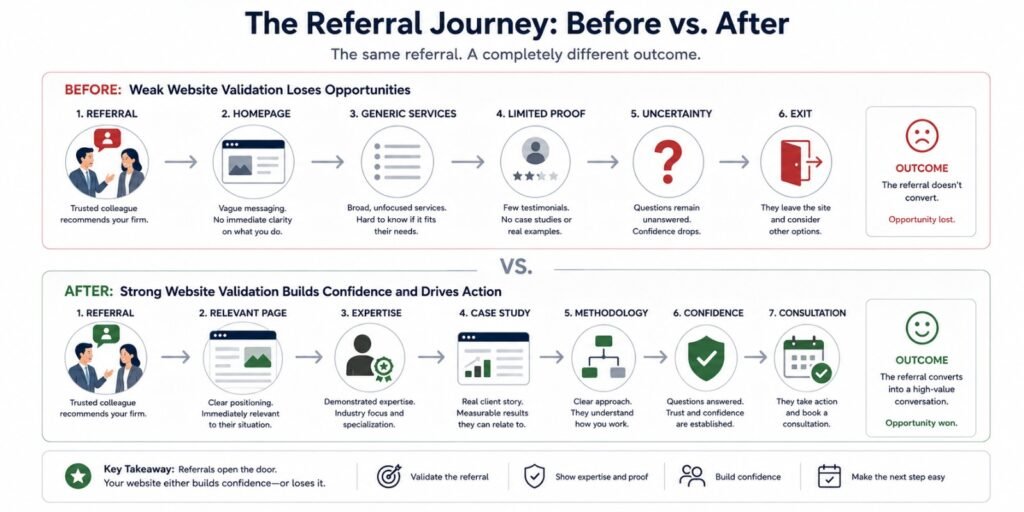
The homepage says the firm provides “strategic solutions for business growth.” The services page lists advisory, transformation, strategy, and leadership. There are testimonials, but no detailed case studies. The partner biographies are brief. The firm’s strongest industry specialization is not obvious.
The CFO does not conclude that the firm is incompetent.
Instead, the CFO becomes uncertain.
That distinction matters.
The referral created confidence.
The website failed to add enough evidence to sustain it.
Now imagine the same prospect lands on a site where the first screen clearly explains the firm’s specialization. The prospect can then explore a relevant service, read two comparable case studies, see the partner’s experience, understand the firm’s methodology, and request a conversation.
The referral did not change.
The website did.
That is the commercial opportunity referral-driven firms often overlook.
Why Most Businesses Get This Wrong
Most referral-driven firms make one of two assumptions.
The first is:
“Our clients already trust us, so our website does not need to work hard.”
The second is:
“If our website is not working, we need a completely new design.”
Both can be wrong.
A referral is not a sales contract.
It is an introduction.
The prospect still evaluates risk, relevance, expertise, fit, and credibility.
At the same time, a website redesign is not automatically the answer. If the underlying problem is unclear positioning or weak proof, changing colors, layouts, animations, and typography will not solve it.
The firms that approach this intelligently do something different.
They identify the highest-value buyer journeys.
They understand what those buyers need to verify.
They strengthen evidence.
They improve the conversion path.
Then they decide whether the current platform can support those changes.
This reduces the risk of spending heavily on a new website when a focused intervention would have been enough.
It also reduces the opposite risk: keeping an ineffective website simply because the firm still receives referrals.
Your Expertise Deserves More Than a Generic Business Website
Whether you run a consulting, advisory, accounting, legal, HR, or other professional services firm, your website should make your expertise clear, establish authority, and give serious prospects a compelling reason to contact you.
Explore Professional Services Website Design →What Does This Mean For Your Business?
It means you should evaluate your website based on how well it supports the reputation your firm has already built.
If referrals are strong, that is an asset.
Your website should make that asset more productive.
It should help a prospect move from:
“Someone recommended them.”
to:
“They clearly understand our problem.”
to:
“They have done this before.”
to:
“I understand how they work.”
to:
“I am comfortable starting a conversation.”
That is the real role of a referral-driven website.
It can also create longer-term advantages beyond referrals.
Your case studies can support sales conversations.
Your articles can demonstrate expertise.
Your service pages can answer questions before the first call.
Your expert profiles can build confidence.
Your original frameworks can differentiate the firm.
Your search visibility can introduce the firm to prospects who were not referred.
And your website can give AI-assisted discovery systems clearer information about your expertise and services.
Google’s 2026 guidance confirms that AI search still relies on foundational search practices rather than a separate technical “AI optimization” system.
Google has also introduced dedicated Search Console reporting for visibility from generative-AI features, including AI Overviews and AI Mode, making this increasingly measurable for site owners.
The website is therefore becoming a broader business asset, not simply a destination for people who already know your firm.
Example From Our Experience
At KG Web Designer, our work with professional-services and consulting websites has repeatedly shown the same underlying problem: firms often have more expertise than their websites communicate.
In our 2026 review of more than 250 consultant and boutique consulting websites, we evaluated positioning, proof, authority, conversion, and AI-readable content rather than judging sites only by visual appearance.
Problem
A recurring pattern was a firm with substantial experience but a website that relied on broad claims.
The business had credibility in the real world.
The website did not make that credibility sufficiently visible to someone encountering the firm for the first time.
Solution
The stronger approach was to connect:
Specialization → Buyer problem → Expertise → Evidence → Outcome → Next step
That meant improving positioning, strengthening case-study presentation, making expert authority more visible, clarifying service architecture, and reducing unnecessary conversion friction.
Outcome
The objective was not simply to make the website newer.
It was to make the firm’s existing expertise easier to understand, verify, and act upon.
That distinction is central to our approach at KG Web Designer.
We do not believe every professional-services firm needs a complete redesign.
We believe every firm should understand what its website is currently helping or preventing a buyer from doing.
For firms that want to understand why traffic can exist without producing enough qualified opportunities, our article on why a consulting website can have traffic but still generate no leads examines the conversion problem from another angle.
Expert Insight from Kanika Gupta
Kanika Gupta, Founder, KG Web Designer
“When a professional-services firm tells me that almost all of its business comes through referrals, I do not see that as a reason to ignore the website. I see it as a reason to make the website exceptionally good at validating those referrals. The prospect has already been given your name. The website should make it easier for them to believe the recommendation.”
My strongest judgment is simple:
Do not redesign because the website looks old. Redesign because the current website is preventing your firm from communicating the value, authority, specialization, and proof you have already earned.
If this were my website, I would take five recent referrals and walk through the exact journey those prospects experienced.
I would search the firm.
I would read the homepage.
I would inspect the most relevant service.
I would look for a comparable case study.
I would read the leadership profiles.
I would test the mobile experience.
Then I would ask one question:
“What could make a qualified prospect hesitate here?”
That question is more commercially useful than asking whether the website looks modern enough.
When Does Professional Help Make Sense?
Professional help makes sense when the website problem extends beyond copy edits or visual improvements and starts affecting positioning, authority, search visibility, user experience, conversion, or the firm’s ability to support growth.
Consider specialist help when:
- Your firm has moved upmarket.
- Your ideal client profile has changed.
- Your strongest services are difficult to find.
- Your website does not demonstrate your current expertise.
- Referral prospects regularly ask questions the website should answer.
- Case studies are weak or outdated.
- Your website generates visits but few qualified enquiries.
- Competitors communicate their specialization more clearly.
- Your current CMS limits what you need to build.
- Mobile UX is creating friction.
- Your SEO architecture needs substantial restructuring.
- You need the website to support international growth.
- You cannot confidently explain which part of the current website is responsible for lost opportunities.
That last point is particularly important.
If you do not know what is wrong, you should not immediately commission a redesign.
Diagnosis should come first.
A specialist should be able to explain what is broken, why it matters commercially, what can be fixed without rebuilding, what requires structural change, and how success will be measured.
That is the standard I would use when evaluating any agency or website partner.
If you are evaluating designers, our guide on choosing the right consultant website designer can help you assess the difference between a designer who primarily delivers pages and one who understands positioning, authority, conversion, and buyer behavior.
Not Sure What Your Professional Services Website Actually Needs?
Let’s talk about your firm, ideal clients, current website, and growth goals. You’ll leave with a clearer understanding of what should change — whether you need a full redesign or simply a smarter conversion strategy.
Book Your Free 30-Minute Strategy Call →A focused conversation about your website — not a high-pressure sales pitch.
Final Thoughts
If most of your clients come through referrals, your website is not irrelevant.
It may be one of the most important parts of the referral journey.
The referrer gives you the introduction.
The prospect then investigates.
That investigation is where positioning, expertise, proof, credibility, usability, and conversion become commercially important.
Hinge’s research provides the clearest warning: 51.9% of respondents had ruled out a referred firm before speaking with it, and 80.8% said they looked at the firm’s website when evaluating providers.
So do not begin by asking whether you need a prettier website.
Ask whether the current website makes a referred prospect more confident or less confident.
Ask whether your best work is visible.
Ask whether your specialization is obvious.
Ask whether your case studies prove anything meaningful.
Ask whether your experts are presented as experts.
Ask whether the buyer knows what to do next.
Then decide whether optimization or redesign is justified.
A strategically strong Professional Services Website Conversion system does not need to replace your referral engine. It should make every high-quality referral more likely to become a serious business conversation.
At KG Web Designer, that is how I would approach the project: diagnose the buyer journey first, identify where confidence is being lost, strengthen the evidence and experience, and only then decide whether the existing website can be improved or needs to be rebuilt.
If your firm has strong referrals but you are not confident that your website is converting those introductions into qualified conversations, request a website strategy discussion with KG Web Designer. The goal is not simply a newer website. The goal is a website that helps the reputation you have already earned work harder.
Frequently Asked Questions
Is a referral enough to close a professional-services sale?
No. A referral can significantly improve initial trust, but the prospect may still research your firm, compare alternatives, involve colleagues, and assess whether your expertise fits the problem. Hinge research found that more than half of respondents had ruled out a referred professional-services firm before speaking with it. The referral creates an opportunity; the rest of the buyer journey still has to work.
Should a professional services website show pricing?
Not necessarily. Pricing depends heavily on the service model, scope, seniority, complexity, geography, and client requirements. Instead of publishing arbitrary numbers, many firms can improve transparency by explaining engagement models, project scope, typical factors that affect investment, and what happens during an initial consultation. The goal is to reduce uncertainty without pretending every engagement has the same economics.
How often should a professional services firm update its website?
There is no universal redesign interval. Review the website whenever your positioning, services, leadership, target markets, technology, SEO performance, or buyer journey materially changes. Individual content should be updated as the underlying facts change. A five-year-old website can outperform a new one if it remains strategically relevant, technically healthy, and useful to buyers.
Can thought leadership actually influence professional-services buyers?
Yes. Thought leadership can influence people who are not directly involved in the initial sales conversation. The 2025 Edelman-LinkedIn B2B Thought Leadership Impact Report found that hidden buyers actively discover, consume, and evaluate thought leadership and can advocate for less familiar providers.
Should every professional services firm invest in SEO?
Not necessarily at the same level. SEO makes more sense when your target buyers actively research problems, services, industries, or providers online and when the firm can create genuinely useful content. Referral-driven firms can still benefit from search visibility because prospects may search the firm after receiving its name. The appropriate investment depends on buyer behavior and commercial goals.
Can I improve my website without rebuilding it?
Yes. Many firms can improve positioning, service pages, case studies, expert profiles, CTAs, navigation, mobile UX, analytics, and content without replacing the entire website. A redesign becomes more compelling when the underlying architecture, technology, UX, or information model prevents meaningful improvement. Diagnose the constraint before choosing the project type.
Does AI search make professional-services websites more important?
It makes clear and useful website information increasingly valuable, but there is no separate technical shortcut for appearing in AI search. Google says foundational SEO remains relevant to AI Overviews and AI Mode and recommends useful content, crawlability, internal links, textual content, page experience, and accurate structured data.