Quick Answer
A firm entering international markets usually needs more than a visual website refresh. Professional Services Website Design should evolve around international buyer expectations, regional search visibility, localized messaging, trust signals, time-zone accessibility, and clear conversion paths. The goal is to make an overseas prospect feel that your firm is experienced, accessible, credible, and operationally prepared to serve clients in their market.
TL;DR: What Changes When a Professional Services Firm Goes International?
- International expansion requires the website to communicate geographic relevance, not simply add country names to existing pages.
- Localized content, regional SEO signals, relevant proof, and transparent service information reduce uncertainty for overseas prospects.
- Google recommends explicit regional and language signals such as locale-specific URLs and
hreflangwhen genuinely different regional or language versions exist. - Gartner reported in 2026 that 67% of B2B buyers preferred a completely digital, self-service buying experience, while 69% preferred validating AI-generated insights with sales representatives.
- International websites should connect search, authority, self-service research, consultation, and sales follow-up into one journey.
| Website Area | Domestic-Focused Firm | International Growth Firm |
|---|---|---|
| Positioning | Explains services | Explains expertise, markets, and international relevance |
| SEO | Primarily domestic search intent | Regional and international search architecture |
| Trust | Local testimonials and credentials | Relevant client proof, expertise, markets served, certifications |
| Content | General service information | Market-specific problems, regulations, industries, outcomes |
| Contact | One generic enquiry path | Time-zone-aware consultation and enquiry options |
| Pricing | One market assumption | Clear commercial context and currency considerations |
| Navigation | Services-first | Services + industries + markets + proof |
| Conversion | “Contact Us” | Consultation, project enquiry, qualification and next-step clarity |
| Localization | Minimal | Language, currency, terminology, regional expectations where justified |
Why does Professional Services Website Design need to change when a firm enters international markets?
Yes, because international growth changes the questions a prospective client asks before making contact. A domestic buyer may already understand your market, location, terminology, and reputation, while an overseas buyer has to evaluate whether your firm can actually operate effectively across borders.
The financial issue is bigger than SEO. If a prospective client from New York, London, or Sydney lands on a website that feels geographically irrelevant, the firm can lose an opportunity before a salesperson ever knows the prospect existed.
International buyers also face additional perceived risk. They may wonder whether your team understands their market, whether meetings can happen during workable hours, whether contracts and communication will be straightforward, whether data will be handled appropriately, and whether you have successfully worked with businesses outside your home market.
This is where professional services website for international clients becomes a strategic issue rather than a cosmetic one. The website has to communicate international readiness through structure, content, proof, usability, and commercial clarity.
The broader market supports this shift. OECD describes services as accounting for more than two-thirds of global GDP and highlights the growing importance of digitally enabled cross-border services. At the same time, its 2026 Digital Services Trade Restrictiveness Index identifies local-presence requirements, data-localization requirements, and differing national payment-security standards among recurring barriers to digitally delivered services.
That means an international website cannot simply say, “We serve clients worldwide.” It needs to demonstrate what that actually means.
What should an international professional services website prove before a buyer makes contact?
The website should answer the buyer’s risk questions before asking for a consultation. A strong international site should make it easy to understand who the firm serves, where it operates, what expertise it brings, what evidence supports its claims, and what happens after an enquiry.
For an international B2B buyer, the website should establish at least seven forms of confidence:
- Relevant expertise: Does the firm understand the buyer’s industry or business problem?
- Geographic relevance: Has the firm worked with clients in comparable markets?
- Commercial clarity: Is the scope of services understandable?
- Proof: Are there case studies, credentials, client examples, or measurable outcomes?
- Operational confidence: Can the firm communicate and collaborate across borders?
- Information security: Are privacy, data handling, and relevant compliance expectations addressed?
- Conversion clarity: Does the buyer know exactly what happens after submitting an enquiry?
This matters because B2B buyers increasingly conduct substantial research without immediately involving a salesperson. Gartner’s 2026 research found that buyers use an average of seven information sources during a recent purchase, with 45% using generative AI primarily to research vendors and products.
The implication is important: your website is competing not only against other websites but against every other information source a buyer can access while evaluating your firm.
At KG Web Designer, we have found that international positioning becomes much stronger when proof is integrated into the buyer journey rather than isolated on a single “Testimonials” page.
A prospect should encounter evidence while evaluating the service, the industry expertise, the team, and the next step.
What international buyers need to see
- Markets or regions served
- Industry-specific expertise
- Relevant case studies
- Recognizable client categories where disclosure permits
- Practitioner or leadership expertise
- Certifications and memberships where relevant
- Clear service scope
- Consultation process
- Time-zone flexibility
- Privacy and security information
- Appropriate regional terminology
- Clear contact information
One of the biggest mistakes is assuming that adding a “Global Clients” statement creates international credibility. It does not. The rest of the website has to support the claim.
Should international firms create separate country pages?
Yes, when there is a genuine reason for regional differentiation. No, when country pages simply replace one city name with another while leaving the content, value proposition, proof, and commercial information essentially unchanged.
Google explicitly distinguishes between multilingual and multi-regional websites and recommends explicit regional signals when a website genuinely targets different countries or regions. These can include locale-specific URLs and hreflang annotations. Google also notes that local addresses, phone numbers, language, currency, local links, and Business Profile signals can contribute to understanding the intended audience.
For a professional services firm, regional pages should therefore have a business reason to exist.
A useful US page might address US-specific terminology, industries served, relevant case evidence, consultation expectations, and commercial considerations. A UK page may require different terminology, regulatory references, proof, and buyer expectations.
Creating /usa/, /uk/, and /australia/ pages with nearly identical text is not a localization strategy. It is duplication with country labels.
The stronger model is to create regional pages only where the firm can provide genuinely useful information.
A useful country-page framework
- Who the firm serves in that market
- Relevant industries
- Services most commonly purchased
- Market-specific problems
- Relevant expertise
- Appropriate case studies
- Regional terminology
- Consultation process
- Time-zone information
- Legal or regulatory considerations where relevant
- Contact pathway
Google also warns against relying on IP-based adaptation to determine which regional version a crawler or user should see. Explicit URLs and clear navigation are generally more reliable approaches.
That makes international architecture an SEO decision and a UX decision at the same time.
How should international SEO differ from domestic SEO?
International SEO requires more deliberate geographic and linguistic architecture than simply adding international keywords to existing pages. The fundamental principle remains the same: build pages that satisfy real search intent but make the intended market clear where regional differentiation is meaningful.
Google recommends locale-specific URLs and hreflang for appropriate multilingual or multi-regional configurations. Each alternate version should reference itself and the other relevant versions, and Google recommends fully qualified URLs for these alternate relationships.
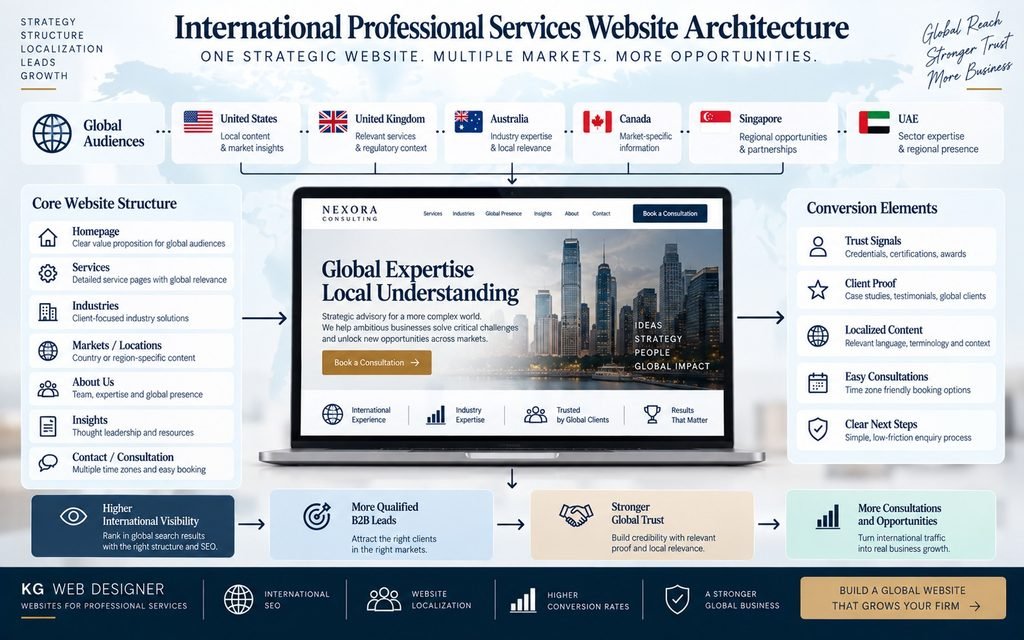
For a professional services firm, the architecture might look like:
/services//industries//locations//usa//uk//australia//case-studies//insights/
The exact structure depends on the firm’s business model. A consulting company with one global English website may not need separate country versions at all if its services, legal setup, terminology, and buyer journey are genuinely consistent.
That is an important distinction. International SEO is not about creating more URLs. It is about creating the right URLs for the markets the firm actually wants to win.
Search visibility also needs to connect with conversion. A page ranking in Australia but presenting irrelevant contact information, unfamiliar terminology, or no evidence of international work can generate impressions without generating qualified opportunities.
At KG Web Designer, this is why we approach SEO architecture together with conversion architecture. Search traffic is only commercially useful when the landing experience supports the intent that generated it.

Your Website Needs to Build Trust Before the First International Conversation
When a professional services firm enters new markets, the website has to do more than explain what you offer. It needs to make your expertise relevant, credible and easy to engage with for prospects who may be thousands of miles away.
What should a professional services website say differently for international buyers?
International messaging should make geographic relevance and commercial value easier to understand. The strongest international positioning usually goes beyond “We provide professional services” and explains who the firm helps, where it operates, what problems it solves, and why its expertise is credible.
This is especially important for firms selling expertise rather than physical products.
A prospective client may not know your firm, your local reputation, or your professional network. Your website therefore has to carry more of the credibility burden.
A useful messaging structure is:
Who we help → Where we operate → What problem we solve → Why we are credible → What happens next
For example, instead of:
“We provide strategic business consulting solutions.”
A stronger positioning direction could be:
“We advise growth-stage technology companies entering North American and European markets, combining market strategy, operational planning, and executive advisory support.”
The second statement gives an international buyer more information with fewer words.
The site should communicate:
- International relevance
- Industry expertise
- Commercial outcomes
- Evidence
- Accessibility
- A clear next step
Gartner’s research reinforces the need for buyer enablement. Its 2024 research found that B2B buying journeys consist of recurring buying tasks, and buyers need consistent and complementary information across digital channels and sales interactions to complete those tasks confidently.
The website should therefore help buyers make progress, not merely provide information.
How should the website handle international consultations, time zones, currencies, and communication?
Yes, operational details can materially affect conversion because they remove uncertainty before a prospect commits to a conversation. International prospects should not have to guess whether your firm can accommodate their working hours or whether an enquiry will disappear into a generic contact form.
A strong international consultation journey can include:
- “Book a strategy call” rather than a generic “Contact Us”
- Time-zone-aware scheduling
- Meeting platform information
- Expected response time
- Contact email
- Appropriate phone or messaging options
- Consultation duration
- What information the buyer should prepare
- What happens after the initial call
For firms selling consulting, legal, accounting, advisory, technology, marketing, or other professional services, the consultation is often the first real product experience.
If the booking experience is confusing, the buyer can reasonably question what the actual client experience will be like.
International payment and commercial information also deserve consideration. Not every firm needs to display multiple currencies, but firms that quote international clients should make their commercial process understandable.
The OECD’s 2026 Digital STRI data shows that international digital services operate across different regulatory environments, with 78 countries having restrictions involving local presence and 46 having certain data-localization requirements in the 2025 dataset.
The website does not need to become a legal manual. It does need to avoid making unsupported claims about worldwide availability, compliance, data handling, or local operations.
That distinction protects both conversion and credibility.
If this were my website, I would make the consultation journey one of the clearest parts of the site. I would tell an overseas buyer exactly what happens after clicking the CTA, how long the call is, which time zones are supported, what the conversation covers, and what information they will receive afterward.
For an international buyer, clarity feels like operational maturity.
Why is website localization more than translation?
Website Localization should adapt the buying experience to the market rather than simply translating words. Translation changes language. Localization changes how information is presented so that it makes sense to the intended audience.
CSA Research’s research across 8,709 consumers in 29 locales found that consumers prefer accessing information, purchasing online, and receiving technical support in their own language.
For professional services, localization can involve:
- Terminology
- Currency
- Date formats
- Contact conventions
- Legal language
- Industry references
- Professional titles
- Case studies
- Client expectations
- Calls to action
- Consultation processes
A US prospect may respond naturally to “schedule a consultation,” while another market may expect “book an initial consultation” or “request an advisory discussion.” The difference is not merely linguistic. It can influence perceived familiarity and professionalism.
However, localization should not become a reason to create dozens of thin regional pages.
The right question is not, “How many country pages can we create?”
The right question is, “Where does the buyer experience materially change?”
That principle keeps the international website useful, maintainable, and credible.
A poorly localized website can actually increase risk perception. A prospect may notice inconsistent terminology, incorrect currency, irrelevant testimonials, or claims that suggest the firm does not understand the market.
A well-localized website feels intentional.
What content should support international B2B lead generation?
International B2B Lead Generation improves when content helps prospects evaluate expertise before they speak with sales. International buyers often need more evidence because they cannot rely on local reputation, referrals, or physical proximity in the same way.
The content architecture should therefore include several layers.
1. Service content
Explain exactly what the firm delivers, who it is for, and what business problem it solves.
2. Industry content
Demonstrate that the firm understands the buyer’s environment rather than selling the same generic service to everyone.
3. Geographic content
Use only where market-specific expertise or relevance exists.
4. Case studies
Show the starting problem, approach, implementation, and business outcome.
5. Expert content
Demonstrate how the firm’s leaders think about important problems.
6. Comparison content
Help prospects understand options, risks, and strategic decisions.
7. Buyer-enablement content
Answer questions that would otherwise require a salesperson.
This approach aligns with current B2B buying behavior. McKinsey’s 2024 B2B Pulse research found that B2B buyers use an average of ten interaction channels during their buying journeys, with the company website among the most frequently used touchpoints. More than half of respondents wanted a genuinely omnichannel experience.
Gartner’s 2026 research adds another layer: buyers are increasingly using AI during vendor research, but still turn to salespeople when they need validation and decision support.
That means the website should not attempt to replace the sales team.
It should make the sales conversation better.
A prospect who arrives at a consultation already understanding your specialization, methodology, relevant experience, and likely fit is a much more qualified conversation than someone who simply saw a generic services page.
Is Your Website Ready to Support International Growth?
Before entering new markets, your website should be able to answer the questions international prospects are likely to have before they trust, shortlist or contact your firm.
Where should international trust signals appear?
Trust signals should appear throughout the buyer journey rather than being confined to a single testimonials page. An international prospect needs reassurance at several moments: when discovering the firm, evaluating services, checking expertise, reviewing proof, and deciding whether to make contact.
Useful trust signals include:
- Relevant client examples
- Case studies
- Leadership profiles
- Professional credentials
- Industry memberships
- Awards where genuinely relevant
- Certifications
- Media mentions
- Published insights
- Clear company information
- Secure and professional contact infrastructure
- Privacy information
- Geographic experience
- Transparent process
The order matters.
If a service page makes a major expertise claim, the supporting proof should be close to that claim. If a case study demonstrates a particular outcome, the relevant service page should be able to reach it easily.
This creates a connected authority system.
One useful supporting resource is KG Web Designer’s guide on How to choose a consultant website designer who understands leads, authority, and AI search. It explains why professional buyers need more than visual polish when evaluating a website partner.
The same principle applies to firms selling professional services internationally: credibility should be demonstrated, not announced.
What should firms avoid when redesigning for international growth?
Avoiding the wrong changes can be as valuable as adding new functionality. The most expensive mistake is treating international expansion as a branding exercise while leaving the underlying information architecture and conversion journey unchanged.
Avoid these common approaches:
- Creating country pages with copied content.
- Adding flags without meaningful localization.
- Claiming worldwide service without explaining actual coverage.
- Using one generic contact form for every market.
- Hiding the firm’s relevant international experience.
- Publishing a long list of countries without supporting proof.
- Assuming English automatically means globally relevant.
- Using machine translation without editorial review.
- Changing URLs without an SEO migration plan.
- Measuring success only through traffic.
The tenth mistake is particularly important.
A firm can increase international organic traffic and still fail commercially if the visitors are poorly matched, the service proposition is unclear, or the website does not create enough confidence to generate enquiries.
Baymard’s extensive UX research provides a useful parallel from ecommerce: its 2024 checkout research involved more than 200 qualitative usability sessions and identified more than 1,350 medium-to-severe checkout usability issues across tested sites.
The lesson extends beyond ecommerce. Small information and UX problems can accumulate into significant commercial friction.
International websites have even more opportunities for this friction because geography, language, expectations, and trust are additional variables.
How should a firm prioritize an international website redesign?
The order of work matters because redesigning everything simultaneously can consume resources without addressing the highest-value problems first. I would prioritize international expansion around buyer confidence, search visibility, conversion, and operational clarity.
First: Fix positioning
Define:
- Who you serve
- Which international markets matter
- What problems you solve
- Why your expertise is different
- What evidence supports your claims
Second: Fix architecture
Build the relationships between:
- Services
- Industries
- Markets
- Case studies
- Experts
- Insights
- Contact and consultation paths
Third: Fix international search signals
Review:
- URL structure
- Regional pages
hreflangwhere appropriate- Metadata
- Internal links
- Localized terminology
- Search intent
- Indexation
- Redirects
Fourth: Fix conversion
Audit:
- CTAs
- Forms
- Consultation booking
- Time-zone communication
- Mobile UX
- Trust placement
- Response expectations
Fifth: Fix measurement
Track:
- International organic traffic
- Market-specific landing pages
- Qualified enquiries
- Consultation bookings
- Conversion rates
- Source/market combinations
- Sales-qualified opportunities
- Revenue influenced by the website
This is where International Website Conversion becomes a measurable commercial discipline rather than a design preference.
If a website is already receiving international visitors, I would not automatically recommend a full redesign. First identify where the buyer journey is breaking.
For firms evaluating that decision, the article on whether an aging consulting website should be redesigned or optimized provides a useful framework for separating genuine business problems from cosmetic dissatisfaction.
A redesign should earn its place through business impact.
What does an international website need to measure after launch?
International performance should be measured by commercial outcomes rather than traffic alone. The most useful dashboard connects market, content, engagement, conversion, and sales data.
Track these metrics separately by target market:
- Organic impressions
- Organic clicks
- Non-branded search visibility
- Landing-page engagement
- Consultation requests
- Qualified enquiries
- Booking completion rate
- Lead-to-opportunity rate
- Opportunity-to-client rate
- Average deal value
- Sales-cycle length
- Revenue influenced by the website
This matters because an international strategy can create very different results across markets.
For example, a UK page may generate fewer visitors than a US page but produce significantly more qualified opportunities. If reporting only looks at traffic, the wrong market may appear to be the winner.
The website should therefore be treated as part of the firm’s commercial infrastructure.
At KG Web Designer, we frequently see businesses discuss “more traffic” when the real requirement is “more qualified conversations.” Those are not the same objective.
A useful international dashboard should answer three questions:
Are the right people finding us?
Are they finding the right information?
Are qualified prospects taking the next step?
That is a much stronger measurement model than simply reporting sessions and rankings.
Why do firms often underestimate the international website problem?
Yes, firms often underestimate it because the existing website may appear successful from an internal perspective. Leadership knows the firm’s reputation, services, team, clients, and market position, so the website can feel obvious to them.
An overseas prospect does not have that context.
They may arrive through a search result, an AI recommendation, a referral, LinkedIn, a conference connection, or a colleague’s shared link.
They then have to reconstruct the firm’s credibility from the website.
This is why International Client Acquisition depends partly on information architecture. The website must reduce the amount of interpretation required from someone who does not already know the company.
One common mistake we notice is the assumption that international buyers need more pages.
Often, they need better relationships between the existing pages.
A service page should lead to relevant proof. A proof page should lead to the relevant service. An expert should be connected to the areas they actually advise on. Market pages should connect to services and evidence rather than existing as isolated SEO landing pages.
The objective is not maximum content.
It is maximum decision support.
Your Website Has to Work Harder When the Prospect Doesn’t Already Know You
International buyers may have less familiarity with your reputation, market and business context. Your website needs to close those confidence gaps before the first conversation.
18+ years of website experience · 500+ websites
Learn More About Kanika →Example Scenario
Yes, a professional services firm entering three international markets can often improve its results without creating three completely separate websites.
Imagine a US-based advisory firm that historically generated most business through referrals. It now wants to develop clients in the UK and Australia.
Its existing website explains services clearly but focuses almost entirely on its home market.
The firm could restructure the website around:
Homepage
→ global positioning
Services
→ detailed commercial offerings
Industries
→ sector-specific expertise
Markets
→ UK, Australia, and other priority regions where genuine relevance exists
Case Studies
→ proof of comparable work
Insights
→ expertise and buyer education
Consultation
→ clear international booking journey
The financial opportunity comes from reducing uncertainty before the first conversation.
Instead of forcing every international prospect to ask, “Do they work with companies like ours?” the website answers that question.
Instead of asking, “Can I book a call from my time zone?” the website answers that too.
Instead of asking, “Do they actually understand our market?” the relevant case study or industry page provides evidence.
That is how website architecture becomes sales enablement.

Example From Our Experience
Yes, the strongest website projects usually begin with diagnosis rather than a visual redesign.
At KG Web Designer, our approach is to examine positioning, information architecture, content hierarchy, SEO, mobile experience, trust signals, and conversion paths before deciding what should actually change.
A recurring pattern across professional services projects is that firms already possess valuable expertise but do not present it in a way that helps an unfamiliar buyer evaluate the business quickly.
The problem is often not a shortage of expertise.
It is a shortage of structured evidence.
The solution is therefore to connect the firm’s expertise to the buyer’s decision journey.
For example:
Problem: The website explains services but does not clearly communicate market relevance.
Solution: Reorganize positioning, service pages, industry content, proof, expert profiles, and conversion paths around the target buyer.
Outcome: The website becomes easier for qualified prospects to evaluate before making contact.
For a wider view of international buyer perception, KG Web Designer has also examined how global clients judge business websites across US, UK, and Australian markets.
The important lesson is that international credibility is created through the entire website experience, not one “International Clients” section.
If this were my website, I would prioritize the markets where the firm already has the strongest combination of demand, expertise, proof, and operational ability. I would not build ten country pages simply because ten countries appear in a target-market spreadsheet.
Focus creates stronger evidence.
Expert Insight from Kanika Gupta
Yes, I believe international website strategy should begin with buyer confidence rather than geographic expansion alone.
Kanika Gupta, Founder, KG Web Designer:
“When a professional services firm starts selling internationally, the website has to carry more of the credibility burden. A prospect may not know your local reputation, your team, or your referral network. If the website does not quickly establish relevance, proof, expertise, and a clear path to conversation, international traffic can become an expensive vanity metric. I would rather build three genuinely strong market experiences than twenty thin country pages.”
That is also why I would not treat internationalization as a simple translation or SEO exercise.
The website should become a digital representation of how confidently the firm operates across borders.
Why Most Businesses Get This Wrong
Yes, most firms get international website strategy wrong when they treat geography as the main variable. They add country names, flags, currencies, or generic “serving clients worldwide” statements without changing the underlying buyer journey.
The successful approach is different.
International buyers should be able to identify:
- Why the firm is relevant to their market
- What expertise applies to their situation
- What proof supports the claims
- How the firm works
- How consultations happen
- What information they can expect
- What happens after the enquiry
The distinction is subtle but commercially important.
A website saying “Serving clients worldwide” makes a claim.
A website showing relevant markets, appropriate proof, industry expertise, international case studies, consultation availability, and market-specific information provides evidence.
Evidence is stronger than a claim.
The second mistake is assuming every international visitor needs a separate localized website.
Google’s own guidance makes clear that multi-regional implementation should be based on meaningful regional differences, with explicit signals used to help Search understand those versions.
The third mistake is separating SEO from conversion.
Ranking internationally is only the beginning.
The page has to convert the resulting attention into confidence and action.
What This Means For Your Business
International growth should change how you think about your website because the site becomes part of the firm’s international sales infrastructure.
For revenue, this means qualified international visitors should have a clear path toward becoming opportunities.
For lead generation, it means service and market pages should match the questions prospects actually ask.
For trust, it means proving international relevance rather than simply claiming it.
For competitive advantage, it means making the buying experience easier for prospects who may be evaluating several firms remotely.
For long-term growth, it means building an architecture that can expand without becoming a collection of disconnected landing pages.
The strongest international website is not necessarily the one with the most country pages.
It is the one that makes the right international buyer feel understood.
That is the real purpose of a global website strategy.
When does professional website help make sense?
Professional help makes sense when international expansion is important enough that website errors could affect pipeline, search visibility, positioning, or brand credibility.
This is particularly relevant when:
- The existing site was designed for one domestic market
- International traffic is increasing
- The firm is entering several new markets
- Services differ by region
- New country pages are required
- The website needs multilingual architecture
- SEO migration is involved
- Existing rankings must be protected
- Consultation workflows need restructuring
- The firm has strong expertise but weak online positioning
At this stage, the question should not be “Who can make the website look international?”
It should be “Who can design the website around how international buyers evaluate and choose a professional services firm?”
That distinction can materially change the project scope.
KG Web Designer approaches these projects around positioning, information architecture, SEO, authority, UX, and conversion rather than visual redesign alone.
If your firm is expanding internationally and the website has become a constraint rather than an asset, you can request an international website strategy review.
You can also book a 30-minute strategy call if you already know which markets you want to target.
Final Thoughts
Yes, international expansion should trigger a website strategy review, even if the current website still looks modern. Professional Services Website Design has to evolve when the firm’s buyers, markets, search visibility, proof requirements, and sales process become international.
The priority is not to create more pages for the sake of SEO.
It is to create a website that helps the right overseas buyer answer five questions quickly:
- Are you relevant to my business?
- Do you understand my market?
- Can I trust your expertise?
- Can you work effectively with an international client?
- What happens if I contact you?
If the website answers those questions clearly, international search traffic has a much better chance of becoming commercial opportunity.
The firms that win internationally will not necessarily have the largest websites.
They will have the clearest ones.
International website strategy is ultimately about reducing distance between a qualified buyer and a confident decision.
Built for One Familiar Market
- Local positioning
- Domestic case studies
- One primary audience
- Simple contact journey
StrategicWebsite Shift
Built to Reduce Cross-Border Uncertainty
- Market-relevant messaging
- International credibility
- Localized SEO strategy
- Clear consultation path
Planning to Take Your Professional Services Firm International?
Let’s review whether your current website is ready to support international search visibility, credibility and lead generation.
Book a Free 30-Minute Call →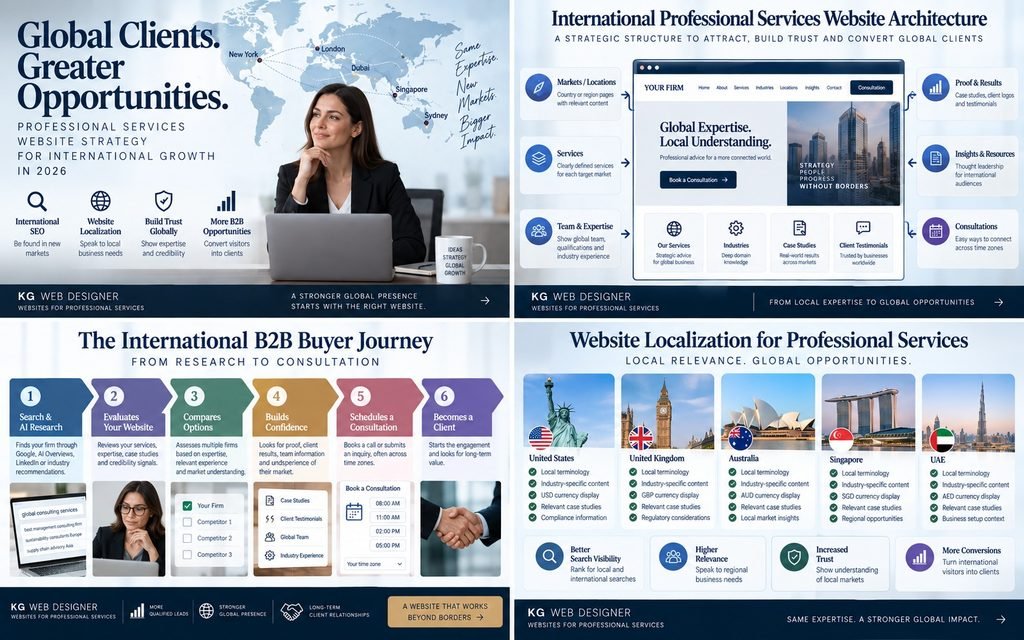
Frequently Asked Questions
Can an international professional services website use one global domain?
Yes. One global domain can work well when the firm has a consistent brand, service offering, and business model across markets. The important issue is not creating multiple domains simply because the firm operates internationally. Strong information architecture, clear service positioning, relevant country or market content, and technically sound international SEO can often provide a better experience than maintaining several disconnected websites.
Should an international services firm display its team across different countries?
Yes. Showing relevant team members, locations, qualifications, and areas of expertise can reduce uncertainty for overseas prospects. International buyers often want to know who will actually deliver the work, where the firm operates, and whether the team understands their market. Team information becomes particularly valuable when a service involves complex consulting, professional advice, or ongoing client relationships.
Is it useful to show international client experience on service pages?
Yes. Relevant international experience can strengthen credibility when it is presented accurately and specifically. A service page can reference the markets served, industries supported, types of engagements completed, or verified client examples without making unsupported claims. The goal is to give a prospective buyer evidence that the firm understands cross-border requirements rather than simply stating that it “works globally.”
Should an international website explain how the firm works with overseas clients?
Yes. Explaining the working process can remove practical concerns before a prospect schedules a consultation. International buyers may want to understand communication methods, project stages, meeting arrangements, response expectations, time-zone flexibility, documentation, and how decisions are handled remotely. A clear process can turn geographic distance from a perceived risk into a manageable operational detail.
Can a professional services website support leads from several time zones?
Yes. A website can support international lead generation by making consultation availability, contact methods, and response expectations clear. Calendar tools can present appointment times in the visitor’s local time, while forms can collect location and preferred communication details. The important point is to make the next step easy without forcing an overseas prospect to calculate time differences manually.
Should international service pages mention local terminology?
Yes. Local terminology can improve clarity and search relevance when it reflects how buyers in that market actually describe a service. However, localization should not mean mechanically changing a few words on an otherwise identical page. Strong localization considers terminology, regulations, buyer expectations, examples, proof, currency, and the commercial context of the target market.
Can an international website generate qualified B2B leads without creating separate country websites?
Yes. A single well-structured website can generate international B2B leads without requiring a separate website for every country. The architecture can combine core service pages with strategically developed market, industry, or location content where there is genuine search demand and commercial relevance. Separate websites become more appropriate when branding, services, regulations, teams, or market positioning differ substantially.
Should an international professional services website show pricing?
No. A firm does not necessarily need to publish fixed prices when the scope, seniority, complexity, or client requirements vary significantly between engagements. Instead, the website should explain what influences fees, what an engagement typically involves, and what information is needed to determine fit. For standardized services, however, transparent pricing or starting ranges may reduce unnecessary qualification friction.