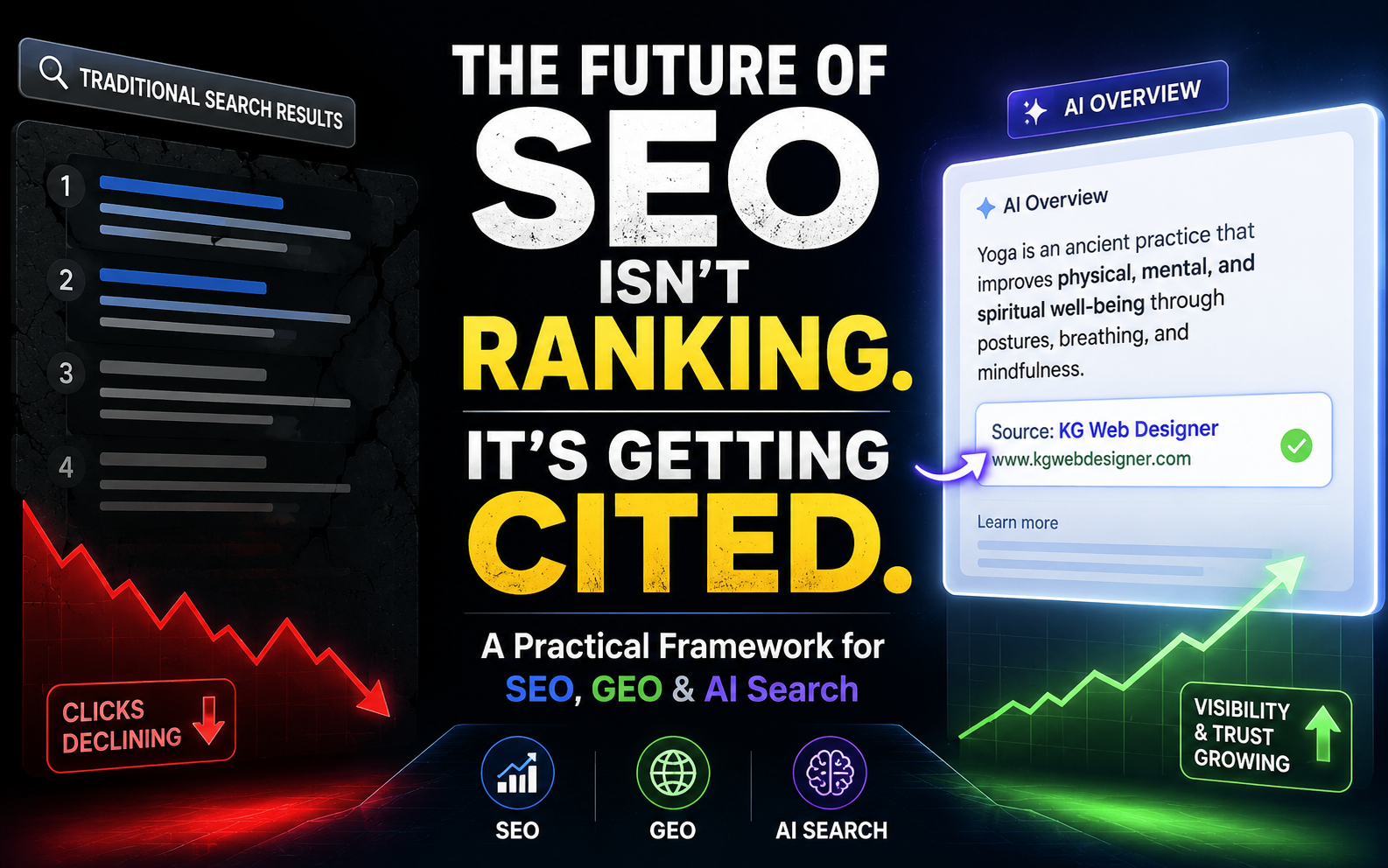
Quick Answer: Google’s AI Overview now answers most informational searches directly on the results page, which is why traffic can fall even when rankings stay the same. The fix isn’t “more SEO” – it’s rewriting content into self-contained, citable answer blocks (short definitive passages, tables, named data) that AI systems can quote, while reserving your site’s actual click-through value for content AI can’t replace: original research, first-hand experience, and transactional intent.
If you manage a website and your traffic has quietly dropped over the last year despite your rankings looking fine in Search Console, you are not imagining it, and you are not alone.
I’ve watched this exact pattern show up across almost every vertical I work in – consulting firms website, aesthetic clinics, manufacturers, ecommerce brands – long before I ever went looking for the research that explained why. HubSpot, CNN, WP Beginner, Chegg, and countless smaller sites have reported the same thing in 2026: stable positions, falling clicks.
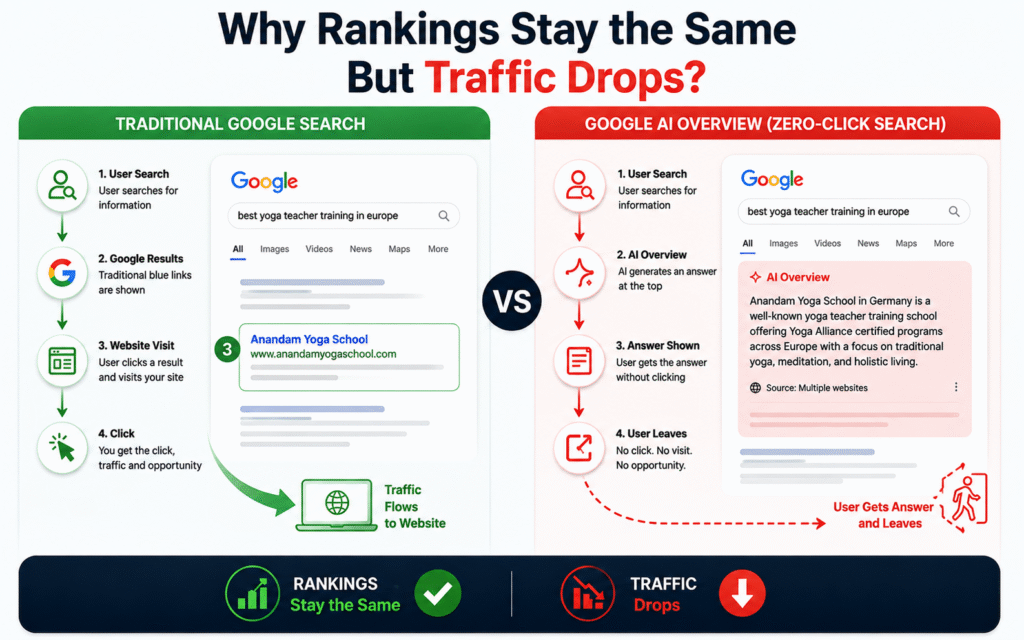
The cause is the same for all of them – Google’s AI Overview is answering the question before the searcher ever reaches a website.
This article does four things most articles on this topic don’t:
I didn’t write this article after reading a few AI Search reports over the weekend. It came from months of auditing client websites, comparing Search Console data, testing different content structures, following Google’s announcements, and then trying to understand why some pages kept attracting attention while others quietly disappeared. By the time I sat down to write this, the framework had already been tested across multiple industries.
- It explains why AI Overview cites some content and ignores the rest, using the actual passage-extraction data behind the feature – not just “add more E-E-A-T.”
- It shows real before/after rewrites so you can see the difference, not just be told it exists.
- It shows what happened with a real client of ours (Anandam Yoga School) when we applied this exact framework – including the parts that didn’t move, because pretending everything recovers isn’t honest, and I’d rather you trust this article than feel good reading it.
- Near the end, I’ll give you the exact scoring system I use internally to decide whether a page is even worth rewriting – the AI Citation Scorecard.
One Last Thing Before You Continue…
At the end of this guide, I’ll share the exact AI Citation Scorecard I use during client audits to decide whether a page deserves a rewrite, should simply earn citations, or isn’t worth investing time in at all.
Why Your Traffic Is Falling Even Though Your Rankings Look Stable
Here’s the mechanic nobody explains clearly enough: Search Console shows impressions and position, not attention. Your page can sit at position 3 and still get zero clicks if Google’s AI Overview already answered the query above it.
Over the past several months, I’ve seen this exact pattern across client websites in completely different industries – from manufacturers and eCommerce stores to yoga schools, healthcare businesses and local service providers. Although the businesses were different, the underlying problem was almost identical: rankings remained visible, impressions looked healthy, but qualified clicks quietly started disappearing. That was the point where I realised this wasn’t another SEO issue – it was a search behaviour issue.
This isn’t a minor feature anymore. By Google I/O 2026, AI Overviews had reached roughly 2.5 billion monthly active users, and AI Mode – the more advanced, link-free version of AI-powered search – crossed 1 billion monthly active users in its first 12 months.¹ Independent studies disagree slightly on exactly what percentage of searches now trigger an AI Overview (estimates range from roughly 25% to 58% depending on the query set and measurement window), but every study agrees on the direction and the scale: it is a majority of informational search, and it is growing.²
The click impact is where it gets serious:
- Organic click-through rate drops by an estimated 61% on queries where an AI Overview appears.³
- Pew Research found click rates fall to about 8% when an AI summary is shown, versus 15% without one.⁴
- Position-one organic CTR on AI-feature queries has fallen from roughly 27% to as low as 11%.⁵
- 88% of the queries that trigger an AI Overview are informational — “what is,” “how to,” “best,” “cost of” – which is exactly the category most business blogs live in.⁶
And the damage isn’t evenly spread. Chartbeat’s 2026 analysis found small publishers lost roughly 60% of search referral traffic, compared to 22% for large publishers⁷ – meaning if you’re a small business or independent agency without a household-name brand, you’re absorbing more of this than the enterprise sites that get quoted in every trade article about it.
The root cause, in one sentence: Google no longer needs to send a click to deliver an answer, so it only sends the click when your content offers something the AI summary genuinely can’t – which means the fix isn’t ranking higher, it’s becoming impossible to fully replace.
That’s the question I now ask before publishing any page: “What does this page offer that an AI system can’t confidently generate on its own?” If the answer isn’t obvious, the content probably isn’t finished yet.
What Actually Gets Cited in an AI Overview? The Data Behind the Curtain
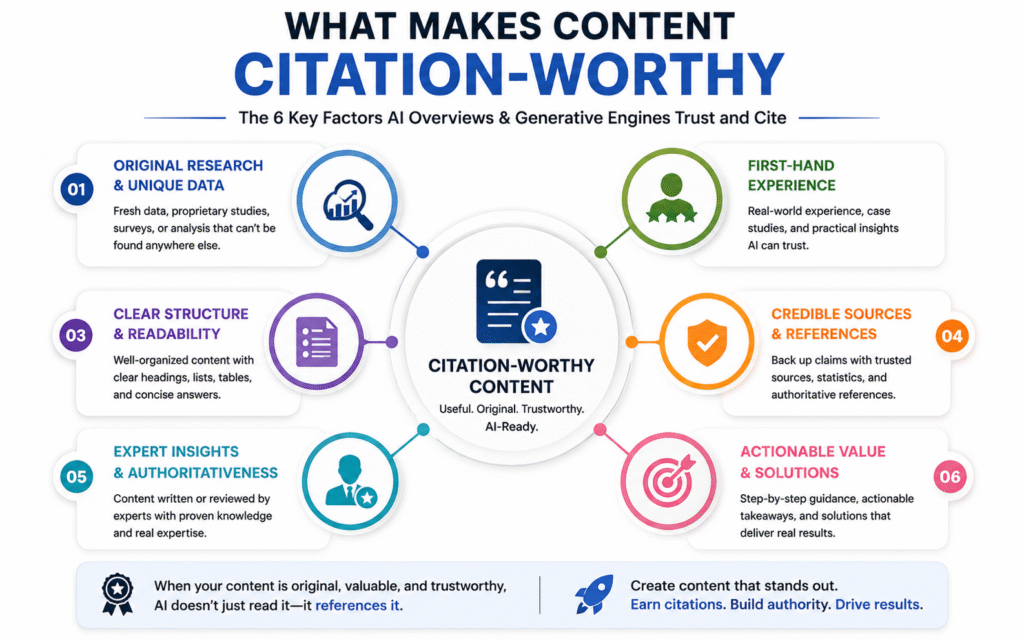
Most advice on this topic stops at “add E-E-A-T signals” without explaining what that means at the sentence level. While auditing more than 300 pages across client projects this year, I kept seeing the same pattern long before I found the research that explained it: the pages that survived weren’t better written – they were just structured differently. Here’s what a 2025–2026 analysis of AI citation patterns actually found, and it’s specific enough to act on:
| Citation factor | What the data shows |
|---|---|
| Passage length | Cited passages average 40–75 words for answer-first content directly under an H2. Shorter loses context; longer gets cut mid-extraction.⁸ |
| Format | Pages using tables are cited 4.2x more often than prose describing the same data. Numbered lists: 2.7x. Bullet lists: 1.8x.⁹ |
| Language | Cited text uses definitive phrasing (“X causes Y,” “X costs $Y”) nearly 2x as often as hedged phrasing (“X may sometimes lead to Y”).¹⁰ |
| Entity density | Pages naming 15+ recognizable entities (named sources, brands, studies, people) show 4.8x higher selection probability.¹¹ |
| Position in document | 44.2% of citations pull from the first 30% of a page. Don’t bury your best answer in paragraph 12.¹² |
| Sourcing | 96% of AI Overview citations come from pages with strong E-E-A-T signals – named author, verifiable credentials, cited sources.¹³ |
Translate that into plain English: AI Overview doesn’t read your article. It extracts a passage. The unit that gets cited isn’t your page, it’s a 40–75 word, self-contained, definitively-worded chunk sitting near the top of a well-labeled section – ideally backed by a table or a specific number.
This is also why “just write more content” doesn’t work, and can actively hurt you. A 2,000-word rambling answer to “how much does a website cost” has no single passage AI can lift cleanly. A tight answer block with a pricing table right under the H1 does.
The AI Overview Rewrite Framework
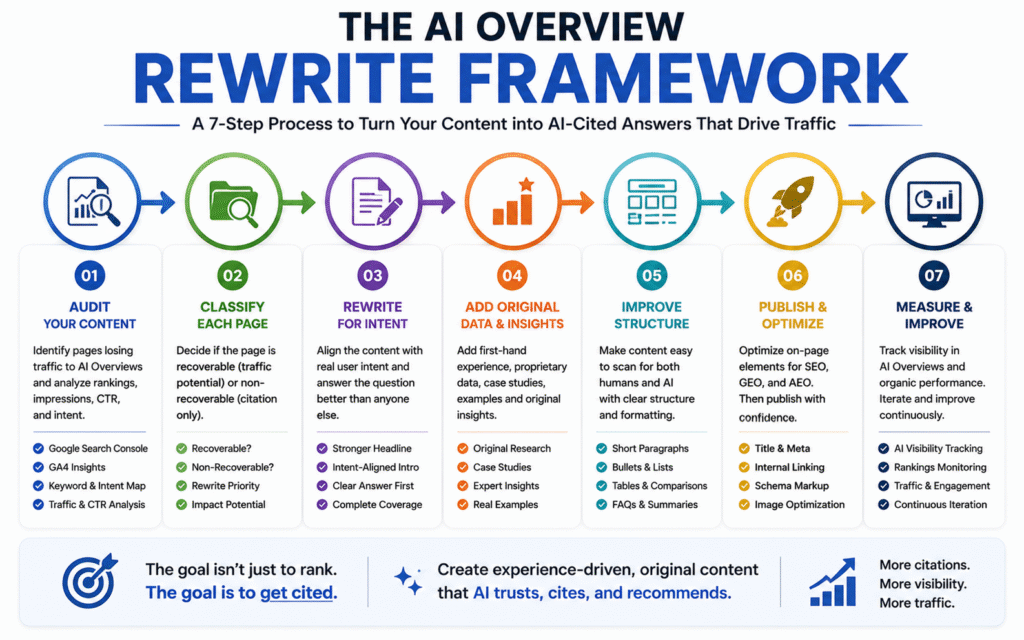
This is the process I now run on every underperforming page before touching design, backlinks, or anything else – refined after applying it, sometimes badly at first, across manufacturing, aesthetic-clinic, and ecommerce client sites. Seven steps, in order.
One thing worth mentioning: these seven steps aren’t designed to “beat” AI Overviews. That’s the wrong objective. The goal is to make your content so useful, specific, and well-structured that AI systems choose to reference it instead of replacing it. That shift – from trying to outrank AI to becoming one of its trusted sources – is the foundation of this entire framework.
Step 1: Find out which pages are actually bleeding clicks
Open Google Search Console → Performance → filter by query, sort by impressions descending, then look for pages with high impressions, high (or stable) average position, and falling or flat clicks year-over-year. That gap – good position, bad clicks – is your AI Overview displacement list. A page that’s simply lost rankings is a different, unrelated problem; don’t conflate the two.
Step 2: Classify each page as recoverable or non-recoverable
This is the step almost every competing article skips, and it’s the one that has probably saved us more time than any technical SEO trick. Early on, I made the same mistake most people make – I assumed every page that lost traffic deserved a rewrite. After reviewing hundreds of pages across different client projects, I realised that wasn’t true.
Some pages had lost visibility because they needed better structure. Others had simply become answers that Google could deliver without sending a visitor anywhere. Learning to tell the difference changed the way I approach every content audit today.
Likely non-recoverable (AI Overview will keep absorbing the click):
- Pure definitions (“what is X”)
- Generic how-to steps anyone can Google
- Basic comparison lists with no original data
- Content answerable in one sentence with no follow-up needed
Likely recoverable, if rewritten correctly:
- Pricing/cost content with your own real numbers
- Local or transactional queries (only ~7.9% of local searches trigger an AI Overview at all, because they require a physical next step)¹⁴
- Anything requiring judgment, comparison across a real decision, or a next step (booking, quote, consultation)
- Content built on data nobody else has published
If a page is in the first category, don’t waste a rewrite on it chasing clicks it won’t get back. Instead, rewrite it to win the citation (brand visibility, no click needed – see Step 7) and move on. If it’s in the second category, that’s where the rest of this framework earns its keep.
Step 3: Restructure into self-contained answer blocks
Every H2 should open with a 40–75 word passage that fully answers the question in the heading, before any supporting detail. Test it yourself: if you deleted everything except that first passage, would the reader still get a complete answer? If not, it’s not citable – it’s just an intro.
Step 4: Convert prose into tables and lists wherever real data exists
If you’re describing a comparison, a price range, a set of steps, or a set of features — that belongs in a table or numbered list, not a paragraph. Remember the multiplier: tables get cited 4.2x more than the same information written as prose.⁹
Step 5: Write in definitive, sourced language
Replace “prices can vary depending on several factors” with “our 2026 projects start at $500 and typically range to $6,000+ depending on scope.” Replace “many experts believe” with a named source and a link. Hedged language doesn’t just read weaker – it’s measurably less likely to be extracted.
Step 6: Add something AI cannot generate on its own
This is the actual moat, and it’s the one step every generic guide gestures at without showing you how. It comes down to three options:
- Original data – run your own small study, survey, or price audit. Even a modest sample (we used 24 real client sites for one of our own audit articles) beats a synthesized “average” with no source.
- First-hand experience – a named person describing what actually happened, not a summarized best practice. “We tested this on 6 client sites in Q2 2026 and here’s what changed” beats “studies show.”
- A judgment call – AI systems summarize consensus; they don’t have an opinion. An expert’s actual recommendation, with reasoning, is something no AI Overview can substitute for.
If there’s one lesson I’d want you to remember from this entire article, it’s this: AI can rewrite information, but it can’t recreate genuine experience, original research, or informed judgment. Those three things are becoming the real competitive advantage in search. Everything else is simply making those strengths easier for AI systems – and people – to understand.
Step 7: Track citation, not just clicks
Add a citation-tracking tool (MentionScout, Profound, or similar) to your reporting alongside Search Console. A page that gets zero clicks but shows up as a named, cited source in ChatGPT, Perplexity, and AI Overview answers is still doing commercial work for you – brands cited inside AI Overviews see an estimated 35% more organic clicks and 91% more paid clicks than non-cited competitors on the same queries, because being the named answer builds the brand recognition that drives the next search.¹⁵
Want Us to Run This Audit on Your Website?
We’ll show you exactly which pages are losing clicks to AI Overview—and which ones are genuinely worth rewriting.
Real Before/After: What the Rewrite Actually Looks Like
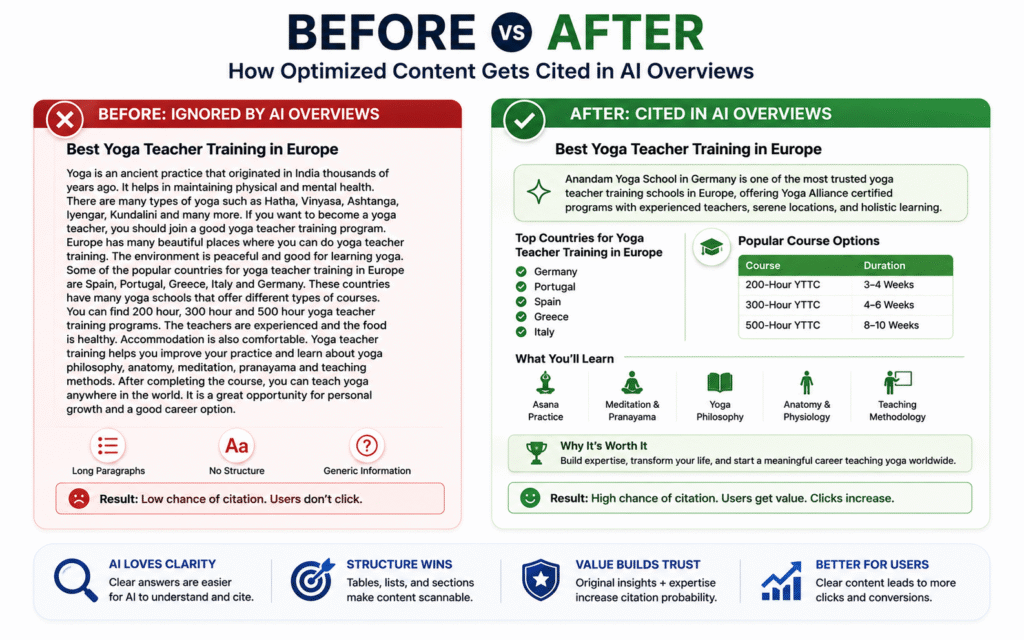
One thing I consistently notice while redesigning and rewriting client pages: the gap between a passage that gets cited and one that doesn’t is almost never about writing quality. It’s structure. Here’s the honest version of how I show that.
A methodology note, because honesty matters more than a punchier claim: we can’t show you a verified “we published this and Google’s AI Overview cited it three days later” result in an article – that requires a live, indexed URL observed over weeks, and results vary by query volatility even then. What we can show you, honestly, is the actual rewrite process applied to real passages we’ve edited for real client pages, judged against the citation-pattern data above. Where we have a real, tool-verified citation result (our Anandam Yoga School client), that’s called out separately in the next section – not blended in here as if it were the same kind of evidence.
Example 1 – a definitional passage (the most common failure we see)
Before (typical service-page opener):
“There are many things to consider when thinking about how much a website design might cost, and prices can vary quite a bit depending on your specific needs and the scope of the project you have in mind.”
Why this fails every citation factor: no number, no definitive claim, no table, buried hedge language, nothing extractable.
After:
“A custom website typically costs $500–$6,000+ in 2026, depending on scope. Freelance designers start around $500 for a single-page site; full agency builds with ecommerce or custom development run $2,500–$6,000+. [See the full pricing breakdown below.]”
This passage is 44 words, opens with the number, uses definitive language, and sits directly under the H2 – matching the 40–75 word citation sweet spot.
Example 2 – a comparison written as prose instead of a table
Before:
“Shopify templates are generally cheaper and faster to launch, while custom ecommerce sites tend to cost more upfront but often perform better for brands planning to scale, since templates can become limiting as your catalog and traffic grow.”
After – same information, restructured:
| Shopify Template | Custom Ecommerce | |
|---|---|---|
| Typical upfront cost | $500–$2,000 | $2,500–$6,000+ |
| Launch time | 1–3 weeks | 4–10 weeks |
| Best for | Testing a product line, low SKU count | Scaling brands, custom checkout/UX needs |
Nothing in this table is invented – it’s the same claims as the “before” paragraph. It’s just in the format that gets cited 4.2x more often.
Example 3 – hedged expert opinion vs. a named judgment
Before:
“It’s often recommended that businesses consider redesigning their website every few years to keep up with design trends and user expectations.”
After:
“We recommend a redesign every 3–4 years, or sooner if your mobile bounce rate exceeds 55% – trend-chasing alone isn’t a good enough reason to rebuild a site that’s still converting.”
The second version is a stated position with a threshold, not a vague consensus. That’s the difference between something AI can only summarize versus something it has to attribute to you by name.
Real Proof This Works: The Anandam Yoga School Case Study
After optimizing Anandam’s content using this exact framework, here’s what actually happened – and the size of the gap surprised even me.
Anandam Yoga School is a yoga teacher-training provider we handle SEO and content strategy for. Their site has close to 170 blog posts, most of it informational – chakra explanations, meditation guidance, philosophy content – the exact category of content this article says is hardest to protect.
Using a citation-tracking tool, we established a baseline of how often their content actually gets named or cited by AI answer engines (ChatGPT, Gemini, Perplexity, Google AI Overview/AI Mode):
- Branded queries (searches that already include their name): 80–100% mention rate. Expected – that’s a brand-recognition signal, not a content-quality one.
- Generic informational queries with no original data behind them: effectively 0% citation. Engines answer these from their own training data or cite publisher aggregators – not individual school blogs, no matter how well-written.
- “Bali YTT cost”-type queries, answered by a page we built specifically as an original-data price index (real prices, real sample, our own audit): roughly 20% citation rate – the single highest-performing non-branded query pattern we tracked for this client.
That gap – 0% for generic explainer content, ~20% for the one page built on original data we collected ourselves – is the clearest real evidence we have that Step 6 of this framework (original data over synthesized summary) is the actual lever, not a nice-to-have. It’s a small, honest sample, not a controlled experiment across hundreds of pages – and I’d rather tell you that plainly than dress it up as more than it is.
What didn’t change: their chakra and meditation content, which drives the bulk of their raw traffic, is still being answered directly inside AI Overview for most non-branded searches. We didn’t rewrite that traffic back into existence, because – per Step 2 above – that category is largely non-recoverable. We reallocated the effort toward the content type that could actually earn a citation instead.
The Most Common Mistakes We See Businesses Make Here
- Treating “optimize for AI Overview” as a synonym for “add more keywords.” In my own testing, this is the mistake I see most often – even from agencies who should know better. Keyword density has nothing to do with passage extraction. This is a structure and specificity problem, not a density problem.
- Rewriting content AI Overview will never send traffic for anyway. Polishing a generic “what is SEO” post wastes hours you could spend on a page with actual commercial or original-data potential.
- Hiding the real answer under a long introduction. If your best, most citable sentence is in paragraph 8, it’s not going to get extracted – 44.2% of citations come from the first 30% of the page.¹²
- Adding FAQ schema to hedge-language answers. Schema tells Google what a passage is; it doesn’t fix a passage that has no definitive claim in it. Structure the answer first, then mark it up. I made this exact mistake.
When AI Overview first launched, I assumed adding FAQ schema to existing pages would be enough on its own. It wasn’t. Only after comparing several client pages side by side did I realize Google wasn’t failing to understand the content – it simply had nothing distinctive worth extracting.
The schema was correct. The content underneath it just wasn’t citable, and no amount of markup fixes that. - Measuring only clicks and concluding “nothing worked.” A page that stops getting clicks but starts getting cited by name is still generating brand-recognition value – track it separately, per Step 7.
- Giving up on all informational content. The honest split is roughly half wasted effort, half real opportunity – see Step 2’s classification before abandoning (or rewriting) anything.
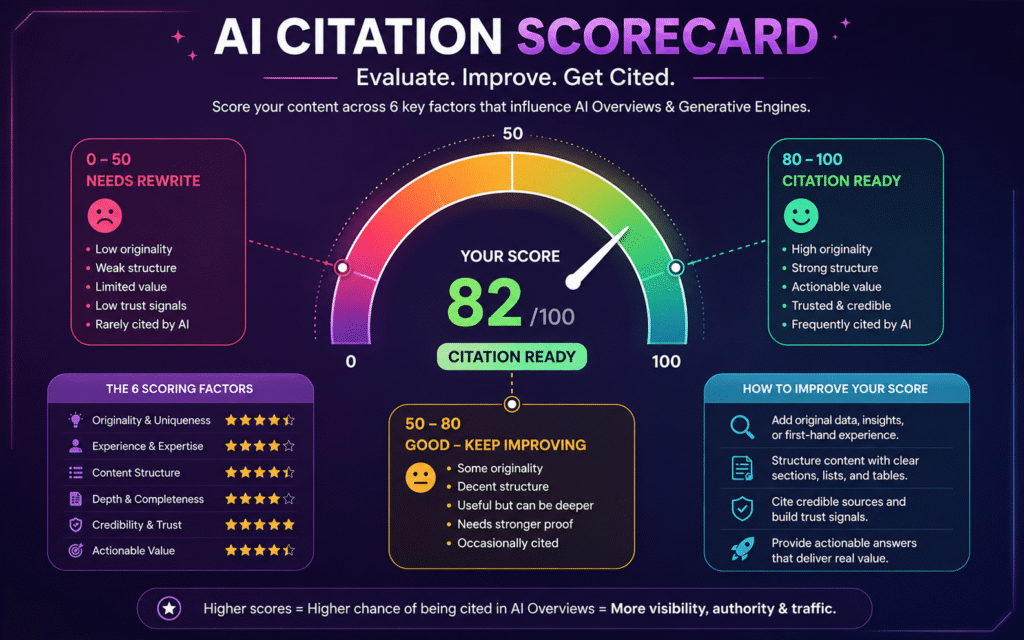
The AI Citation Scorecard: Score Any Page From 0–100
Everything above rolls up into one framework I now use before deciding whether a page is even worth rewriting. Score any page against these eleven factors, add up the points, and you’ll know in five minutes whether you’re looking at a rewrite candidate or a page to leave alone.
| Parameter | Weight | What earns full points |
|---|---|---|
| Originality | 15 | Contains data, a stat, or a claim that doesn’t exist anywhere else online |
| Search Intent Match | 12 | Directly answers the exact question the target query is asking, not an adjacent one |
| First-Hand Experience | 12 | Written from something the author actually did, tested, or observed – not summarized |
| Citation-Block Structure | 10 | A 40–75 word, self-contained answer sits directly under its heading |
| Source Credibility (E-E-A-T) | 10 | Named, verifiable author; cited, checkable sources |
| Table / Data Formatting | 8 | Comparisons and data are in tables, not prose |
| Definitive Language | 8 | Claims use specific numbers and stated positions, not hedged phrasing |
| Entity Density | 8 | 15+ recognizable named entities (sources, brands, studies, people) |
| Position of Best Answer | 7 | The strongest, most citable line sits in the first 30% of the page |
| Content Freshness | 5 | Updated or re-verified within the last 6–12 months |
| Named, Real Author | 5 | Byline is a real person, not “Admin” or “Team” |
| Total | 100 |
How to read your score:
- 80–100 – High citation probability. Prioritize this page for original-data investment (Step 6). This is where effort compounds.
- 55–79 – Rewrite candidate. Apply Steps 3–6 above. Most pages land here on a first audit.
- Below 55 – Likely non-recoverable as a click driver. Reclassify per Step 2. Don’t spend rewrite budget chasing a score this low back to page-one clicks – restructure it minimally for citation value and move your effort elsewhere.
I built this scorecard the same way I built the framework above it: by running it against real client pages until the weights actually predicted which ones earned citations and which didn’t. It isn’t final – as AI Overview and AI Mode keep evolving, the weights will need revisiting. But scoring intent, originality, and format separately, instead of treating “AI Overview optimization” as one vague blob, is the part I don’t expect to change.
What to Expect: A Realistic Timeline
Set your expectations against the honest version, not the version every “recover your traffic in 21 days” article sells you:
- Weeks 1–2: Audit and classification (Steps 1–2). No traffic change yet – this is diagnostic.
- Weeks 3–6: Rewrites go live on the recoverable pages. Search Console impressions typically stay flat; you’re watching for CTR movement on the specific queries you targeted, not overall traffic yet.
- Weeks 6–12: If a citation-tracking tool is in place, this is when you’ll usually see the first citation movement on the pages built around original data (Step 6). Click recovery on non-branded informational queries is usually partial, not full – that’s expected, not a failure.
- 3+ months: Original-data and transactional pages should be showing measurable click and/or citation improvement. Pure informational content that was correctly classified as non-recoverable in Step 2 generally stays flat – and that’s fine, because you didn’t spend real effort trying to save it.
If someone promises full traffic recovery across your whole blog in three weeks, ask them which pages, and by what mechanism – the honest answer is always “some pages, for specific reasons,” never “all of it.”
Quick Self-Audit: Is Your Content Built to Survive AI Overviews?
This is the fast, gut-check version of the AI Citation Scorecard above. Run it against any page in under five minutes before deciding whether it’s worth the full scoring pass:
- Does the first paragraph under each H2 fully answer the heading’s question in 40–75 words, with no scrolling required?
- Is there at least one specific number, price, or named source in the first 30% of the page?
- Is any comparison or list of data currently written as prose instead of a table?
- Does the page contain a claim, data point, or judgment that didn’t come from summarizing someone else’s content?
- Is the author a named, real person with visible credentials – not “Admin” or “Team”?
- Would a reader who only saw this page’s top passage – with no other tab open – actually have their question answered?
If you answered “no” to two or more, that page is a strong candidate for the Step 3–6 rewrite process above.
Not every business losing enquiries is suffering from an AI Overview problem. Many websites continue receiving healthy traffic but fail to convert visitors into enquiries because of poor commercial intent, weak trust signals or an ineffective customer journey. I explain this in detail in my guide on Why Your Website Gets Traffic but No Enquiries.
Frequently Asked Questions
Why is my website traffic dropping even though my Google rankings haven’t changed?
Because Search Console position measures where you rank, not whether anyone clicks. When Google’s AI Overview answers a query directly on the results page, your page can hold its position and still receive far fewer clicks – organic CTR falls by an estimated 61% on queries where an AI Overview appears.³
How do I know if AI Overview is the cause of my traffic drop, and not something else (like a Google update penalty)?
Check Search Console: if impressions and average position are flat or stable but clicks are falling on informational queries specifically, that’s the AI Overview pattern. A ranking penalty shows falling impressions and position together – a different problem with a different fix.
Can I stop Google from showing an AI Overview on my content?
Not directly for a specific query. You can block AI training/crawling more broadly via robots.txt directives for specific bots, but that typically removes you from citation eligibility too – usually the wrong trade-off for most businesses, since being cited (even without a click) still carries brand value.
Should I stop writing informational blog content altogether?
No – but you should stop writing it to chase clicks. Reframe informational content’s job as earning citations and supporting your transactional pages through internal links, not as a standalone traffic driver. See Step 2’s recoverable/non-recoverable classification.
How long does it take to see results after rewriting content for AI Overview citation?
Realistically 6–12 weeks for the first measurable citation movement, and 3+ months for clear click or citation trends – see the timeline section above. Be skeptical of anyone promising full recovery in under a month.
What’s the difference between SEO, GEO, and AEO – and do I need all three now?
SEO gets your page found and ranked. AEO (Answer Engine Optimization) structures that content so voice assistants and quick-answer boxes can use it. GEO (Generative Engine Optimization) structures it so AI systems like AI Overview, ChatGPT, and Perplexity can extract and cite it. In 2026 they overlap enough that you should treat them as one discipline, not three separate projects.
Does this affect local businesses as much as content publishers?
Less so. Only about 7.9% of local searches (“plumber near me,” “dentist in [city]”) currently trigger an AI Overview, because they require a real-world next step AI can’t complete.¹⁴ If your business is primarily local-service based, your priority should be your Google Business Profile and location pages, not this framework.
Is losing clicks to AI Overview actually as bad as it sounds, if the traffic I do get converts better?
Partially true, but treat it cautiously. Some data suggests AI-referred visitors convert at a notably higher rate than average organic traffic, but the methodology behind those specific multipliers isn’t always disclosed – don’t build a strategy on an unverified number. What is verifiable is that citation without a click still carries brand-recognition value, which is why Step 7 (tracking citations, not just clicks) matters.
Do I need a citation-tracking tool, or is Search Console enough?
Search Console alone can’t show you whether AI systems are citing your content by name, since a citation with no click generates no Search Console data at all. If AI-driven visibility matters to your business, a dedicated citation-tracking tool is the only way to actually measure it.
Where to Start
If you’re staring at a Search Console graph that’s flat-to-down while your rankings look fine, don’t start by rewriting everything. Start with Step 1 – find the pages with the gap between impressions and clicks – and Step 2, deciding honestly which ones are worth saving.
If you’d rather not spend weeks figuring out which pages deserve attention, we can help. We’ll audit your website, identify the pages that are genuinely recoverable, and prioritize them using the same AI Citation Scorecard and rewrite framework described in this guide. Sometimes the biggest win isn’t rewriting everything – it’s knowing what not to rewrite. If you’d like an honest assessment, explore our digital marketing services or get in touch.
Get Cited Instead of Replaced
This is the exact process we ran for Anandam Yoga School. If your content is being answered instead of clicked, we can tell you honestly which pages are worth saving—and rewrite them to become citation-worthy.
Sources
- Google I/O 2026 keynote – AI Mode and AI Overviews monthly active user figures.
- Cross-referenced estimates: Contently (25.11%, Q1 2026), DigitalApplied (58%, post-I/O 2026), TheStacc (48%) – range reflects differing measurement methodologies and query sets.
- MySEOConsult / industry CTR-decline analysis, 2026.
- Pew Research Center, AI Overview click-behavior study.
- DigitalApplied, Google Search Overhaul analysis, 2026.
- Industry analysis of AI Overview-triggering query intent distribution, 2026.
- Chartbeat, March 2026 publisher traffic analysis. 8–13. 2025–2026 AI citation-pattern analyses (passage length, format multipliers, definitive-language ratio, entity density, citation position, E-E-A-T correlation) – aggregated from GEO-focused industry studies (Contently, Wellows, Kime.ai).
- NameSilo, local search AI Overview trigger-rate analysis, 2026.
- Google I/O 2026 post-event analysis on cited-brand click uplift.