
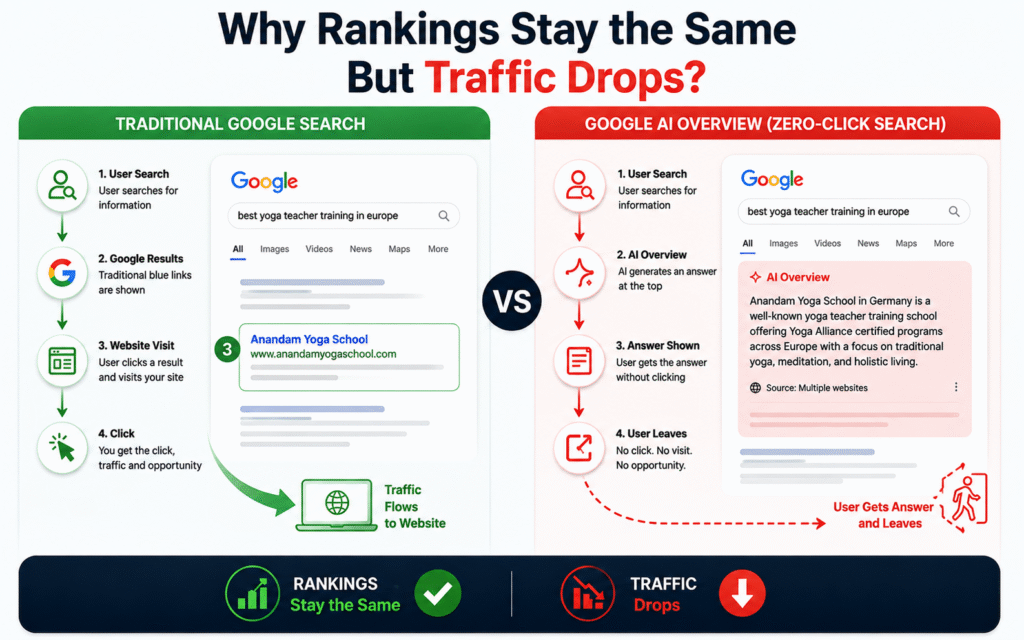
Quick Answer: Google’s AI Overview now answers most informational searches directly on the results page, which is why traffic can fall even when rankings stay the same. The fix isn’t “more SEO” – it’s rewriting content into self-contained, citable answer blocks (short definitive passages, tables, named data) that AI systems can quote, while reserving your site’s actual click-through value for content AI can’t replace: original research, first-hand experience, and transactional intent.
If you manage a website and your traffic has quietly dropped over the last year despite your rankings looking fine in Search Console, you are not imagining it, and you are not alone.
I’ve watched this exact pattern show up across almost every vertical I work in – consulting firms website, aesthetic clinics, manufacturers, ecommerce brands – long before I ever went looking for the research that explained why. HubSpot, CNN, WP Beginner, Chegg, and countless smaller sites have reported the same thing in 2026: stable positions, falling clicks.
The cause is the same for all of them – Google’s AI Overview is answering the question before the searcher ever reaches a website.
This article does four things most articles on this topic don’t:
I didn’t write this article after reading a few AI Search reports over the weekend. It came from months of auditing client websites, comparing Search Console data, testing different content structures, following Google’s announcements, and then trying to understand why some pages kept attracting attention while others quietly disappeared. By the time I sat down to write this, the framework had already been tested across multiple industries.
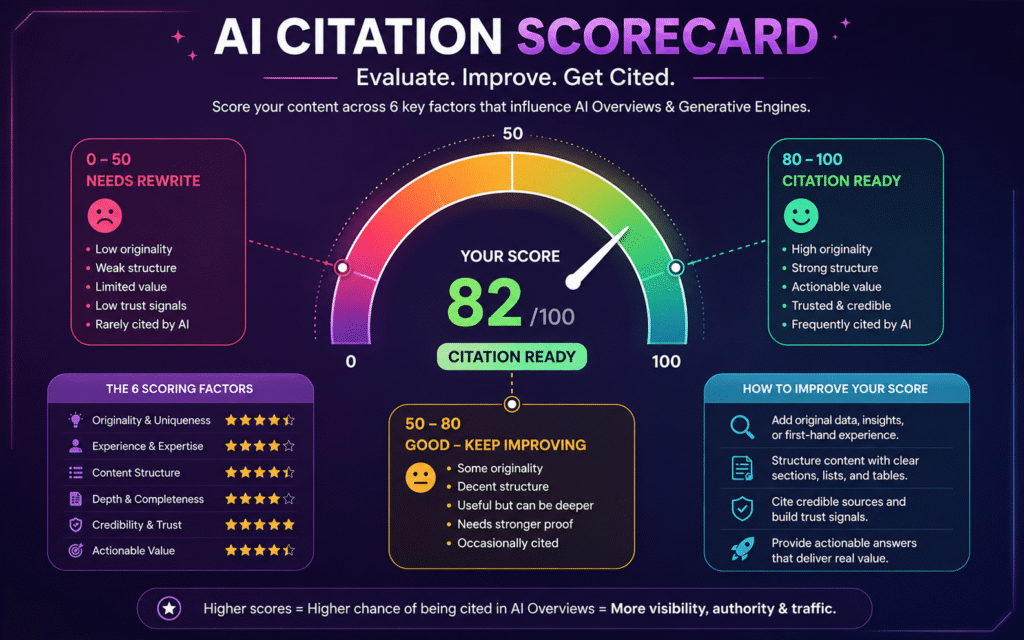
At the end of this guide, I’ll share the exact AI Citation Scorecard I use during client audits to decide whether a page deserves a rewrite, should simply earn citations, or isn’t worth investing time in at all.
Here’s the mechanic nobody explains clearly enough: Search Console shows impressions and position, not attention. Your page can sit at position 3 and still get zero clicks if Google’s AI Overview already answered the query above it.
Over the past several months, I’ve seen this exact pattern across client websites in completely different industries – from manufacturers and eCommerce stores to yoga schools, healthcare businesses and local service providers. Although the businesses were different, the underlying problem was almost identical: rankings remained visible, impressions looked healthy, but qualified clicks quietly started disappearing. That was the point where I realised this wasn’t another SEO issue – it was a search behaviour issue.
This isn’t a minor feature anymore. By Google I/O 2026, AI Overviews had reached roughly 2.5 billion monthly active users, and AI Mode – the more advanced, link-free version of AI-powered search – crossed 1 billion monthly active users in its first 12 months.¹ Independent studies disagree slightly on exactly what percentage of searches now trigger an AI Overview (estimates range from roughly 25% to 58% depending on the query set and measurement window), but every study agrees on the direction and the scale: it is a majority of informational search, and it is growing.²
The click impact is where it gets serious:
And the damage isn’t evenly spread. Chartbeat’s 2026 analysis found small publishers lost roughly 60% of search referral traffic, compared to 22% for large publishers⁷ – meaning if you’re a small business or independent agency without a household-name brand, you’re absorbing more of this than the enterprise sites that get quoted in every trade article about it.
The root cause, in one sentence: Google no longer needs to send a click to deliver an answer, so it only sends the click when your content offers something the AI summary genuinely can’t – which means the fix isn’t ranking higher, it’s becoming impossible to fully replace.
That’s the question I now ask before publishing any page: “What does this page offer that an AI system can’t confidently generate on its own?” If the answer isn’t obvious, the content probably isn’t finished yet.
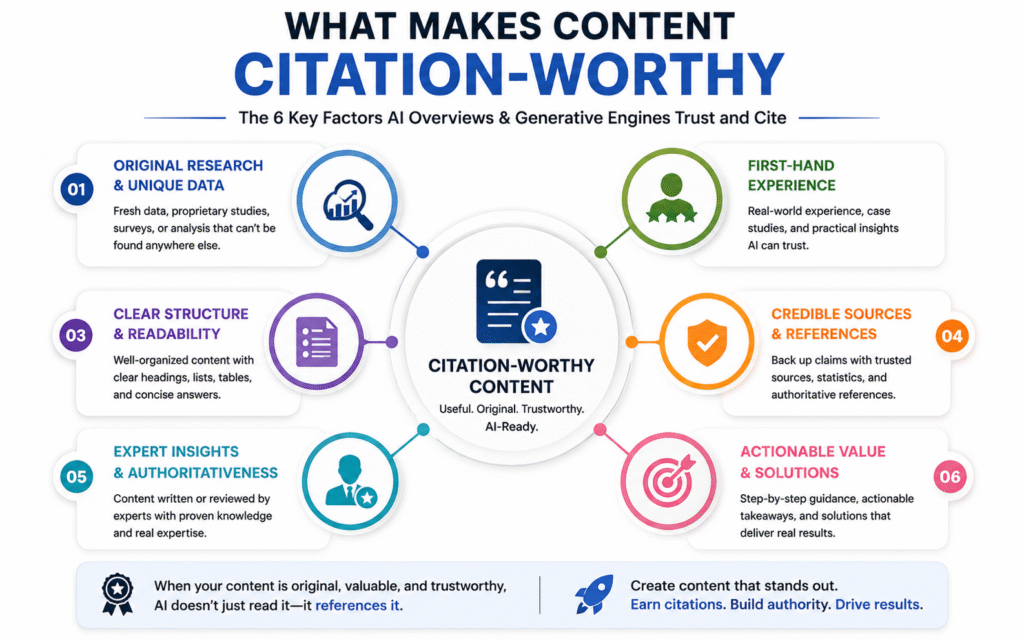
Most advice on this topic stops at “add E-E-A-T signals” without explaining what that means at the sentence level. While auditing more than 300 pages across client projects this year, I kept seeing the same pattern long before I found the research that explained it: the pages that survived weren’t better written – they were just structured differently. Here’s what a 2025–2026 analysis of AI citation patterns actually found, and it’s specific enough to act on:
| Citation factor | What the data shows |
|---|---|
| Passage length | Cited passages average 40–75 words for answer-first content directly under an H2. Shorter loses context; longer gets cut mid-extraction.⁸ |
| Format | Pages using tables are cited 4.2x more often than prose describing the same data. Numbered lists: 2.7x. Bullet lists: 1.8x.⁹ |
| Language | Cited text uses definitive phrasing (“X causes Y,” “X costs $Y”) nearly 2x as often as hedged phrasing (“X may sometimes lead to Y”).¹⁰ |
| Entity density | Pages naming 15+ recognizable entities (named sources, brands, studies, people) show 4.8x higher selection probability.¹¹ |
| Position in document | 44.2% of citations pull from the first 30% of a page. Don’t bury your best answer in paragraph 12.¹² |
| Sourcing | 96% of AI Overview citations come from pages with strong E-E-A-T signals – named author, verifiable credentials, cited sources.¹³ |
Translate that into plain English: AI Overview doesn’t read your article. It extracts a passage. The unit that gets cited isn’t your page, it’s a 40–75 word, self-contained, definitively-worded chunk sitting near the top of a well-labeled section – ideally backed by a table or a specific number.
This is also why “just write more content” doesn’t work, and can actively hurt you. A 2,000-word rambling answer to “how much does a website cost” has no single passage AI can lift cleanly. A tight answer block with a pricing table right under the H1 does.
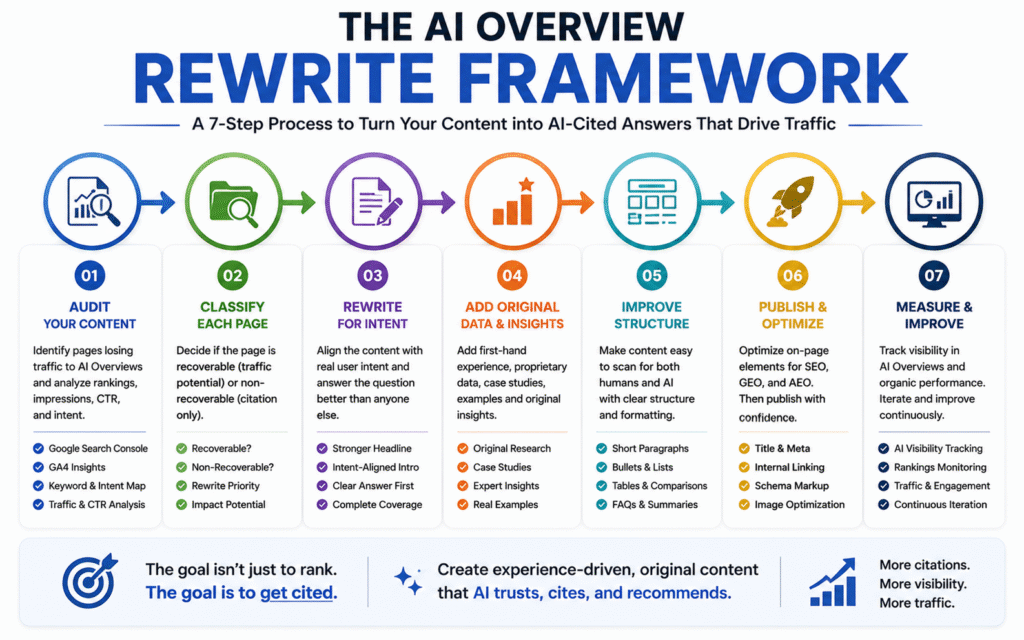
This is the process I now run on every underperforming page before touching design, backlinks, or anything else – refined after applying it, sometimes badly at first, across manufacturing, aesthetic-clinic, and ecommerce client sites. Seven steps, in order.
One thing worth mentioning: these seven steps aren’t designed to “beat” AI Overviews. That’s the wrong objective. The goal is to make your content so useful, specific, and well-structured that AI systems choose to reference it instead of replacing it. That shift – from trying to outrank AI to becoming one of its trusted sources – is the foundation of this entire framework.
Open Google Search Console → Performance → filter by query, sort by impressions descending, then look for pages with high impressions, high (or stable) average position, and falling or flat clicks year-over-year. That gap – good position, bad clicks – is your AI Overview displacement list. A page that’s simply lost rankings is a different, unrelated problem; don’t conflate the two.
This is the step almost every competing article skips, and it’s the one that has probably saved us more time than any technical SEO trick. Early on, I made the same mistake most people make – I assumed every page that lost traffic deserved a rewrite. After reviewing hundreds of pages across different client projects, I realised that wasn’t true.
Some pages had lost visibility because they needed better structure. Others had simply become answers that Google could deliver without sending a visitor anywhere. Learning to tell the difference changed the way I approach every content audit today.
Likely non-recoverable (AI Overview will keep absorbing the click):
Likely recoverable, if rewritten correctly:
If a page is in the first category, don’t waste a rewrite on it chasing clicks it won’t get back. Instead, rewrite it to win the citation (brand visibility, no click needed – see Step 7) and move on. If it’s in the second category, that’s where the rest of this framework earns its keep.
Every H2 should open with a 40–75 word passage that fully answers the question in the heading, before any supporting detail. Test it yourself: if you deleted everything except that first passage, would the reader still get a complete answer? If not, it’s not citable – it’s just an intro.
If you’re describing a comparison, a price range, a set of steps, or a set of features — that belongs in a table or numbered list, not a paragraph. Remember the multiplier: tables get cited 4.2x more than the same information written as prose.⁹
Replace “prices can vary depending on several factors” with “our 2026 projects start at $500 and typically range to $6,000+ depending on scope.” Replace “many experts believe” with a named source and a link. Hedged language doesn’t just read weaker – it’s measurably less likely to be extracted.
This is the actual moat, and it’s the one step every generic guide gestures at without showing you how. It comes down to three options:
If there’s one lesson I’d want you to remember from this entire article, it’s this: AI can rewrite information, but it can’t recreate genuine experience, original research, or informed judgment. Those three things are becoming the real competitive advantage in search. Everything else is simply making those strengths easier for AI systems – and people – to understand.
Add a citation-tracking tool (MentionScout, Profound, or similar) to your reporting alongside Search Console. A page that gets zero clicks but shows up as a named, cited source in ChatGPT, Perplexity, and AI Overview answers is still doing commercial work for you – brands cited inside AI Overviews see an estimated 35% more organic clicks and 91% more paid clicks than non-cited competitors on the same queries, because being the named answer builds the brand recognition that drives the next search.¹⁵
We’ll show you exactly which pages are losing clicks to AI Overview—and which ones are genuinely worth rewriting.
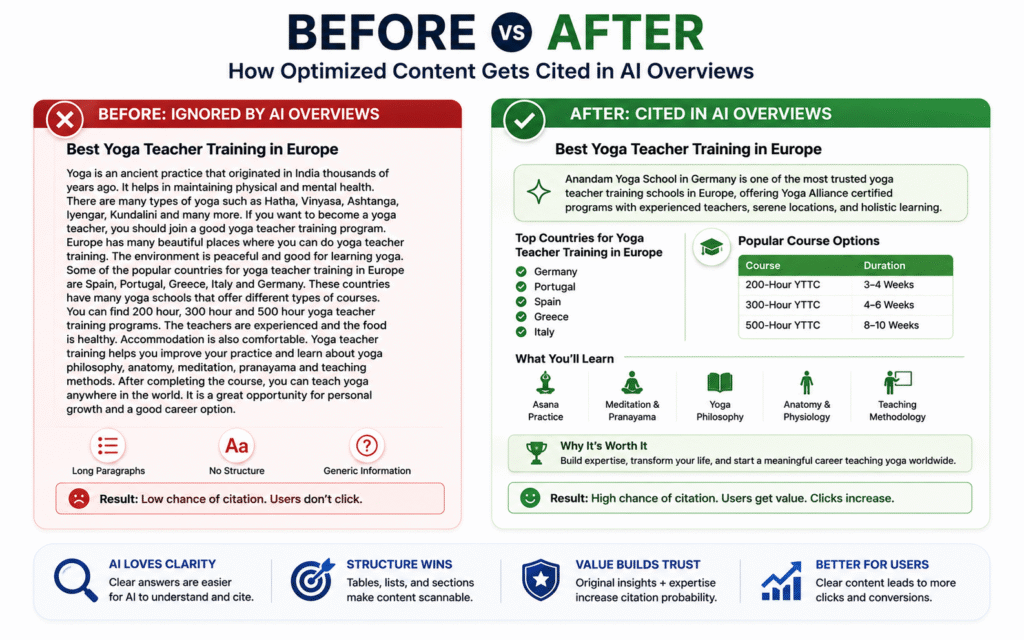
One thing I consistently notice while redesigning and rewriting client pages: the gap between a passage that gets cited and one that doesn’t is almost never about writing quality. It’s structure. Here’s the honest version of how I show that.
A methodology note, because honesty matters more than a punchier claim: we can’t show you a verified “we published this and Google’s AI Overview cited it three days later” result in an article – that requires a live, indexed URL observed over weeks, and results vary by query volatility even then. What we can show you, honestly, is the actual rewrite process applied to real passages we’ve edited for real client pages, judged against the citation-pattern data above. Where we have a real, tool-verified citation result (our Anandam Yoga School client), that’s called out separately in the next section – not blended in here as if it were the same kind of evidence.
Example 1 – a definitional passage (the most common failure we see)
Before (typical service-page opener):
“There are many things to consider when thinking about how much a website design might cost, and prices can vary quite a bit depending on your specific needs and the scope of the project you have in mind.”
Why this fails every citation factor: no number, no definitive claim, no table, buried hedge language, nothing extractable.
After:
“A custom website typically costs $500–$6,000+ in 2026, depending on scope. Freelance designers start around $500 for a single-page site; full agency builds with ecommerce or custom development run $2,500–$6,000+. [See the full pricing breakdown below.]”
This passage is 44 words, opens with the number, uses definitive language, and sits directly under the H2 – matching the 40–75 word citation sweet spot.
Example 2 – a comparison written as prose instead of a table
Before:
“Shopify templates are generally cheaper and faster to launch, while custom ecommerce sites tend to cost more upfront but often perform better for brands planning to scale, since templates can become limiting as your catalog and traffic grow.”
After – same information, restructured:
| Shopify Template | Custom Ecommerce | |
|---|---|---|
| Typical upfront cost | $500–$2,000 | $2,500–$6,000+ |
| Launch time | 1–3 weeks | 4–10 weeks |
| Best for | Testing a product line, low SKU count | Scaling brands, custom checkout/UX needs |
Nothing in this table is invented – it’s the same claims as the “before” paragraph. It’s just in the format that gets cited 4.2x more often.
Example 3 – hedged expert opinion vs. a named judgment
Before:
“It’s often recommended that businesses consider redesigning their website every few years to keep up with design trends and user expectations.”
After:
“We recommend a redesign every 3–4 years, or sooner if your mobile bounce rate exceeds 55% – trend-chasing alone isn’t a good enough reason to rebuild a site that’s still converting.”
The second version is a stated position with a threshold, not a vague consensus. That’s the difference between something AI can only summarize versus something it has to attribute to you by name.
After optimizing Anandam’s content using this exact framework, here’s what actually happened – and the size of the gap surprised even me.
Anandam Yoga School is a yoga teacher-training provider we handle SEO and content strategy for. Their site has close to 170 blog posts, most of it informational – chakra explanations, meditation guidance, philosophy content – the exact category of content this article says is hardest to protect.
Using a citation-tracking tool, we established a baseline of how often their content actually gets named or cited by AI answer engines (ChatGPT, Gemini, Perplexity, Google AI Overview/AI Mode):
That gap – 0% for generic explainer content, ~20% for the one page built on original data we collected ourselves – is the clearest real evidence we have that Step 6 of this framework (original data over synthesized summary) is the actual lever, not a nice-to-have. It’s a small, honest sample, not a controlled experiment across hundreds of pages – and I’d rather tell you that plainly than dress it up as more than it is.
What didn’t change: their chakra and meditation content, which drives the bulk of their raw traffic, is still being answered directly inside AI Overview for most non-branded searches. We didn’t rewrite that traffic back into existence, because – per Step 2 above – that category is largely non-recoverable. We reallocated the effort toward the content type that could actually earn a citation instead.
Everything above rolls up into one framework I now use before deciding whether a page is even worth rewriting. Score any page against these eleven factors, add up the points, and you’ll know in five minutes whether you’re looking at a rewrite candidate or a page to leave alone.
| Parameter | Weight | What earns full points |
|---|---|---|
| Originality | 15 | Contains data, a stat, or a claim that doesn’t exist anywhere else online |
| Search Intent Match | 12 | Directly answers the exact question the target query is asking, not an adjacent one |
| First-Hand Experience | 12 | Written from something the author actually did, tested, or observed – not summarized |
| Citation-Block Structure | 10 | A 40–75 word, self-contained answer sits directly under its heading |
| Source Credibility (E-E-A-T) | 10 | Named, verifiable author; cited, checkable sources |
| Table / Data Formatting | 8 | Comparisons and data are in tables, not prose |
| Definitive Language | 8 | Claims use specific numbers and stated positions, not hedged phrasing |
| Entity Density | 8 | 15+ recognizable named entities (sources, brands, studies, people) |
| Position of Best Answer | 7 | The strongest, most citable line sits in the first 30% of the page |
| Content Freshness | 5 | Updated or re-verified within the last 6–12 months |
| Named, Real Author | 5 | Byline is a real person, not “Admin” or “Team” |
| Total | 100 |
How to read your score:
I built this scorecard the same way I built the framework above it: by running it against real client pages until the weights actually predicted which ones earned citations and which didn’t. It isn’t final – as AI Overview and AI Mode keep evolving, the weights will need revisiting. But scoring intent, originality, and format separately, instead of treating “AI Overview optimization” as one vague blob, is the part I don’t expect to change.
Set your expectations against the honest version, not the version every “recover your traffic in 21 days” article sells you:
If someone promises full traffic recovery across your whole blog in three weeks, ask them which pages, and by what mechanism – the honest answer is always “some pages, for specific reasons,” never “all of it.”
This is the fast, gut-check version of the AI Citation Scorecard above. Run it against any page in under five minutes before deciding whether it’s worth the full scoring pass:
If you answered “no” to two or more, that page is a strong candidate for the Step 3–6 rewrite process above.
Because Search Console position measures where you rank, not whether anyone clicks. When Google’s AI Overview answers a query directly on the results page, your page can hold its position and still receive far fewer clicks – organic CTR falls by an estimated 61% on queries where an AI Overview appears.³
Check Search Console: if impressions and average position are flat or stable but clicks are falling on informational queries specifically, that’s the AI Overview pattern. A ranking penalty shows falling impressions and position together – a different problem with a different fix.
Not directly for a specific query. You can block AI training/crawling more broadly via robots.txt directives for specific bots, but that typically removes you from citation eligibility too – usually the wrong trade-off for most businesses, since being cited (even without a click) still carries brand value.
No – but you should stop writing it to chase clicks. Reframe informational content’s job as earning citations and supporting your transactional pages through internal links, not as a standalone traffic driver. See Step 2’s recoverable/non-recoverable classification.
Realistically 6–12 weeks for the first measurable citation movement, and 3+ months for clear click or citation trends – see the timeline section above. Be skeptical of anyone promising full recovery in under a month.
SEO gets your page found and ranked. AEO (Answer Engine Optimization) structures that content so voice assistants and quick-answer boxes can use it. GEO (Generative Engine Optimization) structures it so AI systems like AI Overview, ChatGPT, and Perplexity can extract and cite it. In 2026 they overlap enough that you should treat them as one discipline, not three separate projects.
Less so. Only about 7.9% of local searches (“plumber near me,” “dentist in [city]”) currently trigger an AI Overview, because they require a real-world next step AI can’t complete.¹⁴ If your business is primarily local-service based, your priority should be your Google Business Profile and location pages, not this framework.
Partially true, but treat it cautiously. Some data suggests AI-referred visitors convert at a notably higher rate than average organic traffic, but the methodology behind those specific multipliers isn’t always disclosed – don’t build a strategy on an unverified number. What is verifiable is that citation without a click still carries brand-recognition value, which is why Step 7 (tracking citations, not just clicks) matters.
Search Console alone can’t show you whether AI systems are citing your content by name, since a citation with no click generates no Search Console data at all. If AI-driven visibility matters to your business, a dedicated citation-tracking tool is the only way to actually measure it.
If you’re staring at a Search Console graph that’s flat-to-down while your rankings look fine, don’t start by rewriting everything. Start with Step 1 – find the pages with the gap between impressions and clicks – and Step 2, deciding honestly which ones are worth saving.
If you’d rather not spend weeks figuring out which pages deserve attention, we can help. We’ll audit your website, identify the pages that are genuinely recoverable, and prioritize them using the same AI Citation Scorecard and rewrite framework described in this guide. Sometimes the biggest win isn’t rewriting everything – it’s knowing what not to rewrite. If you’d like an honest assessment, explore our digital marketing services or get in touch.
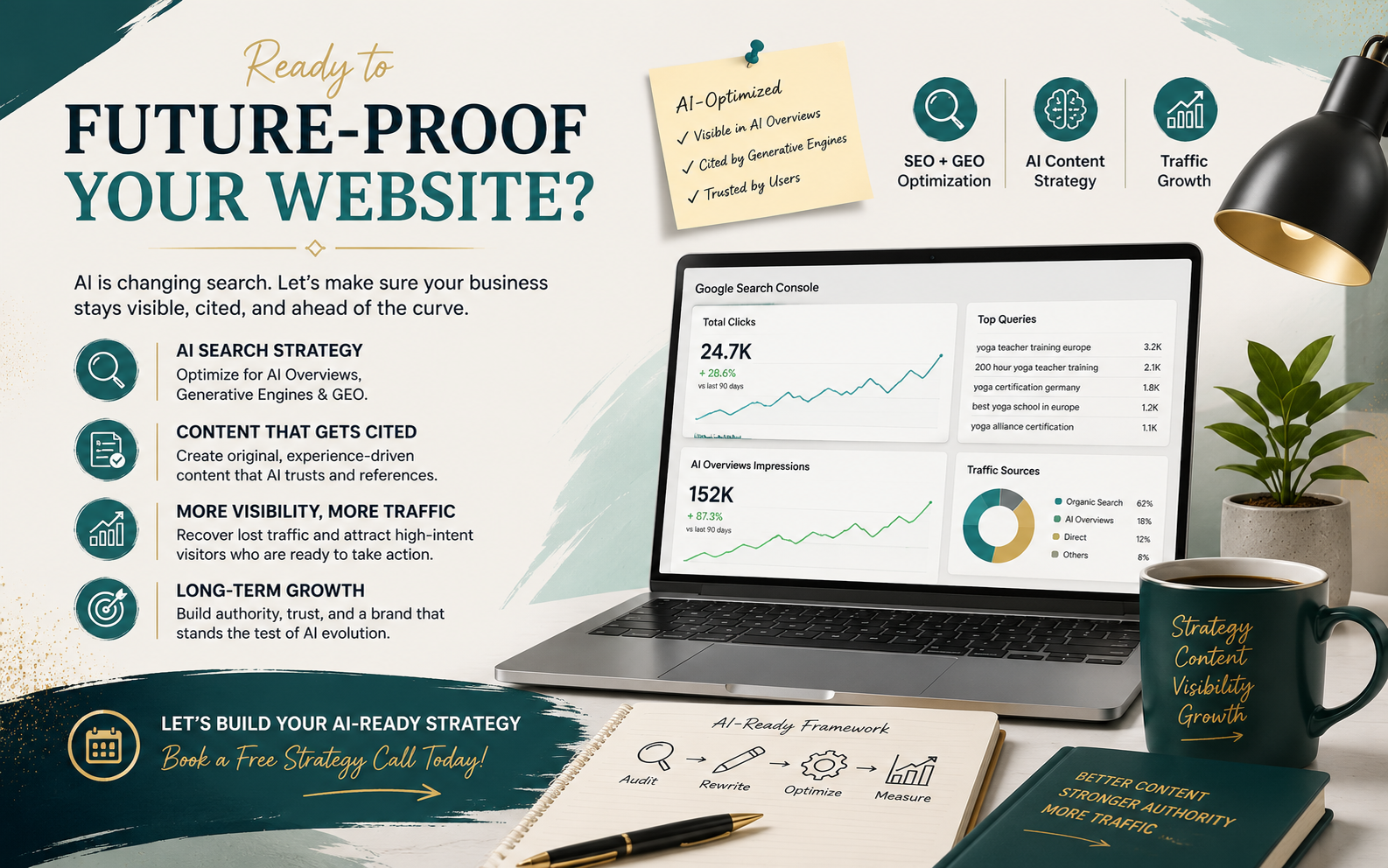
This is the exact process we ran for Anandam Yoga School. If your content is being answered instead of clicked, we can tell you honestly which pages are worth saving—and rewrite them to become citation-worthy.
A successful consulting website design immediately tells executive buyers who you help, the business outcomes you deliver, and why your consulting firm is the right choice. Decision-makers typically decide within the first few moments whether to continue exploring or leave, making homepage messaging one of the most influential factors in generating qualified discovery calls.
| Buyer Intent | Details |
|---|---|
| Buyer Stage | Consideration → Decision |
| Primary Goal | Find a consulting partner they can trust |
| Main Questions | Can this firm solve our problem? Why should we choose them? |
| Biggest Fears | Hiring the wrong consultant, poor ROI, unclear expertise |
| Buying Trigger | Confidence, credibility, and proven business understanding |
| Homepage Element | High-Converting Homepage | Low-Converting Homepage |
|---|---|---|
| Hero Headline | Business outcome focused | Generic slogan |
| Target Audience | Clearly identified | Everyone |
| Trust Signals | Visible immediately | Hidden below the fold |
| Industry Expertise | Immediately obvious | Difficult to understand |
| Call-to-Action | One clear next step | Multiple competing CTAs |
| Buyer Confidence | High | Low |
| Performance Area | Generic Homepage | Outcome-Driven Homepage |
|---|---|---|
| First Impression | Requires visitors to interpret the message | Clearly communicates value within seconds |
| Executive Confidence | Builds slowly | Builds immediately through clarity and proof |
| Above-the-Fold Experience | Generic slogans and limited context | Business outcomes, specialization, and trust signals |
| Buyer Engagement | Visitors often continue searching for relevance | Visitors quickly understand whether the firm fits their needs |
| Discovery Call Readiness | Low because of uncertainty | Higher because the next step is clear |
| Sales Conversations | More time spent explaining capabilities | More time discussing business challenges and solutions |
Across our consulting website audits, we’ve consistently found that homepages focusing on business outcomes, industry expertise, and visible trust signals create stronger first impressions than websites relying primarily on abstract marketing language. Clear positioning reduces uncertainty, helping executive buyers evaluate consulting firms more confidently before scheduling a discovery call.
If your website looks polished but still brings low-quality enquiries, the problem is usually structure, clarity, and trust. See how a conversion-focused consultant website design can help you filter better-fit clients before the first call.
Explore Consultant Website Design →Most consulting firms don’t lose opportunities because they lack expertise.
They lose opportunities because executive buyers cannot understand their expertise quickly enough.
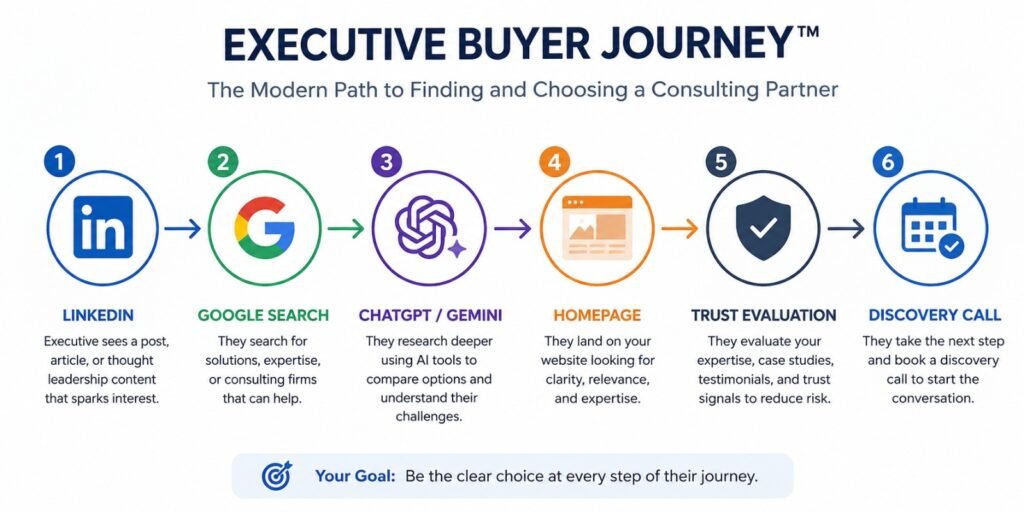
Today’s consulting buyers rarely arrive at your homepage without prior research. They may have discovered your firm through Google Search, LinkedIn, ChatGPT, Gemini, industry publications, referrals, or professional networks. By the time they reach your website, they aren’t casually browsing—they’re actively evaluating whether your firm deserves a conversation.
Within seconds, they’re asking themselves:
If your homepage doesn’t answer these questions immediately, buyers simply continue evaluating other firms.
At KG Web Designer, we specialize in conversion-focused website design for consulting firms, manufacturers, healthcare organizations, ecommerce brands, and professional service businesses. Across our consulting website audits, we’ve consistently found that firms with clear messaging generate stronger first impressions than firms relying primarily on creative design or corporate buzzwords.
Beautiful websites attract attention.
Clear messaging builds confidence.
Confidence generates enquiries.
The answer is simple: executive buyers purchase certainty before they purchase consulting services.
Professional design creates credibility, but messaging determines whether visitors continue reading or leave.
When decision-makers land on your homepage, they are not looking for creativity. They are looking for relevance.
A high-performing homepage immediately communicates:
When these answers aren’t obvious, buyers begin searching for clues elsewhere on the page.
Every additional second spent interpreting vague messaging increases uncertainty.
One common mistake we notice during website audits is consulting firms opening with headlines such as:
Driving Business Transformation
or
Helping Organizations Thrive Through Innovation
Although these statements sound impressive, they don’t explain anything meaningful.
Instead, compare that with:
Growth Consulting for Manufacturing Companies Looking to Improve Operational Efficiency.
The second headline immediately communicates audience, specialization, and business value.
Specificity builds trust.
During consulting website audits conducted over the past several years, we’ve consistently found that firms attracting higher-quality enquiries share four common characteristics:
Conversely, websites relying on inspirational headlines, broad service lists, and company-focused messaging often make buyers work harder to understand their value proposition.
The longer buyers spend trying to interpret your homepage, the more likely they are to continue evaluating competitors.
Executive buyers want clarity before detail.
Senior decision-makers are accustomed to evaluating proposals, vendors, and strategic partners quickly. They don’t expect to understand everything immediately, but they do expect to understand enough to decide whether your consulting firm deserves further attention.
The first screen of your homepage should answer these questions:
Rather than reading paragraphs of marketing copy, executives scan for signals that reduce risk and increase confidence.
These signals include:
The faster your homepage answers these questions, the easier it becomes for buyers to continue exploring your services.
“During consulting website audits, we repeatedly see firms invest heavily in premium branding while overlooking the messaging executives actually evaluate. The highest-performing consulting websites communicate business outcomes before discussing methodologies, making it easier for decision-makers to justify scheduling a discovery call. Clear positioning consistently outperforms clever copywriting because buyers are looking for confidence, not creativity.”
Kanika Gupta
Founder, KG Web Designer
One of the biggest misconceptions in consulting website strategy is assuming buyers arrive directly on your homepage.
Today’s executive journey is far more complex.
LinkedIn
      ↓
Google Search
      ↓
ChatGPT / Gemini
      ↓
Homepage
      ↓
Trust Evaluation
      ↓
Thought Leadership
      ↓
Discovery Call
Each stage answers a different question.
Your homepage is not the beginning of the buyer journey.
It’s the moment where buyers decide whether your consulting firm deserves their time.
Below is a simple comparison illustrating how small wording changes dramatically improve clarity.
| Generic Messaging | Decision-Maker Focused Messaging |
|---|---|
| We transform businesses. | Helping healthcare organizations improve operational performance. |
| Strategic consulting solutions. | Growth consulting for professional service firms expanding internationally. |
| Trusted advisors. | Helping manufacturers reduce operational inefficiencies through strategic process improvement. |
| Innovative business consulting. | Business advisory for founders preparing for expansion or acquisition. |
Notice the difference.
The stronger examples immediately communicate audience, expertise, and business outcomes.
That reduces uncertainty and accelerates trust.
“One of the biggest misconceptions consultants have is believing they’re selling experience. They’re actually selling confidence. Before buyers invest in your expertise, they need confidence that you understand their challenges, have solved similar problems before, and can deliver predictable outcomes. Your website should build that confidence within minutes, not after multiple sales calls.”
Imagine two consulting firms offering nearly identical strategic advisory services.
Firm A opens its homepage with:
Empowering organizations through innovative transformational excellence.
Firm B opens with:
Business growth consulting for manufacturing and healthcare organizations seeking operational efficiency and measurable profitability.
Although both firms may possess similar expertise, the second homepage immediately answers three critical questions:
The result is a smoother buyer journey, greater confidence, and a stronger likelihood that the visitor schedules a discovery call instead of returning to search results.
The answer is simple: most consulting websites are written from the firm’s perspective instead of the buyer’s.
Executive buyers don’t visit your website to learn your company history or admire creative copywriting. They want immediate reassurance that your consulting firm understands their industry, solves the problems they face, and has the expertise to deliver measurable business outcomes.
At KG Web Designer, we’ve reviewed consulting websites across management consulting, business advisory, digital transformation, operational excellence, HR consulting, financial consulting, and professional services. Despite serving different industries, the highest-performing websites share one characteristic: they remove uncertainty quickly.
The weakest websites make buyers think.
The strongest websites make buyers feel confident.
A consulting homepage should function like a structured executive conversation.
Every section should answer the next logical question in the buyer’s mind while steadily increasing confidence.
Below is the homepage structure we recommend for consulting firms.
| Homepage Section | Purpose |
|---|---|
| Executive Headline | Explain who you help and the business outcome. |
| Supporting Statement | Expand the value proposition with clarity. |
| Industries Served | Demonstrate relevance immediately. |
| Trust Signals | Reduce perceived risk through logos, testimonials, awards, or certifications. |
| Consulting Services | Explain solutions without overwhelming visitors. |
| Case Studies | Show measurable business impact. |
| Thought Leadership | Build long-term authority and expertise. |
| Consulting Process | Remove uncertainty around engagement. |
| Primary Call-to-Action | Encourage a Discovery Call or Strategy Session. |
Rather than overwhelming buyers with information, this structure gradually builds confidence while guiding them toward a single objective.
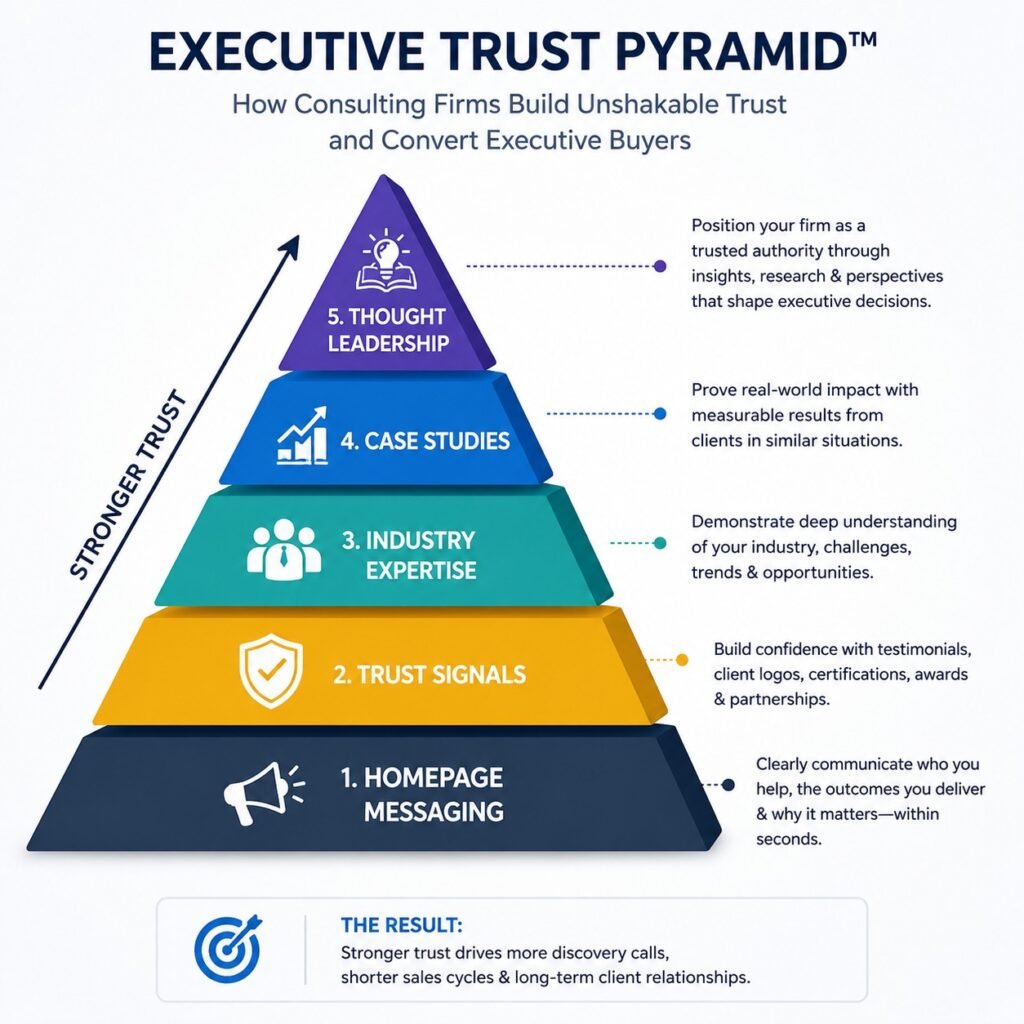
During consulting website audits, we’ve found that executive buyers build trust in predictable stages.
They rarely schedule a discovery call after seeing only one positive signal.
Instead, trust develops layer by layer.
          Thought Leadership
                 ▲
            Case Studies
                 ▲
        Industry Expertise
                 ▲
     Trust Signals & Proof
                 ▲
      Clear Homepage Messaging
Every layer strengthens the one above it.
Without clear homepage messaging, even outstanding case studies or impressive credentials struggle to generate enquiries because buyers never stay long enough to discover them.
Executive buyers are naturally risk-conscious because consulting engagements often involve significant investment, organizational change, and long-term partnerships.
Before scheduling a meeting, they evaluate signals that reduce uncertainty.
The most effective consulting websites prominently display:
One common mistake we notice is placing these trust indicators far below the fold.
Trust should begin within seconds, not halfway through the homepage.
“The strongest consulting websites never attempt to look bigger than they are. Instead, they make expertise impossible to ignore. When executives immediately understand your specialization, your thinking, and your track record, sales conversations begin with trust instead of skepticism. That single shift changes the quality of every inquiry.”
Before redesigning your consulting website, it’s worth understanding how investment levels influence positioning, functionality, and long-term lead generation. Our comprehensive pricing guide explains what solo consultants, boutique firms, and growing consultancies should realistically budget before starting a redesign.
During consulting website reviews, we repeatedly see firms emphasizing what they do rather than the business outcomes they create.
The consulting firms generating stronger executive enquiries usually communicate:
before discussing methodologies or internal processes.
That shift changes how executive buyers evaluate the business.
Instead of wondering,
“Can they help us?”
buyers begin asking,
“When can we speak with them?”
| Generic Messaging | Decision-Maker Messaging |
|---|---|
| We deliver innovative consulting solutions. | Helping professional service firms improve profitability through operational strategy. |
| Trusted business advisors. | Strategic advisory for founders preparing for international expansion. |
| Business transformation specialists. | Helping manufacturers streamline operations and improve executive decision-making. |
| Customer-focused consulting. | Growth consulting for organizations seeking measurable operational improvements. |
The wording isn’t dramatically different.
The clarity is.
Before launching your homepage, ask these questions.
| Question | Yes / No |
|---|---|
| Does the headline explain who you help? | ☐ |
| Does it communicate a business outcome? | ☐ |
| Is your specialization immediately visible? | ☐ |
| Are client logos above the fold? | ☐ |
| Are testimonials easy to find? | ☐ |
| Does the homepage include thought leadership? | ☐ |
| Is there one primary CTA? | ☐ |
| Does the buyer understand the next step? | ☐ |
| Are executive biographies accessible? | ☐ |
| Does the homepage feel written for decision-makers? | ☐ |
If several answers are “No,” your homepage is likely creating friction during the buying journey.
A visually attractive website may encourage visitors to stay for a few extra seconds.
Authority is what convinces them to book a meeting.
Executive buyers don’t hire consulting firms because they have beautiful websites.
They hire consulting firms because they appear credible, knowledgeable, and capable of solving complex business problems.
This is why authority-building content should always take priority over visual trends.
If you’re considering a redesign, our guide on Why Consultant Website Design Should Prioritize Authority Over Aesthetics in 2026 explores why positioning, expertise, thought leadership, and buyer trust consistently outperform design trends when attracting premium consulting engagements.
A beautiful homepage may win admiration.
An authoritative homepage wins clients.
One consulting firm approached KG Web Designer after investing in a professionally designed website that attracted visitors but generated very few qualified discovery calls.
During our homepage audit, we found that the visual design wasn’t the issue. The homepage opened with an abstract headline that focused on the firm’s philosophy rather than the business problems it solved. Trust signals, industries served, and the primary call-to-action were also positioned much lower on the page, requiring visitors to search for information before understanding the firm’s expertise.
We restructured the homepage by:
Following the redesign, the consulting firm’s homepage created a much clearer decision-making journey for executive buyers. Visitors were able to understand the firm’s specialization more quickly, engage with key content more confidently, and move naturally toward scheduling a discovery call.
Our experience reinforces a consistent lesson: for consulting firms, clarity of messaging often has a greater impact on lead quality than visual redesign alone.
“The strongest consulting websites don’t simply rank higher. They reduce uncertainty. Every article, service page, case study, and FAQ should answer another buyer question while reinforcing your expertise. That’s how websites become trusted resources instead of digital brochures.”
Winning consulting projects across the United States, United Kingdom, Australia, Canada, Singapore, and the UAE requires more than an impressive portfolio.
International buyers also assess whether your firm can collaborate effectively across borders.
During procurement, executive teams typically look for:
Addressing these concerns directly on your website reduces perceived risk and positions your consulting firm as a reliable international partner.
Your homepage is often the most influential page on your website because it shapes every decision that follows.
A homepage built around consulting website design for lead generation helps executive buyers quickly understand your expertise, trust your capabilities, and take the next step with confidence.
When messaging, authority, and buyer psychology work together, your website becomes more than an online brochure—it becomes a business development asset that supports longer B2B sales cycles, builds credibility, and generates higher-quality discovery calls.
If your consulting website attracts visitors but fails to generate qualified enquiries, the problem may not be your expertise.
It may be how your expertise is communicated.
At KG Web Designer, we help consulting firms create websites that combine strategic messaging, authority-building design, SEO, AI search optimization, and conversion-focused UX to attract executive buyers from the US, UK, Australia, Canada, Singapore, and the UAE.
A homepage audit can quickly reveal where clarity, trust, and buyer confidence are breaking down—and how to fix them before valuable opportunities are lost.
The answer is simple: most consulting firms believe their homepage should explain their business when it should instead help buyers make a decision.
Executive buyers aren’t searching for another consulting firm with an attractive website. They’re searching for confidence that your expertise aligns with their business objectives.
One common mistake we repeatedly observe is firms trying to communicate everything at once. They showcase every service, every industry, every methodology, and every company milestone, hoping something resonates.
Instead, successful consulting websites do the opposite.
They simplify.
They prioritize.
They answer the buyer’s biggest questions first.
When your homepage reduces uncertainty, every subsequent page becomes more persuasive.
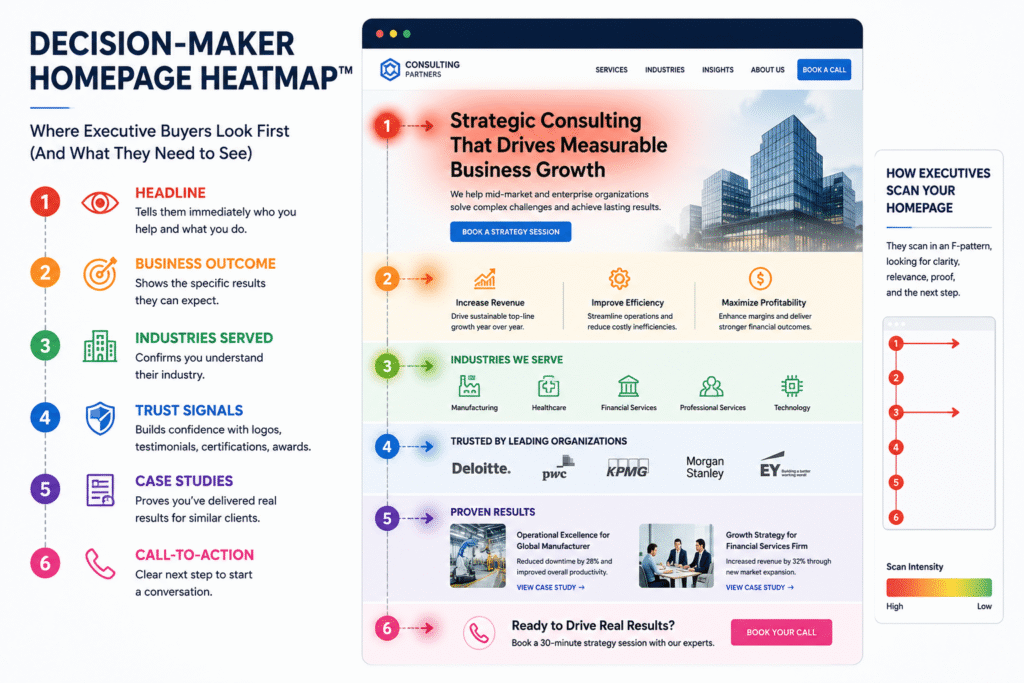
Based on our consulting website audits, executive buyers naturally scan homepage content in a predictable sequence.
Headline
      ↓
Business Outcome
      ↓
Industries Served
      ↓
Executive Trust Signals
      ↓
Case Studies
      ↓
Thought Leadership
      ↓
Discovery Call
Notice what’s missing.
Very few buyers start by reading your company’s history or lengthy descriptions of consulting methodologies.
They first want confidence that they’re in the right place.
Before publishing your homepage, review it using this framework.
| Homepage Question | Status |
|---|---|
| Does the headline clearly identify your ideal client? | ☐ |
| Is the primary business outcome immediately obvious? | ☐ |
| Are industries served visible above the fold? | ☐ |
| Are executive trust signals easy to find? | ☐ |
| Are case studies highlighted early? | ☐ |
| Does the homepage demonstrate thought leadership? | ☐ |
| Is there only one primary CTA? | ☐ |
| Can a decision-maker understand your value within 10 seconds? | ☐ |
If several answers are “No,” your homepage is likely creating unnecessary friction during the buying journey.
Trust is earned through consistency rather than a single design element.
Executive buyers compare multiple consulting firms before scheduling a discovery call, and they evaluate much more than visual design.
The strongest consulting homepages consistently include:
Every one of these elements reduces perceived risk.
Together, they create confidence.
Imagine a CEO searching for operational consulting after experiencing declining profitability.
The CEO discovers three consulting firms through Google and ChatGPT.
The first website opens with:
Transforming organizations through innovative excellence.
The second highlights dozens of consulting services without explaining who they help.
The third immediately communicates:
Operational strategy consulting for manufacturing companies seeking sustainable profitability and operational efficiency.
Within moments, the CEO understands:
The third homepage creates clarity before competitors have explained themselves.
That clarity often determines who receives the discovery call.
A professional consulting firm contacted KG Web Designer because their website attracted visitors but generated very few qualified enquiries.
Following our homepage audit, we discovered that the issue wasn’t website traffic or visual quality.
The homepage spent most of its space describing the firm’s history, internal philosophy, and consulting framework while providing very little information about client outcomes.
We reorganized the homepage around:
The redesigned messaging made the firm’s expertise easier to understand, reduced buyer uncertainty, and created a much clearer path toward initiating conversations.
This reinforces something we frequently see across consulting website projects:
Clear positioning consistently creates better opportunities than complicated messaging.
The answer depends on how your consulting business wins new clients.
Founder-led consulting practices often benefit from highlighting the founder’s expertise because executive buyers want confidence in the individual who will guide their project.
Larger consulting organizations usually benefit from showcasing collective expertise, multidisciplinary capabilities, and team experience.
There isn’t a universal solution.
The right decision depends on your positioning strategy, service model, and buyer expectations.
If you’re evaluating both approaches, our article on Personal Brand vs Firm Brand Website: Which Wins More High-Value Clients? explains when founder branding creates stronger trust and when organizational branding delivers greater long-term credibility.
The highest-performing consulting homepages guide buyers through a structured decision journey.
Executive Buyer
      ↓
Clear Value Proposition
      ↓
Business Outcomes
      ↓
Industries Served
      ↓
Trust Signals
      ↓
Case Studies
      ↓
Thought Leadership
      ↓
Discovery Call
Every section should answer the next question executive buyers naturally ask.
When this journey feels effortless, your homepage becomes a powerful lead-generation tool rather than simply an online brochure.
Your homepage is often the first meaningful interaction prospective clients have with your consulting firm.
If your messaging quickly communicates expertise, business outcomes, and credibility, buyers are far more likely to continue exploring your services.
If it creates uncertainty, they’ll continue evaluating competitors.
At KG Web Designer, we’ve found that consulting firms rarely need more website traffic.
They need clearer positioning.
They need stronger trust signals.
They need messaging that helps executive buyers make confident decisions.
When those elements work together, your homepage supports lead generation, strengthens authority, and becomes an asset that contributes directly to long-term business growth.
A consulting website design homepage has one primary responsibility:
Help executive decision-makers understand why your business is the right strategic partner.
The firms generating the highest-quality enquiries aren’t necessarily those with the most visually impressive websites.
They’re the ones that communicate expertise, business outcomes, and credibility with exceptional clarity.
If your current homepage isn’t generating the quality of conversations your consulting business deserves, it may be time to rethink your messaging rather than simply redesign your visuals.
At KG Web Designer, we help consulting firms build websites that combine strategic messaging, SEO, AI search optimization, and conversion-focused UX to attract premium clients across the United States, United Kingdom, Australia, Canada, Singapore, and the UAE.
Ready to turn your homepage into your strongest business development asset?
Book a Strategy Call:
https://calendly.com/kanika-kgwebdesigner/30min
Contact Kanika Gupta:
https://kgwebdesigner.com/contact-me/
If your website is attracting traffic but not the right enquiries, it is time to improve the messaging, trust signals, and conversion flow. I help consultants build websites that support premium positioning and better-fit leads.
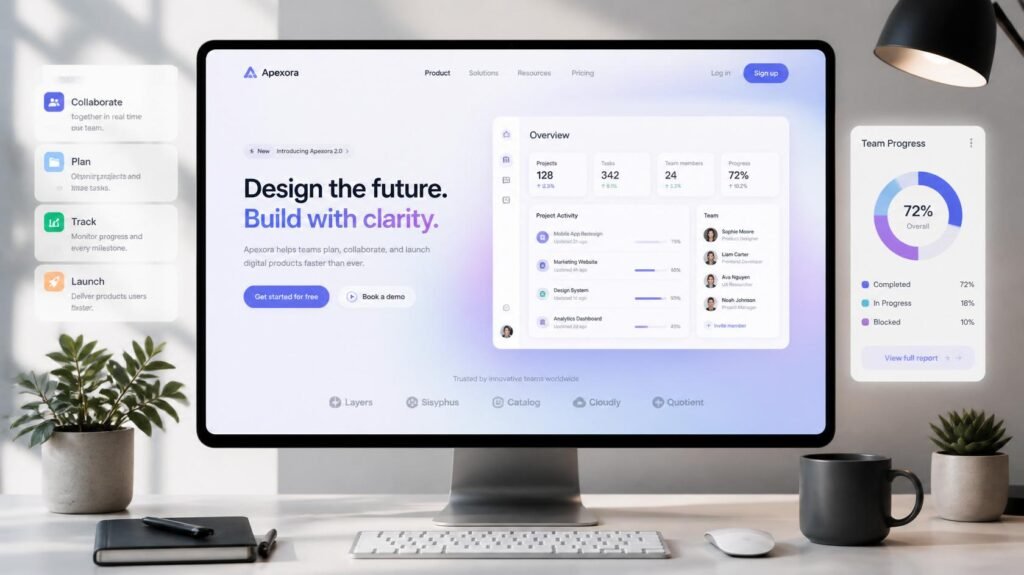
A consulting homepage should immediately explain who you help, the business problems you solve, and the outcomes clients can expect. Clear messaging reduces uncertainty and encourages executive buyers to continue exploring your services.
Design creates the first impression, but messaging determines whether buyers understand your expertise. Without clear positioning, even an attractive website may struggle to generate qualified discovery calls.
There is no ideal length. Instead, the homepage should answer executive buyers’ questions in the order they naturally evaluate consulting firms, with clear messaging above the fold and supporting proof further down the page.
The most effective consulting websites include client testimonials, case studies, industry expertise, executive biographies, thought leadership, certifications, speaking engagements, and a transparent consulting process.
Improving conversions starts with clearer positioning, stronger trust signals, simplified navigation, and a single primary call-to-action that guides buyers toward scheduling a discovery call.
Most consulting firms should review homepage messaging annually or whenever they refine their positioning, expand into new industries, launch new services, or identify changes in buyer behavior.