Quick Answer
Shopify templates are usually the better choice when you need to launch quickly, validate a product, or keep the initial investment controlled. Custom ecommerce design becomes more valuable when your brand has established demand but the existing template limits conversion, differentiation, mobile UX, performance, or scalability. The right choice is not about which option costs less upfront. It is about which website can support your next stage of profitable growth.
Key Takeaways (Quick Wins)
- Shopify templates are ideal for quick launches but limit long-term scalability
- Custom ecommerce websites are built for conversion, differentiation, and higher ROI
- The real decision is not cost—it’s how much revenue your website can generate
- Templates help you start, but custom design helps you scale profitably
- Overseas markets (US/UK/AU) demand high-performance, trust-driven ecommerce experiences
Why This Decision Impacts Your Revenue More Than You Think
Verdict: Choosing between templates and custom design directly impacts your conversion rate, profitability, and long-term scalability.
Most founders compare price and speed. High-growth brands compare outcomes.
Your website controls:
- Conversion rate
- Average order value (AOV)
- Customer trust
- Marketing efficiency
If your site converts poorly, every paid click becomes more expensive.
Example:
- 1% → 100 sales per 10,000 visitors
- 2% → 200 sales
Same traffic. Double revenue.
That’s why custom ecommerce website design vs shopify templates is a profit decision.
Understanding the Core Difference Between Templates and Custom Design
Verdict: Templates prioritize speed; custom design prioritizes performance and scalability.
Shopify templates are pre-built for mass usage. They’re fast but generic.
Custom ecommerce design is built around:
- Your audience
- Your product
- Your funnel
- Your conversion goals
You don’t fit into the template. The system fits your business.
The difference between template-based stores and custom ecommerce experiences becomes obvious when comparing market leaders. Our review of the 15 Best Ecommerce Website Designs in 2026 showcases brands that invest in unique user experiences to strengthen their competitive advantage.
Custom Ecommerce Website vs Shopify Templates (Full Strategic Comparison)
Verdict: Templates are efficient for launch, but custom wins in conversion, SEO, and scale.
| Factor | Shopify Templates | Custom Ecommerce Website |
|---|---|---|
| Launch Speed | Fast | Moderate |
| Cost | Lower upfront | Higher investment |
| UX Strategy | Generic | Conversion-driven |
| Branding | Limited | Unique |
| SEO | Basic | Advanced |
| GEO (AI visibility) | Limited | Optimized |
| Core Web Vitals | App-heavy | Optimized |
| AI Search Visibility | Weak | Structured |
| Scalability | Restricted | Unlimited |
| ROI | Inconsistent | Predictable |
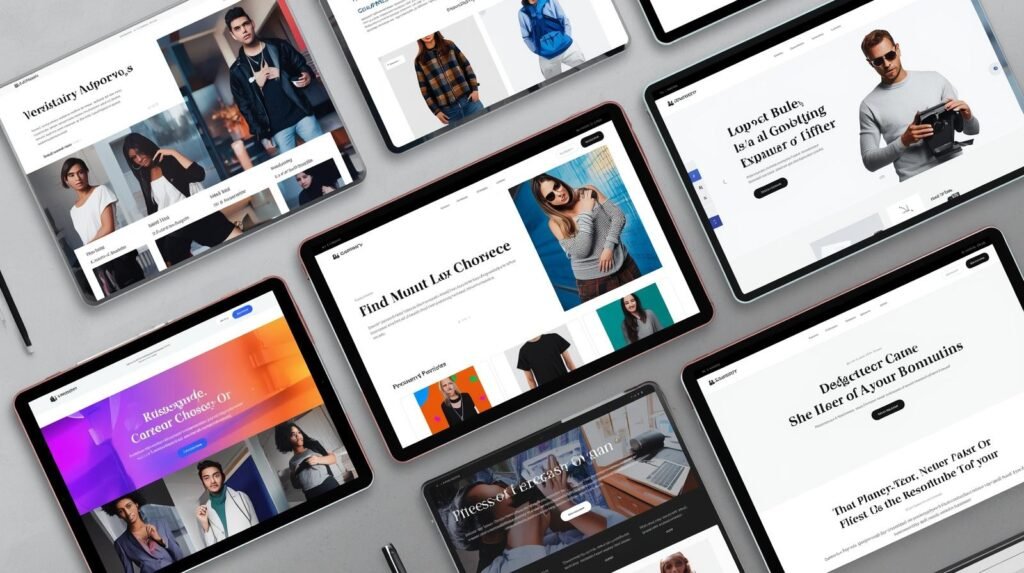
Expert Advice from Kanika Gupta
My advice is to stop treating “Shopify template vs custom website” as a purely design decision. I would first identify where the store is actually losing money.
If product pages are weak, fix the product experience. If mobile navigation is creating friction, solve the mobile journey. If the theme prevents you from presenting products, proof, bundles, merchandising, or brand positioning properly, then a larger redesign becomes easier to justify.
At KG Web Designer, we frequently see businesses jump to a complete redesign because the current website looks dated. That can be an expensive way to solve the wrong problem.
If this were my website, I would measure the buying journey first, identify the highest-value friction point, and only then decide whether the store needs optimization or a complete rebuild.
A custom website should earn its investment by giving the business better control over conversion, positioning, performance, and future growth. It should not simply look more expensive.
Kanika Gupta, Founder, KG Web Designer
Why this improves the article
This adds something the current article is missing: a clear expert judgment before the reader reaches the redesign recommendation.
It also prevents the article from sounding as though every scaling Shopify store automatically needs custom development.
When Shopify Templates Are the Right Choice (And When They’re Not)
Verdict: Templates are ideal for validation but not for scaling.
Use templates if you are:
- Testing a product
- Launching quickly
- Running short-term experiments
But once you have traffic, problems appear:
- Low conversions
- High bounce rate
- Weak differentiation
At that point, templates become a bottleneck.
Whichever route you choose, a store should not go live simply because the design looks finished. Before sending paid traffic, use this Shopify pre-launch checklist to verify mobile UX, real test orders, payments, shipping, analytics, SEO, waitlist forms and Klaviyo flows.
However, outgrowing a Shopify template does not automatically mean that the entire store needs to be redesigned. If your architecture, SEO foundation, and theme are still working but product pages are struggling to convert, targeted optimization may be the smarter first investment. Our guide, Should I Redesign My Shopify Store or Fix the Product Pages First?, provides a practical framework for determining whether the problem is the store itself or the pages where customers make their purchase decisions.
The Hidden Limitations of Shopify Templates (That Cost You Revenue)
Verdict: Templates introduce structural limitations that reduce performance as you scale.
1. Lack of Differentiation
Your site looks like thousands of others.
In competitive markets, average design = average revenue.
2. Limited Conversion Control
You cannot fully optimize:
- Product pages
- Funnels
- Checkout flow
This limits growth.
3. App Dependency = Technical Debt (Deep Dive)
Verdict: App-heavy Shopify stores accumulate technical debt that slows performance and hurts SEO.
Every Shopify app injects scripts into your theme using Liquid templates.
Over time:
- Script tags increase
- DOM becomes bloated
- Deleted apps leave residual code
In 2026, Google’s Interaction to Next Paint (INP) metric is critical.
More scripts = slower interaction = lower rankings.
Custom builds use:
- Vanilla JavaScript or React/Next.js
- Clean, modular code
- Minimal dependencies
Result: faster, cleaner, scalable websites.
4. Scaling Limitations
Templates struggle with:
- Advanced features
- Integrations
- Custom UX
Most brands rebuild within 12–18 months.
For brands selling to distributors, resellers, or business customers, platform scalability also depends on the purchasing experience the store needs to support. Requirements such as account-specific pricing, volume discounts, bulk ordering, and buyer permissions can influence whether a standard setup is sufficient or a more tailored implementation is justified. Our guide to B2B ecommerce account logins and wholesale pricing tiers explains the features wholesale buyers actually check before placing an order.
Why Custom Ecommerce Website Design Wins for Scaling Brands
Verdict: Custom ecommerce Website design maximizes conversions, performance, and long-term growth.
Conversion Rate Optimization (CRO)
Custom UX enables:
- Strategic layouts
- Smart CTAs
- Reduced friction
Higher conversion rates.
Brand Authority
Custom design builds:
- Trust
- Premium perception
- Differentiation
Higher AOV and customer loyalty.
Headless Commerce & Composable Architecture
Verdict: Headless commerce allows faster performance and unlimited flexibility.
Headless architecture separates:
- Frontend (what users see)
- Backend (Shopify engine)
Benefits:
- Ultra-fast performance
- Omnichannel selling
- Flexible UX
This is the future of scalable ecommerce.
If you want a website built for performance, explore our ecommerce website design services to see how we structure high-converting stores.
Real Cost vs Real Value
Verdict: Low-cost websites often create higher long-term losses if they don’t convert.
Most founders compare upfront price. Growth-focused brands compare ROI.
Typical 2026 pricing benchmarks:
- $6,000 – $10,000 → Custom ecommerce for growing brands
- $10,000 – $20,000+ → Advanced builds with CRO and integrations
- $20,000+ → Headless / high-scale ecommerce systems
A higher-performing website can recover this investment through improved conversion rates and lower CAC.
For a full breakdown, see the blog Ecommerce Website Design Cost in 2026.
Customer Psychology: The 3 Stages of Conversion Funnel
Verdict: Custom design aligns with user psychology across all funnel stages.
Top of Funnel:
- Educational landing pages
Middle of Funnel:
- Interactive tools (quizzes, comparisons)
Bottom of Funnel:
- Slide-out carts
- One-click checkout
Each stage is optimized for conversion.
Regional Compliance & Global Logic
Verdict: Custom ecommerce websites handle global compliance more effectively than templates.
US Market:
- Sales tax complexity (Nexus)
- Tools like Avalara/TaxJar
UK/EU Market:
- GDPR compliance
- Server-side tracking (GTM)
AU Market:
- BNPL (Afterpay)
- Installment pricing visibility
Templates struggle with this complexity.

Confused Between Custom Ecommerce vs Shopify?
Choosing the right platform can directly impact your sales, scalability, and long-term growth. Get expert guidance on whether a custom ecommerce website or Shopify is the right fit for your business goals.
What Overseas Customers Expect in 2026
Verdict: Speed, trust, and seamless UX are mandatory.
Customers expect:
- Fast load speeds
- Mobile-first UX
- Transparent policies
- Secure payments
Templates meet some expectations not all.
Mobile-First UX (Advanced)
Verdict: Mobile UX determines conversion success.
Modern UX includes:
- Thumb-zone navigation
- Micro-interactions
- App-like experience
Custom sites outperform templates here.
10 Signs You’ve Outgrown Your Shopify Template
Verdict: If your store is generating traffic but not scaling revenue efficiently, your Shopify template is likely holding you back.
Many ecommerce founders stay on templates longer than they should not because they’re working, but because switching feels like a big decision.
But here’s the reality:
Templates are built for launching, not for scaling
If your business has moved beyond the early stage, your website needs to evolve with it.
Below are the 10 clear signs that you’ve outgrown your Shopify template and it’s time to upgrade to a conversion-focused Ecommerce Website Design.
1. You Have Traffic, But Conversions Are Stuck
You’re investing in ads, SEO, or social media and traffic is coming in.
But your conversion rate isn’t improving.
This usually means your website is not optimized for how users actually make buying decisions.
Templates don’t adapt to your audience they force your audience into a fixed structure.
2. Your Website Looks Like Your Competitors
If your store feels “similar” to others in your niche, that’s a problem.
Templates are widely used.
This leads to:
- Weak brand identity
- Low differentiation
- Reduced trust
In competitive markets like the US and UK, looking average means losing sales.
3. Mobile Experience Feels Clunky or Slow
Most ecommerce traffic is mobile.
If your website:
- Loads slowly
- Feels hard to navigate
- Has awkward layouts
You’re losing a large percentage of potential customers.
Templates often lack advanced mobile UX like:
- Thumb-zone design
- Sticky CTAs
- Smooth micro-interactions
4. You Rely on Too Many Apps
If your Shopify store depends on multiple apps to function properly, it’s a red flag.
Each app adds:
- Extra scripts
- Slower load time
- Technical complexity
This creates technical debt, making your website slower and harder to manage.
5. Your Page Speed Is Declining
Speed is directly tied to conversions.
If your pages take more than 3 seconds to load:
Users leave before engaging.
Templates with multiple apps and scripts often fail performance benchmarks like Core Web Vitals and INP.
6. You Can’t Customize the User Journey
You want to:
- Rearrange product sections
- Add custom layouts
- Improve checkout flow
But your template limits what you can do.
This prevents you from optimizing for conversions.
Custom websites allow full control over how users navigate and purchase.
7. High Cart Abandonment Rates
If users are adding products to cart but not completing purchases:
Your checkout experience is likely the issue.
Templates often use:
- Standard cart pages
- Multi-step checkout flows
Custom UX can include:
- Slide-out carts
- One-click checkout
- Simplified flows
These significantly reduce abandonment.
8. Your Branding Feels Weak or Inconsistent
As your business grows, branding becomes more important.
If your website doesn’t reflect:
- Your positioning
- Your value
- Your uniqueness
Customers won’t perceive your brand as premium.
Templates limit your ability to build a strong visual identity.
9. SEO Growth Has Plateaued
If your organic traffic has stopped growing, your website structure may be the issue.
Templates often have:
- Limited content flexibility
- Poor internal linking structure
- Slower performance
This affects both search rankings and AI visibility.
Custom websites allow deeper SEO optimization and structured content.
10. You’re Already Thinking About a Redesign
This is the biggest sign of all.
If you’re constantly thinking:
- “This could look better”
- “We need something more advanced”
- “Our site doesn’t reflect our brand anymore”
You’ve already outgrown your current setup.
The Turning Point
Most ecommerce brands hit this stage between:
$250K – $1M in annual revenue
At this point:
- Traffic is consistent
- Marketing is working
- But the website becomes the bottleneck
What Happens If You Ignore These Signs?
If you continue using a system that doesn’t scale:
- Conversion rates stagnate
- Marketing costs increase
- Competitors outperform you
You don’t just stay where you are you fall behind.
The Opportunity
Recognizing these signs early gives you an advantage.
Because when you move to a conversion-focused custom ecommerce website, you unlock:
- Higher conversion rates
- Better customer experience
- Stronger brand positioning
- Increased revenue without increasing traffic
Ready to Launch Your Ecommerce Website?
Whether you choose Shopify or a custom ecommerce solution, we help you design a high-converting online store that drives traffic, builds trust, and increases sales.
Bottom Line
Templates are great for getting started.
But scaling requires a system built for performance.
If your store is showing even a few of these signs:
It’s not a design problem it’s a growth limitation.
Real Migration Case Study
A US-based DTC skincare brand migrated from a Shopify template to a custom headless ecommerce build.
Results within 90 days:
- Page load time reduced from 4.2s → 1.1s
- Mobile conversion rate increased from 1.4% → 2.9%
- Customer Acquisition Cost (CAC) dropped by 22%
Same traffic. Higher efficiency. Better profitability.
This is the real impact of moving from a generic template to a conversion-focused system.
Verdict: Custom websites, be it Jewellery Ecommerce Website design or Fashion Apparel Website Design, perform better in AI search due to structured data and clean code.
AI engines prioritize:
- Schema markup
- Clean DOM
- Entity optimization
Custom builds win here.
FAQ – Custom Ecommerce Website vs Shopify Templates
Is Shopify or custom better for SEO?
Custom ecommerce websites allow deeper technical SEO, cleaner code, and faster performance. Shopify templates rely on apps that can slow pages and limit optimization.
What is the average timeline?
Shopify templates can launch in 1–2 weeks. Custom ecommerce websites typically take 4–10 weeks depending on complexity and integrations.
Can I migrate without losing SEO?
Yes, with proper URL mapping, redirects, and technical SEO setup, you can migrate without losing rankings and often improve them.
Does custom design reduce CAC?
Yes. Higher conversion rates mean you need less traffic to generate the same revenue, which lowers your customer acquisition cost.
How much does a custom ecommerce website cost vs Shopify?
Shopify templates have lower upfront costs, but custom ecommerce websites typically range from $6,000 to $20,000+ depending on features and scalability.
Is headless commerce worth it for small brands?
Headless is best for scaling brands. Smaller brands can start with custom builds and upgrade to headless when performance and flexibility become critical.
What’s the difference between Shopify Plus and custom design?
Shopify Plus is a premium version of Shopify, but still template-based. Custom design gives full control over UX, performance, and integrations.
Will I lose data when switching from Shopify templates?
No. Products, customers, and order data can be migrated safely with proper planning and tools.
Glossary (2026 Terms)
- INP: Interaction responsiveness metric
- Headless Commerce: Decoupled frontend/backend
- Composability: Modular architecture
- Server-Side Tracking: Accurate analytics
- Schema Markup: Structured SEO data
Final Thoughts
Verdict: This is a revenue decision not a design choice.
Templates help you start.
Custom design helps you scale.
Choose based on where you want to go.
Ready to Build a High-Converting Ecommerce Website?
👉 Get your top 3 conversion leaks identified.