
Quick Answer
A professionally built small-business website in 2026 can cost anywhere from $500 for a focused starter project delivered by a remote freelancer to $40,000+ for a strategy-led agency build. Most custom, lead-generation-focused small-business websites fall somewhere between $2,500 and $15,000, while ecommerce, multilingual, membership, booking, portal and custom-integration projects can cost substantially more.
The number of pages matters, but it is rarely the biggest price driver. Strategy, copywriting, custom design, functionality, SEO migration, accessibility, performance, integrations, content entry and post-launch support usually have a greater effect on the final quotation.
Not Sure What Your Business Website Should Cost?
Share your business goals, required pages and important features. I’ll help you understand the right scope, likely investment and whether you need a freelancer, agency or phased website plan.
Here are practical 2026 planning ranges for a professional 5–10-page business website:
| Market | Experienced freelancer or small specialist | Established agency | Typical local question |
|---|---|---|---|
| United States | US$3,000–US$15,000 | US$10,000–US$40,000+ | “What is a reasonable price for a small-business website?” |
| United Kingdom | £2,000–£10,000 | £7,500–£30,000+ | “Is £2,500 fair for a WordPress rebuild?” |
| Canada | C$3,000–C$13,000 | C$9,000–C$35,000+ | “Is C$4,000 enough for a business website?” |
| Australia | A$3,500–A$15,000 | A$10,000–A$40,000+ | “What should an A$3K–A$8K website deliver?” |
| UAE | AED 6,000–AED 30,000 | AED 20,000–AED 75,000+ | “What should a non-ecommerce company website in Dubai cost?” |
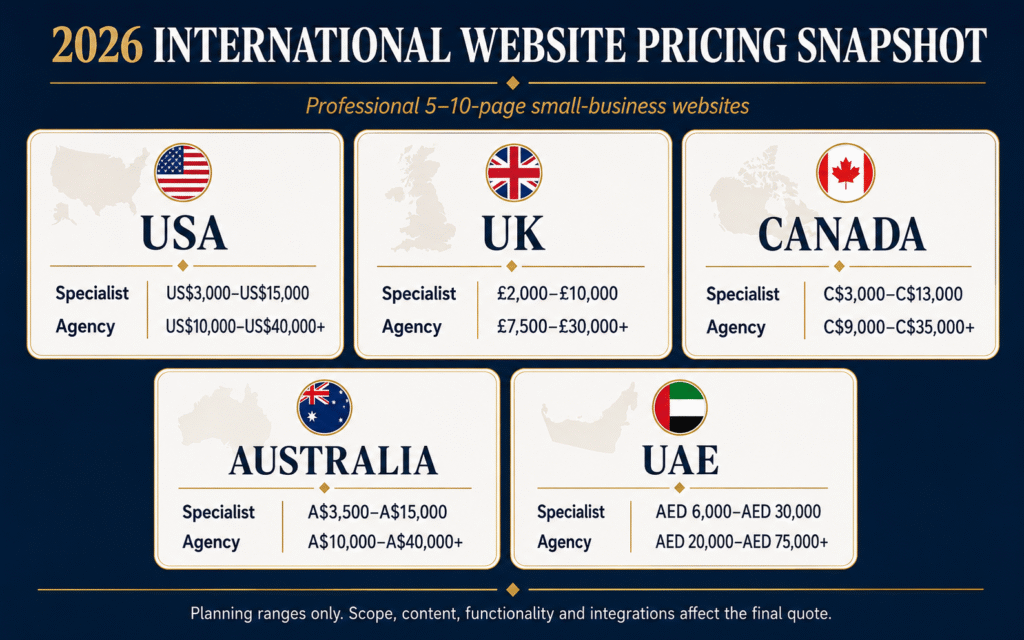
These are budget-planning ranges, not fixed tariffs or guaranteed market averages. They assume a professional small-business website – not a custom web application – and they exclude tax, complex integrations and large-scale content production unless stated otherwise.
A capable remote specialist may charge below local-market ranges because geography and overhead differ, but the comparison is only meaningful when the scope, experience and deliverables are equivalent.
A professional website should not only look better; it should make the business easier to verify and safer to choose. See what makes a small-business website trustworthy before comparing a low-cost build with a professionally planned website.
TL;DR: What Small Businesses Should Know Before Comparing Quotes
- A five-page website is not automatically a simple website. Five strategically planned pages can require more work than twenty template-based pages.
- A low quote may exclude copywriting, SEO, image licensing, analytics, redirects, testing, training or support.
- A high quote is not automatically better. It should be justified by stronger research, custom work, expertise, accountability or measurable business requirements.
- For a standard lead-generation website, freelancers and specialist studios often provide more direct senior involvement and lower overhead than a large agency.
- Agencies make more sense when a project needs a multi-disciplinary team, extensive workshops, enterprise governance or several complex workstreams running at once.
- Ecommerce should be priced separately from a brochure or lead-generation website because products, payments, tax, shipping, email flows and operational integrations increase scope.
- Compare quotations by deliverables, assumptions and exclusions-not by total price alone.
- Budget for the first year of ownership, not only the build: domain, hosting or platform fees, premium tools, maintenance, security and content updates continue after launch.
The most useful question is not “How much does a website cost?” It is “What business job must this website perform, and what scope is required to perform it reliably?”
Why Website Quotes Vary From $500 to $50,000+
Two providers can both quote for a “10-page WordPress website” and still be selling fundamentally different projects.
One may install a template, place client-supplied text into it, connect a contact form and launch. Another may research the audience, map the buying journey, restructure the services, write conversion-focused copy, create a custom visual system, build reusable page templates, migrate SEO safely, improve accessibility, configure analytics and test the website across devices.
Both deliver ten pages. Only the second quotation includes the strategic and technical work surrounding those pages.
Public pricing data shows how wide the market is. Clutch’s July 2026 web design pricing guide reports agency projects ranging from US$2,000 to US$100,000 and notes that many reviewed projects cost below US$10,000. It also lists a common agency hourly band of US$100–US$149.
At the marketplace end, Upwork lists a typical web designer rate of US$15–US$30 per hour and shows business website projects commonly listed around US$1,500–US$5,000.
Those figures should not be treated as a universal rate card. They demonstrate that “web design” includes very different experience levels, business models and deliverables.
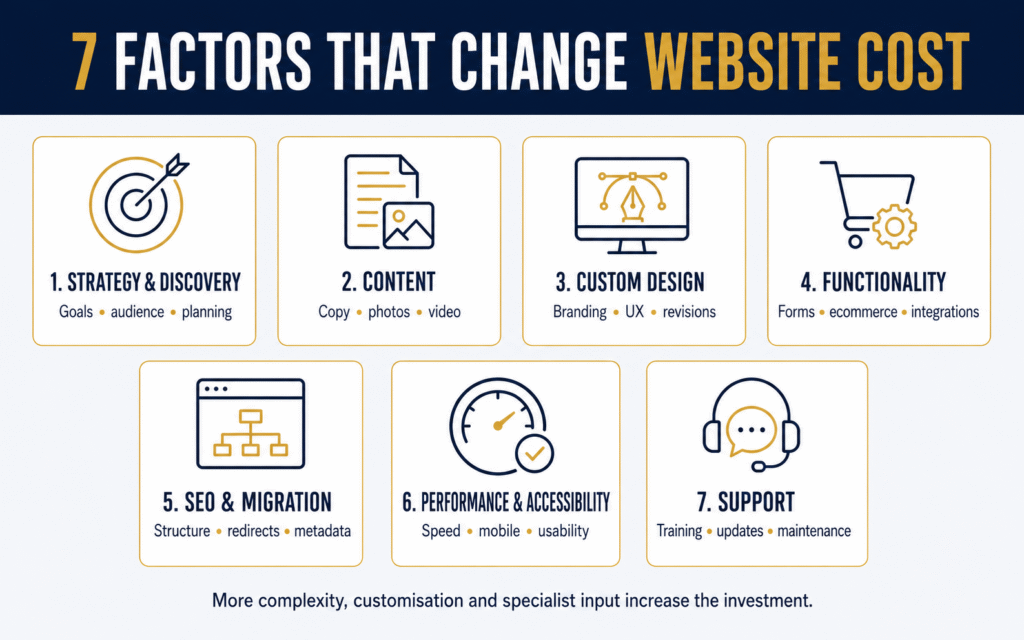
The Seven Variables That Change Website Cost Most
1. Business strategy and discovery
A provider who begins with “Which template do you like?” is pricing a different service from one who studies your customers, competitors, positioning, conversion goals and sales process.
Discovery can include stakeholder interviews, competitor reviews, analytics analysis, customer-question research, conversion planning and content prioritisation. This work increases the initial cost but reduces expensive design revisions and unclear messaging later.
2. Content responsibility
“Content included” can mean anything from basic editing to full research, interviews, brand messaging, SEO copywriting and final content entry.
Clarify who will:
- define the sitemap;
- write each page;
- approve claims and statistics;
- source or produce images;
- upload and format content;
- write metadata and image alt text;
- create legal pages;
- migrate existing articles or resources.
If the client supplies final copy and images, the project can cost less. If the provider must turn unstructured notes into persuasive, search-ready pages, the budget should reflect that expertise and time.
3. Design originality
A professionally configured template can be appropriate for a new business with a limited budget. A custom interface costs more because the designer develops a visual system around the brand, audience and content instead of forcing the content into a pre-made layout.
Custom design becomes more valuable when the business has premium positioning, complex services, multiple audiences, strong competitors or an established identity that should not look interchangeable with other companies.
4. Functionality and integrations
A contact form is different from a conditional quotation tool. A booking button is different from a multi-location appointment system. A product catalogue is different from a complete ecommerce operation.
Common features that increase scope include:
- online booking and calendar logic;
- ecommerce, tax, shipping and payment gateways;
- membership or gated content;
- multilingual content and right-to-left Arabic layouts;
- CRM and marketing automation;
- customer portals or dashboards;
- directories, filters and advanced search;
- API integrations;
- document uploads and automated PDF generation;
- subscription or rental workflows;
- custom calculators and conditional forms.
5. SEO, migration and AI-search readiness
“SEO-friendly” should mean more than installing a plugin. A serious SEO-ready build may include keyword-to-page mapping, information architecture, metadata, schema, internal linking, image optimisation, crawl controls, XML sitemaps, redirect planning and preservation of valuable URLs.
Redesigning an existing site can cost more than building a new starter site because traffic, backlinks, rankings, analytics and conversion paths must be protected. Read Website Redesign vs Rebuild vs New Website before accepting a redesign quote that says nothing about migration.
Content prepared for modern discovery should also answer real buyer questions clearly, use descriptive headings, cite reliable sources, demonstrate first-hand expertise and connect related topics.
That improves usefulness for traditional search, voice queries and AI-assisted research without resorting to repetitive keyword stuffing.
6. Performance, accessibility and quality assurance
A website is not finished simply because it looks correct on the designer’s laptop.
Professional quality assurance includes responsive testing, current browsers, form delivery, keyboard use, readable contrast, image behaviour, analytics, redirects, cookie or privacy tools where required, and backups before launch.
Google’s published “good” Core Web Vitals targets are an LCP within 2.5 seconds, INP below 200 milliseconds and CLS below 0.1. A provider cannot promise identical scores on every device and connection, but a quotation should explain the performance work and testing approach.
Accessibility also changes scope. The W3C recommends WCAG 2.2 as the current conformance target. If your business has a contractual or legal accessibility requirement, specify the intended conformance level and testing process in writing. Do not assume “accessible” is included because the theme is labelled accessible.
7. Project management and support
Senior oversight, scheduled communication, documentation, training and post-launch support all carry value. So do response time, continuity and accountability.
A solo specialist usually gives you direct access to the person doing the work. An agency may provide an account manager, strategist, designer, copywriter and developer. Neither model is automatically superior; the right one depends on the project’s coordination needs.
What If Your Existing Website Was Built With AI?
An AI-generated website may look modern and still struggle to generate enquiries. The problem is often not AI itself, but unclear messaging, weak conversion paths, poor mobile refinement, missing trust signals, limited SEO control or generated code that becomes difficult to maintain.
Some AI-built websites can be improved through better copy, UX, mobile design, SEO and tracking. Others are more economical to rebuild professionally in WordPress, Wix, Shopify or a suitable custom framework-particularly when the business cannot properly manage its pages, integrations, URLs, analytics or source files.
Before spending more on the existing website, determine:
- whether the platform can support the business for the next two to three years;
- whether you own the domain, content, analytics and website files;
- whether search engines can properly crawl and understand the website;
- whether the current code can be maintained without repeatedly breaking;
- and whether repairing it will cost almost as much as rebuilding it correctly.
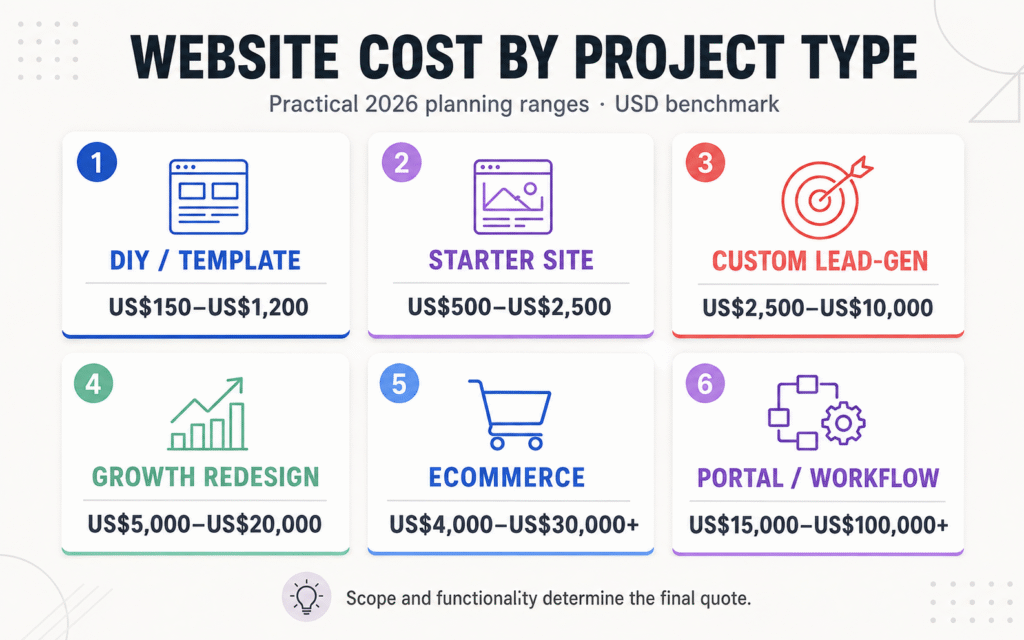
Small-Business Website Cost by Project Type
The clearest way to budget is by business requirement rather than page count.
| Website type | Practical 2026 starting range (USD benchmark) | Usually suitable for | Commonly included |
|---|---|---|---|
| DIY or template-only launch | US$150–US$1,200 first year | Validation, personal project, very early startup | Platform, template, domain/hosting, owner-built pages |
| Professionally configured starter site | US$500–US$2,500 | New microbusiness or focused service | 3–5 pages, responsive setup, form, basic SEO configuration |
| Custom lead-generation website | US$2,500–US$10,000 | Established local or professional service business | Strategy, custom structure/design, 5–15 pages, conversion paths, on-page SEO foundations |
| Growth-focused redesign | US$5,000–US$20,000 | Business with traffic, ads, rankings or multiple services | Research, content/UX improvements, migration, redirects, analytics and conversion work |
| Ecommerce website | US$4,000–US$30,000+ | Product brand, retailer or wholesaler | Products, payment, tax/shipping setup, key store templates, email/integration work |
| Membership, portal or custom workflow | US$15,000–US$100,000+ | Platform-led or operational website | User roles, logic, dashboards, integrations, security and extensive testing |
| AI website rescue or professional rebuild | US$750–US$10,000+ | Small to large SaaS based website and apps | Core logic, new design, quick performance |
These bands overlap because scope matters more than labels. A five-product ecommerce store with complex subscriptions and fulfilment can cost more than a 50-page informational website.
How Much Does a Five-Page Small-Business Website Cost?
A professional five-page small-business website commonly costs US$1,000–US$7,500, depending on whether the provider is configuring a template or developing the strategy, copy, brand direction and custom design.
A typical five-page structure might include Home, About, Services, Case Studies and Contact. However, five pages are rarely enough when several different services need to rank or convert independently. Combining every service on one page may reduce initial cost but make the website less useful for customers and less precise for search engines.
Choose five pages because the customer journey is genuinely simple-not because five is an attractive package number.
How Much Does a 10-Page Business Website Cost?
A professionally planned 10-page business website commonly falls between US$2,500 and US$15,000. The lower end generally assumes supplied content, limited custom functionality and a proven CMS.
The upper end can include positioning, research, original copy, custom UI, advanced conversion components, integrations and migration work.
The quote should identify whether “10 pages” means ten individually designed layouts or ten pages built from a smaller set of reusable templates. Reuse is not a problem-it is good design-system practice-but the scope should be transparent.
Website Cost by Country in 2026
Geography influences labour costs, tax, local expectations and agency overhead. It does not determine quality by itself. An experienced remote freelancer can sometimes deliver senior-level work at a lower total price than a local agency, while a local agency may be the better fit when in-person workshops or regulated procurement are essential.
The following sections answer the exact budgeting questions small-business owners are asking.
How Much Does a Small-Business Website Cost in the United States?
For a custom 5–10-page lead-generation website in the United States, a practical 2026 planning budget is:
- US$1,500–US$5,000: marketplace freelancer or limited-scope build;
- US$3,000–US$15,000: experienced freelancer or specialist studio;
- US$10,000–US$40,000+: established agency with broader strategy and team delivery;
- US$25,000–US$100,000+: advanced ecommerce, integrations, custom systems or enterprise requirements.
The right budget depends on what the site must do. A small-batch consumer brand needing distinctive copy, quality photography, ecommerce, search visibility and original branding is not buying a basic brochure website.
It is combining brand, content, commerce and customer-acquisition work.
What Is a Reasonable Price for a Small-Business Website With Copy, SEO, Photography and Distinctive Branding?
When all four are genuinely included, US$8,000–US$30,000+ can be reasonable in the US market. The price should be separated into workstreams so you can see whether you are paying for:
- positioning and messaging;
- copywriting and research;
- brand identity or brand refinement;
- art direction and photography;
- UX/UI design;
- development;
- SEO foundations;
- ecommerce configuration;
- launch and post-launch support.
An agency quotation in the tens of thousands is not automatically excessive if it includes an experienced multi-disciplinary team and substantial original production. It is also not automatically necessary.
A specialist freelancer can reduce management layers and overhead, particularly when the owner is comfortable collaborating remotely and does not need every service under one agency contract.
Decision rule: compare like with like. Do not compare a US$3,000 build using supplied copy and stock images with a US$20,000 brand, photography, copy and ecommerce engagement as if they are the same product.
What Should a Small-Business Website Cost in the UK?
For a professional UK small-business website in 2026, practical planning ranges are:
- £1,200–£4,000: limited-scope freelancer build or starter site;
- £2,000–£10,000: experienced freelancer or specialist studio;
- £7,500–£30,000+: established agency;
- £15,000–£60,000+: ecommerce, custom integrations or complex multi-stakeholder work.
Prices may be quoted before or after VAT. Ask for the total payable amount and confirm whether hosting, premium plugin licences, copywriting and ongoing maintenance are included.
Is £2,500 Fair for a Complete WordPress Rebuild?
Yes, £2,500 can be fair for a modest WordPress rebuild when the business already has usable branding and content, the site has roughly 5–10 standard pages, functionality is limited, and the scope clearly defines responsive development, forms, basic on-page SEO, testing and launch.
It can be too low if “complete rebuild” also means:
- new positioning and copy for every page;
- custom design for many page types;
- preserving a large number of rankings and backlinks;
- mapping and implementing redirects;
- migrating articles, resources or customer data;
- custom booking, CRM or ecommerce integrations;
- accessibility testing;
- extensive stakeholder revisions;
- long-term maintenance.
Similarly, £5,000 is not unreasonable when a capable professional is taking responsibility for strategy, copy/structure, design, development and safe migration. The deciding factor is not whether £2,500 or £5,000 sounds more “normal.” It is which outcome and risk level each quotation covers.
If you are comparing a rebuild, review KG Web Designer’s WordPress development services and ask every provider for a written migration plan.
How Much Does a Small-Business Website Cost in Canada?
For a 5–10-page professional Canadian business website, plan approximately:
- C$2,000–C$6,000: limited-scope freelancer or template-led build;
- C$3,000–C$13,000: experienced freelancer or small specialist;
- C$9,000–C$35,000+: established agency;
- C$15,000–C$60,000+: advanced ecommerce, bilingual, integration-heavy or custom work.
Canadian projects may also require English/French content workflows, province-specific business considerations, tax configuration or local ecommerce operations.
Translation is not the same as localisation; budget for content review, layouts and quality assurance in each language where relevant.
Let’s Plan a Website That Supports Real Business Growth
Whether you need a new website, a professional redesign or an ecommerce solution, I can help you define the right scope and create a website built for visibility, credibility and conversions. Projects are available for businesses in India and worldwide.
Is C$4,000 Reasonable for a 5–10-Page Shopify or WooCommerce Website?
C$4,000 can be a reasonable lower-to-mid budget for a small ecommerce launch when the product catalogue is limited, the business uses a standard theme or design system, the client supplies final product data and images, and shipping, tax and payment rules are straightforward.
Before accepting the quotation, confirm whether it includes:
- Shopify or WooCommerce setup and theme customisation;
- 5–10 content pages plus product and collection templates;
- the number of products entered;
- payment, shipping and tax configuration;
- transactional email setup;
- analytics and conversion tracking;
- basic technical and on-page SEO;
- mobile and checkout testing;
- training and post-launch support;
- subscription, theme, app and plugin costs.
C$4,000 may not cover original branding, professional product photography, full copywriting, hundreds of product migrations, custom apps, complex fulfilment or a highly custom customer experience.
If price is your only comparison column, two ecommerce quotes can look similar while carrying very different launch risks. Explore conversion-focused ecommerce website design and review the Taruj Skincare WordPress redesign case study to see why product presentation, trust and the buying journey matter alongside platform setup.
How Much Does a Small-Business Website Cost in Australia?
For a professional Australian small-business website in 2026, practical planning ranges are:
- A$2,000–A$6,000: limited-scope freelancer or starter build;
- A$3,500–A$15,000: experienced freelancer or specialist studio;
- A$10,000–A$40,000+: established agency;
- A$20,000–A$70,000+: ecommerce, booking platforms, custom integrations or complex content.
An Australian startup may be able to launch lean with a .com.au domain, a focused site, enquiries and reviews, then add bookings later.
The important architectural question is whether phase one can expand cleanly. A cheap builder becomes expensive if the platform cannot support the booking, payment, SEO or operational requirements planned for phase two.
What Should an A$3,000–A$8,000 Small-Business Website Actually Deliver?
Within this range, a local service business should expect more than an attractive homepage. Depending on the exact scope, a professional quotation should cover:
- a clear sitemap and service structure;
- responsive design for mobile, tablet and desktop;
- strong service pages and visible calls to action;
- trust signals such as reviews, credentials, projects or case studies;
- enquiry, phone and booking pathways;
- local-search foundations and location relevance where appropriate;
- metadata, indexing controls and an XML sitemap;
- performance-conscious images and development;
- analytics and enquiry tracking readiness;
- cross-browser testing, launch and basic training.
If the website receives traffic but does not generate calls, buying more traffic may simply amplify the leak. Read My Website Gets Traffic but No Enquiries before committing the entire budget to SEO or advertising.
Is A$15,000–A$20,000 Reasonable for a Shopify Website and Social Package?
It can be reasonable, but only when the quote separates the deliverables. For a new fashion brand with eight products, ask the provider to show individual allowances for brand strategy, identity, photography, copy, ecommerce design/development, product entry, email flows and social content.
An eight-product store is not automatically inexpensive. Original campaign photography and brand creation can cost more than the Shopify configuration. Conversely, a bundled quote can hide a basic theme build behind a large “marketing package.” A line-by-line scope makes the value visible.
This deserves its own deeper guide because ecommerce intent differs from a standard business website. It should not be used to inflate the non-ecommerce ranges on this page.
What Does a Business Website Cost in Dubai and the UAE?
For a professional non-ecommerce company website in Dubai or the wider UAE, practical 2026 planning ranges are:
- AED 5,000–AED 15,000: limited-scope freelancer or template-led site;
- AED 6,000–AED 30,000: experienced freelancer or specialist studio;
- AED 20,000–AED 75,000+: established agency;
- AED 50,000–AED 150,000+: bilingual, enterprise, custom-platform or integration-heavy work.
The frequently discussed AED 5,000 figure can still describe a lean brochure site, but it should not be treated as a current fixed market price.
The scope changes quickly when the business needs premium positioning, original copy, English and Arabic content, right-to-left design, photography, lead routing, CRM integration or sector-specific compliance.
What Should a Reasonable Company Website in Dubai Cost When Ecommerce Is Not Required?
For a straightforward 5–10-page English-language corporate site, AED 8,000–AED 25,000 is a useful working range for an experienced freelancer or specialist studio. A more established agency engagement may begin around AED 20,000 and rise significantly with strategy, production and stakeholder requirements.
Without ecommerce, the website still needs to establish credibility. A strong Dubai business website should clearly explain services, target sectors and locations; present leadership and proof; work well on mobile; provide fast enquiry options; and support search visibility.
If Arabic is required, confirm whether the quote covers professional translation, Arabic content review, right-to-left layouts, bilingual navigation, metadata, forms and quality assurance-not just automated translation.
For a service-led business, see corporate website design services for the structure and trust elements that should be included in the discussion.
Freelancer vs Web Design Agency: Which Is Better for a Small Business?
Neither is always better. The better choice is the delivery model that matches your scope, risk, communication needs and budget.
| Comparison | Experienced freelancer / specialist | Web design agency |
|---|---|---|
| Communication | Usually direct with the person doing the work | Often through an account or project manager |
| Cost structure | Lower overhead; price is concentrated on delivery | Supports team, management, sales and office overhead |
| Senior involvement | Can be high throughout the project | May be high in sales/strategy and delegated during production |
| Capacity | Best for focused projects and staged growth | Better for many simultaneous workstreams |
| Specialist access | Strong when one senior generalist/specialist covers the need | Access to separate strategy, copy, design and development roles |
| Continuity | Depends heavily on one person’s availability | Team cover may reduce single-person dependency |
| Process | Can be flexible and fast | Usually more formal and documented |
| Best fit | Owner-led small business wanting direct expertise and value | Complex, multi-stakeholder or enterprise project needing a larger team |
Comparing Website Quotes That Include Different Things?
Send me your requirements or existing quotation. With 18+ years of website experience, I can identify missing deliverables, unnecessary costs and the scope your business actually needs.
When Should You Hire a Freelancer?
An experienced freelancer or small specialist is often the best fit when:
- you want direct access to the senior person doing the work;
- the scope is clear enough for one lead expert to manage;
- you value flexibility and faster decisions;
- you do not need a large team in meetings;
- your budget should go primarily into strategy and execution;
- remote collaboration is acceptable;
- you want one person to remain accountable after launch.
When Is an Agency Worth the Higher Cost?
An agency may be the safer choice when:
- the project needs research, branding, copy, UX, development and campaign production simultaneously;
- many executives or departments must be managed;
- procurement requires a larger supplier, insurance or formal service levels;
- the timeline demands several specialists working in parallel;
- the website is part of a wider enterprise transformation;
- the organisation needs ongoing capacity beyond one person.
Is It Safe to Hire a Remote or Overseas Web Designer?
Yes-when the selection process is based on evidence and process rather than the lowest rate. Remote delivery can create substantial value because local overhead and exchange rates differ, but it should not remove professional safeguards.
Check:
- named case studies and live work;
- identity, business history and verifiable reviews;
- a written scope, timeline and payment schedule;
- who owns the website, accounts, licences and source files;
- communication windows and response expectations;
- staging and approval process;
- backup, handover and access arrangements;
- post-launch support terms.
At KG Web Designer, I work directly with small businesses across the United States, United Kingdom, Canada, Australia, UAE and India. With 18+ years of experience and 500+ website projects, the model combines senior direct involvement with remote-market pricing. Focused international projects can start from US$500, with a fixed quotation based on the actual scope rather than an inflated local-agency package.
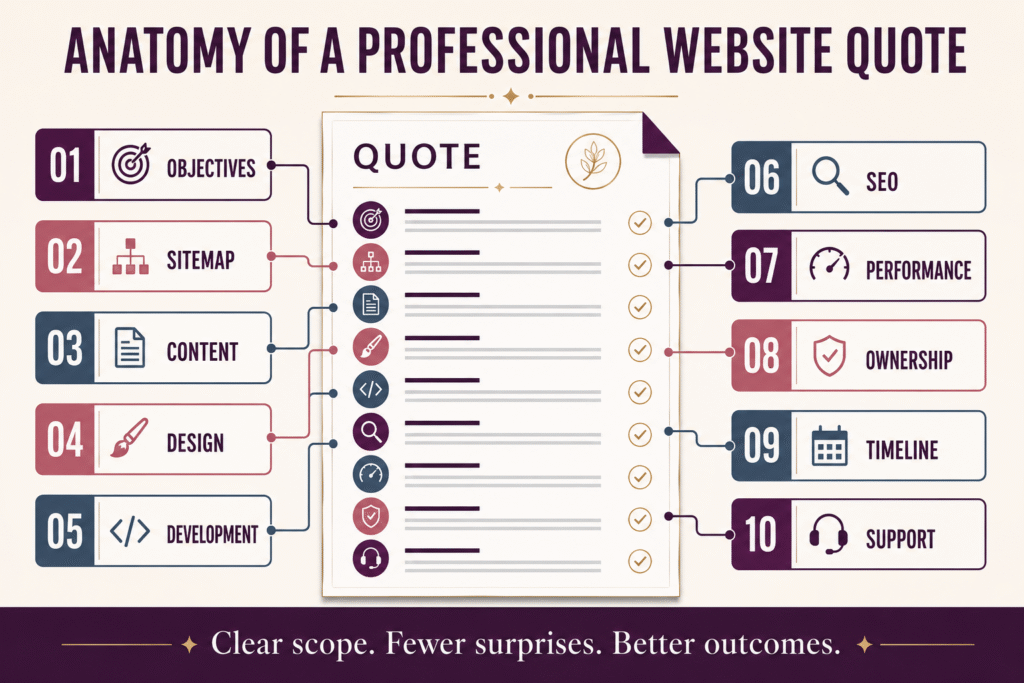
What Should Be Included in a Professional Website Quote?
A useful quotation should make the project easy to compare and hard to misunderstand.
1. Objectives and success criteria
The quote should state whether the project is intended to generate enquiries, support sales, improve credibility, preserve SEO, enable bookings, reduce administrative work or launch ecommerce.
“Modern website” is not a measurable objective.
2. Sitemap and page scope
List the pages, templates or content types. Clarify the difference between a page and a reusable layout. Define product, post, location, team, case-study and landing-page templates separately.
3. Strategy, copy and content
Confirm whether discovery, research, sitemap planning, copywriting, editing, metadata, image sourcing, content entry and migration are included.
4. Design deliverables
State whether the design is custom, template-based or a hybrid. Define the number of concepts, key page mockups and revision rounds.
5. Development and functionality
List the CMS, forms, booking, payments, filters, CRM, email, analytics and third-party integrations. “All required plugins” is too vague when licences may renew annually.
6. SEO and migration
For a new site, define metadata, crawl/index settings, schema, sitemap and search-console setup. For a redesign, add URL mapping, redirects, content migration, analytics preservation and pre/post-launch checks.
7. Performance and accessibility
Ask how images, caching, code and fonts will be handled. If accessibility conformance matters, state the target and testing method explicitly.
8. Ownership and licences
You should know who owns the domain, hosting account, website files, copy, design assets, premium themes, fonts and plugin licences after final payment.
9. Timeline, approvals and dependencies
The schedule should identify what the client must provide and how delays affect delivery. A four-week timeline is meaningless if copy, products and approvals are not assigned.
10. Support and recurring costs
Define the warranty period, maintenance options, response times, training, backups, security updates and which fees renew monthly or annually.
Quote-comparison test: If you cannot explain why one quote costs more after reading both scopes, ask each provider to list assumptions and exclusions. The missing details usually reveal the real price difference.
What Costs Are Commonly Missing From Website Proposals?
The build is only one part of the first-year cost.
Use this formula:
First-year website cost = strategy and build + copy/content + brand/media + domain/hosting/platform + premium tools + integrations + maintenance + tax
Common extra costs include:
- domain registration and privacy;
- hosting, CDN, backups and business email;
- Shopify, Wix, Squarespace or managed WordPress subscriptions;
- premium themes, plugins and apps;
- stock images, custom illustration, video or photography;
- fonts or other licensed brand assets;
- copywriting, translation and legal review;
- payment processing and transaction charges;
- CRM, booking, email marketing or automation tools;
- accessibility testing and remediation;
- security monitoring and maintenance;
- new landing pages and content after launch;
- tax, including VAT or GST where applicable.
Platform fees also change. Check the provider’s official pricing before approval: Shopify pricing, Wix plans, Squarespace pricing and WordPress.com pricing. For self-hosted WordPress, hosting, premium tools and maintenance are sourced separately.
How Much Does Website Maintenance Cost?
For a small business, maintenance can range from US$30–US$500+ per month, depending on whether the plan covers only software updates or also includes security monitoring, backups, uptime checks, content changes, analytics review and priority support.
Ecommerce, membership and integration-heavy sites usually require more care than a stable informational site. Ask what happens when an update breaks something, how backups are tested, and whether development time is included or billed separately.
How Much Do Domain and Hosting Cost?
A common domain may cost approximately US$10–US$30 per year, while premium names and some country-specific extensions can cost more.
Small-business hosting can range from US$5 per month to several hundred dollars per month, depending on traffic, support, infrastructure, backups, security and whether the platform bundles hosting.
The cheapest hosting is not always the lowest-cost choice if poor reliability, slow support or weak backups create downtime. Conversely, most small brochure websites do not need enterprise infrastructure.
Cheap Website vs Expensive Website: What Are You Actually Buying?
Price alone does not predict performance. A US$20,000 website can fail if the provider misunderstands the customer. A US$2,000 website can perform well when the offer is clear, the scope is focused and the execution is disciplined.
The difference usually appears in the questions asked before design begins.
A decorative project asks:
- Which colours do you like?
- Which competitor website should we copy?
- How many pages do you want?
A growth-focused project also asks:
- Who is the most valuable customer?
- What problem brings them to the website?
- What must they believe before contacting you?
- Which services deserve separate pages?
- Where are leads currently being lost?
- What proof reduces risk?
- How will calls, forms, bookings or sales be measured?
Expert Insight From Kanika Gupta
“A website quotation should price the uncertainty it removes. Clear positioning, useful content, trust signals, technical reliability and an easy next step all reduce the buyer’s hesitation. Page count alone cannot measure that value.”
Should You Fix Your Website Before Paying for SEO?
If the website has unclear messaging, weak service pages, poor mobile usability or no reliable conversion tracking, fix those problems before substantially increasing traffic spend.
Use this decision framework:
- Strong conversion, insufficient qualified traffic: invest in SEO, content, local visibility or advertising.
- Qualified traffic, weak enquiries: improve messaging, proof, UX and calls to action first.
- Weak traffic and weak conversion: create a staged website-and-growth plan; do not buy disconnected services.
- Unclear data: configure analytics and lead tracking before making a large decision.
Traffic is an input. Enquiries, sales and qualified opportunities are business outcomes.
The Billiard Broker case study shows how website structure, local SEO and Google Business Profile work can support the same commercial journey rather than operating as isolated tasks.
How to Choose the Right Website Budget
Step 1: Define the website’s job
Choose the primary outcome: credibility, enquiries, bookings, ecommerce, recruitment, investor information, operational automation or customer service.
Step 2: Estimate the cost of inaction
Consider leads lost through an outdated site, staff time wasted on manual work, advertising sent to weak pages, poor trust and the risk of another rebuild.
Step 3: Separate launch essentials from phase two
Build the foundation correctly, then postpone features that do not affect launch validation. Do not postpone security, ownership, responsive quality, analytics or critical SEO migration.
Step 4: Request the same information from every provider
Give each provider the business goal, approximate sitemap, required functionality, content responsibility, launch date and known integrations. Comparable inputs produce more comparable quotes.
Step 5: Evaluate evidence and fit
Review relevant work, case studies, communication, problem-solving and process. A portfolio proves visual capability; a case study should explain the business problem, decisions and result.
Step 6: Calculate first-year ownership
Add build, subscriptions, content, support and tax. A lower build price can become more expensive when essential items are added later.
Step 7: Protect access and ownership
Keep the domain in an account the business controls. Document hosting, admin accounts, licences, backups and handover terms.
A Simple Website Quote Scorecard
Score each quotation from 0 to 2 on every item: 0 = missing, 1 = partly defined, 2 = clearly defined.
| Evaluation area | Score (0–2) |
|---|---|
| Business objectives and target audience | |
| Sitemap, templates and content scope | |
| Copywriting and media responsibility | |
| Design approach and revision limits | |
| Functionality and integrations | |
| SEO and migration plan | |
| Performance and accessibility approach | |
| Analytics and conversion tracking | |
| Ownership and licences | |
| Timeline and client dependencies | |
| Testing, launch and training | |
| Support and recurring costs |
20–24: unusually clear scope. Compare expertise, evidence and commercial fit.
14–19: workable, but resolve the missing details before signing.
Below 14: the final price is likely to change or important work may be assumed rather than included.
How Long Does It Take to Build a Small-Business Website?
A focused starter site may take one to three weeks once final content is available. A custom 5–15-page business website commonly takes four to ten weeks. Strategy-led redesigns, ecommerce and integrations may take eight to sixteen weeks or longer.
The most common delays are not coding problems. They are incomplete copy, late photography, unclear decision-making, product data, stakeholder approval and new requirements introduced after the scope is agreed.
Fast delivery is possible when one decision-maker is available, content responsibilities are clear and feedback is consolidated. See how I work for the stages a professional project should define.
Original Findings From 18+ Years of Website Work
Across small-business, ecommerce, manufacturing, clinic and professional-service projects, I repeatedly see five patterns:
- Businesses underestimate content more than design. The layout cannot compensate for an unclear offer, generic service descriptions or missing proof.
- The cheapest rebuild becomes expensive when SEO is ignored. Lost URLs, missing redirects and discarded content can erase value that took years to build.
- More features do not automatically create more conversions. Clear information and low-friction contact routes frequently produce more value than impressive but unnecessary functionality.
- Owners compare homepages while customers evaluate service, product and trust pages. Budget must follow the customer journey, not only the most visible page.
- Direct senior communication prevents rework. When the person advising the client also understands the implementation, decisions are faster and less is lost between sales, account management, design and development.
Real outcomes depend on the business, offer and marketing-not the website alone. But a strategically built website can remove obstacles between qualified visitors and the next step.
For example, after the Taruj Skincare redesign, the business recorded its first ecommerce order within four hours of launch and more than 100 affiliates joined in the first week.
For The Billiard Broker, website and local-visibility improvements supported consistent qualified enquiries. These are individual project outcomes, not universal guarantees, but they show why the lowest build price is not the only number that matters.
Frequently Asked Questions
How much should a small-business website cost in 2026?
Most professionally built small-business websites cost between US$2,500 and US$15,000, although focused remote-freelancer projects can start near US$500 and strategy-led agency or custom projects can exceed US$40,000. Scope, content, functionality, design, SEO and support determine the final price.
What is a reasonable price for a five-page website?
A professional five-page website commonly costs US$1,000–US$7,500. Template configuration and supplied content sit near the lower end; strategy, custom design, copywriting and stronger SEO/conversion work move the project higher.
Is £2,500 enough for a WordPress website in the UK?
Yes, £2,500 can cover a modest 5–10-page WordPress website or rebuild when branding/content are largely supplied and functionality is straightforward. It may not cover original copy, custom integrations, extensive migration, accessibility work or long-term maintenance.
Is C$4,000 enough for an ecommerce website in Canada?
C$4,000 can be enough for a small Shopify or WooCommerce launch with a limited catalogue, standard functionality and client-supplied product content. Confirm product entry, tax, shipping, payments, email, analytics, apps and support before accepting the quote.
What does a company website cost in Dubai without ecommerce?
A straightforward 5–10-page English corporate website in Dubai may cost AED 8,000–AED 25,000 from an experienced freelancer or specialist studio, while established agencies may charge AED 20,000–AED 75,000 or more. Arabic, RTL design, photography, copy and integrations raise the scope.
What should an A$3,000–A$8,000 Australian business website include?
It should normally include responsive design, a clear service structure, trust elements, enquiry paths, SEO foundations, analytics readiness, performance-conscious development, testing and launch support. Copywriting, photography, complex booking and ongoing marketing may be separate.
Is a freelancer cheaper than a web design agency?
Usually, because a freelancer has lower overhead and fewer management layers. The correct comparison is not freelancer versus agency alone; it is scope, senior involvement, expertise, capacity, accountability and support.
Why do two website quotes have such different prices?
They may include different levels of strategy, copy, custom design, development, SEO, migration, accessibility, testing, integrations and support. Ask both providers to list assumptions and exclusions so you can compare equivalent deliverables.
Does website price include SEO?
Not automatically. Confirm whether SEO means only installing a plugin or includes research, page mapping, metadata, internal links, schema, technical settings, redirects, analytics and search-console setup. Ongoing SEO is normally a separate service.
Should I choose WordPress, Shopify, Wix or Squarespace based on price?
No. Choose based on required functionality, ownership, ease of management, integrations, SEO needs and future plans. A cheaper platform can cost more if it forces a rebuild when the business adds bookings, ecommerce, multilingual content or custom workflows.
How much should I budget for website maintenance?
Many small businesses spend US$30–US$500+ per month, depending on whether the service includes only updates or also backups, security monitoring, content changes, development time, analytics and priority support.
Can I hire a web designer from another country?
Yes. Remote collaboration is standard for many website projects. Verify case studies, reviews, process, communication, ownership, payment milestones, staging, backup and post-launch support rather than selecting by hourly rate alone.
How can I get an accurate website quote?
Share your business goal, target market, required pages, examples, functionality, integrations, content status, preferred platform, current website data and target launch date. The clearer the brief, the fewer assumptions a provider must price.
Let’s Plan a Website That Supports Real Business Growth
Whether you need a new website, a professional redesign or an ecommerce solution, I can help you define the right scope and create a website built for visibility, credibility and conversions. Projects are available for businesses in India and worldwide.
Final Verdict: What Is a Fair Website Price?
A fair website price is one that matches a clearly defined scope, appropriate expertise, transparent ownership and the level of business risk the provider is accepting.
For a simple startup, that may be a focused US$500–US$2,500 project. For an established service business competing for valuable enquiries, US$3,000–US$15,000 may be more realistic. For an agency-led brand, ecommerce or custom system, US$10,000–US$50,000+ can be justified.
The price should never be defended by page count alone. It should show how the website will communicate the offer, earn trust, support discovery, guide customers and remain reliable after launch.
Not Sure Whether Your Website Quote Is Reasonable?
Send me the quotation or scope you are comparing. I will help you identify:
- what is genuinely included;
- which important items are missing;
- where two quotes are not directly comparable;
- which features can be postponed;
- whether a freelancer, specialist or agency is the better fit.
I’m Kanika Gupta, founder of KG Web Designer – an independent website designer and digital growth specialist with 18+ years of experience and 500+ website projects. I work remotely with businesses across the US, UK, Canada, Australia, UAE and India.
Request a scope-based website estimate
Book a free 30-minute strategy call
WhatsApp Kanika
Call: +91 9971966296
No pressure and no generic package. Share what the website needs to achieve, and I’ll recommend the most practical scope.