

Quick Answer
A surgical eye practice needs a website designed around medical expertise, procedure-specific education, physician credentials, patient trust, and surgical consultation pathways. An optometry template may work for routine eye exams and eyewear services, but it often lacks the structure needed to explain cataract surgery, LASIK, glaucoma treatment, or specialized retinal procedures. Effective ophthalmology website design helps prospective patients understand the practice, evaluate their options, and take the appropriate next step.
TL;DR: What Should Surgical Eye Practice Owners Know?
- Surgical practices need dedicated procedure pages, specialist profiles, and clear consultation pathways rather than a generic eye-care services page.
- Clinical credentials, treatment explanations, and transparent patient information help prospective patients evaluate a practice before contacting it.
- Routine eye exam booking and surgical consultation requests should follow different pathways when the practice’s workflow requires it.
- Accessibility, mobile usability, privacy-conscious forms, and accurate provider information are essential parts of the patient experience.
- Healthcare research supports reducing appointment friction, but general consumer statistics should not be treated as guaranteed surgical conversion improvements.
- Website investment should be evaluated through relevant inquiries, patient access, and the quality of the consultation journey.
Why Does a Surgical Eye Practice Need a Different Website Structure?
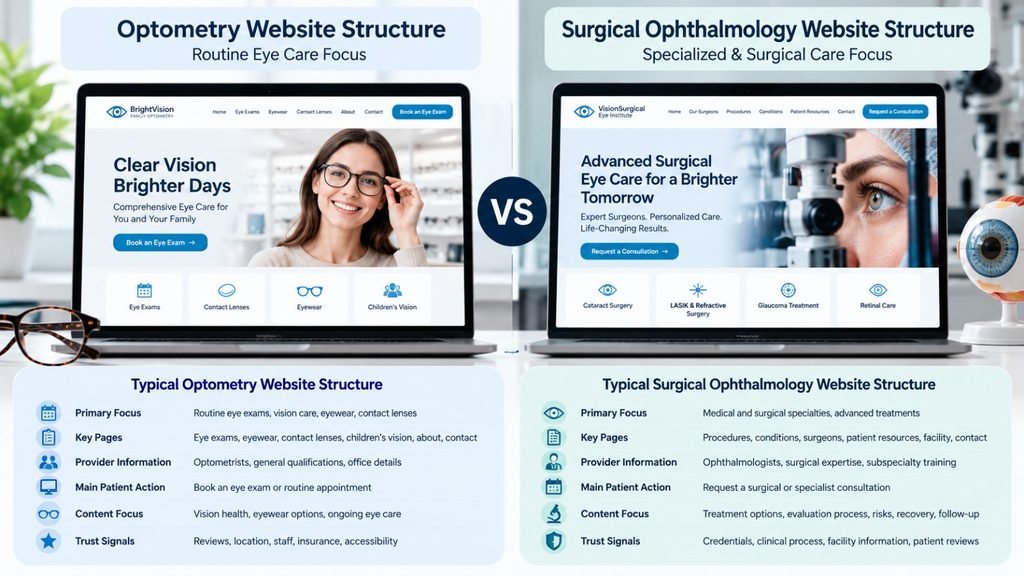
A surgical ophthalmology practice serves a different patient decision journey from a general optometry practice, so its website should reflect the complexity of medical evaluation and treatment. Optometry websites often emphasize routine eye exams, contact lenses, eyewear, and ongoing vision care. Surgical practices may need to explain specialist assessments, diagnostic testing, treatment alternatives, surgical procedures, and postoperative follow-up.
The American Academy of Ophthalmology explains that ophthalmologists are medical doctors trained in the medical and surgical treatment of eye conditions. Some also complete fellowship training in subspecialties such as glaucoma, retina, or cornea care. These qualifications are important to communicate accurately because they help patients understand the clinical expertise available at the practice. Source: American Academy of Ophthalmology.
| Website element | General optometry practice | Surgical ophthalmology practice |
|---|---|---|
| Primary patient action | Schedule an eye exam | Request a specialist or surgical consultation |
| Service architecture | Exams, contact lenses, eyewear | Procedures, conditions, subspecialties, evaluations |
| Physician information | Qualifications and routine services | Medical credentials, surgical expertise, relevant subspecialty training |
| Educational content | Routine eye health and vision care | Treatment options, evaluation, risks, recovery, follow-up |
| Trust signals | Reviews, location, staff, accessibility | Credentials, clinical process, facility information, relevant patient feedback |
| Conversion journey | Appointment booking | Research, specialist evaluation, consultation, clinical decision |
A template designed for routine appointments can force surgical information into layouts that were never intended to explain complex treatment decisions. The result may be a website that looks professional but leaves patients struggling to understand which procedures the practice offers or which specialist they should contact.
For practice owners, the commercial concern is the gap between clinical capability and its digital presentation. A website can attract relevant visitors through referrals, search, or paid campaigns yet still make the next step unnecessarily difficult.
What Should a Surgical Ophthalmology Website Include?
A surgical practice website should organize its procedures, physicians, patient resources, and contact pathways around the questions visitors need answered. The appropriate structure depends on the services performed, the practice’s locations, its referral relationships, and the information patients need before requesting an evaluation.
A practical website architecture includes:
- A specialist-led homepage. Explain the practice’s principal specialties, physicians, locations, and patient pathways.
- Dedicated procedure pages. Give important services such as cataract surgery, refractive surgery, glaucoma procedures, or retinal treatment their own pages when appropriate.
- Condition pages. Explain the conditions treated and how patients can seek an appropriate evaluation.
- Detailed physician profiles. Present accurate qualifications, relevant training, clinical interests, and professional affiliations.
- Patient education resources. Explain consultation preparation, what to expect during an evaluation, and where to find aftercare instructions.
- Facility and technology information. Describe actual facilities and equipment without implying that technology alone guarantees better outcomes.
- Clear consultation options. Help visitors request an evaluation, contact the office, or follow the correct referral process.
- Accessibility and privacy information. Make the site usable across devices and abilities while handling patient information appropriately.
These pages should work as a connected system rather than a collection of disconnected services. A visitor researching cataract surgery should be able to move from the procedure overview to the relevant physician profile, patient resources, and consultation information without repeatedly returning to the homepage.
This is where ophthalmology office website design must reflect the practice’s real clinical workflow. If certain services require referrals while others accept direct consultation requests, the website should explain those differences accurately.
A Surgical Eye Practice Needs More Than a Routine Eye Care Website.
Optometry and ophthalmology websites may share some fundamentals, but surgical patients often need more detailed information before deciding to book a consultation.
Routine Eye Care Journey
Surgical Patient Journey
How Should Procedure Pages Help Patients Make Informed Decisions?
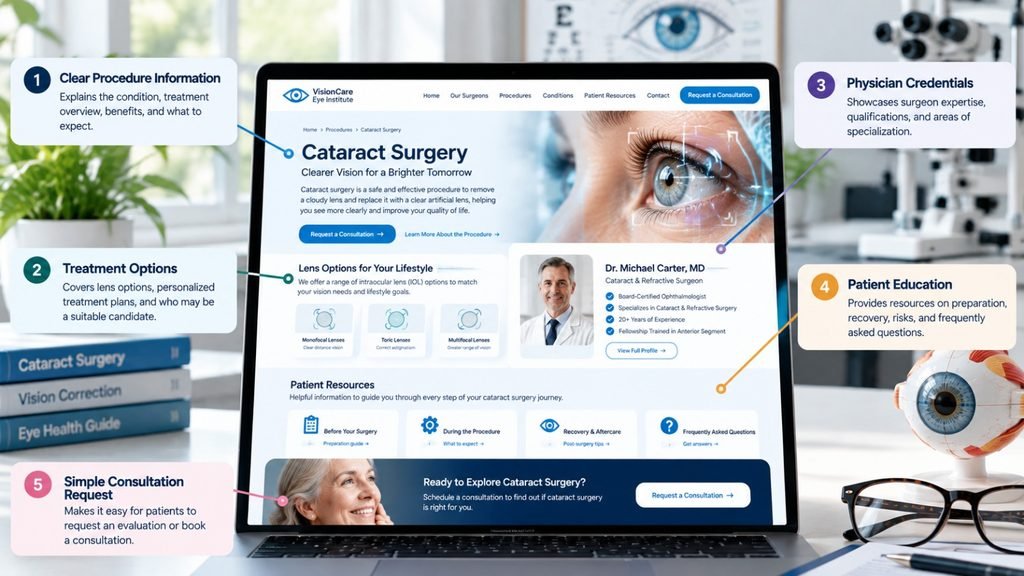
Each procedure page should explain the treatment in plain language, describe the evaluation process, and guide patients toward an appropriate clinical conversation. A single page listing every service may be easy to publish, but it rarely provides enough context for patients comparing treatment options. When evaluating ophthalmology website design inspiration, practice owners should look beyond colors and photography to assess how effectively a website organizes procedures, explains treatment options, presents physician expertise, and guides patients toward an appropriate consultation.
For example, a cataract surgery page should explain what cataracts are, why an assessment is necessary, what the procedure generally involves, and which questions patients should discuss with their surgeon. Where relevant, it can also explain lens options, preparation, recovery, and follow-up, provided the information is accurate and reviewed by qualified clinicians.
A useful procedure page answers six questions:
- What condition or concern does the treatment address?
- How does the practice evaluate whether treatment may be appropriate?
- What does the procedure generally involve?
- What benefits, limitations, and risks should patients discuss with the surgeon?
- What preparation and recovery information is available?
- How can the visitor request an evaluation?
The content must not diagnose visitors, imply that every patient is a suitable candidate, or promise a particular outcome. Its purpose is to help patients prepare for an informed conversation with a medical professional.
Procedure-specific content also creates a clearer search strategy. Each page can address a distinct service and its associated questions, provided it contains genuinely useful information rather than repeated copy created solely to target keywords.
For additional visual ideas, 12 optometry website design examples from leading clinics can help practice owners evaluate navigation, visual hierarchy, physician presentation, and patient-facing content. Surgical practices should adapt relevant design principles to their own clinical services rather than copy an optometry structure unchanged.
How Can a Website Establish Trust Before a Patient Meets the Surgeon?
A website supports trust when patients can verify the practice’s expertise and understand what to expect from its care process. Broad claims such as “world-class care” or “the best eye surgeons” are less useful than specific, accurate information about physician qualifications, procedures, facilities, and patient access.
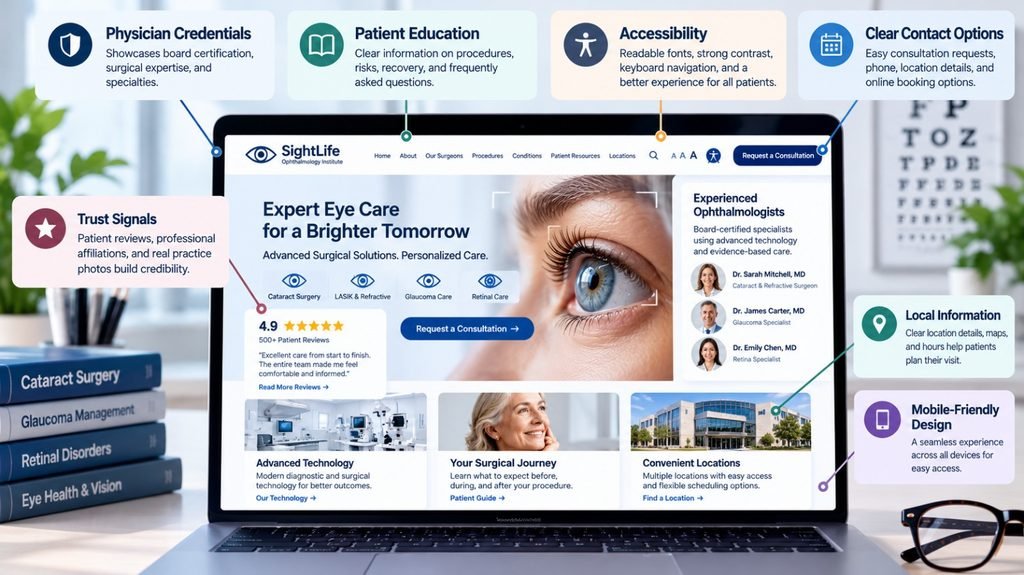
Prioritize these trust elements:
- Accurate physician credentials and relevant specialist training.
- Clear descriptions of conditions treated and procedures offered.
- Authentic photographs of the practice and clinical team where appropriate.
- Transparent location, contact, and consultation information.
- Genuine patient reviews presented in accordance with applicable rules.
- Verifiable professional affiliations or accreditation.
- Educational content that explains treatment benefits and limitations.
- Consistent information across the website and external provider listings.
For a more detailed framework, review seven high-conversion trust signals for eye clinic websites. The principles can inform a surgical practice’s website, but they should be adapted to its procedures and clinical decision-making requirements.
Patient reviews can also help prospective patients understand other people’s experiences, but they should not be presented as proof that a procedure will produce the same result for everyone. The role of patient reviews in eye clinic website conversions explores how reviews can contribute to a broader trust strategy.
Physician profiles should do more than provide short biographies. They should explain relevant qualifications and clinical focus, link to appropriate service pages, and help patients understand who may evaluate their concern without implying that a profile can determine the right treatment for every individual.
What Does Healthcare Research Tell Us About Website Performance?
Healthcare research supports prioritizing accurate information, convenient access, and accessibility, although general healthcare findings should not be treated as guaranteed results for surgical eye practices.
Press Ganey’s 2025 Consumer Experience in Healthcare report draws on 6.5 million patient encounters and a nationwide consumer survey. It reports that 80% of surveyed healthcare consumers say online scheduling influences their choice of provider, while 24% may consider other options if booking is not sufficiently convenient. These are general healthcare consumer findings, not ophthalmology-specific surgical conversion rates. Source: Press Ganey.
| Evidence or standard | What it establishes | Practical implication |
|---|---|---|
| Press Ganey healthcare consumer research | Scheduling convenience influences provider choice | Make the correct consultation pathway easy to find |
| American Academy of Ophthalmology guidance | Ophthalmologists complete specialized medical training | Present qualifications and subspecialty expertise accurately |
| W3C WCAG 2.2 | Accessibility addresses a wide range of disabilities | Use readable content, accessible navigation, and usable controls |
| HHS online tracking guidance | Certain disclosures of protected health information to tracking vendors can create HIPAA issues | Review forms, analytics, scheduling integrations, and data flows |
The Web Content Accessibility Guidelines (WCAG) 2.2 address the needs of people with disabilities, including people with low vision, limited movement, hearing loss, and cognitive disabilities. Readable text, sufficient contrast, keyboard navigation, clear labels, and descriptive links are practical priorities for a website serving patients with different visual and physical abilities.
US practices should also assess how their websites handle personal and health information. The Department of Health and Human Services explains that HIPAA obligations may apply when tracking technologies collect or disclose protected health information. The legal treatment of tracking on public webpages has also been subject to court decisions, so practices should review current guidance and obtain appropriate compliance advice rather than assuming a secure connection makes every integration compliant. Source: HHS online tracking guidance.
How Should the Website Guide Patients Toward a Surgical Consultation?
A consultation journey should help visitors move from researching a condition to contacting the practice without suggesting that a website can determine their clinical suitability. The primary call to action should match the next step the practice actually offers.
A practical journey looks like this:
- A visitor arrives on a procedure or condition page.
- The page explains the service, evaluation process, and relevant treatment information.
- The visitor reviews the appropriate physician’s qualifications and practice details.
- The visitor selects a consultation request, scheduling option, or contact pathway.
- The form collects only the information necessary to route the inquiry.
- The practice explains what happens after submission and how the patient can reach the office.
A routine eye exam and a surgical consultation should not automatically use the same form. The practice may need separate pathways for new-patient appointments, surgical evaluations, referring clinicians, and postoperative questions. A well-structured eye surgery practice website should distinguish routine appointments from surgical consultation requests, explain what patients can expect after submitting a form, and provide clear contact options without implying that online booking replaces clinical evaluation.
Forms should avoid collecting detailed medical information unless it is necessary and handled through an appropriate system. The website should also explain whether a form is intended for appointment requests or general questions. It must not imply that a submission is monitored for emergencies unless the practice can genuinely provide that service.
For practices serving patients in the United States, the consultation journey must also account for privacy and appropriate handling of patient information. Online forms, scheduling tools, analytics, and third-party integrations should be reviewed as part of the practice’s broader compliance process, rather than treated as isolated website features. Our guide to HIPAA-compliant patient booking for US optometrists explains the key booking, user experience, and data-handling considerations that US eye-care practices should evaluate.
Is Your Website Communicating Your Surgical Expertise Clearly?
If your practice offers advanced procedures but presents them like routine eye care, the issue may be information architecture rather than visual design alone. KG Web Designer can help evaluate whether your procedure pages, physician profiles, patient resources, and consultation pathways reflect the services you actually provide.
Request a website consultation with KG Web Designer to identify the most important improvements for your practice.
Before Patients Consider Eye Surgery, They Need Answers — Not Just an Appointment Button.
A patient researching cataract surgery, LASIK or another ophthalmic procedure may need to understand the treatment, evaluate the surgeon and feel confident about the consultation process.
What Is the Procedure?
Explain the condition, treatment options and reasons a procedure may be considered.
Am I a Candidate?
Describe general suitability considerations and the need for specialist evaluation.
Who Will Treat Me?
Present surgeon credentials, clinical expertise and what patients can expect.
What Happens Next?
Make it easy to request a consultation and understand the next steps.
Build a website that supports patient understanding, confidence and the right specialist consultation.
Explore Eye Clinic Website Design →What Should You Fix First, Second, and Third?
The most efficient redesign begins with the changes that remove the biggest barriers to understanding and contacting the practice. A complete rebuild is not automatically necessary; the right scope depends on the existing platform, content, navigation, and patient journey.
| Priority | What to improve | Why it matters |
|---|---|---|
| First | Procedure and specialty architecture | Helps patients find relevant services |
| Second | Physician profiles and clinical content | Makes qualifications and treatment information clearer |
| Third | Consultation pathways and forms | Helps visitors take the appropriate next step |
| Fourth | Accessibility, mobile usability, and performance | Makes information easier to use |
| Fifth | Technical SEO, internal links, and measurement | Supports discovery and performance evaluation |
Begin by checking whether every major surgical service has a useful destination page and whether the homepage communicates the practice’s specialties. Then review the accuracy of clinical content, the visibility of physician credentials, and the completeness of patient resources.
Next, test the consultation process on a mobile device. Can a visitor find the correct contact option, understand what happens after submission, and complete the process without unnecessary steps? Finally, review indexing, accessibility, technical performance, privacy considerations, and analytics.
The aim is to prioritize changes based on actual barriers, not to recommend a redesign simply because the current visual style looks dated.
Why Most Businesses Get This Wrong
Many practices select a healthcare template based on appearance and then try to fit their clinical services into its existing structure. This can become restrictive when the practice offers multiple surgical specialties, has several physicians, or needs different consultation pathways for patients and referring clinicians.
Common mistakes include:
- Listing every procedure on one page with minimal explanation.
- Giving routine eye care more prominence than surgical specialties.
- Using generic physician biographies that do not explain relevant expertise.
- Repeating promotional claims without explaining the evaluation process.
- Sending every visitor to the same booking form.
- Treating accessibility and privacy as post-launch tasks.
- Publishing thin, repetitive procedure or location pages.
- Measuring traffic growth without assessing inquiry quality.
These mistakes create friction that traffic totals alone may not reveal. A visitor may leave because the website does not explain whether the practice treats a particular condition, who performs the relevant procedure, or what happens after contacting the office.
A stronger approach begins with clinical services and patient journeys. Design, SEO, and conversion optimization should support that structure rather than dictate it.
Example Scenario
Consider a fictional ophthalmology practice offering cataract surgery, glaucoma care, and refractive surgery across two locations. Its current website uses a general eye clinic template with one services page, short physician biographies, and a single appointment button.
A prospective cataract patient struggles to find procedure-specific information. Someone researching refractive surgery cannot locate a clear explanation of the consultation process, while a referring clinician has difficulty finding the appropriate specialist contact.
The practice may not need more traffic to address these problems. It needs dedicated procedure pages, more informative physician profiles, distinct patient and referral pathways, and a consultation process that reflects its actual services.
After implementing changes, the practice can track procedure-page engagement, consultation requests by service, form completion, and the relevance of inquiries received. These measurements can show whether the new structure is helping, but the results must come from actual analytics rather than assumed conversion improvements.
Example From Our Experience
At KG Web Designer, we approach healthcare website strategy by examining the relationship between service information, trust signals, navigation, and the action a visitor is expected to take. Our published eye-care website guidance addresses credibility, patient reviews, mobile usability, and appointment pathways.
Problem: A recurring design challenge in eye-care websites is that service descriptions and credibility information may exist without being connected into a clear patient journey. Visitors can find a list of treatments but still struggle to identify the relevant specialist or understand how to proceed.
Solution: The strategic approach is to map important patient journeys first, then align page architecture, clinical content, trust elements, and calls to action with those journeys. For surgical practices, this means distinguishing procedure education from consultation requests and ensuring that clinical claims remain accurate.
Outcome: The intended outcome is a website that makes expertise easier to understand and the next step easier to find. Any effect on consultation volume or revenue must be established using practice-specific analytics and inquiry data.
This is an experience-based design observation, not a claim of a measured conversion increase for a named surgical ophthalmology client. A credible case study should identify a real project, describe the work performed, and report verifiable outcomes rather than inventing success metrics.
Does Your Website Reflect the Expertise and Complexity of Your Ophthalmology Practice?
An attractive website is only the starting point. A surgical eye practice needs clear clinical information, specialist credibility and a patient journey designed around higher-consideration decisions.
Are qualifications, specialisations and relevant surgical experience easy to find?
Are cataract, refractive and other procedures explained clearly and separately?
Do pages help patients understand relevant considerations and realistic expectations?
Are verifiable credentials, facilities and care processes presented appropriately?
Can patients request the right specialist consultation without unnecessary confusion?
Can patients navigate, read and use the website comfortably across devices?
Your website should help prospective patients understand the care you provide before they decide to enquire.
Discuss My Website Review →Expert Insight from Kanika Gupta
Kanika Gupta, Founder, KG Web Designer
My strongest recommendation is to stop treating a surgical ophthalmology website as a more advanced version of an optometry website. The difference is not simply the number of services or the sophistication of the photographs. It is the amount of clinical context a patient needs before deciding to contact the practice.
If this were my website, I would first map the practice’s major surgical services to dedicated pages and connect each page to the appropriate physician, patient resources, and consultation pathway. I would then review every clinical claim, test the mobile experience, and check whether a new visitor can understand what the practice does without already knowing the terminology.
I would not begin by adding animations, a chatbot, or a large collection of generic blog posts. Those features cannot compensate for unclear service architecture or weak clinical information. I would invest first in the structure that makes the practice’s real expertise understandable, then use analytics to identify where patients still encounter friction.
That is the distinction between a website that merely looks professional and one that supports the patient-access goals of a specialist practice.
When Does Professional Website Help Make Sense?
Professional help makes sense when the existing website cannot clearly communicate surgical specialties, support procedure-specific education, or guide visitors toward the correct consultation pathway. It is especially relevant when a practice is adding surgeons or locations, expanding its services, consolidating websites, or investing in marketing without a reliable way to evaluate inquiry quality.
Before approving a complete redesign, review the current platform, page structure, clinical content, accessibility, privacy considerations, and analytics. If the foundations are sound, targeted improvements may be sufficient. If the architecture prevents the practice from presenting its services clearly, a more comprehensive rebuild may be justified.
KG Web Designer can help assess the website from a design, content architecture, search visibility, and conversion perspective. The objective is to identify changes that address real patient and business needs rather than recommending a rebuild simply because the design looks dated.
Professional ophthalmology web development can be valuable when an existing platform cannot support clear procedure pages, accessible patient resources, privacy-conscious booking integrations, or reliable performance measurement. The right scope should be based on an audit of the current website rather than an automatic recommendation to rebuild it.
What This Means For Your Business
A surgical eye practice’s website is part of how prospective patients understand its expertise and access its services. When procedure information, physician credentials, patient resources, and consultation pathways work together, visitors can make more informed decisions about contacting the practice.
The business implications are practical:
- Clearer positioning: Patients can distinguish surgical specialties from routine vision services.
- More relevant inquiries: Procedure-specific pages and appropriate forms can help the team understand why a prospective patient is reaching out.
- Stronger credibility: Accurate physician information and transparent treatment education give visitors concrete reasons to evaluate the practice.
- Better patient access: Accessible pages and mobile-friendly contact pathways make important information easier to use.
- More measurable marketing: Service-level analytics help identify which pages attract relevant inquiries and where visitors encounter friction.
A strong ophthalmology website design strategy should not promise a particular number of surgeries or consultations. It should create a clear, accessible, trustworthy route from patient research to the appropriate clinical conversation, then measure whether that route is working.
Final Thoughts
A surgical eye practice needs more than an attractive healthcare template. It needs a website that communicates medical expertise, explains procedures responsibly, makes important information easy to find, and guides patients toward an appropriate consultation.
Start by evaluating the practice’s procedure pages, physician profiles, patient resources, and contact pathways. Improve the elements that create the greatest confusion or friction, then measure how those changes affect relevant inquiries and patient access.
If your practice has outgrown a general optometry layout, request a website consultation with KG Web Designer to discuss a website strategy aligned with your surgical services, patient needs, and long-term growth goals.
Your Surgical Eye Practice Deserves More Than an Optometry Website Template.
Let’s review whether your website communicates the specialist expertise, surgical information and patient confidence your practice needs. We’ll identify opportunities to improve the experience before you invest in a redesign.
What We’ll Review
Website Strategist
FAQs
Why does a surgical ophthalmology practice need a different website from an optometrist?
A surgical practice needs to explain medical and surgical specialties, procedure options, physician credentials, evaluation steps, and recovery information. An optometry website may focus more heavily on routine exams, eyewear, and contact lenses. The structure should reflect the services offered and guide patients toward the appropriate clinical consultation rather than treating every visit as a routine eye exam.
What pages should a surgical eye practice website have?
A surgical eye practice typically needs a clear homepage, dedicated procedure and condition pages, physician profiles, patient information, facility details, contact information, and consultation pathways. Practices may also need referral information, insurance or payment guidance, and postoperative resources. The final structure should reflect the procedures performed, the locations served, and the questions patients need answered before contacting the practice.
How can an ophthalmology website build patient trust?
A website can support trust through accurate physician credentials, clear explanations of treatment and evaluation, authentic practice photography, transparent contact information, and honest patient reviews. Procedure pages should explain relevant benefits and limitations without promising results. Trust also depends on practical details, including accessibility, privacy-conscious forms, consistent business information, and a clear explanation of what happens after a consultation request.
Should every surgical procedure have its own page?
A dedicated page is useful when a procedure has distinct patient questions, evaluation requirements, risks, or next steps. It gives the practice space to explain the service clearly and helps search engines understand the page’s subject. Pages should not be created simply to target keywords. Each one needs clinically reviewed, genuinely useful information and should accurately represent services the practice provides.
How should patients book a surgical consultation through the website?
The website should provide a clear consultation request or scheduling option that matches the practice’s actual workflow. It should explain what information is needed, what happens after submission, and how the office will respond. The form should collect only appropriate information and use systems reviewed for privacy and security requirements. It should not imply that submitting a form constitutes a diagnosis or guarantees a surgical appointment.
Is SEO important for a surgical ophthalmology practice?
SEO can help patients and referring professionals discover relevant specialties, procedures, locations, and physician information. A useful strategy includes clear service pages, descriptive page titles, accurate local listings, logical internal links, accessible content, and sound technical performance. Search visibility alone does not establish business success, so the practice should also monitor relevant consultation requests and whether inquiries match the services offered.
Should a surgical eye practice redesign its entire website or improve the existing one?
A complete redesign is not always necessary. If the existing platform supports clear navigation, dedicated procedure pages, accessible content, privacy-conscious integrations, and useful analytics, targeted improvements may be sufficient. A rebuild becomes more appropriate when the underlying architecture or technology prevents the practice from supporting its clinical services and patient journeys. An audit should establish the scope before investment is approved.