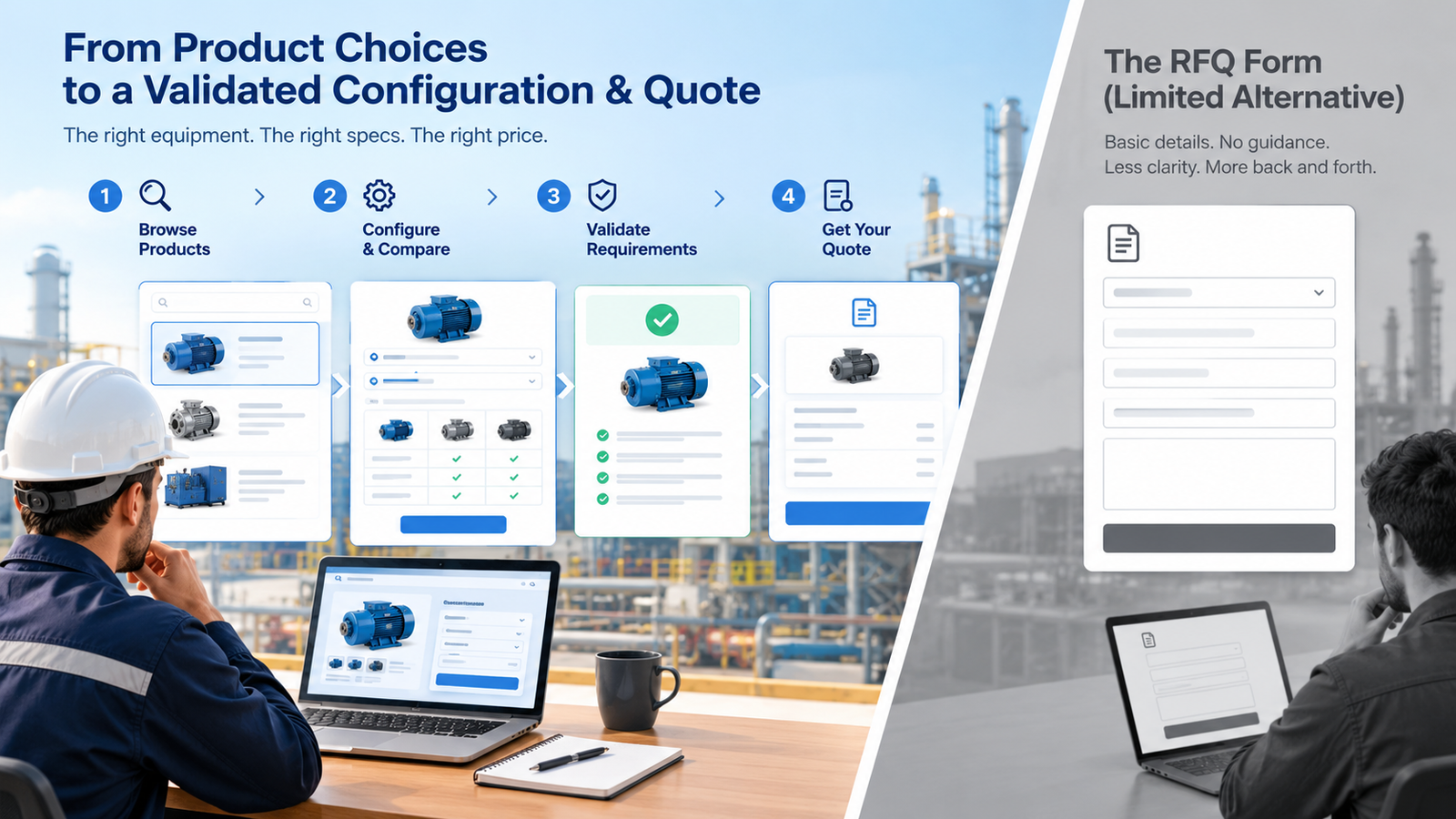
A manufacturing website configurator can shorten the distance between “I think this product might fit” and “this is a valid configuration worth quoting.” But not every manufacturer needs a full 3D experience or enterprise CPQ platform. The right solution depends on product complexity, pricing rules, sales involvement and where reliable product data currently lives.
Quick Answer: Use a website selector when buyers mainly need guidance, a rules-based configurator when choices must produce a valid product, and CPQ when sales teams need controlled pricing and formal quotes. Keep an engineer-led RFQ for genuinely bespoke work. The best architecture may combine these layers, passing structured website selections into CRM, CPQ or engineering review.
Key Takeaways
- A longer RFQ form does not solve product-selection uncertainty; it often transfers incomplete information to sales.
- A configurator validates combinations, while CPQ adds controlled pricing, approvals and quote generation.
- The simplest useful experience may be a guided selector rather than a full configurator.
- Product rules and ownership matter more than animation or 3D presentation.
- Start with one product family and measure qualified progression, not just form submissions.
Many manufacturing websites make visitors choose between two extremes: browse a dense catalogue alone or submit a generic “contact us” form. That gap becomes expensive when products have dependencies, options, load limits, materials, certifications, environmental conditions or accessories that affect suitability.
The answer is not automatically more software. It is a better decision path. If your current site attracts the right companies but produces weak enquiries, first diagnose why manufacturing website traffic is not becoming qualified RFQs. A configurator is valuable when product-choice friction is one of the causes, not when the underlying issue is unclear positioning or missing evidence.
What a Manufacturing Website Configurator Actually Does
A product catalogue presents available items. A selector narrows them. A configurator applies rules to a buyer’s choices so the result is valid, or clearly flags what requires review. CPQ, short for configure, price, quote, extends that process into controlled commercial output. Salesforce describes CPQ as software that helps sales teams configure products, apply pricing and discounts, and produce quotes. That is different from merely displaying options on a public page.
Consider a pump manufacturer. A visitor may choose fluid type, flow rate, pressure, temperature range, voltage and hazardous-area requirement. A useful web experience could recommend a product family and capture those inputs. A rules-based configurator could prevent an incompatible motor and enclosure combination. A CPQ system could then apply account pricing, currency, discount authority and quote templates. Engineering might still approve unusual duty points.
This distinction matters because a glossy front end can still produce invalid enquiries. Microsoft documents product-configuration models in terms of components, attributes, constraints and calculations. In practical website terms, the interface is only the visible layer; a governed rules model is the product.
Four Levels of Product-Selection Experience
Most manufacturers can place their immediate need in one of four levels. The levels can coexist across different product families.
| Level | Best when | Buyer receives | Business commitment |
|---|---|---|---|
| Guided selector | A manageable set of questions can narrow standard products | Recommended families or models | Maintain decision logic and product links |
| Rules-based web configurator | Options have meaningful compatibility rules | A valid configuration, summary and reference | Govern rules, options and version changes |
| Sales-led CPQ | Pricing, approvals, bundles or contracts vary | A formal quote through the sales process | Integrate identities, price books, approvals and documents |
| Engineer-led RFQ | Every solution requires analysis or design | A structured submission for technical review | Define required inputs and response ownership |
1. Guided selector: reduce the search space
A selector is appropriate when the buyer’s main problem is finding the right family. It may ask application, capacity, environment and compliance questions, then show two or three plausible routes with reasons. It should not imply that a product is technically approved when the rules do not support that conclusion.
This is often the sensible first release. It improves navigation without recreating engineering logic. It also reveals which questions users understand and where they abandon the path.
2. Rules-based configurator: prevent invalid combinations
Choose this level when option A changes the availability of options B and C, or when calculated values determine what is viable. Each constraint needs an owner, a source and a test case. The output might be a configuration ID, downloadable summary, bill-of-materials candidate or prefilled enquiry.
A configurator does not need photorealistic 3D to be useful. For many industrial purchases, a clear step sequence, responsive tables, diagrams and an accurate configuration summary create more value than visual spectacle.
3. Sales-led CPQ: control commercial complexity
CPQ becomes relevant when a technically valid product still needs account-specific pricing, regional price books, discount approvals, bundled services, recurring items or formal quote documents. Oracle’s CPQ documentation describes support for product configuration and pricing within quote-to-cash processes, with REST APIs available for integration.
The public website does not have to expose the whole CPQ interface. A buyer can complete a guided flow, authenticate if appropriate, or submit a saved configuration. Sales can continue in CPQ with the captured choices. This preserves a focused public experience while using controlled commercial logic behind it.
4. Engineer-led RFQ: retain judgement where it is essential
Some products cannot be safely or sensibly self-configured. Site conditions may be incomplete, tolerances may interact, or the output may require a professional calculation. In that case, improve the RFQ rather than pretending to automate the decision. Use conditional fields, explain why each technical input matters, allow drawings where secure, and return a structured summary to the requester.
The boundary between public information and gated input deserves deliberate treatment. The framework for deciding which manufacturing technical data to publish or gate can help prevent a configurator from becoming an unnecessary lead wall.
Configurator, CPQ or RFQ Form: A Decision Framework
Score each product family against the following questions. A “yes” does not automatically require CPQ, but the pattern will clarify the minimum viable system.
- Can a small set of buyer-friendly questions narrow the options? If yes, a selector may solve the first problem.
- Can rules determine whether combinations are valid? If yes, a configurator can reduce preventable errors.
- Does price depend on customer, region, volume, currency or approval? If yes, keep sensitive commercial logic in CPQ, ERP or a controlled sales layer.
- Must an engineer interpret site-specific information? If yes, preserve a review gate and collect structured inputs.
- Are product data and rules governed in a reliable system? If no, fix ownership before promising real-time accuracy.
- Does the buyer need an immediate answer? A recommendation or configuration summary may be enough even when a final quote is not instant.
A useful default is to automate repeatable certainty and expose human review honestly. Do not force CPQ into an anonymous website journey simply because the organisation owns it. Equally, do not rebuild pricing logic in WordPress if an existing system is already the authority.
How to Plan a Manufacturing Website Configurator
Define the commercial job
Write a one-sentence outcome before selecting technology. Examples include “help maintenance engineers identify a compatible replacement family” or “give sales a complete, valid configuration before pricing.” Avoid goals such as “make the site interactive.” Interactivity is a characteristic, not a business result.
Choose one primary user and one product family for the first release. The needs of a procurement manager replacing a known part differ from those of a consulting engineer specifying a new system. An industrial equipment website also needs enough context, specifications and evidence around the tool so the recommendation can be evaluated.
Create a governed rule inventory
For every question and option, record its identifier, label, allowed values, dependencies, units, default, source system, owner and effective date. Add plain-language explanations for buyers. If rules live only in a senior engineer’s spreadsheet or memory, the project includes knowledge capture, not merely web development.
Model uncertain outcomes too. “Requires engineering review” is a valid state. So are “not available in your region” and “provide one additional measurement.” A tool that quietly produces a dead end damages trust.
Choose the source of truth and integration boundary
The website may read product content from a product information management system, availability from ERP, customer context from CRM and commercial rules from CPQ. Avoid calling every system on every screen if reliability or speed will suffer. A cached subset may be suitable for public selection, while final validation happens server-side before submission.
Agree what each system owns:
- product names, media, attributes and documents;
- compatibility rules and calculated outputs;
- customer identity and consent records;
- price books, discounts, tax treatment and approvals;
- configuration IDs, revisions, quotes and handoff status.
For international operations, locale can affect units, voltage, standards, product availability, language and sales routing. Plan those differences as part of the international manufacturing website architecture, not as labels added after launch.
Design progressive disclosure
Ask only what is needed for the current decision. Group related technical choices, show the effect of a selection, and provide help without forcing users away from the flow. Preserve selections when a visitor moves back. On mobile, keep labels, units, error messages and summaries legible without horizontal hunting.
Accessibility should be included in component acceptance criteria. The World Wide Web Consortium’s forms guidance covers labels, instructions, validation and user notifications. Keyboard operation, programmatic labels, understandable error recovery and announced status changes are especially important in multi-step tools.
Return a durable result
At completion, give the user more than “thank you.” Show the inputs, output, assumptions, review status and reference ID. Offer a printable or emailed summary if appropriate. Pass the same structured data to CRM or CPQ so sales does not ask the buyer to repeat it.
Implementation Phases and Cost Drivers
There is no honest universal price for a manufacturing configurator. Scope is shaped by the number of product families, options and rules; quality of existing data; calculation complexity; authentication; regional variation; integrations; 2D or 3D visualisation; document generation; security; accessibility; testing and ongoing ownership.
A practical phased plan is:
- Discovery and rule audit: map users, decisions, data sources, exceptions and handoffs.
- Prototype: test the question sequence and terminology with representative buyers and internal teams.
- Pilot: launch one valuable product family with analytics and a defined human fallback.
- Integration: pass structured data into CRM, CPQ, ERP or engineering workflows at the necessary boundary.
- Expansion: add families only after rule ownership, quality assurance and performance are working.
This sequence avoids committing to a large platform before the interaction model is proven. It also separates unavoidable product-knowledge work from interface development. A broader manufacturing website redesign may be warranted when navigation, messaging and product content also need structural change; the configurator should not be asked to compensate for the entire site.
Common Mistakes That Make Configurators Fail
- Starting with the animation: the team approves a polished visual before agreeing on the rules and exceptions.
- Rebuilding uncontrolled data: the website duplicates attributes or prices without an update process.
- Asking internal questions: field labels mirror ERP terminology rather than the buyer’s application.
- Hiding value behind contact details: users must surrender information before seeing whether the tool can help.
- Treating every finish as quote-ready: sales receives configurations that still lack critical site or commercial context.
- Ignoring exceptions: rare but important cases have no escalation path.
- Launching without ownership: nobody is accountable when an option, constraint or document changes.
What to Measure After Launch
Form-submission volume alone can reward low-quality activity. Build a measurement plan around progression and usefulness:
- starts, step completion and abandonment by question;
- valid configurations and engineering-review outcomes;
- recommended product views and specification downloads;
- configuration-to-enquiry and configuration-to-quote progression;
- fields sales must correct or recollect;
- time to first useful response;
- rule failures, integration errors and no-result paths.
Use these signals to improve questions, rules and content. Do not infer sales impact from clicks alone. Connect configuration IDs to downstream records where lawful and operationally appropriate. Privacy, consent, cookie and record-retention requirements vary by market and implementation, so obtain qualified legal or privacy advice for your specific setup.
A Practical Pre-Build Checklist
- One primary user, use case and product family are defined.
- The desired output is named: shortlist, valid configuration, reviewed request or quote.
- Rules, calculations, exceptions and regional differences have owners.
- Source systems and update frequencies are documented.
- The website-to-CRM, CPQ, ERP or engineering handoff is mapped.
- Anonymous, authenticated and returning-user journeys are decided.
- Accessibility, mobile use, performance and security are acceptance criteria.
- Testing includes valid, invalid, boundary and unavailable combinations.
- A human fallback and response expectation are visible.
- Analytics events and downstream quality measures are agreed before launch.
Kanika Gupta brings 18+ years of experience and work across 400+ website projects for international clients. The useful starting point is not “Which configurator plugin should we buy?” It is “Which decisions can the website make reliably, and what should happen next?” That question keeps product logic, buyer experience and commercial operations aligned.
Frequently Asked Questions
What is a manufacturing website configurator?
A manufacturing website configurator is an interactive tool that guides a buyer through product options and applies rules to produce a suitable or valid configuration. It may recommend a family, prevent incompatible combinations, calculate outputs, create a configuration reference or pass structured selections to sales, engineering, CRM or CPQ.
What is the difference between a product configurator and CPQ?
A product configurator focuses on selecting and validating product options. CPQ adds controlled pricing and quote processes, such as customer-specific price books, discounts, approvals, currencies, bundles and formal documents. A public website can use a simpler configurator while passing the result into a sales team’s CPQ workflow.
When is an RFQ form enough for a manufacturer?
An RFQ form can be enough when the product is genuinely bespoke, engineering judgement is unavoidable and a form can collect the minimum information needed for useful review. It should use conditional questions, explain required inputs, accept relevant files securely and send a clear submission summary rather than behaving like a generic contact form.
Can a WordPress manufacturing website integrate with CPQ or ERP?
Yes, when the target system provides suitable APIs or another supported integration method. The architecture should define which system owns product rules, pricing, customer data and quote records. Security, authentication, caching, error handling and data freshness must be designed for the specific systems rather than assumed from a plugin claim.
Should a manufacturing configurator show prices?
Show prices only when they can be accurate, commercially appropriate and maintained across relevant markets and customer types. Some manufacturers can show standard or indicative pricing with clear conditions. Others should return a valid configuration and let CPQ or sales apply account pricing, freight, tax, discounts and approvals.
What data is needed to build an industrial product configurator?
You need product attributes, allowed values, compatibility constraints, calculations, units, defaults, regional availability, exceptions and ownership. You also need buyer-friendly labels, help content and a definition of the output. Integration projects additionally require identifiers and mappings across the website, CRM, CPQ, ERP or product information system.