Quick Answer
The right ecommerce website design company should identify why your store is losing revenue before recommending a rebuild. Evaluate its ability to diagnose product-page friction, mobile UX, cart behavior, checkout, trust, SEO migration, analytics, and platform limitations. If traffic is healthy but sales are weak, CRO may be the better first investment. If the architecture itself is limiting growth, a strategic redesign may be justified.
TL;DR: What You Need to Know
- A store with traffic but weak sales should be diagnosed before more money is spent on acquisition.
- Product pages, mobile UX, cart behavior and checkout create different conversion problems and require different solutions.
- Baymard’s research currently places average ecommerce cart abandonment at roughly 70%.
- The cheapest website proposal can become the most expensive if it preserves the same conversion problems.
- A strong agency should connect design decisions to buyer behavior and commercial outcomes.
- Before approving a $5,000–$20,000 project, identify the specific business problem the investment is supposed to solve.
What Does the Evidence Say About Ecommerce Conversion Problems?
The evidence shows that ecommerce stores can lose substantial revenue after the customer has already demonstrated buying intent.
Baymard currently reports an average cart abandonment rate of 70.19% based on its long-running research. Its research also distinguishes unavoidable abandonment, such as shoppers who are simply browsing, from problems businesses can actually address through better UX and checkout design.
| What you see | Likely problem | What to investigate first |
|---|---|---|
| High traffic, low purchases | Weak conversion path | Landing and product pages |
| Strong product views, weak add-to-cart | Purchase hesitation | Product information and trust |
| Strong carts, weak completed orders | Checkout friction | Cart and checkout |
| Strong desktop, weak mobile | Mobile UX problem | Mobile product and checkout journey |
| Organic traffic drops after redesign | SEO migration problem | URLs, redirects and indexing |
| Low traffic and low sales | Acquisition + conversion issue | SEO, positioning and UX |
| Healthy conversion but weak profit | Economics problem | AOV, CAC, margins and retention |
Baymard’s checkout research identifies several controllable abandonment reasons, including unexpected costs, lack of trust, forced account creation and checkout complexity.
Standalone fact: More traffic does not solve a conversion problem if the buying journey continues to leak qualified shoppers.
That distinction should influence who you hire.
Why Do Ecommerce Stores With Good Traffic Still Struggle to Sell?
A store with qualified traffic but weak revenue usually has a conversion problem somewhere between discovery and payment.
This is the first distinction I would make before recommending an ecommerce website design company. If people are finding products, viewing them and adding them to carts, buying more traffic before understanding the leakage may simply increase the amount of money entering a broken funnel.
The symptoms usually sound like this:
- “We’re getting traffic, but orders aren’t growing.”
- “People add products to their carts and disappear.”
- “Our ads work, but ROAS keeps getting worse.”
- “Customers keep asking questions that the product page should answer.”
- “Mobile traffic is strong, but mobile revenue isn’t.”
- “We redesigned recently and nothing really changed.”
- “Our competitor’s website looks simpler, but seems to sell better.”
These are diagnostic clues, not merely design complaints.
Diagnostic Summary
If traffic is weak, investigate acquisition and search visibility first.
If traffic is healthy but product engagement is weak, investigate positioning, merchandising and product-page UX.
If add-to-cart activity is healthy but completed purchases are weak, investigate cart and checkout friction.
If conversion is healthy but profitability is weak, investigate AOV, margins, CAC and retention.
This distinction can prevent a business from spending thousands of dollars rebuilding a problem that could have been fixed through targeted optimization.

How Much Should You Really Invest in Your Ecommerce Website?
You don’t need the biggest budget — you need the right one. Let’s look at your products, growth goals, functionality, and market to determine what your ecommerce website actually needs and where your investment will have the most impact.
What Would I Inspect Before Recommending a Redesign?
I would inspect the entire buying journey before deciding whether the store actually needs a redesign.
At KG Web Designer, I would start with analytics and customer behavior rather than immediately opening a design file. I want to know which pages attract qualified visitors, where users hesitate, what happens on mobile, which products receive attention and where the funnel loses people.
My first diagnostic pass would cover:
- Traffic quality
- Landing-page relevance
- Category and collection navigation
- Product-page clarity
- Mobile behavior
- Cart behavior
- Checkout completion
- Trust architecture
- SEO structure
- Technical performance
Google’s ecommerce documentation also emphasizes making product information understandable through structured data and clear page relationships, reinforcing the importance of building an ecommerce site that search engines can interpret as well as users can navigate.
The important point is simple:
A website audit should produce a diagnosis before a proposal produces a price.
The same diagnostic approach should guide the investment itself. A strong ecommerce website partner should be able to tell you whether your next dollar should go toward qualified traffic, conversion optimization, or a structural website redesign rather than automatically recommending a new site. This framework on where premium ecommerce brands should invest first explains how to make that decision using traffic quality, funnel behavior, UX, conversion signals, and website limitations.
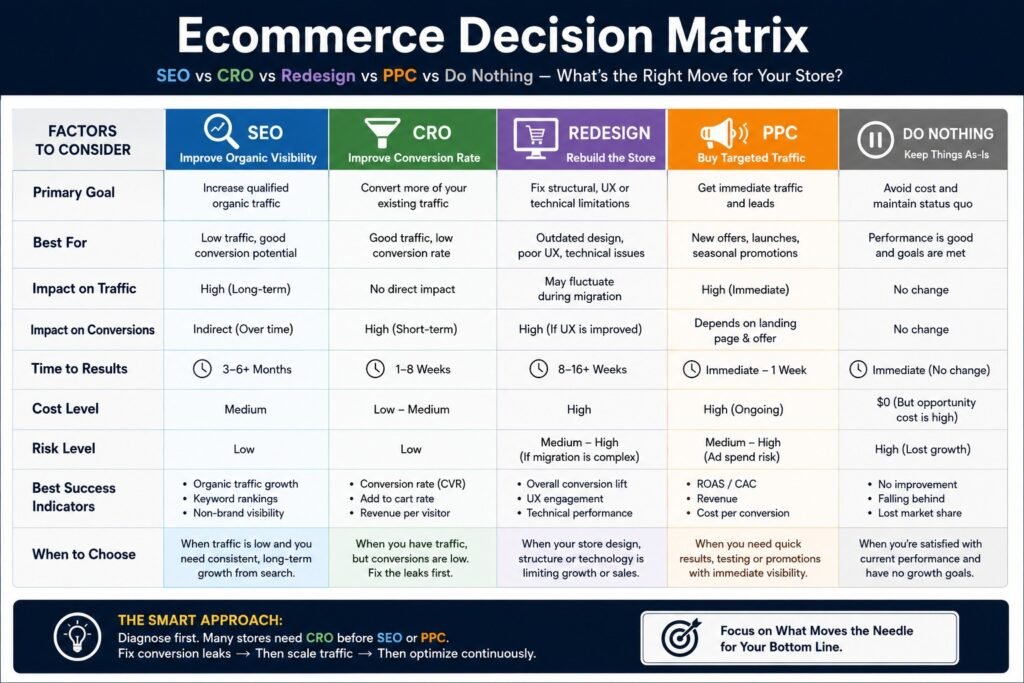
Should I Choose SEO, CRO, PPC, a Redesign, or Do Nothing?
The correct decision depends on where the commercial leakage occurs, not on which service an agency happens to sell.
| Situation | Best first move | Reason |
|---|---|---|
| Good traffic + poor conversion | CRO | Existing demand may be under-converting |
| Poor organic visibility | SEO | Qualified discovery is insufficient |
| Strong offer + acquisition need | PPC | Paid traffic can be tested quickly |
| Broken architecture | Redesign | Structural problems require rebuilding |
| Healthy traffic + conversion | Do nothing major | Avoid unnecessary expenditure |
| Strong desktop + weak mobile | Mobile CRO | Device-specific friction needs attention |
| Strong product views + weak add-to-cart | Product-page optimization | Purchase hesitation needs addressing |
If this were my website, I would first identify the highest-value leakage point and fix that before approving a complete rebuild.
That is one of the clearest ways to avoid wasting a five-figure website budget.
How Much Does Ecommerce Website Design Actually Cost?
A professional ecommerce project can range from several thousand dollars to $20,000 or more depending on strategy, UX complexity, platform, integrations, migration requirements and customization.
The mistake is comparing proposals solely by their headline price.
For example, a $7,000 proposal may include basic page design and development, while a $15,000 proposal might include buyer research, information architecture, conversion strategy, custom product-page UX, SEO migration planning and analytics.
Those are not equivalent projects.
If you are trying to establish whether a proposed investment is reasonable, our detailed guide on ecommerce website design cost in 2026 breaks down the factors that typically drive ecommerce project costs, including platform, functionality, integrations and design complexity.
The better question is therefore not:
“Which agency is cheaper?”
It is:
“Which proposal gives me the clearest path to solving the problem that is costing my business money?”
For brands selling expensive, bespoke, or luxury products, the buying journey often needs more than a standard Add to Cart experience. Our guide to luxury ecommerce website strategy explains when a brand should use direct checkout, private consultation, product enquiry, or a hybrid journey based on product complexity, buyer confidence, and purchase risk.
What Makes Product Pages a Conversion Problem?
Product pages convert more effectively when they answer the buyer’s important questions before the buyer has to leave the page.
A strong product page should make it easy to understand:
- What is this?
- Who is it for?
- Why is it different?
- What does it cost?
- What does it look like?
- How does it work?
- When will it arrive?
- Can I return it?
- Is the company trustworthy?
- What do other customers think?
- What should I buy with it?
This is where product page conversion becomes much more than changing the color or position of a button.
A shopper needs progressively stronger evidence as they move toward purchase.
Images create visual confidence. Specifications reduce uncertainty. Reviews reduce perceived risk. Delivery information reduces surprise. A clear CTA provides direction.
If the ecommerce brand also serves international customers, the agency needs to evaluate more than standard product-page UX. Currency selection, international shipping, duties and taxes, regional payment methods, returns, and country-specific trust signals can all affect whether an overseas visitor completes a high-value purchase. Our guide to international luxury ecommerce website design explains how these requirements can be incorporated into a premium buying experience.
At KG Web Designer, one recurring issue we see in ecommerce projects is that brands invest heavily in product photography but fail to structure the page around the questions those images cannot answer.
The result is a beautiful product page that still leaves the buyer uncertain.
When evaluating an ecommerce design company, it is also worth asking whether the proposed design strengthens or weakens your brand positioning. This matters particularly for premium products, where a visually generic or poorly structured website can make an otherwise valuable product feel less differentiated. Our guide on why a cheap-looking website can make a premium product harder to sell explains how design, product presentation, trust signals, and perceived value work together in the buying decision.
Your Store Should Be Built to Sell — Not Just Look Good
With 18 years of experience and 500+ websites delivered, I help ambitious ecommerce brands build custom shopping experiences that remove friction, strengthen trust, and turn more visitors into customers.
Why Does Visual Hierarchy Matter More Than Most Store Owners Think?
Visual hierarchy matters because shoppers do not read ecommerce pages from top to bottom. They scan for information that helps them decide whether to continue.
The design should therefore establish a clear order:
Product → Value → Evidence → Price → Options → Trust → Action
If everything is visually prominent, nothing is strategically prominent.
This becomes especially important on mobile, where limited screen space forces stronger prioritization.
Before approving a redesign, it is worth understanding how layout and emphasis affect the buying journey. Our analysis of visual hierarchy in ecommerce design examines how typography, spacing, hierarchy, CTA placement and information structure can guide shoppers toward important purchasing decisions.
The financial issue is straightforward: when buyers cannot quickly identify what matters, they have to work harder to purchase.
Some will simply leave.
How Does Checkout Friction Destroy Revenue?
Checkout friction destroys revenue when a customer has already decided to buy but encounters unnecessary obstacles before payment.
Baymard’s current research identifies checkout usability as a major ecommerce opportunity and reports that a substantial proportion of leading ecommerce sites still have mediocre or worse checkout UX.
Common areas to investigate include:
- Guest checkout
- Unexpected shipping costs
- Delivery estimates
- Payment options
- Form length
- Error handling
- Mobile keyboard behavior
- Coupon-code distractions
- Trust messaging
- Order-summary clarity
- Return-policy visibility
Shopify’s current 2026 guidance similarly emphasizes faster checkout, trust signals, multiple payment methods, mobile optimization and reduced form friction.
Standalone fact: Checkout optimization should be treated as a revenue problem, not merely a UI problem.
Does Shopify Require a Different Conversion Strategy?
Shopify can support strong ecommerce performance, but the platform itself does not automatically create a high-converting store.
Good Shopify CRO still requires decisions about navigation, merchandising, product-page structure, mobile interactions, trust, cart behavior and checkout.
Shopify’s current checkout documentation highlights guest checkout, accelerated payment methods, local payment options, address autocomplete and mobile-first checkout capabilities.
That creates an important distinction.
Changing platforms is not the same as improving conversion.
A weak strategy can produce a beautifully configured Shopify store that continues to lose customers at exactly the same points.
What Should a Strong Ecommerce Agency Actually Deliver?
A strong agency should deliver a commercial system rather than simply a collection of attractive pages.
I would expect the project to address:
Buyer and product research
The agency should understand who buys, what they compare, what objections they have and which products matter commercially.
Information architecture
Categories, collections, filters and navigation should help shoppers find products efficiently.
Conversion-focused UX
The interface should reduce hesitation at important decision points.
Product-page architecture
Templates should support the information customers actually need to make decisions.
Mobile-first interaction design
Mobile users should not receive a compressed desktop experience. The interaction model needs to work for scanning, touch and smaller screens.
Cart and checkout strategy
The final stages of the funnel deserve the same strategic attention as the homepage.
SEO-safe development
A redesign should account for URLs, redirects, metadata, internal linking, indexability and structured data.
Measurement
You should know which conversion events matter before launch.
A strong agency should be able to explain not only what it will build, but why each major component should improve the buying journey.
What Do High-Converting Ecommerce Stores Do Differently?
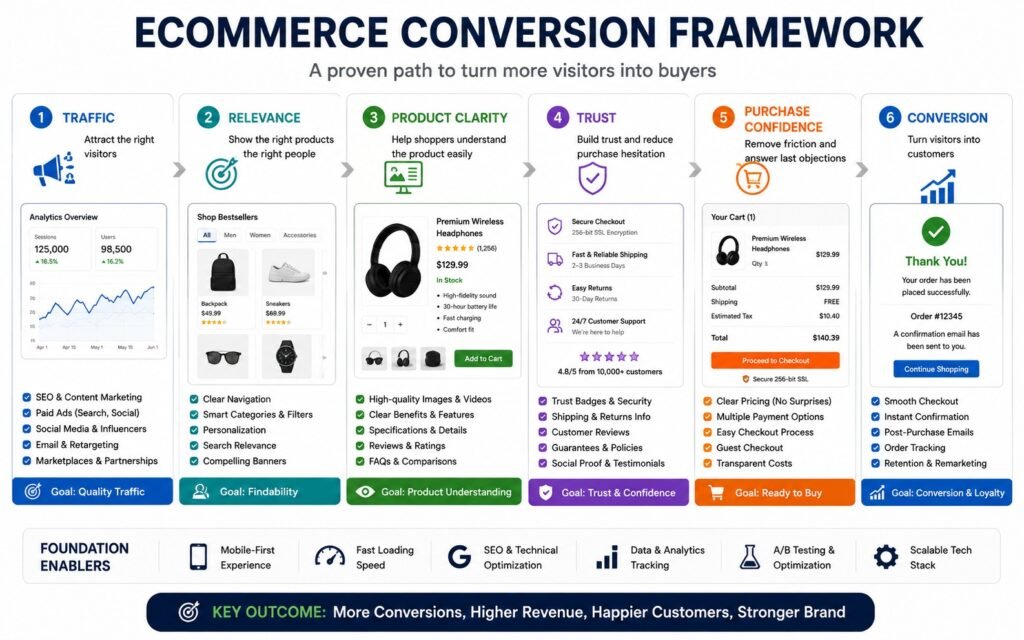
High-converting stores tend to make important buying information easier to find, understand and trust.
Our review of 40 ecommerce stores found recurring patterns around mobile-first UX, trust architecture, checkout simplicity, product presentation and customer retention systems. The important distinction was not that successful stores all looked alike. It was that they deliberately reduced uncertainty.
Our broader analysis, what high-converting ecommerce brands do differently, examines those recurring patterns across the stores we reviewed.
The lesson is not to copy another brand’s visual style.
It is to understand why certain design decisions make buying easier.
What Do Real Ecommerce Buyers Need Before They Purchase?
Buyers need clarity, confidence and a low-friction route to payment.
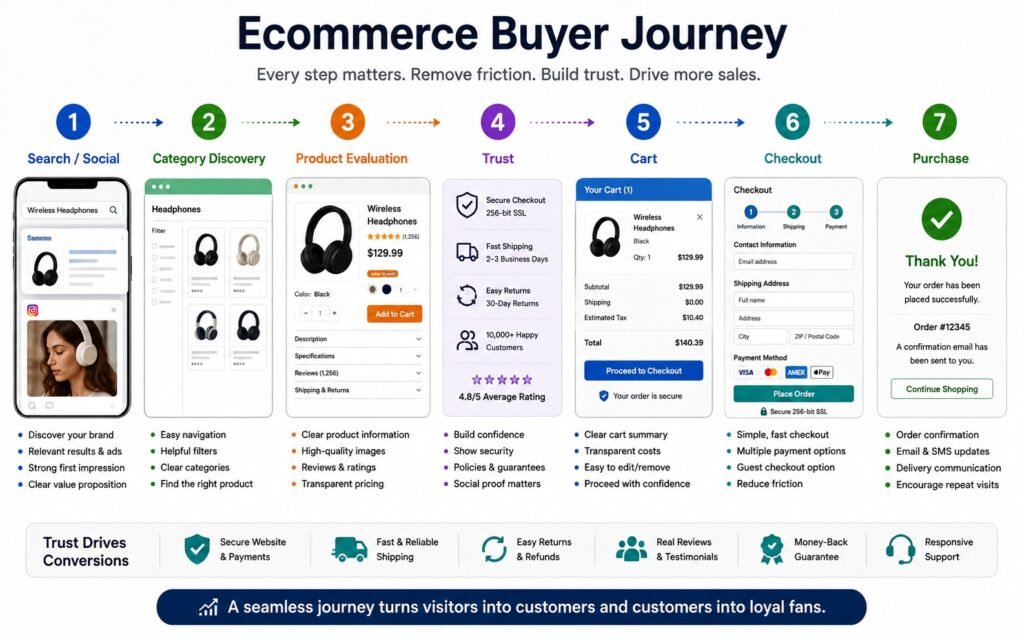
The journey often looks like:
Discovery → Relevance → Product Evaluation → Trust → Add to Cart → Checkout → Purchase
Each stage has different requirements.
A shopper arriving from a product search needs immediate relevance. Someone comparing products needs differentiation and specifications. A customer entering checkout needs confidence around payment, delivery and returns.
This is why ecommerce conversion optimization should not be treated as a collection of disconnected A/B tests.
It is the systematic removal of barriers from the buying journey.
Example Scenario: When a Redesign Is the Wrong First Step
Imagine a DTC skincare company generating 100,000 monthly visitors.
Traffic is stable. Product pages receive strong engagement. Add-to-cart behavior is healthy, but completed purchases remain disappointing.
A redesign agency might immediately recommend rebuilding the homepage, category pages and product templates.
I would first inspect the checkout.
If analytics reveal a large drop after shipping information appears, the first project could involve clearer delivery expectations, better cost visibility, payment options, mobile form improvements and checkout testing.
The business does not necessarily need a new website.
It needs the right problem solved.
No Templates. No Generic Stores. Built Around Your Business.
Your ecommerce website should reflect how your customers discover, compare, trust, and buy your products. I create custom ecommerce experiences for brands in the US, UK, and Australia with conversion and long-term growth at the centre of every decision.
What Should You Learn From Other Ecommerce Website Reviews?
You should use ecommerce examples to understand decision-making patterns, not to copy visual trends.
This is especially important when an agency shows you a portfolio of highly polished stores. A screenshot can tell you what a website looks like, but it cannot tell you which business problem the design solved.
Our review of 40 ecommerce stores is useful for exactly that reason. It focuses on recurring patterns across different ecommerce categories rather than presenting one aesthetic as the universal model.
When reviewing an agency’s portfolio, ask:
- What was the original business problem?
- What changed?
- Why did the agency make those changes?
- What was measured?
- Which parts were strategic versus cosmetic?
That conversation will tell you more than the number of websites in the portfolio.
Example From Our Experience: An Anonymized Ecommerce Audit
Problem: An established ecommerce store had healthy traffic and strong product interest, but revenue was not keeping pace with visitor growth.
Diagnosis: The audit did not identify one isolated design flaw. Issues were distributed across product-page hierarchy, mobile interactions, trust placement and the transition from cart to checkout.
Solution: Rather than treating the project as a visual redesign, we approached the journey as a sequence of buying decisions. Product information was prioritized, CTA hierarchy was reconsidered, mobile friction was reduced and trust information was moved closer to decision points.
Outcome: The store had a clearer path from product discovery to purchase and a stronger basis for testing conversion improvements without assuming that more traffic was the answer.
This is the type of diagnosis an experienced ecommerce website design service company should be able to provide before asking you to approve a major redesign.
Why Do Businesses Get This Decision Wrong?
Most businesses get this decision wrong because they compare deliverables instead of outcomes.
One proposal says “12 custom pages.” Another says “20 pages.” A third offers Shopify development, SEO and branding.
But page count does not tell you whether the store will sell better.
A better comparison asks:
- What buyer problem is being solved?
- What evidence supports the proposed UX?
- What will be measured?
- How will SEO equity be protected?
- How will mobile behavior be handled?
- How will checkout be improved?
- What happens after launch?
- Who owns the strategy?
At KG Web Designer, we have found that some of the most valuable conversations happen before design begins because that is when the scope can still change without paying to build the wrong solution.
Expert Insight from Kanika Gupta
Kanika Gupta, Founder, KG Web Designer
“I would never judge an ecommerce redesign by how much more polished the homepage looks. I want to know whether the buyer can make a confident decision faster than they could before.”
That is my strongest hiring advice.
A serious ecommerce project should make the buyer journey easier to understand, easier to navigate and easier to complete.
If an agency cannot explain the behavioral reason behind its major design decisions, I would be cautious about approving a large redesign budget.
What Does This Mean For Your Business?
The financial implication is straightforward: every conversion problem exists somewhere between the visitor arriving and the customer paying.
If you already have qualified traffic, improving the percentage of visitors who purchase can increase revenue without requiring the same proportional increase in acquisition spending.
That does not mean every store needs CRO instead of SEO or every store needs a redesign instead of PPC.
It means the order of decisions matters.
A useful sequence is:
1. Diagnose → 2. Prioritize → 3. Fix → 4. Measure → 5. Scale
This reduces risk because you are investing against an identified business problem rather than a vague feeling that the website “looks outdated.”
Not Sure What Your Ecommerce Website Really Needs?
You don’t need to guess which features, platform, or budget are right for your business. In a focused 30-minute conversation, we’ll look at your products, customers, growth goals, and current challenges to identify the right direction for your store.
What Should You Fix First, Second and Third?
The first priority should be the highest-value point of measurable leakage.
First: Fix conversion blockers.
Review product engagement, add-to-cart behavior, cart exits and checkout completion.
Second: Fix the buying experience.
Improve hierarchy, navigation, mobile interaction, trust information, product content and checkout clarity.
Third: Scale acquisition.
Once the funnel works more efficiently, increase investment in SEO, paid media, partnerships, content or other acquisition channels.
This order prevents a common mistake: buying more traffic for a store that is already struggling to convert the traffic it receives.
When Should You Hire an Ecommerce Website Design Company?
You should hire an ecommerce website design company when the problem is structural, strategic or too complex to solve through isolated changes.
Professional help makes particular sense when:
- Your architecture limits product discovery.
- Your store is moving to a new platform.
- Mobile conversion is materially weaker than desktop.
- Product pages require strategic restructuring.
- Checkout friction persists.
- SEO traffic is valuable and migration risk is high.
- Multiple integrations affect the buying journey.
- You are entering new international markets.
- The existing website cannot support the next stage of growth.
Before signing, ask the agency to show you where it believes revenue is being lost and why the proposed work addresses that problem.
That single question can reveal more than an hour-long portfolio presentation.
Diagnose Before You Rebuild
If your store is already receiving meaningful traffic but revenue does not reflect that demand, don’t start by commissioning another visual redesign.
A focused ecommerce website audit can identify whether the real problem is product-page clarity, mobile UX, cart friction, checkout, trust, SEO architecture or something else.
Before spending $5,000–$20,000 on a rebuild, diagnose the commercial problem first.
Request an Ecommerce Website Audit
How Should AI Search Fit Into Your Ecommerce Strategy?
AI search should support your commercial strategy rather than become another vanity metric.
Your website needs to communicate products, categories, attributes, policies, expertise and relationships clearly enough for modern search systems to understand what the business offers and why it is relevant.
But visibility alone is not the objective.
A page can generate impressions and still fail commercially if the visitor cannot evaluate the product, understand the offer or trust the business.
That is why our AI Overview traffic and citation framework treats AI visibility as part of a broader relationship between discoverability, content structure, authority and conversion.
For ecommerce brands, the important question is not merely:
“Can AI find my store?”
It is:
“When AI-driven discovery sends someone to my store, can the website give that buyer enough evidence to continue toward purchase?”
That is where SEO, content, UX and CRO start working together.
What Does the Wrong Agency Actually Cost?
The cost of hiring the wrong agency is not limited to the project invoice.
You may also lose:
- Organic rankings during migration
- Existing conversion performance
- Valuable customer data
- Months of development time
- Paid traffic efficiency
- Customer trust
- Internal team capacity
- Opportunities to test better ideas
That is why the $5,000–$20,000 figure should be viewed as an investment-risk question.
The right agency should reduce the probability that you spend that money solving the wrong problem.
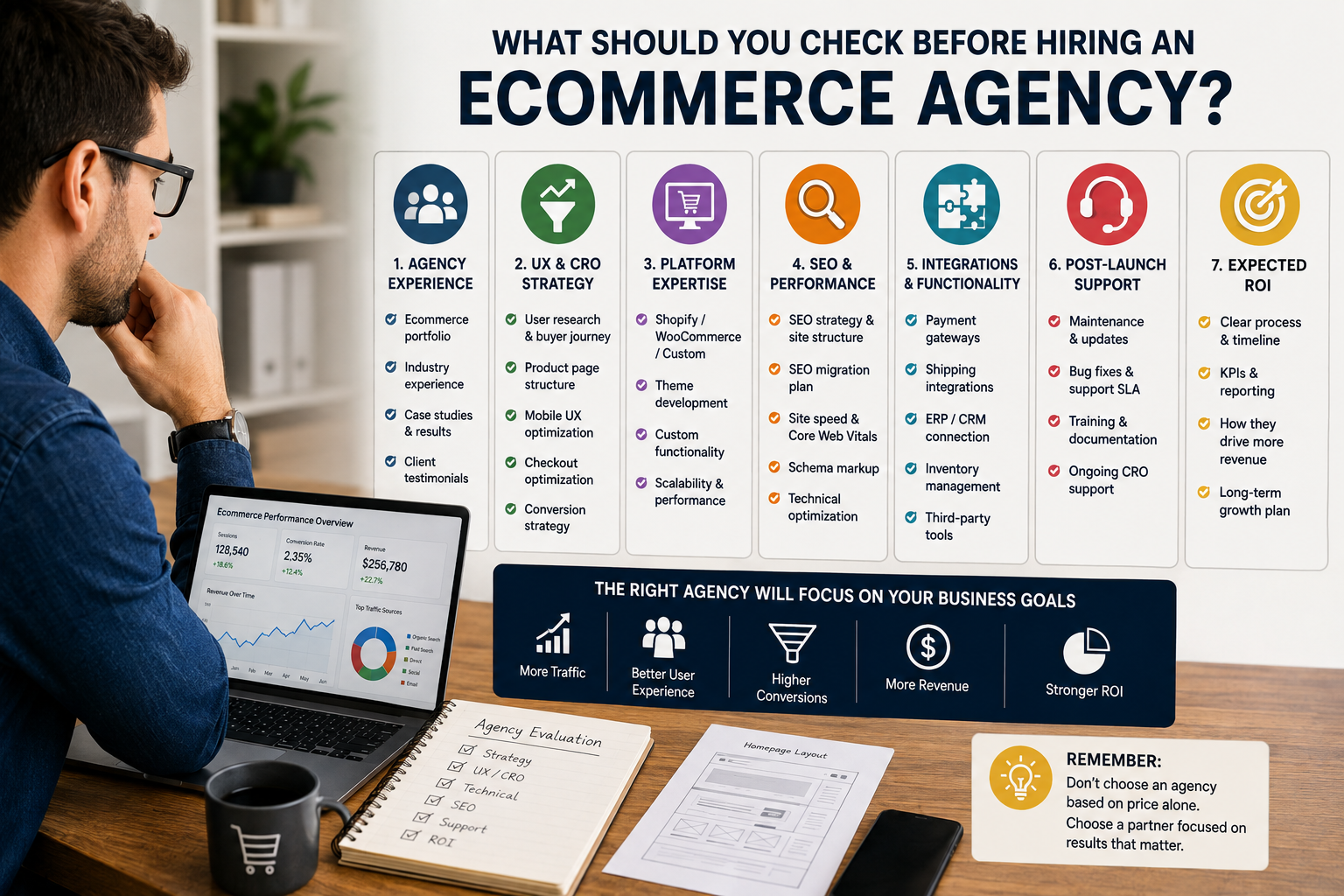
What Should You Ask Before Hiring an Ecommerce Agency?
Ask questions that force the agency to demonstrate diagnosis rather than salesmanship.
1. What do you think is currently preventing more customers from buying?
A serious answer should involve evidence and assumptions that can be tested.
2. What will you measure?
Look for conversion rate, add-to-cart rate, checkout completion, revenue per visitor, AOV and other relevant metrics.
3. How will you protect SEO?
The agency should understand URLs, redirects, indexing, metadata, internal linking and structured data.
4. How will you approach mobile?
The answer should go beyond “responsive design.”
5. What happens after launch?
A store needs measurement and iteration, not simply a handover.
6. What would make you recommend that I do not redesign?
This is one of my favorite questions because it tests whether the agency is willing to diagnose rather than automatically sell a rebuild.
Let’s Turn Your Ecommerce Idea Into a Store Built for Growth
Whether you’re launching, redesigning, or scaling an existing store, let’s discuss what will actually move your business forward — from functionality and customer experience to conversion strategy and the right level of investment.
Final Thoughts
Choosing an ecommerce agency should be a commercial decision, not a portfolio beauty contest.
The right partner should investigate where shoppers hesitate, distinguish traffic problems from conversion problems, protect valuable SEO equity, understand product-page behavior, improve mobile UX and treat checkout as a revenue-critical part of the website.
The biggest mistake is paying for a new storefront before understanding why the existing one is underperforming.
If your store already generates meaningful traffic, start with diagnosis. Then decide whether the right answer is CRO, SEO, PPC, selective optimization or a complete redesign.
If you are considering spending $5,000–$20,000 on your next ecommerce website, I would rather help you identify what actually needs fixing before you spend the money.
Book an Ecommerce Website Audit with KG Web Designer
FAQs
How do I know if I need an ecommerce redesign or CRO?
Start with the data. If your architecture, technology, navigation or mobile experience fundamentally limits the store, a redesign may be justified. If the structure works but customers drop at specific points, CRO may be the better first investment. An audit should identify the situation before you commit to a full rebuild.
How much does an ecommerce website redesign cost?
Professional ecommerce projects can range from several thousand dollars to $20,000 or more depending on UX complexity, platform, integrations, product catalog, migration requirements and customization. The important issue is not simply the project price but whether the proposed work addresses a commercially meaningful problem.
What should I ask an ecommerce website design agency?
Ask what the agency believes is preventing more customers from purchasing, what evidence supports that diagnosis, how success will be measured, how SEO will be protected, how mobile UX will be handled and what happens after launch. The answers should demonstrate commercial thinking rather than simply technical capability.
Can a Shopify store be optimized without rebuilding it?
Yes. Shopify stores can often be improved through product-page changes, navigation improvements, mobile UX adjustments, cart optimization, trust improvements and checkout configuration without replacing the entire store. Shopify’s current guidance emphasizes reducing checkout friction, improving mobile experiences and providing appropriate payment options.
Why is my ecommerce store getting traffic but not sales?
Traffic does not guarantee purchase intent. The problem may be weak landing-page relevance, unclear product positioning, insufficient product information, weak trust signals, mobile friction, unexpected costs or checkout problems. Start by identifying where users leave the funnel rather than assuming you need more traffic.
How important is mobile ecommerce UX?
Mobile UX is critical because shoppers must discover, compare, select and purchase products on a smaller interface. Shopify’s current checkout guidance emphasizes mobile-first design, while broader ecommerce research continues to identify mobile usability as a major conversion opportunity.
Should an ecommerce agency guarantee higher conversion rates?
Be cautious about guaranteed percentage increases. Conversion depends on traffic quality, products, pricing, offers, seasonality, customer intent and many other factors. A credible agency should establish baseline metrics, explain its hypotheses and define what it intends to improve rather than promise a specific result before seeing your data.