
Quick Answer
A premium ecommerce brand should invest first in the part of its growth system that is limiting profitable revenue. If qualified traffic is insufficient, prioritize acquisition. If qualified visitors arrive but fail to progress, prioritize conversion optimization and Premium Ecommerce Website Design improvements where needed. If the website has structural UX, technical, content, platform, or positioning problems, a Premium Ecommerce Growth Strategy should prioritize redesign before scaling traffic. The right sequence is diagnose first, invest second, scale third.
TL;DR: Where should the money go first?
- Paid acquisition should come first when the website already converts qualified visitors reasonably well but lacks sufficient demand.
- CRO should come first when qualified traffic exists but product discovery, evaluation, cart, or checkout performance is creating measurable leakage.
- A website redesign should come first when problems are structural and cannot be efficiently solved through isolated page-level improvements.
- Premium brands should judge conversion performance against product price, category, traffic source, device, and customer intent rather than a universal ecommerce benchmark.
- Baymard’s current research places average documented cart abandonment at 70.22% and estimates that the average large ecommerce site could potentially increase conversion by 35.26% through checkout design improvements alone.
- The most expensive growth mistake is paying to acquire more visitors before understanding whether the existing website can convert qualified demand profitably.
The real decision is not ads versus CRO versus redesign
The right investment depends on where revenue is being lost, not which marketing tactic your team happens to be discussing.
A premium ecommerce brand operates through a connected system:
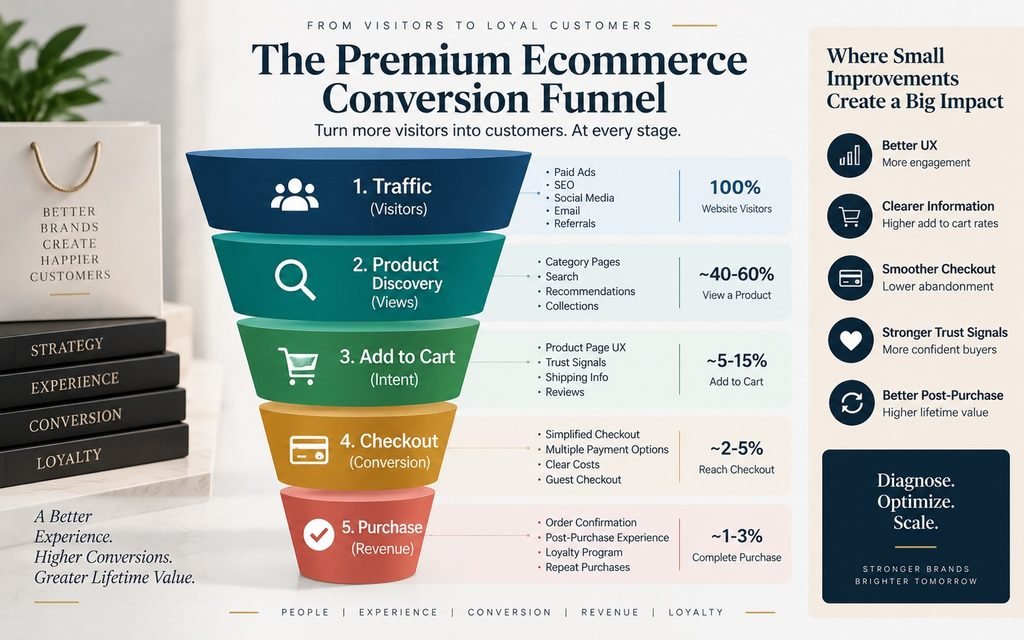
Acquisition → Landing experience → Product discovery → Product evaluation → Cart → Checkout → Purchase → Repeat purchase
A weakness at any stage can make the entire growth program look worse than it actually is.
For example, a brand may report poor advertising performance when the real problem is a product page that does not justify the price. Another brand may blame its website when the actual issue is that its campaigns are attracting low-intent visitors. A third may have reasonable conversion metrics but an outdated technical architecture that prevents the business from scaling new products, markets, or campaigns efficiently.
That is why a Premium Ecommerce Growth Strategy should begin with diagnosis rather than with a predetermined preference for paid ads, CRO, or redesign.
Don’t Redesign Because the Store Looks Old. Redesign Because the Buying Experience Is Holding Growth Back.
When Does Optimization Stop Being Enough?
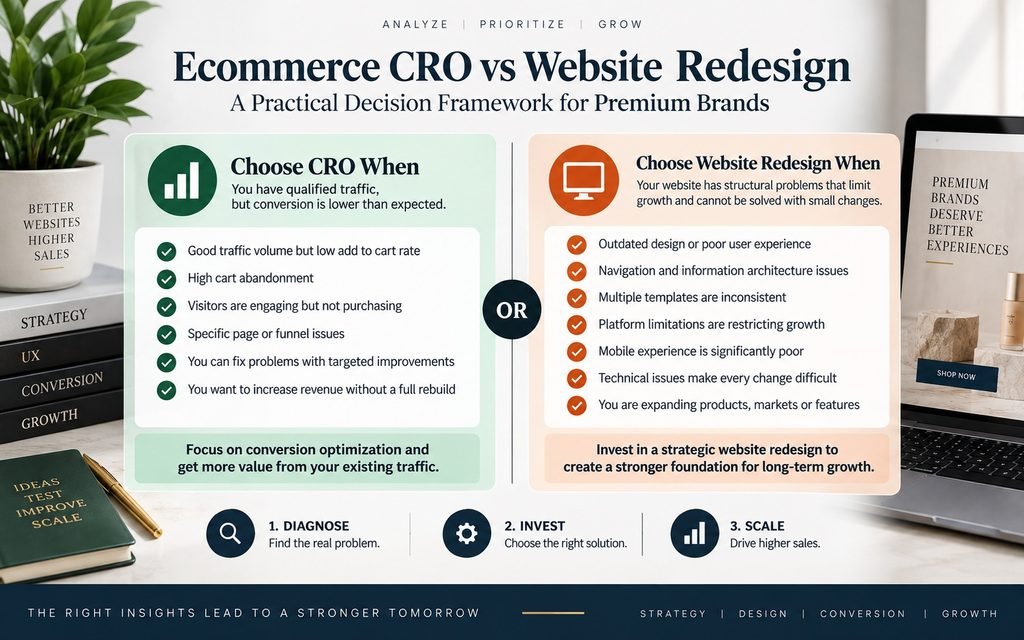
CRO can improve individual elements, but sometimes the bigger problem is structural. If several parts of the shopping journey are creating friction at once, a strategic redesign may provide a stronger foundation for future growth.
If these issues are showing up across the entire customer journey, fixing isolated elements may not be enough. The website itself may need a stronger conversion-focused structure.
Explore Ecommerce Website Design →2026 benchmark context
| Signal | Current benchmark / evidence | What it means |
|---|---|---|
| Global ecommerce conversion rate | 2.66% cited by Shopify from Dynamic Yield | Useful context, not a universal target |
| Shopify-store average cited by Triple Whale | 1.40% | Store/platform context matters |
| Luxury & jewelry conversion rate | 0.63% in Shopify’s June 2026 benchmark data | Premium/high-AOV categories can naturally convert lower |
| Average cart abandonment | 70.22% | Checkout leakage remains a major opportunity |
| Potential conversion uplift from checkout design | 35.26% for average large ecommerce site, according to Baymard’s research | Checkout UX can be commercially significant |
| Meta median CVR | 1.53% across 40,000+ brands in Aug. 2025-Jul. 2026 data | Paid traffic requires channel-specific context |
| Meta median ROAS | 1.88 in the same dataset | ROAS alone does not establish profitability |
Shopify’s August 2026 benchmark update emphasizes that ecommerce conversion varies substantially by industry and price point. Its June 2026 figures show 0.63% for luxury and jewelry compared with 5.32% for beauty and personal care, which is exactly why a premium brand should not diagnose its website from a generic “2% conversion rate” rule.
Triple Whale’s August 2026 benchmark report similarly shows that ecommerce performance varies by channel, industry, device, and business model. Its August 2025-July 2026 dataset reports a 1.69% median conversion rate for paid ads overall, while its separate Meta benchmark covering more than 40,000 brands reports a 1.53% median conversion rate and 1.88 median ROAS.
The important point is not that your store should reach a particular benchmark. The important point is that benchmarks can help identify where to investigate.
How do you identify the actual growth bottleneck?
The first step is to separate traffic quality, conversion friction, and structural website problems.
At KG Web Designer, we approach ecommerce diagnosis by asking a simple question at every stage: What evidence tells us that this is the problem?
Start with the following sequence.
1. Is enough qualified traffic arriving?
Look at:
- Traffic by acquisition channel
- New versus returning visitors
- Geographic traffic quality
- Campaign-to-landing-page relevance
- Branded versus non-branded traffic
- Paid versus organic behavior
- Device mix
- Revenue per acquisition channel
If the website converts qualified visitors but there simply are not enough of them, acquisition becomes a logical investment.
2. Are visitors engaging with the right products?
Look at:
- Product-page views
- Product engagement
- Add-to-cart rate
- Search behavior
- Category-to-product progression
- Product comparison behavior
- Exit pages
A weak add-to-cart rate can indicate several different problems: traffic quality, pricing, positioning, imagery, product information, trust, usability, or product-market fit.
Triple Whale’s 2026 benchmark report puts average ecommerce add-to-cart rate at 5.98%, but also emphasizes that industry and product category materially change the expected range. That makes the metric useful for investigation, not as a pass/fail score.
3. Are shoppers abandoning after demonstrating purchase intent?
Look at:
- Cart abandonment
- Checkout initiation
- Checkout completion
- Payment failures
- Shipping-cost exposure
- Delivery expectations
- Return-policy visibility
- Guest checkout
- Payment method availability
Baymard’s current research reports a 70.22% average documented cart abandonment rate across 50 studies. Its research also identifies checkout usability as a meaningful source of recoverable loss.
4. Are the problems isolated or structural?
This is the question that determines whether CRO or redesign makes more sense.
If one product template is weak, optimize the template.
If checkout is creating friction, improve checkout.
If navigation, templates, content hierarchy, mobile UX, technical performance, product discovery, and brand presentation are all compromised, you may have a structural website problem.
That is the dividing line.
When should paid acquisition come first?
Paid acquisition should come first when the store has a credible conversion foundation but insufficient qualified demand.
This is the scenario where the website is not necessarily the problem. The brand may have strong product pages, clear positioning, reliable checkout, persuasive trust signals, repeat customers, and acceptable conversion economics, yet not enough qualified people are entering the funnel.
For example, imagine a premium home-furnishings brand with strong repeat purchase behavior and good product-page engagement. Its analytics show that customers coming from high-intent search and email convert reasonably well, but new customer volume is too low to support the company’s growth targets.
That is an acquisition problem.
Increasing paid spend makes sense only after the brand understands its economics. Triple Whale’s 2026 Meta benchmark shows a median CPA of $38.99, median ROAS of 1.88, and median conversion rate of 1.53% across its reported dataset. Those figures demonstrate the cost environment, but they do not tell an individual brand whether more spending is profitable.
The real calculation needs to include:
- Gross margin
- Average order value
- Discounting
- Shipping costs
- Returns
- Customer acquisition cost
- Repeat purchase rate
- Customer lifetime value
- Contribution margin
A 3x ROAS can be excellent for one business and inadequate for another. Triple Whale itself now emphasizes peer-group benchmarking because generic ROAS comparisons can be misleading.
Standalone fact: A paid advertising benchmark can indicate channel performance, but it cannot determine profitability without the brand’s own margin and customer economics.
When should CRO come first?
CRO should come first when qualified traffic is reaching the website but the customer journey is losing too many commercially valuable visitors.
This is particularly important for premium ecommerce because customers often need stronger evidence before making a high-value purchase.
A premium shopper may want to understand:
- Why the product is worth its price
- What materials or ingredients are used
- How the product compares with alternatives
- How it fits or performs
- How quickly it will arrive
- What happens if it needs to be returned
- Whether the brand is trustworthy
- Which payment options are available
- Whether the product is authentic or backed by a guarantee
That means CRO is not simply about button colors, popups, or headline tests.
It is about reducing uncertainty.
Baymard’s checkout research is a strong illustration. Its current research reports a 70.22% average cart abandonment rate and estimates a potential 35.26% increase in conversion rate for the average large ecommerce site from addressing checkout design issues alone. Baymard explicitly notes that this is a research-based potential, not a guaranteed result for every store.
10 areas worth investigating before redesigning
- Value proposition clarity
- Product photography and video
- Product information hierarchy
- Reviews and social proof
- Price and payment communication
- Shipping transparency
- Returns and guarantees
- Product comparison
- Mobile navigation
- Checkout friction
Standalone fact: CRO is strongest when it identifies why customers hesitate, not simply which visual element receives more clicks.
When does a website redesign become the better investment?
A website redesign becomes the stronger investment when the problems affect multiple parts of the customer journey and cannot be efficiently solved through isolated optimization.
That distinction matters because redesign is expensive in more than one way.
It requires design resources, development resources, content work, SEO planning, analytics validation, migration planning, QA, stakeholder time, and often operational coordination across marketing and ecommerce teams.
A redesign should therefore solve a meaningful business problem.
Strong evidence for redesign includes:
- Navigation is fundamentally difficult to use.
- The website architecture no longer matches the product catalog.
- Product templates cannot communicate premium positioning.
- Mobile UX requires repeated workarounds.
- The current platform limits merchandising or functionality.
- Technical debt makes every marketing change expensive.
- Page templates are inconsistent across the store.
- The checkout experience cannot be adequately improved within the existing implementation.
- SEO architecture needs substantial restructuring.
- The brand has expanded into new products or markets.
- The current visual experience undermines the price point.
- Marketing teams cannot launch campaigns efficiently because the website is too rigid.
This is where Ecommerce Website Redesign becomes a strategic project rather than a cosmetic refresh.
A premium website should make it easier for the business to sell, market, merchandise, analyze, and scale.
If every campaign requires developers to work around the same architecture, the website is no longer simply a marketing asset. It has become an operating constraint.
What is the difference between a CRO problem and a redesign problem?
The difference is whether the problem can be isolated and improved without rebuilding the underlying system.
The practical distinction is:
| Evidence | Likely priority |
|---|---|
| Insufficient qualified traffic | Paid acquisition |
| Weak landing-page relevance | CRO / landing-page optimization |
| Low product engagement | CRO / product-page optimization |
| High cart abandonment | CRO / checkout optimization |
| Poor mobile usability across the site | Redesign may be justified |
| Broken information architecture | Redesign |
| Outdated product templates | Redesign |
| Platform limitations | Redesign / platform strategy |
| Weak campaign traffic but strong organic conversion | Acquisition |
| Strong traffic and widespread UX problems | CRO followed by redesign or redesign-led CRO |
This is the practical answer to ecommerce CRO vs website redesign.
The mistake is assuming that every conversion problem requires a new website.
The opposite mistake is assuming that every problem can be solved with another A/B test.
A good strategist knows when optimization has reached the point of diminishing returns.
What should premium ecommerce brands not do?
The first thing to avoid is increasing advertising simply because revenue has fallen.
That can create a dangerous cycle:
Sales fall → ad spend increases → more visitors arrive → more visitors encounter the same friction → acquisition costs rise → management concludes that marketing is failing.
The second mistake is redesigning because the website looks old.
A dated visual style can matter, particularly for premium products, but appearance alone does not justify a rebuild. The business needs evidence that the current experience is affecting trust, conversion, discovery, positioning, performance, or scalability.
The third mistake is optimizing conversion without protecting margin.
A discount campaign may increase conversion while reducing profit. A bundle may increase average order value while increasing fulfillment complexity. A promotional landing page may increase orders while attracting customers with lower lifetime value.
The objective is not the highest possible conversion rate.
The objective is profitable conversion from commercially valuable customers.
For premium brands, perceived value is particularly important. A product can be genuinely high quality while the website presentation makes the offer feel ordinary, inconsistent, or difficult to trust. Our analysis of how premium products can lose perceived value through a cheap-looking website addresses this problem from the brand and conversion perspective.
Where Is Your Store Actually Losing Growth?
Before putting more budget into acquisition, identify the part of the customer journey that needs attention first.
Example Scenario: A premium fashion brand with rising ad spend
Consider a premium apparel company spending aggressively on paid acquisition.
Traffic has increased, but sales have not increased proportionally.
The first reaction is to blame advertising performance.
Instead, the business should examine the complete path:
Ad → Landing page → Collection → Product → Size information → Cart → Checkout
Suppose the analysis shows that ads are generating relevant visitors and product pages are receiving strong engagement, but shoppers are hesitating around fit, shipping, returns, and product details.
That is not primarily an acquisition problem.
The correct response would be to improve decision-support content and conversion friction before materially increasing acquisition spend.
Now imagine the opposite.
The product pages have healthy engagement, checkout completion is reasonable, repeat customers convert well, but campaigns are generating insufficient qualified new visitors.
That is a distribution problem.
The same revenue decline produces two completely different investment decisions.
This is why diagnosing the bottleneck matters more than choosing a favorite growth tactic.
What should the action plan look like?
The most defensible sequence is diagnose, fix, validate, then scale.
First: Diagnose
Review:
- Analytics
- Funnel performance
- Acquisition channels
- Product performance
- Device performance
- Customer behavior
- Search behavior
- Checkout
- Technical performance
- Customer feedback
- Revenue and margin
Do not begin with a redesign proposal.
Begin with evidence.
Second: Fix the highest-value constraint
If the issue is isolated, run CRO.
If the issue is acquisition, improve campaigns and landing-page alignment.
If the issue is structural, define the redesign scope.
Third: Validate
Measure the effect against the previous baseline.
Look at:
- Conversion
- Revenue per session
- Add-to-cart
- Checkout completion
- AOV
- CAC
- Contribution margin
- Repeat purchase
Fourth: Scale
Once the website demonstrates that qualified traffic can convert efficiently, scale acquisition.
This is where Ecommerce Paid Ads become much more powerful because they are feeding a better-performing commercial system.
How should a premium brand measure whether the investment worked?
The investment worked when the business economics improved, not simply when a dashboard metric moved.
For acquisition, evaluate:
- Qualified new-customer volume
- CAC
- ROAS
- Contribution margin
- New-customer revenue
- Repeat purchase
For CRO, evaluate:
- Add-to-cart rate
- Checkout initiation
- Checkout completion
- Conversion rate
- Revenue per session
- AOV
For redesign, evaluate:
- Product discovery
- Mobile usability
- Conversion
- Revenue per session
- Organic performance
- Site performance
- Merchandising flexibility
- Development efficiency
Triple Whale’s 2026 ecommerce benchmark research explicitly warns against treating benchmark values as absolute targets. Its current data shows meaningful variation across industry, traffic source, device, and business model.
Shopify’s August 2026 benchmark update makes the same broader point: conversion rates differ substantially according to what is sold, pricing, shopping behavior, traffic source, and device.
That means a premium brand should compare itself primarily against its own historical performance and its closest competitive context.
More Visitors Don’t Automatically Mean More Customers
Your ecommerce website needs to carry shoppers from discovery to purchase without losing confidence, clarity or momentum along the way.
Expert Insight from Kanika Gupta
The strongest growth decisions I make are rarely about recommending the largest project.
They are about identifying the smallest commercially responsible intervention that can remove the current bottleneck.
Kanika Gupta, Founder, KG Web Designer
If this were my website, I would not increase advertising spend until I could explain where qualified visitors are dropping out and why.
I would also not approve a complete redesign simply because the website looks dated.
I would first determine whether the problem is:
Traffic → Conversion → Structure → Technology → Positioning → Economics
Only then would I decide how much work is justified.
That is an important distinction for premium brands because unnecessary website work can consume months of attention that should have gone into acquisition, merchandising, product development, or customer retention.
At KG Web Designer, we believe the website should earn its place in the growth strategy.
It should not simply be the most visible project on the marketing roadmap.
Original Data Callout: How we diagnose the problem at KG Web Designer
Our proprietary observation is methodological rather than a fabricated percentage claim.
Across website audits and ecommerce projects we work on, we repeatedly separate three problems before recommending investment: traffic quality, conversion friction, and structural website limitations.
That distinction changes the recommendation.
A store with strong qualified traffic but poor checkout behavior does not need the same intervention as a store with strong conversion but insufficient acquisition.
Likewise, a store where every new campaign requires workarounds because the architecture is outdated should not be trapped in an endless cycle of small CRO changes.
One common mistake we notice is that businesses describe the entire website as “not converting” when the actual problem is concentrated in one or two stages of the funnel.
That is why our starting point is diagnosis.
We do not use a redesign recommendation as a substitute for understanding the problem.
If you have a genuine internal audit dataset, this is also the section where I would eventually add a verified KG Web Designer percentage or sample size. Until that evidence exists, I would rather use a defensible first-party observation than manufacture a number.
Why premium ecommerce brands need a different conversion strategy
Premium ecommerce cannot be evaluated exactly like low-consideration commodity ecommerce because price changes buyer psychology.
When a shopper spends significantly more, the website has to answer more questions before the transaction feels safe.
The customer is not simply asking:
“Do I want this?”
They are often asking:
“Is this worth the price?”
That changes the role of the website.
A premium ecommerce experience needs to communicate:
- Product quality
- Brand authority
- Differentiation
- Proof
- Craftsmanship or expertise
- Materials or ingredients
- Product benefits
- Social proof
- Shipping confidence
- Returns
- Guarantees
- Payment flexibility
- Consistency
This is why premium ecommerce design cannot be reduced to aesthetics.
The design has to help the buyer justify the purchase.
Shopify’s 2026 category benchmarks illustrate the point numerically. Luxury and jewelry recorded a substantially lower benchmark conversion rate than categories such as beauty and personal care, reinforcing that a lower conversion rate does not automatically mean the site is failing.
Standalone fact: A premium ecommerce site should be judged by conversion quality and commercial economics, not by conversion rate alone.
When does professional help make sense?
Professional help becomes valuable when the decision itself has become expensive.
If your leadership team is debating whether to increase ad spend, redesign the store, migrate platforms, or launch another CRO program without agreeing on the actual bottleneck, the cost of an incorrect decision can be significant.
A qualified ecommerce strategist should be able to explain:
- What appears to be limiting growth.
- What evidence supports that conclusion.
- Which intervention should happen first.
- What should not be changed yet.
- What metrics will determine success.
- What risks exist around SEO and analytics.
- How the investment connects to revenue.
This is also where choosing the right ecommerce design partner matters.
A portfolio of attractive websites is not enough.
Ask prospective partners:
- How do you diagnose conversion problems?
- How do you distinguish CRO from redesign?
- How do you protect SEO during migration?
- How do you handle analytics and tracking?
- How do you define project success?
- What happens if the audit shows I do not need a redesign?
- How do you connect design decisions to commercial outcomes?
For brands evaluating providers, our guide on how to choose an ecommerce website design company covers the questions that should be answered before committing to a major ecommerce project.
Why Most Businesses Get This Wrong
Most businesses get this wrong because different teams see different symptoms.
The paid media team sees traffic.
The ecommerce manager sees conversion.
The designer sees UX.
The developer sees technical debt.
The finance team sees CAC and margin.
The CEO sees revenue.
None of those perspectives is necessarily wrong.
The mistake is allowing one metric to become the diagnosis for the entire business.
A premium ecommerce brand can have excellent advertising and a poor website. It can have an excellent website and weak acquisition. It can have both and still struggle because the product economics are wrong.
Successful businesses connect these signals.
They ask:
Where is the highest-value leakage?
Then they invest there.
They also recognize when optimization has reached its limits.
If the same structural problem appears across every template, every device, every campaign landing page, and every product category, another isolated experiment may simply delay the necessary rebuild.
Conversely, if the problem is concentrated in checkout, a complete redesign may be unnecessary.
The objective is not to spend more.
The objective is to make the next dollar more productive.
What This Means For Your Business
The commercial implication is straightforward: your next investment should remove the constraint closest to profitable revenue.
If qualified traffic is weak, invest in acquisition.
If qualified traffic is healthy but conversion is weak, invest in CRO.
If the website itself is structurally preventing the business from selling effectively, invest in redesign.
If more than one problem exists, sequence the investments rather than trying to solve everything simultaneously.
This reduces risk in several ways.
You avoid increasing CAC by sending more traffic into a weak funnel. You avoid spending heavily on redesign when a focused intervention could solve the problem. You avoid optimizing conversion at the expense of margin. And you create a clearer business case for every major marketing investment.
For Shopify brands specifically, the question of whether to rebuild the store or improve high-value product experiences deserves separate consideration. Our analysis of Shopify redesign versus product page fixes explores how to make that distinction before committing to a larger project.
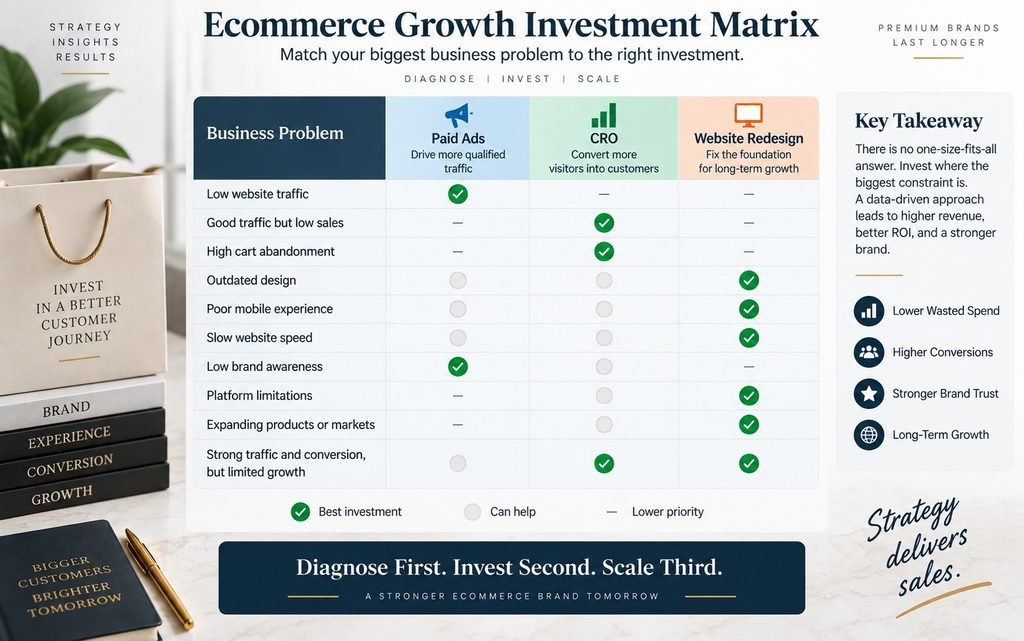
A simple decision matrix for your next investment
Use this framework before approving your next ecommerce growth budget.
| If you see this | Investigate first | Likely priority |
|---|---|---|
| Low qualified traffic | Acquisition channels | Paid acquisition |
| Strong traffic, weak add-to-cart | Product pages, positioning, UX | CRO |
| Strong add-to-cart, weak checkout completion | Checkout | CRO |
| Good conversion, weak new-customer volume | Acquisition economics | Paid acquisition |
| Poor mobile experience across the site | Architecture and UX | Redesign |
| Multiple inconsistent templates | Design system and IA | Redesign |
| Platform limits growth | Technology | Redesign / platform strategy |
| Strong traffic but weak perceived value | Messaging, product presentation, trust | CRO or redesign |
| Multiple structural problems | Full customer journey | Redesign-led CRO |
| Several isolated issues | Highest-value funnel leak | Prioritized CRO |
The framework is deliberately simple because the goal is not to make the decision sound complicated.
The goal is to make the decision defensible.
Example From Our Experience
A recurring ecommerce audit pattern we encounter is a brand that initially believes it needs more traffic because sales have slowed.
Problem:
The business is receiving meaningful website traffic, but leadership cannot confidently explain whether the problem is acquisition, product-page conversion, checkout friction, or website structure.
Diagnosis:
Instead of immediately recommending a redesign, the customer journey is separated into acquisition, discovery, evaluation, cart, checkout, and purchase. Each stage is evaluated against the business’s actual traffic and revenue data.
Solution:
The investment is then prioritized according to the highest-value constraint. A focused conversion problem may receive CRO work, while structural problems affecting navigation, templates, mobile experience, and scalability are escalated into redesign requirements.
Outcome:
The result is a more defensible investment plan rather than an unsupported claim of a particular percentage increase. The business knows what it should fix first, what it should measure, and when additional acquisition spending becomes commercially sensible.
This is the type of strategic restraint we bring to ecommerce website projects at KG Web Designer.
We would rather tell a business that it needs a focused improvement than recommend a larger project simply because the larger project is easier to sell.
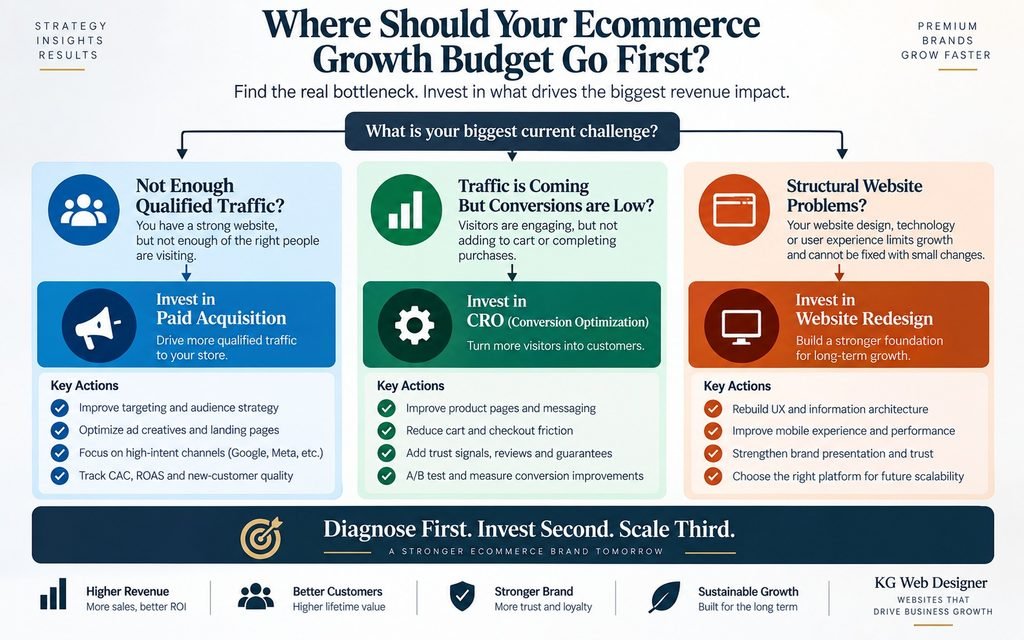
What should a premium ecommerce brand invest in first?
The answer depends on the evidence, but the priority can be summarized in three questions.
Do you need more qualified people?
Invest in acquisition.
Do you have qualified people but lose them during the buying journey?
Invest in CRO.
Is the website itself preventing the business from communicating, selling, merchandising, or scaling properly?
Invest in redesign.
That is the decision framework I would use before approving a major ecommerce budget.
And if the answer is “all three,” do not attempt all three at once.
Sequence them.
Fix the constraint that is suppressing revenue now. Validate the improvement. Then scale the next constraint.
That is the more disciplined approach to Premium Ecommerce Growth Strategy.
Final Thoughts
The best ecommerce growth investment is not necessarily the one with the biggest budget or the most impressive deliverable.
It is the one that removes the biggest commercially meaningful constraint.
Paid acquisition creates qualified demand. CRO helps more of that demand become customers. A redesign addresses structural problems that tactical optimization cannot efficiently solve.
For premium brands, the sequence matters because acquisition costs, buyer expectations, product prices, and brand perception are tightly connected.
The framework is simple:
Diagnose first.
Invest second.
Validate third.
Scale fourth.
If your team is currently debating whether the next major investment should go into advertising, CRO, or a new ecommerce website, do not make the decision from instinct alone.
Request a strategic ecommerce website assessment from KG Web Designer and get a clearer view of what should be fixed, tested, or scaled first.

Paid Ads, CRO or Redesign — Not Sure Where Your Next Investment Should Go?
Let’s look at your current ecommerce journey and identify whether the bigger opportunity is attracting more qualified traffic, improving conversion or fixing deeper website experience issues.
FAQs
How should a premium ecommerce brand evaluate its growth budget before making a major investment?
Start by comparing qualified traffic, product engagement, checkout behavior, acquisition economics, and website limitations. The goal is to identify the constraint closest to profitable revenue. A brand should not automatically increase advertising, start CRO, or commission a redesign until it can explain which part of the customer journey is limiting growth.
What makes a premium ecommerce website different from an average online store?
A premium ecommerce website must do more than display products. It has to communicate why the product deserves its price, reduce perceived purchase risk, provide strong proof, and create a consistent experience across discovery, evaluation, checkout, and post-purchase stages. Higher-consideration products often require stronger information architecture and trust-building content before customers are ready to buy.
Can a premium brand have a lower conversion rate and still have a healthy ecommerce business?
Yes. Conversion rates vary substantially by category, price point, traffic source, device, and purchase frequency. Shopify’s August 2026 benchmark data, for example, shows a large difference between luxury and jewelry and categories such as beauty and personal care. Profitability, customer quality, average order value, acquisition cost, and repeat purchase behavior should therefore be considered alongside conversion rate.
Which ecommerce metrics should executives review every month?
Executives should review qualified traffic, conversion rate, revenue per session, average order value, customer acquisition cost, contribution margin, repeat purchase rate, and channel-level profitability. These metrics provide a better business picture than traffic or ROAS alone because they connect marketing activity to actual economic performance.
How can a business tell whether its ecommerce website is becoming a growth constraint?
Look for repeated structural problems rather than isolated page issues. If teams consistently struggle with navigation, mobile UX, product templates, technical performance, content structure, merchandising, or platform limitations, the website may be restricting growth. If problems are isolated to specific funnel stages, targeted optimization may be more appropriate than a complete rebuild.
What should an ecommerce agency be able to explain before recommending a redesign?
An agency should be able to explain the business problem, the evidence behind the diagnosis, the limitations of the current website, the proposed scope, expected measurement framework, SEO risks, migration requirements, and what happens if a redesign is not actually necessary. A credible partner should be willing to recommend a smaller intervention when the evidence supports it.
How should premium ecommerce brands think about ROAS in 2026?
ROAS should be interpreted alongside margin, average order value, returns, discounts, fulfillment costs, new-customer mix, and repeat purchase economics. Triple Whale’s 2026 research demonstrates why peer and channel context matters: its Meta benchmark reports a 1.88 median ROAS across more than 40,000 brands, but that number cannot establish profitability for an individual company.