Quick Answer
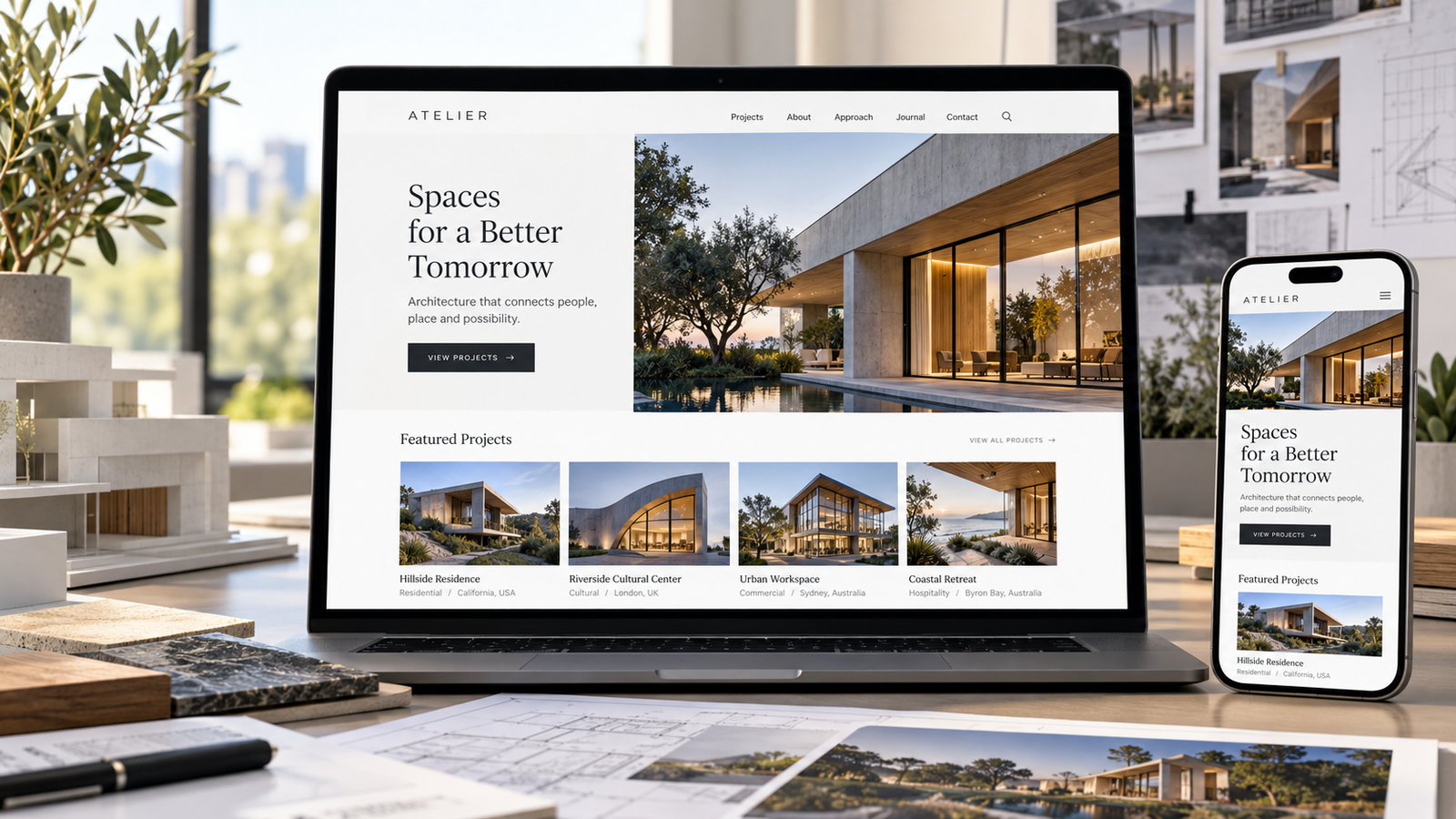
An architecture firm portfolio website should help prospective clients evaluate a firm’s design quality, relevant project experience, and suitability for their commission. Strong photography attracts attention, but clear project descriptions, intuitive navigation, mobile performance, and credible evidence help visitors understand the firm’s capabilities. The most effective portfolio is curated around the projects the firm wants to win, not simply the projects it has completed.
TL;DR: Key Takeaways
- Lead with project photography that reflects the firm’s expertise and desired client base.
- Explain the design challenge, the firm’s role, and the project’s defining decisions.
- Organize projects by meaningful categories so visitors can find relevant experience quickly.
- Optimize image delivery without sacrificing the detail that makes architectural work compelling.
- Connect project pages to relevant services and clear inquiry pathways.
- Measure qualified inquiries and lead relevance instead of judging portfolio performance by page views alone.
What Should an Architecture Portfolio Communicate Before a Client Makes Contact?
An architecture portfolio should establish three things quickly: what the firm does, what kinds of projects it understands, and why a prospective client should consider it. A visually attractive gallery is only the beginning; visitors also need enough context to decide whether the firm’s experience matches their requirements.
A homeowner considering a custom residence may prioritize materials, site response, natural light, privacy, and spatial planning. A developer evaluating a commercial practice may be more interested in project scale, planning constraints, stakeholder coordination, and the firm’s responsibilities during delivery.
The portfolio should reflect these different decision criteria without overwhelming visitors with information. A concise project summary, a purposeful sequence of images, and links to relevant work can make the firm’s expertise easier to evaluate.
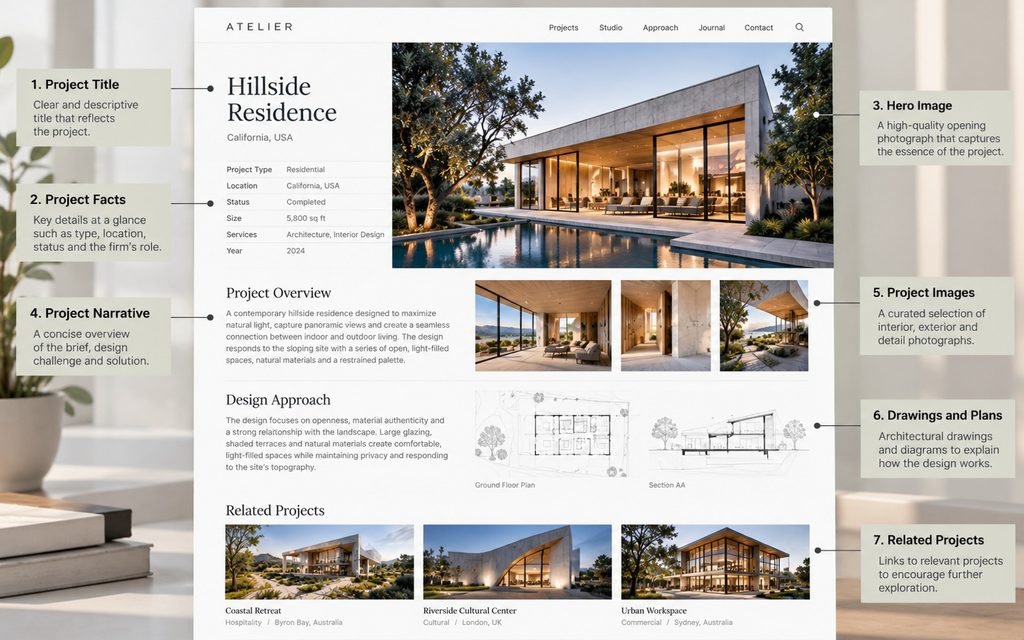
| Portfolio element | What a prospective client wants to know | SEO and conversion opportunity |
|---|---|---|
| Opening photograph | Does the work reflect the quality and style I need? | Create a compelling, relevant first impression |
| Project title and summary | What was designed, where, and for whom? | Establish clear project context |
| Project type and status | Is this comparable to my proposed commission? | Clarify relevance and avoid ambiguity |
| Design narrative | What problem did the firm solve? | Demonstrate expertise beyond visual presentation |
| Plans and supporting imagery | How does the design work? | Add useful information and visual depth |
| Project categories | Can I find work relevant to my needs? | Improve navigation and internal discovery |
| Related services | Does the firm offer the expertise I need? | Connect portfolio interest with commercial intent |
| Inquiry pathway | How can I discuss a similar project? | Reduce friction between interest and contact |
These elements matter commercially because architecture commissions often require substantial consideration before a client makes contact. The website should help that decision progress by presenting relevant evidence clearly, not force visitors to reconstruct the firm’s capabilities from disconnected photographs.
Your Architecture Deserves a Portfolio That Makes People Stop and Look.
Exceptional projects can lose their impact when photography, page layouts and project storytelling aren’t working together. Your website should communicate the quality of your work before a prospective client ever contacts your studio.
How Do Photography and Layout Influence the Client’s First Impression?
Photography establishes the initial visual impression, while layout determines how effectively visitors interpret the work. A dramatic exterior image may communicate form and atmosphere, but it cannot explain the entire design response, the project’s constraints, or the architect’s contribution.
Three architecture-specific considerations deserve attention.
The first is spatial understanding. Architecture is experienced in three dimensions, but a website presents it through a screen. An exterior photograph may show the overall form while revealing little about circulation, daylight, interior transitions, or the relationship between the building and its surroundings. A deliberate sequence of images helps visitors understand more of the project.
The second is commercial relevance. The most visually dramatic photograph is not always the most persuasive one for the target client. A residential client may respond to the relationship between interior spaces and landscape, while a workplace client may want to understand circulation, shared spaces, and the use of materials.
The third is visual hierarchy. A clear opening image, readable project information, and a predictable page structure help visitors understand where to look next. Excessive animation, confusing navigation, or repetitive imagery can distract from the work itself.
The business objective is to use photographs as evidence of design thinking. The visitor should see not only that a building looks compelling, but also that the practice can make decisions relevant to the visitor’s own project.
What Does Published Research Say About Architectural Image Performance?
Published web-performance research shows why image-heavy websites require careful optimization, although it does not establish a universal conversion increase for architecture portfolios.
The HTTP Archive’s 2025 Web Almanac reports median image payloads of approximately 1,058 KB for desktop homepages and 911 KB for mobile homepages across the wider web. These are not architecture-specific figures, but they provide context for the amount of image data websites may deliver. Read the 2025 Web Almanac’s page-weight research.
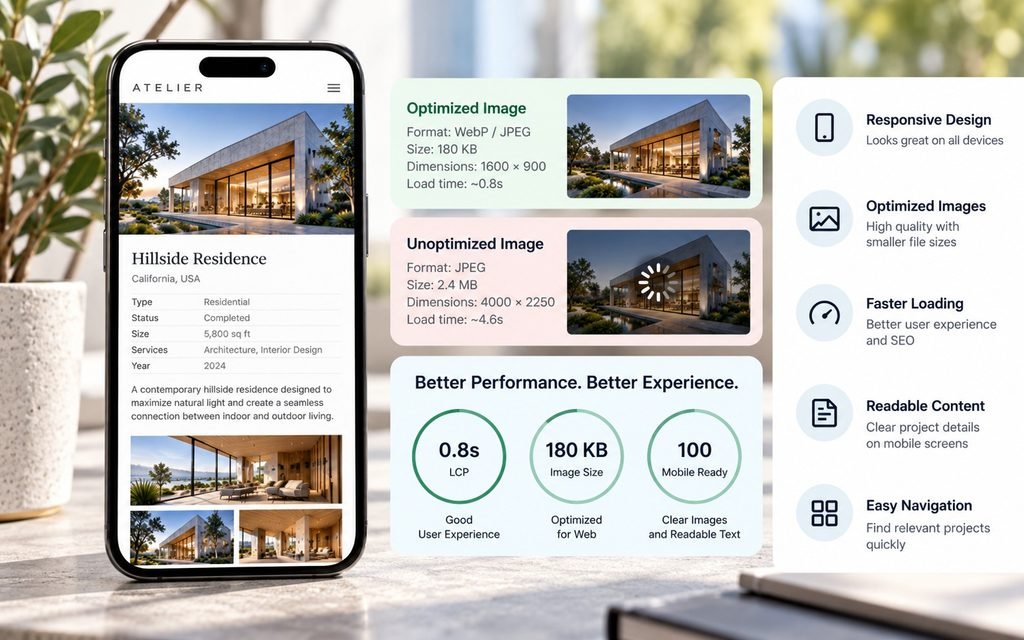
Google recommends a Largest Contentful Paint (LCP) of 2.5 seconds or less for a good user experience. This is particularly relevant when a large hero photograph forms the most prominent element on a project or homepage. Review Google’s Core Web Vitals guidance.
For architecture firms, the practical steps are:
- Export images at dimensions appropriate to their display size.
- Use modern image formats where supported and preserve sufficient visual quality.
- Prioritize the loading behavior of the main hero image.
- Load below-the-fold imagery efficiently.
- Set image dimensions to reduce unexpected layout shifts.
- Test project pages on mobile devices and slower connections.
- Review image crops to ensure important architectural details remain visible.
Research-based observation: Image delivery is a measurable technical consideration, while the commercial effect of a particular photography or layout change must be measured on the individual website. Neither the broad HTTP Archive figures nor Google’s performance thresholds prove that a specific portfolio redesign will generate more inquiries.
Image optimization should not mean making photographs too small to appreciate. It means delivering the detail required for the visual experience without sending unnecessary data to every visitor.
Which Portfolio Layout Works Best for Different Architecture Firms?
The best layout depends on the firm’s specialization, the complexity of its work, and how prospective clients evaluate projects. A residential architecture studio, a commercial workplace practice, and a multidisciplinary firm do not necessarily need the same portfolio structure.
| Firm type | Recommended portfolio approach | Information to emphasize |
|---|---|---|
| Residential architecture | Image-led project pages with concise project facts | Site response, materials, spatial planning, completed photography |
| Commercial and workplace | Categorized projects with detailed narratives | Scale, client requirements, scope, delivery complexity |
| Hospitality and retail | Editorial project storytelling with supporting details | Circulation, customer experience, materials, atmosphere |
| Institutional and public projects | Structured pages with supporting diagrams | Project purpose, stakeholders, accessibility, status |
| Multidisciplinary practices | Filterable project library organized by discipline and type | Service areas, locations, project types, relevant capabilities |
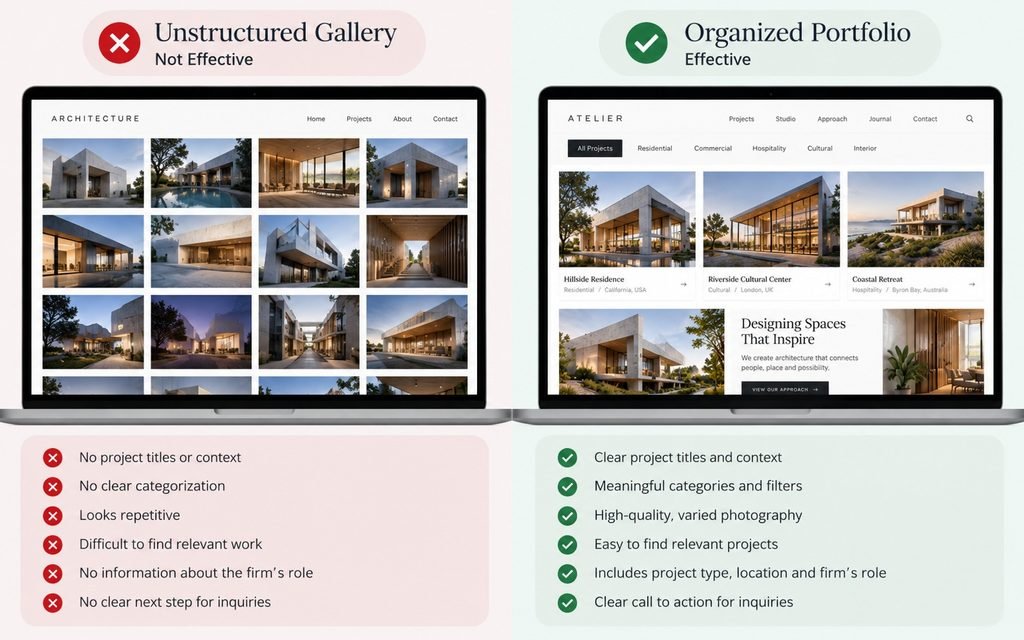
The layout should make relevant projects easy to find without requiring visitors to browse the entire archive. It should also preserve the firm’s identity instead of copying a design trend that may not suit its audience.
For firms serving several sectors, project categories should clarify the firm’s capabilities rather than introduce unnecessary complexity. A curated portfolio of relevant projects can communicate a clearer position than a large archive with no obvious structure.
What Can We Learn From Real Architecture Portfolio Websites?
Public architecture websites provide observable examples of project discovery and presentation. They are useful references for design decisions, but their layouts alone do not prove that any particular approach produces more leads.
- Snøhetta: Its project directory offers filters for discipline, typology, location, and project status. This gives visitors several ways to explore a broad collection of work.
- Gensler: Its project library combines project imagery with names, locations, and descriptions, connecting visual presentation with project context.
- Bjarke Ingels Group (BIG): Its architecture portfolio organizes projects across multiple categories, helping visitors explore work across different sectors and building types.
The lesson is not to copy the visual style of an international practice. It is to make the firm’s work discoverable and its project context understandable.
A smaller architecture firm can apply these principles with a simpler interface: use a manageable set of categories, feature the strongest relevant projects, and give each project a page that explains its purpose and design response.
How Should You Select Project Photography for Your Website?
Choose photography according to what each image needs to communicate about the project. The opening image should establish the overall character, while supporting images should explain different aspects of the building and the design decisions behind it.
Use this selection process:
- Choose a representative hero image. Select a photograph that reflects the project’s character and the kind of work the firm wants to attract.
- Show different spatial conditions. Include exterior, interior, detail, and contextual views when they add meaningful information.
- Explain the site’s relationship to the building. Show the landscape, surroundings, access, or urban context where relevant.
- Include important details. Materials, lighting, circulation, and custom elements can demonstrate design judgment.
- Use drawings when photography is insufficient. Plans, sections, and diagrams can explain spatial relationships that photographs cannot.
- Confirm image permissions. Check publishing rights, photographer credits, and client approvals.
- Review every crop on mobile. Make sure key architectural features remain visible on smaller screens.
A strong architecture firm website examples research process should compare how different firms organize projects, explain context, and support navigation. Inspiration is useful only when the approach is adapted to the firm’s own positioning and client needs.
The objective is not to make every project page identical. It is to create enough consistency for the portfolio to feel coherent while allowing the character of each project to remain visible.
Does Every Project Page Tell the Story Behind the Design?
Strong architecture portfolios do more than display beautiful images. They help visitors understand the project context, design thinking and the expertise behind the finished work.
The Courtyard Residence
A considered approach to light, materiality and the relationship between interior and exterior spaces.
Give each project the space, structure and context it needs to make a stronger impression on prospective clients.
Explore Portfolio Website Design →What Should Every Architecture Project Page Include Beyond Photographs?
A strong project page combines visual evidence with concise, specific information. Photographs show the result, while the narrative helps prospective clients understand the brief, constraints, decisions, and the firm’s actual contribution.
Consider including these elements:
- Project name and location: Provide identifiable project details and geographic context where appropriate.
- Project type and status: Clarify whether the work is proposed, under construction, or completed.
- Scope and the firm’s role: Explain the services and responsibilities the practice actually provided.
- Brief and constraints: Describe the client’s needs, site conditions, or design challenge without revealing confidential information.
- Design response: Explain the decisions that shaped the outcome.
- Supporting drawings and details: Include plans, sections, diagrams, or material details when they improve understanding.
- Verified proof: Add approved testimonials, awards, publications, or documented project facts when available.
- A relevant next step: Offer a clear way to discuss a similar project or explore the firm’s services.
This structure also helps search engines understand the page’s subject. Descriptive text provides context that photographs alone cannot reliably communicate, while clear headings and accurate project facts help both visitors and search systems interpret the content.
A well-planned architect portfolio page design should prioritize the information a prospective client needs to assess fit and credibility. Adding more content is not automatically useful if it makes the page harder to navigate.
What Should You Fix First, Second, and Third?
Improve the portfolio in the order that removes the most important barriers to understanding and contacting the firm. A full redesign is not always the first or most commercially sensible intervention.
| Priority | Improvement | Why it matters |
|---|---|---|
| 1 | Project selection and opening imagery | Establishes the firm’s quality and focus quickly |
| 2 | Project page content and structure | Helps visitors evaluate relevant experience |
| 3 | Navigation and categorization | Makes comparable projects easier to discover |
| 4 | Image performance and mobile presentation | Reduces technical friction during browsing |
| 5 | Service links and inquiry paths | Connects interest with the next business step |
| 6 | Measurement and refinement | Shows which changes deserve further investment |
A practical 30-day action plan
Week 1: Audit the portfolio. Review the homepage and the most important project pages. Identify outdated projects, weak opening images, missing project facts, confusing categories, and unclear calls to action.
Week 2: Curate and rewrite. Select projects that represent the firm’s desired future work. Prepare concise descriptions, verify the firm’s role, and choose images that communicate different aspects of each project.
Week 3: Improve structure and performance. Refine project templates, navigation, responsive image crops, image delivery, and mobile usability. Test loading performance instead of assuming that image compression has solved the problem.
Week 4: Measure the experience. Review organic search impressions, clicks, relevant project-page visits, inquiry-form starts and completions, and the quality of incoming inquiries. Compare results with a baseline and allow sufficient time and traffic before drawing conclusions.
If the structure is sound but the photography and content are weak, targeted improvements may be enough. If the website no longer reflects the firm’s positioning or makes project management difficult, a redesign may be justified.
Planning a portfolio refresh? KG Web Designer can review project presentation, navigation, image performance, and inquiry pathways to identify which improvements are worth prioritizing before you commit to a full redesign.
Example Scenario
Consider a hypothetical architecture firm that wants to win more commercial workplace commissions but leads its portfolio with residential projects. Its photography is polished, yet a commercial property owner must browse several pages before finding relevant workplace experience.
The firm could reorganize its strongest commercial projects, add concise summaries, and connect each project to a relevant service page or inquiry route. This would make its positioning easier to understand without requiring a complete website rebuild.
The expected benefit is a clearer evaluation experience, not a guaranteed increase in leads. The firm would need to track qualified inquiries and assess their relevance over time to determine whether the changes improved business outcomes.
Beautiful Project Photography Gets Attention. The Portfolio Experience Builds Confidence.
Prospective clients don’t evaluate architecture firms through imagery alone. They also look for relevant experience, design thinking and a clear way to start a conversation.
First Visual Impression
Strong project photography communicates the quality and character of your work.
Relevant Projects
Clear categories and navigation help visitors find projects that match their interests.
Design Expertise
Project descriptions, context and process help demonstrate your approach.
Project Enquiry
A well-placed enquiry path makes it easier to discuss a potential commission.
Build an architecture portfolio that connects compelling visual presentation with a clear path to meaningful project enquiries.
Improve My Portfolio Experience →Why Do Architecture Firms Get Portfolio SEO Wrong?
Architecture firms often invest heavily in their work and photography but treat the website as a place to upload finished images. This can leave search engines and prospective clients with too little context to understand the firm’s expertise.
Common mistakes include:
- Publishing project galleries with vague or duplicated descriptions.
- Using image filenames that provide no meaningful project context.
- Omitting descriptive alternative text where images convey useful information.
- Failing to connect project pages with relevant service pages.
- Creating categories that reflect internal preferences rather than client needs.
- Allowing important projects to become difficult to discover through navigation.
- Overloading pages with large images and unnecessary visual effects.
- Making broad claims about project outcomes without supporting evidence.
The remedy is not to insert keywords into every heading or image description. It is to give each page a clear purpose, use natural language that accurately describes the work, connect related pages, and make the website easy to use.
Google’s guidance emphasizes helpful, reliable, people-first content and clear information that helps visitors accomplish their goals. Read Google’s helpful content guidance.
For a portfolio, that means creating original project information and a useful browsing experience rather than publishing many near-identical pages to target slightly different search phrases.
Expert Insight from Kanika Gupta
Kanika Gupta, Founder, KG Web Designer
My strongest recommendation is to curate the portfolio around the work you want to be commissioned for next, rather than treating it as a record of everything the firm has ever completed.
If this were my website, I would select the projects that best represent the firm’s intended market, lead each with a distinctive and well-optimized image, and explain the design challenge and the firm’s role on the same page. I would then check whether visitors can find comparable projects and understand how to start a conversation without returning to the homepage.
That sequence matters because a portfolio is not simply a gallery. It is part of the firm’s business-development process, and each page should help a prospective client assess fit, capability, and credibility.
Example From Our Experience
A responsible portfolio review must distinguish a verified client outcome from a general observation or an example drawn from public research. No architecture-firm client project or measured architecture-portfolio conversion result has been supplied for this article, so it would be misleading to present a fabricated project as a KG Web Designer case study.
The public portfolio examples discussed above provide a documented basis for evaluating navigation, project categorization, and the presentation of project context. They are observations of published websites, not private client audits or evidence of conversion performance.
For a documented KG Web Designer architecture project, the case study should include:
- Problem: What the original portfolio made difficult for prospective clients.
- Solution: Which project-selection, layout, content, navigation, or performance changes were implemented.
- Outcome: What changed in measured behavior or qualified inquiries, supported by an appropriate baseline and measurement period.
Until verified project evidence is available, these recommendations should be treated as a reasoned framework for improvement, not a quantified promise of commercial results.
How Can Architecture Firms Build Trust Before the First Meeting?
Architecture firms can build trust by making their expertise, project responsibilities, process, and relevant experience easy to verify. A visually polished portfolio creates interest, but specific evidence helps prospective clients judge whether the practice is suitable for their commission.
A useful project page should distinguish completed projects from proposals, accurately describe the firm’s role, and avoid implying that the firm delivered work completed by other organizations. Approved client testimonials, awards, publication references, and documented project facts can strengthen credibility when they are relevant and verifiable.
For firms that rely on high-value commissions, case studies can explain how the practice approached a challenge rather than simply displaying the finished building. The same principle applies to other professional-service businesses: the role of case studies in website design and conversion illustrates why contextual evidence is more useful than unsupported claims.
The strongest proof is relevant to the project a visitor is considering. A firm seeking commercial commissions should make its commercial experience easy to find rather than relying on a large gallery of unrelated work to establish credibility.
What Does This Mean For Your Business?
A well-planned architecture firm portfolio website helps prospective clients understand design quality, find relevant experience, and decide whether to initiate a conversation. It also gives the firm a consistent way to communicate its positioning across search, referrals, professional networks, and direct visits.
The commercial value should be evaluated through qualified inquiries and the relevance of the projects those inquiries represent, not page views alone. A portfolio that attracts fewer but better-matched prospects may be more useful than one that receives broad attention without generating suitable opportunities.
For firms competing on expertise and reputation, the website should support the conversations that happen before a formal proposal. Project narratives, clear firm information, and verifiable proof can help prospects arrive better informed and reduce avoidable uncertainty.
The key decision is not whether the portfolio looks fashionable. It is whether the website represents the firm’s strengths accurately and helps the right clients recognize them.
For firms refining their positioning, the principles in this guide to positioning a professional firm as a premium brand through website design offer a related perspective on clarity, authority, and client qualification. Apply those principles to the architecture firm’s own audience rather than copying a consulting firm’s messaging.
When Does Professional Website Help Make Sense?
Professional help makes sense when the portfolio no longer reflects the firm’s positioning, project content is difficult to maintain, or qualified visitors struggle to find relevant work and inquire. The right starting point is a diagnosis of the problem, not an automatic commitment to a full redesign.
A focused review can establish whether the main barrier is photography, content, navigation, mobile performance, or conversion structure. This helps the firm avoid paying for a complete rebuild when a smaller intervention would address the actual issue.
KG Web Designer approaches website projects as business and user-experience decisions, not just visual exercises. For a design-led practice, the scope should account for project types, target clients, photography assets, content requirements, and the desired inquiry journey.
Firms planning a new portfolio or a substantial refresh can explore website design for interior designers and other design-led practices to consider how project presentation and service positioning can work together. The precise scope should be based on the firm’s needs rather than a standard package.
Is Your Architecture Portfolio Making the Impression Your Work Deserves?
Let’s review how your website presents your projects, photography and design expertise. We’ll identify whether improvements to imagery, project storytelling, navigation or the overall portfolio structure could help prospective clients better understand your work.
What We’ll Review
Website Strategist
Final Thoughts
An architecture portfolio should make the firm’s work easier to understand, not merely more attractive to look at. Photography earns attention, project narratives explain the thinking behind the work, and a clear layout helps prospective clients assess whether the firm is right for their needs.
The strongest portfolio strategy combines thoughtful curation, useful project context, efficient image delivery, accessible navigation, and a clear inquiry path. Real performance and inquiry data should then guide further improvements.
At KG Web Designer, the objective is to connect visual presentation with a clear business purpose. If your portfolio no longer reflects the quality of your work or the projects you want to win, discuss an architecture portfolio website review with KG Web Designer to identify the most useful improvements before committing to a full redesign.
Frequently Asked Questions
How many projects should an architecture firm show on its website?
There is no universal ideal number. A firm should feature enough projects to demonstrate the depth and range of experience relevant to its target clients while keeping the strongest work easy to find. A smaller, carefully curated portfolio can be more persuasive than a large archive if it communicates the firm’s expertise and preferred project types clearly.
What makes project photography effective on an architecture website?
Effective project photography shows more than an attractive exterior. It helps visitors understand scale, materials, spatial relationships, light, and the experience of moving through a building. A considered selection of exterior, interior, detail, and contextual images generally communicates more than a long gallery of repetitive angles.
Should an architecture firm use renderings or photographs of completed projects?
Use both when they serve a clear purpose, but label them accurately. Completed photographs show the built result, while renderings communicate proposed or unbuilt work. Clearly identifying project status prevents visitors from mistaking a visualization for a completed building and helps preserve trust in the firm’s presentation.
How can an architecture portfolio attract better-qualified inquiries?
Organize projects around the firm’s target markets, explain the firm’s actual role and project context, and connect relevant work to appropriate service pages or inquiry paths. Track whether the website produces inquiries that match the firm’s capabilities and preferred project types. Evaluate changes using real behavior rather than assuming that a visual redesign will increase conversions.
Does high-resolution photography make an architecture website slower?
It can, especially when oversized files are delivered unnecessarily or many images load at once. The solution is not to sacrifice visual quality automatically, but to use appropriate dimensions, modern formats, responsive image delivery, and efficient loading behavior. Test actual page performance, particularly for the hero image and on mobile devices.
What should an architecture project page include for SEO?
A useful project page should include a descriptive title, project type, location where appropriate, a concise brief, the firm’s role, relevant design decisions, and descriptive image text. The page should be accessible through clear internal links and offer original information rather than relying entirely on photographs. Publish only project facts and claims the firm can verify.
Should an architecture firm redesign its portfolio or improve the existing website?
That depends on the underlying problem. If the website has a sound structure but weak imagery, outdated content, or performance issues, targeted improvements may be enough. If its positioning, navigation, page templates, and content management no longer support the firm’s goals, a redesign may be more appropriate. An audit can help establish the right scope.