Quick Answer
Professional ecommerce website design services should improve customer experience without sacrificing the search visibility your business has spent years building. A successful ecommerce redesign starts with technical SEO planning, URL preservation, structured data validation, and conversion optimization before any design work begins. When executed correctly, a redesign protects rankings while creating a faster, higher-converting, AI-ready online store.
TL;DR / Key Takeaways
- Most ecommerce redesigns fail because SEO planning begins after design instead of before it.
- The safest migrations protect existing rankings while improving customer experience and conversions.
- Redirect mapping, structured data validation, technical SEO audits, and post-launch monitoring are essential for preserving organic traffic.
- AI-powered search rewards ecommerce websites with strong semantic architecture and connected product information.
- International ecommerce migrations require additional planning for language targeting, regional storefronts, and multi-currency experiences.
- A redesign should strengthen your business, not force months of SEO recovery.
Ecommerce Migration Comparison
| Migration Approach | SEO Risk | Revenue Risk | Long-Term Growth |
|---|---|---|---|
| Visual redesign only | High | High | Limited |
| Platform migration without SEO planning | Very High | Very High | Poor |
| SEO added near launch | Moderate | Moderate | Moderate |
| SEO-first migration strategy | Low | Low | Excellent |
| SEO + CRO + AI-ready migration | Very Low | Very Low | Outstanding |
Introduction
A redesign should be one of the most profitable investments an ecommerce business makes.
Unfortunately, many redesigns become expensive recovery projects instead.
We’ve worked with ecommerce businesses that invested months into a beautiful new storefront only to watch their organic rankings decline shortly after launch. Others lost valuable category pages, broke years of internal linking, or unknowingly removed structured data that helped products appear prominently in search.
The redesign wasn’t the problem.
The migration strategy was.
At KG Web Designer, we design conversion-focused websites for ecommerce brands, professional services, manufacturers, and healthcare businesses. While our experience spans multiple industries, our ecommerce migration methodology has been developed specifically for businesses where every ranking, product page, customer journey, and organic visitor directly affects revenue.
A successful ecommerce redesign isn’t simply about launching a modern-looking website.
It’s about protecting the authority you’ve already earned while building a stronger platform for future growth.
Today’s ecommerce migrations demand expertise across multiple disciplines:
- Search Engine Optimization (SEO)
- Conversion Rate Optimization (CRO)
- AI Search Optimization (AIO & GEO)
- Information Architecture
- Technical Performance
- User Experience
- Semantic Structured Data
Ignoring even one of these areas introduces unnecessary business risk.
When planned correctly, a redesign becomes a growth initiative instead of a recovery project.
Buyer Intent Layer
Buyer Stage
Consideration → Decision
Questions Ecommerce Brands Are Asking
- Will redesigning my ecommerce website hurt Google rankings?
- Can I improve conversions without losing organic traffic?
- How do I migrate safely to Shopify, WooCommerce, Magento, or another platform?
- How long should an ecommerce migration take?
- What makes one ecommerce agency safer than another?
Common Buyer Concerns
- Losing rankings after launch
- Broken product URLs
- Revenue declines during migration
- Hiring an agency without migration expertise
- Investing in a redesign that doesn’t improve sales
What Buyers Need Before Investing
- Proven ecommerce migration experience
- Technical SEO expertise
- A documented migration framework
- Conversion optimization strategy
- Clear communication
- Confidence that existing rankings will be protected
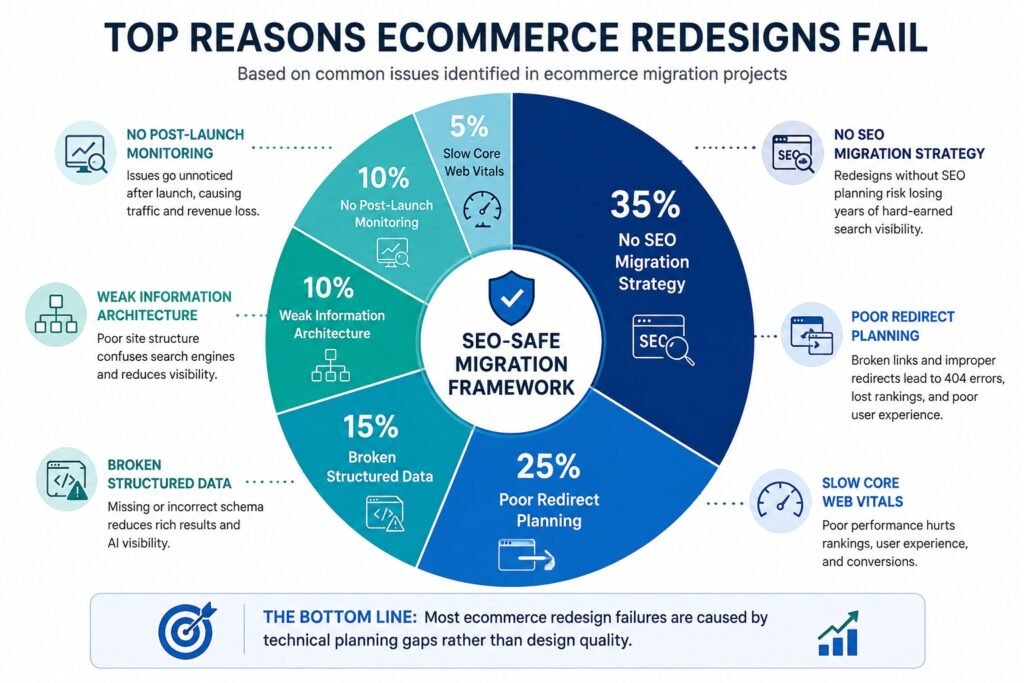
Why Do Most Ecommerce Redesigns Fail?
Most ecommerce redesigns fail because businesses redesign the interface before understanding what already makes their website successful.
A modern homepage doesn’t automatically preserve years of organic rankings.
A faster platform doesn’t automatically improve conversions.
Beautiful design cannot compensate for poor migration planning.
In our experience, ecommerce teams spend weeks discussing layouts, colors, branding, and homepage designs while technical SEO conversations happen near the end of development.
By then, many of the most important decisions have already been made.
URL structures have changed.
Category hierarchies have shifted.
Internal linking has been rebuilt.
Structured data has been altered.
Search engines are suddenly asked to reinterpret an entirely new website.
That uncertainty often leads to ranking fluctuations, traffic declines, and avoidable revenue loss.
One mistake we see repeatedly is businesses rebuilding their website by copying design trends or competitor layouts without understanding the strategy behind them. A successful ecommerce redesign starts by identifying what actually improves the customer experience, not simply what looks modern. If you’re looking for inspiration before planning your migration, our guide, We Analyzed 15 of the Best Ecommerce Website Designs in 2026: Lessons from Fashion, Beauty, Electronics & D2C Brands, breaks down the UX, trust-building, product page strategies, navigation patterns, and conversion principles used by leading global brands. Reviewing what makes these websites successful before beginning a redesign can help you make better design decisions while avoiding costly mistakes during your migration.
Original Data Callout
What We Frequently Discover During Ecommerce Website Audits
Across ecommerce redesign consultations conducted by KG Web Designer, several migration issues appear consistently before development even begins.
| Recurring Migration Issue | Typical Business Impact |
|---|---|
| URL mapping planned too late | Organic traffic fluctuations after launch |
| Missing redirect strategy | Loss of indexed product and category pages |
| Structured data changes left unchecked | Reduced eligibility for rich search results |
| Navigation rebuilt without SEO review | Lower crawl efficiency and weaker topical authority |
| Limited post-launch monitoring | Ranking declines remain unnoticed until revenue is affected |
One trend appears repeatedly.
Businesses that experience the smoothest migrations begin SEO planning before design starts rather than treating it as a checklist completed before launch.
Ready to Build a High-Converting Ecommerce Website?
👉 Get your top 3 conversion leaks identified.
Expert Insight from Kanika Gupta
Kanika Gupta
Founder, KG Web Designer | Ecommerce SEO & AI Strategy Consultant
“A successful ecommerce migration shouldn’t feel like starting over. Our goal is to preserve every piece of trust your business has already earned-from search rankings and customer journeys to structured data and product authority-while building a faster, more scalable platform for future growth.”
Why Is SEO Planning More Important Than Design During a Migration?
SEO planning should begin before design because search engines evaluate relationships, authority, and technical consistency-not visual appearance.
Every indexed product page, category page, buying guide, backlink, and internal link contributes to your current search visibility.
Changing these assets without a documented migration strategy forces Google and AI search platforms to rediscover your business from the beginning.
That creates unnecessary risk.
A successful SEO-friendly ecommerce website design project starts by identifying the assets already driving revenue before discussing templates, layouts, or branding.
Before wireframes are created, your migration team should document:
- Highest-performing landing pages
- Revenue-generating product categories
- Top organic keywords
- Valuable backlinks
- Existing URL structure
- Internal linking architecture
- Structured data implementation
- Indexed content
- Conversion pathways
Only after these assets are protected should design decisions begin.
Industry Observation
After reviewing ecommerce websites across multiple industries, we’ve found that businesses experiencing the smoothest migrations rarely rebuild everything from scratch.
Instead, they identify what already contributes to rankings, trust, and revenue, preserve those strengths, and improve the customer experience around them.
That balanced approach consistently produces stronger long-term business outcomes than redesigning every page without a migration strategy.
What Happens When SEO Is Ignored During an Ecommerce Redesign?
Ignoring SEO during a redesign rarely causes one catastrophic failure.
Instead, it creates dozens of smaller technical issues that accumulate after launch.
Common examples include:
- Broken redirects
- Duplicate content
- Missing canonical tags
- Orphan product pages
- Lost internal links
- Reduced crawl efficiency
- Declining category visibility
- Structured data inconsistencies
- Lower AI discoverability
Individually, these issues may seem manageable.
Collectively, they can significantly reduce organic visibility, customer acquisition, and revenue.
The Reality Check
Search engines don’t reward redesigns.
They reward continuity.
Businesses that preserve search equity before introducing design improvements usually recover faster after launch because they aren’t rebuilding authority-they’re strengthening it.
Many ecommerce businesses begin redesign projects before understanding what separates high-performing online stores from average ones. Our article “Ecommerce Website Design Services in 2026: We Reviewed 40 Ecommerce Stores-What High-Converting Brands Do Differently“ explores the SEO, UX, merchandising, and conversion strategies consistently used by successful ecommerce brands. Reading it before planning a migration can help you identify opportunities worth protecting during your redesign.
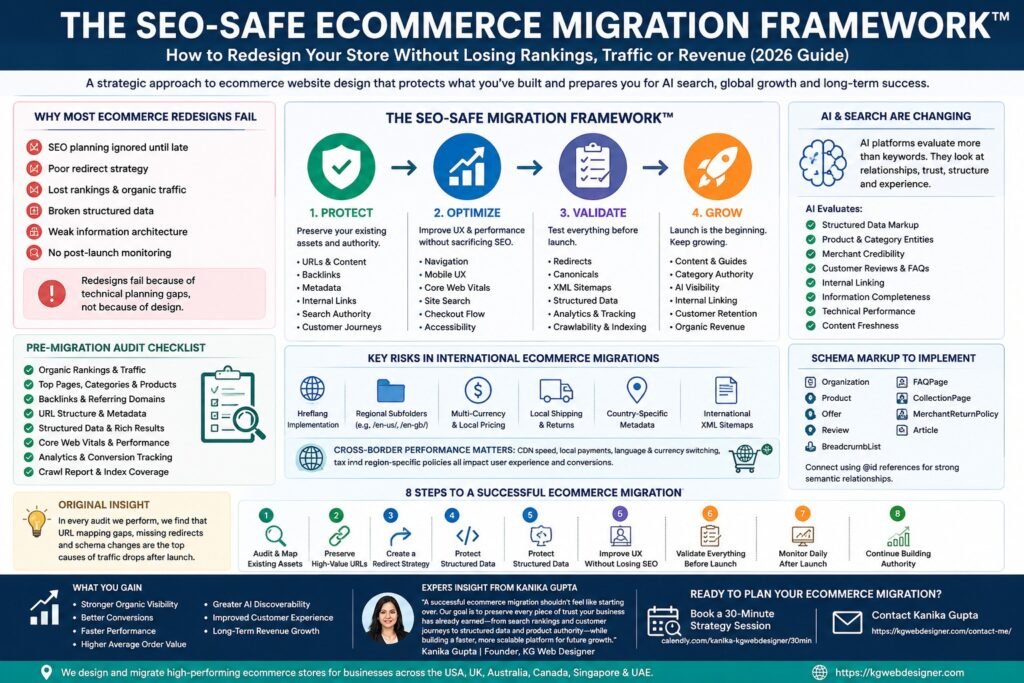
What Is the SEO-Safe Migration Framework?
An SEO-safe migration is a structured methodology that protects existing search visibility while improving customer experience, technical performance, and conversions. At KG Web Designer, we start every ecommerce redesign by identifying what already generates traffic and revenue before deciding what should change.
The objective isn’t simply to launch a new website.
The objective is to launch a stronger business asset.
That philosophy led us to develop the SEO-Safe Migration Framework, which combines technical SEO, CRO, AI readiness, and business continuity into a single migration strategy.
Before a single line of code is rewritten or a URL is modified, your current performance must be benchmarked. You cannot protect the search authority you haven’t quantified.
Prior to executing the migration steps below, make sure your team has audited your store against the baseline criteria outlined in our guide on ecommerce website analytics for redesign, which covers the 15 critical conversion and SEO health metrics required to safeguard your revenue.
The SEO-Safe Migration Framework
1. PROTECT
Preserve every business asset that already contributes to growth before making design changes.
Protect:
- High-ranking URLs
- Product pages
- Category pages
- Backlinks
- Metadata
- Internal linking
- Existing search authority
- Customer journeys
2. OPTIMIZE
Improve customer experience without sacrificing SEO.
Optimize:
- Navigation
- Product discovery
- Mobile usability
- Checkout flow
- Core Web Vitals
- Accessibility
- Site search
- Conversion paths
3. VALIDATE
Every migration should be thoroughly tested before launch.
Validate:
- Redirects
- Canonical tags
- XML sitemaps
- Structured Data Markup
- Analytics
- Conversion tracking
- Crawlability
- Indexation
4. GROW
Launch isn’t the finish line.
Continue strengthening:
- Product education
- Buying guides
- AI visibility
- Category authority
- Internal linking
- Organic traffic
- Customer retention
- Revenue growth
Together, these four pillars ensure a redesign becomes a long-term business investment instead of a short-term design project.
What Should Be Audited Before an Ecommerce Migration?
Everything contributing to search visibility, customer acquisition, and revenue should be documented before development begins.
Many agencies start with homepage concepts.
We begin with data.
Before a single design mockup is created, we perform a comprehensive audit to understand exactly what is already working.
Our migration audit typically includes:
- Organic landing pages
- Product categories
- Collection pages
- Revenue-generating products
- High-value backlinks
- Internal linking architecture
- URL structure
- XML sitemaps
- Canonical implementation
- Search Console performance
- Core Web Vitals
- Crawl reports
- Structured Data Markup
- Analytics configuration
Skipping this stage is similar to renovating a building without identifying which walls support the structure.
Before we recommend a redesign or migration strategy, we never jump straight into design mockups. Every ecommerce project begins with a structured evaluation of the existing website to identify what should be preserved, improved, or rebuilt. We review navigation, product discovery, mobile usability, technical SEO, Core Web Vitals, checkout flow, trust signals, and other conversion-critical factors before making redesign decisions. If you’re interested in our complete evaluation process, read We Audited Ecommerce Stores: The 15 Metrics We Check Before Every Redesign (2026 Guide), where we explain the framework we use to assess ecommerce websites before planning a successful redesign or migration.
From the Trenches
One ecommerce founder shared something we’ll never forget.
“We thought a redesign meant replacing everything. Looking back, we nearly deleted the pages responsible for most of our organic sales.”
That conversation perfectly illustrates why migration planning should begin with preservation instead of replacement.
Expert Insight From Kanika Gupta
Kanika Gupta, Founder, KG Web Designer
“AI shopping platforms don’t simply recommend the cheapest or most popular product. They recommend the products they understand with the highest level of confidence. Brands that invest in structured information, trustworthy content, and technically sound ecommerce architecture are creating an advantage that will become even more valuable as conversational commerce continues to grow.”
How Does AI Search Change Ecommerce Migrations?
AI-powered search has fundamentally changed what a successful ecommerce migration looks like.
Google AI Overviews, ChatGPT, Gemini, Claude, Apple Intelligence, and Perplexity no longer evaluate websites purely through keywords.
They increasingly evaluate whether your website presents complete, trustworthy, and well-connected information.
That means migrations should preserve more than rankings.
They should preserve knowledge.
AI systems increasingly evaluate:
- Product entities
- Merchant credibility
- Product specifications
- Category relationships
- Customer FAQs
- Review content
- Internal linking
- Technical performance
- Structured Data Markup
Maintaining these relationships allows AI platforms to understand your business with greater confidence.
Building an AI-Ready Ecommerce Architecture
A redesign is the ideal opportunity to strengthen semantic architecture.
Rather than treating structured data as an afterthought, every ecommerce website should build a connected knowledge graph using standard schema markup.
At KG Web Designer, we recommend implementing and connecting:
OrganizationProductOfferReviewBreadcrumbListFAQPageCollectionPageMerchantReturnPolicyArticle
Each Structured Data Markup should be connected through consistent @id relationships wherever possible so Google, ChatGPT, Gemini, Claude, Apple Intelligence, and Perplexity clearly understand how your organization, products, buying guides, customer resources, and merchant information relate to one another.
That semantic connectivity improves both traditional SEO and AI discoverability.
Why Schema Parity Matters During Platform Migration
One technical detail businesses frequently overlook is schema parity.
Migrating from WooCommerce to Shopify, Magento to Shopify, Adobe Commerce to BigCommerce, or another ecommerce platform often changes how Product, Offer, Review, BreadcrumbList, and Organization schema are generated.
Never assume your new platform produces identical structured data.
Before launch, compare both implementations carefully.
Maintaining schema parity helps preserve:
- Rich snippets
- Product visibility
- Merchant information
- AI interpretation
- Search consistency
This single validation step can prevent unnecessary visibility losses after migration.
How AI Systems Interpret an Ecommerce Migration
Modern AI assistants don’t simply compare keywords.
They evaluate whether your ecommerce website maintains consistent relationships between products, categories, reviews, buying guides, and your business identity.
When these semantic relationships remain intact after migration, AI systems are significantly more confident recommending your products and educational content in conversational search.
AI platforms increasingly evaluate:
- Structured Data Markup
- Product entities
- Merchant credibility
- Customer reviews
- Internal linking
- Information completeness
- Technical performance
- Content freshness
A technically accurate migration makes your ecommerce website easier for both customers and AI systems to trust.
How Do International Ecommerce Migrations Create Additional SEO Risks?
International ecommerce migrations introduce another layer of complexity because search engines must correctly understand your language, currency, and regional storefronts.
Businesses selling across the United States, United Kingdom, Australia, Canada, Singapore, and the UAE should carefully preserve:
hreflangimplementation- Regional subfolders such as
/en-us/and/en-gb/ - Country-specific metadata
- Multi-currency experiences
- International XML sitemaps
- Local shipping pages
- Regional return policies
If these signals break during migration, Google may begin serving the wrong regional storefront to international customers.
That affects rankings, customer trust, and conversion rates.
For global ecommerce brands, migration planning extends far beyond SEO.
It becomes an international customer experience strategy.
Cross-Border Performance Matters as Much as SEO
A technically successful migration can still disappoint overseas customers if website performance varies across regions.
Businesses serving multiple countries should validate:
- CDN performance by region
- Currency switching
- Language switching
- Local payment methods
- Country-specific tax information
- Shipping calculations
- Regional return policies
- Mobile performance across international markets
A website that loads quickly in New York but slowly in Sydney or Singapore creates inconsistent customer experiences and lower conversion rates.
International ecommerce success depends on both technical SEO and regional usability.
Example Scenario
A growing apparel retailer planned to migrate from WooCommerce to Shopify while simultaneously introducing a completely new visual identity.
The leadership team expected a faster website, easier inventory management, and a better customer experience.
However, the existing website had accumulated years of search authority across hundreds of products and category pages.
Launching without a migration strategy would have placed that authority at considerable risk.
Instead of beginning with design, we completed a comprehensive SEO audit.
We documented every high-performing URL.
Mapped redirects.
Reviewed Structured Data Markup.
Protected internal linking.
Benchmarked Core Web Vitals.
Validated analytics.
Only after these assets were secured did development begin.
The new website launched with a stronger customer experience while preserving the business’s accumulated search authority.
Example From Our Experience
Challenge
A growing ecommerce business wanted to migrate platforms without sacrificing years of SEO progress or disrupting international customer experiences.
Solution
At KG Web Designer, we implemented our SEO-Safe Migration Framework before development began.
We completed a full SEO audit, mapped redirects, validated schema parity, reviewed international SEO signals, strengthened information architecture, optimized Core Web Vitals, and performed extensive pre-launch quality assurance.
Development, SEO, and CRO progressed together instead of operating independently.
Outcome
The business launched a faster, more scalable ecommerce platform with confidence because every technical decision supported long-term search visibility, customer trust, and sustainable growth.
Industry Observation
After working on ecommerce redesigns across multiple industries, one trend has become remarkably clear.
Businesses planning migrations around aesthetics often spend the following months recovering lost visibility.
Businesses planning around SEO architecture, customer experience, semantic relationships, and AI readiness spend those same months expanding revenue.
That’s the difference between launching a redesigned website and launching a stronger digital commerce platform.
Planning an Ecommerce Redesign?
Your migration strategy determines what happens after launch.
Our Ecommerce Migration Audit identifies:
- SEO risks
- Redirect opportunities
- AI readiness
- Schema validation
- Conversion improvements
- Core Web Vitals priorities
- International SEO considerations
- Technical performance gaps
Whether you’re migrating platforms or modernizing an existing store, we’ll help you protect today’s rankings while building tomorrow’s growth.

18+ Years. 500+ Websites. Zero Cookie-Cutter Stores.
I design ecommerce websites for founders in the US, UK, and Australia who are serious about revenue — not just a pretty storefront. Custom-built, conversion-focused, and delivered on time.
Why Most Businesses Get Ecommerce Redesigns Wrong
Most ecommerce businesses believe a redesign is primarily a creative project.
It isn’t.
A successful redesign is a business transformation initiative involving SEO, conversion optimization, AI readiness, technical architecture, analytics, information architecture, and customer experience.
One common mistake we notice is that leadership teams spend weeks reviewing homepage layouts, typography, and branding while allocating very little time to discussing URL preservation, redirect mapping, crawlability, schema validation, or category architecture.
Ironically, those invisible technical decisions usually determine whether revenue grows or declines after launch.
Another misconception is that moving to a modern ecommerce platform automatically improves SEO.
A better platform provides better capabilities.
It doesn’t automatically preserve years of accumulated search authority.
Without careful planning, businesses can unintentionally lose valuable rankings, backlinks, indexed pages, rich snippets, customer trust, and AI visibility during migration.
The Reality Check
Search engines don’t reward redesigns.
They reward consistency.
When Google, ChatGPT, Gemini, Claude, Apple Intelligence, and Perplexity revisit your website after launch, they expect clear signals explaining where pages moved, how products relate to categories, and why your business remains authoritative.
The smoother that transition, the faster your redesigned ecommerce website begins generating results.
What This Means for Your Business
Your ecommerce website isn’t simply an online catalog.
For most ecommerce businesses, it is the primary engine responsible for customer acquisition, product discovery, and long-term revenue growth.
Every indexed product page.
Every category page.
Every buying guide.
Every customer review.
Every FAQ.
Every backlink.
These are valuable business assets.
A redesign should protect those assets while improving everything surrounding them.
When approached strategically, a migration delivers measurable business advantages:
- Stronger organic visibility
- Better conversion rates
- Faster website performance
- Improved customer experience
- Greater AI discoverability
- Better merchandising flexibility
- Higher average order values
- Increased customer lifetime value
Businesses experiencing the smoothest migrations understand one important principle.
They aren’t replacing a website.
They’re upgrading an existing revenue engine.
8 Steps to a Successful Ecommerce Migration
1. Audit Existing SEO Assets Before Design Begins
Document rankings, URLs, backlinks, metadata, Structured Data Markup, internal links, and revenue-generating pages before discussing visual design.
2. Preserve High-Value URLs Wherever Possible
Stable URLs preserve search authority and reduce migration risk.
When URL changes become unavoidable, implement carefully planned redirects.
3. Create a Comprehensive Redirect Strategy
The biggest mistake during an ecommerce migration is altering site architecture, navigation, or URL paths without a documented redirect strategy.
Every retired URL should redirect to its closest equivalent.
Avoid redirecting everything to the homepage.
Search engines-and customers-expect relevance.
4. Protect Structured Data Throughout the Migration
Structured data deserves the same attention as design.
Professional ecommerce website migration services should preserve Product, Offer, Review, BreadcrumbList, FAQPage, Organization, and MerchantReturnPolicy markup while validating every implementation before launch.
5. Improve User Experience Without Sacrificing SEO
Migration is the ideal opportunity to improve navigation, filtering, product discovery, mobile usability, and checkout experiences.
Done correctly, these improvements create high-converting ecommerce website design while maintaining existing search visibility.
6. Validate Everything Before Launch
Never launch until you’ve verified:
- Redirects
- Canonical tags
- XML sitemaps
- Robots directives
- Structured Data Markup
- Analytics
- Conversion tracking
- Internal links
- Core Web Vitals
Preparation is significantly less expensive than post-launch recovery.
7. Monitor Performance Daily After Launch
Migration doesn’t end when the website goes live.
Continue monitoring:
- Rankings
- Organic traffic
- Crawl reports
- Index coverage
- Search Console
- Product indexing
- Revenue
- AI search visibility
Small technical issues become expensive problems when left unnoticed. After launch, define whether monitoring, platform updates and minor fixes belong in a maintenance retainer or will be handled through pay-as-you-go support.
8. Continue Building Authority
Launch day marks the beginning-not the end-of your growth strategy.
Continue expanding:
- Buying guides
- Product education
- Customer FAQs
- Comparison articles
- Category content
- Internal linking
- Merchant trust content
- Original research
This ongoing investment ensures your custom ecommerce website development continues attracting qualified organic traffic long after migration.
Expert Insight From Kanika Gupta
Founder, KG Web Designer | Ecommerce SEO & AI Strategy Consultant
“The most successful ecommerce migrations aren’t the ones with the newest design trends. They’re the ones where customers barely notice the migration because everything simply works better. Search engines retain confidence, customers complete purchases more easily, and the business continues growing without interruption.”
Example From Our Experience
Challenge
A growing ecommerce retailer wanted to migrate to a modern ecommerce platform while refreshing its entire brand identity.
The existing website generated consistent organic revenue, but leadership worried that changing platforms could erase years of SEO progress.
The business also served customers across multiple countries, making international SEO preservation equally important.
Solution
Before development began, we completed a comprehensive migration audit covering SEO, technical architecture, Structured Data Markup, international SEO signals, analytics, customer journeys, and conversion opportunities.
We preserved important URLs, validated schema parity, maintained regional storefront signals, optimized Core Web Vitals, and tested every redirect before launch.
Rather than rebuilding the business from scratch, we strengthened the digital infrastructure supporting it.
Outcome
The redesigned ecommerce platform launched with greater confidence because every technical decision supported search visibility, customer trust, AI discoverability, and long-term business growth.
Businesses investing in a redesign should also think beyond acquiring first-time customers. Our article “How to Design an Ecommerce Store for Repeat Customers, Not Just First Sales“ explores the UX, personalization, loyalty strategies, and post-purchase experiences that encourage customers to return, increasing lifetime value long after your migration is complete.
Final Thoughts
A redesign should never force you to choose between modern design and strong search visibility.
The best ecommerce website redesign for SEO projects improve both simultaneously by combining technical planning, semantic architecture, customer-focused UX, AI readiness, and long-term SEO strategy.
At KG Web Designer, we provide ecommerce website design services that protect the authority you’ve already earned while building faster, smarter, AI-ready ecommerce platforms designed for sustainable growth across the United States, United Kingdom, Australia, Canada, Singapore, and the UAE.
The ecommerce businesses that outperform competitors over the next decade won’t simply launch newer websites.
They’ll build stronger digital commerce platforms.
Ready to Plan a Risk-Free Ecommerce Migration?
Whether you’re migrating from WooCommerce, Shopify, Magento, Adobe Commerce, BigCommerce, or another ecommerce platform, we’ll help you reduce migration risk while improving search visibility, conversions, and long-term business growth.
Our Ecommerce Migration Strategy Includes
- Technical SEO audit
- URL mapping and redirect planning
- Schema validation and parity checks
- AI search readiness assessment
- Conversion optimization review
- International SEO audit
- Core Web Vitals optimization
- Post-launch monitoring roadmap
Ready to Improve Your Ecommerce Conversions?
You now know what the right investment looks like. The next step is a quick call — no pitch, no pressure. Just clarity on what your store needs and what it’ll cost to build it right.

Frequently Asked Questions
Will an ecommerce redesign always hurt SEO?
No. An ecommerce redesign will not automatically hurt SEO when a structured migration framework protects URLs, redirects, structured data, and technical architecture before launch.
Ranking losses typically occur because migration planning is incomplete rather than because the website was redesigned.
How long does an SEO-safe ecommerce migration usually take?
Most ecommerce migrations require several weeks or months depending on product catalog size, platform complexity, integrations, and content volume.
Investing additional time in planning almost always reduces launch risks and minimizes post-launch recovery.
What is the biggest mistake during an ecommerce migration?
The biggest mistake during an ecommerce migration is altering site architecture, navigation, or URL paths without a documented redirect strategy.
Poor redirect planning, broken internal links, and missing Structured Data Markup are among the most common causes of ranking and revenue declines.
Why are redirects so important during a redesign?
Redirects are essential because they transfer accumulated search authority from old URLs to their new destinations while preventing broken links for both customers and search engines.
A carefully planned redirect strategy preserves rankings, protects backlinks, and provides a seamless browsing experience after launch.
Should businesses redesign and migrate platforms simultaneously?
Yes. Businesses can redesign and migrate simultaneously when SEO, technical architecture, redirect planning, structured data, analytics, and quality assurance are managed together within a documented migration framework.
Coordinating both initiatives often produces stronger long-term results than treating them as separate projects.
How does AI search affect ecommerce redesigns?
AI-powered search evaluates far more than keywords.
Platforms such as Google AI Overviews, ChatGPT, Gemini, Claude, Apple Intelligence, and Perplexity increasingly assess semantic relationships, merchant credibility, Structured Data Markup, technical quality, customer resources, and information completeness when recommending ecommerce businesses.