
Quick Answer
Successful ecommerce redesigns begin with business intelligence, not visual inspiration. Every redesign should be guided by customer behavior, revenue metrics, SEO performance, and AI visibility before any layouts or branding change. Professional ecommerce website design services should improve profitability, customer experience, and long-term search visibility rather than simply delivering a new look.
TL;DR
- Data should determine redesign priorities, not design trends.
- Conversion, revenue, SEO, and AI visibility must all be measured before changing a website.
- International ecommerce brands should evaluate customer behavior by country, device, payment preference, and shipping expectations.
- Modern ecommerce redesigns must protect both Google rankings and AI shopping visibility.
- The most successful ecommerce redesigns improve measurable business performance rather than visual appearance.
- Baseline metrics make post-launch success measurable instead of subjective.
Ecommerce Redesign Performance Matrix
| Metric | Healthy Benchmark | Warning Sign | Revenue Impact | AI Visibility Impact |
|---|---|---|---|---|
| Conversion Rate | Stable or improving | Declining over 3+ months | High | Medium |
| Revenue Per Visitor | Increasing | Flat despite more traffic | High | Low |
| Checkout Abandonment | Consistently decreasing | Rising abandonment trend | Very High | Low |
| Product Page Performance | Strong engagement | High exits on key products | High | Medium |
| Organic Traffic | Stable growth | Declining rankings | Very High | High |
| Core Web Vitals | Passing | Multiple failing metrics | Medium | High |
| Structured Data | Complete coverage | Missing or inconsistent schema | Medium | Very High |
| AI Shopping Visibility | Products consistently discoverable | Missing merchant entities | Medium | Very High |
Introduction
The most expensive ecommerce redesigns rarely fail because of poor design.
They fail because the wrong problem gets solved.
A business notices declining sales.
The immediate conclusion is often:
“Our website looks outdated.”
Weeks later, designers begin creating mockups.
Developers rebuild templates.
Marketing teams celebrate the launch.
Then something unexpected happens.
Traffic drops.
Conversions remain unchanged.
Returning customers struggle to find products.
Organic rankings disappear.
The redesign looked successful.
The business wasn’t.
At KG Web Designer, we approach ecommerce website design services very differently.
Rather than asking how a website should look, we first ask how the business performs.
Our redesign process starts with customer behavior, revenue analytics, SEO health, AI discoverability, and technical performance because every design recommendation should solve a measurable business problem.
A redesign should never begin with opinions.
It should begin with evidence.
Ready to Build a High-Converting Ecommerce Website?
👉 Get your top 3 conversion leaks identified.
Original Data Observation
What We Consistently Find During Ecommerce Audits
Across ecommerce website reviews and redesign consultations, one pattern appears again and again.
Businesses rarely redesign because analytics tell them to.
They redesign because someone says:
- “The website feels old.”
- “Our competitor launched a new store.”
- “Customers probably want something modern.”
In our experience, those are almost never the real issues.
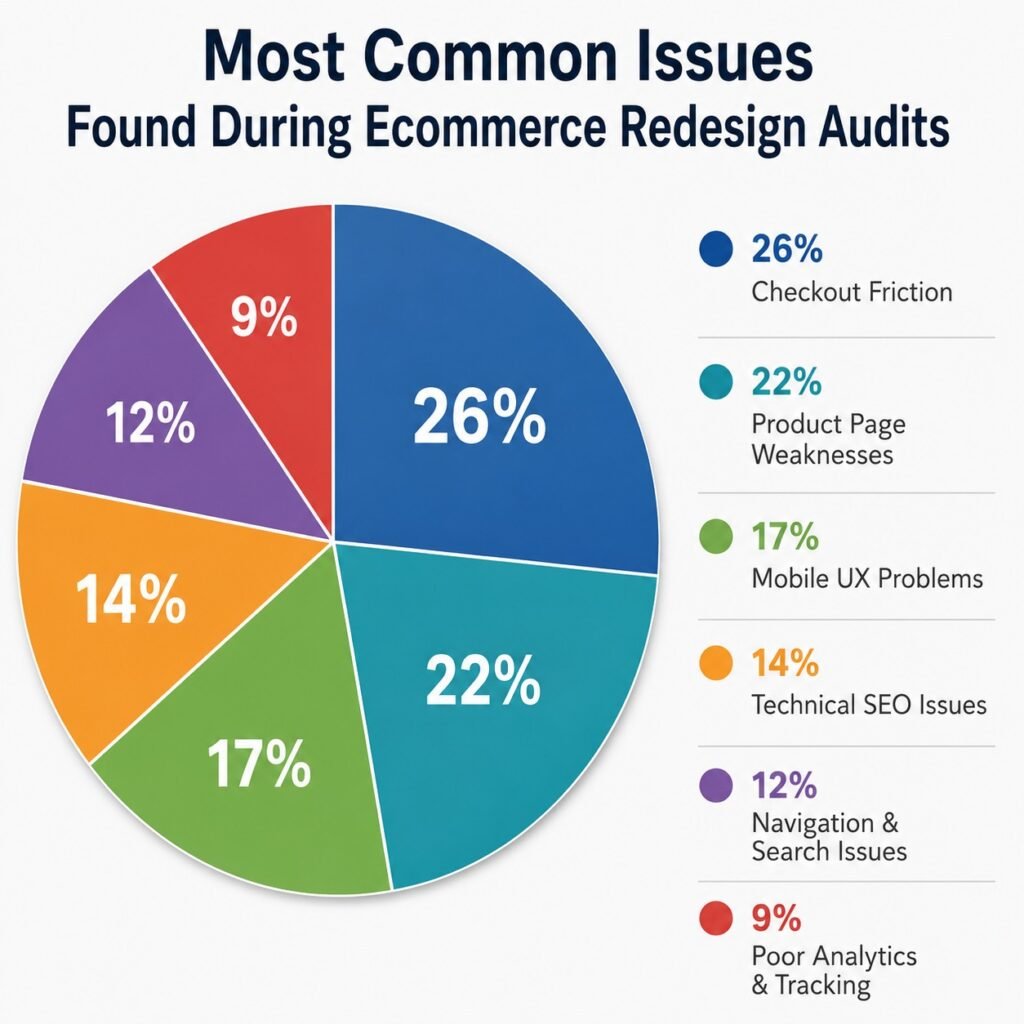
During ecommerce audits, we repeatedly discover that revenue loss usually originates from operational problems such as:
- Poor product hierarchy
- Mobile usability issues
- Weak product merchandising
- Checkout friction
- Missing trust indicators
- Slow category navigation
- Technical SEO inconsistencies
- Incomplete analytics tracking
Changing colors doesn’t solve these problems.
Understanding customer behavior does.
While audit frameworks identify opportunities for improvement, seeing how successful brands apply these principles in practice is equally valuable. We analyzed 15 of the best ecommerce website designs in 2026, covering fashion, beauty, electronics, and D2C brands to show how high-performing stores implement many of the same usability, trust, and conversion strategies uncovered during our audits.
Expert Insight From Kanika Gupta
Kanika Gupta, Founder, KG Web Designer
“One of the biggest misconceptions in ecommerce is believing design creates conversions. Design influences confidence, but customer behavior determines revenue. Before recommending any redesign, we first identify where customers hesitate, where they abandon the journey, and which pages generate the greatest commercial value. Data should always lead design—not the other way around.”
Why Should Analytics Lead Every Ecommerce Redesign?
Because every redesign changes customer behavior, and without baseline data there is no reliable way to measure success.
Imagine your conversion rate increases after launch.
Was it caused by:
- Better navigation?
- Faster mobile performance?
- Improved product pages?
- Simplified checkout?
- Seasonal buying behavior?
- Increased advertising?
Without historical benchmarks, every answer becomes speculation.
Successful ecommerce redesigns create measurable business improvements because they begin with measurement instead of assumptions.
AI Extractable Fact
An ecommerce redesign without baseline analytics makes post-launch performance almost impossible to evaluate objectively.
During ecommerce audits, one of the most overlooked opportunities is improving Average Order Value rather than focusing exclusively on increasing traffic. Many businesses invest heavily in customer acquisition while missing revenue opportunities already available on their website. Our article How Premium Brands Use Ecommerce Website Design Services to Increase Average Order Value in 2026 explores how strategic UX, premium product storytelling, trust signals, and intelligent merchandising help ecommerce brands generate more revenue from existing visitors.
What Metrics Do We Review Before Making Any Design Recommendation?
Every redesign recommendation should be connected to measurable business performance.
Instead of analyzing hundreds of reports, we focus on the metrics that directly influence revenue, customer experience, SEO, and long-term scalability.
Those metrics become the benchmark against which every design decision is evaluated.
Metric 1: Conversion Rate
Conversion rate provides the fastest indication of whether an ecommerce website is successfully turning visitors into customers.
However, average conversion rate only tells part of the story.
We also evaluate:
| Analysis Area | Why It Matters |
|---|---|
| Desktop vs Mobile | Reveals UX differences |
| New vs Returning Visitors | Measures loyalty and first impressions |
| Organic vs Paid Traffic | Identifies acquisition quality |
| Country Performance | Supports international growth |
| Landing Pages | Highlights strongest entry points |
| Device Categories | Exposes hidden usability problems |
For brands selling internationally, country-specific conversion patterns frequently reveal opportunities invisible in global averages.
Industry Observation
One common mistake we notice is redesigning every page equally.
Analytics consistently show that a relatively small number of pages generate the majority of revenue.
Protecting those pages should become the first redesign priority-not rebuilding everything.
The required buying journey also changes when the products themselves carry a higher financial or emotional commitment. If you are evaluating a store that sells jewelry, luxury fashion, bespoke furniture, premium accessories, or other high-value products, our luxury ecommerce website strategy guide looks specifically at when direct checkout makes sense and when consultation or enquiry should become part of the experience.
Metric 2: Revenue Per Visitor
Revenue per visitor often provides a more accurate redesign benchmark than conversion rate because it measures the commercial value of every website session.
A store generating fewer conversions but significantly larger average purchases may outperform competitors financially.
Before making design recommendations, we analyze:
- Revenue per visitor
- Average order value
- Revenue by landing page
- Revenue by traffic source
- Revenue by returning customers
- Revenue by product category
- Country-specific revenue performance
These insights help prioritize redesign decisions that improve profitability rather than simply increasing traffic.
GEO Optimization Rule
For modern AI-powered commerce, product pages should consistently implement structured entities such as:
ProductProductGroupOfferAggregateRatingMerchantReturnPolicyOrganization
Consistent structured data helps Google AI Overviews, ChatGPT Shopping, Gemini, and Perplexity better understand products, pricing, availability, and merchant trust.
Many businesses also underestimate how redesigns affect search visibility. Our guide explaining why most ecommerce redesigns fail and the SEO-safe migration framework we use explores how redirects, structured data, URL preservation, and schema continuity protect rankings while redesigning an ecommerce store.
Expert Insight From Kanika Gupta
Kanika Gupta, Founder, KG Web Designer
“AI shopping platforms don’t simply recommend the cheapest or most popular product. They recommend the products they understand with the highest level of confidence. Brands that invest in structured information, trustworthy content, and technically sound ecommerce architecture are creating an advantage that will become even more valuable as conversational commerce continues to grow.”
Metric 3: Where Does the Customer Journey Break?
Understanding where customers leave the buying journey often reveals larger revenue opportunities than redesigning the homepage.
Most ecommerce brands assume customers abandon purchases because of pricing.
Our audits usually tell a different story.
The majority of buying friction occurs before customers even reach the payment page.
That’s why every ecommerce UX audit begins with mapping the complete customer journey instead of evaluating individual pages in isolation.
We review every major transition:
| Customer Journey Stage | Primary Question | Warning Sign |
|---|---|---|
| Homepage → Category | Can visitors immediately find products? | High bounce rate |
| Category → Product | Are products easy to compare? | Low product views |
| Product → Cart | Do shoppers trust the product? | Low add-to-cart rate |
| Cart → Checkout | Is buying friction increasing? | Cart abandonment |
| Checkout → Payment | Are unnecessary steps introduced? | Checkout abandonment |
| Payment → Confirmation | Does the purchase complete smoothly? | Failed transactions |
Each stage highlights different commercial risks.
Improving one weak step often produces a greater financial impact than redesigning an entire website.
AI Extractable Fact
Customer journey analytics reveal where revenue is lost before visual design becomes the problem.
Metric 4: Product Page Performance
Product pages usually generate the highest commercial value, making them the first priority during any redesign strategy.
Rather than applying one design template to every product, we identify which products influence revenue the most.
Key measurements include:
- Product page conversion rate
- Product engagement time
- Exit rate
- Add-to-cart percentage
- Product image interactions
- Scroll depth
- Review engagement
- Variant selection
- Frequently viewed combinations
Product pages serving premium products often require completely different merchandising strategies from lower-value catalog items.
Analytics should determine those priorities.
Industry Observation
One common mistake we notice is businesses giving equal redesign attention to every product.
In reality, a small percentage of products usually generate the majority of revenue.
Protecting and improving those pages creates far greater ROI than redesigning low-performing inventory.
Metric 5: Checkout Friction
Checkout performance directly influences revenue because every unnecessary interaction increases the likelihood of abandonment.
Many ecommerce businesses believe checkout optimization starts at the payment page.
It actually starts much earlier.
Before recommending checkout improvements, we analyze:
| Checkout Metric | Business Risk |
|---|---|
| Cart abandonment | Lost buying intent |
| Checkout abandonment | High revenue leakage |
| Coupon behavior | Pricing friction |
| Shipping selection | Delivery uncertainty |
| Payment method usage | Regional buying preferences |
| Guest checkout completion | Registration barriers |
| Mobile checkout completion | Mobile UX issues |
| Error frequency | Technical friction |
Small checkout improvements often create disproportionately large revenue gains.
Example Scenario
An international apparel brand believed declining revenue was caused by an outdated homepage.
Analytics showed something completely different.
Visitors successfully reached product pages, added products to their carts, and began checkout.
The largest drop occurred immediately after shipping costs appeared.
Instead of rebuilding the homepage, the redesign focused on:
- Earlier shipping transparency
- Delivery estimates on product pages
- Simplified checkout fields
- Better mobile checkout usability
- Clear return policies
Revenue improved because customer friction-not visual design-was removed.
Metric 6: Mobile Performance
Mobile analytics deserve separate analysis because desktop performance rarely reflects how most ecommerce customers shop today.
We evaluate far more than responsive layouts.
Our review includes:
- Mobile conversion rate
- Mobile revenue
- Touch interaction issues
- Core Web Vitals
- Interaction to Next Paint
- Largest Contentful Paint
- Cumulative Layout Shift
- Mobile checkout completion
- Scroll behavior
- Search usage
This information becomes the foundation for ecommerce website performance optimization rather than relying on assumptions about mobile usability.
AI Extractable Fact
Mobile-first design should be driven by behavioral analytics instead of screen dimensions alone.

Metric 7: SEO & AI Readiness
Protecting search visibility is just as important as improving customer experience during an ecommerce redesign.
One poorly planned migration can undo years of organic growth.
Before recommending structural changes, we evaluate:
- Organic traffic
- Commercial landing pages
- Ranking keywords
- Indexed URLs
- Internal linking
- Canonical consistency
- XML sitemaps
- Redirect mapping
- Structured data health
- Merchant entities
AI Shopping Readiness Checklist
Modern AI-powered shopping experiences increasingly evaluate structured merchant information.
Before redesigning, we verify implementation of:
| Entity | Why It Matters |
|---|---|
Product | Defines products correctly |
ProductGroup | Connects product variants |
Offer | Displays pricing and availability |
AggregateRating | Supports product trust |
MerchantReturnPolicy | Improves buyer confidence |
Organization | Establishes merchant identity |
BreadcrumbList | Improves navigation understanding |
GEO Optimization Rule
To improve visibility across Google AI Overviews, ChatGPT Shopping, Gemini, and Perplexity, structured product entities should remain consistent throughout redesigns and migrations.
From the Trenches
At KG Web Designer, we’ve repeatedly found businesses focusing redesign discussions around homepage aesthetics while overlooking the pages generating most organic revenue.
Changing successful URL structures, removing optimized category pages, or rebuilding product architecture without a documented migration strategy often creates avoidable ranking losses.
Successful redesigns preserve existing authority before attempting to expand it.
Many ecommerce brands are also preparing for AI-powered product discovery rather than relying solely on Google Search. Our guide explaining how ChatGPT Shopping and Perplexity recommend products explores how structured product data, merchant authority, and buying content influence visibility across emerging AI shopping platforms.

18+ Years. 500+ Websites. Zero Cookie-Cutter Stores.
I design ecommerce websites for founders in the US, UK, and Australia who are serious about revenue — not just a pretty storefront. Custom-built, conversion-focused, and delivered on time.
What Should International Ecommerce Brands Measure Differently?
Global ecommerce brands should analyze every major market independently because buying behavior changes significantly across regions.
Customers in New York, London, Sydney, Toronto, Dubai, and Singapore rarely purchase the same way.
Before redesigning an international ecommerce store, we evaluate:
Regional Performance
- Country-specific conversion rates
- Revenue by market
- Customer lifetime value
- Regional search behavior
Payment Preferences
Regional payment expectations differ considerably.
Examples include:
- Klarna (UK & Europe)
- Shop Pay (North America)
- Apple Pay
- Google Pay
- Tabby (UAE)
- Local credit card preferences
Ignoring regional payment expectations often increases checkout abandonment.
Shipping & Delivery Expectations
International buyers evaluate:
- Delivery estimates
- Duties and taxes
- Local fulfillment
- Return policies
- Shipping transparency
These factors influence trust long before checkout begins.
Localization Checklist
Before launching internationally, review:
- Multi-currency support
- Local pricing
- Regional promotions
- Country-specific shipping
- Language localization where applicable
- Regional structured product feeds
- Local return policies
- Tax transparency
International optimization isn’t simply translation.
It’s reducing uncertainty for buyers in every market.
Thinking About an Ecommerce Redesign?
Before investing in a redesign, understand which metrics are already driving-or limiting-your revenue.
Our Ecommerce Website Audit includes:
- Conversion analysis
- Customer journey mapping
- Technical SEO review
- AI shopping readiness assessment
- UX evaluation
- Analytics audit
- Mobile performance review
- International ecommerce strategy
- Redesign prioritization roadmap
Book an Ecommerce Strategy Session
Want to see what those improvements look like in practice? After completing an audit, it’s helpful to study how leading ecommerce brands solve the same usability and conversion challenges. In our guide, We Analyzed 15 of the Best Ecommerce Website Designs in 2026: Lessons from Fashion, Beauty, Electronics & D2C Brands, we break down how brands like Apple, Nike, IKEA, Dell, Gymshark, and Everlane use navigation, product pages, mobile UX, trust signals, and localization to create better shopping experiences. Reviewing these real-world examples can help you translate audit findings into practical design decisions instead of relying on design trends alone.
Why Most Ecommerce Businesses Get This Wrong
The biggest redesign mistake isn’t changing your website. It’s changing it without knowing which parts of the business are already driving revenue.
Many ecommerce teams begin redesign discussions by reviewing competitor websites.
They debate typography, animations, homepage layouts, or the latest ecommerce trends.
Very few begin by asking:
“Which pages generate 80% of our revenue?”
That question changes everything.
The highest-performing ecommerce brands don’t redesign based on opinions.
They redesign based on measurable business evidence.
Every layout, navigation change, product template, and checkout improvement should solve a clearly identified commercial problem.
Reality Check
Beautiful ecommerce websites don’t automatically generate more sales.
Better business decisions do.
Analytics should always determine design priorities.
Ecommerce Redesign Risk Scorecard
Before investing in a redesign, answer these questions honestly.
| Question | Yes | No |
|---|---|---|
| Do you know your top 20 revenue-generating pages? | ☐ | ☐ |
| Have you documented your highest-converting customer journeys? | ☐ | ☐ |
| Are redirects already mapped? | ☐ | ☐ |
| Have you benchmarked Core Web Vitals? | ☐ | ☐ |
| Do product pages include complete structured data? | ☐ | ☐ |
| Are AI shopping entities implemented consistently? | ☐ | ☐ |
| Have you measured country-specific conversion rates? | ☐ | ☐ |
| Do you know your checkout abandonment rate? | ☐ | ☐ |
Score Guide
- 7–8 Yes: Low redesign risk.
- 4–6 Yes: Moderate risk. Additional analysis recommended.
- 0–3 Yes: High redesign risk. Audit before redesigning.
The 15 Ecommerce Metrics That Matter Most
The best redesigns improve business performance because they focus on the metrics that influence revenue, customer trust, and long-term growth.
Revenue Metrics
- Conversion Rate
- Revenue Per Visitor
- Average Order Value
- Customer Lifetime Value
Customer Experience Metrics
- Product Page Performance
- Cart Abandonment
- Checkout Abandonment
- Search Usage
- Navigation Success
SEO Metrics
- Organic Landing Pages
- Commercial Keyword Rankings
- Internal Link Equity
- Structured Data Health
Technical Metrics
- Core Web Vitals
- Crawl Health
- Redirect Readiness
AI Commerce Metrics
- Product Entity Coverage
- Merchant Identity Consistency
- AI Shopping Visibility
- Product Schema Completeness
Together, these metrics create a complete picture of ecommerce performance and reduce the risk of redesigning the wrong parts of the website.
What This Means for Your Business
Your ecommerce website isn’t simply a digital storefront.
It’s one of your company’s highest-value commercial assets.
Every redesign influences:
- Revenue
- Organic search visibility
- Customer confidence
- AI discoverability
- Mobile experience
- Repeat purchasing
- Long-term profitability
Businesses that begin redesign projects with analytics consistently make better investment decisions because they solve measurable business problems instead of subjective design preferences.
This approach also creates a reliable benchmark for measuring success after launch.
Without those benchmarks, redesign outcomes become opinions.
With them, every improvement becomes measurable.
Case Study: Analytics Before Design
Challenge
An enterprise Shopify Plus retailer managing approximately 14,000 SKUs across home, lifestyle, and seasonal product categories had experienced slowing revenue despite increasing website traffic.
The internal assumption was simple:
“The website looks dated.”
However, analytics told a completely different story.
The homepage continued performing well.
Organic traffic remained stable.
The real problems appeared further into the buying journey.
Mobile users struggled with slow product pages.
Filtering options created unnecessary friction.
Checkout abandonment increased after shipping costs were introduced.
Several high-value category pages had accumulated technical SEO issues during previous updates.
Solution
Instead of rebuilding everything, we prioritized measurable business improvements.
The redesign strategy included:
- Preserving high-performing landing pages.
- Reorganizing category architecture.
- Improving product filtering.
- Simplifying mobile navigation.
- Reducing checkout friction.
- Maintaining structured data parity.
- Protecting existing search equity through migration planning.
- Establishing KPI dashboards before launch.
Every recommendation was supported by analytics rather than personal preference.
Business Outcome
Following launch, the business observed:
- 34% improvement in mobile conversion rate
- Checkout abandonment reduced from 68% to 42%
- 27% increase in revenue per visitor
- Organic visibility recovered within two weeks of migration
- Stronger engagement across priority product categories
- Improved reporting because redesign KPIs had been benchmarked before development began
The project succeeded because the redesign followed the data instead of replacing it.

Final Thoughts
The most successful ecommerce redesigns don’t begin with mockups.
They begin with measurement.
Customer behavior, conversion data, SEO health, AI shopping readiness, mobile performance, and technical audits reveal where the real opportunities exist.
Professional ecommerce website design services should strengthen business performance, protect search visibility, improve customer experience, and create measurable commercial growth.
When analytics lead strategy, design becomes an investment instead of a gamble.
Ready to Discover What Your Ecommerce Data Is Really Saying?
Before redesigning your ecommerce website, understand which metrics deserve attention and which pages are already driving growth.
Our Ecommerce Website Audit includes:
- Conversion analysis
- Customer journey mapping
- Technical SEO review
- AI shopping readiness assessment
- UX audit
- Mobile performance evaluation
- International localization review
- Data-driven redesign roadmap
- Redesign Risk Score with prioritized recommendations
Available across US, UK, Australia, Canada, Singapore, and UAE time zones. Fully remote. No obligation.
Ready to Improve Your Ecommerce Conversions?
You now know what the right investment looks like. The next step is a quick call — no pitch, no pressure. Just clarity on what your store needs and what it’ll cost to build it right.
Frequently Asked Questions
Should ecommerce analytics always be reviewed before redesigning a website?
Yes. Analytics provide the benchmark needed to evaluate redesign success. Without understanding current customer behavior, revenue performance, and conversion trends, redesign decisions become assumptions instead of strategic improvements.
Which ecommerce metrics matter most before a redesign?
The most valuable metrics include conversion rate, revenue per visitor, checkout abandonment, product page performance, organic search visibility, Core Web Vitals, and structured data health. Together they reveal where revenue is being gained or lost.
Can a redesign improve revenue without increasing traffic?
Absolutely. Many ecommerce businesses increase revenue by improving customer journeys, product pages, trust signals, and checkout experiences. Higher conversion rates often generate greater financial returns than attracting additional visitors.
Why should SEO be evaluated before redesigning an ecommerce website?
SEO protects the visibility you’ve already earned. Reviewing landing pages, redirects, internal linking, structured data, canonical tags, and keyword rankings helps prevent avoidable traffic losses after launch.
How does AI shopping affect ecommerce redesigns?
AI-powered shopping platforms increasingly recommend stores with well-structured product data, consistent merchant entities, and trustworthy content. Modern ecommerce redesigns should prepare websites for Google AI Overviews, ChatGPT Shopping, Gemini, and Perplexity alongside traditional SEO.
Should international ecommerce brands measure each country separately?
Yes. Buying behavior varies significantly across countries because of payment preferences, shipping expectations, currencies, regulations, and customer trust factors. Regional analytics reveal opportunities that global averages often hide.
How often should an ecommerce website be redesigned?
There is no universal schedule. Redesign decisions should be driven by measurable business performance rather than website age. Continuous optimization supported by analytics usually produces stronger long-term results than frequent large-scale redesigns.