
Quick Answer
A website maintenance retainer for a CPA or accounting firm should cover software updates, security checks, backups, uptime monitoring, form testing, technical troubleshooting, and agreed content changes. It should also define response targets, reporting, and exclusions for larger projects. Website management for CA firms is most valuable when it protects website reliability, supports client inquiries, and keeps business information accurate without requiring partners to manage technical work themselves.
TL;DR: Key Takeaways
- A maintenance retainer should define what is monitored, updated, tested, reported, and supported each month.
- Security, backups, access controls, and incident responsibilities need clear ownership.
- Accounting firms should prioritize inquiry forms, appointment links, service descriptions, and contact information.
- Technical maintenance is different from SEO campaigns, content strategy, and conversion optimization.
- Tax-season readiness should include testing critical website functions before inquiry volumes increase.
- A useful retainer provides documented deliverables, a clear escalation process, and transparent charges for additional work.
What Should an Accounting Firm Website Maintenance Retainer Cover?
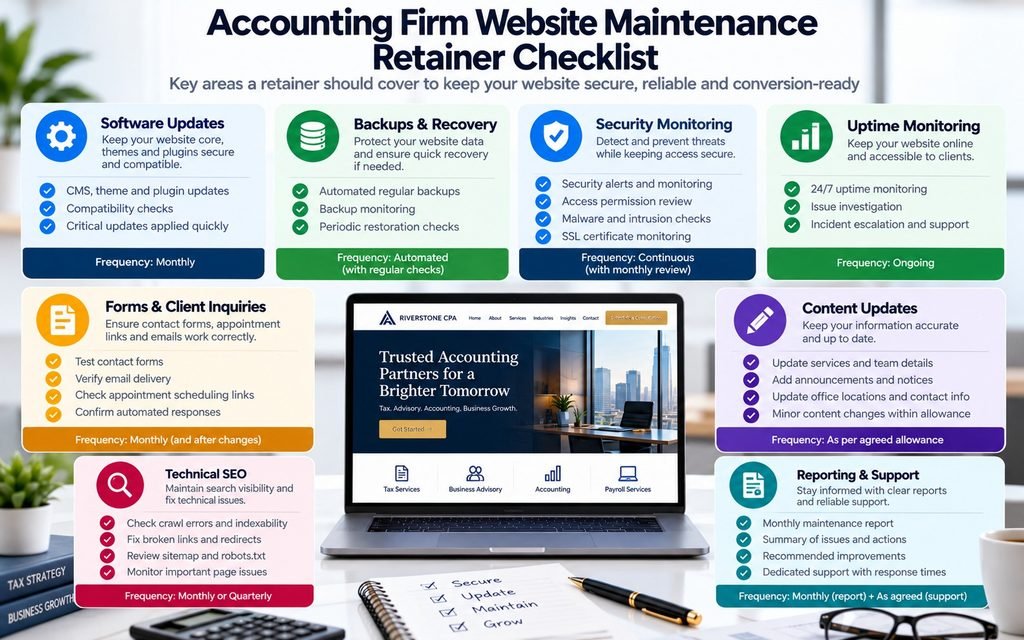
A good retainer covers the recurring work required to keep a website secure, functional, accurate, and commercially useful. It should identify the tasks included, how often they are performed, who is responsible, and what happens when an issue falls outside the agreement.
| Maintenance area | What the retainer should include | Suggested frequency |
|---|---|---|
| Software updates | CMS, theme, and plugin compatibility reviews and updates | Monthly, with critical updates assessed promptly |
| Backups and recovery | Backup monitoring, retention expectations, and documented restoration procedures | Automated backups with periodic recovery checks |
| Security | Available alerts, access permissions, suspicious activity, and security-control reviews | Continuous monitoring where available; scheduled human review |
| Uptime | Website availability monitoring and incident escalation | Automated monitoring with agreed response procedures |
| Inquiry functions | Contact forms, email delivery, appointment links, and confirmation messages | Monthly and after relevant changes |
| Content changes | Approved updates to services, staff profiles, contact details, and notices | Within an agreed allowance |
| Technical SEO | Broken links, redirects, crawl errors, and indexability checks | Monthly or quarterly, depending on site complexity |
| Performance | Key page templates, mobile usability, and significant performance issues | Monthly or quarterly |
| Reporting | Completed work, incidents, outstanding risks, and recommendations | Monthly |
| Support | Contact channels, severity levels, response targets, and escalation | As stated in the agreement |
These frequencies are starting points, not universal requirements. The appropriate schedule depends on the platform, website complexity, risk profile, and how often the firm changes its content or functionality.
A retainer should not simply promise to “keep the website running.” It should show what was done, what remains unresolved, and what needs approval or additional investment. That visibility makes it easier for firm leadership to evaluate the service rather than judging it solely by the monthly fee.
Your Clients Expect Accuracy. Does Your Website Reflect It?
Outdated service details, broken enquiry forms, slow pages, or neglected updates can undermine an otherwise professional online presence. Ongoing website care helps your firm’s information stay current and your site work as expected.
Why Does Website Maintenance Matter Specifically for CPA and Accounting Firms?
Accounting firms rely on their websites to establish credibility before prospective clients schedule a consultation or share sensitive financial information. An outdated service page, incorrect office details, or broken inquiry form can undermine confidence at the exact point when a prospect is deciding whether to contact the firm.
Three industry-specific issues deserve particular attention.
First, service accuracy matters. Tax preparation, bookkeeping, audit, outsourced accounting, and advisory services serve different client needs. If a website describes services the firm no longer offers or fails to explain the types of clients it serves, the firm may attract unsuitable inquiries while confusing better-fit prospects.
Second, seasonal readiness matters. Accounting firms experience periods when inquiries and client requests become especially time-sensitive. Testing contact forms, appointment links, and important service pages before a busy period helps identify problems before the firm depends on those functions.
Third, trust depends on operational details. Clear team credentials, current contact information, accurate service descriptions, accessible privacy information, and a dependable inquiry process help prospective clients assess a firm before speaking with its staff.
KG Web Designer is a conversion-focused website design studio specializing in custom websites for clinics, professional services, manufacturers, and growing businesses. For an accounting firm, the objective is to connect technical maintenance with the experience that turns a visitor into a qualified inquiry.
For a related trust checklist, read our guide to what CA firms must include on their websites to win trust in 2026. The maintenance plan should preserve those trust-building elements as services, staff, and business priorities change.
What Security Responsibilities Should the Retainer Cover?
The retainer should document the website provider’s security responsibilities without implying that routine website maintenance guarantees complete cybersecurity or regulatory compliance. The firm needs to know which controls are handled by its website provider, hosting company, internal IT team, and other technology vendors.
The IRS reiterated in August 2026 that tax and accounting professionals must maintain a Written Information Security Plan (WISP) to help protect client information. The IRS identifies risk assessment, safeguards, monitoring, service-provider responsibilities, and incident planning as important parts of the wider security process. See the IRS guidance on Written Information Security Plans.
A website maintenance provider can support that wider process by agreeing to:
- Apply relevant CMS, theme, and plugin security updates.
- Review administrator accounts and remove unnecessary access.
- Monitor available security alerts and investigate suspected website compromise.
- Maintain backups and document recovery steps.
- Check that HTTPS and security certificates are functioning correctly.
- Escalate incidents to the firm’s designated IT or security contact.
- Record what happened, what was changed, and what follow-up is required.
The agreement must also identify what is excluded. Website maintenance may not cover employee devices, email security, tax software, internal networks, or the firm’s entire information security program. These responsibilities require explicit ownership and coordination with qualified IT or cybersecurity professionals.
A CA firm website support plan should therefore define the provider’s role within the firm’s broader security process, rather than treating website maintenance as a substitute for a complete security program.
How Should Website Management for CA Firms Be Structured?
Website management for CA firms should be organized around risk, business continuity, and the tasks that help the firm attract and serve clients. A useful agreement separates routine maintenance from urgent incident response and larger improvements that need their own budget or approval.
| Service level | Typical responsibilities | Best suited for |
|---|---|---|
| Essential maintenance | Updates, backups, uptime checks, basic security reviews, and technical troubleshooting | Firms with stable websites and few changes |
| Maintenance plus content support | Essential maintenance plus agreed service-page edits, team updates, announcements, and form testing | Firms that update website information regularly |
| Strategic website management | Maintenance plus technical SEO reviews, conversion-path analysis, performance priorities, and an improvement roadmap | Firms treating the website as an active business-development channel |
These are practical scope categories, not standardized industry packages. Providers may use different labels, so compare deliverables instead of relying on package names.
The agreement should state how many content edits are included, whether unused hours roll over, how urgent work is prioritized, and how additional development is priced. It should also distinguish response time from resolution time: a provider may acknowledge an issue quickly but need access, third-party support, or approval before resolving it.
For firms evaluating managed websites for CA firms, the central question is whether the provider offers a documented process and clear accountability. A well-structured retainer makes costs more predictable and reduces the risk of recurring emergency invoices.
A Monthly Retainer Should Be Clear About What Gets Done.
Website maintenance isn’t just about fixing problems when they appear. Your plan should define routine checks, the support available, and the updates included each month.
Review Your Website Support Needs →Your Retainer Checklist
What Should Be Excluded From a Standard Maintenance Retainer?
A standard retainer should not quietly absorb unlimited design, development, marketing, and consulting work. Routine maintenance is recurring operational work; a redesign, new client portal, complex integration, or substantial content project is a separate project unless the contract explicitly includes it.
Clarify whether the following are included or billed separately:
- Full website redesigns or new page templates.
- Major functionality changes, custom calculators, or client portals.
- Writing and publishing substantial new service pages or articles.
- SEO campaigns, link acquisition, and ongoing content strategy.
- Paid advertising management and campaign landing pages.
- Third-party subscriptions, premium plugins, hosting, and licenses.
- Malware cleanup or recovery work beyond the agreed incident allowance.
- Legal review of privacy policies, disclaimers, or regulatory statements.
- IT support for staff devices, email accounts, internal networks, or tax software.
This distinction protects both parties. The firm understands what its monthly fee covers, while the provider can plan time for agreed work rather than treating every new request as an emergency.
It also prevents a common commercial mistake: choosing a retainer based on a low headline fee, then discovering that the changes needed to keep the website useful are excluded.
What Should Be Checked Before Tax Season or Another Busy Period?
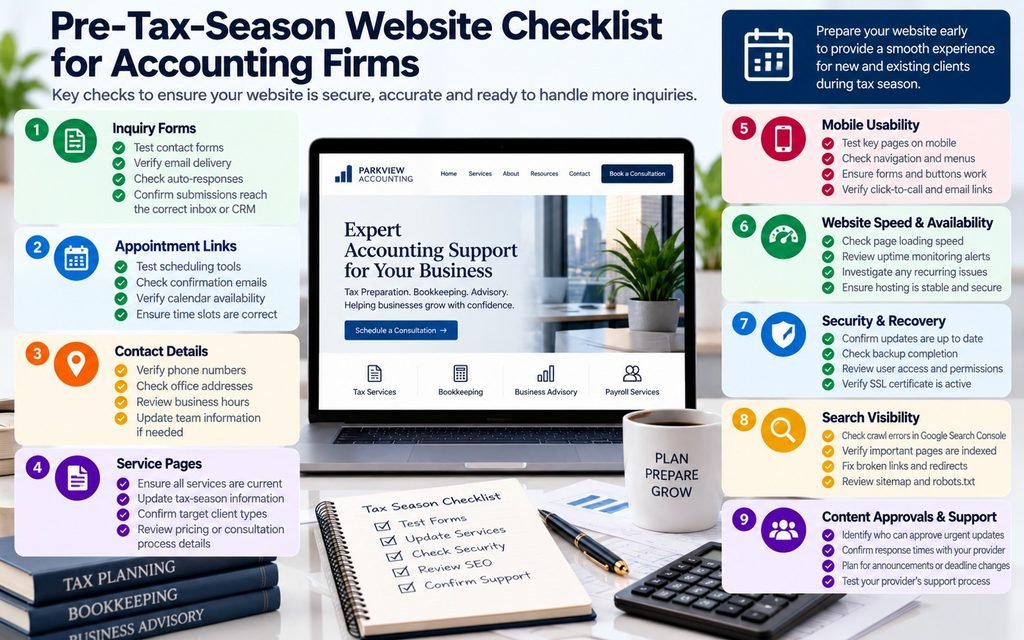
Before a high-demand period, the firm should test its most important client journeys and resolve known issues before they become urgent. A repeatable review is more dependable than assuming that a website working last month will continue to work without testing.
Use this pre-season checklist:
- Inquiry forms: Submit a test inquiry and confirm that it reaches the intended inbox or CRM.
- Appointment links: Test scheduling tools, confirmation messages, and calendar availability.
- Contact details: Verify phone numbers, office addresses, business hours, and staff information.
- Service pages: Confirm that current services, client types, and relevant deadlines are described accurately.
- Mobile usability: Check navigation, forms, buttons, and phone links on an actual mobile device.
- Website availability: Review monitoring alerts and investigate recurring performance issues.
- Security and recovery: Confirm update status, backup completion, access permissions, and escalation contacts.
- Search visibility: Check important pages, internal links, crawl errors, and indexability.
- Content approvals: Identify who can approve urgent updates and how quickly they can be published.
- Incident communication: Confirm who is contacted if the website becomes unavailable or appears compromised.
These checks cannot eliminate every failure. They create a repeatable process for identifying preventable problems before the firm depends on the website during a busy period.
What Should a Monthly Website Management Report Show?
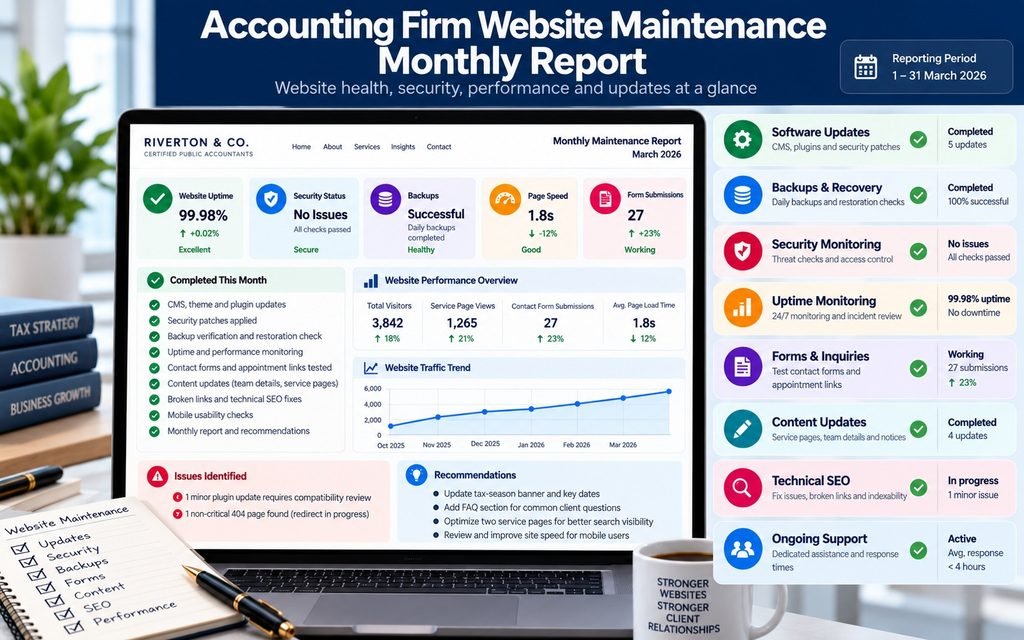
A useful report should show what was completed, what changed, what needs attention, and which actions require approval. A list of software updates alone does not tell partners whether the website is functioning properly or whether an unresolved issue may affect client inquiries.
At minimum, the report should cover:
- Updates applied and updates deferred, including the reason.
- Backup status and any recovery tests performed.
- Uptime incidents, security alerts, and technical issues investigated.
- Contact forms, scheduling links, and other critical functions tested.
- Content changes completed and outstanding approval requests.
- Important technical SEO issues discovered or resolved.
- Performance concerns and the affected pages or templates.
- Open risks, recommended priorities, and work requiring a separate quote.
Where analytics are available and correctly configured, the report can also summarize relevant behavior, such as inquiry-form completions, visits to priority service pages, and referral sources. Traffic changes alone do not prove that maintenance caused an increase or decrease in leads.
Google explains that server availability, crawling errors, redirects, and page resources can affect its ability to access website content. Providers can use Google Search Central’s guidance on troubleshooting crawling errors to inform their technical review.
A report should end with a short action list: what is urgent, what can wait, who owns each action, and whether additional budget is required.
What Should You Fix First, Second, and Third?
The most efficient maintenance plan prioritizes risks and client-facing failures before cosmetic improvements. Firms do not need to tackle every possible enhancement at once; they need a defensible sequence that protects essential functions and directs investment toward meaningful business outcomes.
First: resolve security, availability, and recovery risks. Investigate suspected compromise, failed backups, expired certificates, broken hosting, and other issues that threaten access or integrity. Assign security responsibilities clearly and involve the firm’s IT or cybersecurity provider when the issue extends beyond the website.
Second: repair client inquiry paths. Test forms, appointment links, email routing, phone links, and important service pages. If prospects cannot make contact or receive unclear information, polishing the homepage will not solve the immediate problem.
Third: improve accuracy, search health, and conversion. Update outdated services and team information, review important links and indexability, then prioritize improvements based on analytics and user feedback. This sequence helps firms avoid spending the maintenance budget on cosmetic work while more consequential issues remain unresolved.
For firms reviewing how service pages communicate value, our guide to pricing transparency for professional services websites offers a related perspective. Clear explanations of service scope, pricing, and expectations can reduce uncertainty before a prospective client requests a consultation.
Your Firm Changes. Your Website Should Keep Up.
From new team members to updated service offerings and office details, your website should reflect the firm clients are dealing with today—not the one you were several months ago.
Service Information
Keep tax, audit, bookkeeping, GST, and advisory service descriptions accurate as your offerings evolve.
People & Credentials
Update partner profiles, team details, professional credentials, office hours, and contact information.
Client Enquiries
Check that contact forms, consultation links, phone numbers, and email links work properly.
Is Your Retainer Covering the Right Work?
If your firm pays a monthly maintenance fee but cannot tell which risks are monitored, whether inquiry forms are tested, or what work triggers extra charges, the next step is a scope review. KG Web Designer can help assess whether the website’s maintenance responsibilities, client journey, and planned improvements align with the way your firm attracts and qualifies prospective clients.
Discuss your accounting firm’s website requirements to review the current website, maintenance scope, and priorities for the next stage of growth.
What Does the Evidence Tell Accounting Firms About Website Maintenance?
Published guidance supports a risk-based approach to website maintenance, but it does not establish a universal monthly retainer price or prove that maintenance alone increases leads. The appropriate scope depends on the website’s complexity, the firm’s risk exposure, its internal capabilities, and the business outcomes the site is expected to support.
For US tax professionals, the IRS reiterated in August 2026 that tax and accounting professionals must maintain a Written Information Security Plan to help protect client information. Its guidance also emphasizes risk assessment, safeguards, service-provider responsibilities, and security-plan review. Read the IRS’s 2026 reminder on tax professional security plans.
Google’s technical documentation provides a separate reason to monitor website health: server availability, blocked pages, crawling problems, and errors can affect Google’s ability to access important content. Technical checks can help identify these issues, although no retainer can guarantee rankings or indexing.
The distinction matters. IRS guidance addresses security responsibilities for tax professionals, while Google documentation explains technical search behavior. Neither defines a standard accounting-firm maintenance package or typical retainer price. Firms should use the evidence to define responsibilities and obtain quotes based on their actual requirements.
Example Scenario
Consider a fictional CPA firm with several service pages, a team directory, a consultation form, and an appointment scheduling tool. The firm pays for hosting and assumes its website is being maintained, but nobody is responsible for testing the inquiry process or reviewing the accuracy of its service information.
Before tax season, the firm discovers that its consultation form is no longer sending submissions to the correct inbox. Some team information is outdated, and the provider’s agreement does not specify whether content changes or form troubleshooting are included.
The firm does not necessarily need a redesign. It needs the form repaired and tested, an agreed process for reviewing critical website functions, clear ownership of content updates, and a documented escalation path. A retainer that defines these responsibilities could reduce operational uncertainty and make the website easier to manage.
This is an illustrative scenario, not a verified KG Web Designer client result. The financial impact would need to be measured using the firm’s own inquiry data and business records.
Example From Our Experience
A credible maintenance recommendation should be based on documented website findings, not a fabricated client story or an unsupported claim about typical accounting firms. No internal KG Web Designer audit dataset, client-specific maintenance report, or verified accounting-firm case study was provided for this article.
For an actual project, the review should record three elements:
- Problem: Which technical failures, outdated content, security responsibilities, or conversion issues have been confirmed?
- Solution: Which maintenance tasks, monitoring processes, ownership changes, or planned improvements address those findings?
- Outcome: Were the issues resolved, did critical functions continue to work, and did inquiry or performance measures change over a defined period?
At KG Web Designer, the recommended approach is to separate verified technical findings from business hypotheses. If a firm wants to show that a maintenance retainer improved inquiry performance, the evidence should include a baseline, a defined measurement period, and relevant context about other changes made during that period.
This makes the recommendation more useful to managing partners and avoids promising results that maintenance alone cannot guarantee.
Why Most Businesses Get This Wrong
Many firms treat maintenance as a low-cost technical subscription rather than an operational responsibility with defined deliverables. They compare monthly fees without checking whether the provider tests forms, documents backups, monitors technical errors, reports completed work, or responds appropriately when the website fails.
Another common mistake is assuming that a provider who manages the website also manages every part of the firm’s cybersecurity. Website maintenance, internal IT support, email protection, tax software, and regulatory compliance are related but distinct responsibilities. The agreement should make those boundaries explicit.
Successful firms do not necessarily buy the largest retainer. They identify their most important website functions, assign responsibility for each risk, and pay for the level of support their business actually needs. They also review the agreement when the firm adds services, changes technology, expands into new markets, or increases its reliance on online inquiries.
What This Means For Your Business
A well-defined maintenance retainer can reduce avoidable technical disruption, help keep client-facing information accurate, and give firm leadership a clearer view of website risks. Its value is strongest when the work supports the website’s business role, rather than treating updates and backups as the only outcomes that matter.
If your firm is trying to attract clients across the United States, United Kingdom, or Australia, the website may also need accurate regional service information, clear contact routes, appropriate privacy information, and a reliable mobile experience. The maintenance process should preserve these elements as the firm grows.
KG Web Designer’s guide to international professional services website design explores considerations that matter when a professional-services business serves buyers across different markets. International visibility and regional relevance require deliberate planning; routine maintenance alone will not create them.
For firms that rely on consultation inquiries, website management should connect technical reliability with conversion performance. The practical questions are whether prospective clients can find the relevant service, understand the firm’s expertise, and make contact without unnecessary friction.
When Does Professional Website Management Make Sense?
Professional management becomes worthwhile when the firm lacks the internal time or technical expertise to maintain the website consistently, when critical functions need regular testing, or when technical problems repeatedly interrupt business operations. It can also help when leadership wants one accountable provider to coordinate agreed maintenance tasks and report on unresolved risks.
Before choosing a provider, ask for clear answers to these questions:
- Which updates, backups, and security checks are included?
- How are backups verified, and what is the recovery process?
- Who tests forms, scheduling links, and other critical website functions?
- What are the response targets for urgent and routine issues?
- Which content edits are included, and how are larger requests priced?
- Does the service include technical SEO monitoring or only basic maintenance?
- What is excluded, and which issues must be referred to the firm’s IT provider?
- What does the monthly report contain, and who reviews outstanding actions?
The provider should explain its process in plain language and show examples of reporting or documentation without exposing another client’s confidential information.
If the firm also needs a redesign, clearer service positioning, or a more effective inquiry journey, treat that as a separate strategic conversation. A maintenance retainer should preserve and support the website, not substitute for a larger improvement plan when one is genuinely needed.
Expert Insight from Kanika Gupta
Kanika Gupta, Founder, KG Web Designer
My view is that an accounting firm’s maintenance retainer should be judged by accountability, not by the number of tasks listed in the proposal. A long checklist has little value if nobody confirms that the consultation form works, explains who handles an incident, or tells the partners which issues remain unresolved.
If this were my website, I would first verify backups and recovery responsibilities, test every important inquiry route, and review access and update procedures. I would then require a concise monthly report showing completed work, open risks, and the next recommended action. Only after those fundamentals were dependable would I spend the maintenance budget on lower-priority refinements.
That order helps a firm protect its online presence while keeping the website connected to its commercial objectives.
Final Thoughts
A maintenance retainer should give an accounting firm clear ownership of the work that keeps its website reliable, accurate, and ready to support prospective clients. Prioritize security responsibilities, backups, critical inquiry paths, technical monitoring, and transparent reporting before spending on cosmetic improvements.
Website management for CA firms should be treated as an operational and commercial responsibility, not simply a monthly software-update service. The right agreement reduces uncertainty, helps protect the client journey, and gives partners a clear view of what their provider is doing.
If your firm needs a clearer maintenance scope or a website that better supports its service positioning and consultation inquiries, discuss your website management requirements with KG Web Designer.

Focus on Your Clients. Let Your Website Get the Attention It Needs.
Kanika Gupta at KG Web Designer helps professional service businesses build and maintain websites that reflect their expertise. Discuss your current website, ongoing maintenance needs, and the right level of support for your CA or accounting firm.
Frequently Asked Questions
How much should an accounting firm pay for website maintenance each month?
There is no single reliable monthly price for every accounting firm because the scope varies by platform, website size, support requirements, security responsibilities, and included content work. Request quotes that list deliverables, response targets, exclusions, and additional-work rates. Compare the total scope rather than choosing the lowest monthly fee.
What should a CPA website maintenance contract include?
A contract should define software updates, backups, security checks, uptime monitoring, form testing, technical troubleshooting, reporting, and agreed content changes. It should also identify response targets, escalation contacts, access responsibilities, and exclusions. Larger development projects, legal review, and broader cybersecurity services should be explicitly included or excluded.
Does website maintenance help an accounting firm’s SEO?
Maintenance can help identify technical issues that interfere with website availability, crawling, links, or indexability. However, maintenance does not automatically improve rankings, and it is not a substitute for useful content, relevant service pages, or a sound SEO strategy. Search performance should be monitored separately, with findings and corrective actions documented.
How often should an accounting firm’s website be checked?
Security alerts and uptime can be monitored continuously where appropriate, while updates, backups, and critical website functions should follow a documented schedule. Forms and scheduling links should also be tested after relevant changes and before important business periods. The exact frequency depends on the website’s complexity and risk profile.
Should website maintenance include cybersecurity compliance?
Website maintenance can support certain security controls, but it should not be represented as complete cybersecurity compliance. US tax professionals have specific responsibilities concerning written information security plans and client data. The firm should coordinate website maintenance with its internal security owner, IT provider, and qualified compliance advisers.
What is the difference between website maintenance and website management?
Website maintenance focuses on keeping the site technically functional, updated, and monitored. Website management may include those tasks plus agreed content changes, reporting, technical SEO oversight, and planned improvements. Providers use these terms differently, so the service agreement should specify exactly what work is included.
Can I manage my accounting firm’s website without a monthly retainer?
Yes, if the firm has the skills, time, access, and documented processes to manage updates, backups, monitoring, testing, and recovery. The important issue is not whether the work is outsourced but whether someone is accountable for completing it. Firms without that capacity may benefit from a defined external support arrangement.