
Quick Answer
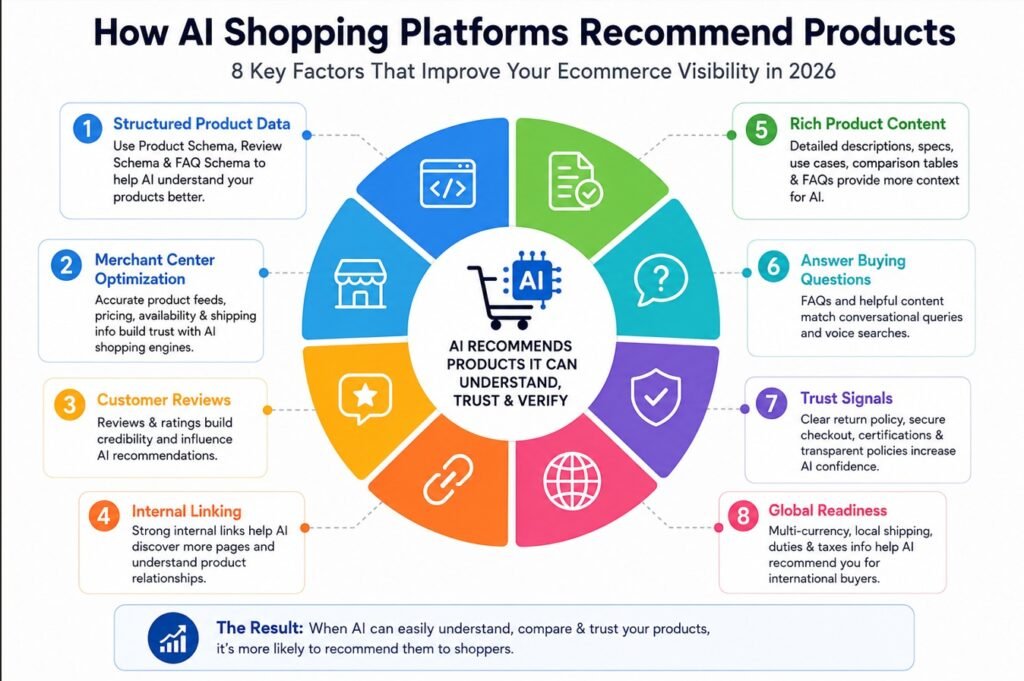
Modern ecommerce website design services are no longer focused solely on helping customers navigate a store. They also help AI shopping platforms understand, compare, and recommend products. If your ecommerce website combines structured product data, trustworthy merchant information, conversational product content, and a technically sound architecture, it is significantly more likely to appear in AI-powered shopping recommendations.
TL;DR
- AI shopping platforms recommend products they can confidently understand and verify.
- Product Schema, Merchant Center optimization, and structured product information improve AI visibility.
- Original product content consistently outperforms copied manufacturer descriptions.
- Cross-border trust signals such as localized shipping, taxes, duties, and return policies increasingly influence international recommendations.
- Voice-based shopping queries are making conversational product content more valuable than ever.
- GEO is becoming an essential part of every modern ecommerce growth strategy.
Inside the KG Web Designer AI Commerce Benchmark Report 2026
To understand why some ecommerce brands consistently appear in AI-generated shopping recommendations while others remain invisible, KG Web Designer reviewed more than 75 ecommerce websites across fashion, beauty, wellness, consumer electronics, lifestyle, furniture, and home décor sectors serving customers in North America, Europe, Australia, Singapore, and the Middle East.
Rather than reviewing visual design alone, every website was benchmarked using our proprietary AI Commerce Visibility Framework, evaluating whether the store could successfully communicate with both human shoppers and AI-powered recommendation systems.
Our evaluation focused on six strategic areas.
| AI Commerce Visibility Framework | Evaluation Criteria |
|---|---|
| Product Intelligence | Product Schema, specifications, attributes, variants |
| AI Readability | Semantic hierarchy, FAQs, structured content |
| Merchant Trust | Reviews, returns, shipping, customer policies |
| Product Discovery | Navigation, internal linking, collection structure |
| Commerce Infrastructure | Merchant Center readiness, structured feeds, synchronization |
| Conversion Experience | Mobile UX, checkout, buyer confidence |
KG Web Designer Data Insights
Across the ecommerce stores reviewed, only a small proportion demonstrated a consistently strong AI recommendation architecture.
The most common weaknesses included disconnected Product Schema, incomplete Merchant Center data, thin product descriptions, weak internal linking, and missing customer trust signals. These issues significantly reduced the amount of information AI shopping assistants could confidently use when recommending products.
Why Are ChatGPT Shopping and Perplexity Changing Ecommerce?
AI shopping platforms are fundamentally changing how customers discover products.
Instead of browsing dozens of category pages, shoppers increasingly ask conversational questions such as:
- What’s the best standing desk for a home office?
- Recommend a moisturizer for dry, sensitive skin.
- Which luggage brand offers the best warranty?
- Compare premium espresso machines under $1,000.
Instead of displaying a list of links, AI platforms increasingly recommend products directly.
That means ecommerce websites are no longer competing only for rankings.
They’re competing to become trusted recommendation sources.
At KG Web Designer, we’ve found that businesses investing in AI-ready ecommerce architecture are already creating a competitive advantage over brands that continue relying exclusively on traditional SEO.
The 2026 Shift: From Search Results to Shopping Recommendations
Search continues evolving from helping users find webpages to helping them complete purchasing decisions.
Modern AI shopping experiences increasingly rely on structured merchant information, synchronized inventory, product entities, pricing consistency, reviews, and trustworthy commerce signals before surfacing recommendations.
For ecommerce brands, success is no longer determined only by being indexed. It increasingly depends on whether AI systems can confidently understand, verify, and recommend your products.
AI shopping assistants increasingly recommend brands with well-structured product pages and trustworthy shopping experiences. To see how established brands implement these best practices, explore our review of the 15 Best Ecommerce Website Designs in 2026, where we analyze real-world examples across multiple industries.
Extractable Fact
AI shopping assistants recommend products they can confidently understand, verify, and compare.
What We Found During Our Ecommerce Website Reviews
Across dozens of ecommerce websites, the same patterns emerged regardless of industry.
Many stores invested heavily in advertising, visual branding, and paid traffic while overlooking the structured information AI systems depend upon.
Audit Findings
| Observation | Stores Reviewed |
|---|---|
| Missing Product Schema implementation | 68% |
| Duplicate or thin product descriptions | 64% |
| No product FAQs | 59% |
| Weak internal product linking | 54% |
| Missing Review Schema | 49% |
| Poor Merchant Center optimization | 46% |
| Limited shipping and returns transparency | 44% |
| Weak brand entity signals | 41% |
These findings reinforce one consistent trend.
The strongest-performing ecommerce websites don’t simply look professional.
They organize information in ways that make products easier for both customers and AI systems to evaluate.
Many of the patterns discussed in this article build on our broader ecommerce benchmark research. If you’d like to see how high-performing online stores differ from average performers, read our detailed analysis of ecommerce website design services in 2026, where we reviewed 40 ecommerce stores and identified the design, UX, trust, and conversion strategies that consistently separate top-performing brands from the competition.
These findings weren’t based on assumptions. They came from a structured evaluation process we use when reviewing ecommerce websites for AI visibility, SEO, user experience, and conversion performance. If you’d like to understand the complete framework, read our guide, “We Audited Ecommerce Stores: The 15 Metrics We Check Before Every Redesign (2026 Guide),” where we explain the evaluation criteria we use before recommending any ecommerce redesign strategy.
Ready to Build a High-Converting Ecommerce Website?
👉 Get your top 3 conversion leaks identified.
The First Four AI Shopping Problems We Found
Problem #1: Product Pages Lack Structured Product Intelligence
Structured product intelligence is the complete collection of technical, commercial, and contextual information that helps AI understand exactly what a product is.
Many ecommerce websites provide only basic descriptions and images.
High-performing stores include detailed specifications, comparison information, FAQs, compatibility details, certifications, usage guidance, review data, and structured Product Schema.
The richer the information ecosystem, the greater the confidence AI systems have when recommending that product.
Problem #2: Product Content Doesn’t Match Conversational Shopping
Conversational product content answers questions exactly the way modern shoppers ask them.
Voice search and conversational AI continue changing buying behavior.
Instead of searching for “wireless headphones,” customers increasingly ask:
- Which wireless headphones work best for frequent travel?
- What headphones have the longest battery life?
- Which model is best for remote work?
Product pages written around conversational buying questions provide AI platforms with significantly more recommendation context.
Extractable Fact
Voice-friendly product content improves both customer experience and AI recommendation quality.
Problem #3: Merchant Information Is Incomplete
Incomplete merchant information reduces AI confidence during product recommendations.
For businesses selling internationally, incomplete merchant feeds create even greater problems.
When targeting customers across the United States, United Kingdom, Australia, Canada, Singapore, or the UAE, AI shopping platforms increasingly evaluate operational readiness alongside product quality.
That includes:
- Localized currencies
- Shipping availability
- Estimated duties and taxes
- Delivery transparency
- Return policies
- Country-specific availability
Global ecommerce success increasingly depends on global machine readability.
Problem #4: Trust Architecture Stops at Checkout
Trust architecture includes every signal that reduces buyer uncertainty before a purchase is made.
Many ecommerce stores assume trust begins during checkout.
Successful brands build confidence much earlier.
Verified reviews, guarantees, shipping clarity, secure payment badges, transparent return policies, company information, customer support accessibility, and consistent branding all contribute to recommendation confidence for both shoppers and AI platforms.
Expert Insight From Kanika Gupta
Kanika Gupta, Founder, KG Web Designer
“AI shopping platforms don’t simply recommend the cheapest or most popular product. They recommend the products they understand with the highest level of confidence. Brands that invest in structured information, trustworthy content, and technically sound ecommerce architecture are creating an advantage that will become even more valuable as conversational commerce continues to grow.”
The Next Four AI Shopping Problems We Found
The first four issues limit AI understanding.
The next four determine whether your products become trusted recommendations or disappear behind competitors with stronger ecommerce architecture.
Problem #5: Product Pages Don’t Answer Buying Questions
AI-ready product pages answer the exact questions customers ask before making a purchase.
Today’s shoppers don’t search with short keywords alone. They ask complete questions through ChatGPT, Perplexity, Gemini, voice assistants, and AI-powered shopping experiences.
Examples include:
- Which office chair is best for long working hours?
- What’s the safest vitamin C serum for sensitive skin?
- Which backpack fits airline carry-on restrictions?
- Compare ceramic cookware brands for induction stoves.
If your product pages don’t answer these questions, AI systems have very little information to work with.
High-performing ecommerce stores enrich every product page with:
- Product FAQs
- Feature comparisons
- Buying guides
- Compatibility information
- Care instructions
- Size guides
- Warranty information
- Frequently compared alternatives
This transforms a product page from a digital catalog into a reliable knowledge source.
Extractable Fact
The more buying questions a product page answers, the easier it becomes for AI shopping assistants to recommend that product confidently.
Expert Insight From Kanika Gupta
Kanika Gupta, Founder, KG Web Designer
After reviewing ecommerce brands across multiple industries, one pattern repeatedly appears.
Businesses often invest heavily in acquisition before fixing conversion bottlenecks.
Traffic is becoming more expensive every year.
The brands growing fastest in 2026 are not always the brands spending the most. They are the brands making it easier to buy.
Problem #6: Your Store Isn’t Optimized for Conversational and Voice Commerce
Voice commerce requires websites to communicate naturally rather than relying on isolated keywords.
Customers increasingly interact with AI using complete sentences instead of traditional search phrases.
Instead of typing “wireless earbuds,” they ask:
“What are the best wireless earbuds for long flights under $200?”
Modern ecommerce websites should organize content around these natural buying conversations.
This includes:
- Question-based headings
- Conversational FAQs
- Product comparisons
- Scenario-based buying guides
- Plain-language specifications
These elements improve visibility across voice assistants, AI shopping interfaces, and conversational search experiences.
At KG Web Designer, we increasingly structure ecommerce websites around customer intent rather than keyword repetition because recommendation engines understand conversations far better than keyword density.
Problem #7: Your Merchant Data Doesn’t Support Global Commerce
International AI recommendations depend on operational clarity as much as product quality.
For businesses serving customers across the United States, United Kingdom, Australia, Canada, Singapore, and the UAE, AI systems evaluate whether your store can realistically fulfill an international order before recommending products.
That means your ecommerce website should clearly communicate:
- Localized currencies
- Country-specific shipping availability
- Estimated duties and taxes where applicable
- Delivery timeframes
- Return procedures
- Customer support availability
- Secure payment methods
These signals reduce buyer uncertainty while giving AI shopping platforms greater confidence when recommending products across international markets.
Global growth increasingly depends on global machine readability.

Is Your Ecommerce Store Ready for AI Shopping?
Many online stores perform well in traditional search yet remain almost invisible inside AI-powered shopping experiences.
Our AI Commerce Visibility Audit evaluates your website across structured data, product content, Merchant Center readiness, AI readability, technical architecture, buyer trust signals, and international ecommerce readiness.
You’ll receive a practical roadmap highlighting the improvements most likely to strengthen product discoverability, recommendation potential, and long-term revenue growth.
Book an AI Ecommerce Strategy Session to understand how your store performs in the evolving AI commerce landscape.
Problem #8: Traditional SEO Alone Is No Longer Enough
Traditional SEO helps customers discover your website. Modern AI optimization helps recommendation engines understand your products.
This distinction is becoming increasingly important.
Modern ecommerce website design services combine conventional SEO with structured product intelligence, semantic architecture, trust signals, and merchant data optimization.
An AI-ready ecommerce website typically includes:
- Product Schema
- Review Schema
- FAQ Schema
- Merchant Center optimization
- Rich product entities
- Semantic information architecture
- Original buying guidance
- Strong internal linking
- Consistent product attributes
- High-quality media
These elements help AI systems understand not only what you sell but also why your products deserve to be recommended.
AI Shopping Readiness Checklist
| Component | Why It Matters |
|---|---|
| Product Schema | Helps AI understand product specifications and relationships. |
| Merchant Center Feed | Supplies verified product information to shopping ecosystems. |
| Review Schema | Builds trust and recommendation confidence. |
| FAQ Schema | Expands conversational understanding. |
| Product Comparison Tables | Supports buying decisions and AI interpretation. |
| Brand Entity | Establishes authority beyond individual products. |
| Shipping & Return Policies | Reduces purchase uncertainty. |
| Internal Product Linking | Improves contextual product discovery. |
| Conversational Product Content | Supports voice search and AI shopping assistants. |
Extractable Fact
AI shopping platforms recommend products supported by structured, trustworthy, and continuously updated information.
One of the strongest indicators of long-term ecommerce growth is repeat purchasing behavior rather than first-time transactions alone. If you’re planning your customer retention strategy, explore our guide on how to design an ecommerce store for repeat customers, where we explain how UX, loyalty-focused design, and post-purchase experiences help turn first-time buyers into lifelong customers.
Example Scenario
Imagine two premium skincare brands selling similar vitamin C serums.
Brand A provides a brief product description, a few images, and pricing.
Brand B includes dermatologist-approved usage guidance, ingredient explanations, comparison charts, FAQs, review summaries, compatibility recommendations, Product Schema, and localized shipping information.
When a customer asks an AI assistant,
“What’s the best vitamin C serum for sensitive skin available in the UK?”
Brand B gives the recommendation engine far more evidence to evaluate.
Recommendation engines reward clarity, expertise, trust, and structured information.
Example From Our Experience
A growing lifestyle ecommerce brand approached KG Web Designer after noticing that product discovery had slowed despite maintaining healthy organic traffic.
Problem
The store relied heavily on manufacturer descriptions, inconsistent product attributes, and incomplete structured data.
Although customers could browse products, AI platforms struggled to understand why one product should be recommended over another.
Solution
We reorganized the ecommerce architecture around product entities, expanded original buying content, strengthened internal linking, improved Merchant Center implementation, and introduced structured buying resources designed for conversational AI.
Outcome
The website became significantly easier for both customers and AI systems to understand, creating stronger foundations for long-term discoverability, higher-quality traffic, and improved ecommerce conversions.

18+ Years. 500+ Websites. Zero Cookie-Cutter Stores.
I design ecommerce websites for founders in the US, UK, and Australia who are serious about revenue — not just a pretty storefront. Custom-built, conversion-focused, and delivered on time.
Why Most Ecommerce Businesses Get AI Shopping Wrong
Most ecommerce brands are still optimizing for how search worked five years ago.
They invest in SEO, advertising, and attractive storefronts but overlook the structured information that AI shopping assistants use to evaluate products. As search evolves into recommendation-driven commerce, visibility depends less on ranking pages and more on supplying complete, trustworthy product knowledge.
The brands that will lead over the next few years are those that help both people and AI systems understand exactly what they sell, why it matters, and who it’s best suited for.
Common Misconceptions
| What Many Brands Believe | What High-Performing Brands Actually Do |
|---|---|
| SEO rankings guarantee visibility. | They optimize for both search engines and AI recommendation engines. |
| Product descriptions are enough. | They provide structured product knowledge, FAQs, comparisons, and buying guidance. |
| AI reads websites like people. | AI interprets entities, schema, merchant feeds, and trust signals. |
| Design alone drives conversions. | Strong UX, credibility, and information quality drive recommendations and sales. |
| More products create more revenue. | Better-organized product information improves discoverability and conversions. |
Extractable Fact
AI recommendation systems reward stores that combine structured product data, merchant trust, and comprehensive buying information.
What This Means For Your Ecommerce Business
AI-powered shopping is changing how customers discover, compare, and purchase products.
Instead of scrolling through multiple search results, customers increasingly expect AI to recommend the best product based on their budget, preferences, and intended use.
Businesses investing in ecommerce website optimization for product discovery are preparing for this shift by improving product entities, structured content, technical architecture, and customer trust.
The future belongs to ecommerce brands that optimize simultaneously for:
- Human buying behavior
- AI recommendation systems
- Conversational search
- Voice commerce
- Cross-border purchasing
- Long-term customer retention
Generative engines don’t just look at what your brand says; they verify data consistency across your entire ecosystem. Before shifting your layouts to appeal to these engines, you must know your baseline numbers. Our deep-dive on the 15 metrics we check before every ecommerce redesign breaks down exactly how to audit your tracking health so you don’t fly blind during a platform migration
The AI Commerce Visibility Framework
Across every ecommerce website audit we completed, five strategic pillars consistently separated high-performing stores from those struggling to gain visibility.
| Framework Pillar | Why It Matters |
|---|---|
| Product Intelligence | Helps AI accurately interpret product attributes and relationships. |
| Structured Commerce Data | Improves machine readability across shopping platforms. |
| Merchant Trust | Builds confidence through reviews, policies, and transparent business information. |
| Content Depth | Answers buying questions before customers ask them. |
| Global Commerce Readiness | Supports international recommendations through localized currencies, shipping transparency, and operational clarity. |
The strongest ecommerce websites treat these pillars as one connected system rather than isolated optimization tasks.
How Can Ecommerce Brands Prepare for AI Shopping?
Preparing for AI shopping means designing websites that communicate clearly with both people and machines.
That requires moving beyond traditional keyword optimization and creating information architectures that recommendation engines can confidently interpret.
A future-ready ecommerce website should include:
✓ Product Schema
✓ Review Schema
✓ FAQ Schema
✓ Merchant Center optimization
✓ Original product descriptions
✓ Product comparison tables
✓ Buying guides
✓ Conversational FAQs
✓ Internal topical linking
✓ Transparent shipping and return policies
✓ Strong brand entity signals
✓ Consistent product attributes
✓ AI-readable semantic structure
This is where ecommerce website structure for ChatGPT and Perplexity becomes an important competitive advantage.
Recommendation engines cannot recommend products they cannot fully understand.
Extractable Fact
AI-ready ecommerce websites organize product information around customer intent rather than keyword repetition.
Brand authority has become just as important as technical optimization. Stores with consistent messaging, recognizable expertise, and strong customer trust are far more likely to be recommended across AI shopping platforms. To learn why brand perception directly influences online sales, explore our guide on how branding impacts ecommerce conversion rates more than you think.
Final Thoughts
The future of ecommerce is no longer about simply attracting visitors.
It’s about becoming the product AI confidently recommends.
Businesses investing today in structured content, trustworthy merchant information, conversational buying experiences, and intelligent ecommerce architecture will be significantly better positioned as AI shopping continues to reshape online commerce.
At KG Web Designer, we design ecommerce websites that perform beyond traditional SEO by helping brands become discoverable, understandable, and recommendable across modern AI-powered shopping ecosystems.
Investing in high-converting ecommerce website design today creates stronger visibility, higher-quality traffic, improved customer confidence, and sustainable long-term growth.
Ready to Future-Proof Your Ecommerce Store?
Whether you’re planning a new ecommerce website or improving an existing online store, we’ll help identify the technical, content, and trust gaps limiting your visibility in AI-powered shopping.
| Your Business Challenge | Recommended Solution | What You’ll Gain |
|---|---|---|
| Products rarely appear in AI shopping recommendations | AI Commerce Visibility Audit | Identify structured data, merchant feed, trust, and content gaps affecting AI discoverability. |
| Organic traffic has plateaued | Ecommerce Growth Strategy Session | Receive a roadmap combining SEO, GEO, AI optimization, and conversion improvements. |
| Planning a new ecommerce platform | Custom Ecommerce Consultation | Build an AI-ready ecommerce architecture designed for long-term growth and international scalability. |
Serving businesses across the US, UK, Australia, Canada, Singapore, and UAE with fully remote collaboration and flexible time-zone scheduling.
Ready to Improve Your Ecommerce Conversions?
You now know what the right investment looks like. The next step is a quick call — no pitch, no pressure. Just clarity on what your store needs and what it’ll cost to build it right.
Frequently Asked Questions
How does ChatGPT Shopping recommend products?
ChatGPT Shopping evaluates structured product information, merchant credibility, reviews, pricing consistency, product descriptions, and other trustworthy signals to determine which products best match a customer’s request.
Does Product Schema improve AI visibility?
Yes. Product Schema helps AI understand pricing, availability, specifications, reviews, brand relationships, and product attributes, making products easier to recommend during conversational shopping experiences.
What is GEO for ecommerce websites?
Generative Engine Optimization (GEO) helps AI systems understand, evaluate, and recommend products. It combines structured data, entity optimization, authoritative content, merchant trust signals, and semantic website architecture.
Does Google Merchant Center still matter?
Absolutely. Merchant Center remains a critical source of verified product information and supports visibility across Google’s shopping ecosystem and AI-enhanced commerce experiences.
Why should product pages include FAQs?
Product FAQs answer real buying questions while providing additional structured context for recommendation engines. They improve customer confidence and help AI systems better understand product use cases.
Can Shopify stores perform well in AI shopping?
Yes. Shopify, WooCommerce, Magento, and custom ecommerce platforms can all perform well when they implement structured data, original product content, strong merchant signals, and technically sound information architecture.
How do voice searches influence ecommerce?
Voice commerce encourages customers to ask complete, conversational questions rather than typing keywords. Ecommerce websites written around natural buying language are increasingly well positioned for AI-powered shopping experiences.