Quick Answer
Ranking treatment keywords requires more than adding service pages to your website. Successful aesthetic clinic website design combines patient-focused content, local SEO, conversion optimization, medical compliance, structured data, and AI-ready information that helps both search engines and prospective patients trust your clinic before they schedule a consultation.
TL;DR
- Treatment pages should target patient search intent instead of internal clinic terminology.
- Informational and commercial keywords require different content strategies to maximize bookings.
- Google AI Overviews and AI assistants increasingly prioritize medically trustworthy, structured content.
- Local SEO, practitioner credibility, reviews, and before-and-after galleries strongly influence consultation rates.
- Websites built around patient journeys consistently outperform websites organized only by treatment categories.
- Technical SEO, structured data, and healthcare compliance help clinics earn visibility across both traditional and AI-powered search.
SEO Success Factors for Aesthetic Clinics
| Ranking Factor | SEO Impact | Business Impact |
|---|---|---|
| Individual treatment pages | Higher keyword relevance | More consultation requests |
| Patient-focused educational content | Broader keyword coverage | Increased trust before booking |
| Local SEO optimization | Higher local rankings | Better quality patient leads |
| Structured medical schema | Better AI understanding | Increased rich results visibility |
| Mobile performance | Better Core Web Vitals | Lower abandonment |
| Conversion-focused UX | Higher engagement | More booked consultations |
Introduction
Patients don’t search for websites.
They search for solutions.
Someone typing “Botox near me,” “lip filler clinic London,” or “best laser skin clinic Sydney” has already identified a problem. Your website becomes the deciding factor in whether they trust your clinic enough to book a consultation.
Many aesthetic clinics invest heavily in paid advertising while overlooking the long-term value of organic search. Others achieve respectable rankings but still struggle to convert visitors because their treatment pages answer very few of the questions patients actually have before committing to a cosmetic procedure.
Search behavior has also changed dramatically.
Patients now receive recommendations not only from Google Search but also from Google AI Overviews, ChatGPT, Gemini, Claude, and Perplexity. These systems evaluate expertise, topical authority, structured information, and trust signals rather than simply counting keywords.
That means the clinics winning in 2026 are not necessarily those producing the most content. They’re publishing the most useful content.
At KG Web Designer, we build conversion-focused websites for clinics, professional service firms, manufacturers, ecommerce brands, and growing businesses. After reviewing healthcare websites across competitive international markets, we’ve consistently found that the highest-performing clinics combine search visibility with exceptional patient experience. Rankings attract visitors. Trust converts them into consultations.
This guide explains how aesthetic clinics can build sustainable search visibility while creating websites that genuinely support patient decision-making.
Is Your Clinic Website Attracting the Wrong Type of Patient?
If your treatments are premium but your enquiries are price-sensitive, your website may be creating the wrong first impression. A refined clinic website can help position your brand for higher-value consultations.
Explore Aesthetic Clinic Website Design →Buyer Intent Layer
Buyer Stage
Consideration → Decision
Most clinic owners reading this guide are asking:
- Why aren’t our treatment pages ranking?
- Why do competitors consistently outrank us?
- Is our website limiting consultation bookings?
- Should we redesign or improve what we already have?
- How can AI search help generate more patients?
Common Objections
- SEO takes too long to produce results.
- Paid advertising already brings inquiries.
- Our website looks modern enough.
- We’ve hired SEO companies before without success.
Common Fears
- Spending thousands without measurable ROI.
- Losing existing Google rankings.
- Hiring an agency unfamiliar with healthcare marketing.
- Receiving website traffic that never converts.
What Builds Confidence
Decision-makers generally look for:
- Healthcare industry expertise
- Proven SEO methodology
- Patient-first UX strategy
- Technical SEO knowledge
- AI search readiness
- Compliance awareness
- Long-term strategic support
Original Data Observation
What We Consistently Notice During Healthcare Website Reviews
Across the aesthetic clinic websites we’ve reviewed, one pattern appears repeatedly.
Most websites organize navigation around internal treatment categories instead of patient search behavior.
Patients don’t usually begin by searching:
- Cosmetic Injectables
- Facial Aesthetics
- Non-Surgical Treatments
Instead, they search questions such as:
- How long does Botox last?
- Best treatment for acne scars
- Lip filler recovery time
- Does microneedling hurt?
- Laser treatment for pigmentation
The websites earning stronger organic visibility consistently answer these questions before asking patients to book an appointment.
That shift from selling treatments to solving patient concerns improves both search performance and consultation rates.
Ranking for treatment keywords is only part of the equation. Once prospective patients arrive on your website, they still need enough confidence to book a consultation. Many clinics invest heavily in SEO but overlook the patient journey, resulting in traffic that never converts into enquiries. A successful aesthetic clinic website combines search visibility with trust-building design, educational content, and clear consultation pathways. Our article, Why Beautiful Clinic Websites Still Fail to Generate Consultations in 2026, explores why visually appealing websites often underperform and how strategic website design can turn qualified traffic into booked consultations.
Expert Insight From Kanika Gupta
Founder, KG Web Designer | AI Search & Conversion-Focused Website Strategist
“The clinics generating the strongest organic growth rarely publish the most pages. They publish the most helpful ones. Patients don’t reward keyword stuffing, and neither do modern search engines. Every treatment page should reduce uncertainty, demonstrate expertise, and naturally guide visitors toward scheduling a consultation.”
How Should Aesthetic Clinics Map Content to Patient Search Intent?
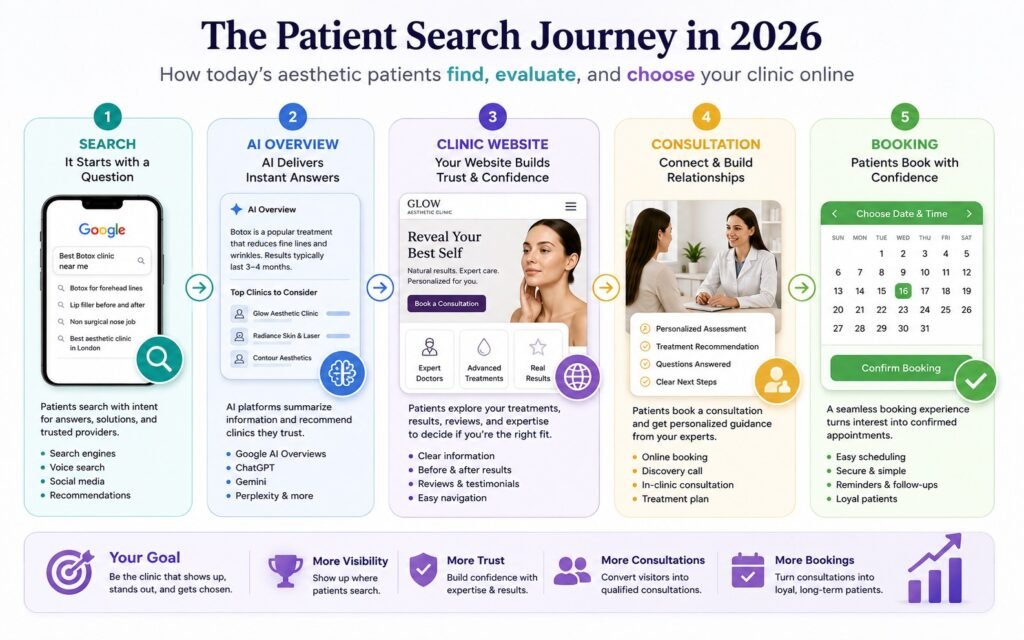
Successful SEO begins by understanding that not every visitor is ready to book today.
One of the biggest mistakes clinics make is treating every search as a sales opportunity. In reality, patients move through distinct research stages before selecting a provider.
Informational Search Intent (Top of Funnel)
These searches focus on education rather than immediate booking.
Examples include:
- How long does Botox last?
- Is laser hair removal permanent?
- What is PRP therapy?
- Lip filler swelling timeline
- Chemical peel recovery
The goal of these pages is to build trust, demonstrate expertise, and introduce patients to your clinic before they begin comparing providers.
Commercial Search Intent (Bottom of Funnel)
These searches indicate a stronger intention to schedule a consultation.
Examples include:
- Botox clinic Manhattan
- Lip filler specialist London
- HydraFacial Sydney
- Best aesthetic clinic Dubai
- PRP clinic Toronto
These pages should prioritize practitioner credentials, reviews, before-and-after galleries, consultation pathways, and local trust signals.
Clinics that build separate content for informational and commercial intent typically create stronger topical authority while guiding patients naturally from education to booking.
Search optimization alone is no longer enough. Patients increasingly begin their research through AI-powered platforms before they ever visit a clinic’s website. Understanding how AI search recommends skin clinics is becoming just as important as traditional SEO because AI systems evaluate expertise, structured information, practitioner authority, and digital trust signals before surfacing recommendations. Our guide on how AI search recommends skin clinics explains how modern AI platforms evaluate aesthetic clinics and what you can do to improve your visibility in AI-driven search experiences.
The Reality Check
Many clinics try to rank every page for every keyword.
The most successful websites don’t.
They create educational resources for patients still researching treatment options and dedicated conversion pages for patients ready to choose a provider. That approach aligns with Google’s Helpful Content System, supports YMYL (Your Money or Your Life) quality expectations for healthcare content, and improves the likelihood of appearing in AI-generated search experiences.
Why Does YMYL Matter for Aesthetic Clinic SEO?
Healthcare websites are evaluated more rigorously because they influence decisions affecting people’s health, safety, and finances.
Google classifies aesthetic clinics within its broader Your Money or Your Life (YMYL) framework. This means search engines expect stronger evidence of expertise, experience, authority, and trust than they would for many other industries.
High-performing clinic websites typically include:
- Qualified practitioner biographies
- Medical reviewer information where appropriate
- Updated treatment content
- Transparent safety guidance
- Accurate before-and-after examples
- References to recognized medical standards
- Consistent authorship across educational resources
This approach doesn’t just support traditional SEO. It also helps AI systems determine whether your clinic provides reliable information worthy of recommendation.
Many clinic owners discover these issues only after their rankings begin to plateau. Our review of 50 aesthetic clinic websites in 2026 highlights the most common SEO, UX, and conversion mistakes preventing clinics from turning organic traffic into consultation bookings.
How Has AI Search Changed Aesthetic Clinic SEO?
Patients increasingly discover clinics through AI-powered search before they ever visit your website.
Google AI Overviews, ChatGPT, Gemini, Claude, and Perplexity no longer evaluate websites based solely on keywords. They assess topical authority, semantic relationships, practitioner expertise, structured data, external reputation, and whether your content genuinely answers patient questions.
A modern aesthetic clinic website SEO strategy therefore extends beyond traditional optimization. It must provide clear, trustworthy information that both human visitors and AI systems can understand and verify.
Today’s AI systems evaluate factors such as:
- Treatment expertise
- Practitioner credentials
- Website freshness
- Internal content relationships
- Structured data
- External brand mentions
- Patient reviews
- Content completeness
The clinics appearing consistently in AI-generated recommendations usually demonstrate authority across their entire digital presence rather than relying on a handful of optimized pages.
How Can Clinics Improve Their AI Authority Beyond Their Own Website?
AI models increasingly verify clinic credibility using third-party sources as well as your own website.
One trend we’ve observed is that AI assistants rarely rely on a single website before recommending a healthcare provider. Instead, they compare multiple trusted sources to validate a clinic’s reputation and expertise.
Examples include:
- Google Business Profile
- Professional medical directories
- RealSelf
- Trustpilot
- Healthgrades
- Practitioner association memberships
- News mentions
- Industry publications
These external references strengthen your clinic’s overall digital entity.
Rather than viewing SEO as something that only happens on your website, successful clinics now think in terms of digital reputation management.
The stronger your online footprint across trusted platforms, the easier it becomes for AI systems to understand your expertise and confidently recommend your clinic.
Industry Observation
One common mistake we see is clinics investing heavily in blog content while neglecting off-site credibility.
Publishing helpful content is essential, but earning genuine reviews, professional citations, and mentions from respected healthcare sources often amplifies that content’s authority far more effectively than producing dozens of additional articles.
What Treatment Keywords Should Clinics Actually Target?
Not every keyword deserves the same type of page. Matching content to patient intent produces stronger rankings and higher consultation rates.
Many clinics target broad phrases like:
- Cosmetic treatments
- Skin clinic
- Beauty clinic
Although these terms generate search volume, they often attract visitors at very different stages of the buying journey.
Instead, organize your keyword strategy into three distinct groups.
Treatment Keywords
These attract patients actively researching a specific procedure.
Examples include:
- Botox for forehead lines
- Lip filler clinic
- Chemical peel
- PRP hair restoration
- Laser pigmentation treatment
- Microneedling
Problem-Based Keywords
These address patient concerns before treatment selection.
Examples include:
- Best treatment for acne scars
- How to reduce wrinkles naturally
- Skin tightening options
- Hyperpigmentation treatment
- Best anti-aging procedures
Educational pages targeting these searches build trust early in the decision-making process.
Local Commercial Keywords
These indicate immediate booking intent.
Examples include:
- Botox clinic Manhattan
- Lip fillers London
- MedSpa New York
- Aesthetic clinic Sydney CBD
- Cosmetic clinic Toronto
These pages should prioritize:
- Consultation booking
- Practitioner experience
- Reviews
- Before-and-after galleries
- Clinic location
- Contact information
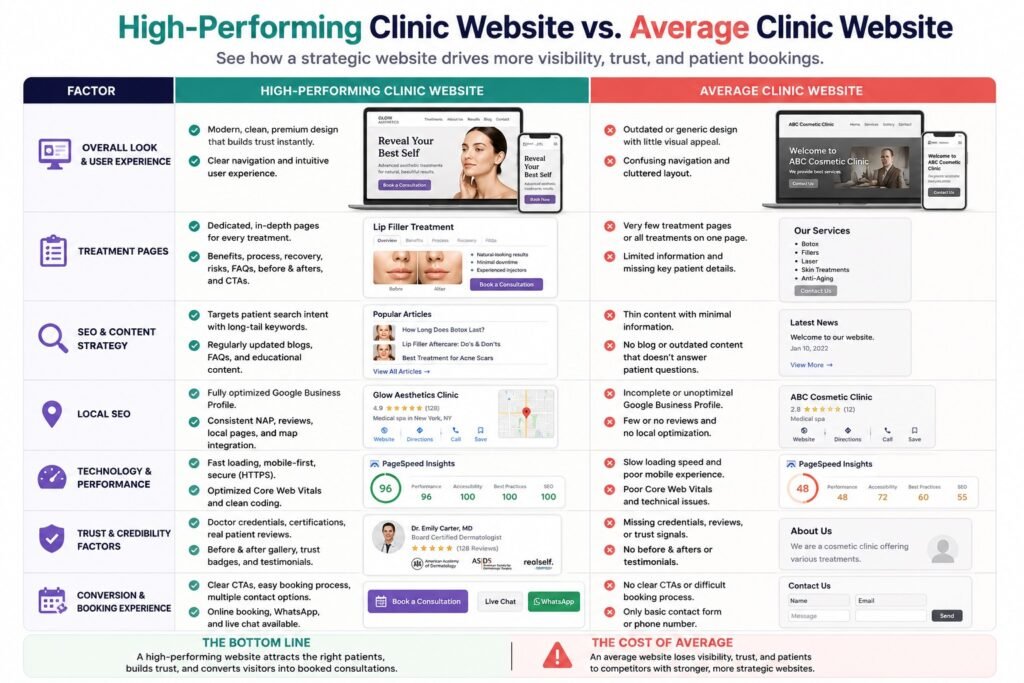
How Should Treatment Pages Be Structured?
High-ranking treatment pages educate first and convert second.
Patients don’t want promotional copy.
They want reassurance.
Every treatment page should answer the questions patients naturally ask before contacting a clinic.
An effective structure includes:
- Treatment overview
- Benefits
- Ideal candidates
- Consultation process
- Recovery expectations
- Risks and safety
- Frequently asked questions
- Practitioner credentials
- Before-and-after gallery
- Related treatments
- Consultation CTA
A SEO-friendly aesthetic clinic website makes every treatment page a comprehensive resource rather than a sales brochure.
Example Scenario
Imagine two clinics offering the same lip filler treatment.
Clinic A has a short service page listing the procedure, price, and booking form.
Clinic B publishes a complete treatment guide explaining candidacy, recovery time, expected results, safety considerations, practitioner qualifications, FAQs, and aftercare instructions.
Both clinics optimize for similar keywords.
Yet Google AI Overviews summarize Clinic B.
Perplexity references Clinic B.
Patients spend more time reading Clinic B’s content.
More consultations follow.
The competitive advantage isn’t keyword density.
It’s information quality.
Want Your Website to Feel as Premium as Your Clinic?
High-end clients notice design quality, photography, trust signals, and booking flow within seconds. Let’s identify what your current website is communicating before patients ever contact you.
8 SEO Strategies That Improve Treatment Rankings
1. Create Individual Treatment Pages
Every core procedure deserves its own optimized landing page.
Avoid combining unrelated services into a single page.
2. Build Educational Content Around Patient Questions
Answer questions such as:
- Does Botox hurt?
- How long does filler last?
- Is PRP safe?
- What is downtime after laser resurfacing?
Educational content expands keyword coverage while supporting patient confidence.
3. Strengthen Internal Linking
Every treatment page should naturally connect with:
- Related treatments
- Practitioner pages
- FAQs
- Blog articles
- Consultation pages
Strong internal linking improves topical authority.
4. Optimize Every Image
Before-and-after photography should include:
- Descriptive filenames
- Alt text
- Compression
- Structured image markup
Images contribute significantly to organic visibility.
5. Build Topic Clusters
Support treatment pages with educational articles covering:
- Recovery
- Risks
- Comparisons
- Aftercare
- FAQs
- Technology
Clusters demonstrate expertise across an entire treatment category.
6. Implement Comprehensive Medical Structured Data
Structured data helps AI systems understand the relationships between your practitioners, services, treatments, and clinic.
Beyond standard schema implementation, clinics should connect entities using appropriate healthcare properties.
Recommended schema includes:
- MedicalBusiness
- LocalBusiness
- Physician
- FAQPage
- BreadcrumbList
- ImageObject
Where appropriate, include properties such as:
medicalSpecialtyspecialtyfounderemployeesameAs
Linking practitioners to professional organizations, licensing bodies, and clinic entities strengthens semantic understanding for both search engines and AI assistants.
7. Strengthen Local SEO
Patients almost always choose providers nearby.
Prioritize:
- Google Business Profile
- Location landing pages
- Local citations
- Reviews
- Maps integration
- Consistent NAP information
8. Improve Technical Performance
Page speed, mobile usability, accessibility, and Core Web Vitals remain essential ranking factors.
Patients expect fast-loading websites.
Search engines do too.
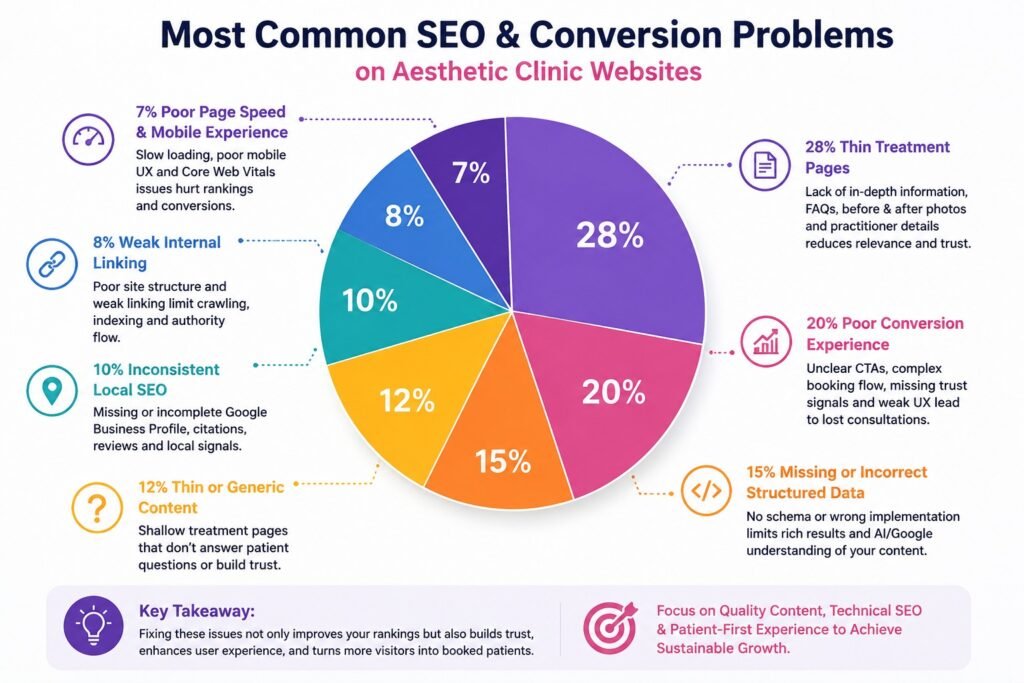
Is Your Website Helping Patients Find You or Helping Competitors?
Many clinics invest in SEO campaigns while overlooking the website experience that ultimately converts visitors into consultations.
At KG Web Designer, we evaluate:
- Patient search intent
- AI search readiness
- Treatment page optimization
- Technical SEO
- Structured data
- Conversion pathways
- Mobile UX
- Local SEO
Our recommendations focus on sustainable patient acquisition rather than temporary ranking improvements.
Book Your Website Strategy Session
Why Do Clinics Lose Rankings After Website Redesigns?
Most ranking losses occur because SEO planning happens after design decisions instead of before them.
Changing URLs, removing treatment pages, breaking internal links, deleting structured data, or modifying navigation without preserving existing authority can significantly reduce organic visibility.
Planning technical SEO before redesigning a clinic website protects years of accumulated search equity while creating opportunities for future growth.
Many clinic owners also ask whether publishing treatment pricing improves or harms conversions. Our guide explaining Should Aesthetic Clinic Website Design Display Treatment Prices on Their Website in 2026? explores how transparency influences patient trust, consultation rates, SEO performance, and compliance considerations.
Cross-Border Compliance Matters More Than Most Clinics Realize
International SEO success isn’t just about ranking—it also requires complying with regional healthcare advertising regulations.
If your clinic serves international patients or operates across multiple countries, your website strategy should reflect local compliance requirements.
Examples include:
- United States: HIPAA privacy expectations and state-specific advertising regulations.
- United Kingdom: ASA and CAP guidance governing medical advertising claims, testimonials, and promotional content.
- Australia: TGA restrictions relating to prescription-only medicines, including advertising limitations around Botox and similar injectable treatments.
- Canada, Singapore, and the UAE: Local healthcare marketing, consent, and privacy requirements.
International patients also expect localized experiences.
Simple improvements such as regional treatment terminology (for example, “MedSpa” in the US versus “Aesthetic Clinic” in the UK), appropriate appointment scheduling across time zones, and location-specific content help reduce friction while improving trust.
A global clinic website should demonstrate not only expertise in treatments but also an understanding of the regulations and expectations that influence patient confidence in different markets.
Why Most Clinics Get SEO Wrong
The biggest SEO mistake isn’t choosing the wrong keywords. It’s assuming every patient searches the same way.
Some patients are beginning their research. Others are comparing providers. A third group is ready to schedule a consultation immediately. When every page tries to serve all three audiences, it usually serves none of them well.
Another common misconception is treating SEO as a one-time project. Search behavior evolves constantly, especially in healthcare, where treatment trends, AI search, and regulatory guidance continue to change. Clinics that consistently perform well view SEO as an ongoing patient education strategy rather than a technical checklist.
We also frequently see clinics relying almost entirely on paid advertising while neglecting organic visibility. Paid campaigns stop generating leads the moment the budget ends. Well-structured organic content continues attracting qualified patients month after month.
The Reality Check
The clinics generating the strongest long-term growth don’t necessarily publish the most content.
They publish the most trustworthy content.
That means every article, treatment page, practitioner profile, and FAQ contributes to demonstrating expertise, experience, authority, and trustworthiness.
What This Means for Your Clinic
Your website should do much more than rank on Google.
It should become your clinic’s primary patient acquisition platform.
When SEO, patient education, local optimization, technical performance, and conversion strategy work together, your website begins attracting higher-quality consultations instead of simply generating more website traffic.
The business impact extends far beyond rankings.
A stronger digital presence helps your clinic:
- Generate more qualified consultation requests
- Reduce dependence on paid advertising
- Build long-term authority within your treatment specialties
- Improve visibility across Google Search, Google AI Overviews, ChatGPT, Gemini, Claude, and Perplexity
- Increase patient confidence before the first consultation
- Strengthen referral opportunities from healthcare partners
- Create sustainable organic growth
Example From Our Experience
Challenge
A growing aesthetic clinic approached us after investing heavily in paid advertising while seeing little improvement in organic visibility. The website contained fewer than ten treatment pages, most of which briefly described procedures without addressing patient concerns, recovery expectations, practitioner expertise, or local search intent.
Navigation was built around internal service categories rather than patient search behavior, and there was minimal structured data supporting search engines or AI platforms.
Solution
Instead of recommending another SEO campaign, we focused on rebuilding the website around patient intent.
Our strategy included:
- Expanding the website from a handful of generic service pages into dedicated treatment resources.
- Reorganizing navigation around how patients search rather than how clinics categorize treatments.
- Improving internal linking between treatments, FAQs, practitioner profiles, and educational content.
- Implementing healthcare-focused structured data with properly connected entities, including
MedicalBusiness,Physician,medicalSpecialty, and related schema properties. - Optimizing local landing pages and strengthening conversion pathways throughout the patient journey.
To see how thoughtful UX, information architecture, and conversion strategy can transform a healthcare website, explore our Taruj Skincare Website Redesign Case Study, where we redesigned the website to create a more intuitive user experience and a stronger digital foundation for future growth.
Outcome
Within several months of implementing the new website structure, the clinic had:
- Expanded from 8 treatment pages to 24 comprehensive treatment resources.
- Increased first-page keyword rankings for treatment-specific searches by approximately 65%.
- Improved organic consultation enquiries by around 40% compared with the previous period.
- Reduced reliance on paid advertising as organic traffic became a larger source of qualified patient enquiries.
While every clinic’s results will vary depending on competition, geography, and implementation quality, this project reinforced something we repeatedly observe: sustainable SEO growth comes from improving patient experience, not chasing algorithm updates.
Expert Advice from Kanika Gupta
Founder, KG Web Designer | Healthcare & Conversion-Focused Website Strategist
“Pricing should never become the headline of an aesthetic clinic website. Patients invest in expertise, safety, and outcomes. When your website explains those factors first, pricing becomes easier to understand and far less likely to become the deciding objection.”
Building a successful pricing strategy also requires an effective website structure. Our article Why Some Aesthetic Clinic Websites Convert Better (and How to Structure Yours) explains how patient journeys, treatment pages, trust signals, and conversion-focused design work together to generate more consultation requests.
Final Thoughts
Search engines continue evolving.
Patient expectations evolve even faster.
The clinics generating sustainable growth understand that SEO isn’t about manipulating algorithms. It’s about becoming the most trusted source of information for prospective patients while making it easy to take the next step.
Professional aesthetic clinic website design combines technical SEO, healthcare compliance, patient psychology, structured data, and conversion strategy into one cohesive experience. When these elements work together, your website becomes far more than an online brochure. It becomes a reliable patient acquisition system capable of supporting long-term business growth.
Whether your goal is improving local rankings, strengthening AI visibility, increasing consultation bookings, or reducing reliance on paid advertising, investing in a strategic website foundation creates lasting competitive advantages.
Ready to Grow Your Aesthetic Clinic?
If you’re unsure whether your current website is helping or limiting your clinic’s growth, we’d be happy to review it.
Our strategy sessions include:
- SEO audit
- AI search readiness assessment
- Treatment page evaluation
- Local SEO review
- Technical performance audit
- Conversion optimization recommendations
- Patient journey analysis
- Website growth roadmap
We’ll provide practical recommendations tailored to your clinic—not generic SEO advice.
Book a Strategy Call
📩 Contact Kanika Gupta
https://kgwebdesigner.com/contact-me/
📅 Schedule a Strategy Session
https://calendly.com/kanika-kgwebdesigner/30min/
Available across US, UK, Australia, Canada, Singapore, and UAE time zones. Fully remote. No obligation.
Related Healthcare Website Design Services
Frequently Asked Questions
How long does SEO take to generate patient bookings for an aesthetic clinic?
Most clinics begin seeing measurable SEO improvements within three to six months, although competitive markets may take longer. Results depend on your existing authority, website quality, competition, and how consistently you publish helpful content. Sustainable SEO should be viewed as a long-term patient acquisition strategy rather than a quick marketing tactic.
Should every treatment have its own landing page?
Yes. Every major treatment should have a dedicated landing page targeting a specific patient search intent. Individual pages help search engines understand your expertise while giving patients detailed information about benefits, recovery, candidacy, FAQs, practitioner credentials, and consultation options.
How does AI search affect aesthetic clinic SEO?
AI-powered search platforms increasingly recommend clinics that publish trustworthy, structured, and comprehensive information rather than simply repeating keywords. Educational treatment guides, structured data, practitioner expertise, patient-focused FAQs, and strong internal linking all improve the likelihood of appearing in AI-generated recommendations.
Is local SEO still important if patients increasingly use AI search?
Absolutely. AI platforms still rely heavily on local signals when recommending healthcare providers. Optimized Google Business Profiles, reviews, location-specific landing pages, consistent contact information, and healthcare-focused structured data remain essential components of modern local SEO.
Should aesthetic clinics display treatment prices online?
The answer depends on the treatment, consultation process, and local advertising regulations. Simple procedures may benefit from greater pricing transparency, while personalized treatments often require an individual assessment before accurate pricing can be provided. Clinics should also ensure pricing complies with applicable regional healthcare advertising requirements.
Does website design influence SEO rankings?
Yes. Website design directly affects page speed, mobile usability, navigation, internal linking, accessibility, user engagement, and conversion rates—all of which influence search performance. A professionally designed website supports both higher rankings and stronger patient confidence.
Why is structured data important for aesthetic clinics?
Structured data helps search engines and AI platforms understand your clinic, practitioners, treatments, and medical specialties more accurately. Implementing healthcare-specific schema, including MedicalBusiness, Physician, medicalSpecialty, and FAQ markup, improves semantic understanding and strengthens your eligibility for rich search experiences.