Quick Answer
Yes, a better website can be worth the investment even when referrals are your main source of new patients. A well-planned eye clinic website investment can help referred patients verify credentials, read reviews, compare services, confirm location, and find an easy booking path. Strong eye clinic website design does not replace referrals. It helps referred patients trust the recommendation enough to take the next step.
TL;DR: What an Eye Clinic Owner Should Know
- Referrals create awareness, but your website can influence whether a referred patient actually books.
- Patients increasingly compare healthcare providers online before committing, even when another person has recommended the provider.
- A website should communicate clinical expertise, services, doctors, locations, reviews, accessibility, and booking options quickly.
- Online booking matters, but it should complement phone scheduling rather than replace it.
- Local SEO and a strong Google Business Profile help referred patients verify that they have found the right practice.
- A redesign is not automatically the answer; the right investment depends on whether the problem is visibility, trust, UX, booking friction, or outdated infrastructure.
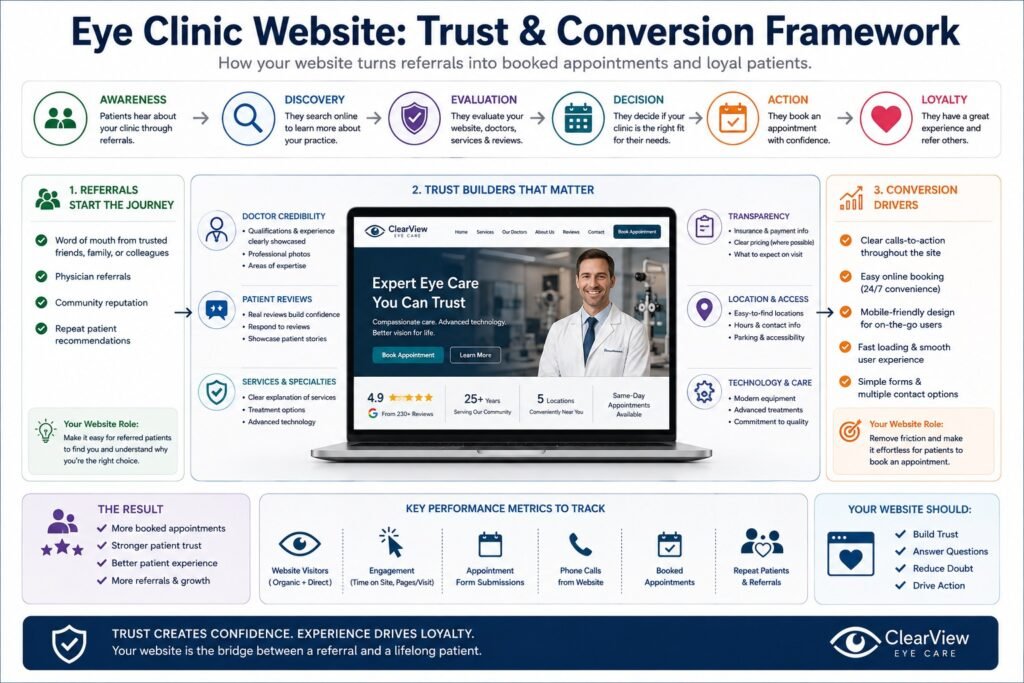
Why Referrals Do Not Make Your Website Less Important
A referral gets a patient interested. Your digital presence can determine whether that interest becomes an appointment.
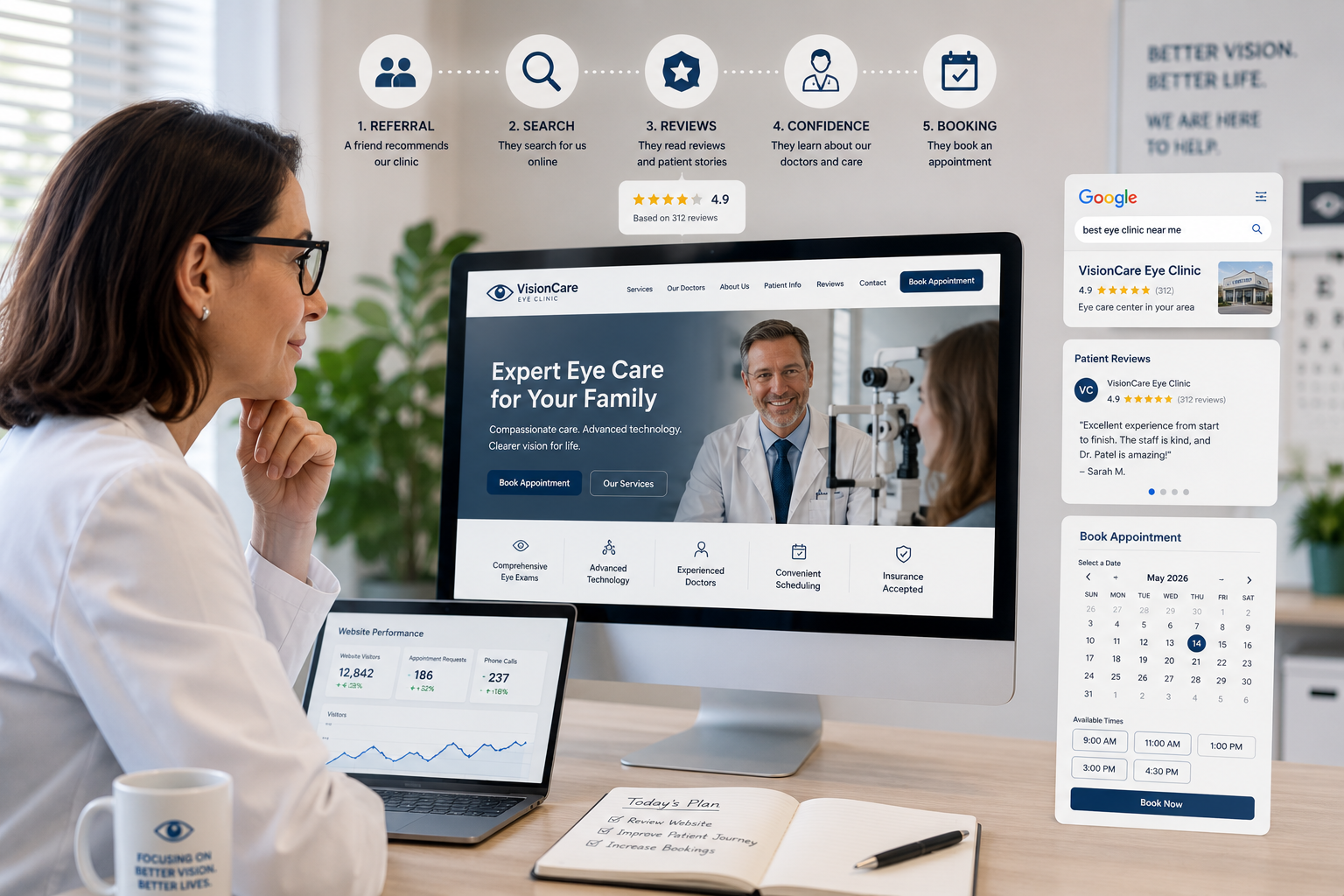
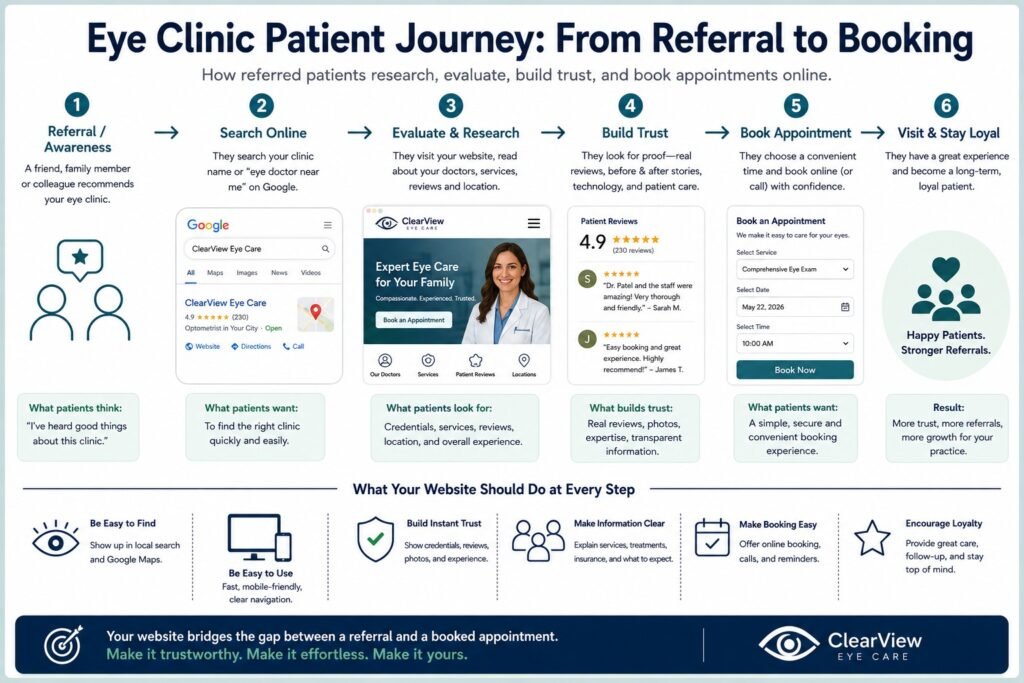
Imagine a patient tells a friend, “You should see our optometrist. They are excellent.” The patient may remember the clinic name, search it on Google that evening, open the website, look at the doctors, check the location, review services, read testimonials, and look for a booking option.
That behavior matters because healthcare decisions increasingly involve online comparison. Zocdoc’s 2026 analysis of millions of appointment bookings found that patients compared an average of 21 provider profiles before booking, while 84% of patients who booked with a new provider returned to that provider for their next appointment in the same specialty.
A referral therefore should not be viewed as the end of the acquisition process. It can be the beginning of the digital evaluation.
At KG Web Designer, we approach this differently from a traditional brochure-style website project. KG Web Designer is a conversion-focused website design studio specializing in custom websites for clinics, professional services, manufacturers, and growing businesses.
The financial question is not simply, “Will the website generate new patients?”
A better question is:
How many referred, searched, returning, and locally discovered patients are currently reaching the website and leaving without enough confidence to book?
That is where the business case for a website becomes much clearer.
Common owner comments that signal a website problem
You may recognize some of these:
- “Most of our patients come through referrals anyway.”
- “We have a website, but I don’t know whether it does anything.”
- “People call us after searching our name, but I don’t know what they see first.”
- “Our doctors are highly experienced, but that doesn’t come across online.”
- “We have online booking, but hardly anyone seems to use it.”
- “Our competitors don’t have better doctors, but their websites look much more professional.”
- “We don’t want to spend money on a redesign unless there is a business reason for it.”
These are not necessarily redesign problems.
They are diagnosis problems.
AI search adds another reason to think about the website as a long-term digital asset rather than simply an online brochure. When an eye clinic clearly communicates its doctors, specialties, treatment expertise, locations, patient resources, and trust signals, that information can support both traditional search visibility and AI-driven patient discovery. Our detailed guide on AI Search Optimization for Eye Clinics explains the website, content, authority, and information signals that can make a clinic easier for AI systems to understand and reference.
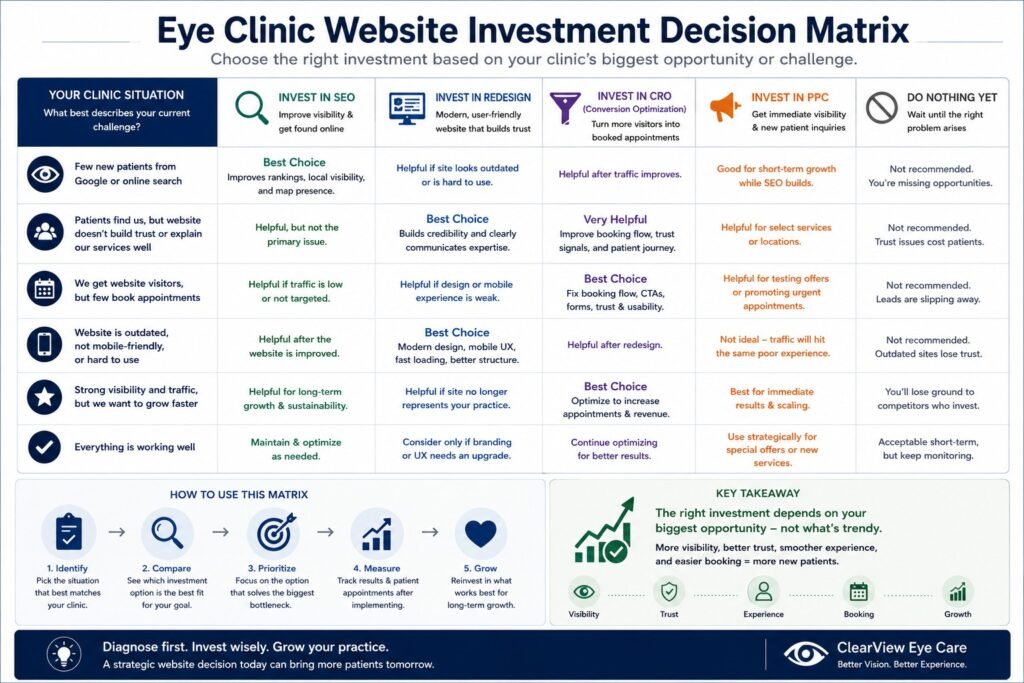
Should You Invest in SEO, CRO, a Redesign, PPC, or Nothing?
The correct investment depends on where the patient journey is breaking. A clinic with strong visibility but weak booking behavior has a very different problem from a clinic that is barely appearing in local search.
| Situation | Most likely issue | First investment to consider | Why |
|---|---|---|---|
| Patients cannot find the clinic | Local SEO / visibility | SEO + Google Business Profile | Improve discovery |
| Patients find the clinic but leave quickly | UX / trust | CRO or redesign | Reduce uncertainty |
| Website gets visits but few appointment actions | Conversion | CRO + booking UX | Improve visitor-to-lead behavior |
| Website looks outdated and is difficult to use | Structural UX | Redesign | Fix usability and credibility |
| Google visibility is weak despite a good website | Search strategy | Local SEO | Increase qualified discovery |
| Website and SEO are good but demand is low | Demand generation | PPC or other acquisition | Generate additional qualified traffic |
| Website performs adequately and bookings are healthy | No major issue | Do nothing | Avoid spending for appearance alone |
This is why I would not recommend a redesign simply because a website is five or six years old.
The business case should come from a measurable problem.
Does an eye clinic really need a good website?
Yes, because an eye clinic website is often part of the patient’s verification process even when the original awareness came from a referral.
Healthcare is unusually trust-sensitive. Patients are not simply evaluating a product or comparing prices. They are deciding whether they feel comfortable placing their vision and health in the hands of a practice.
Current research supports the importance of this digital evaluation. In Tebra’s January 2026 U.S. survey of 805 patients, 48% reported using Google to find new providers, while 26% said online reviews mattered more to them than a doctor’s credentials or years in practice.
That does not mean patients value a website more than clinical quality.
It means the website can influence whether they understand and trust the clinical quality that already exists.
For an eye clinic, the website should make several things obvious:
- What type of eye care does the practice provide?
- Which doctors or optometrists provide the care?
- What conditions and treatments are handled?
- Where is the clinic located?
- What makes the practice credible?
- What do patients say about their experience?
- How can someone schedule an appointment?
- What should a new patient expect?
If those answers are buried, vague, or difficult to find, a referral can lose momentum.
For an eye clinic with more than one office, the website’s value becomes even more closely tied to location clarity. Patients need to know which clinic serves them, where it is located, what services are available there, and how to book the appropriate appointment. That is why our guide to multi-location optometry website design explains how location architecture, local SEO, navigation, and appointment booking need to work together rather than treating every clinic as a simple duplicate of the main website.
Is a new website worth it if most patients come from referrals?
Yes, when the existing website is weakening the value of those referrals; otherwise, a redesign may be unnecessary.
This distinction is important.
Suppose 60 new patients arrive through referrals each month. If 40 of them search for the clinic before calling, the website becomes part of the referral pathway even though Google did not generate the original lead.
The website may influence whether the patient:
- feels the referral was credible,
- understands the clinic’s specialty,
- trusts the doctor,
- confirms insurance or location information,
- sees evidence of patient satisfaction,
- finds the appropriate service,
- and books without unnecessary friction.
Healthgrades has also reported that patients may check a physician’s experience and reviews even after receiving a recommendation from someone they know.
That is why I would treat referrals and website performance as complementary rather than competing acquisition channels.
Patients may check the doctors, services, reviews, location, insurance information, and booking options before deciding whether to move forward. If you are considering a redesign, it is also worth understanding how to choose an optometry website designer who understands patient bookings, local search, healthcare trust, and the practical decision-making process behind an appointment.
The real ROI question
A website does not need to generate every patient independently to justify its investment.
It can create value by protecting demand that the clinic has already earned through reputation, referrals, repeat patients, physician relationships, local visibility, and brand recognition.
That is a much more realistic way to calculate website ROI.
Look at the Patient Journey Before Redesigning the Website
Insight from Kanika Gupta, Founder, KG Web Designer
“If I were reviewing an eye clinic website, I would not begin with colors, layouts, or whether the homepage feels modern. I would follow the same journey a patient takes, from finding the clinic on Google to choosing a service and completing an appointment booking, and look for every moment where confidence or momentum is lost.”
The takeaway: A redesign should begin with diagnosing friction in the patient journey. Once those problems are clear, design decisions can be made around improving trust, usability, and appointment conversion.
Do referred patients check an eye clinic online before booking?
Yes, many do, and current healthcare research shows that online research is now a normal part of provider selection.
A 2026 rater8 patient-choice report found that 47% of surveyed patients had used AI to research healthcare providers, while 40% said review sites influenced their provider decision and 34% cited Google search results. Friends and family remained influential at 43%, showing that digital research and referrals increasingly coexist rather than replace one another.
This is particularly relevant for an eye clinic because a referral can be specific but still leave questions unanswered.
A patient may hear:
“Dr. Smith is excellent.”
But then search:
- Does the doctor treat my condition?
- Does the clinic accept my insurance?
- Where exactly is the office?
- What are the opening hours?
- Do they offer comprehensive eye exams?
- Do they provide specialty services?
- What do other patients say?
- Can I book online?
- What should I bring?
- Is the clinic modern and accessible?
Your website should answer those questions before the patient has to call.
Google also states that complete and accurate Business Profile information helps businesses appear in relevant local search results and helps customers understand what a business does, where it is, and when they can visit. Google identifies relevance, distance, and prominence as key local-ranking factors.
That means your website and local presence work together.
Can a better optometry website increase appointments?
Yes, but only when the website removes barriers between patient intent and appointment action.
A visually attractive website by itself does not guarantee more bookings. The improvement comes when design, messaging, service architecture, trust signals, accessibility, local visibility, and appointment UX work together.
For example, optometrist website design should account for different patient intents rather than treating every visitor as someone who simply wants to “contact the clinic.”
A first-time patient may want a comprehensive eye exam.
Another visitor may be looking for contact lenses.
Someone else may be researching myopia management, dry eye treatment, pediatric care, or a specialist referral.
Each intent creates a different information requirement.
A better website does not necessarily mean rebuilding every page. If the existing site already has useful traffic and search visibility, the higher-value opportunity may be fixing booking friction, mobile navigation, service-page clarity, or the points where patients hesitate before scheduling. This is why the question of eye clinic redesign versus better booking UX should be evaluated before committing to a full rebuild.
What a high-converting eye care site should make easy
- Finding the right service
- Understanding who provides the service
- Seeing relevant credentials
- Checking location and hours
- Understanding insurance or payment information
- Reading genuine reviews
- Finding phone and booking options
- Using the website comfortably on mobile
- Understanding what happens after requesting an appointment
A 2024 study of online appointment scheduling in an ophthalmology practice found that new patients showed a preference for online booking, and online scheduling was associated with a substantially lower no-show rate in that particular practice. The study does not prove that every eye clinic will achieve the same result, but it demonstrates why booking UX deserves to be treated as an operational feature rather than merely a marketing button.
What Should You Fix Before Redesigning Your Eye Clinic Website?
If your clinic already has strong referrals but you are unsure whether the website is helping or hurting those referrals, the right starting point is not necessarily a redesign.
A focused website audit can examine the patient journey from Google or a referral search through the homepage, service pages, trust signals and booking process.
If the problem is structural, KG Web Designer can then recommend the appropriate redesign or conversion work rather than asking you to rebuild pages that are already performing.
What do patients look for on an eye clinic website?
Patients generally look for evidence that the practice is credible, relevant to their needs, convenient to access, and easy to contact.
The most important mistake is assuming that patients want a long list of medical information first. They usually need enough information to decide whether this is the right practice before they invest time in reading deeply.
For example, eye doctor website design should bring doctor credibility closer to the services and conditions where patients are making decisions.
Seven trust signals worth evaluating
- Named doctors and credentials
Patients should be able to identify who provides their care. - Clear specialties and services
Avoid forcing patients to interpret generic medical terminology. - Real patient reviews
Reviews can provide evidence about communication, staff experience, comfort, and overall care. - Professional clinic photography
The physical environment can reduce uncertainty about what the patient will experience. - Clear location information
Include address, parking or access information where relevant, hours, and location-specific details. - Appointment options
Make the next action obvious without forcing every patient into one booking method. - Useful patient information
Explain what to expect, preparation requirements, insurance information, and common questions where appropriate.
Rater8’s 2026 research found that 55% of surveyed patients had avoided or canceled an appointment because of online reviews, while 66% said seeing a provider respond to reviews influenced their trust.
That makes reputation management part of the broader conversion environment.
Your website cannot control every review.
It can, however, provide context around the practice and make it easier for patients to understand the experience behind the rating.
Can an outdated website make patients choose another optometrist?
Yes, particularly when outdated design creates uncertainty, friction, or a credibility gap.
An outdated website does not automatically mean a clinic is losing patients. Some older websites still perform reasonably well because they contain strong content, accurate information, excellent local visibility, and an easy booking process.
The problem occurs when visual age reflects deeper structural problems.
Warning signs I would investigate
- The website is difficult to use on a phone.
- Appointment buttons are difficult to find.
- Services are buried in one generic page.
- Doctor credentials are hidden.
- Location information is outdated.
- Pages contain old promotions or outdated information.
- Reviews are difficult to find.
- The site loads slowly.
- Forms are unnecessarily complicated.
- Patients cannot determine what happens after submitting a request.
- Accessibility has not been considered.
- The website does not clearly differentiate the clinic from nearby competitors.
Google’s current guidance for AI features reinforces that ordinary SEO fundamentals remain important. Google specifically recommends making content findable through internal links, providing a strong page experience, keeping important information in text, and ensuring structured data matches visible content.
So an outdated website is not simply an aesthetic problem.
It can become a search, accessibility, trust, and conversion problem simultaneously.
Where Are Potential Patients Dropping Off?
Your clinic may already have strong referrals and website traffic — but what happens after patients arrive? A focused website review can uncover unclear messaging, missing trust signals, booking friction, and other gaps that may be stopping visitors from becoming appointments.
Should an optometry practice invest in its website or local SEO first?
The answer depends on whether the clinic has a visibility problem or a conversion problem.
If the practice is difficult to find for relevant local searches, local SEO should probably come first.
If patients already find the clinic but the website creates uncertainty or poor booking behavior, improving the website may produce more value than simply increasing traffic.
Google confirms that local ranking is influenced by relevance, distance, and prominence, with complete business information and reviews contributing to how a business can appear in local results.
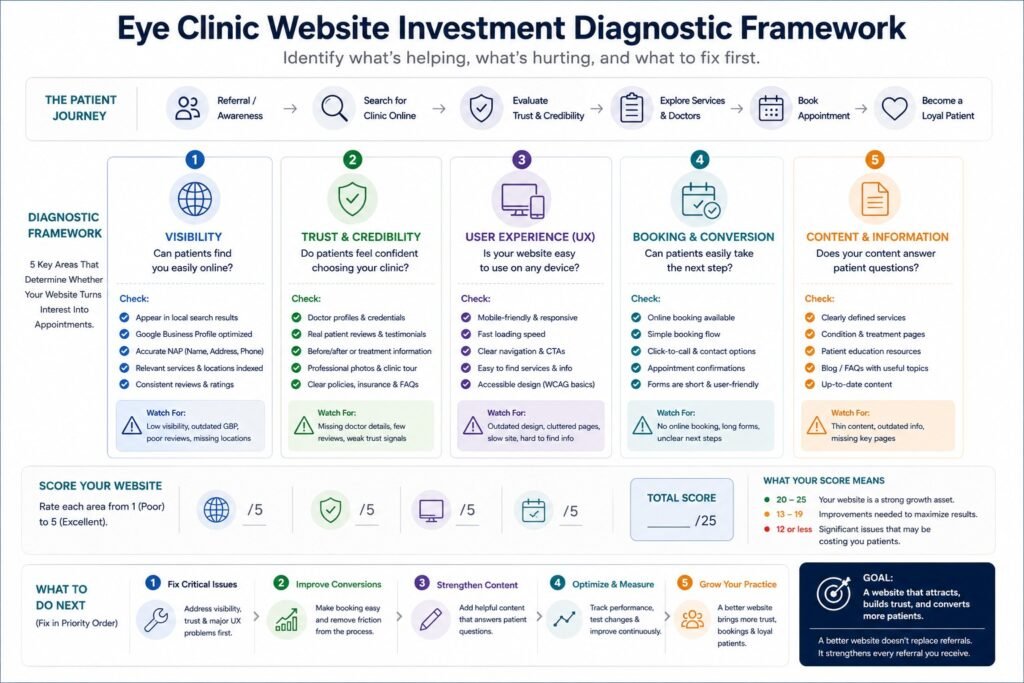
This creates a simple diagnostic framework:
If relevant searches are low → investigate local SEO.
If relevant traffic is healthy but appointment actions are weak → investigate conversion.
If both visibility and conversion are weak → address the website architecture and local search strategy together.
If both are healthy → do not redesign merely because competitors have newer websites.
That last point is important.
Website spending should solve a business problem.
It should not become an annual cosmetic exercise.
How do I know if my eye clinic website is losing patients?
You can identify the problem by comparing search visibility, relevant traffic, engagement, trust signals, and appointment behavior rather than looking at traffic alone.
A clinic can receive thousands of visits and still have a weak website.
At KG Web Designer, one of the first things we look for during a website review is the gap between visitor intent and available next steps.
Diagnostic summary
If traffic is low and impressions are low, likely visibility is the problem.
If traffic is relevant but appointment actions are low, likely conversion or trust is the problem.
If patients reach booking but abandon it, likely booking UX is the problem.
If branded traffic is strong but patients still call with basic questions, likely information architecture is the problem.
If reviews are strong but the website looks unreliable, likely digital trust is the problem.
If the website works but Google visibility is weak, likely local SEO is the problem.
Original observation from KG Web Designer
Across website reviews we conduct for healthcare businesses, we frequently see a mismatch between the quality of the clinic and the quality of the digital explanation of that clinic. The clinical business may be strong, but the website makes patients work too hard to understand why.
That is not a published industry statistic.
It is an observation from website work and audits, and I would treat it differently from a survey result.
The opportunity is to turn the expertise the clinic already possesses into visible evidence.
What does a smart eye clinic website investment actually need to deliver?
A smart eye clinic website investment should improve at least one measurable business outcome: qualified discovery, patient confidence, appointment completion, service understanding, or operational efficiency.
The KG Eye Clinic Website Decision Framework
The KG Eye Clinic Website Decision Framework evaluates an eye clinic website across five layers: Visibility → Relevance → Trust → Conversion → Experience.
| Layer | Business question | What to improve |
|---|---|---|
| Visibility | Can patients find us? | Local SEO, technical SEO, location structure |
| Relevance | Do they know we treat their need? | Service and condition architecture |
| Trust | Do they believe we are right for them? | Doctors, credentials, reviews, evidence |
| Conversion | Can they take the next step? | CTAs, forms, booking UX |
| Experience | Can they use the site comfortably? | Mobile UX, accessibility, speed, clarity |
This is where website design for eye clinics differs from generic corporate web design.
The website has to accommodate patient uncertainty.
A patient may be nervous about a diagnosis.
An older patient may need larger, clearer text.
A parent may want to know whether a clinic treats children.
A patient with a referral may want to confirm that the recommended doctor actually handles the relevant condition.
A premium elective procedure may require considerably more education and trust than a routine eye examination.
The investment should therefore be based on patient decision complexity, not simply the number of pages.
What should an optometry website do besides provide information?
It should help patients make decisions and take the next appropriate action.
A brochure tells someone what the clinic offers.
A conversion-focused website helps them determine whether the clinic is right for them.
That difference is significant.
For example, optometry website design should connect services, doctors, conditions, locations, patient information, reviews, and booking paths rather than treating each page as an isolated piece of content.
KG Patient Journey Test
Search or referral → Clinic verification → Service discovery → Doctor evaluation → Trust → Location/insurance check → Appointment
Every stage can create friction.
If a patient finds the clinic but cannot determine whether their insurance is accepted, they may leave.
If they find the right service but cannot identify who provides it, they may hesitate.
If they trust the doctor but cannot figure out how to book, they may call a competitor with a simpler process.
This is why the website should be measured as a patient journey rather than a collection of pages.
Is online booking important for an eye clinic?
Yes, but online booking should complement phone scheduling rather than replace it.
Healthcare patients have different preferences, ages, accessibility needs, urgency levels, and comfort with digital tools. A strong website gives patients an appropriate choice rather than assuming one booking method works for everyone.
Tebra’s 2026 patient survey found that 17% of patients said inability to book online would strongly push them toward switching doctors. The same study found that patients used multiple discovery channels, including word of mouth, referrals, Google, insurance portals, and digital platforms.
That is a useful warning for clinics that say, “Our patients prefer to call.”
Some do.
But that does not mean every prospective patient wants to call during office hours.
A good booking system should answer
- What appointment types are available?
- Which location should I choose?
- Which doctor should I see?
- What information do I need?
- Can I book outside office hours?
- What happens after I submit the request?
- Can I still call if I prefer speaking to someone?
Online booking is therefore not simply a conversion feature.
It can also be a convenience feature and an operational feature.
Online booking is therefore not simply a conversion feature. It can also be a convenience and operational feature, particularly for patients who are ready to choose a service and appointment time without calling during office hours. If you are evaluating whether your practice should prioritize online scheduling, a useful next step is to compare online appointment booking vs. contact forms for eye clinics and understand which option fits different patient intents.
Example Scenario
A referred patient is told about an excellent optometry practice by a family member.
The patient searches the clinic on Google that evening.
The Google Business Profile looks credible. The reviews are strong. The patient clicks through to the website.
The homepage, however, says “Comprehensive Vision Care for Your Family” without immediately clarifying the clinic’s key services, doctors, location, or next step. The patient searches through the navigation, eventually finds the services page, and then has difficulty identifying which appointment type is appropriate.
Nothing is technically broken.
But the decision journey is harder than it needs to be.
Now imagine the same referral leading to a website where the patient immediately sees the practice’s specialty, named doctors, relevant services, location, reviews, insurance information, and a clear appointment pathway.
The referral did the first job.
The website did the second.
That is the business case for the investment.
Why Most Businesses Get This Wrong
Most eye clinics get website investment wrong because they judge the website by appearance or traffic rather than patient decision behavior.
A modern homepage can still fail if it does not answer the questions patients have before booking.
Likewise, a dated-looking website can continue producing appointments if it is clear, trusted, accessible, technically sound, and easy to use.
The common mistakes are:
- Redesigning before diagnosing the problem.
- Treating referrals as completely offline.
- Measuring traffic without measuring appointment actions.
- Putting every service into one generic page.
- Hiding doctor credentials behind a separate biography section.
- Making booking available but difficult to find.
- Treating mobile UX as an afterthought.
- Ignoring accessibility.
- Assuming more SEO traffic automatically means more patients.
- Copying a competitor’s website without understanding its patient journey.
Google’s own guidance for AI search emphasizes that there are no special AI-only optimization requirements. Strong foundational SEO, useful content, internal linking, good page experience, accessible textual information, and accurate structured data remain important.
That matters because some clinics are tempted to chase AI visibility while their basic website experience remains weak.
I would fix the foundation first.
What This Means For Your Business
Your website does not need to replace your referral network to justify its cost.
It needs to strengthen the commercial value of the reputation you have already built.
For an established eye clinic, that can mean:
- Protecting referred patients during their online evaluation.
- Making your doctors’ expertise easier to understand.
- Helping local searchers discover the practice.
- Making specialty services easier to evaluate.
- Increasing confidence before the first call.
- Reducing unnecessary questions for front-desk staff.
- Giving patients a convenient booking option.
- Creating a stronger digital impression than nearby competitors.
- Supporting future SEO and AI-search visibility.
- Providing a measurable patient journey rather than a static brochure.
This is particularly important as healthcare discovery becomes more digital. Google’s current guidance confirms that AI features such as AI Overviews and AI Mode use relevant web content to help users explore complex questions, while foundational SEO remains the basis for eligibility and visibility.
The goal is not to make your website “AI optimized” in isolation.
The goal is to make your clinic clearly understandable to patients, search engines, and AI systems because the underlying information is structured, useful, credible, and easy to interpret.
Example From Our Experience
Problem: In our eye clinic website reviews, we have repeatedly encountered practices with strong clinical credentials and referral-driven reputations but websites that communicate those strengths poorly. The problem is often not a lack of expertise. It is that the evidence is scattered across doctor biographies, generic service pages, outdated content, and difficult navigation.
Solution: Our approach is to review the website as a patient would. We examine the homepage, services, doctor positioning, location information, reviews, mobile experience, accessibility, booking pathway, and search intent before recommending design changes.
Outcome: The immediate outcome of this type of audit is a clearer list of what actually needs fixing. Sometimes the recommendation is a full redesign. Sometimes it is a smaller conversion or content intervention. That distinction prevents clinics from spending on a visual rebuild when the real problem is elsewhere.
One of our recent eye clinic-focused audits similarly emphasized the difference between a visually modern website and one that actually answers patient questions, builds confidence, and creates a clear route toward an appointment. That principle is central to how we approach healthcare website projects.
For a broader look at how we evaluate patient journeys, our article on why patients leave eye clinic websites without booking explores the gap between attracting visitors and giving them enough confidence to take action.
What Should You Fix First, Second, and Third?
The first step should be diagnosis, not design.
First: Fix the patient decision path
Check whether a new visitor can understand:
- What the clinic does.
- Who provides care.
- Which services are relevant.
- Where the clinic is located.
- Why the clinic is credible.
- What to do next.
If those basics are unclear, design polish will not solve the underlying problem.
Second: Fix trust and conversion friction
Bring reviews, doctor credentials, service evidence, location details, patient information, and booking options closer to the decisions patients are actually making.
A strong website should not force visitors to hunt for reassurance.
Third: Fix visibility and technical foundations
Once the patient journey is clear, address local SEO, internal linking, technical performance, structured content, mobile UX, accessibility, and analytics.
This is where increase eye clinic appointments becomes a measurable business objective rather than a vague website promise.”
You can measure whether more relevant visitors reach key service pages, whether they interact with appointment CTAs, whether forms are completed, and whether branded searches and direct inquiries change over time.
When Does Professional Help Make Sense?
Professional help makes sense when the clinic has enough existing demand or reputation that the cost of digital friction is becoming more significant than the cost of improving the website.
I would especially consider outside expertise when:
- The clinic has strong referrals but weak digital conversion.
- The current website is difficult to manage or update.
- The website is not mobile-friendly.
- Patients struggle to find services or doctors.
- Booking behavior is difficult to measure.
- Local search visibility is inconsistent.
- The website does not reflect the quality of the physical clinic.
- The practice is expanding locations or services.
- The clinic is investing heavily in SEO or paid traffic but the website is not converting well.
If this were my website, I would not start by asking three agencies to redesign the homepage.
I would first ask each one:
“What do you believe is preventing this website from converting more of the demand we already have?”
Then I would ask them to show me the evidence behind that diagnosis.
That question quickly separates a design vendor from a strategic website partner.
For clinics that need a more specialized solution, specialized eye care website design services should be evaluated based on patient journey, booking UX, trust, accessibility, local visibility, and measurable business goals, not just visual style.
Are Visitors Finding Enough Reasons to Contact You?
Traffic alone does not create enquiries. Your website needs to communicate the right value, establish credibility, answer important questions, and make the next step obvious. Small gaps in that journey can mean valuable prospects leave before contacting you.
Explore Website Design Solutions →Let’s review your website, goals, and conversion journey together.
Book Your Free 30-Minute Call →Expert Insight from Kanika Gupta
“I don’t think an eye clinic should redesign its website simply because referrals are working. I would redesign when the website fails to support the reputation that those referrals have already created. A referred patient should arrive online and feel, within a few minutes, that the person who recommended the clinic made a good recommendation. If the website creates doubt instead, the clinic is paying for a problem it could have prevented.”
Kanika Gupta, Founder, KG Web Designer
That is the distinction I would make between a website that looks better and a website that performs better.
A good eye clinic website should make excellent clinical care easier to understand.
It should not try to manufacture credibility.
It should expose the credibility that already exists.
Final Thoughts
A referral is valuable because it transfers trust from one person to another. Your website should protect that trust, not make the referred patient question whether they have chosen the right clinic.
For an established eye clinic, the right website investment is therefore not automatically a full redesign. First determine whether the problem is visibility, relevance, trust, booking friction, accessibility, or the overall patient experience.
At KG Web Designer, we look at the website as part of the patient decision journey rather than as a standalone marketing asset. If the clinic already has strong referrals, the opportunity may be less about generating entirely new demand and more about converting more of the demand the practice has already earned.
The best investment is the one tied to a diagnosed business problem and a measurable outcome.
If you are unsure whether your current site needs a redesign, conversion improvements, SEO work, or simply better measurement, start with a patient-journey review before committing to a rebuild.
If you want to evaluate whether your current website needs a redesign, conversion work, SEO, or simply better measurement, you can request a website consultation and start with the patient journey rather than the visual design.
Minutes to review your
patient journey
Where Does Patient Confidence Break Down?
From the moment someone finds your clinic online to the moment they book, every page can either strengthen or weaken their confidence. Let’s look at your website through a patient’s eyes and identify the areas that could be costing you appointments.
Frequently Asked Questions
How much should an established eye clinic invest in improving its website?
An established eye clinic should invest based on the business problem it needs to solve, not simply on how old the website is. A focused UX, content, or booking improvement may be appropriate when the existing site is structurally sound. A larger investment makes sense when outdated technology, weak positioning, poor mobile experience, or limited conversion paths are preventing the website from supporting the clinic’s growth.
How can an eye clinic measure whether its website influences referrals?
An eye clinic can measure referral influence by tracking what referred patients do before booking. Ask new patients how they heard about the clinic and whether they visited the website before making an appointment. Website analytics can then show visits to doctor profiles, services, reviews, location information, and booking pages. Comparing these signals with appointment inquiries helps reveal whether the website is reinforcing referral trust.
What should an eye clinic track before deciding to redesign?
An eye clinic should track qualified website traffic, key service-page engagement, calls, online booking starts, completed bookings, contact-form submissions, mobile behavior, and traffic sources before deciding on a redesign. These measurements help distinguish a traffic problem from a conversion problem. Without this baseline, a clinic can spend heavily on a new design without knowing which existing weaknesses actually affected patient decisions.
Can we improve an existing eye clinic website without rebuilding it?
Yes, many eye clinics can improve an existing website without a complete rebuild. If the underlying platform is stable, targeted changes to navigation, service pages, doctor profiles, reviews, mobile usability, calls to action, and booking flow may produce meaningful improvements. A rebuild becomes more appropriate when the current technology, information architecture, performance, or content structure makes those improvements difficult to implement properly.
How long should an eye clinic measure booking performance before deciding the website is not working?
An eye clinic should usually establish a meaningful baseline and evaluate performance over enough traffic and booking activity to identify a reliable pattern rather than judging the website after a few days. The appropriate period depends on traffic volume and appointment demand. More importantly, track the full journey from discovery to booking so you can identify exactly where potential patients are dropping out.
Should an eye clinic improve booking UX before investing in a complete redesign?
Yes, booking UX should often be tested before committing to a complete redesign, particularly when the existing website already attracts relevant visitors. If patients are reaching service or doctor pages but struggling to take the next step, reducing booking friction may address the immediate problem at a lower cost. If broader structural issues remain, those findings can then inform a more strategic redesign.
What website changes are most likely to help referred patients take the next step?
The most useful changes usually reduce uncertainty and make the next action obvious. Clear doctor credentials, relevant services, patient reviews, location and insurance information, understandable treatment explanations, prominent contact options, and a simple booking process can all support the decision. For a referred patient, the website should quickly confirm that the recommendation is credible, relevant, convenient, and worth acting on.