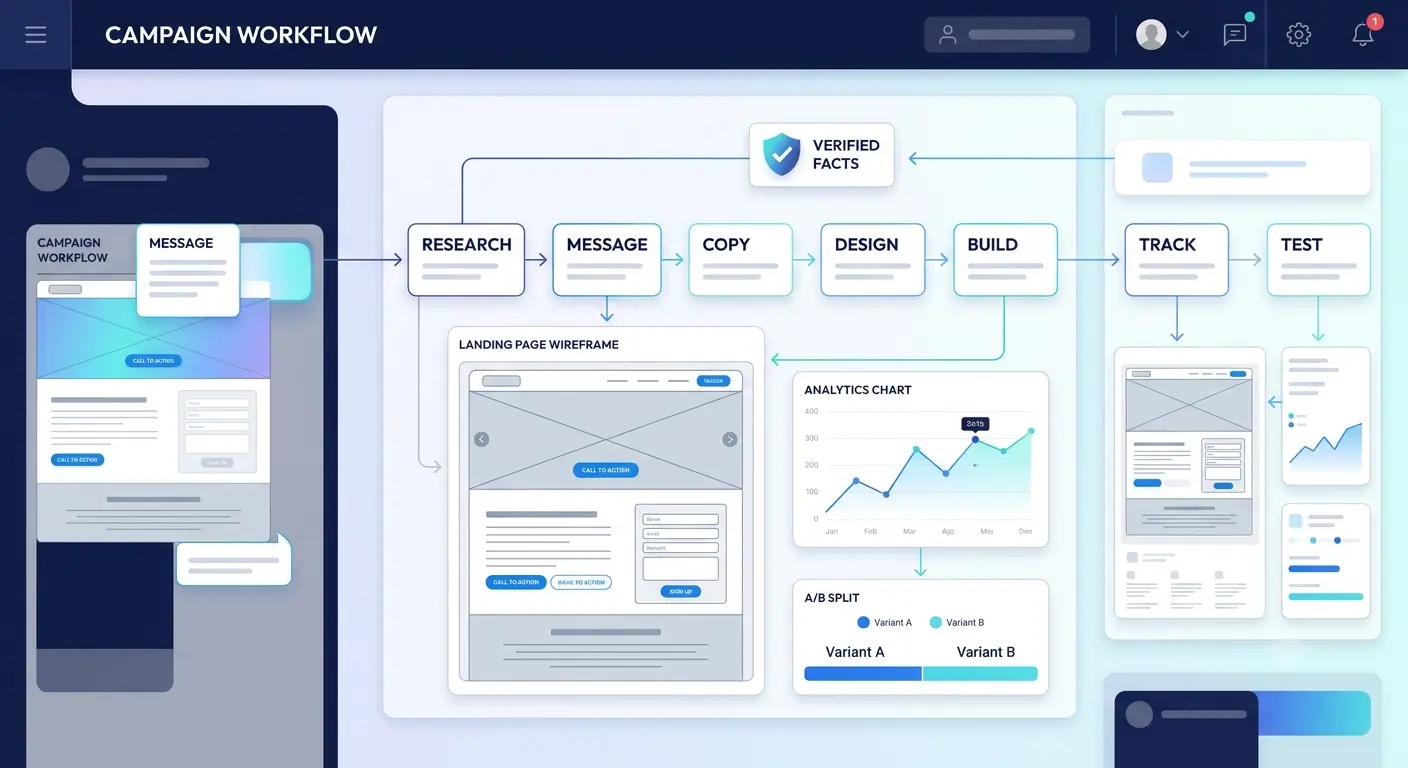

Digital marketing agencies do not need another list of vague commands to “write a post” or “analyze a campaign.” They need governed workflows that carry verified client context into research, production, reporting and implementation. This library is organized around the full client lifecycle, from qualification and access to SEO, paid media, content, conversion, reporting, retention and agency operations.
Quick Answer
AI prompts can help an agency structure research, draft deliverables, examine supplied data and prepare decisions. The useful ones name the client facts, source data, output format, privacy boundary and human reviewer. They do not create proof, replace platform expertise or make live changes. This guide provides 100 copy-ready prompts built for controlled agency delivery across SEO, PPC, content, CRO, reporting and growth.
Turn prompts into a safer agency workflow
Start with the fact-pack worksheet below, then compare this specialist guide with the broader AI Prompt Library. The hub helps teams choose the right prompt collection without mixing client contexts.
Explore the AI Prompt LibraryKey Takeaways
- Begin with a verified client fact pack, not a blank chat window.
- Keep client data separated and follow an approved privacy process.
- Use AI to prepare drafts and decisions, not to claim implementation or results.
- Require a named human reviewer for platform, legal, tracking and commercial work.
- Measure the approved downstream outcome, not the number of generated words.
Table of Contents
- Agency fact pack and privacy gate
- Prompt selection table
- Client discovery, qualification and onboarding (Prompts 01 to 10)
- SEO research and strategy (Prompts 11 to 20)
- Technical SEO, AEO and content quality (Prompts 21 to 30)
- PPC planning and optimization (Prompts 31 to 40)
- Content strategy and production (Prompts 41 to 50)
- Email, social and campaign distribution (Prompts 51 to 60)
- Website, landing page and CRO workflows (Prompts 61 to 70)
- Analytics, reporting and decision support (Prompts 71 to 80)
- Client communication, retention and scope control (Prompts 81 to 90)
- Agency growth, operations and profitability (Prompts 91 to 100)
- Worked example
- Common mistakes and verification checklist
- FAQs
Prepare the Agency Fact Pack Before Prompting
Create one approved fact pack per client and keep it separate from every other account. Record the source and last-verified date beside each fact. Never paste credentials, confidential contracts, raw customer records or personally identifiable information into an AI system unless the agency has an approved process for that tool and data type.
Business and audience
- Business model, markets and jurisdiction
- Offers, margins and capacity constraints
- Verified audience evidence and buying criteria
- Approved positioning and differentiators
Proof and restrictions
- Approved case studies, testimonials and claims
- Brand voice examples and prohibited language
- Legal, policy and regulatory review needs
- Known exclusions, risks and missing evidence
Delivery and measurement
- Signed scope, owners and approval process
- Primary conversion and qualified lead definition
- Metric definitions, sources and attribution limits
- Dependencies, access and implementation status
Privacy and security gate
- Approved AI tools and account types
- Allowed, redacted and prohibited data classes
- Retention, access and incident rules
- Client consent and contractual boundaries
For analytics work, remember that Google prohibits sending personally identifiable information to Google Analytics. Review the official PII avoidance guidance before defining parameters or campaign URLs. For advertising claims and endorsements in the United States, use the FTC endorsement guidance and obtain qualified review where the campaign or market requires it.
Prompt Selection Table
| Workflow | Prompt numbers | Start here when |
|---|---|---|
| Client discovery, qualification and onboarding | 01 to 10 | Before a sales or kickoff call. |
| SEO research and strategy | 11 to 20 | Before a content or page plan. |
| Technical SEO, AEO and content quality | 21 to 30 | For an indexing report or crawl cleanup. |
| PPC planning and optimization | 31 to 40 | Before Google Ads buildout. |
| Content strategy and production | 41 to 50 | For a quarterly content plan. |
| Email, social and campaign distribution | 51 to 60 | For a lead magnet, inquiry or onboarding flow. |
| Website, landing page and CRO workflows | 61 to 70 | Before redesign or page creation. |
| Analytics, reporting and decision support | 71 to 80 | At onboarding or reporting reset. |
| Client communication, retention and scope control | 81 to 90 | For weekly client communication. |
| Agency growth, operations and profitability | 91 to 100 | For positioning or business development planning. |
Expert Insight from Kanika Gupta
Kanika Gupta’s 18+ years in website and digital work point to a practical agency boundary: a draft becomes valuable only when it survives the handoff into a real page, campaign, tracking plan, CRM process or client decision. Prompt quality matters, but verified inputs, implementation ownership and post-launch measurement determine whether the work is usable.
Client discovery, qualification and onboarding
Build a discovery call agenda
Purpose: Prepare a first call that uncovers business goals, decision criteria and delivery risk.
When to use it: Before a sales or kickoff call.
Required inputs: Prospect website, known services, referral source, stated need, call length, agency capabilities.
You are supporting a digital marketing agency with a controlled, evidence-led workflow. Task: Build a discovery call agenda. Context and inputs to supply: Prospect website, known services, referral source, stated need, call length, agency capabilities. Create a timed agenda with opening, business model, audience, offer, past marketing, technology, measurement, stakeholders, budget process, risk and next steps. Separate questions that qualify fit from questions needed only after engagement. Return the work in a practical format with a short assumptions section, a list of missing inputs, and an implementation handoff that names the responsible role and next action. Do not present a recommendation as completed platform work. Use only the facts, proof and source material I provide. Do not invent customers, reviews, testimonials, statistics, results, certifications, prices, deadlines, legal requirements, medical claims, guarantees, awards, product features or scarcity. Mark missing information as [VERIFICATION REQUIRED]. Do not expose confidential client information or personal data. If an input appears sensitive, identify it and ask for an approved, redacted version before continuing.
Human review: Confirm that budget, authority and timing language matches the agency sales process.
Turn call notes into a verified brief
Purpose: Convert messy notes into a reliable handoff without filling gaps.
When to use it: Immediately after discovery or kickoff.
Required inputs: Redacted call notes, proposal, scope, stakeholder list.
You are supporting a digital marketing agency with a controlled, evidence-led workflow. Task: Turn call notes into a verified brief. Context and inputs to supply: Redacted call notes, proposal, scope, stakeholder list. Produce a one-page brief with confirmed facts, assumptions, open questions, goals, audience, offer, channels, constraints, approvals, dependencies and success measures. Tag every item Confirmed, Assumption or Verification Required. Return the work in a practical format with a short assumptions section, a list of missing inputs, and an implementation handoff that names the responsible role and next action. Do not present a recommendation as completed platform work. Use only the facts, proof and source material I provide. Do not invent customers, reviews, testimonials, statistics, results, certifications, prices, deadlines, legal requirements, medical claims, guarantees, awards, product features or scarcity. Mark missing information as [VERIFICATION REQUIRED]. Do not expose confidential client information or personal data. If an input appears sensitive, identify it and ask for an approved, redacted version before continuing.
Human review: The account lead must compare the brief with the recording or notes before circulation.
Score agency prospect fit
Purpose: Apply a consistent fit screen without pretending the score predicts success.
When to use it: Before investing in a proposal.
Required inputs: Ideal client profile, service capacity, prospect facts, red flags, required margins.
You are supporting a digital marketing agency with a controlled, evidence-led workflow. Task: Score agency prospect fit. Context and inputs to supply: Ideal client profile, service capacity, prospect facts, red flags, required margins. Create a transparent scoring rubric for service fit, urgency, access, budget process, measurement readiness, decision complexity and delivery risk. Show evidence for each score and list disqualifying unknowns separately. Return the work in a practical format with a short assumptions section, a list of missing inputs, and an implementation handoff that names the responsible role and next action. Do not present a recommendation as completed platform work. Use only the facts, proof and source material I provide. Do not invent customers, reviews, testimonials, statistics, results, certifications, prices, deadlines, legal requirements, medical claims, guarantees, awards, product features or scarcity. Mark missing information as [VERIFICATION REQUIRED]. Do not expose confidential client information or personal data. If an input appears sensitive, identify it and ask for an approved, redacted version before continuing.
Human review: A director should review high-risk or borderline opportunities.
Map stakeholders and approvals
Purpose: Prevent hidden approvers from delaying delivery.
When to use it: During onboarding.
Required inputs: Stakeholder names or role labels, responsibilities, meeting notes, procurement process.
You are supporting a digital marketing agency with a controlled, evidence-led workflow. Task: Map stakeholders and approvals. Context and inputs to supply: Stakeholder names or role labels, responsibilities, meeting notes, procurement process. Create a RACI-style approval map for strategy, creative, content, tracking, media spend, legal review and launch. Flag conflicting authority and missing owners. Return the work in a practical format with a short assumptions section, a list of missing inputs, and an implementation handoff that names the responsible role and next action. Do not present a recommendation as completed platform work. Use only the facts, proof and source material I provide. Do not invent customers, reviews, testimonials, statistics, results, certifications, prices, deadlines, legal requirements, medical claims, guarantees, awards, product features or scarcity. Mark missing information as [VERIFICATION REQUIRED]. Do not expose confidential client information or personal data. If an input appears sensitive, identify it and ask for an approved, redacted version before continuing.
Human review: Do not include personal data beyond approved business contact details.
Create a client fact pack
Purpose: Build the evidence base reused across prompts and deliverables.
When to use it: At the start of an engagement.
Required inputs: Approved positioning, offers, audience research, proof, brand rules, exclusions, source links.
You are supporting a digital marketing agency with a controlled, evidence-led workflow. Task: Create a client fact pack. Context and inputs to supply: Approved positioning, offers, audience research, proof, brand rules, exclusions, source links. Organize a fact pack with source references, last-verified dates, approved claims, prohibited claims, audience evidence, terminology, differentiators and unresolved questions. Add a change log template. Return the work in a practical format with a short assumptions section, a list of missing inputs, and an implementation handoff that names the responsible role and next action. Do not present a recommendation as completed platform work. Use only the facts, proof and source material I provide. Do not invent customers, reviews, testimonials, statistics, results, certifications, prices, deadlines, legal requirements, medical claims, guarantees, awards, product features or scarcity. Mark missing information as [VERIFICATION REQUIRED]. Do not expose confidential client information or personal data. If an input appears sensitive, identify it and ask for an approved, redacted version before continuing.
Human review: The client owner must approve the pack before it becomes reusable context.
Audit access and permissions
Purpose: Find missing account access before work is blocked.
When to use it: Before strategy or implementation begins.
Required inputs: Contracted channels, platform list, known owners, security policy.
You are supporting a digital marketing agency with a controlled, evidence-led workflow. Task: Audit access and permissions. Context and inputs to supply: Contracted channels, platform list, known owners, security policy. Create a least-privilege access checklist for website, DNS, CMS, analytics, tag manager, ad platforms, search tools, CRM, email and creative assets. Include owner, requested role, status and revocation step. Return the work in a practical format with a short assumptions section, a list of missing inputs, and an implementation handoff that names the responsible role and next action. Do not present a recommendation as completed platform work. Use only the facts, proof and source material I provide. Do not invent customers, reviews, testimonials, statistics, results, certifications, prices, deadlines, legal requirements, medical claims, guarantees, awards, product features or scarcity. Mark missing information as [VERIFICATION REQUIRED]. Do not expose confidential client information or personal data. If an input appears sensitive, identify it and ask for an approved, redacted version before continuing.
Human review: A technical owner should confirm roles against current platform documentation.
Plan kickoff decisions
Purpose: Turn kickoff into decisions rather than introductions.
When to use it: Before the kickoff meeting.
Required inputs: Signed scope, discovery brief, stakeholder map, open questions.
You are supporting a digital marketing agency with a controlled, evidence-led workflow. Task: Plan kickoff decisions. Context and inputs to supply: Signed scope, discovery brief, stakeholder map, open questions. Produce a kickoff decision log covering scope boundaries, priority audiences, primary conversion, measurement definitions, review cadence, approval SLA, launch dependencies and escalation path. Return the work in a practical format with a short assumptions section, a list of missing inputs, and an implementation handoff that names the responsible role and next action. Do not present a recommendation as completed platform work. Use only the facts, proof and source material I provide. Do not invent customers, reviews, testimonials, statistics, results, certifications, prices, deadlines, legal requirements, medical claims, guarantees, awards, product features or scarcity. Mark missing information as [VERIFICATION REQUIRED]. Do not expose confidential client information or personal data. If an input appears sensitive, identify it and ask for an approved, redacted version before continuing.
Human review: Compare every decision with the signed contract.
Define a measurement charter
Purpose: Agree what success means before reporting starts.
When to use it: During onboarding or a measurement reset.
Required inputs: Business goals, funnel stages, available data sources, sales cycle, baseline period.
You are supporting a digital marketing agency with a controlled, evidence-led workflow. Task: Define a measurement charter. Context and inputs to supply: Business goals, funnel stages, available data sources, sales cycle, baseline period. Draft a charter that distinguishes business outcomes, leading indicators, diagnostic metrics and guardrails. For each metric include definition, source, owner, reporting window and known limitation. Return the work in a practical format with a short assumptions section, a list of missing inputs, and an implementation handoff that names the responsible role and next action. Do not present a recommendation as completed platform work. Use only the facts, proof and source material I provide. Do not invent customers, reviews, testimonials, statistics, results, certifications, prices, deadlines, legal requirements, medical claims, guarantees, awards, product features or scarcity. Mark missing information as [VERIFICATION REQUIRED]. Do not expose confidential client information or personal data. If an input appears sensitive, identify it and ask for an approved, redacted version before continuing.
Human review: Analytics and commercial owners must agree on definitions and attribution limits.
Create a channel responsibility matrix
Purpose: Clarify who owns work across agency and client teams.
When to use it: For multi-channel retainers.
Required inputs: Scope, channel list, agency roles, client roles, vendor roles.
You are supporting a digital marketing agency with a controlled, evidence-led workflow. Task: Create a channel responsibility matrix. Context and inputs to supply: Scope, channel list, agency roles, client roles, vendor roles. Map strategy, production, approval, publishing, budget changes, QA, incident response and reporting ownership by channel. Highlight duplicated or unowned work. Return the work in a practical format with a short assumptions section, a list of missing inputs, and an implementation handoff that names the responsible role and next action. Do not present a recommendation as completed platform work. Use only the facts, proof and source material I provide. Do not invent customers, reviews, testimonials, statistics, results, certifications, prices, deadlines, legal requirements, medical claims, guarantees, awards, product features or scarcity. Mark missing information as [VERIFICATION REQUIRED]. Do not expose confidential client information or personal data. If an input appears sensitive, identify it and ask for an approved, redacted version before continuing.
Human review: Have each named team confirm its responsibilities.
Prepare a 30-day onboarding plan
Purpose: Sequence a realistic first month.
When to use it: After contract signature.
Required inputs: Scope, access status, meeting cadence, launch dates, capacity.
You are supporting a digital marketing agency with a controlled, evidence-led workflow. Task: Prepare a 30-day onboarding plan. Context and inputs to supply: Scope, access status, meeting cadence, launch dates, capacity. Create a week-by-week onboarding plan with dependencies, decision gates, client inputs, agency outputs, risks and acceptance criteria. Do not promise dates that the supplied dependencies cannot support. Return the work in a practical format with a short assumptions section, a list of missing inputs, and an implementation handoff that names the responsible role and next action. Do not present a recommendation as completed platform work. Use only the facts, proof and source material I provide. Do not invent customers, reviews, testimonials, statistics, results, certifications, prices, deadlines, legal requirements, medical claims, guarantees, awards, product features or scarcity. Mark missing information as [VERIFICATION REQUIRED]. Do not expose confidential client information or personal data. If an input appears sensitive, identify it and ask for an approved, redacted version before continuing.
Human review: The project manager must reconcile the plan with actual capacity.
SEO research and strategy
Build a search intent map
Purpose: Group verified queries by the decision each searcher is trying to make.
When to use it: Before a content or page plan.
Required inputs: Keyword export, localized SERP notes, existing URLs, business priorities.
You are supporting a digital marketing agency with a controlled, evidence-led workflow. Task: Build a search intent map. Context and inputs to supply: Keyword export, localized SERP notes, existing URLs, business priorities. Cluster queries by shared intent and overlapping results. Assign informational, commercial, transactional or navigational intent, a recommended page type and a confidence note. Flag clusters that may belong on one page. Return the work in a practical format with a short assumptions section, a list of missing inputs, and an implementation handoff that names the responsible role and next action. Do not present a recommendation as completed platform work. Use only the facts, proof and source material I provide. Do not invent customers, reviews, testimonials, statistics, results, certifications, prices, deadlines, legal requirements, medical claims, guarantees, awards, product features or scarcity. Mark missing information as [VERIFICATION REQUIRED]. Do not expose confidential client information or personal data. If an input appears sensitive, identify it and ask for an approved, redacted version before continuing.
Human review: Validate important clusters against live localized results.
Find keyword cannibalization risk
Purpose: Identify pages competing for the same intent before publishing.
When to use it: During planning or a traffic review.
Required inputs: URL inventory, query-page export, titles, target keywords.
You are supporting a digital marketing agency with a controlled, evidence-led workflow. Task: Find keyword cannibalization risk. Context and inputs to supply: URL inventory, query-page export, titles, target keywords. Find query clusters mapped to multiple URLs, distinguish healthy multiple visibility from conflicting intent, and recommend keep, differentiate, merge, redirect or monitor with evidence. Return the work in a practical format with a short assumptions section, a list of missing inputs, and an implementation handoff that names the responsible role and next action. Do not present a recommendation as completed platform work. Use only the facts, proof and source material I provide. Do not invent customers, reviews, testimonials, statistics, results, certifications, prices, deadlines, legal requirements, medical claims, guarantees, awards, product features or scarcity. Mark missing information as [VERIFICATION REQUIRED]. Do not expose confidential client information or personal data. If an input appears sensitive, identify it and ask for an approved, redacted version before continuing.
Human review: Do not merge or redirect without a manual content and backlink review.
Create an SEO content brief
Purpose: Turn search evidence into an original writer brief.
When to use it: After keyword and SERP research.
Required inputs: Primary query, supporting queries, SERP notes, client expertise, internal pages, sources.
You are supporting a digital marketing agency with a controlled, evidence-led workflow. Task: Create an SEO content brief. Context and inputs to supply: Primary query, supporting queries, SERP notes, client expertise, internal pages, sources. Create a brief with reader problem, intent, original angle, H1, H2 and H3 plan, answer-first passages, evidence needs, entities, internal links, conversion path and content to avoid copying. Return the work in a practical format with a short assumptions section, a list of missing inputs, and an implementation handoff that names the responsible role and next action. Do not present a recommendation as completed platform work. Use only the facts, proof and source material I provide. Do not invent customers, reviews, testimonials, statistics, results, certifications, prices, deadlines, legal requirements, medical claims, guarantees, awards, product features or scarcity. Mark missing information as [VERIFICATION REQUIRED]. Do not expose confidential client information or personal data. If an input appears sensitive, identify it and ask for an approved, redacted version before continuing.
Human review: An SEO strategist should verify intent and source quality.
Compare localized SERPs
Purpose: Find meaningful differences across target countries.
When to use it: For international campaigns.
Required inputs: Country-specific result notes, language conventions, client markets, service availability.
You are supporting a digital marketing agency with a controlled, evidence-led workflow. Task: Compare localized SERPs. Context and inputs to supply: Country-specific result notes, language conventions, client markets, service availability. Compare result types, local entities, terminology, commercial expectations and missing questions by country. Separate observed differences from hypotheses and propose one page, localized sections or separate pages. Return the work in a practical format with a short assumptions section, a list of missing inputs, and an implementation handoff that names the responsible role and next action. Do not present a recommendation as completed platform work. Use only the facts, proof and source material I provide. Do not invent customers, reviews, testimonials, statistics, results, certifications, prices, deadlines, legal requirements, medical claims, guarantees, awards, product features or scarcity. Mark missing information as [VERIFICATION REQUIRED]. Do not expose confidential client information or personal data. If an input appears sensitive, identify it and ask for an approved, redacted version before continuing.
Human review: Review with a native market expert where wording or regulation matters.
Prioritize an SEO backlog
Purpose: Rank work by commercial value and evidence, not volume alone.
When to use it: For quarterly planning.
Required inputs: Query data, page performance, conversion relevance, effort estimates, dependencies.
You are supporting a digital marketing agency with a controlled, evidence-led workflow. Task: Prioritize an SEO backlog. Context and inputs to supply: Query data, page performance, conversion relevance, effort estimates, dependencies. Score opportunities on intent, revenue relevance, current position, CTR opportunity, content gap, authority fit, effort and cannibalization risk. Show the formula and sensitivity to uncertain inputs. Return the work in a practical format with a short assumptions section, a list of missing inputs, and an implementation handoff that names the responsible role and next action. Do not present a recommendation as completed platform work. Use only the facts, proof and source material I provide. Do not invent customers, reviews, testimonials, statistics, results, certifications, prices, deadlines, legal requirements, medical claims, guarantees, awards, product features or scarcity. Mark missing information as [VERIFICATION REQUIRED]. Do not expose confidential client information or personal data. If an input appears sensitive, identify it and ask for an approved, redacted version before continuing.
Human review: A business owner should validate commercial weights.
Design a topic cluster
Purpose: Create a useful hub and support structure without thin pages.
When to use it: When strengthening an established service cluster.
Required inputs: Service page, existing articles, query clusters, buyer journey, internal link inventory.
You are supporting a digital marketing agency with a controlled, evidence-led workflow. Task: Design a topic cluster. Context and inputs to supply: Service page, existing articles, query clusters, buyer journey, internal link inventory. Propose a hub-and-spoke map where each page has a distinct job, target intent, onward commercial link and at least two relevant reverse-link sources. Reject spokes that lack distinct value. Return the work in a practical format with a short assumptions section, a list of missing inputs, and an implementation handoff that names the responsible role and next action. Do not present a recommendation as completed platform work. Use only the facts, proof and source material I provide. Do not invent customers, reviews, testimonials, statistics, results, certifications, prices, deadlines, legal requirements, medical claims, guarantees, awards, product features or scarcity. Mark missing information as [VERIFICATION REQUIRED]. Do not expose confidential client information or personal data. If an input appears sensitive, identify it and ask for an approved, redacted version before continuing.
Human review: Check the final map against the live site inventory.
Draft an internal linking plan
Purpose: Connect pages contextually for users and crawlers.
When to use it: Before publication or during a content refresh.
Required inputs: New page draft, existing page URLs, headings, target service page.
You are supporting a digital marketing agency with a controlled, evidence-led workflow. Task: Draft an internal linking plan. Context and inputs to supply: New page draft, existing page URLs, headings, target service page. Recommend natural outbound and reverse links with exact source, insertion location, sentence and varied anchor. Explain why each link helps the reader. Return the work in a practical format with a short assumptions section, a list of missing inputs, and an implementation handoff that names the responsible role and next action. Do not present a recommendation as completed platform work. Use only the facts, proof and source material I provide. Do not invent customers, reviews, testimonials, statistics, results, certifications, prices, deadlines, legal requirements, medical claims, guarantees, awards, product features or scarcity. Mark missing information as [VERIFICATION REQUIRED]. Do not expose confidential client information or personal data. If an input appears sensitive, identify it and ask for an approved, redacted version before continuing.
Human review: Verify every destination is live, canonical and relevant.
Plan a content refresh
Purpose: Improve a decaying page without erasing earned relevance.
When to use it: When performance or freshness has declined.
Required inputs: Current page, query trends, change log, competitor updates, conversion data.
You are supporting a digital marketing agency with a controlled, evidence-led workflow. Task: Plan a content refresh. Context and inputs to supply: Current page, query trends, change log, competitor updates, conversion data. Create a preserve, update, add and remove plan. Identify outdated claims, missing buyer questions, weak answer passages, internal-link gaps and metadata opportunities. Keep a record of material changes. Return the work in a practical format with a short assumptions section, a list of missing inputs, and an implementation handoff that names the responsible role and next action. Do not present a recommendation as completed platform work. Use only the facts, proof and source material I provide. Do not invent customers, reviews, testimonials, statistics, results, certifications, prices, deadlines, legal requirements, medical claims, guarantees, awards, product features or scarcity. Mark missing information as [VERIFICATION REQUIRED]. Do not expose confidential client information or personal data. If an input appears sensitive, identify it and ask for an approved, redacted version before continuing.
Human review: Compare pre-update rankings and conversions after an appropriate settling period.
Assess SERP competitor gaps
Purpose: Find information gain instead of cloning rankings.
When to use it: Before outlining a priority page.
Required inputs: Top-result notes, headings, sources, UX observations, client expertise.
You are supporting a digital marketing agency with a controlled, evidence-led workflow. Task: Assess SERP competitor gaps. Context and inputs to supply: Top-result notes, headings, sources, UX observations, client expertise. Compare intent coverage, evidence, examples, decision support, freshness, accessibility and conversion flow. List unanswered needs and propose an original angle grounded in supplied expertise. Return the work in a practical format with a short assumptions section, a list of missing inputs, and an implementation handoff that names the responsible role and next action. Do not present a recommendation as completed platform work. Use only the facts, proof and source material I provide. Do not invent customers, reviews, testimonials, statistics, results, certifications, prices, deadlines, legal requirements, medical claims, guarantees, awards, product features or scarcity. Mark missing information as [VERIFICATION REQUIRED]. Do not expose confidential client information or personal data. If an input appears sensitive, identify it and ask for an approved, redacted version before continuing.
Human review: Do not copy distinctive frameworks, wording or sequencing.
Create an SEO experiment hypothesis
Purpose: Define a test that can produce a useful decision.
When to use it: Before changing titles, templates or internal links.
Required inputs: Page set, baseline metrics, proposed change, expected mechanism, constraints.
You are supporting a digital marketing agency with a controlled, evidence-led workflow. Task: Create an SEO experiment hypothesis. Context and inputs to supply: Page set, baseline metrics, proposed change, expected mechanism, constraints. Write a hypothesis, primary metric, guardrails, test and control criteria, duration logic, confounders and decision rules. State when a before-and-after comparison would be too weak. Return the work in a practical format with a short assumptions section, a list of missing inputs, and an implementation handoff that names the responsible role and next action. Do not present a recommendation as completed platform work. Use only the facts, proof and source material I provide. Do not invent customers, reviews, testimonials, statistics, results, certifications, prices, deadlines, legal requirements, medical claims, guarantees, awards, product features or scarcity. Mark missing information as [VERIFICATION REQUIRED]. Do not expose confidential client information or personal data. If an input appears sensitive, identify it and ask for an approved, redacted version before continuing.
Human review: An analyst must confirm sample size and implementation consistency.
AI can prepare the plan. Implementation still decides the outcome.
Campaign structure, landing pages, SEO fixes, analytics, consent, CRM routing and QA need specialist execution in the client’s actual systems. KG Web Designer supports international teams with website strategy and digital marketing implementation that connects the plan to the working customer journey.
Review Digital Marketing ServicesTechnical SEO, AEO and content quality
Audit indexability inputs
Purpose: Classify URL issues before requesting indexing.
When to use it: For an indexing report or crawl cleanup.
Required inputs: URL sample, status codes, canonicals, robots directives, sitemap membership, page purpose.
You are supporting a digital marketing agency with a controlled, evidence-led workflow. Task: Audit indexability inputs. Context and inputs to supply: URL sample, status codes, canonicals, robots directives, sitemap membership, page purpose. Classify each URL as important canonical, new awaiting indexing, redirect or stale, low-value generated, or intentionally noindexed. Recommend the next diagnostic check for each class. Return the work in a practical format with a short assumptions section, a list of missing inputs, and an implementation handoff that names the responsible role and next action. Do not present a recommendation as completed platform work. Use only the facts, proof and source material I provide. Do not invent customers, reviews, testimonials, statistics, results, certifications, prices, deadlines, legal requirements, medical claims, guarantees, awards, product features or scarcity. Mark missing information as [VERIFICATION REQUIRED]. Do not expose confidential client information or personal data. If an input appears sensitive, identify it and ask for an approved, redacted version before continuing.
Human review: Use URL Inspection and server evidence before making index decisions.
Review canonical consistency
Purpose: Find conflicting canonical signals.
When to use it: During a technical audit or migration.
Required inputs: URL list, redirects, canonical tags, sitemap URLs, internal links.
You are supporting a digital marketing agency with a controlled, evidence-led workflow. Task: Review canonical consistency. Context and inputs to supply: URL list, redirects, canonical tags, sitemap URLs, internal links. Identify mismatches among final URL, canonical, redirects, sitemap and internal links. Produce a correction table with the preferred canonical and affected signal. Return the work in a practical format with a short assumptions section, a list of missing inputs, and an implementation handoff that names the responsible role and next action. Do not present a recommendation as completed platform work. Use only the facts, proof and source material I provide. Do not invent customers, reviews, testimonials, statistics, results, certifications, prices, deadlines, legal requirements, medical claims, guarantees, awards, product features or scarcity. Mark missing information as [VERIFICATION REQUIRED]. Do not expose confidential client information or personal data. If an input appears sensitive, identify it and ask for an approved, redacted version before continuing.
Human review: A developer should test changes in staging and confirm variants.
Create a redirect mapping brief
Purpose: Plan one-to-one redirects with content relevance.
When to use it: Before a redesign or URL change.
Required inputs: Old URLs, proposed URLs, traffic, backlinks, content summaries.
You are supporting a digital marketing agency with a controlled, evidence-led workflow. Task: Create a redirect mapping brief. Context and inputs to supply: Old URLs, proposed URLs, traffic, backlinks, content summaries. Map each old URL to the closest equivalent, flag no-match cases, preserve query intent and list chains or loops to avoid. Do not recommend redirecting every removed page to the homepage. Return the work in a practical format with a short assumptions section, a list of missing inputs, and an implementation handoff that names the responsible role and next action. Do not present a recommendation as completed platform work. Use only the facts, proof and source material I provide. Do not invent customers, reviews, testimonials, statistics, results, certifications, prices, deadlines, legal requirements, medical claims, guarantees, awards, product features or scarcity. Mark missing information as [VERIFICATION REQUIRED]. Do not expose confidential client information or personal data. If an input appears sensitive, identify it and ask for an approved, redacted version before continuing.
Human review: Manually review high-traffic and linked URLs before deployment.
Audit structured data eligibility
Purpose: Check whether markup matches visible content and current rules.
When to use it: Before adding or updating schema.
Required inputs: Page type, visible content, current markup, official documentation links.
You are supporting a digital marketing agency with a controlled, evidence-led workflow. Task: Audit structured data eligibility. Context and inputs to supply: Page type, visible content, current markup, official documentation links. List eligible schema types, required and recommended properties, visible-content mismatches and duplicate plugin output risks. Recommend no markup where eligibility is unclear. Return the work in a practical format with a short assumptions section, a list of missing inputs, and an implementation handoff that names the responsible role and next action. Do not present a recommendation as completed platform work. Use only the facts, proof and source material I provide. Do not invent customers, reviews, testimonials, statistics, results, certifications, prices, deadlines, legal requirements, medical claims, guarantees, awards, product features or scarcity. Mark missing information as [VERIFICATION REQUIRED]. Do not expose confidential client information or personal data. If an input appears sensitive, identify it and ask for an approved, redacted version before continuing.
Human review: Validate with official tools and current documentation.
Create answer-first passages
Purpose: Improve extractable answers without flattening nuance.
When to use it: When a page has clear buyer questions.
Required inputs: Question set, verified facts, jurisdiction or market, page goal.
You are supporting a digital marketing agency with a controlled, evidence-led workflow. Task: Create answer-first passages. Context and inputs to supply: Question set, verified facts, jurisdiction or market, page goal. Draft concise direct answers followed by conditions, evidence and next steps. Keep each answer self-contained and avoid guarantees about rankings or AI citations. Return the work in a practical format with a short assumptions section, a list of missing inputs, and an implementation handoff that names the responsible role and next action. Do not present a recommendation as completed platform work. Use only the facts, proof and source material I provide. Do not invent customers, reviews, testimonials, statistics, results, certifications, prices, deadlines, legal requirements, medical claims, guarantees, awards, product features or scarcity. Mark missing information as [VERIFICATION REQUIRED]. Do not expose confidential client information or personal data. If an input appears sensitive, identify it and ask for an approved, redacted version before continuing.
Human review: A subject expert must check accuracy and exceptions.
Review AI-assisted content quality
Purpose: Find commodity sections, unsupported claims and prompt residue.
When to use it: Before publication.
Required inputs: Draft article, source list, client fact pack, audience intent.
You are supporting a digital marketing agency with a controlled, evidence-led workflow. Task: Review AI-assisted content quality. Context and inputs to supply: Draft article, source list, client fact pack, audience intent. Audit originality, factual support, specificity, repetition, generic openings, false experience, source proximity, heading logic and useful next actions. Return exact revision instructions, not a rewritten article. Return the work in a practical format with a short assumptions section, a list of missing inputs, and an implementation handoff that names the responsible role and next action. Do not present a recommendation as completed platform work. Use only the facts, proof and source material I provide. Do not invent customers, reviews, testimonials, statistics, results, certifications, prices, deadlines, legal requirements, medical claims, guarantees, awards, product features or scarcity. Mark missing information as [VERIFICATION REQUIRED]. Do not expose confidential client information or personal data. If an input appears sensitive, identify it and ask for an approved, redacted version before continuing.
Human review: A human editor remains responsible for the final copy.
Build an entity and source map
Purpose: Connect claims to authoritative evidence.
When to use it: For research-heavy content.
Required inputs: Outline, factual claims, candidate sources, target market.
You are supporting a digital marketing agency with a controlled, evidence-led workflow. Task: Build an entity and source map. Context and inputs to supply: Outline, factual claims, candidate sources, target market. Create a table of claim, named entity, required source type, current source, jurisdiction, freshness date and citation location. Flag weak secondary sourcing. Return the work in a practical format with a short assumptions section, a list of missing inputs, and an implementation handoff that names the responsible role and next action. Do not present a recommendation as completed platform work. Use only the facts, proof and source material I provide. Do not invent customers, reviews, testimonials, statistics, results, certifications, prices, deadlines, legal requirements, medical claims, guarantees, awards, product features or scarcity. Mark missing information as [VERIFICATION REQUIRED]. Do not expose confidential client information or personal data. If an input appears sensitive, identify it and ask for an approved, redacted version before continuing.
Human review: Open and verify every consequential source before publishing.
Audit crawlable navigation
Purpose: Check whether important content is reachable through meaningful links.
When to use it: For a new hub or navigation change.
Required inputs: Navigation structure, URL inventory, crawl output, priority pages.
You are supporting a digital marketing agency with a controlled, evidence-led workflow. Task: Audit crawlable navigation. Context and inputs to supply: Navigation structure, URL inventory, crawl output, priority pages. Find orphan or deeply buried pages, weak generic anchors, duplicate paths and irrelevant sitewide links. Propose contextual routes from established pages. Return the work in a practical format with a short assumptions section, a list of missing inputs, and an implementation handoff that names the responsible role and next action. Do not present a recommendation as completed platform work. Use only the facts, proof and source material I provide. Do not invent customers, reviews, testimonials, statistics, results, certifications, prices, deadlines, legal requirements, medical claims, guarantees, awards, product features or scarcity. Mark missing information as [VERIFICATION REQUIRED]. Do not expose confidential client information or personal data. If an input appears sensitive, identify it and ask for an approved, redacted version before continuing.
Human review: Confirm changes do not overload menus or footers.
Review heading and semantic structure
Purpose: Repair document hierarchy for readers and assistive technology.
When to use it: During on-page QA.
Required inputs: Rendered HTML, page outline, template output.
You are supporting a digital marketing agency with a controlled, evidence-led workflow. Task: Review heading and semantic structure. Context and inputs to supply: Rendered HTML, page outline, template output. Report H1 count, skipped levels, duplicated titles, empty headings, misleading labels and sections that need lists, tables or prose. Provide a corrected outline. Return the work in a practical format with a short assumptions section, a list of missing inputs, and an implementation handoff that names the responsible role and next action. Do not present a recommendation as completed platform work. Use only the facts, proof and source material I provide. Do not invent customers, reviews, testimonials, statistics, results, certifications, prices, deadlines, legal requirements, medical claims, guarantees, awards, product features or scarcity. Mark missing information as [VERIFICATION REQUIRED]. Do not expose confidential client information or personal data. If an input appears sensitive, identify it and ask for an approved, redacted version before continuing.
Human review: Test the rendered page, not only editor content.
Create an SEO launch checklist
Purpose: Coordinate content, technical and measurement readiness.
When to use it: Before a page or site launch.
Required inputs: Final URL, metadata, content, redirects, schema, analytics plan, owners.
You are supporting a digital marketing agency with a controlled, evidence-led workflow. Task: Create an SEO launch checklist. Context and inputs to supply: Final URL, metadata, content, redirects, schema, analytics plan, owners. Create a go or no-go checklist for crawlability, canonical, status, metadata, headings, links, accessibility, performance, tracking, forms, consent, sitemap and post-launch monitoring. Return the work in a practical format with a short assumptions section, a list of missing inputs, and an implementation handoff that names the responsible role and next action. Do not present a recommendation as completed platform work. Use only the facts, proof and source material I provide. Do not invent customers, reviews, testimonials, statistics, results, certifications, prices, deadlines, legal requirements, medical claims, guarantees, awards, product features or scarcity. Mark missing information as [VERIFICATION REQUIRED]. Do not expose confidential client information or personal data. If an input appears sensitive, identify it and ask for an approved, redacted version before continuing.
Human review: Assign an owner and evidence field to every check.
PPC planning and optimization
Turn a business brief into a paid search plan
Purpose: Translate goals into a campaign structure without inventing economics.
When to use it: Before Google Ads buildout.
Required inputs: Offer, markets, approved budget, margins, conversion action, audience, exclusions.
You are supporting a digital marketing agency with a controlled, evidence-led workflow. Task: Turn a business brief into a paid search plan. Context and inputs to supply: Offer, markets, approved budget, margins, conversion action, audience, exclusions. Propose campaign themes, keyword intent, landing-page mapping, negative themes, bidding prerequisites, location settings, conversion requirements and launch risks. Mark missing economics. Return the work in a practical format with a short assumptions section, a list of missing inputs, and an implementation handoff that names the responsible role and next action. Do not present a recommendation as completed platform work. Use only the facts, proof and source material I provide. Do not invent customers, reviews, testimonials, statistics, results, certifications, prices, deadlines, legal requirements, medical claims, guarantees, awards, product features or scarcity. Mark missing information as [VERIFICATION REQUIRED]. Do not expose confidential client information or personal data. If an input appears sensitive, identify it and ask for an approved, redacted version before continuing.
Human review: A paid media lead must validate current platform options.
Group keywords into ad groups
Purpose: Create tightly related groups based on intent and destination.
When to use it: During search campaign planning.
Required inputs: Keyword list with match types, landing pages, markets, exclusions.
You are supporting a digital marketing agency with a controlled, evidence-led workflow. Task: Group keywords into ad groups. Context and inputs to supply: Keyword list with match types, landing pages, markets, exclusions. Group terms by shared intent and landing page, flag mixed-intent groups, propose negatives and identify keywords that need a different page. Do not estimate performance without supplied data. Return the work in a practical format with a short assumptions section, a list of missing inputs, and an implementation handoff that names the responsible role and next action. Do not present a recommendation as completed platform work. Use only the facts, proof and source material I provide. Do not invent customers, reviews, testimonials, statistics, results, certifications, prices, deadlines, legal requirements, medical claims, guarantees, awards, product features or scarcity. Mark missing information as [VERIFICATION REQUIRED]. Do not expose confidential client information or personal data. If an input appears sensitive, identify it and ask for an approved, redacted version before continuing.
Human review: Review search results and actual query language.
Draft responsive search ad assets
Purpose: Create claim-safe asset options.
When to use it: After message and landing page approval.
Required inputs: Approved offer facts, differentiators, keywords, limits, prohibited claims, destination.
You are supporting a digital marketing agency with a controlled, evidence-led workflow. Task: Draft responsive search ad assets. Context and inputs to supply: Approved offer facts, differentiators, keywords, limits, prohibited claims, destination. Draft distinct headline and description options within supplied current limits. Label the fact source for each claim and avoid fabricated urgency. Map assets to intent themes. Return the work in a practical format with a short assumptions section, a list of missing inputs, and an implementation handoff that names the responsible role and next action. Do not present a recommendation as completed platform work. Use only the facts, proof and source material I provide. Do not invent customers, reviews, testimonials, statistics, results, certifications, prices, deadlines, legal requirements, medical claims, guarantees, awards, product features or scarcity. Mark missing information as [VERIFICATION REQUIRED]. Do not expose confidential client information or personal data. If an input appears sensitive, identify it and ask for an approved, redacted version before continuing.
Human review: Check character counts and policy before upload.
Audit search terms
Purpose: Separate waste, discovery and intent drift.
When to use it: On a regular optimization cadence.
Required inputs: Search-term export, match types, conversions, cost, campaign goals, exclusions.
You are supporting a digital marketing agency with a controlled, evidence-led workflow. Task: Audit search terms. Context and inputs to supply: Search-term export, match types, conversions, cost, campaign goals, exclusions. Classify terms as relevant, negative candidate, new keyword candidate, ambiguous or landing-page mismatch. Show evidence and avoid recommending negatives from too little data. Return the work in a practical format with a short assumptions section, a list of missing inputs, and an implementation handoff that names the responsible role and next action. Do not present a recommendation as completed platform work. Use only the facts, proof and source material I provide. Do not invent customers, reviews, testimonials, statistics, results, certifications, prices, deadlines, legal requirements, medical claims, guarantees, awards, product features or scarcity. Mark missing information as [VERIFICATION REQUIRED]. Do not expose confidential client information or personal data. If an input appears sensitive, identify it and ask for an approved, redacted version before continuing.
Human review: A practitioner must review context before adding negatives.
Diagnose budget pacing
Purpose: Explain pacing against the approved plan.
When to use it: Mid-month or before a budget change.
Required inputs: Budget, spend by day, remaining days, planned events, conversion lag, platform notes.
You are supporting a digital marketing agency with a controlled, evidence-led workflow. Task: Diagnose budget pacing. Context and inputs to supply: Budget, spend by day, remaining days, planned events, conversion lag, platform notes. Calculate supplied pacing, show simple projection scenarios, identify timing or allocation issues and list decisions. Do not recommend extra spend without commercial context. Return the work in a practical format with a short assumptions section, a list of missing inputs, and an implementation handoff that names the responsible role and next action. Do not present a recommendation as completed platform work. Use only the facts, proof and source material I provide. Do not invent customers, reviews, testimonials, statistics, results, certifications, prices, deadlines, legal requirements, medical claims, guarantees, awards, product features or scarcity. Mark missing information as [VERIFICATION REQUIRED]. Do not expose confidential client information or personal data. If an input appears sensitive, identify it and ask for an approved, redacted version before continuing.
Human review: Finance and account owners should approve budget changes.
Review conversion tracking readiness
Purpose: Find measurement gaps before optimization.
When to use it: Before launch or bidding changes.
Required inputs: Conversion list, tag evidence, CRM stages, consent setup, test results.
You are supporting a digital marketing agency with a controlled, evidence-led workflow. Task: Review conversion tracking readiness. Context and inputs to supply: Conversion list, tag evidence, CRM stages, consent setup, test results. Map primary and secondary actions, deduplication, values, attribution limits, offline import needs, consent and QA evidence. Flag button clicks incorrectly treated as completed leads. Return the work in a practical format with a short assumptions section, a list of missing inputs, and an implementation handoff that names the responsible role and next action. Do not present a recommendation as completed platform work. Use only the facts, proof and source material I provide. Do not invent customers, reviews, testimonials, statistics, results, certifications, prices, deadlines, legal requirements, medical claims, guarantees, awards, product features or scarcity. Mark missing information as [VERIFICATION REQUIRED]. Do not expose confidential client information or personal data. If an input appears sensitive, identify it and ask for an approved, redacted version before continuing.
Human review: A tracking specialist must test successful and failed paths.
Create a landing-page message-match audit
Purpose: Check continuity from query and ad to page.
When to use it: When clicks do not become qualified actions.
Required inputs: Search query, ad assets, landing-page copy, offer, audience, device screenshots.
You are supporting a digital marketing agency with a controlled, evidence-led workflow. Task: Create a landing-page message-match audit. Context and inputs to supply: Search query, ad assets, landing-page copy, offer, audience, device screenshots. Compare promise, terminology, proof, objections, CTA and post-click expectation. Return mismatches ranked by likely friction, without claiming causation. Return the work in a practical format with a short assumptions section, a list of missing inputs, and an implementation handoff that names the responsible role and next action. Do not present a recommendation as completed platform work. Use only the facts, proof and source material I provide. Do not invent customers, reviews, testimonials, statistics, results, certifications, prices, deadlines, legal requirements, medical claims, guarantees, awards, product features or scarcity. Mark missing information as [VERIFICATION REQUIRED]. Do not expose confidential client information or personal data. If an input appears sensitive, identify it and ask for an approved, redacted version before continuing.
Human review: Use analytics and user evidence before assigning cause.
Plan a controlled ads experiment
Purpose: Turn an optimization idea into a clean test.
When to use it: Before changing bids, creative or landing pages.
Required inputs: Hypothesis, baseline, eligible campaign, primary metric, guardrails, constraints.
You are supporting a digital marketing agency with a controlled, evidence-led workflow. Task: Plan a controlled ads experiment. Context and inputs to supply: Hypothesis, baseline, eligible campaign, primary metric, guardrails, constraints. Define one variable, control, treatment, success metric, guardrails, runtime considerations and decision rules. List changes that would contaminate the test. Return the work in a practical format with a short assumptions section, a list of missing inputs, and an implementation handoff that names the responsible role and next action. Do not present a recommendation as completed platform work. Use only the facts, proof and source material I provide. Do not invent customers, reviews, testimonials, statistics, results, certifications, prices, deadlines, legal requirements, medical claims, guarantees, awards, product features or scarcity. Mark missing information as [VERIFICATION REQUIRED]. Do not expose confidential client information or personal data. If an input appears sensitive, identify it and ask for an approved, redacted version before continuing.
Human review: Follow current platform experiment documentation.
Prepare a PPC creative brief
Purpose: Give designers evidence and constraints.
When to use it: Before ad creative production.
Required inputs: Audience evidence, offer, placements, brand rules, approved claims, assets, CTA.
You are supporting a digital marketing agency with a controlled, evidence-led workflow. Task: Prepare a PPC creative brief. Context and inputs to supply: Audience evidence, offer, placements, brand rules, approved claims, assets, CTA. Create a brief with objective, audience moment, single message, proof, format variants, safe areas, accessibility, disclaimers, CTA and review checklist. Return the work in a practical format with a short assumptions section, a list of missing inputs, and an implementation handoff that names the responsible role and next action. Do not present a recommendation as completed platform work. Use only the facts, proof and source material I provide. Do not invent customers, reviews, testimonials, statistics, results, certifications, prices, deadlines, legal requirements, medical claims, guarantees, awards, product features or scarcity. Mark missing information as [VERIFICATION REQUIRED]. Do not expose confidential client information or personal data. If an input appears sensitive, identify it and ask for an approved, redacted version before continuing.
Human review: Legal or policy review may be required for regulated claims.
Write a paid media optimization log
Purpose: Make account changes auditable.
When to use it: After an optimization session.
Required inputs: Change export, analyst notes, reason, expected effect, approval record.
You are supporting a digital marketing agency with a controlled, evidence-led workflow. Task: Write a paid media optimization log. Context and inputs to supply: Change export, analyst notes, reason, expected effect, approval record. Create a dated log of change, evidence, owner, affected entity, hypothesis, risk, approval and review date. Separate facts from analyst judgment. Return the work in a practical format with a short assumptions section, a list of missing inputs, and an implementation handoff that names the responsible role and next action. Do not present a recommendation as completed platform work. Use only the facts, proof and source material I provide. Do not invent customers, reviews, testimonials, statistics, results, certifications, prices, deadlines, legal requirements, medical claims, guarantees, awards, product features or scarcity. Mark missing information as [VERIFICATION REQUIRED]. Do not expose confidential client information or personal data. If an input appears sensitive, identify it and ask for an approved, redacted version before continuing.
Human review: Compare the log with platform change history.
Content strategy and production
Create a client editorial strategy
Purpose: Connect content to buyer decisions and commercial pages.
When to use it: For a quarterly content plan.
Required inputs: Business goals, audience research, services, sales questions, existing content, channel data.
You are supporting a digital marketing agency with a controlled, evidence-led workflow. Task: Create a client editorial strategy. Context and inputs to supply: Business goals, audience research, services, sales questions, existing content, channel data. Propose themes by funnel stage, distinct page jobs, evidence sources, distribution, internal links and conversion path. Exclude topics that lack relevance or proof. Return the work in a practical format with a short assumptions section, a list of missing inputs, and an implementation handoff that names the responsible role and next action. Do not present a recommendation as completed platform work. Use only the facts, proof and source material I provide. Do not invent customers, reviews, testimonials, statistics, results, certifications, prices, deadlines, legal requirements, medical claims, guarantees, awards, product features or scarcity. Mark missing information as [VERIFICATION REQUIRED]. Do not expose confidential client information or personal data. If an input appears sensitive, identify it and ask for an approved, redacted version before continuing.
Human review: A strategist should confirm resource and subject-expert availability.
Turn sales objections into content
Purpose: Use real objections without overstating frequency.
When to use it: When sales has usable call evidence.
Required inputs: Redacted objection notes, deal stages, approved responses, service pages.
You are supporting a digital marketing agency with a controlled, evidence-led workflow. Task: Turn sales objections into content. Context and inputs to supply: Redacted objection notes, deal stages, approved responses, service pages. Group objections by decision stage, distinguish misconception from valid concern, and propose content formats with source evidence and intended next action. Return the work in a practical format with a short assumptions section, a list of missing inputs, and an implementation handoff that names the responsible role and next action. Do not present a recommendation as completed platform work. Use only the facts, proof and source material I provide. Do not invent customers, reviews, testimonials, statistics, results, certifications, prices, deadlines, legal requirements, medical claims, guarantees, awards, product features or scarcity. Mark missing information as [VERIFICATION REQUIRED]. Do not expose confidential client information or personal data. If an input appears sensitive, identify it and ask for an approved, redacted version before continuing.
Human review: Sales leadership must verify that themes reflect actual conversations.
Build a case study evidence plan
Purpose: Collect proof before writing the story.
When to use it: At project completion or interview planning.
Required inputs: Permission status, project scope, baseline, deliverables, available outcomes, stakeholder contacts.
You are supporting a digital marketing agency with a controlled, evidence-led workflow. Task: Build a case study evidence plan. Context and inputs to supply: Permission status, project scope, baseline, deliverables, available outcomes, stakeholder contacts. Create an interview and evidence checklist covering context, constraints, decisions, implementation and verified outcomes. Mark claims that require written client approval. Return the work in a practical format with a short assumptions section, a list of missing inputs, and an implementation handoff that names the responsible role and next action. Do not present a recommendation as completed platform work. Use only the facts, proof and source material I provide. Do not invent customers, reviews, testimonials, statistics, results, certifications, prices, deadlines, legal requirements, medical claims, guarantees, awards, product features or scarcity. Mark missing information as [VERIFICATION REQUIRED]. Do not expose confidential client information or personal data. If an input appears sensitive, identify it and ask for an approved, redacted version before continuing.
Human review: Never publish a client name, metric or quote without permission.
Draft a case study outline
Purpose: Structure verified evidence into a useful narrative.
When to use it: After evidence collection.
Required inputs: Approved interview notes, metrics, project files, limitations.
You are supporting a digital marketing agency with a controlled, evidence-led workflow. Task: Draft a case study outline. Context and inputs to supply: Approved interview notes, metrics, project files, limitations. Create an outline with situation, decision criteria, approach, implementation, evidence, limitations and next steps. Keep agency contribution precise and avoid implying sole causation. Return the work in a practical format with a short assumptions section, a list of missing inputs, and an implementation handoff that names the responsible role and next action. Do not present a recommendation as completed platform work. Use only the facts, proof and source material I provide. Do not invent customers, reviews, testimonials, statistics, results, certifications, prices, deadlines, legal requirements, medical claims, guarantees, awards, product features or scarcity. Mark missing information as [VERIFICATION REQUIRED]. Do not expose confidential client information or personal data. If an input appears sensitive, identify it and ask for an approved, redacted version before continuing.
Human review: The client and project lead should approve factual statements.
Create a thought leadership brief
Purpose: Develop a defensible point of view from expertise.
When to use it: For founder or expert content.
Required inputs: Expert notes, market evidence, counterarguments, examples, sources.
You are supporting a digital marketing agency with a controlled, evidence-led workflow. Task: Create a thought leadership brief. Context and inputs to supply: Expert notes, market evidence, counterarguments, examples, sources. Build a brief with central thesis, what the expert observes, evidence, boundary conditions, strongest counterargument and practical implications. Remove generic advice. Return the work in a practical format with a short assumptions section, a list of missing inputs, and an implementation handoff that names the responsible role and next action. Do not present a recommendation as completed platform work. Use only the facts, proof and source material I provide. Do not invent customers, reviews, testimonials, statistics, results, certifications, prices, deadlines, legal requirements, medical claims, guarantees, awards, product features or scarcity. Mark missing information as [VERIFICATION REQUIRED]. Do not expose confidential client information or personal data. If an input appears sensitive, identify it and ask for an approved, redacted version before continuing.
Human review: The named expert must review and own the viewpoint.
Repurpose one source into channel-native assets
Purpose: Adapt without cloning or losing context.
When to use it: After a strong source asset is approved.
Required inputs: Source article or webinar, audience by channel, current format limits, CTA.
You are supporting a digital marketing agency with a controlled, evidence-led workflow. Task: Repurpose one source into channel-native assets. Context and inputs to supply: Source article or webinar, audience by channel, current format limits, CTA. Create a repurposing map for email, LinkedIn, short video and sales enablement. For each, specify the unique angle, source excerpt to paraphrase, format and destination. Return the work in a practical format with a short assumptions section, a list of missing inputs, and an implementation handoff that names the responsible role and next action. Do not present a recommendation as completed platform work. Use only the facts, proof and source material I provide. Do not invent customers, reviews, testimonials, statistics, results, certifications, prices, deadlines, legal requirements, medical claims, guarantees, awards, product features or scarcity. Mark missing information as [VERIFICATION REQUIRED]. Do not expose confidential client information or personal data. If an input appears sensitive, identify it and ask for an approved, redacted version before continuing.
Human review: Verify every asset stays faithful to the source.
Create an editorial fact-check sheet
Purpose: Make verification part of production.
When to use it: Before final edit.
Required inputs: Draft, source list, interview notes, approved claims.
You are supporting a digital marketing agency with a controlled, evidence-led workflow. Task: Create an editorial fact-check sheet. Context and inputs to supply: Draft, source list, interview notes, approved claims. Extract consequential claims into a table with source, quote or data location, date, jurisdiction, owner and status. Flag vague superlatives and implied guarantees. Return the work in a practical format with a short assumptions section, a list of missing inputs, and an implementation handoff that names the responsible role and next action. Do not present a recommendation as completed platform work. Use only the facts, proof and source material I provide. Do not invent customers, reviews, testimonials, statistics, results, certifications, prices, deadlines, legal requirements, medical claims, guarantees, awards, product features or scarcity. Mark missing information as [VERIFICATION REQUIRED]. Do not expose confidential client information or personal data. If an input appears sensitive, identify it and ask for an approved, redacted version before continuing.
Human review: A human fact checker must open sources and resolve flags.
Write a conversion-aware article brief
Purpose: Balance reader value with a relevant next step.
When to use it: For commercial informational content.
Required inputs: Search intent, buyer stage, service fit, proof, internal pages, objections.
You are supporting a digital marketing agency with a controlled, evidence-led workflow. Task: Write a conversion-aware article brief. Context and inputs to supply: Search intent, buyer stage, service fit, proof, internal pages, objections. Plan answer-first opening, decision sections, examples, implementation limits, contextual internal links and three distinct CTAs. Ensure the article can stand alone without the sale. Return the work in a practical format with a short assumptions section, a list of missing inputs, and an implementation handoff that names the responsible role and next action. Do not present a recommendation as completed platform work. Use only the facts, proof and source material I provide. Do not invent customers, reviews, testimonials, statistics, results, certifications, prices, deadlines, legal requirements, medical claims, guarantees, awards, product features or scarcity. Mark missing information as [VERIFICATION REQUIRED]. Do not expose confidential client information or personal data. If an input appears sensitive, identify it and ask for an approved, redacted version before continuing.
Human review: Review CTA relevance and avoid forced service references.
Audit content for brand voice
Purpose: Compare language with approved examples rather than adjectives alone.
When to use it: During editing.
Required inputs: Draft, approved sample copy, voice rules, banned terms, audience.
You are supporting a digital marketing agency with a controlled, evidence-led workflow. Task: Audit content for brand voice. Context and inputs to supply: Draft, approved sample copy, voice rules, banned terms, audience. Identify sentences that diverge from approved syntax, vocabulary, warmth and certainty. Suggest targeted revisions and explain each change using the supplied examples. Return the work in a practical format with a short assumptions section, a list of missing inputs, and an implementation handoff that names the responsible role and next action. Do not present a recommendation as completed platform work. Use only the facts, proof and source material I provide. Do not invent customers, reviews, testimonials, statistics, results, certifications, prices, deadlines, legal requirements, medical claims, guarantees, awards, product features or scarcity. Mark missing information as [VERIFICATION REQUIRED]. Do not expose confidential client information or personal data. If an input appears sensitive, identify it and ask for an approved, redacted version before continuing.
Human review: A brand owner makes the final voice decision.
Create a content update log
Purpose: Document why and how a page changed.
When to use it: After substantial refresh work.
Required inputs: Old copy, new copy, research notes, date, editor, URLs.
You are supporting a digital marketing agency with a controlled, evidence-led workflow. Task: Create a content update log. Context and inputs to supply: Old copy, new copy, research notes, date, editor, URLs. Summarize preserved sections, additions, removals, corrected claims, new sources, changed links and expected purpose. Include a rollback reference. Return the work in a practical format with a short assumptions section, a list of missing inputs, and an implementation handoff that names the responsible role and next action. Do not present a recommendation as completed platform work. Use only the facts, proof and source material I provide. Do not invent customers, reviews, testimonials, statistics, results, certifications, prices, deadlines, legal requirements, medical claims, guarantees, awards, product features or scarcity. Mark missing information as [VERIFICATION REQUIRED]. Do not expose confidential client information or personal data. If an input appears sensitive, identify it and ask for an approved, redacted version before continuing.
Human review: Store the log with the editorial record.
Email, social and campaign distribution
Plan an email nurture sequence
Purpose: Move a known audience through a real decision path.
When to use it: For a lead magnet, inquiry or onboarding flow.
Required inputs: Audience source, consent basis, offer, objections, proof, send constraints, CTA.
You are supporting a digital marketing agency with a controlled, evidence-led workflow. Task: Plan an email nurture sequence. Context and inputs to supply: Audience source, consent basis, offer, objections, proof, send constraints, CTA. Create a sequence map with purpose, trigger, delay, subject direction, key message, evidence, CTA and suppression rule. Do not create false urgency. Return the work in a practical format with a short assumptions section, a list of missing inputs, and an implementation handoff that names the responsible role and next action. Do not present a recommendation as completed platform work. Use only the facts, proof and source material I provide. Do not invent customers, reviews, testimonials, statistics, results, certifications, prices, deadlines, legal requirements, medical claims, guarantees, awards, product features or scarcity. Mark missing information as [VERIFICATION REQUIRED]. Do not expose confidential client information or personal data. If an input appears sensitive, identify it and ask for an approved, redacted version before continuing.
Human review: Confirm consent, unsubscribe and jurisdiction requirements.
Draft a client newsletter
Purpose: Turn verified developments into a useful update.
When to use it: For a recurring newsletter.
Required inputs: Approved news, links, audience, brand voice, CTA.
You are supporting a digital marketing agency with a controlled, evidence-led workflow. Task: Draft a client newsletter. Context and inputs to supply: Approved news, links, audience, brand voice, CTA. Draft subject options, preview text and sections that explain what changed, why it matters and what to do. Keep claims linked to sources. Return the work in a practical format with a short assumptions section, a list of missing inputs, and an implementation handoff that names the responsible role and next action. Do not present a recommendation as completed platform work. Use only the facts, proof and source material I provide. Do not invent customers, reviews, testimonials, statistics, results, certifications, prices, deadlines, legal requirements, medical claims, guarantees, awards, product features or scarcity. Mark missing information as [VERIFICATION REQUIRED]. Do not expose confidential client information or personal data. If an input appears sensitive, identify it and ask for an approved, redacted version before continuing.
Human review: Check every link and time-sensitive detail.
Create a LinkedIn campaign plan
Purpose: Build a coherent professional series, not isolated posts.
When to use it: For authority or lead-generation campaigns.
Required inputs: Audience roles, business goal, expert themes, proof, posting capacity, destination.
You are supporting a digital marketing agency with a controlled, evidence-led workflow. Task: Create a LinkedIn campaign plan. Context and inputs to supply: Audience roles, business goal, expert themes, proof, posting capacity, destination. Plan a four-week series with post job, hook, evidence, format, discussion question and onward path. Avoid fabricated personal stories. Return the work in a practical format with a short assumptions section, a list of missing inputs, and an implementation handoff that names the responsible role and next action. Do not present a recommendation as completed platform work. Use only the facts, proof and source material I provide. Do not invent customers, reviews, testimonials, statistics, results, certifications, prices, deadlines, legal requirements, medical claims, guarantees, awards, product features or scarcity. Mark missing information as [VERIFICATION REQUIRED]. Do not expose confidential client information or personal data. If an input appears sensitive, identify it and ask for an approved, redacted version before continuing.
Human review: The expert should approve personal perspective and examples.
Draft a social proof request
Purpose: Ask for genuine feedback without scripting praise.
When to use it: After a legitimate customer milestone.
Required inputs: Relationship context, permission process, review destination, prohibited incentives.
You are supporting a digital marketing agency with a controlled, evidence-led workflow. Task: Draft a social proof request. Context and inputs to supply: Relationship context, permission process, review destination, prohibited incentives. Draft a respectful request that makes participation optional, asks for honest experience and explains how feedback may be used. Do not suggest wording that the customer did not choose. Return the work in a practical format with a short assumptions section, a list of missing inputs, and an implementation handoff that names the responsible role and next action. Do not present a recommendation as completed platform work. Use only the facts, proof and source material I provide. Do not invent customers, reviews, testimonials, statistics, results, certifications, prices, deadlines, legal requirements, medical claims, guarantees, awards, product features or scarcity. Mark missing information as [VERIFICATION REQUIRED]. Do not expose confidential client information or personal data. If an input appears sensitive, identify it and ask for an approved, redacted version before continuing.
Human review: Review platform and local endorsement rules.
Create a campaign UTM governance plan
Purpose: Keep attribution labels consistent across teams.
When to use it: Before multi-channel distribution.
Required inputs: Channel list, campaign taxonomy, analytics rules, existing naming.
You are supporting a digital marketing agency with a controlled, evidence-led workflow. Task: Create a campaign UTM governance plan. Context and inputs to supply: Channel list, campaign taxonomy, analytics rules, existing naming. Define lowercase naming, allowed values, source-medium rules, campaign and content patterns, QA examples and ownership. Prohibit personal data in parameters. Return the work in a practical format with a short assumptions section, a list of missing inputs, and an implementation handoff that names the responsible role and next action. Do not present a recommendation as completed platform work. Use only the facts, proof and source material I provide. Do not invent customers, reviews, testimonials, statistics, results, certifications, prices, deadlines, legal requirements, medical claims, guarantees, awards, product features or scarcity. Mark missing information as [VERIFICATION REQUIRED]. Do not expose confidential client information or personal data. If an input appears sensitive, identify it and ask for an approved, redacted version before continuing.
Human review: Test final URLs and redirects before launch.
Plan webinar promotion
Purpose: Coordinate content, registration and follow-up.
When to use it: Before an educational event.
Required inputs: Topic, speaker facts, audience, date, platform, capacity, approved outcomes.
You are supporting a digital marketing agency with a controlled, evidence-led workflow. Task: Plan webinar promotion. Context and inputs to supply: Topic, speaker facts, audience, date, platform, capacity, approved outcomes. Create a promotion timeline for landing page, email, organic social, partner outreach, reminders and follow-up. Include registration data needs and no-show handling. Return the work in a practical format with a short assumptions section, a list of missing inputs, and an implementation handoff that names the responsible role and next action. Do not present a recommendation as completed platform work. Use only the facts, proof and source material I provide. Do not invent customers, reviews, testimonials, statistics, results, certifications, prices, deadlines, legal requirements, medical claims, guarantees, awards, product features or scarcity. Mark missing information as [VERIFICATION REQUIRED]. Do not expose confidential client information or personal data. If an input appears sensitive, identify it and ask for an approved, redacted version before continuing.
Human review: Verify dates, speaker claims and privacy notices.
Create a channel adaptation matrix
Purpose: Translate one campaign idea across channels.
When to use it: When several teams share a campaign.
Required inputs: Core message, audience, assets, channels, objectives, restrictions.
You are supporting a digital marketing agency with a controlled, evidence-led workflow. Task: Create a channel adaptation matrix. Context and inputs to supply: Core message, audience, assets, channels, objectives, restrictions. For each channel, define audience state, format, length, CTA, proof, tracking and what must not be copied verbatim. Keep the same verified promise. Return the work in a practical format with a short assumptions section, a list of missing inputs, and an implementation handoff that names the responsible role and next action. Do not present a recommendation as completed platform work. Use only the facts, proof and source material I provide. Do not invent customers, reviews, testimonials, statistics, results, certifications, prices, deadlines, legal requirements, medical claims, guarantees, awards, product features or scarcity. Mark missing information as [VERIFICATION REQUIRED]. Do not expose confidential client information or personal data. If an input appears sensitive, identify it and ask for an approved, redacted version before continuing.
Human review: Channel owners should check current specifications.
Audit promotional claims
Purpose: Identify claims that need substantiation or disclosure.
When to use it: Before campaign approval.
Required inputs: All copy variants, evidence, testimonials, influencer relationships, markets.
You are supporting a digital marketing agency with a controlled, evidence-led workflow. Task: Audit promotional claims. Context and inputs to supply: All copy variants, evidence, testimonials, influencer relationships, markets. List objective claims, implied claims, comparisons, endorsements, results language and urgency. Map each to evidence or required review and rewrite unsupported versions conservatively. Return the work in a practical format with a short assumptions section, a list of missing inputs, and an implementation handoff that names the responsible role and next action. Do not present a recommendation as completed platform work. Use only the facts, proof and source material I provide. Do not invent customers, reviews, testimonials, statistics, results, certifications, prices, deadlines, legal requirements, medical claims, guarantees, awards, product features or scarcity. Mark missing information as [VERIFICATION REQUIRED]. Do not expose confidential client information or personal data. If an input appears sensitive, identify it and ask for an approved, redacted version before continuing.
Human review: Qualified legal review may be necessary by jurisdiction.
Write an outreach personalization brief
Purpose: Use public business context without pretending a relationship.
When to use it: For account-based outreach.
Required inputs: Target company facts, source URLs, service relevance, sender identity, opt-out process.
You are supporting a digital marketing agency with a controlled, evidence-led workflow. Task: Write an outreach personalization brief. Context and inputs to supply: Target company facts, source URLs, service relevance, sender identity, opt-out process. Create a short brief with verified trigger, relevance hypothesis, respectful opener, value point and low-pressure next step. Do not infer private pain or fabricate familiarity. Return the work in a practical format with a short assumptions section, a list of missing inputs, and an implementation handoff that names the responsible role and next action. Do not present a recommendation as completed platform work. Use only the facts, proof and source material I provide. Do not invent customers, reviews, testimonials, statistics, results, certifications, prices, deadlines, legal requirements, medical claims, guarantees, awards, product features or scarcity. Mark missing information as [VERIFICATION REQUIRED]. Do not expose confidential client information or personal data. If an input appears sensitive, identify it and ask for an approved, redacted version before continuing.
Human review: Check source freshness and outreach compliance.
Create a campaign postmortem
Purpose: Capture lessons without rewriting history.
When to use it: After a completed campaign.
Required inputs: Plan, change log, final data, incidents, stakeholder notes.
You are supporting a digital marketing agency with a controlled, evidence-led workflow. Task: Create a campaign postmortem. Context and inputs to supply: Plan, change log, final data, incidents, stakeholder notes. Compare objective, execution and outcomes; separate correlation from cause; identify what to repeat, stop, test or investigate. Include data limitations and unresolved questions. Return the work in a practical format with a short assumptions section, a list of missing inputs, and an implementation handoff that names the responsible role and next action. Do not present a recommendation as completed platform work. Use only the facts, proof and source material I provide. Do not invent customers, reviews, testimonials, statistics, results, certifications, prices, deadlines, legal requirements, medical claims, guarantees, awards, product features or scarcity. Mark missing information as [VERIFICATION REQUIRED]. Do not expose confidential client information or personal data. If an input appears sensitive, identify it and ask for an approved, redacted version before continuing.
Human review: Review with channel and analytics owners.
Website, landing page and CRO workflows
Create a website conversion brief
Purpose: Connect page decisions to a specific visitor action.
When to use it: Before redesign or page creation.
Required inputs: Audience, traffic sources, offer, proof, objections, current data, technical constraints.
You are supporting a digital marketing agency with a controlled, evidence-led workflow. Task: Create a website conversion brief. Context and inputs to supply: Audience, traffic sources, offer, proof, objections, current data, technical constraints. Define page job, visitor state, primary and secondary actions, evidence hierarchy, content modules, measurement and implementation dependencies. Return the work in a practical format with a short assumptions section, a list of missing inputs, and an implementation handoff that names the responsible role and next action. Do not present a recommendation as completed platform work. Use only the facts, proof and source material I provide. Do not invent customers, reviews, testimonials, statistics, results, certifications, prices, deadlines, legal requirements, medical claims, guarantees, awards, product features or scarcity. Mark missing information as [VERIFICATION REQUIRED]. Do not expose confidential client information or personal data. If an input appears sensitive, identify it and ask for an approved, redacted version before continuing.
Human review: A strategist and developer should review feasibility.
Map a service-page decision journey
Purpose: Organize information around buyer questions.
When to use it: When creating or improving a service page.
Required inputs: Service facts, audience roles, buying criteria, objections, process, proof.
You are supporting a digital marketing agency with a controlled, evidence-led workflow. Task: Map a service-page decision journey. Context and inputs to supply: Service facts, audience roles, buying criteria, objections, process, proof. Sequence problem recognition, fit, approach, proof, process, risk, FAQs and next step. Mark missing evidence rather than filling it with generic claims. Return the work in a practical format with a short assumptions section, a list of missing inputs, and an implementation handoff that names the responsible role and next action. Do not present a recommendation as completed platform work. Use only the facts, proof and source material I provide. Do not invent customers, reviews, testimonials, statistics, results, certifications, prices, deadlines, legal requirements, medical claims, guarantees, awards, product features or scarcity. Mark missing information as [VERIFICATION REQUIRED]. Do not expose confidential client information or personal data. If an input appears sensitive, identify it and ask for an approved, redacted version before continuing.
Human review: Check that sales and delivery describe the same service.
Audit a landing page for message match
Purpose: Find where campaign context breaks on the page.
When to use it: Before or after paid traffic launch.
Required inputs: Ad or email copy, search term, landing-page screenshot and text, conversion goal.
You are supporting a digital marketing agency with a controlled, evidence-led workflow. Task: Audit a landing page for message match. Context and inputs to supply: Ad or email copy, search term, landing-page screenshot and text, conversion goal. Compare intent, promise, terminology, visual priority, proof, CTA, form and next-step expectation. Rank mismatches and propose targeted tests. Return the work in a practical format with a short assumptions section, a list of missing inputs, and an implementation handoff that names the responsible role and next action. Do not present a recommendation as completed platform work. Use only the facts, proof and source material I provide. Do not invent customers, reviews, testimonials, statistics, results, certifications, prices, deadlines, legal requirements, medical claims, guarantees, awards, product features or scarcity. Mark missing information as [VERIFICATION REQUIRED]. Do not expose confidential client information or personal data. If an input appears sensitive, identify it and ask for an approved, redacted version before continuing.
Human review: Use behavioral data before declaring any issue causal.
Design a form qualification strategy
Purpose: Collect enough information without unnecessary friction or sensitive data.
When to use it: For lead-generation forms.
Required inputs: Sales routing needs, CRM fields, audience, privacy rules, current drop-off data.
You are supporting a digital marketing agency with a controlled, evidence-led workflow. Task: Design a form qualification strategy. Context and inputs to supply: Sales routing needs, CRM fields, audience, privacy rules, current drop-off data. Classify fields as essential now, useful later or remove. Propose conditional logic, validation, confirmation and routing. Explain the business reason for each retained field. Return the work in a practical format with a short assumptions section, a list of missing inputs, and an implementation handoff that names the responsible role and next action. Do not present a recommendation as completed platform work. Use only the facts, proof and source material I provide. Do not invent customers, reviews, testimonials, statistics, results, certifications, prices, deadlines, legal requirements, medical claims, guarantees, awards, product features or scarcity. Mark missing information as [VERIFICATION REQUIRED]. Do not expose confidential client information or personal data. If an input appears sensitive, identify it and ask for an approved, redacted version before continuing.
Human review: Privacy and sales operations must approve the final form.
Create a CRO research plan
Purpose: Prioritize evidence before test ideas.
When to use it: When conversion performance is unclear.
Required inputs: Analytics, recordings or surveys available, traffic, page goal, constraints.
You are supporting a digital marketing agency with a controlled, evidence-led workflow. Task: Create a CRO research plan. Context and inputs to supply: Analytics, recordings or surveys available, traffic, page goal, constraints. Plan quantitative review, qualitative research, technical checks and customer evidence. For each method, state question, sample limitation, owner and decision it informs. Return the work in a practical format with a short assumptions section, a list of missing inputs, and an implementation handoff that names the responsible role and next action. Do not present a recommendation as completed platform work. Use only the facts, proof and source material I provide. Do not invent customers, reviews, testimonials, statistics, results, certifications, prices, deadlines, legal requirements, medical claims, guarantees, awards, product features or scarcity. Mark missing information as [VERIFICATION REQUIRED]. Do not expose confidential client information or personal data. If an input appears sensitive, identify it and ask for an approved, redacted version before continuing.
Human review: Obtain consent and protect user data.
Turn research into test hypotheses
Purpose: Create specific, evidence-linked experiments.
When to use it: After CRO research.
Required inputs: Observed issue, evidence, affected users, page, metric, constraints.
You are supporting a digital marketing agency with a controlled, evidence-led workflow. Task: Turn research into test hypotheses. Context and inputs to supply: Observed issue, evidence, affected users, page, metric, constraints. Write hypotheses in because, change, expected behavior form. Rank by evidence strength, impact reach, effort and risk. Reject cosmetic ideas without a mechanism. Return the work in a practical format with a short assumptions section, a list of missing inputs, and an implementation handoff that names the responsible role and next action. Do not present a recommendation as completed platform work. Use only the facts, proof and source material I provide. Do not invent customers, reviews, testimonials, statistics, results, certifications, prices, deadlines, legal requirements, medical claims, guarantees, awards, product features or scarcity. Mark missing information as [VERIFICATION REQUIRED]. Do not expose confidential client information or personal data. If an input appears sensitive, identify it and ask for an approved, redacted version before continuing.
Human review: An analyst should review sample and guardrails.
Plan website analytics events
Purpose: Specify meaningful interactions and success conditions.
When to use it: Before GTM or GA4 implementation.
Required inputs: Conversion journey, forms, buttons, CRM states, business definitions.
You are supporting a digital marketing agency with a controlled, evidence-led workflow. Task: Plan website analytics events. Context and inputs to supply: Conversion journey, forms, buttons, CRM states, business definitions. Create an event specification with name, trigger, parameters, success condition, exclusions, PII risk, data layer need and QA test. Distinguish clicks from completed outcomes. Return the work in a practical format with a short assumptions section, a list of missing inputs, and an implementation handoff that names the responsible role and next action. Do not present a recommendation as completed platform work. Use only the facts, proof and source material I provide. Do not invent customers, reviews, testimonials, statistics, results, certifications, prices, deadlines, legal requirements, medical claims, guarantees, awards, product features or scarcity. Mark missing information as [VERIFICATION REQUIRED]. Do not expose confidential client information or personal data. If an input appears sensitive, identify it and ask for an approved, redacted version before continuing.
Human review: A tracking specialist must validate in debug tools and reports.
Create a CRM handoff specification
Purpose: Connect website leads to accountable follow-up.
When to use it: Before integration work.
Required inputs: Form fields, CRM objects, routing rules, consent, sales stages, error handling.
You are supporting a digital marketing agency with a controlled, evidence-led workflow. Task: Create a CRM handoff specification. Context and inputs to supply: Form fields, CRM objects, routing rules, consent, sales stages, error handling. Map field names, validation, deduplication, owner assignment, source capture, alerts, failure logging and reconciliation. Include test cases for success and failure. Return the work in a practical format with a short assumptions section, a list of missing inputs, and an implementation handoff that names the responsible role and next action. Do not present a recommendation as completed platform work. Use only the facts, proof and source material I provide. Do not invent customers, reviews, testimonials, statistics, results, certifications, prices, deadlines, legal requirements, medical claims, guarantees, awards, product features or scarcity. Mark missing information as [VERIFICATION REQUIRED]. Do not expose confidential client information or personal data. If an input appears sensitive, identify it and ask for an approved, redacted version before continuing.
Human review: Technical and revenue operations owners must sign off.
Review mobile conversion flow
Purpose: Find mobile-specific obstacles without guessing from desktop.
When to use it: During page QA or optimization.
Required inputs: Mobile screenshots, device data, forms, page speed evidence, interaction recordings.
You are supporting a digital marketing agency with a controlled, evidence-led workflow. Task: Review mobile conversion flow. Context and inputs to supply: Mobile screenshots, device data, forms, page speed evidence, interaction recordings. Audit content priority, tap targets, form input, sticky elements, keyboard behavior, visual stability and next-step clarity. Separate observed defects from hypotheses. Return the work in a practical format with a short assumptions section, a list of missing inputs, and an implementation handoff that names the responsible role and next action. Do not present a recommendation as completed platform work. Use only the facts, proof and source material I provide. Do not invent customers, reviews, testimonials, statistics, results, certifications, prices, deadlines, legal requirements, medical claims, guarantees, awards, product features or scarcity. Mark missing information as [VERIFICATION REQUIRED]. Do not expose confidential client information or personal data. If an input appears sensitive, identify it and ask for an approved, redacted version before continuing.
Human review: Test on representative real devices.
Create a prelaunch website QA plan
Purpose: Coordinate content, design, development and measurement checks.
When to use it: Before publishing a campaign page or site.
Required inputs: Staging URL, requirements, device list, integrations, tracking plan.
You are supporting a digital marketing agency with a controlled, evidence-led workflow. Task: Create a prelaunch website QA plan. Context and inputs to supply: Staging URL, requirements, device list, integrations, tracking plan. Create role-based tests for links, forms, validation, emails, CRM, analytics, consent, accessibility, responsive layout, performance, SEO and rollback. Include evidence and owner fields. Return the work in a practical format with a short assumptions section, a list of missing inputs, and an implementation handoff that names the responsible role and next action. Do not present a recommendation as completed platform work. Use only the facts, proof and source material I provide. Do not invent customers, reviews, testimonials, statistics, results, certifications, prices, deadlines, legal requirements, medical claims, guarantees, awards, product features or scarcity. Mark missing information as [VERIFICATION REQUIRED]. Do not expose confidential client information or personal data. If an input appears sensitive, identify it and ask for an approved, redacted version before continuing.
Human review: Do not launch until critical failures are resolved and retested.
Analytics, reporting and decision support
Build a monthly reporting brief
Purpose: Define the report before building slides.
When to use it: At onboarding or reporting reset.
Required inputs: Business goals, scope, KPI definitions, audience, data sources, cadence.
You are supporting a digital marketing agency with a controlled, evidence-led workflow. Task: Build a monthly reporting brief. Context and inputs to supply: Business goals, scope, KPI definitions, audience, data sources, cadence. Specify audience decisions, reporting window, metrics, comparisons, segments, annotations, limitations and action owners. Exclude vanity metrics without a decision use. Return the work in a practical format with a short assumptions section, a list of missing inputs, and an implementation handoff that names the responsible role and next action. Do not present a recommendation as completed platform work. Use only the facts, proof and source material I provide. Do not invent customers, reviews, testimonials, statistics, results, certifications, prices, deadlines, legal requirements, medical claims, guarantees, awards, product features or scarcity. Mark missing information as [VERIFICATION REQUIRED]. Do not expose confidential client information or personal data. If an input appears sensitive, identify it and ask for an approved, redacted version before continuing.
Human review: Client and analytics owners must agree on definitions.
Check data source consistency
Purpose: Find disagreements before writing a narrative.
When to use it: Before monthly reporting.
Required inputs: Exports from analytics, ads, CRM, ecommerce or call tracking, date windows, timezone.
You are supporting a digital marketing agency with a controlled, evidence-led workflow. Task: Check data source consistency. Context and inputs to supply: Exports from analytics, ads, CRM, ecommerce or call tracking, date windows, timezone. Compare windows, timezones, attribution, currency, filters, deduplication and conversion definitions. Produce a discrepancy log and stop narrative conclusions where conflicts remain. Return the work in a practical format with a short assumptions section, a list of missing inputs, and an implementation handoff that names the responsible role and next action. Do not present a recommendation as completed platform work. Use only the facts, proof and source material I provide. Do not invent customers, reviews, testimonials, statistics, results, certifications, prices, deadlines, legal requirements, medical claims, guarantees, awards, product features or scarcity. Mark missing information as [VERIFICATION REQUIRED]. Do not expose confidential client information or personal data. If an input appears sensitive, identify it and ask for an approved, redacted version before continuing.
Human review: Resolve material mismatches with source owners.
Write an executive performance summary
Purpose: Turn verified results into decisions, not decoration.
When to use it: After data QA.
Required inputs: Approved metrics, targets, prior period, annotations, scope, limitations.
You are supporting a digital marketing agency with a controlled, evidence-led workflow. Task: Write an executive performance summary. Context and inputs to supply: Approved metrics, targets, prior period, annotations, scope, limitations. Draft a concise summary of outcome, change, contributing evidence, uncertainty, next action and owner. Keep correlation separate from causation. Return the work in a practical format with a short assumptions section, a list of missing inputs, and an implementation handoff that names the responsible role and next action. Do not present a recommendation as completed platform work. Use only the facts, proof and source material I provide. Do not invent customers, reviews, testimonials, statistics, results, certifications, prices, deadlines, legal requirements, medical claims, guarantees, awards, product features or scarcity. Mark missing information as [VERIFICATION REQUIRED]. Do not expose confidential client information or personal data. If an input appears sensitive, identify it and ask for an approved, redacted version before continuing.
Human review: The analyst must verify every number against the final report.
Diagnose a traffic change
Purpose: Build a structured investigation tree.
When to use it: When traffic rises or falls unexpectedly.
Required inputs: Settled date ranges, channel, page, query, country, device and technical data.
You are supporting a digital marketing agency with a controlled, evidence-led workflow. Task: Diagnose a traffic change. Context and inputs to supply: Settled date ranges, channel, page, query, country, device and technical data. Compare magnitude and scope, then test demand, ranking, CTR, tracking, site change, seasonality and mix hypotheses. Rank checks by evidence and do not select a cause prematurely. Return the work in a practical format with a short assumptions section, a list of missing inputs, and an implementation handoff that names the responsible role and next action. Do not present a recommendation as completed platform work. Use only the facts, proof and source material I provide. Do not invent customers, reviews, testimonials, statistics, results, certifications, prices, deadlines, legal requirements, medical claims, guarantees, awards, product features or scarcity. Mark missing information as [VERIFICATION REQUIRED]. Do not expose confidential client information or personal data. If an input appears sensitive, identify it and ask for an approved, redacted version before continuing.
Human review: Use settled data and record reporting delays.
Analyze query and page CTR
Purpose: Find snippets that underperform their actual context.
When to use it: For Search Console optimization.
Required inputs: Query-page-country-device export, positions, impressions, clicks, titles, result notes.
You are supporting a digital marketing agency with a controlled, evidence-led workflow. Task: Analyze query and page CTR. Context and inputs to supply: Query-page-country-device export, positions, impressions, clicks, titles, result notes. Prioritize meaningful impressions at comparable positions, split brand and nonbrand, inspect intent match and propose title or description hypotheses. Avoid universal CTR benchmarks. Return the work in a practical format with a short assumptions section, a list of missing inputs, and an implementation handoff that names the responsible role and next action. Do not present a recommendation as completed platform work. Use only the facts, proof and source material I provide. Do not invent customers, reviews, testimonials, statistics, results, certifications, prices, deadlines, legal requirements, medical claims, guarantees, awards, product features or scarcity. Mark missing information as [VERIFICATION REQUIRED]. Do not expose confidential client information or personal data. If an input appears sensitive, identify it and ask for an approved, redacted version before continuing.
Human review: Review live SERPs before editing metadata.
Create a lead quality report
Purpose: Connect marketing volume to sales outcomes.
When to use it: When lead count alone is misleading.
Required inputs: CRM stages, source data, qualification rules, revenue windows, missing-data notes.
You are supporting a digital marketing agency with a controlled, evidence-led workflow. Task: Create a lead quality report. Context and inputs to supply: CRM stages, source data, qualification rules, revenue windows, missing-data notes. Report lead volume, accepted leads, stage progression, disqualification reasons and source quality with denominators. Flag sample and attribution limitations. Return the work in a practical format with a short assumptions section, a list of missing inputs, and an implementation handoff that names the responsible role and next action. Do not present a recommendation as completed platform work. Use only the facts, proof and source material I provide. Do not invent customers, reviews, testimonials, statistics, results, certifications, prices, deadlines, legal requirements, medical claims, guarantees, awards, product features or scarcity. Mark missing information as [VERIFICATION REQUIRED]. Do not expose confidential client information or personal data. If an input appears sensitive, identify it and ask for an approved, redacted version before continuing.
Human review: Sales operations must verify stage hygiene.
Plan an anomaly response
Purpose: Define what to check when a dashboard changes suddenly.
When to use it: Before or during an incident.
Required inputs: Metric, normal range, reporting latency, platform status, recent changes, owners.
You are supporting a digital marketing agency with a controlled, evidence-led workflow. Task: Plan an anomaly response. Context and inputs to supply: Metric, normal range, reporting latency, platform status, recent changes, owners. Create a triage sequence for data freshness, tagging, site availability, spend, demand and real performance. Include escalation and communication thresholds. Return the work in a practical format with a short assumptions section, a list of missing inputs, and an implementation handoff that names the responsible role and next action. Do not present a recommendation as completed platform work. Use only the facts, proof and source material I provide. Do not invent customers, reviews, testimonials, statistics, results, certifications, prices, deadlines, legal requirements, medical claims, guarantees, awards, product features or scarcity. Mark missing information as [VERIFICATION REQUIRED]. Do not expose confidential client information or personal data. If an input appears sensitive, identify it and ask for an approved, redacted version before continuing.
Human review: Confirm the anomaly persists after normal latency.
Create a campaign forecast scenario
Purpose: Show ranges without presenting a prediction as fact.
When to use it: For budget or capacity planning.
Required inputs: Historical rates, budget options, constraints, seasonality, sales capacity.
You are supporting a digital marketing agency with a controlled, evidence-led workflow. Task: Create a campaign forecast scenario. Context and inputs to supply: Historical rates, budget options, constraints, seasonality, sales capacity. Calculate conservative, base and stretch scenarios from supplied inputs, expose formulas and sensitivity, and list assumptions that most change the result. Return the work in a practical format with a short assumptions section, a list of missing inputs, and an implementation handoff that names the responsible role and next action. Do not present a recommendation as completed platform work. Use only the facts, proof and source material I provide. Do not invent customers, reviews, testimonials, statistics, results, certifications, prices, deadlines, legal requirements, medical claims, guarantees, awards, product features or scarcity. Mark missing information as [VERIFICATION REQUIRED]. Do not expose confidential client information or personal data. If an input appears sensitive, identify it and ask for an approved, redacted version before continuing.
Human review: Finance and channel owners must approve assumptions.
Build a QBR decision agenda
Purpose: Use quarterly review time for choices and trade-offs.
When to use it: Before a quarterly business review.
Required inputs: Quarter results, roadmap, risks, client priorities, open decisions.
You are supporting a digital marketing agency with a controlled, evidence-led workflow. Task: Build a QBR decision agenda. Context and inputs to supply: Quarter results, roadmap, risks, client priorities, open decisions. Create an agenda with outcome review, learning, unresolved risks, strategic options, required decisions, owners and next-quarter measures. Move routine status items to an appendix. Return the work in a practical format with a short assumptions section, a list of missing inputs, and an implementation handoff that names the responsible role and next action. Do not present a recommendation as completed platform work. Use only the facts, proof and source material I provide. Do not invent customers, reviews, testimonials, statistics, results, certifications, prices, deadlines, legal requirements, medical claims, guarantees, awards, product features or scarcity. Mark missing information as [VERIFICATION REQUIRED]. Do not expose confidential client information or personal data. If an input appears sensitive, identify it and ask for an approved, redacted version before continuing.
Human review: Account leadership should align on recommendations before the meeting.
Audit dashboard usefulness
Purpose: Remove charts that do not support action.
When to use it: When dashboards are crowded or ignored.
Required inputs: Dashboard screenshots, audience roles, decisions, metric definitions.
You are supporting a digital marketing agency with a controlled, evidence-led workflow. Task: Audit dashboard usefulness. Context and inputs to supply: Dashboard screenshots, audience roles, decisions, metric definitions. Map each chart to a user and decision, flag duplication, unclear denominators, missing comparisons and inaccessible presentation. Recommend keep, revise or remove. Return the work in a practical format with a short assumptions section, a list of missing inputs, and an implementation handoff that names the responsible role and next action. Do not present a recommendation as completed platform work. Use only the facts, proof and source material I provide. Do not invent customers, reviews, testimonials, statistics, results, certifications, prices, deadlines, legal requirements, medical claims, guarantees, awards, product features or scarcity. Mark missing information as [VERIFICATION REQUIRED]. Do not expose confidential client information or personal data. If an input appears sensitive, identify it and ask for an approved, redacted version before continuing.
Human review: Interview actual dashboard users before final redesign.
Client communication, retention and scope control
Draft a status update
Purpose: Communicate progress, decisions and blockers clearly.
When to use it: For weekly client communication.
Required inputs: Completed work, work in progress, decisions, blockers, dates, owners.
You are supporting a digital marketing agency with a controlled, evidence-led workflow. Task: Draft a status update. Context and inputs to supply: Completed work, work in progress, decisions, blockers, dates, owners. Draft a brief update with outcome first, completed items, evidence, next work, client actions, risks and any date impact. Do not hide uncertainty. Return the work in a practical format with a short assumptions section, a list of missing inputs, and an implementation handoff that names the responsible role and next action. Do not present a recommendation as completed platform work. Use only the facts, proof and source material I provide. Do not invent customers, reviews, testimonials, statistics, results, certifications, prices, deadlines, legal requirements, medical claims, guarantees, awards, product features or scarcity. Mark missing information as [VERIFICATION REQUIRED]. Do not expose confidential client information or personal data. If an input appears sensitive, identify it and ask for an approved, redacted version before continuing.
Human review: The project manager must verify status and dates.
Prepare a difficult performance conversation
Purpose: Explain underperformance without blame or false certainty.
When to use it: Before a client meeting.
Required inputs: Verified results, target, context, changes, limitations, recovery options.
You are supporting a digital marketing agency with a controlled, evidence-led workflow. Task: Prepare a difficult performance conversation. Context and inputs to supply: Verified results, target, context, changes, limitations, recovery options. Create a discussion plan that states facts, separates causes from hypotheses, owns agency responsibilities, asks for client context and presents options with trade-offs. Return the work in a practical format with a short assumptions section, a list of missing inputs, and an implementation handoff that names the responsible role and next action. Do not present a recommendation as completed platform work. Use only the facts, proof and source material I provide. Do not invent customers, reviews, testimonials, statistics, results, certifications, prices, deadlines, legal requirements, medical claims, guarantees, awards, product features or scarcity. Mark missing information as [VERIFICATION REQUIRED]. Do not expose confidential client information or personal data. If an input appears sensitive, identify it and ask for an approved, redacted version before continuing.
Human review: A director should review material commercial implications.
Write a scope change notice
Purpose: Document new work respectfully and precisely.
When to use it: When a request exceeds signed scope.
Required inputs: Signed scope, client request, impact, options, approval process.
You are supporting a digital marketing agency with a controlled, evidence-led workflow. Task: Write a scope change notice. Context and inputs to supply: Signed scope, client request, impact, options, approval process. Draft a notice that acknowledges the goal, quotes the relevant boundary, explains impact on effort and schedule, offers in-scope and change-order options, and asks for a decision. Return the work in a practical format with a short assumptions section, a list of missing inputs, and an implementation handoff that names the responsible role and next action. Do not present a recommendation as completed platform work. Use only the facts, proof and source material I provide. Do not invent customers, reviews, testimonials, statistics, results, certifications, prices, deadlines, legal requirements, medical claims, guarantees, awards, product features or scarcity. Mark missing information as [VERIFICATION REQUIRED]. Do not expose confidential client information or personal data. If an input appears sensitive, identify it and ask for an approved, redacted version before continuing.
Human review: Confirm contractual wording before sending.
Create a client decision log
Purpose: Keep approvals and consequences visible.
When to use it: Throughout a project.
Required inputs: Meeting notes, emails, approvals, open choices.
You are supporting a digital marketing agency with a controlled, evidence-led workflow. Task: Create a client decision log. Context and inputs to supply: Meeting notes, emails, approvals, open choices. Create entries with decision, context, options, owner, date, evidence, dependencies and impact. Distinguish proposal from approval. Return the work in a practical format with a short assumptions section, a list of missing inputs, and an implementation handoff that names the responsible role and next action. Do not present a recommendation as completed platform work. Use only the facts, proof and source material I provide. Do not invent customers, reviews, testimonials, statistics, results, certifications, prices, deadlines, legal requirements, medical claims, guarantees, awards, product features or scarcity. Mark missing information as [VERIFICATION REQUIRED]. Do not expose confidential client information or personal data. If an input appears sensitive, identify it and ask for an approved, redacted version before continuing.
Human review: The account owner should confirm disputed entries.
Plan a renewal review
Purpose: Evaluate value and next needs before proposing continuation.
When to use it: Ahead of retainer renewal.
Required inputs: Scope, delivered work, outcomes, client priorities, capacity, risks.
You are supporting a digital marketing agency with a controlled, evidence-led workflow. Task: Plan a renewal review. Context and inputs to supply: Scope, delivered work, outcomes, client priorities, capacity, risks. Create a review that maps commitments to delivery, results to agreed measures, unresolved needs and next-period options. Do not manufacture ROI. Return the work in a practical format with a short assumptions section, a list of missing inputs, and an implementation handoff that names the responsible role and next action. Do not present a recommendation as completed platform work. Use only the facts, proof and source material I provide. Do not invent customers, reviews, testimonials, statistics, results, certifications, prices, deadlines, legal requirements, medical claims, guarantees, awards, product features or scarcity. Mark missing information as [VERIFICATION REQUIRED]. Do not expose confidential client information or personal data. If an input appears sensitive, identify it and ask for an approved, redacted version before continuing.
Human review: Commercial leadership must validate the proposal.
Identify account expansion signals
Purpose: Find relevant needs without forcing an upsell.
When to use it: During account planning.
Required inputs: Client roadmap, performance gaps, stakeholder requests, current scope, agency capabilities.
You are supporting a digital marketing agency with a controlled, evidence-led workflow. Task: Identify account expansion signals. Context and inputs to supply: Client roadmap, performance gaps, stakeholder requests, current scope, agency capabilities. List observed signals, evidence, business impact, readiness, conflicts and a helpful question to ask. Reject ideas based only on agency inventory. Return the work in a practical format with a short assumptions section, a list of missing inputs, and an implementation handoff that names the responsible role and next action. Do not present a recommendation as completed platform work. Use only the facts, proof and source material I provide. Do not invent customers, reviews, testimonials, statistics, results, certifications, prices, deadlines, legal requirements, medical claims, guarantees, awards, product features or scarcity. Mark missing information as [VERIFICATION REQUIRED]. Do not expose confidential client information or personal data. If an input appears sensitive, identify it and ask for an approved, redacted version before continuing.
Human review: Discuss needs before presenting a solution.
Create a service recovery plan
Purpose: Respond to a missed expectation with accountability.
When to use it: After a delivery failure or serious complaint.
Required inputs: Incident facts, commitments, impact, client message, corrective options.
You are supporting a digital marketing agency with a controlled, evidence-led workflow. Task: Create a service recovery plan. Context and inputs to supply: Incident facts, commitments, impact, client message, corrective options. Draft an internal and client-facing plan with verified timeline, responsibility, immediate containment, corrective action, follow-up evidence and boundaries. Avoid defensive language. Return the work in a practical format with a short assumptions section, a list of missing inputs, and an implementation handoff that names the responsible role and next action. Do not present a recommendation as completed platform work. Use only the facts, proof and source material I provide. Do not invent customers, reviews, testimonials, statistics, results, certifications, prices, deadlines, legal requirements, medical claims, guarantees, awards, product features or scarcity. Mark missing information as [VERIFICATION REQUIRED]. Do not expose confidential client information or personal data. If an input appears sensitive, identify it and ask for an approved, redacted version before continuing.
Human review: Leadership should review legal or contractual exposure.
Prepare meeting notes and actions
Purpose: Turn a conversation into accountable follow-through.
When to use it: After client meetings.
Required inputs: Redacted transcript or notes, attendee roles, agenda.
You are supporting a digital marketing agency with a controlled, evidence-led workflow. Task: Prepare meeting notes and actions. Context and inputs to supply: Redacted transcript or notes, attendee roles, agenda. Summarize decisions, rationale, open questions, actions, owner and due date. Quote nothing unless supplied verbatim and approved. Return the work in a practical format with a short assumptions section, a list of missing inputs, and an implementation handoff that names the responsible role and next action. Do not present a recommendation as completed platform work. Use only the facts, proof and source material I provide. Do not invent customers, reviews, testimonials, statistics, results, certifications, prices, deadlines, legal requirements, medical claims, guarantees, awards, product features or scarcity. Mark missing information as [VERIFICATION REQUIRED]. Do not expose confidential client information or personal data. If an input appears sensitive, identify it and ask for an approved, redacted version before continuing.
Human review: Send to attendees for correction where appropriate.
Create an offboarding checklist
Purpose: Protect continuity, access and data at engagement end.
When to use it: Before contract completion.
Required inputs: Platforms, assets, permissions, deliverables, retention policy, final obligations.
You are supporting a digital marketing agency with a controlled, evidence-led workflow. Task: Create an offboarding checklist. Context and inputs to supply: Platforms, assets, permissions, deliverables, retention policy, final obligations. Create a checklist for handover, ownership, credentials, access revocation, data export, documentation, final reporting and deletion obligations. Assign owners and confirmation evidence. Return the work in a practical format with a short assumptions section, a list of missing inputs, and an implementation handoff that names the responsible role and next action. Do not present a recommendation as completed platform work. Use only the facts, proof and source material I provide. Do not invent customers, reviews, testimonials, statistics, results, certifications, prices, deadlines, legal requirements, medical claims, guarantees, awards, product features or scarcity. Mark missing information as [VERIFICATION REQUIRED]. Do not expose confidential client information or personal data. If an input appears sensitive, identify it and ask for an approved, redacted version before continuing.
Human review: Security and contract owners must approve.
Write a referral request
Purpose: Ask at the right moment without assuming satisfaction.
When to use it: After verified positive feedback or successful handoff.
Required inputs: Relationship context, feedback received, ideal referral, contact preference.
You are supporting a digital marketing agency with a controlled, evidence-led workflow. Task: Write a referral request. Context and inputs to supply: Relationship context, feedback received, ideal referral, contact preference. Draft a low-pressure message that references the supplied feedback, explains who the agency helps and makes declining easy. Do not claim outcomes beyond the approved evidence. Return the work in a practical format with a short assumptions section, a list of missing inputs, and an implementation handoff that names the responsible role and next action. Do not present a recommendation as completed platform work. Use only the facts, proof and source material I provide. Do not invent customers, reviews, testimonials, statistics, results, certifications, prices, deadlines, legal requirements, medical claims, guarantees, awards, product features or scarcity. Mark missing information as [VERIFICATION REQUIRED]. Do not expose confidential client information or personal data. If an input appears sensitive, identify it and ask for an approved, redacted version before continuing.
Human review: The account owner should confirm timing and tone.
Agency growth, operations and profitability
Define an agency ideal client profile
Purpose: Turn delivery evidence into a practical targeting filter.
When to use it: For positioning or business development planning.
Required inputs: Past project data, service strengths, margins, retention, team preference, market constraints.
You are supporting a digital marketing agency with a controlled, evidence-led workflow. Task: Define an agency ideal client profile. Context and inputs to supply: Past project data, service strengths, margins, retention, team preference, market constraints. Synthesize firmographic, need, readiness, buying process and risk criteria. Separate evidence-backed patterns from preferences and exclusions. Return the work in a practical format with a short assumptions section, a list of missing inputs, and an implementation handoff that names the responsible role and next action. Do not present a recommendation as completed platform work. Use only the facts, proof and source material I provide. Do not invent customers, reviews, testimonials, statistics, results, certifications, prices, deadlines, legal requirements, medical claims, guarantees, awards, product features or scarcity. Mark missing information as [VERIFICATION REQUIRED]. Do not expose confidential client information or personal data. If an input appears sensitive, identify it and ask for an approved, redacted version before continuing.
Human review: Leadership should review for bias and capacity fit.
Package an agency service
Purpose: Clarify outcome, boundaries and dependencies.
When to use it: When productizing or refining an offer.
Required inputs: Delivery process, client inputs, exclusions, team roles, proof, pricing policy.
You are supporting a digital marketing agency with a controlled, evidence-led workflow. Task: Package an agency service. Context and inputs to supply: Delivery process, client inputs, exclusions, team roles, proof, pricing policy. Create a service architecture with buyer problem, deliverables, phases, responsibilities, acceptance criteria, dependencies, exclusions and suitable alternatives. Do not invent price or results. Return the work in a practical format with a short assumptions section, a list of missing inputs, and an implementation handoff that names the responsible role and next action. Do not present a recommendation as completed platform work. Use only the facts, proof and source material I provide. Do not invent customers, reviews, testimonials, statistics, results, certifications, prices, deadlines, legal requirements, medical claims, guarantees, awards, product features or scarcity. Mark missing information as [VERIFICATION REQUIRED]. Do not expose confidential client information or personal data. If an input appears sensitive, identify it and ask for an approved, redacted version before continuing.
Human review: Delivery and sales must agree before marketing it.
Audit proposal clarity
Purpose: Find ambiguity that can create sales or delivery risk.
When to use it: Before sending a proposal.
Required inputs: Proposal draft, discovery brief, scope template, terms.
You are supporting a digital marketing agency with a controlled, evidence-led workflow. Task: Audit proposal clarity. Context and inputs to supply: Proposal draft, discovery brief, scope template, terms. Review goals, deliverables, assumptions, responsibilities, timeline dependencies, measurement, exclusions and acceptance. List exact unclear passages and questions to resolve. Return the work in a practical format with a short assumptions section, a list of missing inputs, and an implementation handoff that names the responsible role and next action. Do not present a recommendation as completed platform work. Use only the facts, proof and source material I provide. Do not invent customers, reviews, testimonials, statistics, results, certifications, prices, deadlines, legal requirements, medical claims, guarantees, awards, product features or scarcity. Mark missing information as [VERIFICATION REQUIRED]. Do not expose confidential client information or personal data. If an input appears sensitive, identify it and ask for an approved, redacted version before continuing.
Human review: Qualified legal review is separate from editorial review.
Create a capability-to-demand map
Purpose: Choose growth priorities that the agency can deliver.
When to use it: For annual or quarterly planning.
Required inputs: Pipeline themes, win-loss notes, team skills, capacity, margins, partner capabilities.
You are supporting a digital marketing agency with a controlled, evidence-led workflow. Task: Create a capability-to-demand map. Context and inputs to supply: Pipeline themes, win-loss notes, team skills, capacity, margins, partner capabilities. Map observed demand to capability, proof, delivery risk and training need. Recommend invest, partner, monitor or decline with reasons. Return the work in a practical format with a short assumptions section, a list of missing inputs, and an implementation handoff that names the responsible role and next action. Do not present a recommendation as completed platform work. Use only the facts, proof and source material I provide. Do not invent customers, reviews, testimonials, statistics, results, certifications, prices, deadlines, legal requirements, medical claims, guarantees, awards, product features or scarcity. Mark missing information as [VERIFICATION REQUIRED]. Do not expose confidential client information or personal data. If an input appears sensitive, identify it and ask for an approved, redacted version before continuing.
Human review: Use current pipeline and operational data.
Build a utilization review
Purpose: Find capacity issues without treating people as interchangeable units.
When to use it: For operations planning.
Required inputs: Planned hours, actual hours, role, project stage, leave, nonbillable commitments.
You are supporting a digital marketing agency with a controlled, evidence-led workflow. Task: Build a utilization review. Context and inputs to supply: Planned hours, actual hours, role, project stage, leave, nonbillable commitments. Compare planned and actual load by role and week, identify bottlenecks, context and reallocation options. Avoid performance judgments from hours alone. Return the work in a practical format with a short assumptions section, a list of missing inputs, and an implementation handoff that names the responsible role and next action. Do not present a recommendation as completed platform work. Use only the facts, proof and source material I provide. Do not invent customers, reviews, testimonials, statistics, results, certifications, prices, deadlines, legal requirements, medical claims, guarantees, awards, product features or scarcity. Mark missing information as [VERIFICATION REQUIRED]. Do not expose confidential client information or personal data. If an input appears sensitive, identify it and ask for an approved, redacted version before continuing.
Human review: Operations leads should review workload quality and wellbeing.
Analyze project profitability
Purpose: Connect scope, effort and change without hiding uncertainty.
When to use it: After a project or during a long engagement.
Required inputs: Revenue, approved costs, time, scope changes, write-offs, shared-cost policy.
You are supporting a digital marketing agency with a controlled, evidence-led workflow. Task: Analyze project profitability. Context and inputs to supply: Revenue, approved costs, time, scope changes, write-offs, shared-cost policy. Calculate supplied gross contribution under the stated policy, show planned versus actual effort, identify variance drivers and missing data. Do not infer staff performance. Return the work in a practical format with a short assumptions section, a list of missing inputs, and an implementation handoff that names the responsible role and next action. Do not present a recommendation as completed platform work. Use only the facts, proof and source material I provide. Do not invent customers, reviews, testimonials, statistics, results, certifications, prices, deadlines, legal requirements, medical claims, guarantees, awards, product features or scarcity. Mark missing information as [VERIFICATION REQUIRED]. Do not expose confidential client information or personal data. If an input appears sensitive, identify it and ask for an approved, redacted version before continuing.
Human review: Finance must verify cost allocation.
Create a standard operating procedure
Purpose: Document repeatable work while preserving judgment points.
When to use it: After a workflow stabilizes.
Required inputs: Current steps, owners, tools, examples, exceptions, QA evidence.
You are supporting a digital marketing agency with a controlled, evidence-led workflow. Task: Create a standard operating procedure. Context and inputs to supply: Current steps, owners, tools, examples, exceptions, QA evidence. Write purpose, trigger, inputs, steps, decision points, QA, failure handling, security, handoff and revision owner. Mark actions requiring specialist judgment. Return the work in a practical format with a short assumptions section, a list of missing inputs, and an implementation handoff that names the responsible role and next action. Do not present a recommendation as completed platform work. Use only the facts, proof and source material I provide. Do not invent customers, reviews, testimonials, statistics, results, certifications, prices, deadlines, legal requirements, medical claims, guarantees, awards, product features or scarcity. Mark missing information as [VERIFICATION REQUIRED]. Do not expose confidential client information or personal data. If an input appears sensitive, identify it and ask for an approved, redacted version before continuing.
Human review: A practitioner should test the SOP on a real task.
Build a reusable prompt governance policy
Purpose: Control prompt quality across multiple clients.
When to use it: When establishing an internal AI library.
Required inputs: Approved tools, privacy policy, client contracts, review roles, prompt repository.
You are supporting a digital marketing agency with a controlled, evidence-led workflow. Task: Build a reusable prompt governance policy. Context and inputs to supply: Approved tools, privacy policy, client contracts, review roles, prompt repository. Define allowed data, redaction, client separation, source recording, version control, output review, prohibited uses, incident handling and retirement of outdated prompts. Return the work in a practical format with a short assumptions section, a list of missing inputs, and an implementation handoff that names the responsible role and next action. Do not present a recommendation as completed platform work. Use only the facts, proof and source material I provide. Do not invent customers, reviews, testimonials, statistics, results, certifications, prices, deadlines, legal requirements, medical claims, guarantees, awards, product features or scarcity. Mark missing information as [VERIFICATION REQUIRED]. Do not expose confidential client information or personal data. If an input appears sensitive, identify it and ask for an approved, redacted version before continuing.
Human review: Security, privacy and legal owners should review by jurisdiction.
Plan an agency website service page
Purpose: Translate an offer into a qualified enquiry journey.
When to use it: Before creating or redesigning a service page.
Required inputs: Ideal client, service architecture, proof, process, objections, exclusions, CTA.
You are supporting a digital marketing agency with a controlled, evidence-led workflow. Task: Plan an agency website service page. Context and inputs to supply: Ideal client, service architecture, proof, process, objections, exclusions, CTA. Create a page plan that qualifies fit, explains process and dependencies, presents verified proof, addresses risk and routes visitors to the right next step. Return the work in a practical format with a short assumptions section, a list of missing inputs, and an implementation handoff that names the responsible role and next action. Do not present a recommendation as completed platform work. Use only the facts, proof and source material I provide. Do not invent customers, reviews, testimonials, statistics, results, certifications, prices, deadlines, legal requirements, medical claims, guarantees, awards, product features or scarcity. Mark missing information as [VERIFICATION REQUIRED]. Do not expose confidential client information or personal data. If an input appears sensitive, identify it and ask for an approved, redacted version before continuing.
Human review: Website strategy, sales and delivery should review together.
Create a quarterly agency growth plan
Purpose: Choose a small set of evidence-led growth bets.
When to use it: For leadership planning.
Required inputs: Pipeline, retention, capacity, positioning, channel data, financial constraints.
You are supporting a digital marketing agency with a controlled, evidence-led workflow. Task: Create a quarterly agency growth plan. Context and inputs to supply: Pipeline, retention, capacity, positioning, channel data, financial constraints. Propose three growth options with target audience, problem, channel, offer, proof needed, leading indicators, cost and stop conditions. Recommend a portfolio based on supplied constraints. Return the work in a practical format with a short assumptions section, a list of missing inputs, and an implementation handoff that names the responsible role and next action. Do not present a recommendation as completed platform work. Use only the facts, proof and source material I provide. Do not invent customers, reviews, testimonials, statistics, results, certifications, prices, deadlines, legal requirements, medical claims, guarantees, awards, product features or scarcity. Mark missing information as [VERIFICATION REQUIRED]. Do not expose confidential client information or personal data. If an input appears sensitive, identify it and ask for an approved, redacted version before continuing.
Human review: Leadership must own final risk and investment decisions.
Worked Example: From Raw Metrics to a Client Decision
Scenario and input
An agency needs a monthly summary for a B2B lead-generation client. The supplied fact pack contains the agreed primary conversion, a settled reporting window, prior-period data, Google Ads spend, CRM-qualified leads, one tracking incident and the client’s capacity constraint. Customer names and personal data have been removed.
Weak request
This request asks the model to choose a cause and tone before the evidence has been checked.
Improved prompt
You are supporting a digital marketing agency preparing a monthly client decision brief. Use the supplied reporting charter, settled date ranges, channel exports, CRM stage counts and incident log. First reconcile definitions, windows, currency and attribution. If sources disagree, create a discrepancy log and stop conclusions that depend on the conflict. Then write: a five-sentence executive summary, performance versus the agreed target, channel evidence, known events, hypotheses clearly labeled as hypotheses, three prioritized actions with owners, and the data needed to judge those actions next month. Keep denominators and limitations visible. Do not describe correlation as causation. Do not include personal data. Use only the facts, proof and source material I provide. Do not invent customers, reviews, testimonials, statistics, results, certifications, prices, deadlines, legal requirements, medical claims, guarantees, awards, product features or scarcity. Mark missing information as [VERIFICATION REQUIRED]. Do not expose confidential client information or personal data. If an input appears sensitive, identify it and ask for an approved, redacted version before continuing.
Expected output
- A data consistency check before the narrative.
- A distinction between verified results, contextual events and hypotheses.
- Actions connected to an owner, evidence and review date.
- No invented explanation for the lead change.
Human review and implementation
The analyst reconciles every number with the final dashboards. The account lead checks scope, commercial context and client language. The paid media, SEO or CRO owner accepts the assigned action. Tracking changes are tested in the real implementation, while budget or platform changes follow the agreed approval process. Where the handoff requires custom forms, data layers, APIs or CRM connections, scope it as a web development and integration task, not as prompt output.
Common Agency Prompt Mistakes
- Combining several clients in one context or workspace without approved separation.
- Pasting raw customer records, call transcripts or credentials without a privacy process.
- Asking for a cause before definitions, date windows and tracking are reconciled.
- Using a generic marketing prompt when the task needs a platform export and a decision rule.
- Publishing claims, testimonials, results or deadlines that the fact pack does not prove.
- Treating generated recommendations as completed SEO, ads, analytics or CRM work.
- Sending client-facing output before the accountable specialist reviews it.
Final Verification Checklist
- The correct client’s fact pack and approved sources are attached.
- Confidential data and personal information are removed or handled under an approved process.
- Every claim is supported, dated and appropriate to the target market.
- Current platform rules and character limits are checked in official documentation.
- Recommendations are clearly separated from completed implementation.
- Links, forms, tracking, CRM routing and consent are tested where relevant.
- The responsible human reviewer, implementer and approver are named.
- The final deliverable answers the buyer or client decision without filler.
Google’s current guidance says generative AI can help with research and structure, but automatically generated pages still need accuracy, quality, relevance and manual fact checking. Review Google Search’s generative AI content guidance. For paid media tests, use a clear hypothesis and isolate variables in line with the official Google Ads experiments guidance.
Conclusion
A 100-prompt library is useful only when it improves a controlled agency workflow. Give the model verified context, ask one decision-focused job at a time, protect client data, require source-backed output and assign a human owner for review and implementation. Agencies that connect these disciplines can produce clearer briefs, safer drafts, more accountable reporting and better client decisions without pretending the model has done the real platform work.
For broader business workflows, use the 100 AI prompts for business growth. For campaign page production, the AI landing page prompt workflow covers research, copy, design, tracking and testing. Before paid traffic, the website conversion audit guide helps determine whether the destination is ready. When implementation affects measurement, use the GA4 and GTM planning guide.
Need the prompts connected to a working website and measurement system?
Share the client journey, current platform and implementation gap. Kanika Gupta can review the website, landing pages, analytics and technical handoffs, then scope the work that belongs outside the prompt.
Discuss Your Agency or Client ProjectFrequently Asked Questions
What are the best AI prompts for a digital marketing agency?
The best agency prompts are tied to a specific workflow, include verified client context, name the source data, define the required output and end with human review. Strong prompts support discovery, SEO, PPC, content, CRO, reporting, client communication and operations without inventing evidence or making unapproved platform changes.
Can an agency use AI with confidential client data?
Only when the agency has an approved privacy, security and contractual process for that tool and data type. Remove or redact personal data, credentials, unpublished commercial information and confidential client material unless authorized controls specifically permit their use. When in doubt, use a sanitized fact pack.
Can AI manage Google Ads or SEO campaigns automatically?
AI can help organize evidence, draft options and identify questions, but prompts do not replace account access controls, current platform knowledge, specialist review or change approval. Any recommendation that affects spend, tracking, indexing, claims or live settings should be validated and implemented through the normal governed workflow.
How should agencies check AI-generated marketing work?
Check every claim against the client fact pack and original source, verify current platform rules, review brand and legal constraints, test links and tracking, and confirm that the output matches the agreed scope. A polished answer is not proof that the facts, diagnosis or implementation are correct.
Which AI tool should a marketing agency use?
Choose a tool based on approved data handling, access controls, required context, output quality, collaboration needs and total workflow cost. The prompt library is model-neutral because agency governance and human review matter more than assuming one model is always best for every task.
How do agencies turn AI prompts into measurable business value?
Start with a defined decision or deliverable, record the time and quality baseline, require source-backed outputs, assign implementation ownership and measure the downstream business event. Do not count generated words as value. Measure approved work, reduced rework, faster decisions, qualified leads, reliable reporting or another agreed outcome.