
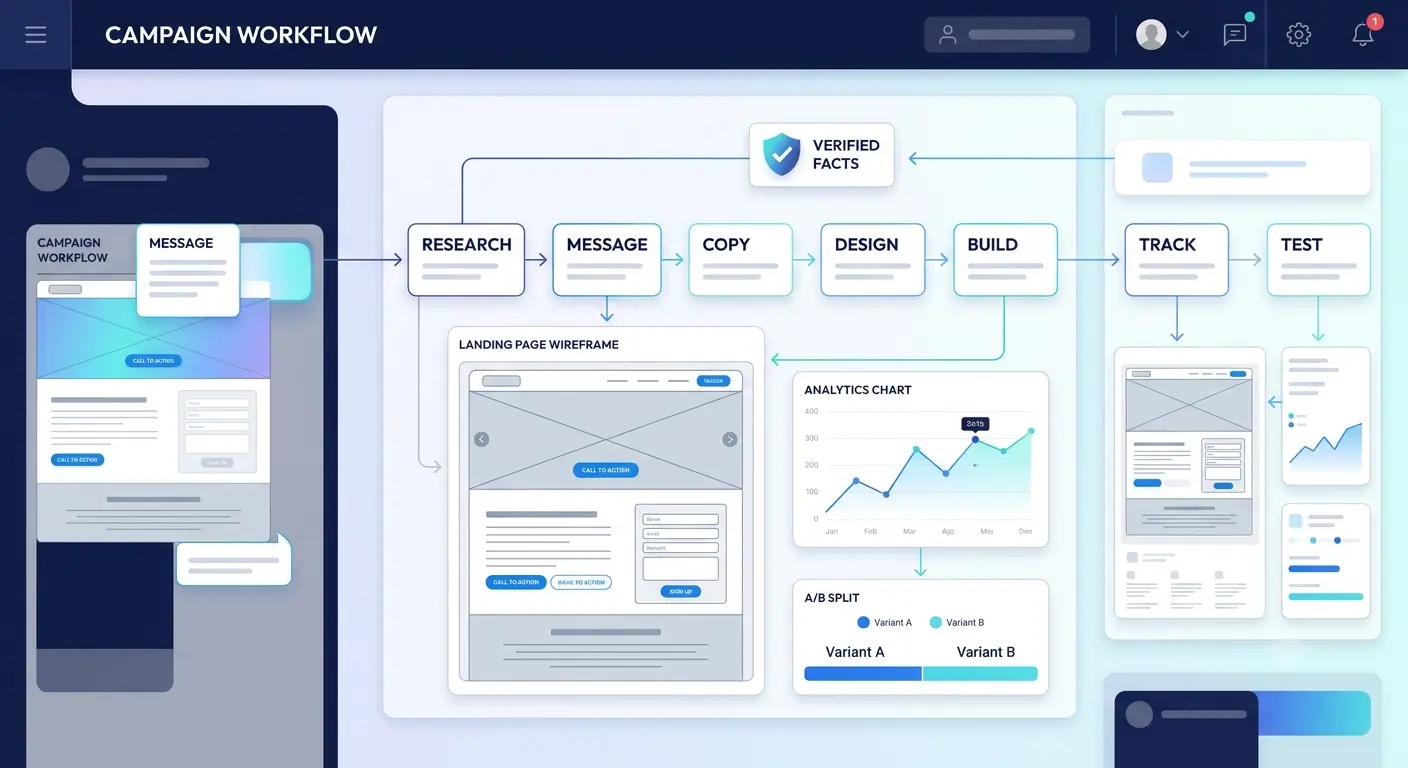
Build a landing page as a measurable campaign system, not a one-shot AI draft. These copy-ready prompts move from verified inputs and message match to copy, responsive UX, development, analytics, follow-up and experimentation.
Quick Answer
The best AI landing page prompts begin with verified facts about the audience, traffic source, offer, proof and conversion goal. Use AI in stages to research, structure, draft, specify, test and review the page. Keep human owners responsible for claims, design decisions, accessibility, development, privacy, tracking accuracy, CRM follow-up and final publication.
From campaign brief to test learning.
Missing evidence is marked for verification.
Copy, UX, code, tracking and follow-up stay connected.
Key Takeaways
- A landing page prompt needs a traffic source, audience, offer, proof, primary action and measurement plan.
- Do not ask AI to invent testimonials, customer language, urgency, results or legal claims.
- Create the page in reviewed stages instead of accepting a one-shot draft.
- Message match, mobile usability, accessible forms and working follow-up matter as much as the headline.
- Track the conversion journey before buying more traffic or starting an A/B test.
- AI can prepare hypotheses and variants, but a qualified human must approve implementation and interpret results.
Before You Write Another Landing Page, Check the Conversion Path
If a campaign already exists, start by checking whether its promise, page, form, tracking and follow-up agree. This prevents a polished new draft from hiding the same conversion problem.
Use the Website Conversion AuditWho This Guide Is For
This prompt library is for founders, consultants, marketing teams, agencies and in-house website owners who need campaign landing pages for paid search, paid social, email, partner traffic, product launches, lead generation, consultations, demos or focused service offers. It supports WordPress and custom builds, but the workflow is platform independent.
Google Ads describes landing-page experience through factors such as useful and relevant information, ease of navigation and whether the page meets expectations created by the ad. That is why these prompts keep the traffic promise connected to the page instead of treating copy, design and media as separate jobs. Review the current Google Ads landing page guidance when a page will receive paid search traffic.
Expert Insight from Kanika Gupta
In more than 18 years of website and digital work, I have seen that landing-page problems rarely belong to one section alone. A strong headline cannot rescue an unclear offer, a beautiful layout cannot repair weak proof, and accurate tracking cannot improve a broken form. The brief must connect the campaign promise, visitor decision, page experience, technical implementation and follow-up before design begins.
Prepare This Verified Landing Page Fact Pack
Complete this worksheet before using any prompt. Remove confidential information and personally identifiable data unless your organization has an approved privacy process for the AI system being used.
| Input | What to collect | Owner |
|---|---|---|
| Campaign | Traffic source, ad or email copy, keyword or audience, campaign objective, UTM convention | Media or campaign owner |
| Audience | Verified segment, awareness stage, trigger, questions, objections, decision criteria | Research and sales |
| Offer | Scope, price rules, deliverables, exclusions, process, availability and next step | Business and delivery owner |
| Proof | Permissioned testimonials, case studies, credentials, screenshots, product evidence and source links | Marketing and legal reviewer |
| Conversion | Primary action, form fields, qualification rules, thank-you state, booking or checkout destination | Sales and operations |
| Technology | CMS, form tool, CRM, analytics, tag manager, consent requirements and integrations | Development and analytics |
| Constraints | Brand rules, accessibility target, legal review, privacy policy, launch date and device priorities | Project owner |
Prompt Selection Table
| Stage | Prompts | Use them to |
|---|---|---|
| Evidence and strategy | 1-5 | Control facts, understand visitors and align the campaign. |
| Structure and copy | 6-10 | Plan the page, write key sections and reduce form friction. |
| Design and accessibility | 11-13 | Create a responsive visual brief, wireframe and accessibility review. |
| Implementation and measurement | 14-17 | Specify development, search handling, analytics and follow-up. |
| Quality and experimentation | 18-21 | Complete QA, prioritize hypotheses, design tests and interpret evidence. |
Table of Contents
- Evidence and Strategy Prompts
- Structure and Copy Prompts
- Design and Accessibility Prompts
- Implementation and Measurement Prompts
- Quality and Experimentation Prompts
- Worked Example
- Common Mistakes
- Final Verification Checklist
- Frequently Asked Questions
Evidence and Strategy Prompts
Landing Page Fact Pack
Purpose: Create one governed source of truth before copy or design begins.
When to use: At project kickoff or when information is scattered across briefs, ads, emails and sales notes.
Required inputs: campaign materials, audience research, offer details, proof, policies, technology and owners.
Copy-ready prompt
You are a landing-page research editor. Organize the materials I provide into a fact pack with these sections: campaign, audience, offer, proof, conversion action, form and follow-up, technology, policies, constraints and unresolved decisions. For every item, show the supplied fact, source, owner, approval status and review date. Separate verified facts, assumptions, recommendations and missing information. Do not draft the page yet. End with the ten questions most likely to change the page strategy.
Use only the facts, proof and source material I provide. Do not invent customers, reviews, testimonials, statistics, results, certifications, prices, deadlines, legal requirements, medical claims, guarantees, awards, product features or scarcity. Mark missing information as [VERIFICATION REQUIRED].
Do not include confidential customer records, personal data or privileged material. If the supplied material contains sensitive data, identify the risk and work only with a redacted summary.
Human review: Each source owner must approve the facts attributed to their function.
Audience, Trigger and Awareness Map
Purpose: Define what visitors know, need and fear when they arrive.
When to use: When a page sounds broad or tries to speak to several audiences at once.
Required inputs: interview notes, sales calls, CRM reasons, audience segment, traffic source and offer.
Copy-ready prompt
You are a conversion research strategist. Analyze the audience evidence I provide. Build a map covering the visitor segment, trigger event, current situation, desired progress, alternatives considered, awareness stage, decision criteria, objections, risk, questions and language used. Quote only phrases present in my materials and label each quote with its source. Identify contradictions and missing evidence. Recommend one primary audience for this landing page and explain which segments should receive a different page or message.
Use only the facts, proof and source material I provide. Do not invent customers, reviews, testimonials, statistics, results, certifications, prices, deadlines, legal requirements, medical claims, guarantees, awards, product features or scarcity. Mark missing information as [VERIFICATION REQUIRED].
Human review: Do not turn demographic assumptions into buyer motivations.
Voice-of-Customer Evidence Synthesis
Purpose: Convert real customer language into a usable message bank.
When to use: Before writing headlines, objections, benefits or FAQs.
Required inputs: permissioned interviews, reviews, support questions, chat transcripts and sales notes.
Copy-ready prompt
You are a qualitative research analyst. Code the redacted customer material I provide into themes: problem language, desired outcome, triggering event, objection, proof sought, alternative tried, decision criterion and words to avoid. Return a table with exact supplied phrase, theme, source type, frequency in this dataset and suggested page location. Do not claim the sample represents the market. List research gaps and five neutral follow-up questions.
Use only the facts, proof and source material I provide. Do not invent customers, reviews, testimonials, statistics, results, certifications, prices, deadlines, legal requirements, medical claims, guarantees, awards, product features or scarcity. Mark missing information as [VERIFICATION REQUIRED].
Do not expose names, contact details, account information or other personally identifiable information. Work from approved, redacted material only.
Human review: Confirm permission before publishing any recognizable quotation.
Ad-to-Page Message Match Audit
Purpose: Keep the page consistent with the promise that earned the click.
When to use: For paid search, paid social, email and partner campaigns.
Required inputs: exact ad or email, keyword or audience, final URL copy, offer, proof and CTA.
Copy-ready prompt
You are a campaign message auditor. Compare the exact traffic-source message with the landing-page material I provide. Evaluate audience, problem, promise, specificity, terminology, offer, price, proof, geography, timing, CTA and post-click expectation. Return a mismatch table with severity, evidence, likely visitor confusion and a recommended correction. Then draft a message-match brief for the first screen without creating new claims. If several ads promise materially different things, recommend separate variants or pages.
Use only the facts, proof and source material I provide. Do not invent customers, reviews, testimonials, statistics, results, certifications, prices, deadlines, legal requirements, medical claims, guarantees, awards, product features or scarcity. Mark missing information as [VERIFICATION REQUIRED].
Human review: Compare the final live ad and final live page, not an earlier draft.
Offer and Conversion Decision Brief
Purpose: Decide what the page should ask a qualified visitor to do.
When to use: When several CTAs, offers or qualification paths compete.
Required inputs: offer, audience, buying stage, price model, sales process, capacity and qualification rules.
Copy-ready prompt
You are a funnel strategist. Using the supplied facts, recommend the primary conversion action for this landing page and no more than one supporting action. Compare relevant options such as purchase, request a quote, book a consultation, request a demo, start a trial, join a waitlist or download a resource. For each option, evaluate visitor readiness, information needed, sales capacity, friction, lead quality, follow-up dependency and measurement. Return the recommendation, disqualified alternatives, required form fields and what must happen after submission.
Use only the facts, proof and source material I provide. Do not invent customers, reviews, testimonials, statistics, results, certifications, prices, deadlines, legal requirements, medical claims, guarantees, awards, product features or scarcity. Mark missing information as [VERIFICATION REQUIRED].
Human review: Sales and operations must confirm they can deliver the promised next step.
Structure and Copy Prompts
Page Architecture by Awareness Stage
Purpose: Put sections in the order a specific visitor needs.
When to use: After the audience, message and conversion action are approved.
Required inputs: fact pack, awareness stage, traffic source, offer, proof, objections and CTA.
Copy-ready prompt
You are a landing-page information architect. Create a section-by-section page plan for the supplied audience and awareness stage. For each section, state its decision job, key message, supporting proof, asset needed, objection answered, CTA behavior and what may be removed on mobile. Keep one dominant conversion path. Do not write final copy. Identify which sections are essential, conditional or unsupported by available evidence. Explain how the sequence would change for a visitor who is problem aware, solution aware or product aware.
Use only the facts, proof and source material I provide. Do not invent customers, reviews, testimonials, statistics, results, certifications, prices, deadlines, legal requirements, medical claims, guarantees, awards, product features or scarcity. Mark missing information as [VERIFICATION REQUIRED].
Human review: Check that every section moves a real decision forward.
Hero Value Proposition and CTA
Purpose: Draft the first screen without inflating the promise.
When to use: After message match and page architecture are settled.
Required inputs: ad promise, audience, offer, differentiation, proof and action.
Copy-ready prompt
You are a conversion copywriter. Draft five hero routes for the landing page using only the facts supplied. Each route must include headline, supporting statement, primary CTA, optional reassurance line and recommended proof element. Preserve the level of specificity in the traffic-source promise. Vary the angle by buyer priority, not by adding unsupported claims. For each route, explain the audience assumption, strength, risk and fact still needed. Recommend one route and provide desktop and narrow-screen versions.
Use only the facts, proof and source material I provide. Do not invent customers, reviews, testimonials, statistics, results, certifications, prices, deadlines, legal requirements, medical claims, guarantees, awards, product features or scarcity. Mark missing information as [VERIFICATION REQUIRED].
Human review: Reject superlatives, guaranteed outcomes and urgency that the business cannot prove.
Benefits, Mechanism and Proof Sections
Purpose: Explain value and support it with real evidence.
When to use: When features are clear but the buying reason is weak.
Required inputs: capabilities, process, deliverables, proof sources, limitations and audience priorities.
Copy-ready prompt
You are a proof-led copy strategist. Turn the supplied capabilities into a page section that connects feature, mechanism, practical benefit, evidence and limitation. Return a table first, then draft the approved section in concise landing-page copy. Use only proof I supplied. If a benefit depends on customer behavior, configuration, market conditions or professional review, state that condition. Recommend the strongest available proof format for each claim, such as a screenshot, demonstration, credential, process artifact, case study or permissioned quotation.
Use only the facts, proof and source material I provide. Do not invent customers, reviews, testimonials, statistics, results, certifications, prices, deadlines, legal requirements, medical claims, guarantees, awards, product features or scarcity. Mark missing information as [VERIFICATION REQUIRED].
Human review: Confirm that the visible disclosure is close enough to the claim it qualifies.
Objection and FAQ Copy
Purpose: Answer real concerns without creating a disguised sales pitch.
When to use: After reviewing interviews, sales questions and support records.
Required inputs: verified objections, policies, process, price rules, exclusions and next-step details.
Copy-ready prompt
You are a buyer-objection editor. Rank the supplied objections by frequency in this dataset, impact on the decision and ability to answer with verified information. Draft six to eight concise FAQs in the visitor’s language. Each answer must give the direct answer first, then the necessary qualification, evidence or next step. Include at least one question about fit, one about process, one about price or scope, one about risk and one about what the offer does not include. List questions that cannot yet be answered.
Use only the facts, proof and source material I provide. Do not invent customers, reviews, testimonials, statistics, results, certifications, prices, deadlines, legal requirements, medical claims, guarantees, awards, product features or scarcity. Mark missing information as [VERIFICATION REQUIRED].
Human review: Legal, medical, financial or regulated answers require the relevant qualified reviewer and jurisdiction.
CTA, Form and Confirmation Microcopy
Purpose: Make the next step clear before, during and after submission.
When to use: For lead forms, bookings, quote requests, demos, trials and waitlists.
Required inputs: primary action, required fields, qualification rules, privacy language, routing and response process.
Copy-ready prompt
You are a UX writer for conversion forms. Review the supplied form and write: CTA labels, field labels, help text, required-field instructions, validation messages, privacy reassurance, consent language supplied by the business, success message and next-step email outline. Recommend which fields belong before conversion, after conversion or in sales follow-up. Do not use placeholder text as the only field label. Return the copy in implementation order and identify every dependency on CRM, calendar, email or routing logic.
Use only the facts, proof and source material I provide. Do not invent customers, reviews, testimonials, statistics, results, certifications, prices, deadlines, legal requirements, medical claims, guarantees, awards, product features or scarcity. Mark missing information as [VERIFICATION REQUIRED].
Do not ask users to upload confidential, financial, health, legal or identity documents unless the business has an approved secure process and appropriate professional review.
Human review: Verify consent, privacy and data-retention language for the applicable market.
Design and Accessibility Prompts
Visual Direction and Design Token Brief
Purpose: Translate approved brand inputs into a focused design system.
When to use: Before wireframes, mockups or AI website-builder output.
Required inputs: brand assets, approved colors and fonts, reference sites, audience, offer and accessibility target.
Copy-ready prompt
You are a senior visual designer. Create a landing-page visual brief from the approved brand materials I provide. Define color roles, typography roles, spacing rhythm, container width, button hierarchy, form styling, image direction, icon approach, card treatment and motion limits. Explain how each choice supports the visitor decision and primary CTA. Copy exact color values, fonts and assets only when supplied. If an input is missing, mark it for verification instead of inventing a brand system. Identify accessibility risks and recommend a manual contrast and keyboard review.
Use only the facts, proof and source material I provide. Do not invent customers, reviews, testimonials, statistics, results, certifications, prices, deadlines, legal requirements, medical claims, guarantees, awards, product features or scarcity. Mark missing information as [VERIFICATION REQUIRED].
Human review: A visual reference is inspiration, not permission to copy another brand’s design.
Responsive Wireframe Specification
Purpose: Turn the content hierarchy into desktop and mobile behavior.
When to use: Before high-fidelity design or development.
Required inputs: approved section plan, CTA rules, form, assets, navigation decision and breakpoints.
Copy-ready prompt
You are a responsive UX architect. Produce a text wireframe for desktop, tablet and narrow-screen layouts using the approved sections I provide. For each viewport, specify order, width, alignment, content priority, CTA visibility, sticky behavior, image treatment, form placement, accordion behavior and what must not be hidden. Include loading, empty, error and success states. Keep reading order logical in both visual layout and source order. Flag any component that requires interaction design, custom code or user testing.
Use only the facts, proof and source material I provide. Do not invent customers, reviews, testimonials, statistics, results, certifications, prices, deadlines, legal requirements, medical claims, guarantees, awards, product features or scarcity. Mark missing information as [VERIFICATION REQUIRED].
Human review: Test the actual page on representative devices, not only inside a design tool.
Accessibility Review for Copy, Forms and Interaction
Purpose: Find barriers before development and again before launch.
When to use: During design review and prelaunch QA.
Required inputs: copy, wireframe or live URL, form behavior, media and accessibility target.
Copy-ready prompt
You are an accessibility review assistant. Evaluate only the materials I provide against the stated accessibility target. Review heading hierarchy, link purpose, form labels and instructions, error identification, keyboard order, focus visibility, color reliance, contrast candidates, alternative text needs, motion, video captions, touch targets and status messages. Return an issue list with affected element, user impact, relevant criterion to verify, recommended correction and manual test. Do not claim compliance from an AI review. Mark any criterion that requires code inspection, assistive-technology testing or qualified accessibility review.
Use only the facts, proof and source material I provide. Do not invent customers, reviews, testimonials, statistics, results, certifications, prices, deadlines, legal requirements, medical claims, guarantees, awards, product features or scarcity. Mark missing information as [VERIFICATION REQUIRED].
Human review: Use the current W3C guidance on form labels and complete manual keyboard and screen-reader checks.
AI Can Draft the Page. Implementation Still Determines Whether It Works.
Responsive behavior, accessible components, fast loading, form delivery, CRM routing, consent handling and analytics need deliberate implementation. A prompt is the specification starting point, not the finished system.
Explore Web Development SupportImplementation and Measurement Prompts
Developer Handoff and Acceptance Criteria
Purpose: Convert approved design into testable implementation requirements.
When to use: Before building in WordPress, a page builder or a custom stack.
Required inputs: final copy, design, components, breakpoints, forms, integrations, analytics and policies.
Copy-ready prompt
You are a technical product analyst. Turn the approved landing-page materials into a developer handoff. For every component, specify content source, responsive behavior, interaction, accessibility requirement, data captured, integration, analytics event, error state, success state and acceptance test. Include performance considerations, image formats, editable CMS fields, validation rules, spam protection, redirect behavior and rollback needs. Separate must-have launch requirements from later enhancements. Do not generate production code unless I explicitly request a reviewed code task.
Use only the facts, proof and source material I provide. Do not invent customers, reviews, testimonials, statistics, results, certifications, prices, deadlines, legal requirements, medical claims, guarantees, awards, product features or scarcity. Mark missing information as [VERIFICATION REQUIRED].
Human review: The developer and business owner should sign off on acceptance criteria before launch.
SEO, Canonical and Campaign URL Plan
Purpose: Decide how the page should be discovered, indexed and attributed.
When to use: Before publishing a landing page or test variant.
Required inputs: campaign purpose, query intent, existing pages, proposed URL, variants, paid-media URLs and analytics convention.
Copy-ready prompt
You are a technical SEO and campaign-governance assistant. Review the supplied landing-page purpose, current site inventory and proposed URLs. Recommend the primary URL, yearless slug, title, description, canonical handling, index or noindex decision, internal-link role and UTM naming plan. Identify possible cannibalization with existing pages. If A/B variants use separate URLs, document temporary redirect and canonical considerations for qualified technical review. Return a decision table and launch checklist. Do not assume every paid landing page should be indexed.
Use only the facts, proof and source material I provide. Do not invent customers, reviews, testimonials, statistics, results, certifications, prices, deadlines, legal requirements, medical claims, guarantees, awards, product features or scarcity. Mark missing information as [VERIFICATION REQUIRED].
Human review: For URL-based tests, check Google’s current A/B testing guidance for Search before implementation.
GA4 and GTM Measurement Plan
Purpose: Define what must be measured before the page receives traffic.
When to use: Before development is complete or before a campaign launch.
Required inputs: business objective, conversion action, form steps, CTA locations, thank-you behavior, analytics and consent setup.
Copy-ready prompt
You are a digital analytics planner. Build a GA4 and GTM measurement specification for the supplied landing-page journey. Start with the business outcome, then define primary conversion, diagnostic interactions and failure signals. For every event, provide event name, trigger, parameters, expected value, consent dependency, platform destination, QA method and reporting use. Prefer a documented recommended GA4 event when it fits. Include page_view context, CTA clicks, form starts, validation errors, successful lead generation, booking completion and thank-you verification only when relevant. Separate an interaction from a verified conversion.
Use only the facts, proof and source material I provide. Do not invent customers, reviews, testimonials, statistics, results, certifications, prices, deadlines, legal requirements, medical claims, guarantees, awards, product features or scarcity. Mark missing information as [VERIFICATION REQUIRED].
Do not place personal, health, financial, legal or other sensitive user data in analytics event names, parameters or URLs.
Human review: Compare the plan with GA4 recommended events, then verify events in DebugView and downstream reports. For a broader migration and measurement framework, use the website redesign analytics plan.
CRM Routing, Follow-Up and Lead QA
Purpose: Ensure the conversion reaches the right system and person.
When to use: For quote, consultation, demo and lead-generation pages.
Required inputs: form fields, CRM, routing rules, notifications, response process, qualification and consent.
Copy-ready prompt
You are a revenue-operations analyst. Map the supplied landing-page conversion from form submission to CRM record, owner assignment, notification, customer confirmation, qualification, follow-up, status update and reporting. Return a field-mapping table, routing rules, duplicate handling, failure alerts, service-level expectations supplied by the business and test cases. Identify fields collected on the page that are not used downstream and information sales needs but the form does not capture. Include a fallback process if the integration fails.
Use only the facts, proof and source material I provide. Do not invent customers, reviews, testimonials, statistics, results, certifications, prices, deadlines, legal requirements, medical claims, guarantees, awards, product features or scarcity. Mark missing information as [VERIFICATION REQUIRED].
Do not expose or copy confidential lead data into an AI system. Use fictional test records and an approved privacy process.
Human review: Submit test leads from each intended route and verify the complete record and response.
Quality and Experimentation Prompts
Prelaunch Landing Page QA
Purpose: Catch content, functionality and measurement failures before traffic arrives.
When to use: On staging and again immediately after launch.
Required inputs: live or staging page, approved brief, device list, browser list, form routes, integrations and event plan.
Copy-ready prompt
You are a launch QA coordinator. Create a test plan for the landing page using the supplied scope. Cover content accuracy, links, buttons, forms, validation, spam protection, booking or checkout, confirmation, CRM delivery, email, analytics, consent, responsive layout, keyboard use, screen-reader basics, performance, metadata, canonical behavior and campaign parameters. For each test, provide device or environment, steps, expected result, owner, severity if failed and evidence to capture. Separate staging tests, production smoke tests and post-launch monitoring.
Use only the facts, proof and source material I provide. Do not invent customers, reviews, testimonials, statistics, results, certifications, prices, deadlines, legal requirements, medical claims, guarantees, awards, product features or scarcity. Mark missing information as [VERIFICATION REQUIRED].
Human review: Do not launch paid traffic until the primary conversion and attribution path are verified.
Evidence-Based CRO Hypothesis Backlog
Purpose: Turn observed friction into prioritized experiments.
When to use: After collecting reliable quantitative and qualitative evidence.
Required inputs: GA4 data, campaign data, form performance, device findings, research and known changes.
Copy-ready prompt
You are a conversion-research facilitator. Review the supplied evidence and create hypotheses in this format: Because we observed [evidence], we believe [specific change] for [segment] may improve [primary metric] by addressing [mechanism]. We will learn this if [decision rule]. For each hypothesis, list supporting and conflicting evidence, affected page element, risk, implementation effort, measurement dependency and priority. Do not estimate uplift. Reject ideas based only on personal preference or generic best practices.
Use only the facts, proof and source material I provide. Do not invent customers, reviews, testimonials, statistics, results, certifications, prices, deadlines, legal requirements, medical claims, guarantees, awards, product features or scarcity. Mark missing information as [VERIFICATION REQUIRED].
Human review: Investigate tracking changes, traffic shifts and campaign changes before blaming the page.
A/B Test Design and Stopping Rules
Purpose: Create a controlled experiment instead of comparing random periods.
When to use: When traffic, conversions and implementation support a valid test.
Required inputs: hypothesis, baseline data, primary metric, minimum meaningful effect, allocation, test tool and business cycle.
Copy-ready prompt
You are an experimentation planning assistant. Using the supplied baseline data and approved hypothesis, draft an A/B test protocol with control, single defined change, target segment, primary metric, guardrail metrics, exclusions, allocation, instrumentation checks, sample-size input requirements, duration considerations, novelty and seasonality risks, stopping rule and decision outcomes. Do not calculate significance without the required raw inputs and a declared method. Do not recommend stopping because an early result looks favorable. If traffic is insufficient, recommend a research or usability alternative instead of pretending the test will be conclusive.
Use only the facts, proof and source material I provide. Do not invent customers, reviews, testimonials, statistics, results, certifications, prices, deadlines, legal requirements, medical claims, guarantees, awards, product features or scarcity. Mark missing information as [VERIFICATION REQUIRED].
Human review: A qualified analyst should approve the method, implementation and stopping rule.
Test Result Interpretation and Learning Memo
Purpose: Decide what was learned without overstating causation.
When to use: After the predeclared test reaches its decision point.
Required inputs: protocol, raw results, quality checks, segment data, incidents and external changes.
Copy-ready prompt
You are an experimentation documentation assistant. Compare the completed results with the predeclared protocol. First check sample-ratio issues, instrumentation changes, missing data, overlapping campaigns, implementation defects and external events. Then summarize the control and variant, primary metric, guardrails, uncertainty, segment patterns and whether the planned decision rule was met. Distinguish result, interpretation, limitation and next hypothesis. Produce a learning memo with adopt, reject, retest or inconclusive as possible outcomes. Do not generalize beyond the tested audience and page.
Use only the facts, proof and source material I provide. Do not invent customers, reviews, testimonials, statistics, results, certifications, prices, deadlines, legal requirements, medical claims, guarantees, awards, product features or scarcity. Mark missing information as [VERIFICATION REQUIRED].
Human review: Archive the final variant, dates, allocation, implementation and decision with the memo.
Worked Example: From Weak Request to Implementable Landing Page Brief
This fictional example demonstrates the workflow without presenting invented proof as a real business claim.
Initial request
“Write a high-converting landing page for our operations consulting service.”
Verified input supplied for the exercise
- Audience: owners of US professional-service firms with 10 to 40 employees.
- Traffic source: LinkedIn campaign aimed at firm owners.
- Offer: a 30-minute operations-fit call.
- Scope: workflow diagnosis and implementation planning. No guaranteed cost or time saving.
- Available proof: founder biography, documented process and two permissioned testimonials that must be inserted verbatim by the business.
- Primary action: request a fit call. The team confirms the appointment after reviewing the form.
- Required fields: name, work email, company, team size, main workflow problem and preferred contact time.
- Missing information: response-time commitment, CRM owner and approved privacy text.
Improved prompt
You are a B2B landing-page strategist. Build a section brief for a LinkedIn campaign aimed at owners of US professional-service firms with 10 to 40 employees. The offer is a 30-minute operations-fit call. The service covers workflow diagnosis and implementation planning. It does not guarantee cost or time savings. Use the supplied founder biography, process and permissioned testimonials as proof, but do not rewrite the testimonial text. The primary action is to request a fit call, which the team confirms after reviewing the form.
Return: message-match statement, page sequence, hero options, proof placement, objection plan, form microcopy, confirmation-state requirements, tracking events and unresolved implementation questions. Mark the response-time commitment, CRM owner and privacy text as [VERIFICATION REQUIRED].
Use only the facts, proof and source material I provide. Do not invent customers, reviews, testimonials, statistics, results, certifications, prices, deadlines, legal requirements, medical claims, guarantees, awards, product features or scarcity. Mark missing information as [VERIFICATION REQUIRED].
Expected output
- A first screen that continues the LinkedIn message and names the audience.
- A section order tied to the visitor’s decision, not a generic template.
- Proof slots that use only approved evidence.
- A form and success state consistent with a request that still needs confirmation.
- A measurement plan that separates form start, validation failure and successful lead generation.
- A clear list of missing operational decisions before publication.
Human review and implementation
The business owner approves scope and proof. The designer turns the brief into responsive layouts. The developer implements accessible components, form validation, CRM routing and failure alerts. The analytics owner verifies events and campaign parameters. Sales confirms that the lead record contains the information needed for follow-up. The page receives traffic only after production QA.
Common AI Landing Page Mistakes
- Starting with “make it high converting.” The model cannot know the offer, audience, traffic promise, proof or conversion constraints.
- Creating the whole page in one pass. Strategy errors become polished copy and design before anyone reviews them.
- Inventing social proof. Testimonials, logos, metrics and customer stories must come from real, permissioned sources.
- Using one page for incompatible campaigns. Visitors who clicked different promises may need different first screens or separate pages.
- Optimizing for clicks instead of outcomes. Button clicks do not prove that forms arrived, bookings completed or qualified leads entered the CRM.
- Ignoring accessibility. Unlabeled forms, weak focus states and visual-only instructions create barriers and conversion failures.
- Starting an A/B test without enough evidence or traffic. A usability review, interview or staged rollout may produce better learning.
- Publishing legal or regulated claims without review. AI output is not professional advice and cannot establish compliance.
For US advertising, the Federal Trade Commission states that advertising claims must be truthful, cannot be deceptive or unfair, and must be evidence based. Review the FTC advertising and marketing basics and obtain appropriate professional review for your market and offer.
Final Landing Page Verification Checklist
- The live page matches the final ad, email or campaign promise.
- The audience, offer, exclusions, price rules and next step are accurate.
- Every testimonial, logo, credential, metric and result has a permissioned source.
- The page has one dominant conversion action and an honest confirmation state.
- Forms use visible labels, useful instructions and understandable errors.
- Keyboard order, focus visibility, contrast, alternative text and responsive behavior were manually reviewed.
- Links, forms, bookings, checkout, email and CRM routing work in production.
- GA4 and GTM distinguish interactions from verified conversions.
- UTM parameters and click identifiers are preserved through the journey. Use Google’s campaign URL guidance when defining custom campaign URLs.
- Canonical, indexation and test-variant handling are intentional.
- Privacy, consent, claims and disclosures received appropriate review.
- The team knows who owns leads, failures, reporting and the next optimization decision.
Frequently Asked Questions
What should an AI landing page prompt include?
An AI landing page prompt should include the traffic source, target audience, awareness stage, offer, verified proof, objections, primary conversion action, form and follow-up requirements, brand rules, technical constraints and measurement plan. It should also prohibit invented claims and mark missing facts for verification.
Can ChatGPT create a complete landing page?
ChatGPT can help prepare research summaries, page structure, copy options, design specifications, code drafts and QA checklists. A human team still needs to validate facts, approve claims, design the experience, implement integrations, test accessibility, verify analytics and confirm that the page works in production.
Should I use one prompt to generate the whole landing page?
Usually, no. A staged workflow is safer and more useful. Approve the fact pack, audience, message match, offer and page architecture before drafting copy. Review design, development, tracking and testing as separate connected stages so an early assumption does not spread through the whole page.
How do I stop AI from inventing landing page testimonials or results?
Supply only approved evidence and explicitly prohibit invented customers, testimonials, statistics, results, certifications and guarantees. Require the model to mark missing evidence as [VERIFICATION REQUIRED]. A human must still compare the final page with the original permissioned source before publication.
What should I track on a lead-generation landing page?
Track the verified business conversion and the diagnostic steps that explain it. Depending on the journey, this may include CTA clicks, form starts, validation errors, successful lead generation, booking completion and CRM receipt. Do not place personal or sensitive form values in analytics parameters.
When should I A/B test a landing page?
A/B test when you have a specific evidence-based hypothesis, reliable instrumentation, a meaningful primary metric, enough traffic and conversions, and a predeclared decision rule. If those conditions are missing, customer interviews, usability testing, message testing or a controlled rollout may provide better learning.
AI Output Is the Draft. The Landing Page Is the System.
A useful prompt can organize evidence, expose missing decisions and speed up production. Results still depend on the offer, message match, proof, responsive design, accessibility, development quality, tracking, CRM routing and follow-up. If the wider website already gets traffic but produces few enquiries, diagnose the complete journey with the website growth audit framework. For broader prompt workflows beyond landing pages, explore the AI prompts for business growth.
Need a Landing Page That Connects Strategy, Design and Measurement?
KG Web Designer can help turn the brief into a responsive WordPress or custom landing page with clear conversion paths, technical implementation, analytics and campaign-ready QA.
Discuss Your Landing Page Project