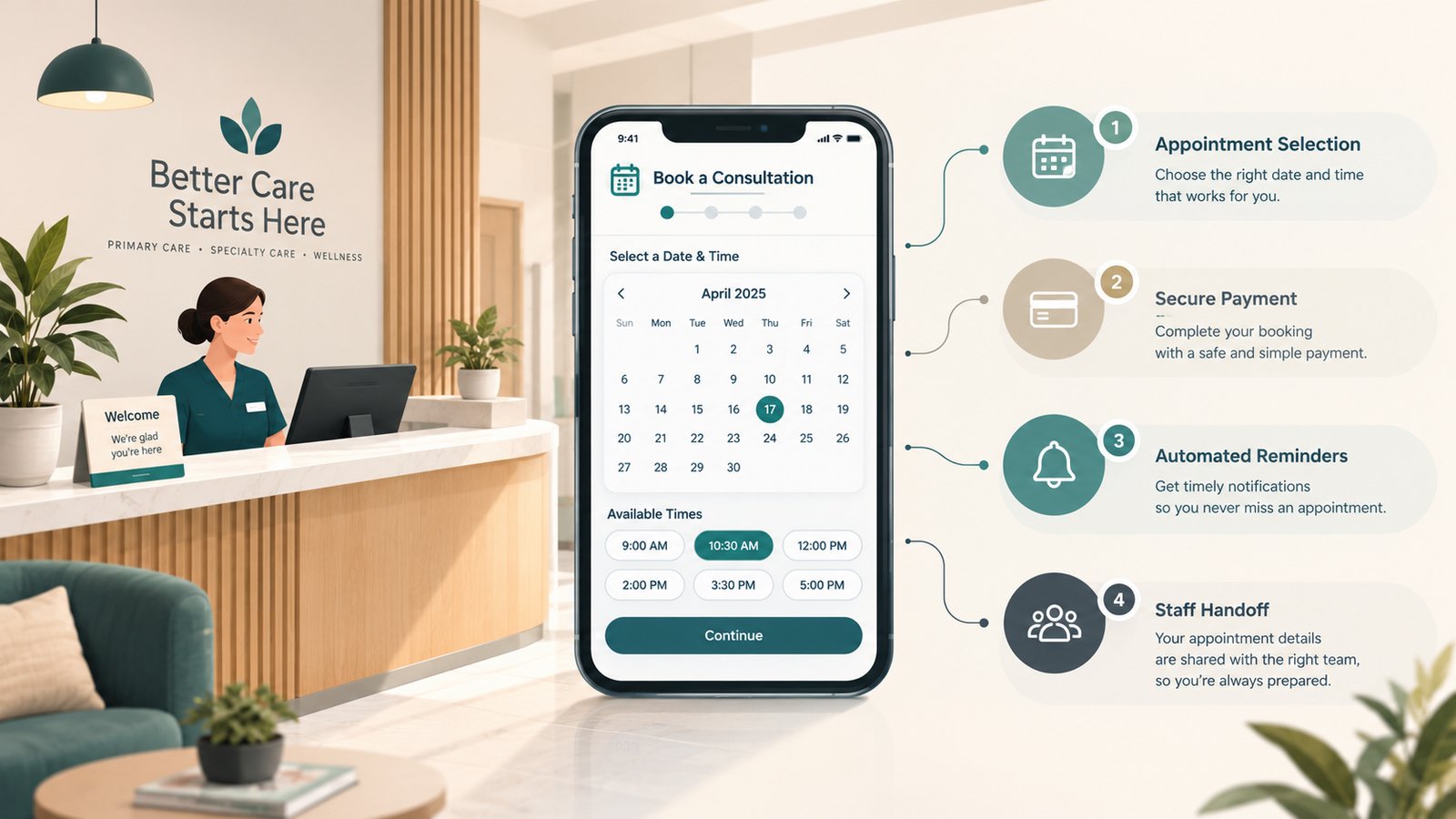

Quick Answer
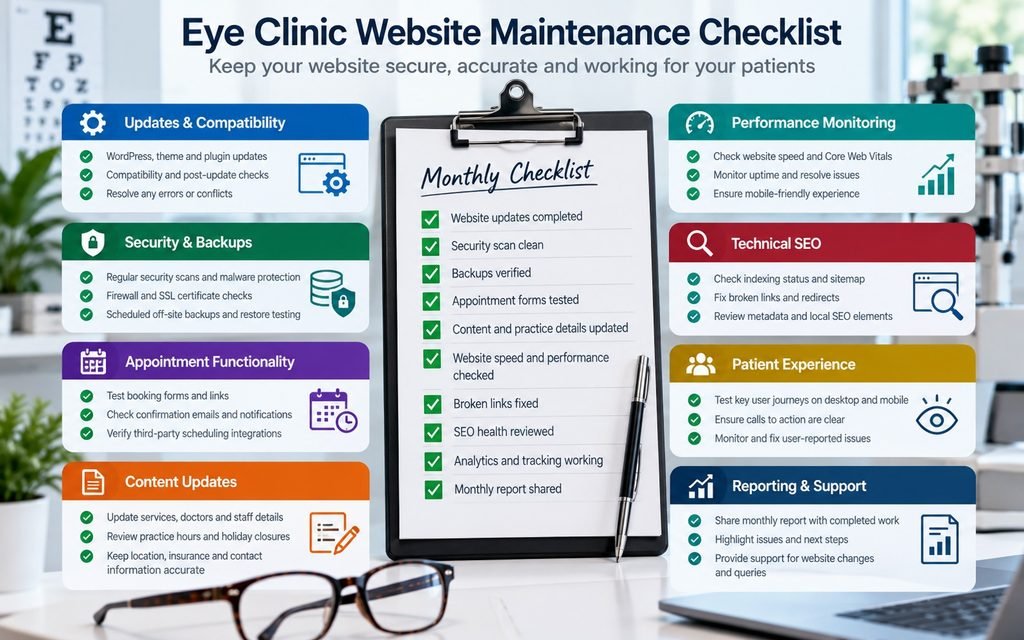
Website management services for eye doctor practice should include more than software updates. A monthly retainer should cover security, tested updates, backups, booking and contact-form checks, accurate practice information, and a documented support process. Depending on the clinic’s needs, it may also include technical SEO, performance monitoring, content changes, and conversion improvements. Before signing, compare the actual deliverables, response commitments, exclusions, and reporting, not just the monthly price.
TL;DR: What Should Your Monthly Retainer Include?
- A website management retainer should protect the clinic’s website and the patient actions that depend on it.
- Backups, security monitoring, tested updates, and appointment-path checks are core maintenance responsibilities.
- SEO, content editing, conversion optimization, and development should be explicitly included or quoted separately.
- Publicly listed website care plans provide pricing benchmarks, but they do not establish a universal eye clinic management fee.
- Every report should show work completed, issues identified, fixes made, and outstanding risks.
- The clinic should retain ownership of its website, domain, hosting, analytics, and booking accounts.
What Should a Monthly Website Management Retainer Actually Include?
A useful retainer should combine technical maintenance, operational reliability, patient-facing accuracy, and a defined process for resolving problems. The right scope depends on whether the practice operates a simple informational website, a multi-location clinic website, or a more complex platform connected to scheduling and marketing systems.
| Service | What the provider should do | Evidence to request |
|---|---|---|
| Software maintenance | Review and apply relevant CMS, theme, and plugin updates | Update log and post-update checks |
| Backups | Maintain scheduled backups and a documented recovery process | Backup status and restoration procedure |
| Security | Monitor security issues, SSL status, and relevant alerts | Security and incident records |
| Booking functionality | Test appointment links, forms, telephone links, and scheduling destinations | Functional test checklist |
| Content changes | Update approved hours, provider details, services, and location information | Record of completed edits |
| Performance | Review mobile usability and relevant performance metrics | Performance findings and prioritized fixes |
| Technical SEO | Check indexing problems, broken links, and other agreed technical issues | Documented findings and actions |
| Conversion improvements | Review important calls to action and patient pathways | Recommendations and completed changes |
| Reporting | Summarize work, risks, support requests, and next steps | Monthly report |
A maintenance provider should not simply report that updates were installed. It should explain whether important pages and functions were checked afterward and how problems will be handled if an update causes an error.
KG Web Designer is a conversion-focused website design studio specializing in custom websites for clinics, professional services, manufacturers, and growing businesses. For an eye clinic, that means considering the website’s role in helping prospective patients understand services, find the right location, and take the next step toward an appointment.
Is Your Eye Care Website Working as Hard as Your Practice?
Your website should do more than look professional. It should stay secure, load quickly, display correctly on mobile devices, and make it easy for patients to find your services and contact your practice.
How Much Does Eye Clinic Website Management Cost in 2026?
Website management pricing varies according to the amount of hands-on work, technical complexity, response coverage, and development time included. Publicly listed plans offer useful comparison points, but a general WordPress maintenance plan is not necessarily equivalent to a specialist agreement for an eye clinic.
The following prices were available on the providers’ published pricing pages when checked for this article:
| Provider and plan | Published monthly price | Selected inclusions |
|---|---|---|
| GoWP Pro | $39 per site | Automatic updates with visual checks, daily backups, security scans and cleanup, support, and reports |
| GoWP Business | $99 per site | Pro features plus 50 AI edits and five human edits monthly |
| Oh My Web Care Essential | $79 | Updates tested on staging, daily off-site backups, monitoring, malware cleanup, one hour of monthly edits, and a health check |
| Oh My Web Care Pro | $199 | Essential features plus four hours of edits and small development work, a staging site, quarterly speed work, and priority support |
| Oh My Web Care Growth | $499 | Eight hours of monthly development and design, landing-page work, search-health checks, and quarterly conversion reviews |
Sources: GoWP official pricing and Oh My Web official pricing. These are advertised provider prices, not an independent market survey. Service conditions, taxes, eligibility, and the precise scope of work may differ.
The practical lesson is that two retainers with similar prices may offer very different levels of support. One may cover routine maintenance with limited edits, while another includes several hours of development, performance work, or conversion reviews.
A monthly fee is only comparable when the included work, response commitments, and exclusions are comparable.
Before requesting a quote, list the functions your practice relies on, how frequently content changes, and which issues would require urgent attention. Ask the provider to separate maintenance, hosting, licenses, SEO, content work, and larger development tasks so you can see what you are actually purchasing.
Which Tasks Should Your Provider Fix First?
The first priority should be the functions that protect the website and allow prospective patients to contact or book with the practice. Visual refinements can wait if appointment links are broken, forms are not delivering messages, or important location information is inaccurate.
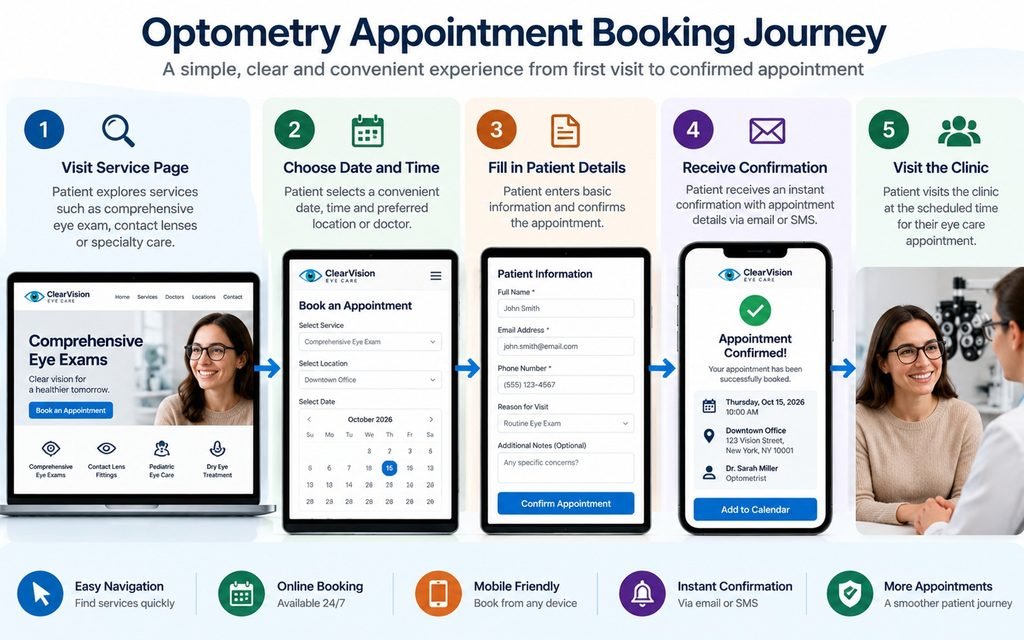
First: Test the appointment journey. Check the primary booking button on mobile and desktop. Confirm the destination, form submission, confirmation message, notification delivery, and any external scheduling integration. A button that looks correct is not proof that the complete process works.
Second: Verify backups and updates. Confirm that backups run on an agreed schedule, are stored appropriately, and can be restored. Updates should be assessed for compatibility, tested in staging where practical, and checked after deployment.
Third: Correct patient-facing information. Review hours, holiday closures, provider details, services, contact information, and location-specific booking instructions. Multi-location practices should ensure that changes are reflected on the correct pages without introducing inconsistencies elsewhere.
Fourth: Review search health and performance. Google’s current Core Web Vitals guidance identifies three important thresholds: Largest Contentful Paint (LCP) of 2.5 seconds or less, Interaction to Next Paint (INP) below 200 milliseconds, and Cumulative Layout Shift (CLS) of 0.1 or less. These thresholds help assess loading, responsiveness, and visual stability; they do not guarantee rankings or appointment growth. See Google’s Core Web Vitals documentation.
Fifth: Set a measurable improvement plan. Once critical issues are under control, decide whether the practice needs content improvements, technical SEO, landing pages, or conversion optimization. These activities should have clear deliverables rather than being bundled into a vague promise to “improve the website.”
What Is Different About Website Management for Eye Doctor Practices?
Eye clinic website design requires maintenance decisions that reflect patient needs, service differences, location accuracy, and the handling of potentially sensitive information. A generic website plan may not account for these responsibilities unless the contract specifically includes them.
Observation 1: Different services can require different booking paths. A routine eye exam, pediatric eye exam, contact lens appointment, and specialist consultation may have different instructions or scheduling requirements. Test each important route against the practice’s actual workflow.
Observation 2: Location changes can affect the patient journey. A multi-location practice needs accurate addresses, hours, telephone numbers, provider details, and booking destinations. The provider should know which information is controlled centrally and which belongs to an individual office.
Observation 3: Clinical content needs appropriate approval. Updates to treatment descriptions, service availability, provider credentials, and patient instructions should be reviewed by the practice. A website manager should not introduce unsupported medical claims or change clinical guidance without approval.
Observation 4: Third-party tools can create privacy risks. Appointment forms, analytics platforms, chat tools, advertising pixels, and embedded scheduling systems should be reviewed for the information they collect and transmit. In the United States, HIPAA obligations may apply to tracking technologies used by regulated entities when protected health information is involved. HHS has also published updates to its tracking guidance following legal proceedings, so practices should obtain current, situation-specific advice rather than assume a maintenance package guarantees compliance. See HHS guidance on online tracking technologies.
These responsibilities should be reflected in the scope where applicable. Installing a security plugin or adding a privacy statement does not, by itself, establish that a website meets every legal or regulatory requirement.
What Should an Eye Clinic Support Agreement Specify?
An eye care website management agreement should state what work is included, how often it is performed, who approves changes, and how urgent problems are handled. The practice should be able to understand the contract without having to interpret broad promises such as “complete website care.”
Use this checklist before signing:
- Maintenance schedule: How often are updates reviewed, applied, and checked?
- Backup policy: How often are backups created, how long are they retained, and how is restoration handled?
- Security response: Who investigates alerts and coordinates incident response?
- Support commitments: When will a request be acknowledged, and what qualifies as an emergency?
- Content allowance: How many edits or hours are included, and what counts as one task?
- Booking checks: How frequently are appointment forms and scheduling links tested?
- Reporting: Which technical, search, and conversion indicators are reviewed?
- Approval process: Who signs off on clinical content, tracking tools, and substantial changes?
- Ownership: Does the clinic retain administrative access to its domain, hosting, CMS, analytics, and booking accounts?
- Exit procedure: What happens to credentials, backups, documentation, and unfinished work when the contract ends?
Do not confuse response time with resolution time. A provider may acknowledge an issue within one business day but need longer to resolve a complex booking integration or a problem caused by another vendor.
The agreement should also distinguish routine care from redesigns, new integrations, extensive content writing, and major SEO campaigns. These may be worthwhile investments, but they require separate estimates or a clearly defined development allowance.
Your Monthly Retainer Should Deliver More Than “We Keep an Eye on It.”
Eye care practices need a clear plan for website maintenance, updates, monitoring, and support—not vague promises. Make sure you know exactly what is covered each month.
Explore Website Services →A Strong Retainer Checklist
Is Your Website Being Maintained or Actually Improved?
Before increasing your monthly spend, identify where the current website is failing and what the provider will change. A decline in appointment inquiries could result from a technical problem, unclear service information, poor search visibility, or a booking process that creates unnecessary friction.
KG Web Designer recommends beginning with the pages and actions that matter most to the practice. Document the current booking journey, verify form delivery, review service-page accuracy, and establish a baseline before commissioning improvements.
If the patient journey is difficult to follow, our guide to structuring an eye clinic website for maximum appointment bookings provides a useful starting point for evaluating navigation, page structure, and appointment calls to action.
Need a clearer scope for your clinic’s website support?
How Can You Measure Whether the Retainer Is Worth the Money?
A retainer is easier to evaluate when the practice separates technical reliability, service delivery, and business performance. Traffic alone is not enough to judge a maintenance provider, and the number of tasks completed does not prove that the work improved the patient experience.
| Measurement area | What to review | Why it matters |
|---|---|---|
| Technical reliability | Uptime alerts, errors, backup status, unresolved incidents | Shows whether the website is being maintained and can be recovered |
| Booking functionality | Test submissions, working links, delivery failures | Confirms that important patient actions function correctly |
| Search health | Indexing issues, broken links, organic clicks to priority pages | Helps identify technical barriers to visibility |
| Conversion performance | Appointment-button clicks, form completions, measurable calls | Shows whether visitors take intended actions |
| Support delivery | Response times, resolution times, hours used | Makes service quality and capacity visible |
| Content accuracy | Review dates and approved changes | Reduces the risk of outdated patient information |
The practice should record a baseline before making changes. For example, document whether booking links work, how forms are delivered, which priority pages receive organic visits, and how many completed inquiries can be measured reliably.
Results also need context. Appointment demand can change because of seasonality, advertising, staffing, local competition, and appointment availability. A provider should distinguish completed work from recommendations and explain what evidence supports any claimed improvement.
What Should You Avoid Paying for in a Monthly Retainer?
Avoid vague promises, duplicated services, and recurring charges that do not correspond to documented work. A low price is not automatically poor value, and a high price is not proof of strategic attention.
Watch for these warning signs:
- Unlimited support without boundaries. Ask how requests are prioritized and which tasks count as development.
- Updates without verification. Confirm that important pages and functions are checked after changes.
- Backups without recovery procedures. Ask about retention, storage, and restoration.
- SEO promises without deliverables. Identify which checks, changes, or campaigns are actually included.
- Reports without recommendations. A report should identify risks, completed fixes, and next priorities.
- No account ownership. The practice should retain control of its core website and marketing accounts.
- Compliance guarantees without evidence. Maintenance and security tools alone cannot guarantee legal compliance.
- Duplicated charges. Check whether the host, booking provider, SEO agency, and maintenance company charge for overlapping work.
The right agreement makes accountability clear. If several vendors are involved, decide who owns each issue, who communicates with the practice, and who verifies the final fix.
Example Scenario: What Would a Better Retainer Look Like?
Consider a hypothetical two-location optometry practice that pays for routine updates but receives no record of booking checks, content changes, or technical findings. The practice later discovers that a location page sends patients to the wrong scheduling destination.
The problem is not necessarily that the monthly fee was too low. The agreement failed to define responsibility for a patient-facing function that mattered to the business.
A stronger agreement would assign responsibility for checking each location’s booking path, recording the test, notifying the practice of failures, and verifying the correction. The monthly report would document the issue and resolution, while the practice would confirm that the scheduling destination matches its operational process.
The potential benefit is reduced friction and clearer accountability. Without actual clinic data, it would be misleading to attach a specific increase in bookings or revenue to this hypothetical situation.
Example From Our Experience: What Evidence Should a Provider Show?
A credible case study needs a real project record, a documented problem, evidence of the work performed, and a verifiable outcome. No verified eye clinic retainer audit dataset or client outcome has been supplied for this article, so it would be inappropriate to invent a clinic name, a percentage increase in bookings, or a revenue result.
For an actual engagement, the case study should document three elements:
- Problem: What was failing or missing, such as broken booking links, outdated information, recurring errors, or inadequate reporting?
- Solution: Which checks, fixes, content changes, or technical improvements were completed, and when?
- Outcome: What changed in verified measurements, such as form-delivery reliability, technical errors, support response times, or qualified appointment inquiries?
The important standard is evidence, not impressive wording. A provider should be able to show the work completed, the risks identified, and the measurements used to assess progress.
Until a verified project record is available, these are the standards KG Web Designer recommends rather than a claim that a particular client outcome has already been achieved.
Make Every Patient Visit to Your Website Count
Patients may visit your website before they ever call your office. Give them a smooth experience with clear information, working appointment links, and easy access to the details they need.
Easy to Navigate
Help patients quickly find eye exams, specialty services, doctor information, and office locations.
Simple to Contact
Keep appointment links, phone numbers, forms, and opening hours accurate and functional.
Built for Mobile
Check page speed, readability, and usability across phones, tablets, and desktop screens.
Expert Insight from Kanika Gupta
Kanika Gupta, Founder, KG Web Designer
My judgment is that an eye clinic should not buy a maintenance retainer simply because a provider says websites need regular updates. The practice should pay for clear responsibility for the digital functions that matter: reliable appointment pathways, accurate patient-facing information, safe technical changes, and evidence that the work is being completed.
If this were my website, I would first test every primary appointment path, confirm that submissions reach the right person, and verify that backups can be restored. I would then review the agreement to separate routine care from conversion improvements and larger development work.
Only after those basics were established would I consider paying for a broader growth-oriented retainer. Otherwise, the clinic risks funding reports and routine activity while the actual barrier to patient inquiries remains unresolved.
Why Most Businesses Get This Wrong
Many practices approve website maintenance as a recurring expense without reviewing the scope. They compare monthly prices but overlook the number of locations covered, the booking integrations involved, the response commitment, the available development hours, and the exclusions that may generate additional charges.
A better approach is to treat website management as an operational responsibility. The practice should know who manages updates, who approves clinical content, who tests booking functionality, who handles incidents, and who interprets performance data.
The expensive mistake is assuming that keeping a website online automatically makes it effective. Technical reliability is essential, but it does not correct unclear service-page messaging, poor local visibility, confusing navigation, or an inconvenient booking process. Those problems require separate diagnosis and should be scoped accordingly.
What This Means For Your Business
The right retainer should reduce avoidable website risk while making the patient journey easier to maintain and improve. It should also give the practice owner enough visibility to decide whether to continue, change the scope, or invest in a more substantial improvement project.
If your website receives visitors but few appointment inquiries, maintenance may be only part of the answer. Our guide to why optometry websites get traffic but no bookings explore the difference between attracting visitors and helping them take the next step.
If the current website is outdated, difficult to maintain, or structurally unsuitable for the practice’s services, a redesign may be more sensible than repeatedly paying for repairs. Our eye clinic website redesign teardown offers another way to assess the website’s structure and patient-facing experience.
The decision is not simply whether to pay for monthly support. It is whether the website’s current condition, the work included in the agreement, and the practice’s priorities justify the recurring commitment.
How Do You Choose the Right Optometry Website Management Services?
The right provider should explain its maintenance process clearly, demonstrate how work is verified, and show what the practice receives each month. Ask for a sample report, a written scope, an escalation procedure, and a clear separation between routine maintenance and additional development.
For optometry website management services, assess whether the provider understands appointment flows, service-page accuracy, local search requirements, accessibility considerations, and privacy-sensitive integrations. A generic technical plan may cover the platform but overlook the operational needs of an eye clinic.
Before signing, ask:
- What will you check every month, and what will you check less frequently?
- How will you test appointment forms and external booking links?
- How are updates tested, and what is the recovery plan if something breaks?
- How many content or development hours are included?
- Which SEO and conversion tasks are included?
- What does the monthly report show, and who will explain it?
- Which costs, licenses, integrations, and emergency tasks are excluded?
- Will the practice retain ownership of all accounts and website assets?
The answers should be specific enough to compare providers fairly. If a provider cannot explain how its work will be verified, the practice has little basis for evaluating the value of the retainer.
For a separate build-budget comparison, see our eye clinic website design cost guide for 2026. Website design or redesign costs are different from recurring maintenance costs, so compare the deliverables rather than treating them as interchangeable.
Final Thoughts
A monthly retainer is worthwhile when it gives your eye doctor practice reliable technical care, clear accountability, and a defined process for improving the website’s most important functions. It is not worthwhile simply because updates are performed or a report arrives each month.
Start by checking booking functionality, backups, security, content accuracy, and the written scope. Then decide whether the practice also needs SEO improvements, conversion work, or a broader redesign. Each requires a different level of effort and should have a clear deliverable.
If you are evaluating website management services for eye doctor practice, focus on the work that protects the patient journey and the evidence that the provider is doing it. A clear scope and measurable baseline will help you make a better investment decision than a low monthly price or a vague promise of ongoing support.
Want a clearer plan for managing and improving your eye clinic website? Discuss your eye clinic website requirements with KG Web Designer and outline the technical, content, and conversion support your practice needs.

Focus on Patient Care. Give Your Website a Clear Maintenance Plan.
Kanika Gupta of KG Web Designer helps businesses create and maintain websites that support their goals. Let’s discuss a practical management plan for your eye care practice, from routine updates to performance and patient-facing functionality.
Frequently Asked Questions
What should a monthly website maintenance plan include for an eye doctor?
A monthly plan should define software updates, backups, security and uptime monitoring, post-update checks, and support for technical problems. For an eye clinic, it should also specify how appointment forms, booking links, location details, and other important patient-facing functions are checked. Content changes, SEO work, conversion optimization, and development hours should be listed separately so the practice knows exactly what the fee covers.
How much does website management cost for an optometry practice?
The price depends on the platform, number of locations, booking integrations, content workload, response requirements, and level of technical support. The published WordPress plans reviewed for this article range from $39 to $499 per month across different service levels, but these are general website care prices, not a verified eye clinic market average. Request a quote based on a written scope and the practice’s actual requirements.
Is website maintenance different from website hosting?
Yes. Hosting provides the infrastructure that makes a website available, while maintenance covers work such as updates, backups, security checks, troubleshooting, and agreed changes. Some providers bundle hosting and maintenance, while others charge separately. Ask for an itemized scope so you know who is responsible for each service and whether any charges overlap.
Should my eye clinic’s maintenance retainer include SEO?
It should include basic technical SEO checks if those tasks are part of the agreed scope, such as reviewing broken links, sitemap availability, indexing issues, and important metadata. Ongoing content strategy, local SEO campaigns, and substantial landing-page development may require additional work. Ask the provider to identify which activities are included and what evidence will be reported each month.
How often should appointment forms and booking links be tested?
Critical booking paths should be tested after relevant website updates or changes to the scheduling integration, with a recurring schedule defined in the agreement. The appropriate frequency depends on how often the system changes and how important online bookings are to the practice. Testing should confirm the correct destination and successful delivery without unnecessarily collecting or exposing patient information.
Can my existing website be maintained, or does it need a redesign?
An existing website can often be maintained if its platform remains supportable, its essential functions work, and its structure still serves the practice. A redesign becomes more compelling when recurring repairs, outdated architecture, confusing navigation, poor mobile usability, or limited integration options make maintenance inefficient. An audit should establish whether targeted fixes are sufficient before you commit to a larger project.
What should an eye clinic expect in its monthly maintenance report?
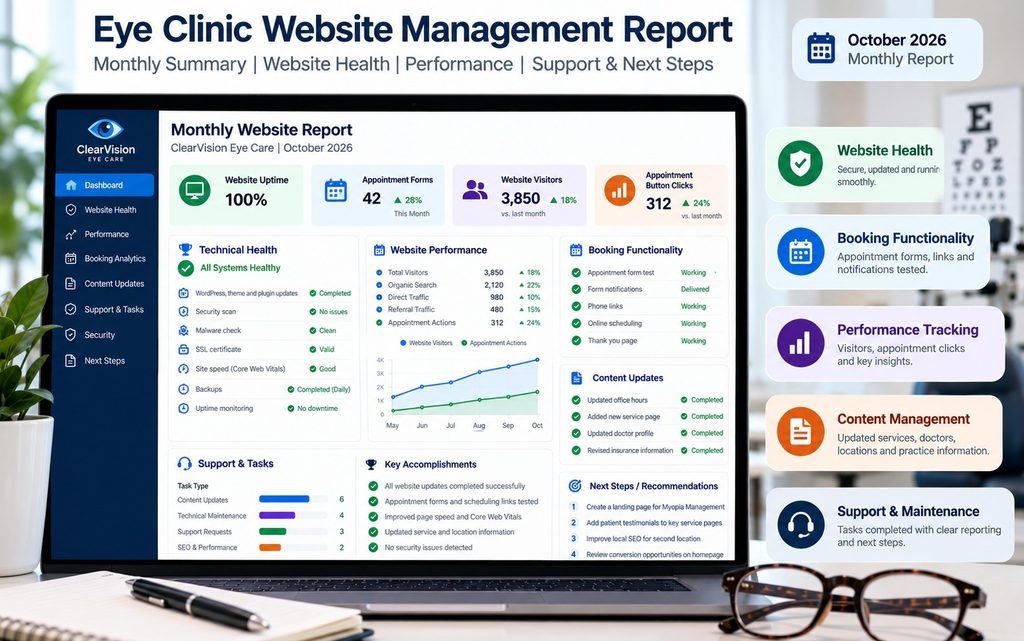
The report should show updates completed, backup and monitoring status, technical or security issues, booking-function checks, content changes, support time used, and unresolved risks. If SEO or conversion work is included, it should identify the metrics reviewed, actions taken, and next priorities. It should distinguish completed work from recommendations so the practice can assess what it actually received.
How can I tell whether my website management provider is doing a good job?
Look for documented work, clear communication, reliable access to your website accounts, verified technical checks, and timely handling of agreed responsibilities. The provider should explain issues without exaggerating risks or promising guaranteed rankings and bookings. Over time, compare the delivered service with the contract and review meaningful technical and conversion indicators rather than relying on activity counts alone.