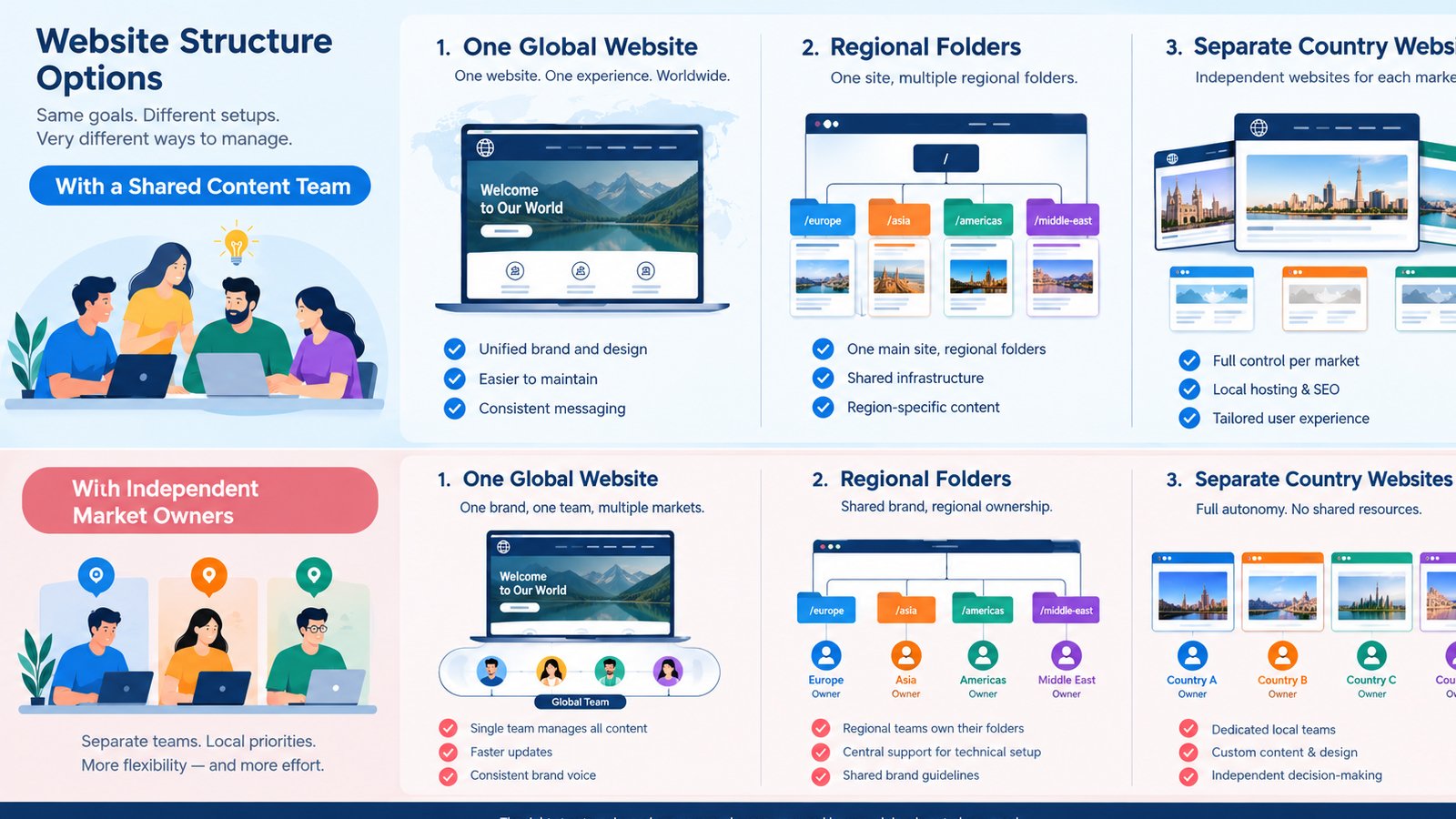
Quick Answer
A distributor or wholesale website should help business buyers find products, access the correct pricing, request quotes, manage purchasing permissions, and reorder efficiently. Effective distributor website design connects the product catalog with the commercial rules behind each account. Instead of forcing every buyer to call sales for routine information, the website can support self-service purchasing while preserving sales assistance for complex orders, negotiated contracts, and high-value relationships.
TL;DR: Key Takeaways
- B2B buyers need accurate product information, relevant pricing, and efficient purchasing workflows, not just a company profile.
- Customer-specific catalogs and volume pricing can support different commercial agreements for retailers, dealers, resellers, and wholesale accounts.
- Account logins should provide useful functionality, such as saved lists, order history, quote requests, and purchasing permissions.
- Product search, SKU lookup, quantity rules, and accurate availability information are essential for businesses with large catalogs.
- Platform selection should follow requirements discovery, not the other way around.
- Measure account activation, quote conversion, repeat ordering, order errors, and sales administration before judging the commercial success of a redesign.
Why Is a Brochure Website Often Insufficient for a Distributor?
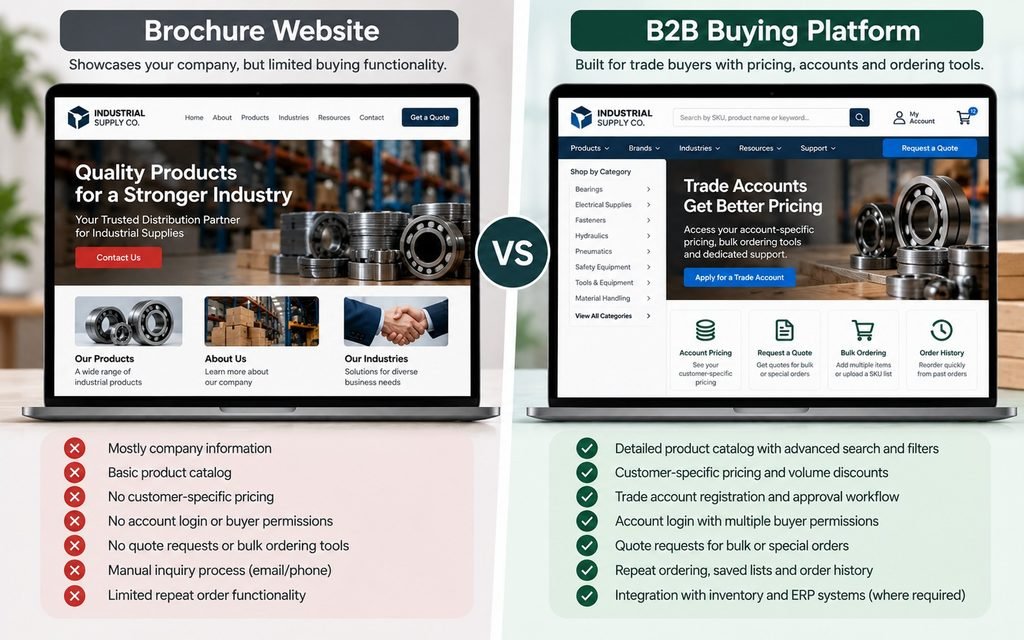
A brochure website explains what a company sells, where it operates, and how a prospect can get in touch. A B2B buying platform also helps customers complete the tasks involved in purchasing from that company.
This difference matters when buyers already know the supplier but still need to email sales for a price list, confirm minimum quantities, check product availability, or repeat a previous order. These interactions may be necessary for some transactions, but making every customer use them can create avoidable friction.
KG Web Designer is a conversion-focused website design studio specializing in custom websites for clinics, professional services, manufacturers, and growing businesses. For distributors, the strategic challenge is to build a digital experience around the actual sales process, including account eligibility, product discovery, pricing rules, quotations, and fulfillment.
Your Buyers Need an Ordering System, Not Just a Product Catalogue.
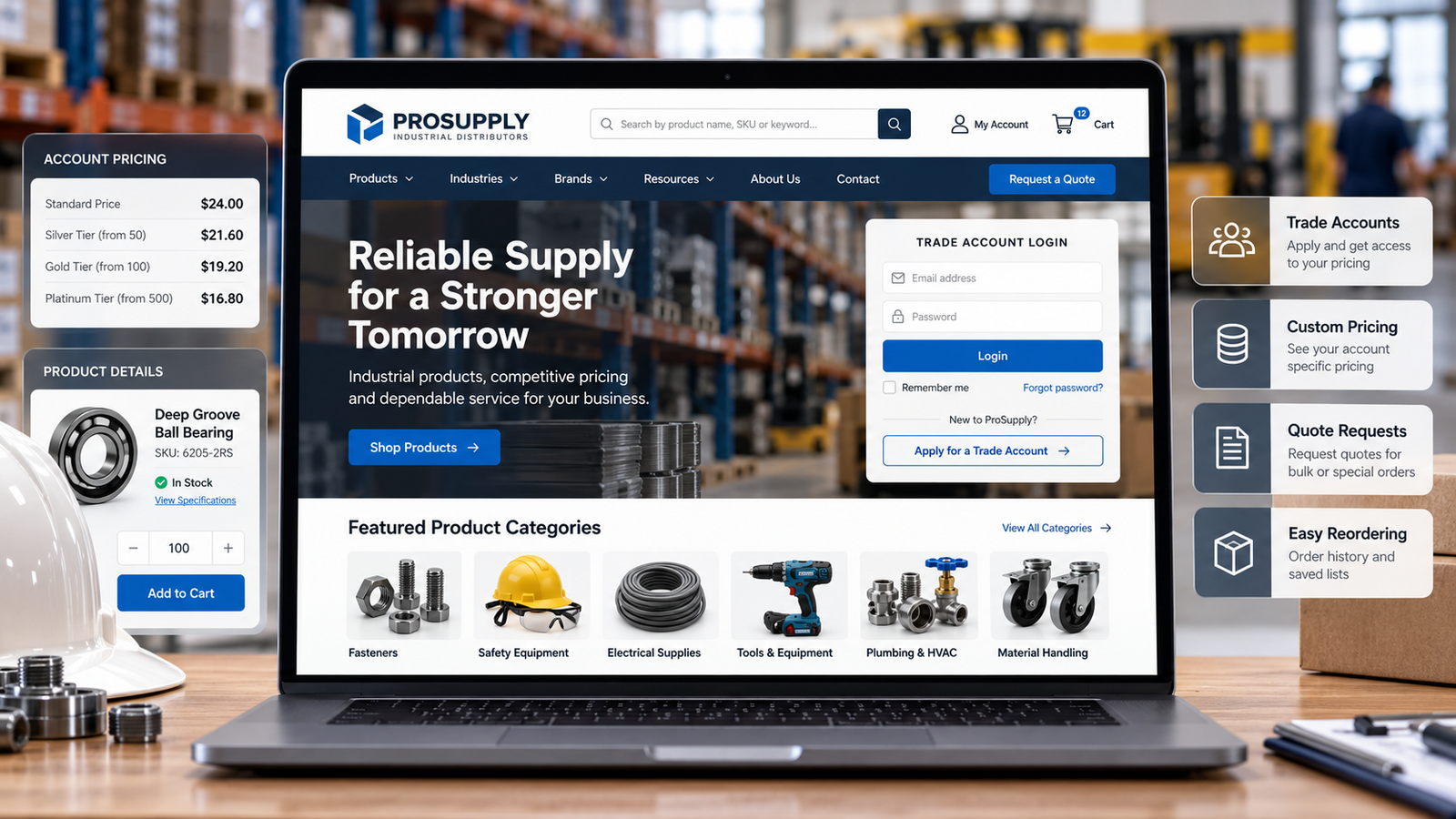
Wholesale customers often need to check account-specific pricing, review bulk quantities and place repeat orders. A brochure-style website may introduce your business, but a B2B portal can support the purchasing tasks your customers perform every day.
Information Without Ordering
Buyers may need to contact your team to complete routine purchasing tasks.
Built for Business Purchasing
Approved buyers can access the information and tools relevant to their accounts.
How do the two website models compare?
| Capability | Brochure website | B2B buying platform |
|---|---|---|
| Company information | Core purpose | Included |
| Product catalog | Primarily informational | Organized for product discovery and purchasing |
| Customer-specific pricing | Often handled by sales | Available when supported and configured |
| Volume pricing | Explained or calculated manually | Can be configured through supported pricing rules |
| Trade-account applications | Contact form or email | Structured application and approval workflow |
| Quote requests | General inquiry form | Product and quantity-specific quote workflow where supported |
| Repeat orders | Manual re-entry or email | Saved lists, order history, or reorder tools where supported |
| Buyer permissions | Often limited | Company users and purchasing roles where supported |
| Inventory and ERP integration | May be limited | Can be integrated subject to platform and system requirements |
A brochure website is not automatically wrong. It may suit a distributor that relies on relationship-led sales and handles every order through a representative. The problem occurs when the business needs efficient self-service purchasing but its website provides no practical route to it.
What Do Real B2B Platforms Offer Distributors in 2026?
Current platform documentation confirms that customer-specific catalogs, volume pricing, buyer roles, quotations, and ordering tools are available in established B2B commerce solutions. Their availability, implementation requirements, and costs vary by platform, plan, and configuration.
Shopify documents B2B catalogs that control product availability and customer pricing, as well as quantity rules and volume pricing. BigCommerce B2B Edition documents company accounts, buyer roles, quote workflows, quick ordering, shopping lists, and invoice-related functions. These are verified platform capabilities, not evidence that every distributor needs every feature.
| Published capability | Documented example | Potential business application |
|---|---|---|
| Customer-specific catalogs | Shopify B2B catalogs | Present products and prices appropriate to an account |
| Volume pricing | Shopify quantity-based price breaks | Apply approved quantity discounts |
| Buyer roles | BigCommerce B2B Edition | Separate buyers who prepare orders from those who approve them |
| Quote workflows | BigCommerce B2B Edition | Support negotiated transactions |
| Quick ordering | BigCommerce B2B Edition | Help buyers place orders using product codes or bulk-order tools |
| Shopping lists and order tools | BigCommerce B2B Edition | Support repeat purchasing |
Sources: Shopify B2B catalogs and pricing, Shopify quantity rules and volume pricing, and BigCommerce B2B Edition features.
Baymard Institute also publishes dedicated B2B ecommerce UX research covering product discovery, product lists and filtering, product details, checkout, accounts, and self-service. Its published research overview reports more than 270 B2B UX guidelines, providing a substantial evidence base for evaluating complex purchasing journeys. See Baymard’s B2B ecommerce UX research.
The practical conclusion is straightforward: select features because they solve a defined buyer or operational problem, not because they appear on a platform’s feature list.
How Should You Structure Pricing Tiers for Different B2B Accounts?
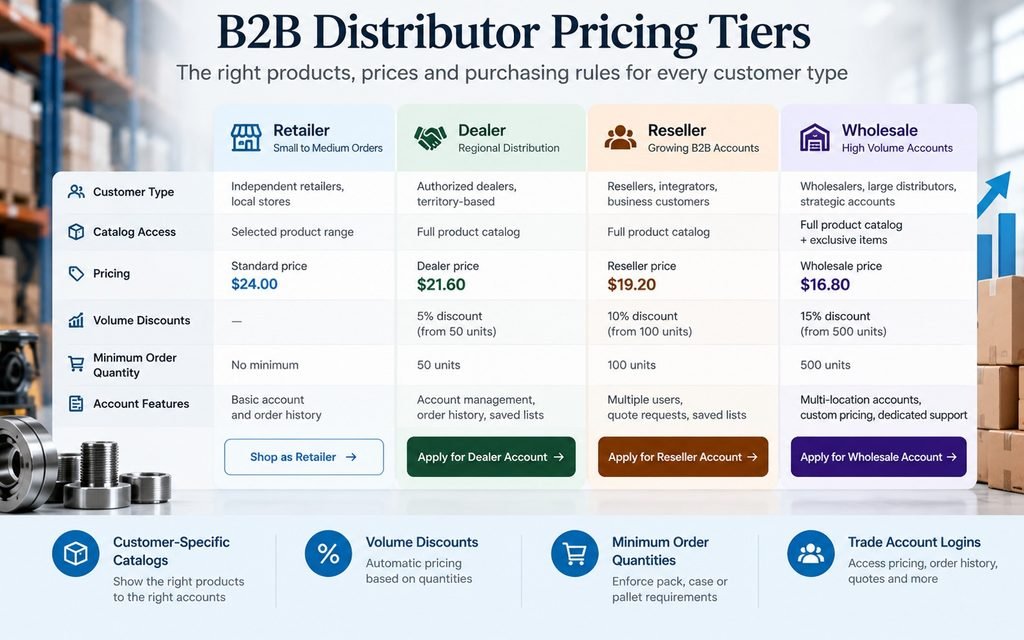
A pricing structure should reflect the distributor’s real commercial agreements. Depending on the business, retailers, dealers, resellers, and large wholesale accounts may receive different product access, price lists, quantity breaks, minimum order requirements, or negotiated terms.
The website must translate those rules into a consistent experience. Showing one public price when customers have account-specific terms can create confusion, while hiding all pricing behind a login may prevent qualified prospects from assessing whether the supplier is worth approaching.
A practical pricing plan should answer these questions before development begins:
- Account eligibility: Who can apply for a trade account, and what information must they provide?
- Approval rules: Who approves new accounts, and how are applicants informed of the decision?
- Catalog visibility: Which products can public visitors see, and which are restricted to approved buyers?
- Price visibility: Which prices are public, indicative, negotiated, or account-specific?
- Volume discounts: What quantities trigger a different price?
- Minimum quantities: Are minimums applied per product, pack, case, pallet, or order?
- Payment terms: Which accounts can use approved credit terms or purchase orders?
- Exceptions: How are special quotations and negotiated agreements managed?
A useful wholesale website design strategy also makes commercial rules visible before checkout. Buyers should not discover a minimum order requirement only after spending time building a cart, or find out that a price applies to a different customer group after submitting an order.
Give Every Approved Buyer a Clearer Route to Their Next Order.
A well-planned wholesale portal can bring account access, relevant pricing, product availability and ordering tools together in one place. The exact features should match your commercial rules and existing operations.
This is a conceptual portal preview. Your real account dashboard can reflect your pricing rules, customer groups and fulfilment process.
Plan My Wholesale Portal →What should you fix before introducing advanced pricing?
Start with the source of truth for prices and customer records. If sales representatives maintain negotiated prices in spreadsheets while the accounting system contains different values, putting those records online without resolving the discrepancy can create more problems than it solves.
Document the account groups, price ownership, update frequency, and exception-handling process. Then test representative accounts against real purchasing scenarios before enabling self-service ordering.
Evidence note: The pricing framework above is a recommended implementation method, not a claim about a proprietary KG Web Designer audit or a measured industry average.
Which Features Should You Prioritize on a Distributor Website?
Prioritize features according to the frequency and commercial importance of the tasks buyers need to complete. For a distributor with a large catalog, accurate product search may be more valuable initially than a complex loyalty program or a highly customized dashboard.
1. Product search and SKU lookup
Business buyers may arrive with a product code, model number, manufacturer name, or technical specification. Search should support these identifiers and return useful results for partial product names or codes where possible.
Filters should reflect real purchasing criteria, such as dimensions, material, compatibility, application, brand, product type, and availability. A large catalog that looks impressive but is difficult to search creates unnecessary work for both customers and sales staff.
2. Account registration and approval
A trade-account application should collect the information required to assess eligibility without asking for unnecessary details. The website should explain the approval process and what applicants can expect next.
After approval, users should see only the pricing, products, account data, and purchasing functions permitted for their company and role. Access controls require careful testing to prevent exposure of another customer’s orders, invoices, negotiated prices, or personal information.
3. Customer-specific pricing and quantity rules
Pricing must match the account and the order quantity. If products are sold in packs, cases, or pallets, the minimums and increments should be clearly explained before checkout.
The website should also explain how volume discounts are applied. Buyers need to understand whether a discount applies to one SKU, a particular variant, or an eligible group of products.
4. Quote requests and negotiated orders
Not every B2B transaction belongs in a standard checkout. Large orders, custom specifications, special delivery arrangements, and negotiated contracts may need a sales representative to review the requirements.
A product-specific quotation workflow can capture selected items, quantities, and relevant notes. The internal process should then define who reviews the request, how pricing is approved, and how an accepted quote becomes an order.
5. Repeat ordering and account history
Repeat buyers should not have to rebuild familiar orders from scratch. Order history, saved shopping lists, and reorder options can simplify recurring purchases when supported by the chosen platform.
Businesses with extensive catalogs may also benefit from quick ordering by SKU or bulk upload. These tools should be tested with real product data and realistic order sizes rather than just a small demonstration catalog.
6. Inventory, delivery, and payment information
Buyers need accurate information about stock, lead times, shipping restrictions, and payment options. The website should not make promises that the underlying inventory or fulfillment systems cannot support.
Before integrating an ERP, inventory system, or accounting platform, define which system controls product data, prices, stock, orders, and invoices. Where live integration is not feasible, make the limits of displayed information clear.
7. Mobile usability and accessibility
Trade buyers may need to check a product, review a quote, or place an order away from their desks. Product tables, filters, account dashboards, forms, and checkout should remain usable on smaller screens.
Test the complete mobile journey, including login, product search, quantity selection, cart review, quotation submission, and order confirmation. A responsive homepage alone does not establish that the purchasing experience works well on mobile.
What Does a B2B Buyer Need From a Distributor Website?
A B2B buyer needs enough reliable information to evaluate a product, confirm the applicable commercial terms, and understand how to complete the purchase. The website should support both buyers who are researching alternatives and experienced customers who arrive knowing exactly what they want.
This creates three distinct design requirements.
First, new prospects need clear product categories, technical specifications, company credentials, shipping information, and a straightforward way to request pricing. A dealer website design approach should also explain the supplier’s territory coverage, product brands, eligibility criteria, and support arrangements when those factors matter to dealer selection.
Second, approved buyers need efficient tools for routine tasks. They may prioritize SKU search, account pricing, saved orders, invoice access, or approval workflows over promotional content.
Third, purchasing managers and business owners need confidence that the website reflects the company’s real policies. Clear returns information, order terms, delivery expectations, privacy controls, and accessible sales support help reduce uncertainty before a buyer commits.
The website should not force all three audiences through the same journey. Navigation, product visibility, calls to action, and account functions should reflect their different needs while keeping the overall experience consistent.
Why Can a Brochure-Only Website Create Operational Friction?
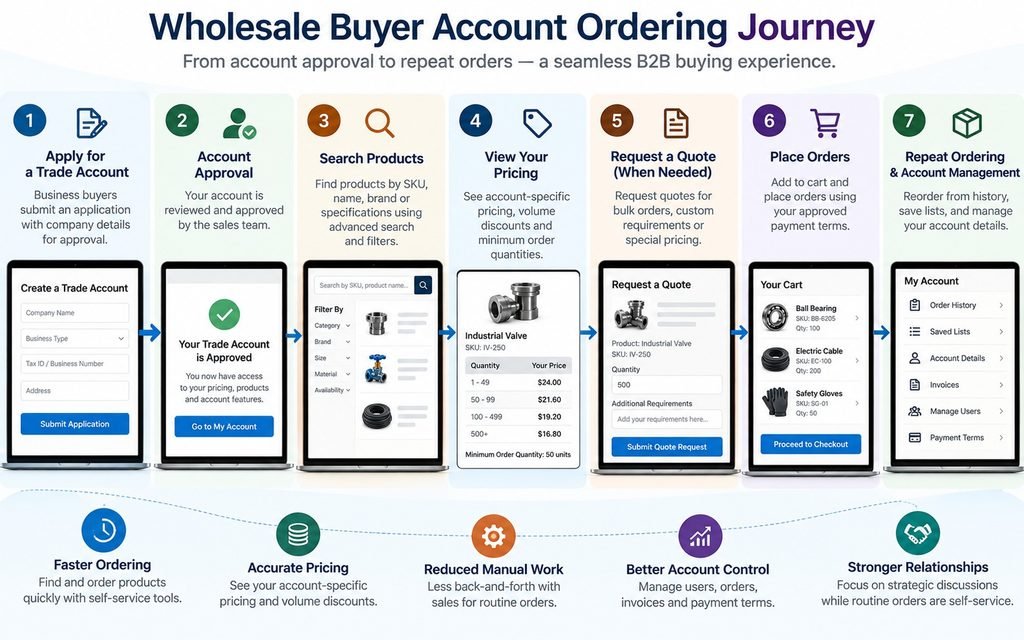
A brochure-only website can make the sales team the default route for tasks that customers could complete themselves. If every price inquiry, product lookup, account application, and repeat order requires an email or phone call, staff time becomes tied up in routine transactions.
Personal service remains valuable for complex negotiations, strategic accounts, and product guidance. The opportunity is to reserve that time for tasks where human judgment matters instead of requiring staff to manually handle every routine request.
Start by mapping the most common customer activities:
- Finding a product by SKU or specification.
- Checking account-specific pricing.
- Confirming minimum order quantities.
- Applying for a trade account.
- Requesting a quotation.
- Reordering previously purchased products.
- Checking order or invoice status.
- Asking sales to resolve an exception.
For each activity, document the current steps, people involved, customer wait time, and common errors. This creates a baseline against which the business can prioritize website improvements and later measure whether they have helped.
For a related perspective on how website purpose affects lead generation, read brochure website vs. lead-generation website. Although the article focuses on manufacturing, its central question is relevant to distributors too: does the website merely present the business, or does it help visitors take a commercially useful next step?
How Can You Plan the Project Without Wasting Budget?
The most effective project plan resolves commercial and technical uncertainty before investing in advanced functionality. A phased approach helps the business prioritize the features that matter most and identify dependencies before development begins.
| Phase | Main work | Validation |
|---|---|---|
| First: requirements | Map buyer types, pricing rules, catalog structure, and approval processes | Requirements are documented and agreed upon |
| Second: foundations | Improve product data, navigation, search, and account eligibility | Buyers can find products and understand account requirements |
| Third: purchasing | Add pricing tiers, quote workflows, repeat ordering, and permissions as needed | Common customer tasks work end to end |
| Fourth: integration | Connect inventory, ERP, accounting, or CRM systems where justified | Data ownership, accuracy, and error handling are tested |
| Fifth: measurement | Establish reporting and review post-launch performance | Results can be compared with a reliable baseline |
This sequence is a planning framework, not a universal development order. A business with unreliable inventory data may need to resolve the integration problem before enabling online ordering. A distributor with complex negotiated contracts may need to implement account-specific pricing and quotation workflows before checkout.
A professional reseller website design project should therefore include discovery, platform evaluation, information architecture, data migration planning, access-control testing, integration requirements, launch preparation, and ongoing maintenance. The proposal should explain what is included, what depends on third parties, and which responsibilities remain with the client.
Does Your Website Support the Way Your B2B Customers Buy?
Use this checklist to identify the core capabilities your wholesale website may need as your customer base and ordering requirements grow.
Can business buyers request access and be reviewed before viewing restricted information?
Can approved accounts access the correct price lists, negotiated rates or discount tiers?
Are case packs, order minimums and quantity rules clear?
Can buyers find specifications, pack sizes, availability and relevant product documents?
Can customers review previous purchases and repeat orders where supported?
Have inventory, ERP, CRM, payment and fulfilment requirements been considered?
Your portal should fit your actual sales operations—not add complexity your team doesn’t need.
Discuss My B2B Requirements →Review Your B2B Buying Journey
If customers still need to email sales for basic product, pricing, or account information, start by identifying which tasks should remain sales-led and which could become self-service.
KG Web Designer can help assess your website structure, buyer journeys, and functional requirements before you commit to a redesign. Discuss your distributor or wholesale website requirements.
What Should You Avoid When Investing in a Distributor Website?
Avoid purchasing features before defining the business process they are intended to support. A sophisticated buyer portal will not resolve inconsistent product data, unclear discount rules, or an order workflow that depends on undocumented staff knowledge.
Common mistakes include:
- Choosing a design before defining requirements. Map account types, pricing policies, approval stages, and order processes first.
- Treating login as the entire B2B strategy. An account is useful only if it provides relevant pricing, information, or purchasing tools.
- Displaying misleading prices. Make it clear whether prices are public, indicative, account-specific, or quotation-based.
- Ignoring product data quality. Missing SKUs, inconsistent units, and duplicate records undermine search and ordering.
- Overlooking integrations. Establish how product, stock, price, customer, order, and invoice records stay consistent.
- Making every transaction self-service. Preserve quote-based and sales-assisted workflows where complexity requires them.
- Launching without measurement. Define the baseline and success criteria before launch.
Another costly mistake is choosing a platform solely because a competitor uses it. Platform fit depends on catalog complexity, pricing rules, buyer permissions, integration requirements, internal capabilities, and the total cost of ownership.
For businesses comparing their own online channel with third-party marketplaces, the article on your own website versus IndiaMART, Alibaba, and Thomasnet explores the wider question of controlling the digital buying experience and building an independent channel. The relevant lesson for a distributor is to assess how each channel supports customer relationships, product discovery, and repeat purchasing rather than assuming one channel fits every business.
What Does This Mean for Your Business?
A well-planned B2B website can give customers a more direct way to buy and help the company manage repeat transactions consistently. The value depends on whether the new experience removes genuine friction, reflects the business’s commercial rules, and is adopted by customers.
Measure performance using indicators tied to business objectives:
- Qualified trade-account applications and approval rates.
- Percentage of approved accounts that place an order.
- Quote requests and quote-to-order conversion.
- Repeat-order frequency and time required to reorder.
- Product-search success and zero-result searches.
- Checkout completion and cart abandonment.
- Order-entry errors and customer-service contacts related to routine tasks.
- Website-generated revenue and gross margin where attribution is reliable.
Compare these measures with a pre-launch baseline. Account for seasonality, inventory availability, sales activity, and pricing changes before attributing any improvement to the website.
For distributors serving the United States, United Kingdom, or Australia, regional tax rules, shipping requirements, currencies, delivery expectations, and account terms may also affect the buying experience. These requirements should be considered during planning rather than added as an afterthought.
A useful related resource is the article on common lead-generation problems found during manufacturing website audits. Its manufacturing focus is distinct, but the broader practice of reviewing real buyer journeys, identifying friction, and prioritizing fixes is also relevant to distributor websites.
Example Scenario
Consider a hypothetical industrial distributor serving independent retailers, regional resellers, and large purchasing accounts. Its existing website displays company information and product categories, but customers must email sales for trade pricing and repeat orders.
The business first improves SKU search and product information. It then introduces approved accounts with appropriate pricing rules, followed by saved order lists and a quotation workflow for products that require negotiated terms.
The intended result is a clearer division between routine self-service purchases and transactions that require sales involvement. Whether the changes increase revenue, reduce order errors, or lower service costs must be established through post-launch measurement. This is an illustrative scenario, not a documented KG Web Designer client result.
Example From Our Experience: What Can We Substantiate?
A genuine case study requires a real business, a documented problem, an implemented solution, and a verifiable outcome. I do not have a verified KG Web Designer distributor project with those details available for this article, so I will not present the hypothetical scenario as a client success story.
What can be substantiated is the existence of relevant platform functionality. Shopify documents customer-specific catalogs, volume pricing, and quantity rules. BigCommerce documents company accounts, buyer roles, quotations, quick ordering, and other B2B account tools. These official sources establish available capabilities, but they do not demonstrate that KG Web Designer implemented them for a client or achieved a particular commercial result.
For publication as a client case study, add a permission-cleared project with the original workflow problem, the work delivered, and an outcome supported by analytics or business records. If those records are not available, retain this transparent evidence statement rather than inventing a result.
Expert Insight from Kanika Gupta
My judgment is that a distributor should not begin by asking how to make its website look more modern. It should begin by identifying which customer tasks create the most unnecessary manual work, which commercial rules must be represented online, and which data must be accurate for buyers to order confidently.
If this were my website, I would map the five most frequent customer tasks that currently require staff intervention. I would then prioritize the fixes that remove the greatest friction without compromising pricing accuracy, account security, or the sales team’s ability to handle complex transactions.
Kanika Gupta, Founder, KG Web Designer
The right platform is the one that supports the business’s real sales model and can be maintained without unnecessary operational complexity. A long feature list is not a substitute for a clear commercial strategy.
Why Do Most Businesses Get This Wrong?
Businesses often treat B2B website development as a branding exercise or a feature checklist. They may invest in a new visual identity, a larger catalog, or a login system without agreeing on pricing ownership, account approval rules, inventory accuracy, and the relationship between online orders and the sales team.
The result can be a modern-looking website that reproduces the same manual processes behind a new interface. Buyers still need to call for pricing, staff still re-enter orders, and exceptions continue to move through disconnected email threads.
A stronger approach combines commercial discovery, information architecture, product data planning, platform evaluation, integration design, and usability testing. Each feature should have a defined purpose and a way to evaluate whether it has improved the intended task.
The article on manufacturing website redesign and generating more RFQs provides another related perspective on aligning website structure with commercial outcomes. For distributors, the equivalent priority is to align the buying journey with the way customers discover products, access terms, and place orders.
When Does Professional Website Strategy Make Sense?
Professional support makes sense when the current website cannot support the buying process, when account and pricing requirements are difficult to manage, or when product data and systems need a coordinated implementation plan.
It is especially valuable when a project involves customer-specific catalogs, multiple buyer permissions, ERP or inventory integration, negotiated quotations, or migration from a legacy ordering process. These requirements affect architecture, data flows, security, and operational responsibilities, not just the appearance of the site.
A useful engagement should establish requirements before recommending a platform. It should define scope, integration dependencies, migration responsibilities, testing, training, launch criteria, maintenance, and the measures used to evaluate success.
KG Web Designer approaches website strategy as a business and conversion decision rather than simply a design deliverable. If your website needs to move from an informational presence to a more effective B2B buying experience, discuss your distributor website requirements with KG Web Designer.
Final Thoughts
A distributor website design should reflect how customers buy, not simply how the company describes itself. Pricing rules, account permissions, product discovery, quote requests, and repeat-order tools can make the buying experience more useful when they are designed around real business requirements.
The priority is to solve the right problems in the right order: define the commercial rules, improve product information, select a suitable platform, implement the necessary account and ordering functions, and measure what changes after launch.
If your current website leaves buyers dependent on email for routine tasks, KG Web Designer can help you assess the next steps toward a more effective B2B website. Discuss your distributor or wholesale website project.
Is Your Wholesale Website Making Business Purchasing Easier—or Slowing It Down?
Let’s review how your website supports wholesale buyers, from product discovery and account-specific pricing to bulk ordering and repeat purchases. We’ll identify practical improvements based on your business model, customer requirements and operational workflow.
What We’ll Review
Website Strategist
FAQs
What features should a distributor website have?
A distributor website should make products easy to find and provide the buying tools appropriate to its sales model. Common requirements include structured product catalogs, SKU search, trade-account applications, customer-specific pricing, quantity rules, quote requests, order history, and repeat ordering. Inventory, payment, and invoice functions may also be necessary, depending on the business’s operations and platform capabilities.
Should wholesale prices be visible without a login?
Wholesale prices do not always need to be public. A distributor can display list prices, show indicative pricing, or reserve negotiated prices for approved accounts, depending on its commercial agreements. The important points are to communicate the policy clearly and make account registration straightforward. Hiding every price without explaining the process can create unnecessary friction for qualified buyers.
How do customer-specific pricing tiers work on a B2B website?
Customer-specific pricing tiers assign eligible accounts the prices or discounts defined by the distributor’s commercial rules. Depending on the platform, this may involve company catalogs, customer groups, price lists, or account-level assignments. Volume pricing and minimum quantity rules can be configured separately where supported. Test representative accounts and order scenarios before launch.
Do distributors need an account portal if most orders come through sales representatives?
Not necessarily, but a portal can still help customers review product information, access account-specific terms, request quotations, and reorder familiar products. The best starting point depends on the tasks customers repeat and the sales team’s workload. A distributor can preserve relationship-led selling while moving suitable routine account activities online.
How much does a B2B distributor website cost?
Cost depends on catalog size, design requirements, pricing complexity, account permissions, integrations, and whether the website supports direct ordering or quote-based transactions. A simple catalog and account inquiry website has a different scope from an integrated B2B ecommerce platform. Request a proposal based on documented requirements, migration needs, integration dependencies, testing, and ongoing maintenance.
Which ecommerce platform is best for distributors and wholesalers?
The best platform is the one that supports the distributor’s pricing rules, customer accounts, catalog structure, order workflow, and required integrations at a sustainable cost. Shopify and BigCommerce both document B2B capabilities, but suitability depends on the specific requirements and configuration. Compare the full buying journey rather than selecting a platform based on feature lists alone.
How can I measure whether a new distributor website is working?
Measure outcomes tied to the business’s goals. Relevant indicators include qualified account registrations, quote-to-order conversion, repeat orders, search success, checkout completion, order-entry errors, and customer-service workload. Record a baseline before launch and review performance afterward. Consider seasonality, inventory availability, and sales activity before attributing changes to the website alone.