We reviewed 25 public manufacturing and industrial websites across the United States, United Kingdom, and Australia and identified 10 recurring website problems affecting buyer evaluation and lead generation. The most important issues involved capability clarity, technical depth, RFQ pathways, trust signals, international readiness, mobile usability, AI-readable content, and differentiation.
TL;DR / Key Takeaways
Most manufacturing websites fail because they communicate company information rather than buyer value.
Procurement teams evaluate trust, expertise, and operational capability before requesting quotes.
Hidden RFQ pathways create unnecessary friction and reduce inquiry volume.
Export buyers require significantly more proof than domestic prospects.
AI-powered search is becoming part of industrial supplier discovery.
High-performing manufacturers treat their websites as business development tools rather than digital brochures.
How We Audited 25 Manufacturing Websites
To make this review more than a collection of opinions, we used a consistent website audit framework across 25 public manufacturing and industrial websites.
The sample covers manufacturers and industrial companies operating primarily across the United States, United Kingdom, and Australia, with different business models and subsectors including precision manufacturing, contract manufacturing, aerospace, industrial equipment, power systems, advanced materials, medical products, packaging, construction equipment, shipbuilding, and industrial products.
Each website was reviewed against the same 10 areas:
Audit area
What we evaluated
Capability clarity
Whether buyers can quickly understand what the company manufactures and what capabilities it offers
Technical depth
Whether capability and product pages provide useful technical information for supplier evaluation
RFQ pathway
Whether a prospective buyer can easily identify and start the appropriate inquiry or quotation process
Trust signals
Visibility of certifications, quality systems, compliance information, and other credibility evidence
Buyer-focused messaging
Whether the website answers procurement and engineering questions rather than focusing mainly on company history
International readiness
Whether overseas buyers can understand geographic coverage and international support
Logistics and compliance
Whether relevant operational, delivery, documentation, and compliance information is accessible
Mobile experience
Whether important pages and commercial actions remain usable on mobile
AI-readable structure
Whether capabilities, industries, applications, expertise, and supporting evidence are clearly organized
Differentiation
Whether the website provides specific, evidence-backed reasons for a buyer to shortlist the supplier
The review was based on publicly accessible website information. We did not use private Google Analytics, Search Console, CRM, sales-pipeline, revenue, or conversion-rate data.
The purpose was not to rank the companies or identify the “best” and “worst” manufacturing websites. The purpose was to identify recurring website problems that can make supplier evaluation, trust building, and RFQ generation more difficult.
Sample size: 25 public manufacturing and industrial websites.
Geographic focus: United States, United Kingdom, and Australia.
Audit type: Public website content, UX, trust, RFQ, information architecture, and buyer-experience review.
Which 25 Manufacturing Websites Did We Audit?
To make this audit transparent, we reviewed 25 publicly accessible manufacturing and industrial websites across the United States, United Kingdom, and Australia. The sample included digital manufacturers, aerospace suppliers, industrial technology companies, power and energy manufacturers, steel and materials companies, packaging manufacturers, mining equipment companies, and other industrial businesses. We evaluated the publicly visible website experience rather than private analytics, CRM data, revenue data, or conversion data.
We counted a problem when the weakness was observable on the public website against the same checklist used for the other sites.
For example, an RFQ problem was not counted simply because a website used a short contact form. We looked at whether a prospective buyer could identify the appropriate commercial next step, provide relevant project information, and reach the manufacturer without unnecessary friction.
Similarly, a technical-depth problem was based on the information available to a prospective buyer. We looked for meaningful details such as processes, materials, tolerances, equipment, production capabilities, quality procedures, applications, technical documentation, or specifications.
The audit evaluates publicly visible website conditions. It does not use private Google Analytics, Search Console, CRM, sales-pipeline, revenue, or conversion-rate data. Therefore, the findings describe observable website conditions within the sample rather than claiming that a particular website loses a specific percentage of leads.
What was the sample?
Sample size: 25 public manufacturing and industrial websites Primary markets: United States, United Kingdom, Australia Audit focus: Website content, information architecture, buyer experience, trust signals, RFQ pathways, international readiness, and differentiation Method: Consistent 10-point public website review Private data used: None
The purpose of the audit was not to rank these companies or declare which manufacturer has the “best” website. It was to identify recurring website conditions that can make industrial supplier evaluation easier or harder for prospective buyers.
What We Found During Our Audit
The 25 websites in this review varied considerably in size, sector, product complexity, and digital maturity. The common issue was not that manufacturers lacked technical capability. It was that the website often made buyers work too hard to verify that capability.
Because this was a public-site audit, the findings below should be read as website observations, not claims about each company’s actual conversion rate or sales performance. We counted a problem only when the weakness was observable during the review against the same 10-point checklist.
Audit Findings
Across the 25 manufacturing and industrial websites we reviewed, we found recurring issues that can make it harder for prospective buyers to evaluate a supplier and take the next commercial step.
Rather than ranking individual companies or assigning a universal score to each website, we used the same review framework across the entire sample. The focus was on whether a prospective buyer could quickly understand capabilities, verify technical and quality information, evaluate supplier fit, and start an RFQ or commercial conversation.
The 10 recurring problem areas identified through the review were:
Buyers cannot verify capabilities quickly
Capability pages lack technical depth
RFQ processes create unnecessary friction
Certifications and trust signals are difficult to verify
Company messaging overshadows buyer needs
International buyers cannot easily assess supplier readiness
Logistics and compliance information is difficult to find
Mobile conversion experience needs improvement
Website information is not structured clearly for AI-assisted search
There is not enough evidence of differentiation
The purpose of this audit was not to determine which manufacturer has the best or worst website. It was to identify recurring website problems that manufacturing companies can address to make supplier evaluation clearer and the path to qualified inquiries easier.
What Evidence Did We Use?
The audit was based on information that a prospective buyer could access through each company’s public website. We reviewed primary navigation, homepage messaging, capability and product pages, industry and application pages, RFQ or contact pathways, certification and quality information, technical resources, case studies, global or regional information, and other publicly available buyer resources.
For each website, we recorded the evidence supporting the assessment rather than relying on a general impression of the brand.
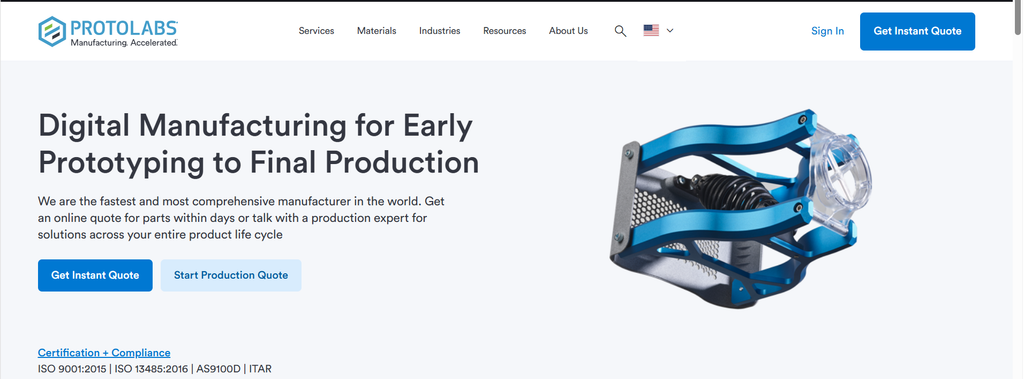
For example, Protolabs publicly exposes manufacturing services, instant and production quote pathways, certifications, quality documentation, manufacturing processes, industry resources, and production information. Those are the types of observable signals included in our review.
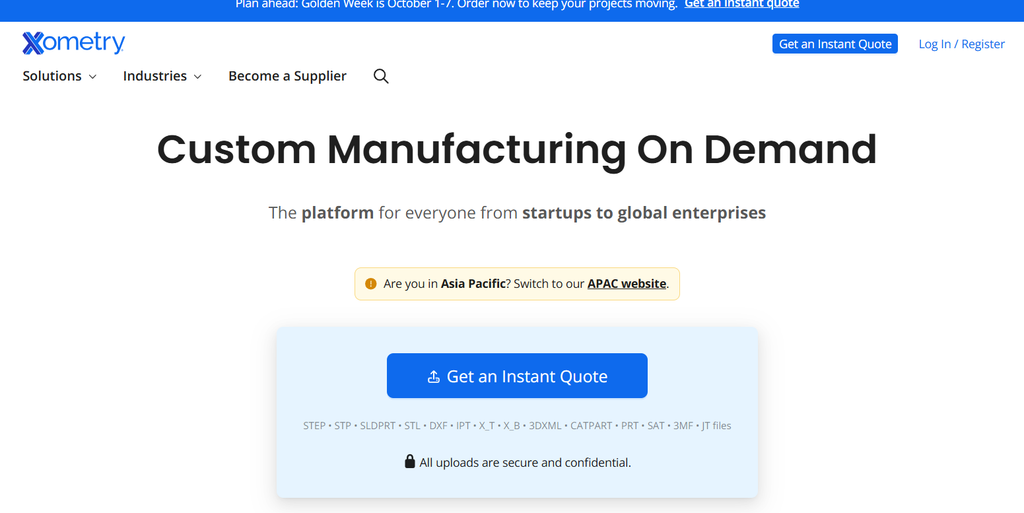
Xometry similarly publishes a detailed manufacturing capability structure and certification information, including ISO 9001, ISO 13485, IATF 16949, AS9100D, ITAR, and CMMC information.
These examples illustrate the type of public evidence considered in the audit. They are not intended to suggest that any company performs better commercially simply because its website exposes more information.
Important limitation
A website audit cannot prove how many leads a company actually receives or loses.
A manufacturer may generate substantial business through referrals, existing customer relationships, distributors, sales representatives, trade shows, procurement platforms, or direct sales activity even when its website has weaknesses.
For that reason, this audit measures observable website conditions, not actual company conversion rates or revenue performance.
Original Industry Observation
One pattern was visible repeatedly across the public websites we reviewed: many manufacturers had substantial technical information, but that information was not always organized around the questions a procurement buyer needs to answer before making contact.
This does not mean those companies have a traffic problem or a conversion problem. Public website inspection cannot establish either without access to analytics and CRM data.
What we can establish from the audit is that information architecture, technical specificity, trust visibility, and RFQ accessibility vary considerably across manufacturing websites.
Ready to Build a High-Converting Manufacturing Website?
Most manufacturing websites are structured around the company rather than around buyer decision-making.
Procurement teams, engineers, sourcing managers, and distributors arrive with specific questions.
They want to know:
Can this company meet our requirements?
Have they solved similar challenges?
What certifications do they hold?
What production capabilities do they have?
Can they support long-term growth?
When websites fail to answer these questions efficiently, buyers continue researching competitors.
At KG Web Designer, we have found that manufacturers frequently underestimate how much website structure influences inquiry quality and RFQ volume.
The First 5 Lead Generation Problems We Found Most Often
Problem #1: Buyers Cannot Verify Capabilities Quickly
The first question a manufacturing buyer needs answered is simple: Can this company actually make what I need?
Capability information should make the answer obvious through manufacturing processes, materials, tolerances, production scale, equipment, industries served, and relevant applications. When these details are fragmented across generic service pages, PDFs, or broad corporate sections, buyers have to do the interpretation themselves.
In our 25-site review, this problem was counted only when the website made capability or application fit difficult to verify through the primary navigation and relevant capability content.
What buyers should be able to verify quickly:
What the company manufactures
Which processes it specializes in
Materials and technical capabilities
Production scale or capacity where appropriate
Industries and applications served
Relevant certifications and quality systems
How to start a technical conversation or RFQ
Problem #2: Capability Pages Lack Technical Depth
We counted this problem when a manufacturer’s public capability pages described services primarily with promotional language but provided limited technical information needed for supplier evaluation.
For industrial buyers, “precision manufacturing” is not enough. The useful information may include materials, tolerances, equipment, production volumes, quality procedures, finishing options, testing, applications, and relevant technical documentation.
A capability page should help an engineer or procurement manager decide whether the supplier is worth contacting without requiring a sales call simply to understand basic technical fit.
Problem #3: RFQ Processes Create Friction
A manufacturing website does not need a complex quoting platform to generate a good inquiry, but it does need a clear next step.
We counted RFQ friction when buyers had to search for the inquiry path, use a generic contact form for a technical request, navigate unnecessarily between pages, or could not provide relevant project information through the available workflow.
For manufacturers handling technical sourcing, useful RFQ functionality may include:
Project or product category
Material requirements
Quantity or production volume
Timeline
Industry or application
Technical notes
CAD or drawing upload where appropriate
Secure file submission
Clear response expectations
The objective is not to make the form longer. It is to make the right inquiry easier to start.
Problem #4: Certifications Are Difficult To Find
Manufacturers often have the certifications buyers care about, but the website does not always make them easy to verify.
During the audit, we looked for visible references to relevant certifications, quality systems, compliance standards, inspection processes, and other trust signals. The issue was not whether a company possessed a certification internally. The issue was whether a prospective buyer could find and understand the relevant evidence through the public website.
Problem #5: Company Messaging Overshadows Buyer Needs
Manufacturers need to explain who they are, but procurement buyers are usually trying to answer a different set of questions: Can you solve our problem? Can you meet our requirements? Can you support the application? Can we trust the operation?
We counted this problem when company history, generic claims, or broad corporate messaging dominated the buyer-facing experience while capability, applications, proof, and commercial next steps received comparatively little attention.
“The manufacturing companies generating the strongest inquiry pipelines are rarely the companies with the most elaborate websites. They are the companies that make it easy for buyers to evaluate expertise, verify capabilities, and request quotes without friction. Clarity consistently outperforms complexity.”
Before planning a redesign, manufacturers should understand the investment required to build a website that supports lead generation, trust building, and long sales cycles. Our detailed budgeting guide breaks down what industrial companies should realistically expect to invest.
Wondering Why Your Website Isn’t Generating More RFQs?
Our manufacturing website audits evaluate:
Buyer journey friction
RFQ conversion opportunities
Capability presentation
Trust signal effectiveness
Export buyer readiness
AI visibility opportunities
Many manufacturers discover significant growth opportunities without increasing advertising budgets.
Problems #6–#10 We Found Most Often
The first five issues primarily affect trust and buyer confidence.
The next five directly impact visibility, international growth, AI discoverability, and long-term lead generation.
Problem #6: The website does not adequately address export-buyer concerns.
Many manufacturers want international business but provide very little information that helps overseas buyers reduce risk.
A procurement manager in Germany, a distributor in Dubai, or an OEM sourcing team in Australia often evaluates suppliers differently than a domestic buyer.
International buyers typically require more proof because facility visits are difficult and supplier relationships involve greater operational risk.
What Information Do International Buyers Need Before Requesting A Quote?
The strongest manufacturing websites proactively answer concerns before buyers ask.
Buyer Concern
Website Content That Reduces Risk
International shipping capability
Global logistics information
Regulatory compliance
ISO certifications and standards
Customs requirements
Export documentation expertise
Delivery reliability
Regional distribution networks
Product quality
Testing and quality assurance procedures
Communication barriers
Dedicated international sales support
Industry Observation
Many manufacturers discuss products extensively while providing almost no information about global delivery capabilities.
For export-focused companies, this creates unnecessary hesitation.
Extractable Fact
Export buyers often evaluate logistics confidence before evaluating pricing.
Problem #7: Logistics and compliance information is difficult to verify.
High-performing manufacturers increasingly dedicate sections of their websites to logistics, compliance, and international operations.
Many audited websites provided none of this information.
A modern capability page should include:
Export regions served
Shipping capabilities
Customs experience
Quality certifications
Regulatory compliance
Regional distribution support
For manufacturers serving aerospace, medical, defense, energy, or industrial automation sectors, compliance visibility becomes a major trust signal.
Examples include:
ISO 9001
ISO 13485
AS9100
FDA-related manufacturing standards
ITAR awareness where applicable
These details help reduce buyer uncertainty.
Problem #8: Mobile Conversion Experience Needs Improvement
Manufacturing buyers increasingly use phones during trade shows, supplier meetings, travel, and early-stage research. That makes mobile navigation and the ability to reach an RFQ or contact path quickly commercially important.
For this article, mobile findings should be reported separately from the public-content tally unless the sites have also been tested through a consistent mobile device or performance methodology. Do not present a precise mobile failure percentage based only on desktop/source inspection.
Problem #9: The Website Does Not Clearly Explain the Business to AI-Assisted Search
AI-assisted supplier discovery makes information architecture increasingly important.
For this audit, we looked for clearly structured capability pages, industry/application pages, certification information, technical resources, FAQs, case studies, and other content that makes the manufacturer’s expertise explicit and machine-readable.
The finding should not be phrased as “AI cannot understand this company.” A more defensible statement is that some websites provide too little structured, specific information for modern search and AI-assisted discovery systems to easily interpret the company’s capabilities and specialization.
↗
B2B AI Search Strategy
Is AI Search Answering Your Expertise Without Sending the Buyer?
Use this framework to identify which manufacturing pages can still attract qualified clicks—and which should be rebuilt to earn visibility and citations inside AI-powered search.
AI systems reward clarity, specificity, and expertise.
Problem #10: There Is Not Enough Evidence of Differentiation
Manufacturing websites frequently use the same claims: quality, reliability, experience, competitive pricing, advanced technology, and customer service.
The problem is not the claims themselves. The problem is that buyers need evidence to understand why one supplier should be shortlisted over another.
Stronger differentiation can come from:
Specific manufacturing capabilities
Relevant certifications
Production scale
Technical tolerances
Industry specialization
Facility or equipment evidence
Application expertise
Documented project outcomes
Real customer examples where disclosure is permitted
A useful differentiation statement should help a buyer answer one question: Why should we consider this manufacturer instead of the next qualified supplier?
18+ Years. 500+ Websites. Zero Cookie-Cutter Stores.
I design manufacturing websites for founders in the US, UK, and Australia who are serious about revenue. Custom-built, conversion-focused, and delivered on time.
What Do Strong Manufacturing Websites Do Differently?
The strongest examples in the review made the buyer’s evaluation process unusually clear.
Protolabs is a useful example because its website connects manufacturing services, materials, industries, certifications, technical resources, and quoting into one coherent journey. Its homepage also makes “Get Instant Quote” prominent, while capability pages provide detailed technical information and certification context.
Xometry is another strong example of procurement-oriented digital architecture. Its public website combines instant quoting, CAD upload, manufacturing capabilities, industry-specific pages, certifications, and secure file submission rather than forcing buyers through a generic contact process.
Rolls-Royce demonstrates a different model. It is not a transactional quote platform, but its website makes its business sectors, products, services, technical capabilities, global operations, research, and innovation areas highly explicit. That level of information architecture helps sophisticated buyers understand what the organization actually does before making contact.
The lesson is not that every manufacturer should copy these companies. The lesson is that strong industrial websites reduce the amount of interpretation required from the buyer.
Example Scenario: What Happens When a Buyer Cannot Verify Technical Fit?
Imagine an aerospace component buyer comparing two qualified suppliers.
Both companies have relevant certifications and modern production equipment. Supplier A provides a broad statement about “high-quality aerospace manufacturing,” while Supplier B clearly explains its relevant processes, materials, quality systems, applications, technical documentation, and RFQ requirements.
The second website does not necessarily prove that Supplier B is operationally better. It simply makes evaluation easier.
That distinction matters because procurement teams often have to eliminate unsuitable suppliers before speaking with them. A website that reduces uncertainty can therefore support the sales process even when the underlying manufacturing capabilities are similar.
How Did We Score the 25 Manufacturing Websites?
Each website received one point for each checklist item it satisfied and zero when the audited weakness was present.
The scoring was intentionally simple. This was not intended to produce a universal “best manufacturing website” ranking. It was designed to identify recurring lead-generation weaknesses across a consistent sample.
Audit area
What we checked
Capability clarity
Can buyers quickly understand what the company manufactures?
Technical depth
Are meaningful technical details available?
RFQ pathway
Is the commercial next step obvious and practical?
Trust signals
Are certifications and quality evidence easy to verify?
Buyer messaging
Does the site answer procurement questions?
Export readiness
Does it address international buyer concerns?
Logistics and compliance
Can buyers understand relevant operational requirements?
Mobile experience
Can buyers navigate and act effectively on mobile?
AI-readable structure
Is expertise organized clearly for modern search systems?
Differentiation
Is there credible evidence explaining why the supplier is different?
The percentages in this article represent the number of websites where the corresponding issue was observed divided by the total sample of 25 websites.
Why Is AI Visibility Becoming A Competitive Advantage?
Industrial buyers increasingly rely on AI-assisted research during supplier discovery.
This shift means manufacturers must communicate expertise not only to human buyers but also to AI systems interpreting website content.
The strongest-performing companies publish:
Detailed capability content
Industry-specific expertise
Certification information
Technical FAQs
Case studies
Process explanations
This is one reason custom manufacturing website development projects increasingly focus on content architecture and discoverability rather than visual redesign alone.
What Successful Manufacturers Are Doing Differently
They are building websites that help:
Buyers evaluate suppliers.
AI systems understand expertise.
Procurement teams verify capabilities.
Sales teams generate better inquiries.
The companies that adapt first will likely gain the greatest visibility advantage over the next several years.
Why Most Manufacturers Get This Wrong
Most manufacturers believe their website’s primary purpose is to provide company information.
That mindset creates one of the biggest lead generation problems we see.
Procurement teams, engineers, sourcing managers, distributors, and OEM buyers are not visiting your website to learn your company history. They are trying to determine whether you can solve a business problem, meet technical requirements, and reduce supplier risk.
During website audits we conducted, we repeatedly found manufacturers investing heavily in trade shows, outbound sales, and paid advertising while overlooking the buyer experience on their website.
The result is predictable.
Traffic arrives.
Interest exists.
But inquiries never happen.
The Most Common Misconceptions
Common Assumption
What Actually Happens
More traffic will generate more RFQs
Weak conversion systems waste existing traffic
Buyers compare suppliers primarily on price
Buyers evaluate trust and capability before pricing
Product catalogs are enough
Buyers need context, proof, and expertise
Certifications speak for themselves
Certifications must be visible and explained
A modern design guarantees results
Strategy and buyer experience drive performance
Extractable Fact
Industrial buyers often eliminate suppliers before making contact if required information is difficult to find.
What This Means For Your Business
Your website influences far more than marketing metrics.
It impacts:
RFQ volume
Lead quality
Export opportunities
Distributor inquiries
Sales efficiency
Buyer trust
Competitive positioning
The strongest manufacturing companies understand that websites are no longer passive marketing assets.
They are sales enablement platforms.
At KG Web Designer, we frequently see manufacturers improve inquiry quality simply by restructuring information, clarifying expertise, and reducing buyer friction.
In many cases, the opportunity already exists.
The website simply isn’t helping buyers reach a decision.
How Should Manufacturers Prepare For The Next Generation Of Industrial Search?
AI-assisted supplier discovery is becoming increasingly common.
Procurement teams are beginning to use conversational search tools to shortlist vendors before contacting them.
Questions increasingly resemble:
Best aerospace machining supplier in North America
ISO-certified medical device manufacturer
OEM contract manufacturer for industrial automation
Precision engineering company with export capabilities
Manufacturers that clearly communicate expertise are more likely to appear in these research workflows.
After auditing manufacturing websites across multiple industrial sectors, one conclusion became clear.
Most manufacturers do not have a traffic problem.
They have a communication problem.
The companies generating more qualified inquiries consistently make it easier for buyers to verify expertise, evaluate capabilities, understand differentiation, and request quotes with confidence.
The strongest websites reduce uncertainty.
They help procurement teams make informed decisions.
They support export growth.
They strengthen trust.
And they improve sales efficiency.
Investing in manufacturing website design services can help manufacturers create a more effective digital sales process, generate stronger RFQs, and compete more effectively in increasingly competitive industrial markets.
The manufacturers that communicate expertise most clearly are often the manufacturers that win more opportunities.
Ready To Improve Your Website’s RFQ Performance?
Whether you serve domestic buyers, OEM partners, distributors, export markets, or enterprise procurement teams, your website should contribute directly to business growth.
What You Are Facing
Recommended Solution
What You Get
Low RFQ volume despite decent traffic
Website Audit
Identification of buyer friction points, trust gaps, conversion issues, and AI visibility opportunities
Strong capabilities but weak market positioning
Strategy Session
A focused review of messaging, capability presentation, differentiation, and lead generation opportunities
Outgrown your current digital footprint
Project Consultation
A tailored redesign roadmap, technical scope definition, timeline planning, and investment guidance
Available across US, UK, Australia, Canada, Singapore, and UAE time zones. Fully remote. No commitment required.
Industry Insight
What We Learned Reviewing Manufacturing Websites
Over the past year, we reviewed manufacturing websites ranging from local machine shops to export-focused industrial suppliers. One pattern appeared repeatedly: most manufacturers already had strong technical capabilities, but their websites did not communicate those strengths clearly to buyers.
1. Product Information Was Hard to Find
Many websites placed important specifications, certifications, and product details inside PDFs or deep navigation paths, making it harder for buyers to evaluate the company quickly.
2. RFQ Opportunities Were Not Visible
Several manufacturing websites had enquiry forms, but they were hidden or disconnected from product and service pages where buyers were most likely to take action.
3. Industry-Specific Content Was Missing
Buyers want to know whether a manufacturer understands their sector. Websites that lacked application pages or industry-focused content often failed to build enough confidence.
Key Takeaway:
Design quality matters, but for manufacturers, clear information architecture, visible RFQ pathways, and technical credibility often influence lead generation more than visuals alone.
What This Audit Does Not Measure
This audit evaluates publicly visible website conditions. It does not measure private Google Analytics data, Search Console performance, CRM pipeline data, actual RFQ conversion rates, sales-qualified lead rates, revenue attribution, or customer acquisition cost.
The findings therefore identify website problems we could observe, not proof that a specific problem caused a specific company’s revenue or lead-generation performance to decline.
That distinction matters. A manufacturing website can have a weakness identified in this audit and still generate strong commercial results through referrals, sales teams, distributors, existing customers, or other acquisition channels.
Frequently Asked Questions
Can a manufacturing website really generate qualified RFQs?
Yes. A strategically designed manufacturing website helps buyers evaluate capabilities, certifications, production expertise, and operational fit before making contact. This improves both inquiry volume and lead quality.
What makes manufacturing websites different from other B2B websites?
Manufacturing websites support longer buying cycles and more complex evaluations. Procurement teams often require technical information, certifications, quality standards, engineering expertise, and proof of capability before requesting pricing.
Should manufacturers include CAD file upload functionality?
In many industries, yes. High-performing manufacturers increasingly support STEP, IGES, DWG, and other engineering file formats to streamline quoting processes and reduce friction during supplier evaluation.
How important are certifications on a manufacturing website?
Certifications are often critical trust signals. Standards such as ISO 9001, ISO 13485, and AS9100 can significantly influence supplier selection decisions and should be prominently displayed.
Can AI visibility influence industrial lead generation?
Absolutely. AI-powered search tools increasingly assist procurement teams with supplier research. Companies that clearly communicate expertise, capabilities, certifications, and industries served are more likely to benefit from AI-driven discovery.
What information do export buyers expect to see?
Export buyers typically look for logistics capabilities, international certifications, compliance information, production capacity, shipping expertise, and regional support capabilities before requesting a quote.
What systems should manufacturing websites integrate with?
Modern manufacturing websites often integrate with CRM platforms, ERP systems, CAD submission workflows, quote management tools, and marketing automation systems to improve efficiency and lead management.
Kanika Gupta is the Founder of KG Web Designer, a freelance website designer and digital marketing specialist from India. She helps businesses in India, the US, UK, Canada, and Australia build conversion-focused WordPress, ecommerce, SEO, and industry-specific websites.
Her work focuses on website design, WordPress development, SEO, local SEO, ecommerce UX, conversion optimization, and AI-ready content strategy for service businesses, consultants, healthcare brands, manufacturers, and online stores.
Hey, I’m Kanika Gupta. I help businesses design websites that attract customers, build trust, and generate real leads. My only question is, will it be yours?
I am Kanika Gupta, a creative website designer from India. I worked with MNC’s and the overseas clients for many years, and then one day I realized that I don’t need this 9 to 6 job anymore and it’s the right time to take some risks and learn from my mistakes and so I did start my career as a freelance web designer and developer.
Wax in the City has been specialising in professional waxing services for over 20 years. What began as a dedicated waxing studio has grown into a trusted name for clients who value experience, consistency, and results. While trends and treatments have changed over the years, our focus has remained the same — delivering high-quality waxing in a clean.
Gamahouse Publishing is a printing house that has been associated with Academic Publishing in the USA from the past 20 years and has printed more than 24000+ titles. Expanding its horizons from Academic, the publishing house is now open to the world of Fiction and Non-Fiction Authors.