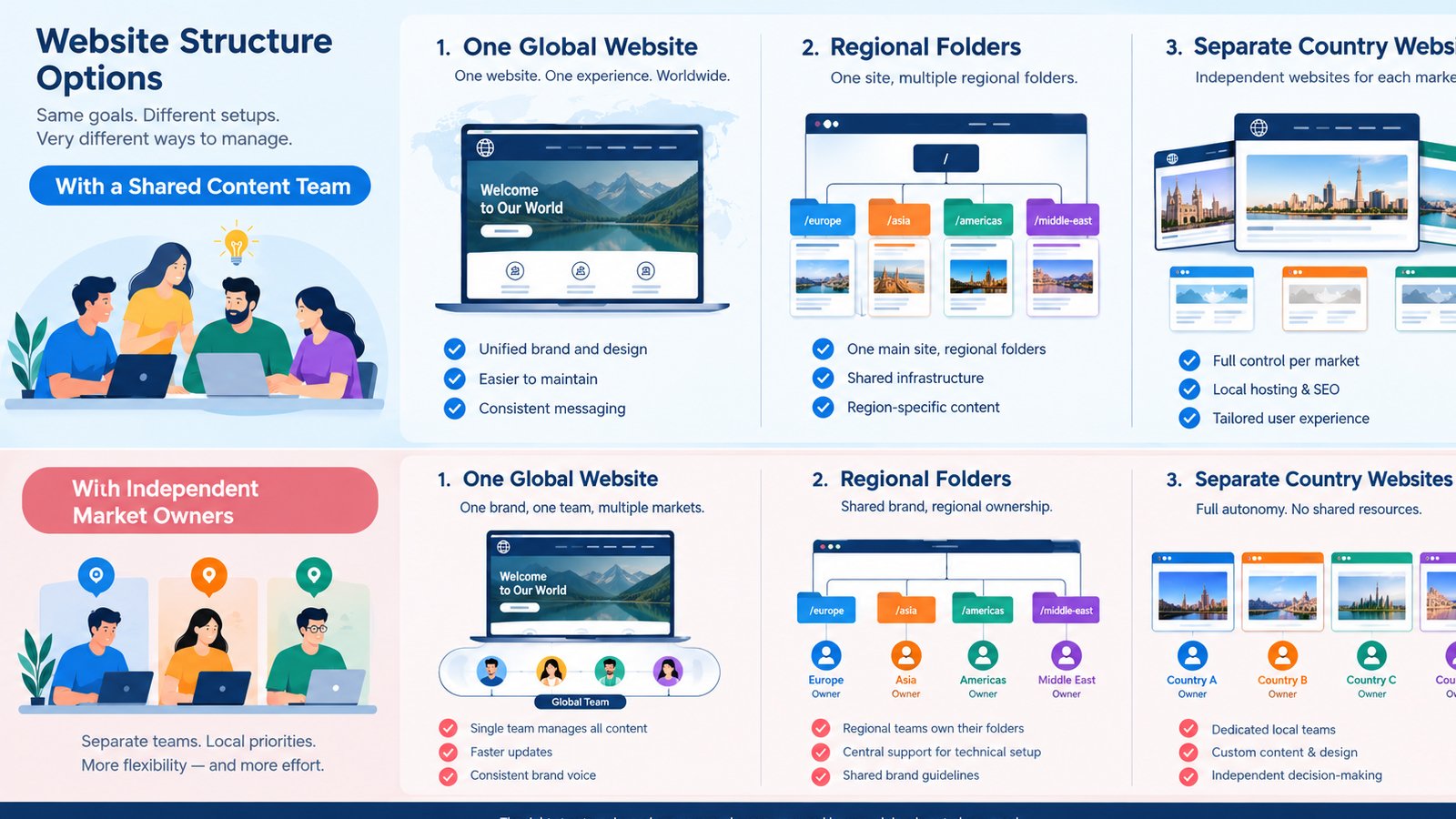
A business can serve five countries without needing five websites. It can also outgrow a single global site before anyone notices. The right international website structure depends on what changes between markets, who maintains those changes and how customers move from research to enquiry.
The expensive mistake is choosing domains first and investigating the operating model later. A country website creates obligations: someone must keep its services, claims, contact details and technical setup accurate. A subfolder is not automatically simpler if nobody owns its content.
Quick Answer: Use one global domain when your offer and delivery model are consistent. Add country or language subfolders when visitors need meaningfully different content and your team can maintain it. Consider separate websites when markets operate independently. Decide from buyer needs, publishing ownership and implementation constraints, not the assumption that every country requires its own domain.
Key Takeaways
- International sales do not automatically require regional website copies.
- Language, country and commercial availability are different planning dimensions.
- Subfolders can simplify shared operations; separate sites can support genuine independence.
- Hreflang, canonicals and redirects solve different problems.
- Approve a content owner and maintenance process before launching each market.
First ask what actually changes between countries
Suppose a consulting firm serves US, UK and Australian businesses through one team. Its offer, delivery process and pricing method are identical. Different time zones affect scheduling, but they do not necessarily justify three copies of every service page.
Now suppose a second firm has independent Canadian and UAE operations. Each sells different engagements, uses a different contracting entity and routes enquiries to different specialists. That business needs clearer market separation, even if every page is in English.
These are illustrative scenarios, not client case studies. Their difference is operational, not cosmetic. A useful architecture begins with a market-difference inventory:
- Offer: Which services or products are actually available?
- Language: Which languages can customers read and receive support in?
- Commercial terms: Do pricing, contracts or service boundaries differ?
- Proof: Which credentials and examples apply to each audience?
- Ownership: Who approves content and handles enquiries?
- Systems: Does each market depend on different software?
Mark each difference as required, useful or unnecessary. This prevents a sales wishlist from becoming an unmanageable publishing plan. For broader investment priorities, compare SEO, thought leadership and website redesign for professional services.
Compare the four realistic structures
| Structure | Example | Best operational fit | Main trade-off |
|---|---|---|---|
| Global site | example.com/services/ | One offer and delivery team | Limited room for regional differences unless deliberately added |
| Subfolders | example.com/en-gb/ | Shared brand, platform and governance | Regional content still requires ongoing ownership |
| Subdomains | uk.example.com | Separate applications under a shared brand | More infrastructure and integration coordination |
| Separate domains | example.co.uk | Independently operated market businesses | More assets, releases and maintenance to coordinate |
This is a business-fit comparison, not a ranking scorecard. None of these patterns removes the need for useful content, accessible navigation or a reliable contact journey.
One global domain without regional copies
A global site can explain coverage, delivery arrangements and market relevance without duplicating its core services. Keep one authoritative service description and add genuinely useful market information where necessary.
That can be the strongest starting point for a small professional firm. A visitor wants to know whether you can solve their problem, not whether your navigation contains their flag. Do not imply a local office, team or professional authorization that does not exist.
Country or language subfolders
Subfolders are a practical default to consider when one team controls the brand and technology. Shared templates, security updates and editorial standards can remain coordinated while regional pages differ.
However, folders do not maintain themselves. Every regional variation creates review work. If your UK offer changes, someone must update its page, connected FAQs and enquiry routing without accidentally changing the global offer.
Subdomains
A subdomain can make sense when a market uses a distinct application or publishing stack. It is an infrastructure option, not an automatic SEO upgrade. Ask whether the separation solves a genuine platform constraint or merely follows an old agency preference.
Before approving it, identify responsibility for DNS, certificates, deployment, monitoring and cross-site navigation. A tidy URL is not evidence of a tidy operating model.
Separate country websites
Separate domains deserve consideration when markets have independent leadership, service catalogs or systems. They can give local teams greater control, but shared changes become coordination tasks instead of single releases.
A brand-wide accessibility improvement or security correction may need implementation across several environments. Separate websites should therefore be funded as continuing operations, not just launch projects.
A practical international website structure decision framework
Use three gates before making a technical commitment. This framework is an editorial recommendation, not a search-engine requirement.
Gate 1: Does the visitor need a different experience?
Identify the smallest meaningful difference. A French translation may require language URLs. A market-specific service may require one regional page. Neither necessarily requires an entirely separate website.
If you cannot describe what changes for the customer, keep the experience shared. Country-name substitutions are not a persuasive reason to multiply pages.
Gate 2: Can the organization maintain it?
Name the approver, editor and enquiry owner for every proposed market. Confirm who handles holidays, departures and urgent corrections. A folder without an owner becomes stale just as quickly as an independent website.
For manufacturers, market differences often center on buyer requirements and sales coverage. The guide to websites for international manufacturing buyers explains that commercial context. Keep the architecture decision separate from detailed product-localization work.
Gate 3: Does technical separation solve a real constraint?
If one platform and team can support the required experiences, compare a shared implementation first. If independent systems, releases or market ownership make sharing impractical, examine subdomains or separate sites.
Ask a vendor to explain the rejected options as well as the recommendation. “This is better for SEO” is not enough. You need a clear account of maintenance, visitor journeys, migration and future expansion.
Separate language planning from country planning
English is a language, not a market. Canada may need English and French experiences. A UAE business may require English and Arabic. Meanwhile, several countries may use the same English page if the offer and supporting information are unchanged.
Write a locale register before development. Record the language, intended audience, actual service availability, content owner and proposed URL pattern. Path names are conventions your team chooses; they are not substitutes for implementation.
For example, /en-ca/ might identify English content for Canadian buyers. A generic /fr/ experience might serve French readers across countries. Select the arrangement that reflects your business rather than producing every possible language-country combination.
Google recommends distinct URLs for language versions. See its multi-regional and multilingual site guidance. That is not a recommendation to create a page for every country you hope to serve.
Keep untranslated or unavailable services out of a regional navigation until there is a useful destination. If a resource exists only in English, label that limitation instead of sending readers into an unexpected language change.
Make the SEO signals agree
Your implementation brief should distinguish three jobs:
- Hreflang: Associates language or regional alternatives.
- Canonical: Indicates the preferred URL among duplicate or very similar versions.
- Redirect: Sends a request from an old or alternative address to another URL.
Do not use one as a substitute for another. Hreflang cannot repair a broken destination. A redirect does not preserve access to two alternatives. A canonical strategy must not accidentally contradict the pages you intend to publish.
For hreflang sets, use valid language and optional region codes, complete URLs and reciprocal references, including each page itself. UK English uses en-GB, not en-UK. Google documents these requirements in its localized page implementation guide.
Choose canonical treatment deliberately. Do not automatically canonicalize every translation to the English homepage. Equally, do not assume every near-identical regional English page should be independently canonical without reviewing its purpose. Consult Google’s canonical URL guidance when resolving duplicate versions.
A developer should test representative service, article and contact pages, not just the homepage. Broken alternate sets often emerge where one language has fewer pages than another.
Design the switcher around the task
A visitor reading a specific service should land on the equivalent service after switching markets, where available. Returning everyone to a homepage makes them repeat their research.
If there is no equivalent, explain the gap and offer a relevant next step. Do not silently route them to an unrelated page. Use language and market names in text; a flag alone does not explain language or availability.
Prefer a market suggestion over forced redirection. A buyer traveling abroad may still need their home-market service, while a procurement team may compare several markets. Allow visitors to choose and change their selection.
Test persistence carefully. A remembered preference should not prevent access to another public version. Keep browser behavior, search destinations and internal navigation aligned.
Scope the build before requesting prices
There is no defensible universal cost for international architecture. A proposal covering two translated pages is not comparable with one covering hundreds of regional variants and a migration.
Request separate scope lines for architecture, template development, content adaptation, technical configuration, integration testing and ongoing support. Record assumptions about page counts and who supplies reviewed copy.
An illustrative planning exercise shows the workload: four markets with twelve regional page variants each create forty-eight pages to review, before shared articles and supporting materials. That arithmetic estimates content responsibility, not project price or SEO benefit.
Ask what adding a fifth market would involve. Can the team reuse templates? Which settings are global? What requires manual review? Who tests the new enquiry route? Answers reveal whether the system can expand without repeated rebuilding.
For WordPress, compare a multilingual installation with a multisite or independently managed approach against those requirements. None is inherently the right answer. WordPress implementation support should connect platform configuration with editorial ownership and quality assurance.
Include maintenance in the decision. The distinction between a website maintenance retainer and occasional support becomes especially relevant when several market experiences depend on shared code.
Protect existing URLs during a rollout
If the current site already has useful pages, changing their addresses is a migration decision. Do not move everything into a new regional folder simply to make the structure look symmetrical.
Map old pages to appropriate new destinations, update internal references and test redirects. Preserve business-critical forms and resources as well as landing pages. Google’s site-move guidance provides the technical reference; your launch plan should also identify owners and rollback criteria.
A staged rollout can reduce operational uncertainty. Pilot one market and a representative set of pages, resolve workflow problems, then expand. This is not a guarantee against search fluctuations, but it gives the team a manageable testing boundary.
The pre-launch acceptance checklist
- Each market has a documented service scope and accountable content owner.
- Public pages resolve successfully and the intended versions are indexable.
- Canonicals, hreflang and sitemap URLs do not conflict.
- Switchers preserve context or clearly explain unavailable alternatives.
- Forms reach the correct team and confirmation messages match the market.
- Booking times, phone formats and contact expectations are understandable.
- Mobile navigation, translated layouts and right-to-left content are tested where relevant.
- Measurement distinguishes page locale from visitor location and actual sales market.
- Redirect mappings and recovery responsibilities are documented.
Privacy notices, contractual language and professional claims may differ between markets. Have qualified advisers review applicable requirements. This article is website strategy guidance, not legal, tax or regulatory advice.
Measure the market experience, not just the visitor’s country
A visitor located in London may represent a Canadian company. A US session may browse a UAE service. Geography alone cannot establish which experience generated a qualified opportunity.
Keep page locale, visitor geography and self-declared sales market as separate reporting fields. Review enquiry quality alongside traffic. A regional site that attracts sessions but sends them to the wrong team has not solved the commercial problem.
Agree the first review questions before launch: Are prospects finding the intended pages? Are forms reaching the right owners? Which markets produce relevant conversations? Which variations consume maintenance time without serving a clear need?
Those questions keep expansion disciplined. Add another regional experience when evidence and delivery capacity justify it, not because an architecture diagram has an empty branch.
Choose the smallest structure that supports real differences
A global website is not a lesser option. Separate country sites are not proof of maturity. The useful structure is the one your buyers can understand and your organization can operate accurately.
Start with the market-difference inventory. Select the lightest workable architecture. Assign ownership, test complete journeys and document how expansion will happen. That sequence creates a stronger foundation than buying domains and filling them later.
Frequently Asked Questions
What is the best international website structure for a small business?
Start with one global domain when services and delivery are substantially the same across markets. Add language or country subfolders only when they support a genuine visitor need and you can maintain them. Separate websites usually need a stronger operational reason than wanting to rank in another country.
Should I use subfolders or separate domains for international SEO?
Subfolders suit a shared brand, platform and publishing team. Separate domains can suit independently operated markets with different services, ownership or systems. Neither structure guarantees rankings. Compare ongoing maintenance, local content ownership, migration risk and the buyer journey before choosing.
Do I need separate websites for the US, UK, Canada, Australia and UAE?
Not automatically. If buyers receive the same service through the same team, a global website may be sufficient. Create regional experiences where availability, language, terms, proof or contact routing differ meaningfully. Do not create five copied sites simply because five countries appear in your sales plan.
Can English pages for different countries use hreflang?
Yes. Hreflang can identify language and regional alternatives, including English variants such as en-US and en-GB. The pages must actually exist and form a valid alternate set. Hreflang is not a substitute for relevant content, indexability or a deliberate canonical strategy.
Should my website automatically redirect visitors to their country page?
Prefer a visible market suggestion and a visitor-controlled switcher. Automatic location or language redirects can send travelers, remote buyers and crawlers to the wrong experience. Keep every public version accessible through a stable URL and allow visitors to change their choice.
How much does an international website architecture project cost?
There is no reliable universal price. Scope depends on market and language counts, page variants, migration, platform limitations, content review and integrations. Request separate estimates for strategy, implementation, localization, testing and ongoing maintenance, with explicit assumptions about what happens when another market is added.