Quick Answer
A day spa website should sell a relaxing experience and make treatments, packages, pricing, and booking easy to navigate. A med spa website must also establish professional credibility, explain treatment options, and guide prospective clients toward an appropriate consultation or appointment. Effective spa website design reflects these different customer decisions through distinct content, trust signals, and booking pathways. The same template can look attractive while failing to address the needs of either audience.
TL;DR: Key Takeaways
- Day spas need clear treatment menus, pricing, packages, gift cards, and convenient appointment booking.
- Med spas need accurate provider credentials, treatment-specific education, realistic expectations, and appropriate consultation pathways.
- Zenoti’s published benchmark reports that 97% of med spa clients want mobile booking, while the average med spa books 11% of appointments online.
- A booking button alone cannot compensate for unclear service information, weak trust signals, or a confusing scheduling process.
- The best redesign starts with the biggest customer-journey problem, not the most visually outdated page.
- Website performance should be measured using the business’s own qualified inquiries, booking completion, and customer behavior.
Why Do Day Spas and Med Spas Need Different Website Strategies?
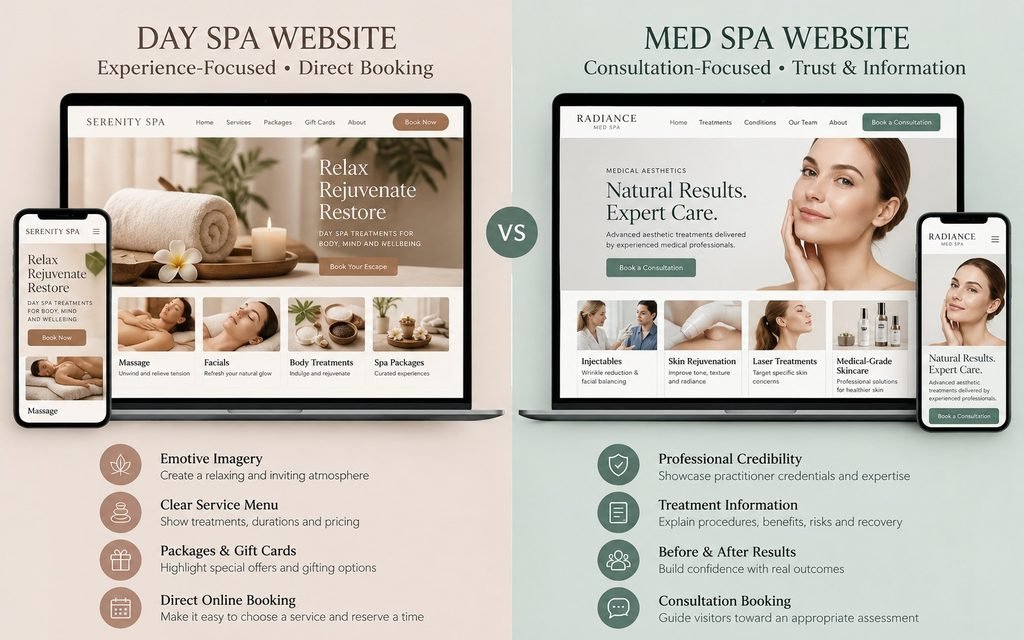
Day spas and medical spas may both offer skincare services, but customers often arrive with different expectations. A day spa visitor may be looking for a massage this weekend, a gift card for a friend, or a relaxing package for a special occasion. A med spa visitor may be researching injectables, laser treatments, or other aesthetic procedures and need information about practitioner qualifications, treatment suitability, potential risks, and consultations before deciding what to do.
The American Med Spa Association describes medical spas as businesses that provide aesthetic medical services within a spa-like environment and under appropriate professional oversight. Traditional day spas generally focus on relaxation and wellness. Specific obligations vary by jurisdiction, service, and provider, so a med spa website must accurately reflect the practice’s actual services and professional arrangements.
This distinction changes the website’s purpose. A day spa needs to make an experience easy to understand and book. A med spa needs to help prospective clients evaluate the practice, understand relevant treatment information, and identify the appropriate next step without suggesting that every visitor is automatically a suitable treatment candidate.
KG Web Designer is a conversion-focused website design studio specializing in custom websites for clinics, professional services, manufacturers, and growing businesses. A conversion-focused approach connects page structure, messaging, trust, and usability to the action the business wants the right visitor to take.
Day spa vs. med spa website requirements
| Website element | Day spa | Med spa |
|---|---|---|
| Main customer motivation | Relaxation, convenience, self-care, gifting | Aesthetic goals, treatment suitability, professional confidence |
| Homepage priority | Experience, popular services, packages, booking | Treatment expertise, provider credibility, consultation |
| Service-page content | Duration, price, inclusions, experience | Purpose, suitability, process, risks, recovery where relevant |
| Trust signals | Facilities, therapist information, genuine reviews, policies | Provider qualifications, professional oversight, realistic treatment information |
| Booking pathway | Direct booking for clearly defined services | Consultation or appointment pathway appropriate to the treatment |
| Supporting content | Gift cards, packages, memberships, FAQs | Treatment comparisons, preparation, aftercare, candidacy information |
| Main conversion question | “Can I book the experience I want?” | “Can I make an informed decision about this treatment and provider?” |
This comparison is a strategic framework rather than a rigid formula. A day spa offering specialist services may need more detailed educational content. An established med spa may allow returning clients to book selected services directly. The website should reflect the actual customer journey and the business’s operating requirements.
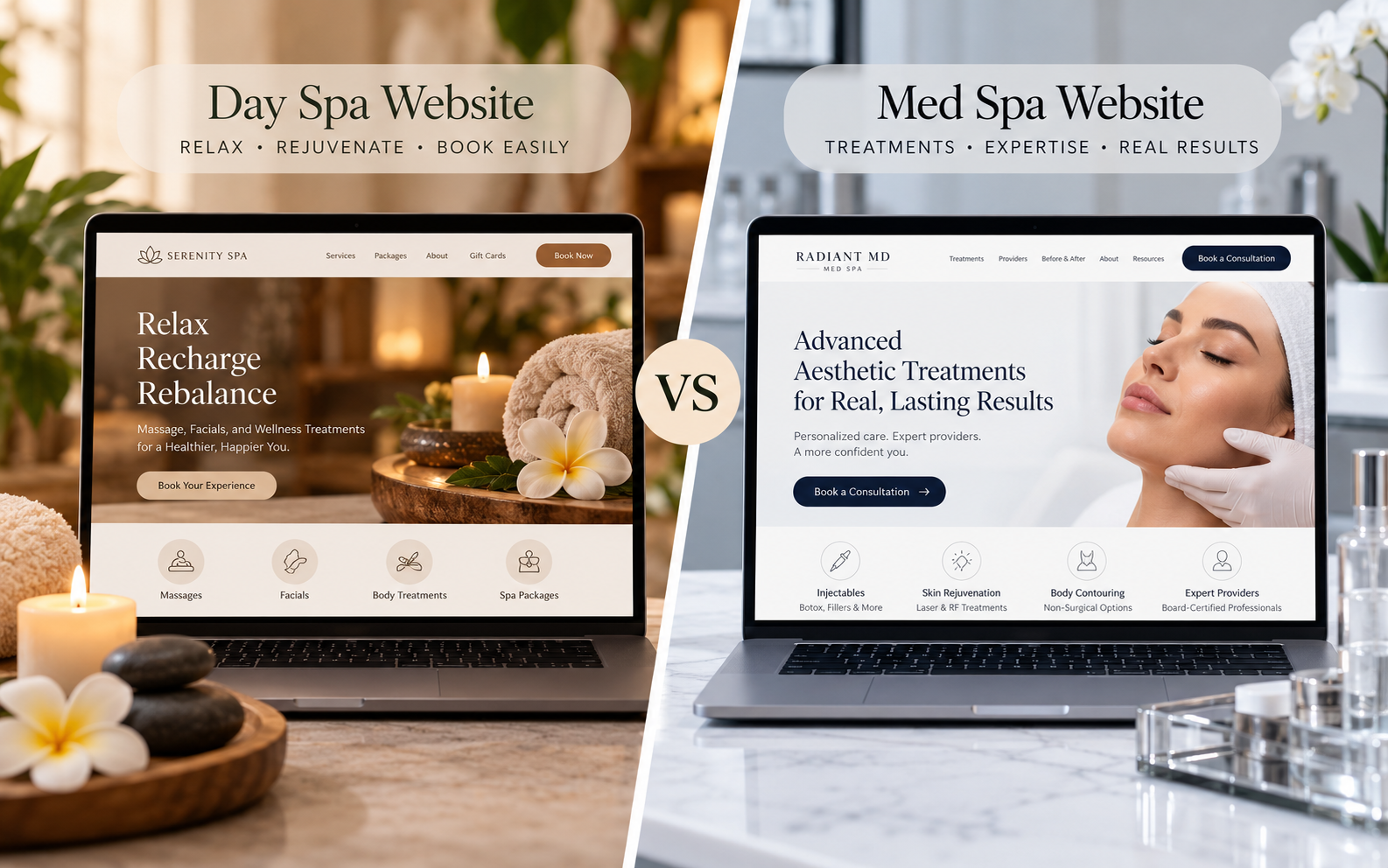
A med spa vs spa website comparison should focus on customer intent, provider credibility, treatment information, and the booking journey rather than visual style alone.
Same Industry. Different Decisions. Different Website Experiences.
A day spa guest may be looking for relaxation and convenience. A med spa patient may need more information about practitioners, procedures and suitability before booking.
Sell the Experience
Build Informed Confidence
What Does Real Industry Data Reveal About Spa Website Bookings?
Published industry benchmarks show that digital booking matters to customers, but adoption varies across business categories. Zenoti’s 2025 Beauty and Wellness Benchmark Report includes performance data from businesses using its platform and consumer preference findings. Its figures provide useful context for website planning, but they do not prove that a redesign alone causes an increase in bookings or revenue.
| Published finding | Reported figure | Practical implication |
|---|---|---|
| Med spa clients who want mobile appointment booking | 97% | Make the appropriate booking or consultation action easy to access on mobile. |
| Salon and spa guests who want mobile booking | 80% | Treat mobile scheduling as a core customer-experience requirement. |
| Average online booking rate for med spas | 11% | Investigate scheduling friction and whether the pathway fits the service. |
| Average online booking rate for non-membership spas | 61% | Compare with the relevant business category, not a generic industry average. |
| Online booking rate among top-earning med spas | 31% | Study the operational and customer-experience differences behind stronger performance. |
Source: Zenoti’s beauty and wellness industry benchmarks.
The difference between stated preference and actual behavior matters. The 97% figure reflects med spa clients’ reported preference for mobile booking, while 11% describes the average share of appointments booked online in the report’s med spa category. Neither number means that 97% of website visitors will book simply because a business adds a mobile booking button.
For a spa owner, the useful question is where customers encounter friction. Can visitors find the right treatment? Do they understand whether they should book a service or a consultation? Does the scheduling platform work on a phone? Are prices, policies, and next steps clear before confirmation?
The International SPA Association’s 2024 U.S. Spa Industry Study provides additional context about the spa industry. When using any benchmark, check the report’s category definitions, geographic coverage, and sample before comparing it with your own analytics.
Original data and transparency note: The figures in this article are published third-party benchmarks, not proprietary findings from KG Web Designer. No verified day spa or med spa audit dataset has been supplied for this article, so it would be misleading to claim a specific percentage of spa websites has a particular problem or that a redesign guarantees more appointments.
What Should a Day Spa Website Prioritize for Day Spas?
A day spa website should make the experience appealing while keeping practical booking information easy to find. Customers often compare treatments, prices, duration, availability, and packages before committing. When these details are hidden beneath decorative imagery or vague descriptions, the website creates unnecessary work at the moment the customer is deciding. Effective Day spa website design makes it easy for customers to compare treatments, understand prices, and move from browsing to booking.
A useful day spa website should include:
- A clear experience statement. Explain whether the business specializes in massage, facials, relaxation, couples’ treatments, full-day packages, or another defined offering.
- A scannable service menu. Organize treatments into meaningful categories and show duration, price, and inclusions where possible.
- Visible booking access. Give visitors a clear path from each service page to available appointments.
- Authentic photography. Show the real facilities and treatment environment rather than relying entirely on generic stock imagery.
- Gift cards and packages. Make them easy to discover when they are meaningful revenue streams.
- Clear policies. Explain deposits, cancellations, arrival times, and rescheduling before customers confirm.
- Retention options. Present memberships or repeat-visit benefits when they fit the business model, without overwhelming first-time visitors.
One industry-specific issue is that the person purchasing a spa service may not be the person receiving it. Gift-card buyers need to understand redemption rules, available experiences, and any restrictions. A website designed only around customers booking for themselves can overlook this separate purchase journey.
Another issue is the balance between atmosphere and clarity. Calm colors, refined typography, and generous spacing can communicate relaxation, but they should not make prices, treatment details, or booking actions difficult to locate. Visual appeal should support the decision rather than delay it.
What Must a Med Spa Website Do Differently?
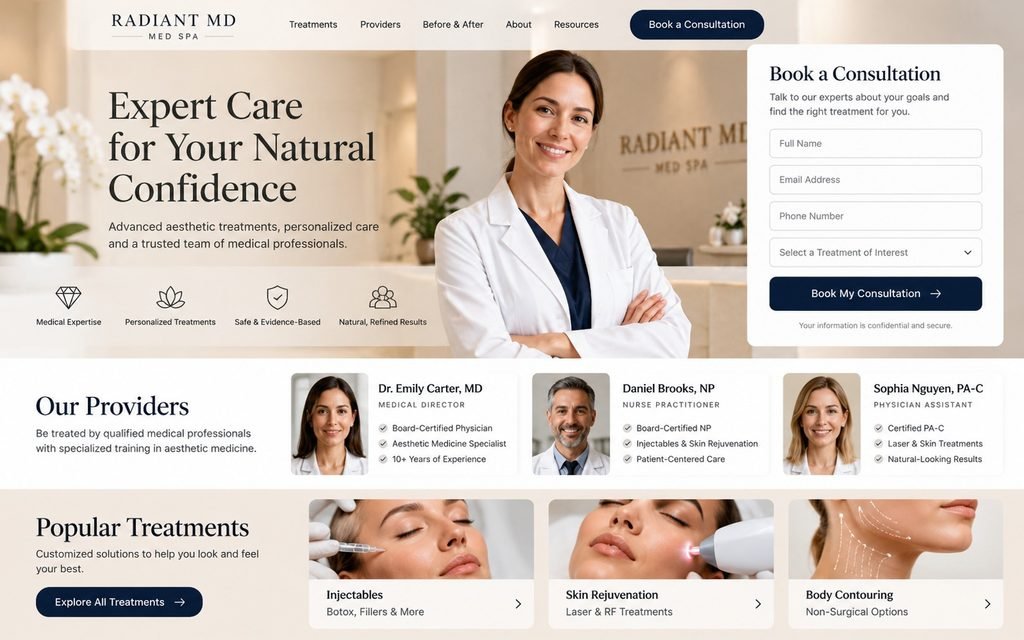
A med spa website must help prospective clients evaluate the practice and understand the treatment pathway. A premium visual identity can support confidence, but it cannot replace accurate provider information, clear treatment descriptions, or appropriate professional oversight.
Important elements include:
- Provider profiles: Identify practitioners, relevant qualifications, and roles accurately.
- Dedicated treatment pages: Explain the purpose of each service, the process involved, and who may be an appropriate candidate.
- Clear consultation pathways: Explain when a consultation is required and what happens during the appointment.
- Realistic expectations: Avoid guaranteed outcomes, unsupported claims, and misleading before-and-after presentations.
- Relevant safety information: Include appropriate information about risks, preparation, and aftercare, with clinical content reviewed by qualified professionals.
- Privacy-conscious forms: Collect only the information needed at each stage and use suitable systems for sensitive information.
- Treatment-specific FAQs: Answer common questions without suggesting that website content replaces individualized professional advice.
A frequent mistake is assuming that luxury design automatically communicates medical credibility. A sophisticated palette and polished photography can create a premium impression, but visitors still need to understand who provides treatment, what the process involves, and how the practice approaches suitability and safety.
Medical-aesthetic advertising also requires care. The Federal Trade Commission’s Health Products Compliance Guidance explains that health-related marketing claims must be truthful, not misleading, and adequately substantiated. The exact rules depend on the claim, service, jurisdiction, and professional regulations, so clinical or legal review may be appropriate before publication.
The website should also reflect differences between first-time and returning clients. A first-time visitor may need education and a consultation. An established client may need a straightforward route to an appropriate follow-up appointment. Sending both through the same generic form can create unnecessary friction.
For more specific conversion guidance, read med spa website conversion, which explores how service messaging, trust, and booking friction can affect the next step a visitor takes.
How Should You Structure the Booking Journey?
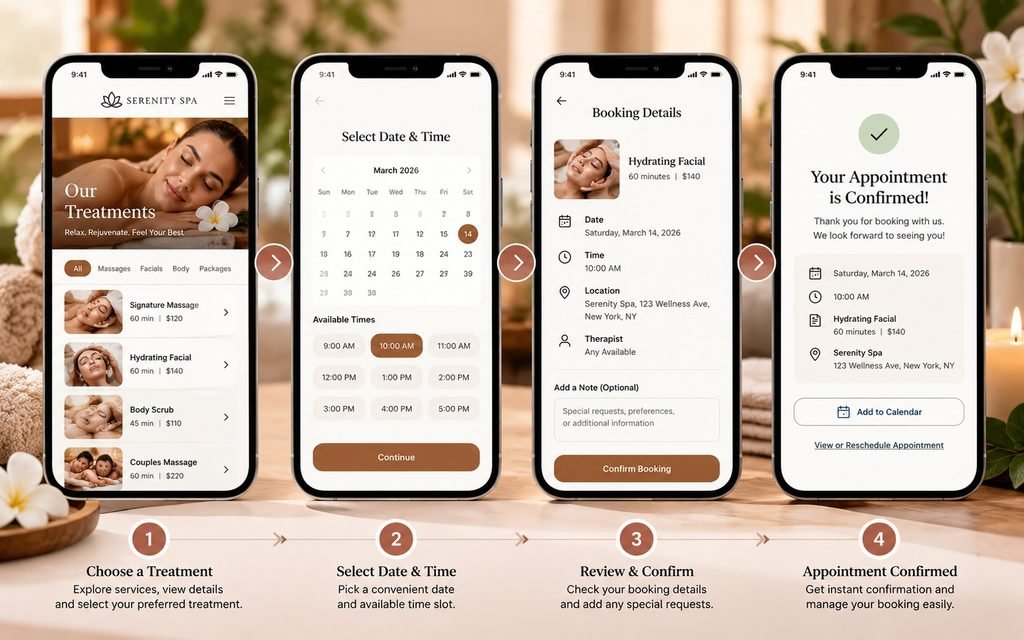
The booking journey should remove uncertainty at the moment a customer is ready to act. Day spas often need a straightforward route from treatment selection to appointment confirmation. Med spas may need a consultation pathway, direct scheduling for appropriate appointments, or both, depending on the treatment and professional requirements. A spa website booking page should make the next step clear, explain what the customer is booking, and remove unnecessary friction before confirmation.
A well-structured booking page should answer four questions: What am I booking? What will it cost or require? What happens next? What should I know before confirming?
For a day spa, the journey might involve selecting a treatment or package, reviewing its duration and price, choosing an available time, and confirming the appointment. Relevant policies should be easy to understand before the customer completes the booking.
For a med spa, the journey may begin with selecting a consultation or requesting an appropriate appointment. Explain what the initial visit involves, whether a provider will assess suitability, and what the client should expect afterward. The website should reflect the practice’s real workflow rather than imply that every visitor can proceed directly to a procedure.
Do not assume that every service should use the same scheduling flow. Test the process on a phone, make it easy to return to treatment information, and ensure that prices, appointment types, and policies match the website copy. If an external scheduling platform is involved, test the complete journey rather than only the button on the main site.
A booking button is not a complete conversion strategy. Where tracking is available, measure booking completion, form abandonment, mobile usability, and the quality of resulting inquiries. These signals can help distinguish website friction from limited appointment availability, unclear service positioning, or an operational issue.
Are You Sending Every Visitor Through the Same Booking Journey?
The path from discovery to appointment should reflect the level of information and reassurance each service requires.
Design the right conversion journey for the services you offer — without adding unnecessary steps.
Explore Spa Website Design →What should you fix before paying for a full redesign?
Start by reviewing the highest-intent pages and tracing the steps from a visitor’s first meaningful interaction to booking. Check whether people can find the right service, understand what happens next, and complete the process on a mobile device.
KG Web Designer can help businesses assess whether the main issue is positioning, page structure, booking usability, or a broader website strategy problem. The objective is to prioritize a real commercial obstacle rather than replace functional pages simply because their design feels dated.
How Can You Build Trust Without Losing a Premium Aesthetic?
Trust comes from giving visitors the evidence they need at the right point in their decision. A day spa can build confidence with authentic facility photography, clear service information, transparent pricing, staff introductions, and consistent policies. A med spa needs those foundations alongside professional information relevant to its services.
For day spas, useful trust elements include real photographs, therapist profiles, clear treatment descriptions, genuine reviews, accessible policies, and easy-to-find contact information. For med spas, the website should also accurately present provider qualifications, explain the consultation process, set realistic expectations, and provide relevant treatment information.
Wellness spa website design should communicate the experience through authentic imagery while keeping service details, policies, and appointment options easy to find.
The design should reinforce these signals rather than compete with them. A med spa can maintain a warm, premium aesthetic while making provider credentials easy to find. A day spa can feel calming and exclusive without hiding essential details inside decorative menus or unclear navigation.
For businesses aiming to create a premium skincare or aesthetic experience, designing a luxury experience through a skin clinic website provides a related perspective on aligning visual presentation with customer confidence.
A final trust consideration is consistency. If an advertisement promotes a particular treatment, the destination page should explain that treatment rather than send the visitor to a generic homepage. If a booking platform displays different prices or appointment names from the website, customers may hesitate. Consistent messaging reduces uncertainty and makes the business easier to evaluate.
Example Scenario
Consider two hypothetical businesses using the same spa website template. The day spa offers massages, facials, gift cards, and couples’ packages. The med spa offers consultations, injectables, and laser-based treatments under appropriate professional oversight.
The day spa homepage uses atmospheric imagery and a general “Explore Our Services” button. Prices and durations are several clicks away, and gift cards are difficult to find. A visitor who wants to book a massage must navigate unnecessary steps before reaching the calendar.
The med spa uses the same layout and sends every visitor to a generic booking form. Provider credentials are buried in the footer, treatment pages provide little explanation, and the form does not clarify when a consultation is appropriate.
The day spa should prioritize accessible service details, gift-card information, packages, and direct booking. The med spa should clarify provider information, treatment pathways, and consultation requirements. The appropriate changes differ because the customers’ questions differ.
This is an illustrative scenario, not a measured client result. The business impact should be assessed through actual analytics and customer feedback after the relevant changes are implemented.
Example From Our Experience
A credible case study should be based on a documented project and should distinguish measured results from lessons that can reasonably transfer to another business. Taruj Skincare is a relevant adjacent example, but it is a skincare ecommerce brand, not a day spa or med spa. Its results should not be presented as evidence of improved spa consultations or appointment bookings.
Problem: Taruj Skincare, a Florida-based natural and organic skincare brand, had an existing Squarespace website that no longer supported its growth ambitions. The business needed a more premium online experience, stronger product presentation, a better mobile experience, and a platform that could support future marketing initiatives.
Solution: KG Web Designer moved the website to WordPress and WooCommerce, addressing website strategy, UX/UI, product presentation, conversion considerations, mobile experience, affiliate integration, and SEO foundations.
Documented outcome: The published case study reports that Taruj Skincare received its first order on launch day, affiliates began joining during the first week, and the client subsequently commissioned ongoing SEO work. These are reported outcomes of that ecommerce project, not a forecast for spa businesses.
The transferable lesson is that a website should support the business’s next commercial stage rather than simply look more modern. For a spa, the equivalent strategy would need to address service discovery, trust, appointment scheduling, and the specific customer journey. Its results would then need to be measured independently.
Read the Taruj Skincare website redesign case study for the project details and documented outcomes.
Expert Insight from Kanika Gupta
Kanika Gupta, Founder, KG Web Designer
My view is that day spa and med spa websites should not be differentiated by color palette alone. They should be differentiated by the decision the visitor needs to make. A day spa often needs to make an appealing experience easy to select and book. A med spa needs to help visitors evaluate treatment information, professional credibility, and the appropriate next step.
If this were my website, I would first examine the highest-intent service pages and the steps between landing on a page and booking. I would ask whether the website answers the customer’s real questions before deciding whether it needs a new template, a revised booking flow, better service content, or a broader redesign.
I would also resist copying a competitor without understanding its business model. A destination spa, a membership-focused wellness business, and a medical-aesthetic practice may all need different paths to conversion. The right structure follows the customer journey and operating model, not a design trend.
Finally, I would not judge success by the new homepage alone. I would compare relevant measures before and after the changes, including qualified inquiries, completed bookings, mobile abandonment, and repeat bookings where tracking is available. A redesign is an investment; the business needs evidence that it addresses the right problem.
Does Your Website Look Beautiful — But Explain the Wrong Things?
A polished spa template can still create confusion if its photography, service pages and booking experience don’t match the type of business you’re running.
Can visitors quickly understand whether you offer relaxation services, aesthetic procedures or both?
Do the images represent your actual services, facilities and customer experience?
Do visitors see relevant information about staff, qualifications, treatment processes and expectations?
Can visitors book straightforward services directly and request consultation where appropriate?
What Should You Fix First, Second, and Third?
Start with the problem that prevents the most qualified visitors from taking the next appropriate action. A prioritized plan helps owners avoid spending on decorative changes while more consequential problems remain unresolved.
First: Fix clarity and trust. Make the business type, services, target customer, and next step immediately understandable. For med spas, review provider information, treatment claims, and consultation requirements. For day spas, review service descriptions, prices, durations, packages, and policies.
Second: Fix the booking journey. Test the website on a phone, remove unnecessary steps, make booking actions visible, and explain what happens after submission. Where direct booking is not appropriate, provide a clear consultation or inquiry route.
Third: Improve service content and measurement. Create dedicated pages for important services, answer real customer questions, improve internal navigation, and track relevant actions. Measure qualified inquiries, booking completion, abandoned forms, and repeat bookings where your systems support these measurements.
Before committing to a full redesign, review analytics, search visibility, the booking platform, and the cost of changing existing systems. Some businesses need a focused conversion improvement; others need a new information architecture and a more coherent brand experience.
Professional help makes sense when the problem spans strategy, UX, content, search visibility, mobile usability, and booking integration. It is particularly valuable when a med spa needs accurate treatment information within a premium brand experience, or when a day spa must coordinate several service categories, packages, memberships, and booking rules.
Why Most Businesses Get This Wrong
Many spa owners select a template based on how luxurious it looks in a demo. That can produce a polished website without considering how visitors compare services, evaluate trust, or complete a booking. The template may also assume that every service is interchangeable, even when different treatments require different information and levels of commitment.
Another mistake is treating a booking link as the entire conversion strategy. Visitors need enough context to select the right service and understand what happens next. If that information is missing, they may abandon the process, call staff with basic questions, or choose a competitor whose website is easier to understand.
Generic copy is another missed opportunity. Phrases such as “relax, refresh, and rejuvenate” do not explain why a customer should choose one business over another. Day spas should communicate their experience, service quality, convenience, and genuine differentiators. Med spas should explain their treatment approach, relevant provider expertise, consultation process, and realistic expectations.
Successful websites are not necessarily the ones with the most animations, the longest service menus, or the most dramatic photography. They are the ones that present the right information in a useful order and make the next action clear.
What This Means For Your Business
Your website influences whether visitors understand your services, trust your business, choose an appropriate appointment, and return for future services. A mismatch between the website and the buying process can waste paid traffic, create unnecessary staff inquiries, and make a premium business appear less credible than it is.
For day spas, clearer service pages and a simpler booking experience can help customers move from browsing to selecting a treatment. Gift cards, packages, and memberships may also deserve dedicated journeys when they are meaningful parts of the business model.
For med spas, accurate provider information, treatment education, and suitable consultation pathways can help prospective clients make informed decisions. They may also reduce the time staff spend clarifying basic information, although the actual effect should be measured rather than assumed.
The right investment might be a targeted booking-page improvement, better service content, or a broader redesign. The decision should follow evidence about the website’s weaknesses and the commercial importance of fixing them.
For a med spa that needs more structured, treatment-specific pages, med spa treatment page design is a relevant service to review. Treatment pages should do more than list a procedure: they should explain the service clearly, address appropriate questions, and guide visitors toward the next step that fits the practice’s workflow.
Final Thoughts
Day spas and med spas operate in adjacent markets, but their websites should not be built around the same assumptions. A day spa needs to communicate an appealing experience and make booking straightforward. A med spa needs to combine a premium experience with credible professional information, treatment-specific education, and a suitable route to consultation or care.
Strong spa website design begins with the business model and the customer’s decision, not a template demo. Use industry benchmarks to identify opportunities, examine your own analytics to find friction, and prioritize improvements that support qualified bookings and long-term customer relationships.
If your current website looks polished but does not make services, trust, or booking clear, KG Web Designer can help assess the gaps and develop a strategy aligned with your business. Discuss your spa website project to identify the most important improvements before investing in a redesign.
Is Your Spa Website Designed for the Business You Actually Run?
Let’s review whether your website reflects your services, communicates the right trust signals and guides visitors toward the right next step. We’ll identify practical improvements before you commit to a full redesign.
What We’ll Review
Website Strategist
Frequently Asked Questions
Should a day spa and a med spa use the same website template?
They can share a design system or technical components, but they should not automatically share the same page structure and conversion journey. A day spa often prioritizes service discovery, packages, and direct booking. A med spa also needs treatment education, provider credibility, and consultation pathways appropriate to its services. The best structure depends on the business model and customer decisions.
What is the biggest difference between day spa and med spa websites?
The biggest difference is the type of confidence the website must establish before a visitor acts. Day spa customers often need confidence in the experience, service details, pricing, and convenience. Med spa visitors may also need information about provider qualifications, treatment suitability, risks, and consultations. Both need a clear booking journey, but the supporting information differs.
Does a med spa website need a consultation booking page?
A consultation page is useful when prospective clients need professional assessment before a treatment decision. It should explain who the consultation is for, what the appointment involves, and what happens next. Whether a consultation is required depends on the treatment, provider, and applicable rules. The website should reflect the practice’s actual workflow rather than forcing every visitor through one generic form.
What should a day spa booking page include?
A day spa booking page should make it easy to select a service, review duration and price, choose an available time, and confirm the appointment. It should also explain relevant cancellation, deposit, arrival, and rescheduling policies. If gift cards, packages, or couples’ services have special booking requirements, explain those before the customer reaches checkout.
How can a spa website generate more bookings without a complete redesign?
Start by identifying where visitors get stuck. Check whether service pages explain the offer clearly, booking actions are visible on mobile, scheduling is easy to complete, and customers can find prices and policies. Improve the highest-impact friction points first, then measure booking completion and qualified inquiries. A full redesign is justified when the underlying problems require broader changes.
What trust signals should a med spa website display?
A med spa should accurately identify qualified providers, explain relevant professional oversight, provide clear treatment information, and set realistic expectations. It should also offer appropriate information about suitability, risks, preparation, and aftercare. Claims and imagery must not mislead visitors. Because requirements vary by jurisdiction and treatment, qualified professionals should review clinical content and relevant compliance issues.
How much does spa website design cost?
The cost depends on the number of service pages, content and photography requirements, booking integrations, brand complexity, and whether the project involves a targeted improvement or a complete redesign. A straightforward day spa website may have different requirements from a med spa with multiple treatment pathways and consultation workflows. Request a scoped proposal based on business goals and functionality rather than choosing a provider on price alone.
How do I know whether my spa needs a redesign or better booking UX?
If the brand, service structure, and content are sound but visitors struggle to schedule appointments, start with a booking and conversion audit. If the website has unclear positioning, outdated information architecture, poor mobile usability, weak trust signals, and inconsistent service pages, a broader redesign may be justified. Analytics, user testing, and a review of the existing system can help distinguish between the two.