Quick Answer
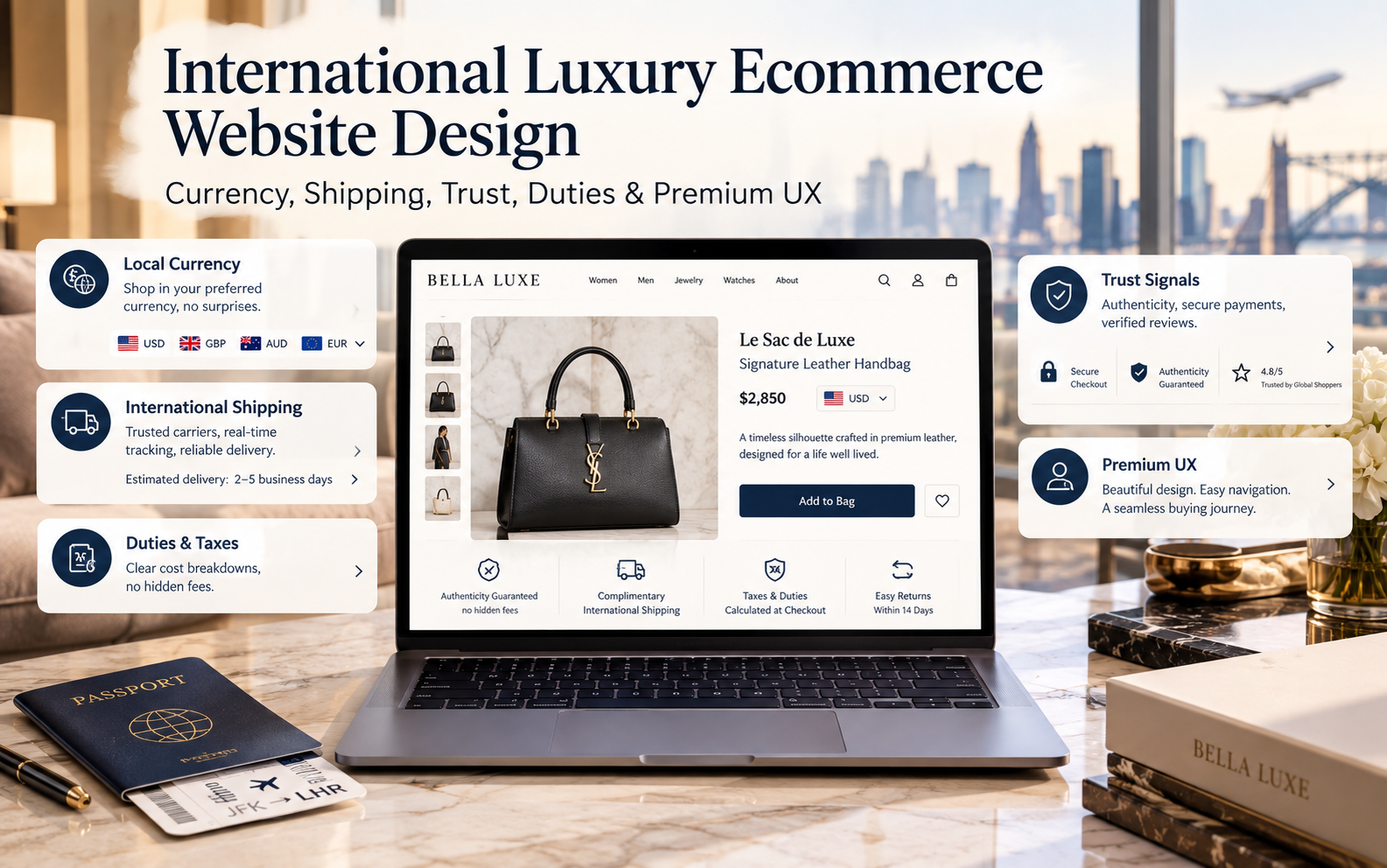
International Luxury Ecommerce Website Design should make an expensive international purchase feel as clear and trustworthy as a premium in-person experience. Show the right local currency, explain shipping and duties before checkout, make returns easy to understand, support appropriate payment methods, and localize the experience without diluting the brand. For luxury buyers, premium UX is not decoration. It is part of the trust system that supports the purchase.
TL;DR: What Luxury Brands Need to Get Right
- International buyers need to understand the real cost of ownership before committing to a high-value purchase.
- Local currency, appropriate payment methods, delivery expectations, duties, and returns should be visible before checkout rather than discovered afterward.
- Luxury UX should reduce uncertainty while preserving exclusivity, editorial quality, and premium presentation.
- International SEO requires technically sound regional structures, localization, and appropriate handling of currency and market-specific content.
- High-ticket ecommerce should treat shipping, customer service, returns, and post-purchase communication as part of the buying experience.
- A premium international store should be designed around buyer confidence, not simply around visual sophistication.
| International buyer concern | What the website should communicate | Why it matters for luxury |
|---|---|---|
| Currency | Local or clearly selectable currency | Reduces price uncertainty |
| Shipping | Delivery method and timing | Makes a high-value purchase predictable |
| Duties and taxes | Whether charges are included, estimated, or collected | Prevents unpleasant surprises |
| Returns | Eligibility, process, timing, exclusions | Reduces purchase risk |
| Payment | Familiar, secure payment methods | Reinforces trust |
| Product authenticity | Materials, provenance, certifications, guarantees | Supports confidence |
| Customer support | Accessible human assistance | Preserves premium service |
| Localization | Regional language, pricing, policies, and expectations | Makes the store feel market-aware |
KG Web Designer is a conversion-focused website design studio specializing in custom websites for clinics, professional services, manufacturers, and growing businesses. For luxury ecommerce brands, that same conversion-first approach becomes even more important because the financial and emotional cost of uncertainty is much higher.
What Does International Luxury Ecommerce Website Design Need to Prioritize?
International Luxury Ecommerce Website Design should prioritize confidence before conversion. A visitor considering a $500 accessory, $2,000 watch, $5,000 handbag, premium jewelry, designer furniture, or another high-value product is not simply asking whether the product looks desirable. They are evaluating whether the entire transaction feels credible, secure, predictable, and worthy of the price.
That means the website has to answer several questions before the buyer reaches the final payment step:
- What exactly am I buying?
- What will I actually pay?
- Will it arrive safely?
- When will it arrive?
- Will I have to pay additional duties?
- Can I return it if there is a problem?
- Is this brand legitimate?
- Can I reach someone if something goes wrong?
- Is the product authentic and appropriately represented?
- Does this brand understand customers in my market?
Luxury design often focuses heavily on typography, photography, whitespace, animation, and visual restraint. Those elements matter, but they cannot compensate for operational ambiguity.
At KG Web Designer, we have found that premium ecommerce experiences work better when the design connects brand perception with practical reassurance. The strongest international storefronts make the purchase feel sophisticated without making the buying process mysterious.
Expert Insight from Kanika Gupta
“Luxury ecommerce should never make customers work harder to understand the purchase. The design can be minimal, but the information architecture should be exceptionally clear. When the product is expensive, clarity becomes part of the luxury experience.”
Should Luxury Ecommerce Show Prices in Local Currency?
Yes. Local currency should normally be available for the markets a luxury brand intentionally serves. International buyers should not have to mentally convert a large purchase price before deciding whether the product is within their expected range.
Local currency does not mean every market needs a completely separate storefront. A well-planned commerce architecture can use market-specific currency, pricing rules, language, product availability, payment options, and shipping information while maintaining one central brand experience.
For example, a brand targeting the United States, United Kingdom, and Australia could present:
- USD for US shoppers
- GBP for UK shoppers
- AUD for Australian shoppers
- Market-specific shipping information
- Appropriate tax presentation
- Regionally available products
- Relevant payment methods
- Localized returns information
Multi-Currency Ecommerce should therefore be treated as part of the conversion architecture rather than a decorative feature.
The interface should also make the active market obvious. A discreet country selector, visible currency indicator, and consistent pricing throughout product, cart, and checkout pages are preferable to confusing automatic changes that leave shoppers wondering why the price changed.
This is particularly important for luxury products because the psychological impact of currency uncertainty increases as order value increases. A small currency difference may be tolerable on a low-value purchase, while a substantial difference on a $4,000 product can change the buyer’s willingness to complete the transaction.
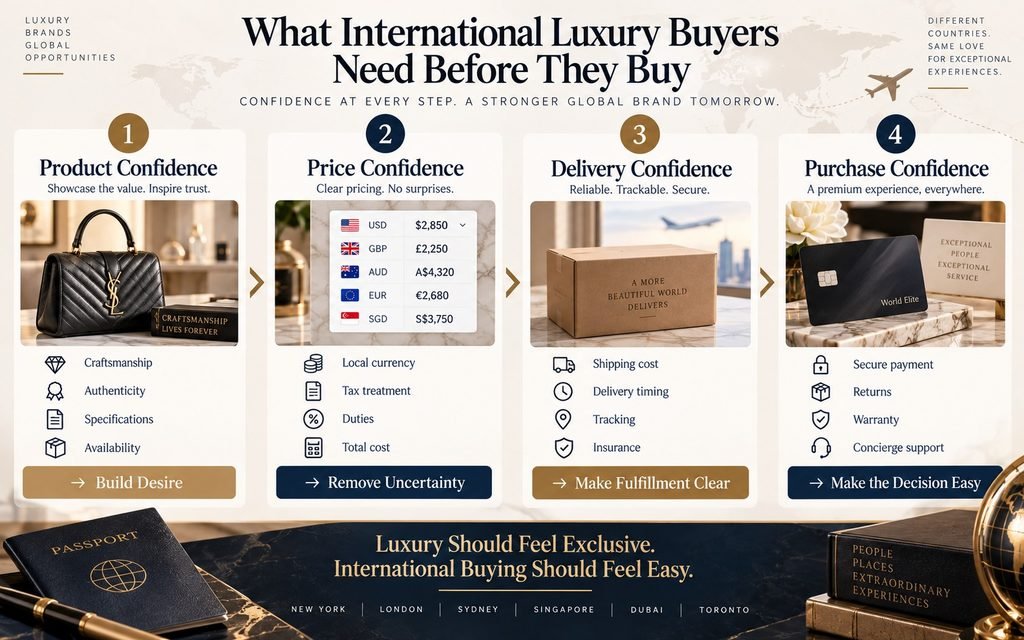
Would You Feel Confident Ordering From Your Store From Another Country?
International buyers face questions domestic customers may never need to ask. Your website should answer them before they become reasons to abandon the purchase.
Currency
Can buyers understand what they’ll actually pay?
Shipping
Are international delivery costs and expectations clear?
Duties
Will taxes or customs charges create a surprise?
Trust
Does the store reduce uncertainty around authenticity and service?
Returns
Can international customers understand what happens if they return?
A premium international experience should make buying across borders feel considered, transparent and straightforward.
Request an Ecommerce Website Review →How Should International Shipping Be Designed for High-Value Products?
International Ecommerce Shipping should be presented as a premium service rather than a technical afterthought. For expensive products, shipping information is part of the value proposition because customers are evaluating both delivery risk and service quality.
A luxury product page should make relevant information easy to find without overwhelming the visual design. Depending on the business model, this can include:
- Estimated delivery window
- Shipping destination
- Shipping method
- Insurance information
- Signature requirements
- Tracking availability
- Packaging details
- Delivery restrictions
- Duties and tax treatment
- Return shipping conditions
- Customer support contact
The goal is not to place a large block of logistics text beside a beautiful product photograph. Instead, information should be progressively disclosed through carefully designed sections, accordions, cart messaging, and checkout summaries.
For luxury brands, international shipping should communicate control. The buyer should feel that the brand knows exactly how the product will move from warehouse to doorstep.
A strong international store should also connect shipping communication to the broader buying strategy. Brands developing or reviewing their overall luxury ecommerce website strategy should consider fulfillment, delivery promises, returns, service, and international UX at the planning stage rather than adding these elements after the visual design has already been completed.
How Should Luxury Brands Handle Duties and Taxes?
Ecommerce Duties and Taxes should be addressed before the customer reaches the final payment decision. A luxury buyer should not discover a substantial customs obligation only when the courier arrives.
There are several ways a business can structure this, depending on its market, fulfillment model, tax obligations, carrier arrangements, and commerce platform:
- Include applicable costs in the displayed price.
- Estimate duties and taxes during checkout.
- Clearly identify what is included and excluded.
- Use Delivered Duties Paid arrangements where appropriate.
- Explain when the customer remains responsible for import charges.
- Provide market-specific shipping and customs policies.
The technical side matters too. Accurate duty calculations can depend on product classification, country of origin, destination, and other transaction details.
This is not just a tax configuration problem. It is a UX problem.
If the customer sees a beautiful $3,000 product page and then encounters a substantial additional charge at the end of checkout, the emotional experience changes immediately.
The better approach is to explain the commercial reality in plain language. For example:
“Taxes and import duties are calculated for your destination and shown at checkout where available. Your final delivered cost will be displayed before payment.”
The exact wording should reflect the brand’s actual fulfillment and tax model. Never promise a landed cost the business cannot reliably provide.
What Makes International Ecommerce Trust Different for Luxury Buyers?
International Ecommerce Trust depends on more than displaying payment-security icons. A high-value customer is assessing the brand, product, transaction, delivery process, and after-sales support as one combined system.
The trust layer should include:
- Clear company information
- Authentic product photography
- Detailed specifications
- Materials and dimensions
- Product provenance where relevant
- Authenticity information
- Secure checkout
- Recognizable payment methods
- Clear returns
- Shipping transparency
- Customer service availability
- Reviews or credible social proof where appropriate
- Privacy and security information
- Warranty or guarantee details where applicable
Luxury brands should also be careful with excessive trust badges. A page covered with generic security graphics can make a premium store look less sophisticated rather than more trustworthy.
Trust should instead be communicated through the quality and consistency of the entire experience.
At KG Web Designer, we frequently see that trust improves when every important claim has supporting evidence. If a brand says a product is handcrafted, the website should explain what that means. If it claims exceptional materials, the product page should demonstrate the materials rather than simply repeat the adjective “premium.”
That is a more credible form of luxury positioning.
Why Does Premium UX Matter More When the Product Is Expensive?
Luxury Ecommerce UX should remove unnecessary uncertainty without removing the sense of discovery. A luxury website should still feel aspirational, but the path from inspiration to purchase must remain easy to understand.
The visual hierarchy should guide buyers through three stages.
1. Desire
High-quality imagery, editorial storytelling, product details, video, craftsmanship information, and brand narrative create the initial emotional connection.
2. Confidence
The customer needs information about materials, sizing, authenticity, availability, shipping, payment, delivery, and returns.
3. Commitment
The final experience should provide a clean cart, transparent costs, appropriate payment methods, clear delivery expectations, and reassuring confirmation.
This distinction is important because luxury UX is not simply “minimal design.” Minimal design can become problematic when important information is hidden because the designer wants the interface to look cleaner.
The better approach is visible simplicity: the interface feels calm because the information architecture is strong, not because information has been removed.
How Should Luxury Brands Localize Their International Store?
International Ecommerce Website Design should distinguish between translation and genuine localization. A translated website changes words. A localized website changes the buying experience to match the expectations of the market.
Localization can affect:
- Currency
- Pricing
- Taxes
- Payment methods
- Shipping
- Returns
- Product availability
- Measurements
- Date and number formatting
- Language
- Spelling
- Customer service
- Promotional messaging
- Delivery expectations
- Legal information
A US and UK storefront can both be written in English while still requiring meaningful differences in terminology, pricing presentation, delivery messaging, and customer expectations.
Regional SEO should also reflect these differences. A technically sound international structure can help search engines understand which version is intended for which audience.
However, separate websites should not be created simply because a business has international traffic. The architecture should reflect genuine differences in products, pricing, fulfillment, legal requirements, content, or customer experience.
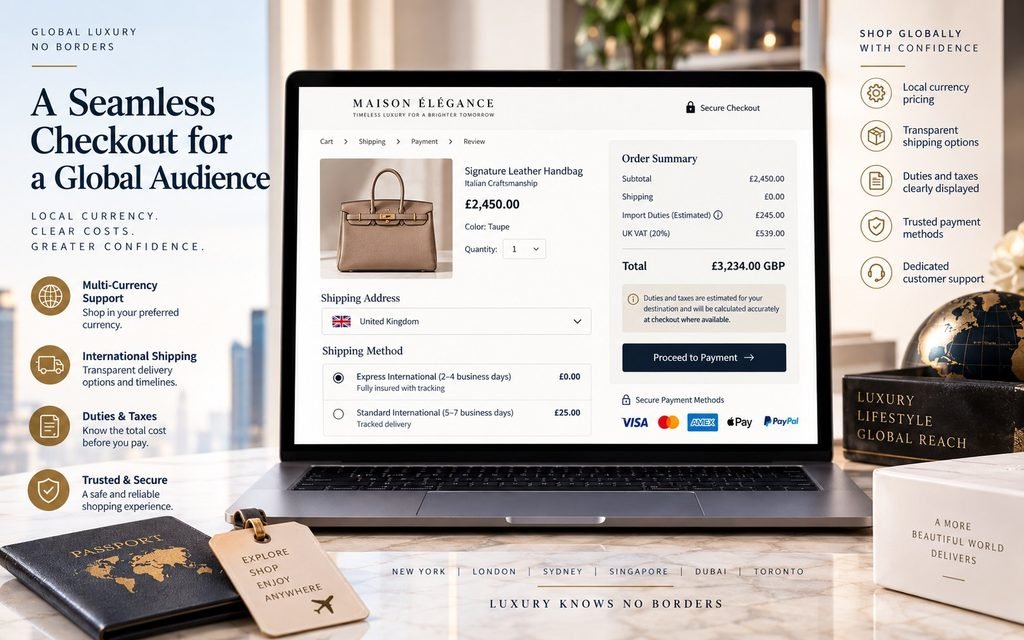
“What Will I Actually Pay?” Shouldn’t Be a Luxury Buyer’s Last-Minute Question.
When an international customer reaches checkout, uncertainty around currency, shipping, taxes or duties can undermine an otherwise premium buying experience.
Industry-Specific Observation: Fashion and Accessories
Fashion buyers frequently care about sizing, fit, materials, shipping speed, and returns. International fashion ecommerce therefore needs exceptionally clear size information and regional measurement guidance.
Industry-Specific Observation: Jewelry and Watches
For high-value jewelry and watches, product authenticity, materials, certifications, warranty information, insurance, delivery security, and customer support become particularly important.
Industry-Specific Observation: Luxury Home and Furniture
Large or fragile products require stronger delivery communication, freight expectations, installation information, and damage-resolution policies. A beautiful product page is not enough if the customer cannot understand how the item will reach their home.
For fashion-led brands, the principles used in fashion ecommerce website design are particularly relevant here because visual merchandising, product discovery, sizing, filtering, mobile browsing, and returns all influence the international buyer’s confidence.
What Should the Checkout Experience Look Like for International Luxury Ecommerce?
The checkout should feel like a continuation of the brand experience rather than a generic payment form. It should preserve visual quality while making the commercial details extremely clear.
A strong international checkout should show:
- Product and quantity
- Customer’s destination
- Currency
- Product subtotal
- Shipping
- Taxes where applicable
- Duties where applicable
- Discounts if relevant
- Final amount
- Delivery estimate
- Payment options
- Returns or policy access
The customer should not need to leave checkout to understand what they are paying.
Payment options should also reflect the target market. A customer in one country may expect card payment while another market may rely heavily on digital wallets or other local methods.
For premium stores, payment choice should be presented carefully. The objective is not to display every possible payment method. It is to offer appropriate, trusted options without cluttering the interface.
Why Most Luxury Brands Get International Ecommerce Wrong
Most brands get international ecommerce wrong by treating internationalization as a technical expansion rather than a buyer-experience expansion.
They add a country selector, enable another currency, and activate international shipping. From the business side, the store is now “international.”
From the customer’s perspective, it may still feel foreign.
Common problems include:
- Local currency appears only at checkout.
- Shipping information is vague.
- Duties are not explained.
- Returns apply different rules by country but the differences are hidden.
- Product availability changes after the customer selects a country.
- Customer support hours are unclear.
- Payment options do not reflect the market.
- The website automatically redirects visitors without giving them control.
- Regional SEO pages are poorly structured.
- Product pages lack the information required for international comparison.
- The checkout suddenly changes the price.
These problems are especially damaging for high-ticket products because the customer has more to lose.
The answer is not necessarily more content. It is better information architecture.
Example Scenario: A Luxury Brand Expanding From the US Into the UK and Australia
Imagine a premium accessories brand that has strong US sales and wants to expand into the UK and Australia.
The company already has excellent photography and a recognizable brand. Its existing website displays USD, provides US shipping estimates, and has a US-centric returns policy.
Simply enabling international shipping would create a technically functional store, but the buying experience would still be incomplete.
A stronger expansion would introduce:
- GBP and AUD pricing
- Regional shipping information
- Market-specific delivery estimates
- Clear tax and duty treatment
- Regional returns information
- Local payment options where commercially appropriate
- UK and Australian spelling where relevant
- Country-aware product availability
- Appropriate SEO signals
- Market-specific customer support information
The visual identity can remain consistent.
The experience becomes localized without fragmenting the brand.
That is the balance luxury ecommerce should aim for.
Example From Our Experience: Where International UX Usually Breaks
At KG Web Designer, one recurring pattern in ecommerce reviews is that businesses invest heavily in the visible part of the website and comparatively little in the decision-making layer.
Problem
The storefront looks premium, but customers need to search through multiple pages to understand shipping, returns, delivery timelines, and international purchase conditions.
Solution
The information architecture is reorganized so that critical purchase information appears closer to the product, cart, and checkout decisions. Important details remain accessible without overwhelming the visual design.
Outcome
The experience becomes easier to evaluate because customers can answer commercial questions at the point where those questions naturally arise.
The important lesson is not that one particular UX change guarantees a specific conversion increase. It is that removing uncertainty from the buying journey creates a more complete premium experience.
That distinction matters because genuine conversion optimization should be based on the actual behavior and constraints of the store, not an invented universal benchmark.
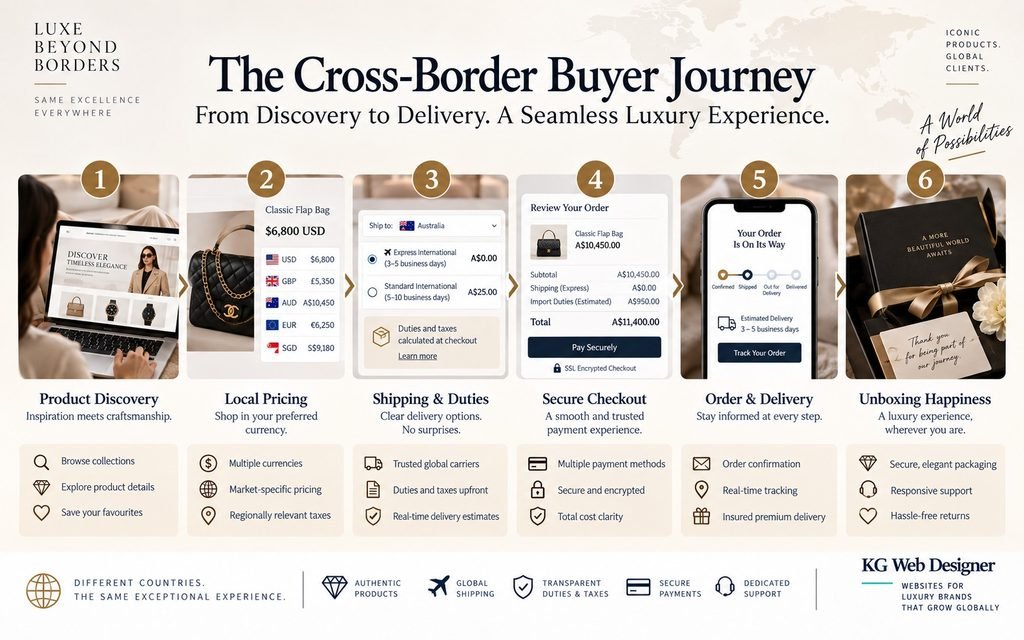
A Premium Experience Should Survive the Entire Journey — Not Stop at the Product Page
International buyers need the same sense of confidence at every stage, from discovering the product to understanding what happens after it arrives.
Luxury ecommerce design should connect brand perception with practical buying confidence across the complete international journey.
Build a Better Buying Experience →What Does This Mean For Your Business?
If your brand is already selling internationally, the first question should not be “How can we make the website look more luxurious?”
The better question is:
Where does an international buyer still have to guess?
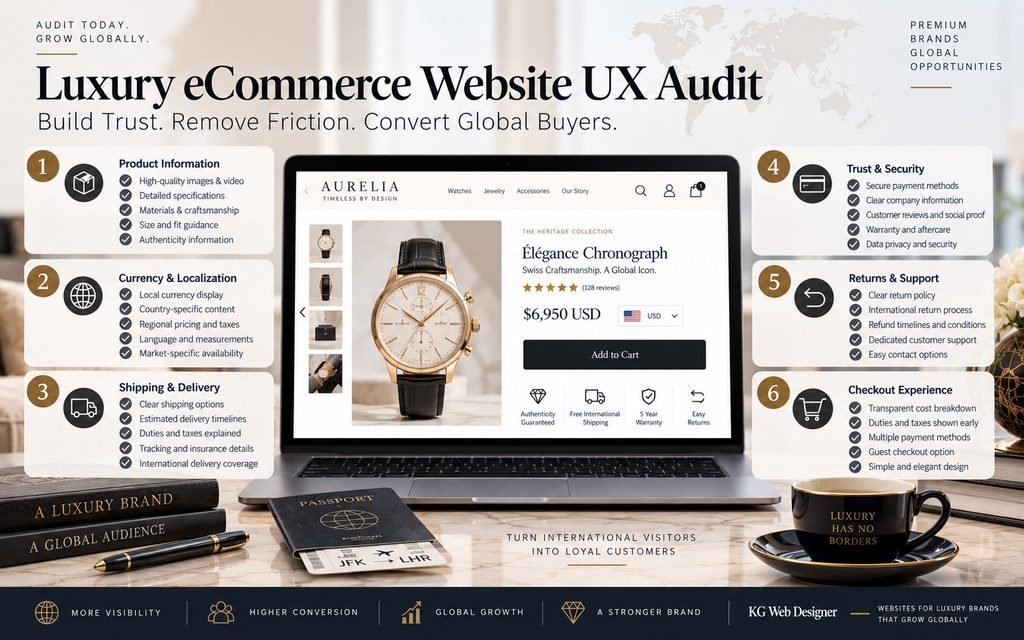
Audit the journey from the first product interaction through post-purchase support.
Check:
- Can the buyer understand the price immediately?
- Can they select their market?
- Can they understand shipping?
- Can they estimate the total delivered cost?
- Can they understand duties?
- Can they find returns information?
- Can they identify payment options?
- Can they verify authenticity?
- Can they contact someone?
- Can search engines understand the regional versions?
- Does the mobile experience provide the same clarity?
- Does the checkout preserve the same level of trust as the product page?
This is where choosing the right ecommerce website designer becomes a business-system question rather than a button-color or layout question.
The same audit should also examine whether the underlying commerce architecture is appropriate for the brand’s next stage of growth. If the business is comparing agencies, platforms, or freelancers, it is useful to evaluate not only design quality but also international UX, SEO, migration experience, conversion optimization, technical capability, and post-launch support.
How Should AI Search and GEO Influence Luxury Ecommerce in 2026?
Luxury ecommerce brands should now consider how products and brands are represented beyond traditional search results.
AI-assisted shopping is increasingly relevant to premium retail. Modern luxury shoppers can use AI assistants, visual search, product comparison tools, and other discovery technologies before reaching a brand’s website.
That changes what a product website needs to communicate.
AI systems need clear, structured information about:
- Product names
- Product categories
- Materials
- Sizes
- Dimensions
- Colors
- Availability
- Pricing
- Shipping
- Returns
- Brand positioning
- Product benefits
- Authenticity information
- FAQs
- Related products
This does not mean writing content for machines instead of humans.
It means creating a website where important information is explicit, consistent, structured, and easy for both humans and systems to interpret.
For GEO, this also means building topical authority around the questions buyers actually ask. A luxury brand should not rely entirely on product pages. Supporting content can explain craftsmanship, materials, care, sizing, international delivery, authenticity, product selection, and market-specific buying considerations.
What Should a Luxury International Ecommerce Audit Include?
A serious audit should examine the complete customer journey rather than reviewing only the homepage.
Brand and positioning
- Does the website communicate the intended level of luxury?
- Is the value proposition specific?
- Does the brand feel credible internationally?
Product experience
- Are product details comprehensive?
- Are images sufficient?
- Is product information easy to compare?
- Are materials, dimensions, sizing, and care information accessible?
Internationalization
- Are markets correctly configured?
- Is currency clear?
- Are regional URLs technically sound?
- Are localized pages properly connected?
Shipping
- Are delivery expectations clear?
- Are high-value shipments appropriately explained?
- Are insurance and signature requirements addressed?
Duties and taxes
- Are potential charges transparent?
- Is the final cost understandable?
- Does the technical setup support accurate estimates?
Checkout
- Are payment methods appropriate?
- Is guest checkout available where suitable?
- Are all costs visible?
- Are unnecessary form fields removed?
Trust
- Is authenticity demonstrated?
- Are policies easy to find?
- Can customers reach support?
Post-purchase
- Are order confirmations clear?
- Is tracking available?
- Are returns easy to understand?
- Does customer support maintain the same premium standard?
Final Thoughts
The strongest international luxury ecommerce experiences do not force customers to choose between aspiration and clarity. They create desire through premium visual storytelling and then support that desire with precise information about price, shipping, duties, returns, payment, authenticity, and service.
International shopping is now a normal part of ecommerce behavior, while AI-assisted product discovery is creating another layer of competition for premium brands. The implication is important: a luxury website has to communicate both emotional value and practical certainty.
For a premium brand, international growth therefore requires more than translating a website or adding a currency dropdown.
It requires designing a buying experience that makes an overseas customer feel as confident as a local customer.
That is the real objective of International Luxury Ecommerce Website Design: not simply selling across borders, but making the entire cross-border purchase feel considered, trustworthy, and worthy of the brand.
If your luxury ecommerce website is attracting international traffic but losing buyers during product evaluation, shipping selection, or checkout, a structured UX and conversion review can identify where uncertainty is entering the journey.
Would an International Buyer Feel as Confident as a Customer in Your Home Market?
Let’s review how your ecommerce experience handles the questions international buyers face — from currency and shipping to trust, duties, checkout and the overall premium buying journey.

Frequently Asked Questions
Is local currency necessary for international luxury ecommerce?
Local currency is strongly recommended for markets that a brand actively targets. It helps customers understand pricing without manual conversion and can make the purchase experience feel more familiar. The implementation should also keep currency consistent across product pages, cart, checkout, and refunds rather than changing prices unexpectedly during the buying process.
How transparent should luxury brands be about shipping costs?
Luxury brands should be highly transparent about shipping costs and delivery expectations. The exact presentation can remain visually restrained, but customers should be able to understand the applicable delivery method, estimated timing, destination coverage, and any meaningful conditions before committing to the purchase.
Should duties information appear on product pages?
It can be useful to communicate duties and tax treatment before checkout, particularly when the brand serves markets where additional import charges are common. The website should explain whether those charges are included, calculated during checkout, or potentially payable by the customer on delivery.
Does a luxury ecommerce website need a country selector?
A country selector is useful when the brand serves multiple markets with different currencies, products, shipping arrangements, taxes, or content. It should give customers control rather than relying entirely on automatic geolocation. The selected market should then produce a consistent localized experience throughout browsing and checkout.
What should luxury brands do about international returns?
International returns should be designed around the actual economics and logistics of the product. The website should clearly explain eligibility, return windows, exclusions, shipping responsibility, refund treatment, and any destination-specific requirements. High-value products may also require special handling, insurance, authentication, or inspection before a refund is issued.
How can a luxury ecommerce brand maintain exclusivity while improving UX?
Exclusivity comes from positioning, product quality, storytelling, service, design restraint, and controlled merchandising. It does not require hiding essential information. A luxury store can remain visually minimal while making price, shipping, product details, returns, and customer support easy to understand.
Should an international luxury store have separate websites for every country?
Not necessarily. Separate websites make sense when markets have substantially different products, pricing, legal requirements, fulfillment, languages, or commercial strategies. When differences are limited, a properly structured multi-market architecture can provide localized experiences without creating unnecessary technical and content-management complexity.