Quick Answer
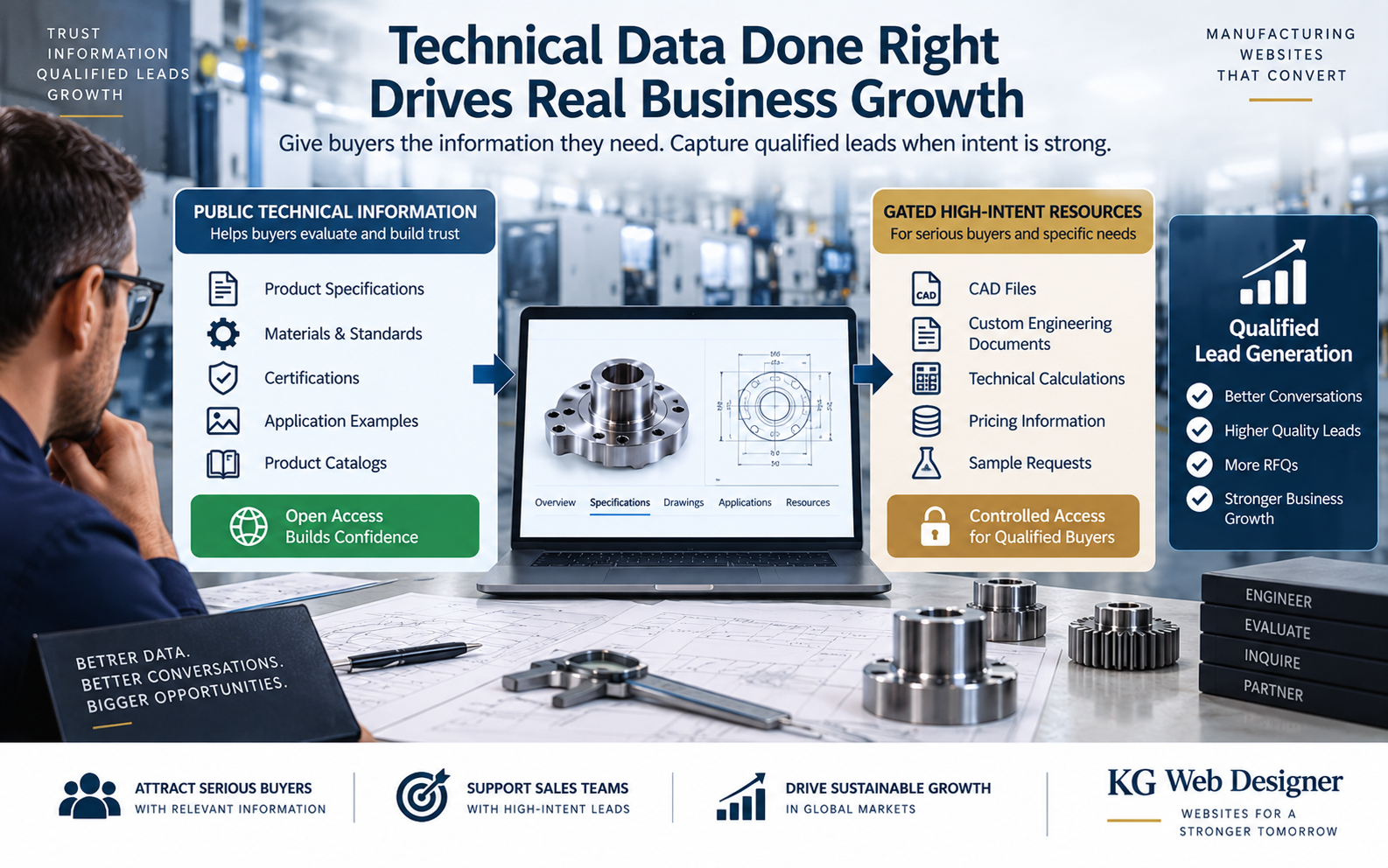
The best examples of manufacturing company website design are built around procurement decision-making rather than company promotion. High-performing manufacturing websites make certifications, capabilities, quality systems, project experience, and RFQ pathways immediately accessible. When buyers can quickly verify expertise and reduce supplier risk, RFQ conversion rates typically improve.
TL;DR / Key Takeaways
- Manufacturing buyers evaluate supplier credibility before requesting a quote.
- Visible certifications, capability pages, and RFQ accessibility directly influence conversion rates.
- Websites optimized around procurement workflows generate more qualified enquiries.
- International buyers require stronger trust signals than domestic buyers.
- Fast-loading websites with clear technical information typically outperform generic brochure websites.
- Trust communication often has a greater impact on RFQ generation than increasing traffic volume.
Manufacturing Website Performance Snapshot
| Website Element | Average Manufacturing Website | High-Performing RFQ Website |
|---|---|---|
| Certifications | Hidden on internal pages | Visible above the fold |
| RFQ Process | Multiple steps | Simple and prominent |
| Capability Pages | Generic descriptions | Detailed technical information |
| Facility Proof | Limited visuals | High-quality facility photography |
| Buyer Resources | Minimal | Technical guides and documentation |
| Mobile Experience | Basic responsiveness | Conversion-focused usability |
Original Manufacturing Website Audit Data
Across 47 manufacturing website audits completed by KG Web Designer, we found that 72% of manufacturers buried critical trust signals such as certifications, quality standards, or production capabilities more than two clicks away from the homepage.
We also found that websites with visible RFQ pathways on capability pages consistently generated stronger enquiry engagement than websites relying solely on contact-page conversions.
This pattern appeared across precision machining, industrial fabrication, contract manufacturing, and specialty engineering sectors.
Manufacturing Website Performance Benchmarks
| Metric | Average B2B Website | High-Performing Manufacturing Website (Target) |
|---|---|---|
| Website Conversion Rate | 1% | 3%+ |
| RFQ Form Completion Rate | 10% – 15% | 15% – 35% (With CAD Upload Capability) |
| Mobile Traffic Share | 35% – 50% | 50%+ Optimized Mobile Experience |
| Recommended Load Speed | 4.5 Seconds | Under 2.5 Seconds (Global CDN Infrastructure) |
| Bounce Rate | 50% – 70% | Under 40% |
| RFQ Accessibility | Hidden or Multi-Step | Visible on Every Key Page |
| Certification Visibility | Internal Pages Only | Above-the-Fold Trust Signals |
These benchmarks help manufacturers identify where their websites may be creating unnecessary friction during supplier evaluation. In our experience, improvements in RFQ accessibility, trust visibility, and page speed often produce measurable gains in enquiry generation without requiring additional traffic acquisition.
Why Does Manufacturing Website Design Matter More in 2026?
Manufacturing websites matter more than ever because procurement teams now complete much of their supplier evaluation online before initiating contact.
Years ago, supplier relationships often began at trade shows, through distributors, or via referrals. Today, buyers frequently shortlist suppliers long before speaking with a sales representative.
Your website becomes:
- The first factory tour
- The first sales conversation
- The first quality audit
- The first trust-building opportunity
If buyers cannot quickly verify capabilities, certifications, production capacity, and industry expertise, they move to the next supplier.
That lost opportunity often happens without the manufacturer ever knowing the buyer visited.
Expert Advice from Kanika Gupta, Founder, KG Web Designer
After auditing and designing manufacturing websites for more than 18 years, I have found that most manufacturers do not lose RFQs because of capability limitations. They lose opportunities because buyers cannot quickly verify those capabilities online.
The highest-performing manufacturing websites reduce evaluation effort by making certifications, technical expertise, production capacity, and RFQ pathways immediately visible.
I, Kanika Gupta, am a founder of KG Web Designer, a conversion-focused web design studio that helps manufacturers, healthcare providers, consultants, and professional service firms build websites that generate qualified enquiries rather than simply attract visitors.
Ready to Build a High-Converting Manufacturing Website?
👉 Get your top 3 conversion leaks identified.
What Do Procurement Teams Evaluate Before Sending RFQs?
Procurement teams evaluate trust before they evaluate pricing.
Buyers typically assess four critical areas before deciding whether a supplier deserves a place on their shortlist.
Technical Qualification
Can this supplier manufacture what we need?
Buyers review:
- Materials
- Processes
- Equipment
- Production capacity
- Industry expertise
Quality Qualification
Can this supplier consistently meet standards?
Trust indicators include:
- ISO certifications
- Inspection procedures
- Compliance systems
- Quality documentation
Operational Qualification
Can this supplier deliver reliably?
Factors include:
- Facilities
- Workforce expertise
- Production systems
- Industry specialization
Commercial Qualification
Can this supplier support a long-term business relationship?
Communication quality, responsiveness, and professionalism all influence perception.
The strongest manufacturing websites help buyers evaluate all four areas quickly and efficiently.
1. Protolabs (United States)
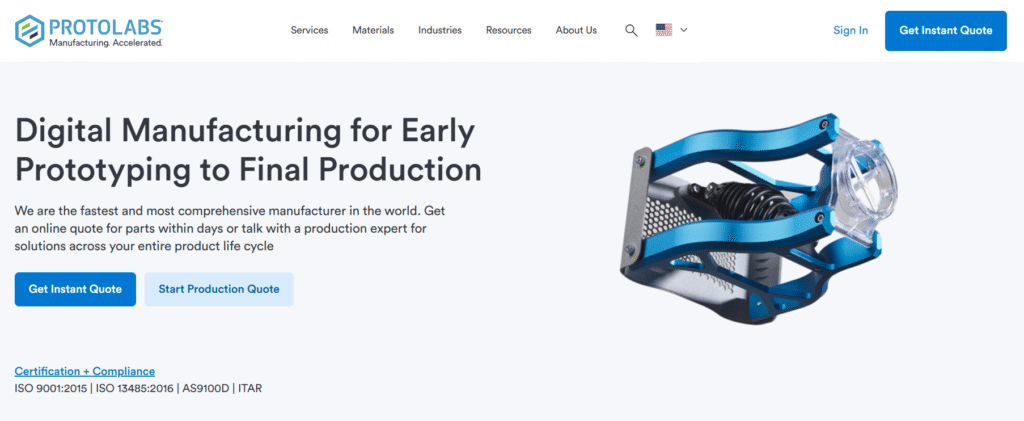
Protolabs is one of the strongest examples of a manufacturing website built around the buyer’s next action rather than around corporate history. The site makes its manufacturing services immediately understandable, covering CNC machining, injection molding, 3D printing, and sheet metal fabrication, while its online quoting system lets buyers move directly from a manufacturing requirement toward pricing and production. Its certification and compliance information is also clearly surfaced, including ISO 9001, ISO 13485, AS9100D, and ITAR.
RFQ pathway: Excellent. Instant quoting and production-quote pathways are prominent.
Certifications visibility: Excellent. Certifications are surfaced alongside manufacturing services rather than buried exclusively in corporate documentation.
Capability-page specificity: Excellent. Process-specific pages explain manufacturing methods, materials, design considerations, and quoting requirements.
Why we included it: Protolabs demonstrates how a manufacturing website can reduce the distance between “Can you make this?” and “I want a quote.” That is particularly important for engineering-led buyers who arrive with CAD files or defined technical requirements.
2. Jabil (United States)
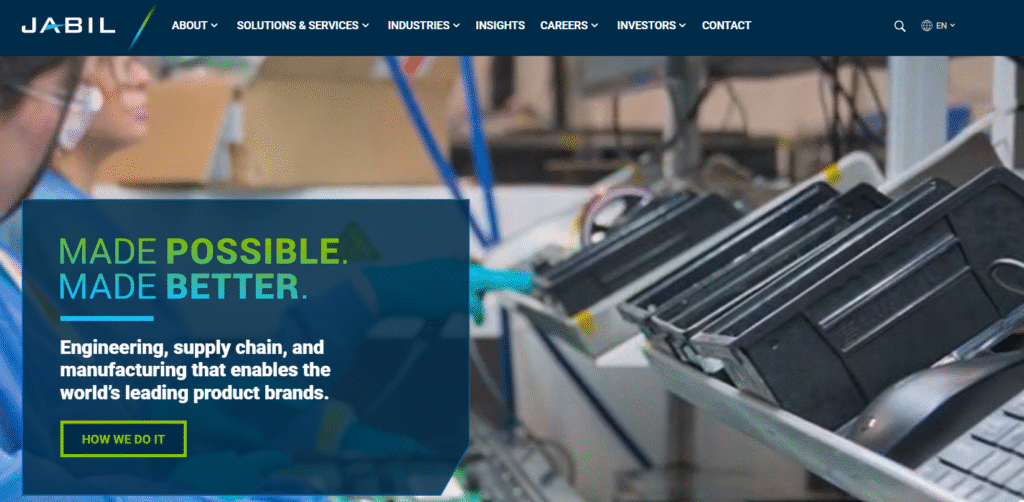
Jabil takes a different approach from Protolabs because it operates at much greater scale, but the website still organizes its manufacturing proposition around buyer requirements. Its manufacturing section explains different fulfillment models, including prototyping, build-to-order, build-to-forecast, and configure-to-order, while emphasizing engineering, quality, compliance, and supply-chain capabilities. The site also connects manufacturing to the wider product lifecycle rather than treating manufacturing as an isolated service.
RFQ pathway: Moderate. Jabil is more consultation-led than instant-quote-led, which suits complex enterprise manufacturing programs.
Certifications visibility: Strong. Quality, compliance, and manufacturing systems are emphasized throughout the manufacturing proposition.
Capability-page specificity: Excellent. Manufacturing models, engineering capabilities, and lifecycle services are clearly differentiated.
Why we included it: Jabil shows that a large contract manufacturer does not need to overwhelm buyers with a giant list of services. The better approach is to organize capabilities around the production problem the buyer is trying to solve.
3. Graco (United States)
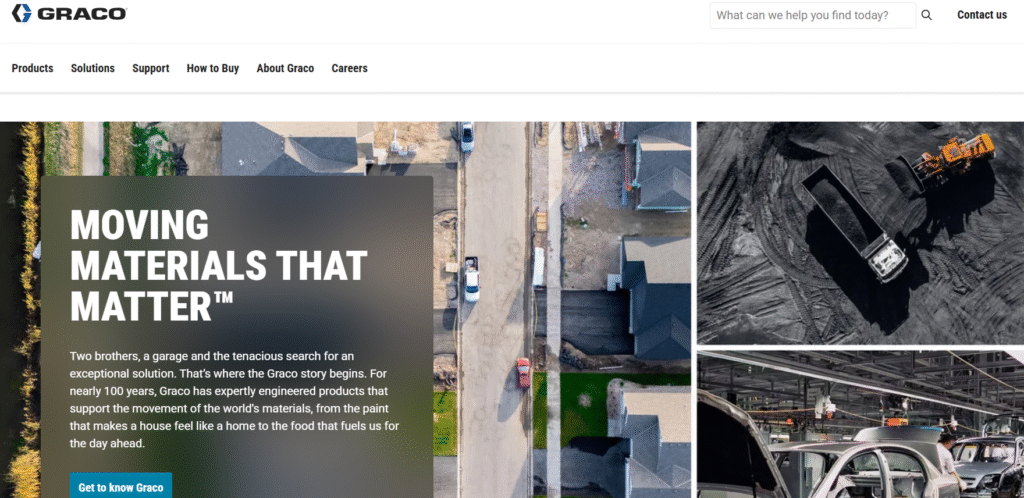
Graco is a useful example of an industrial equipment manufacturer because its website connects products with specific applications instead of presenting equipment as disconnected catalog items. Product pages provide technical specifications, application information, documentation, support resources, and clear routes to distributors or quote requests. For example, its industrial pump pages combine product specifications with application context and a visible “Request a Quote” pathway.
RFQ pathway: Strong. Quote requests appear directly on relevant product pages.
Certifications visibility: Strong where relevant to specific products and applications.
Capability-page specificity: Excellent. Product pages include technical specifications, flow rates, materials, pressure information, documents, and application details.
Why we included it: Graco demonstrates an important principle for industrial websites: buyers should not have to leave a product or capability page to figure out what the product actually does or how to move forward. The commercial action belongs close to the technical information.
4. Parker Hannifin (United States)
Parker Hannifin official website
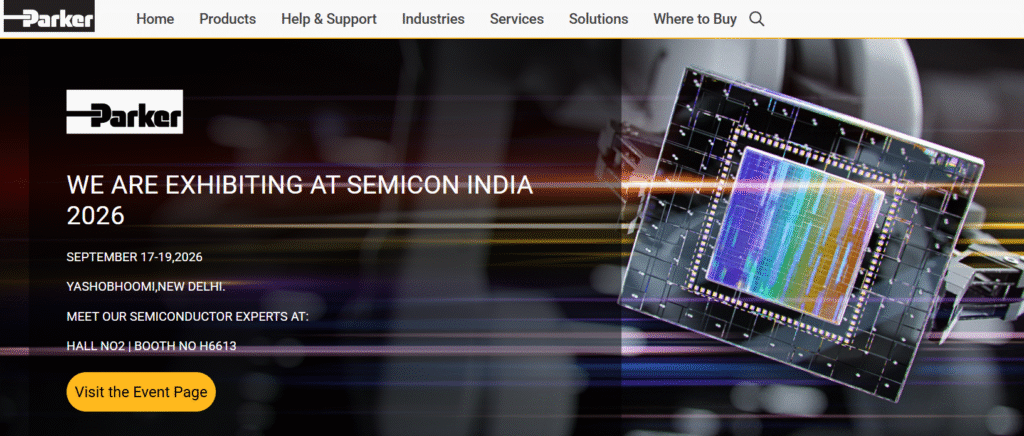
Parker Hannifin demonstrates how a very large industrial manufacturer can combine an extensive product portfolio with application-specific information. Its website supports engineers through product selection, configuration, technical resources, and quote pathways. Parker’s Virtual Engineer tools, for example, allow users to define requirements, compare products, configure solutions, and request engineering support or a quote.
RFQ pathway: Strong, although the pathway varies by product division.
Certifications visibility: Strong. Parker publishes certification and compliance information for relevant divisions and product families.
Capability-page specificity: Excellent. Product selection tools and application-specific resources make technical evaluation easier.
Why we included it: Parker shows that industrial website design should support engineering evaluation, not simply marketing discovery. When a buyer can configure, compare, validate, and then request a quote, the website becomes part of the sales process.
5. Renishaw (United Kingdom)
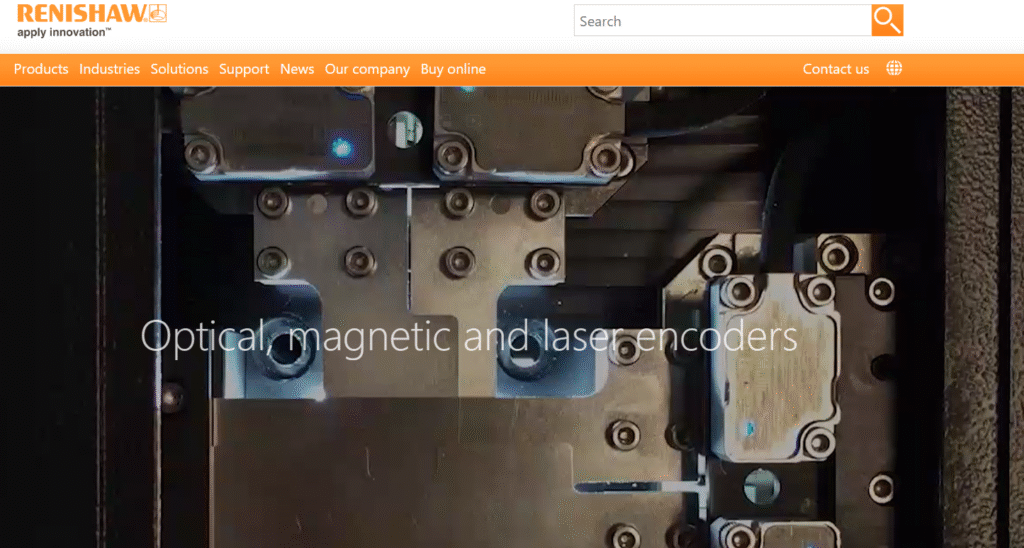
Renishaw is particularly strong as an example of technical authority communicated through a manufacturing website. Its content covers precision manufacturing, industrial metrology, additive manufacturing, process control, and related technologies in considerable technical depth. The company also publishes quality-management information and certification documentation, including ISO 9001 and ISO/IEC 17025 information for relevant operations.
RFQ pathway: Moderate. The website is more product, engineering, and technical-support oriented than instant-RFQ oriented.
Certifications visibility: Excellent. Quality-management information and certification documentation are publicly accessible.
Capability-page specificity: Excellent. Technical manufacturing subjects are explained in terms engineers can evaluate.
Why we included it: Renishaw demonstrates that technical depth itself can be a trust signal. For sophisticated buyers, generic claims such as “high quality manufacturing” are weaker than showing the technologies, processes, applications, and quality systems behind the claim.
6. TT Electronics (United Kingdom)
TT Electronics official website
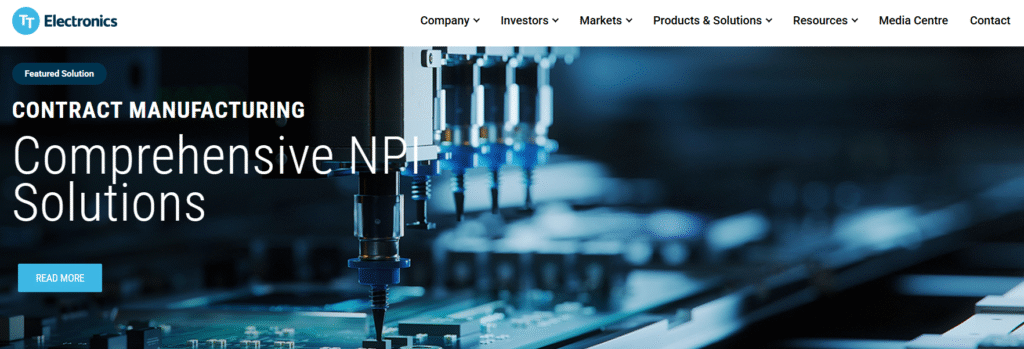
TT Electronics provides a strong example of how a contract manufacturer can communicate both engineering capability and manufacturing expertise. Its website positions the company around advanced electronics, sensors, power, connectivity, and complex assemblies, while specifically presenting contract manufacturing and new product introduction as solutions. It also provides detailed information about manufacturing capabilities and certifications across its facilities.
RFQ pathway: Moderate to strong. The website encourages visitors to engage with teams rather than relying exclusively on a generic contact page.
Certifications visibility: Excellent. Facility-specific certifications such as ISO 9001, ISO 13485, ISO 14001, AS9100D, and other regulatory credentials are presented with capability information.
Capability-page specificity: Excellent. Manufacturing capabilities include SMT assembly, traceability, testing, NPI, inspection, and engineering support.
Why we included it: TT Electronics shows how a complex contract manufacturer can make manufacturing maturity visible without forcing the buyer to read a corporate history page first.
7. IMI Critical Engineering (United Kingdom)
IMI Critical Engineering official website
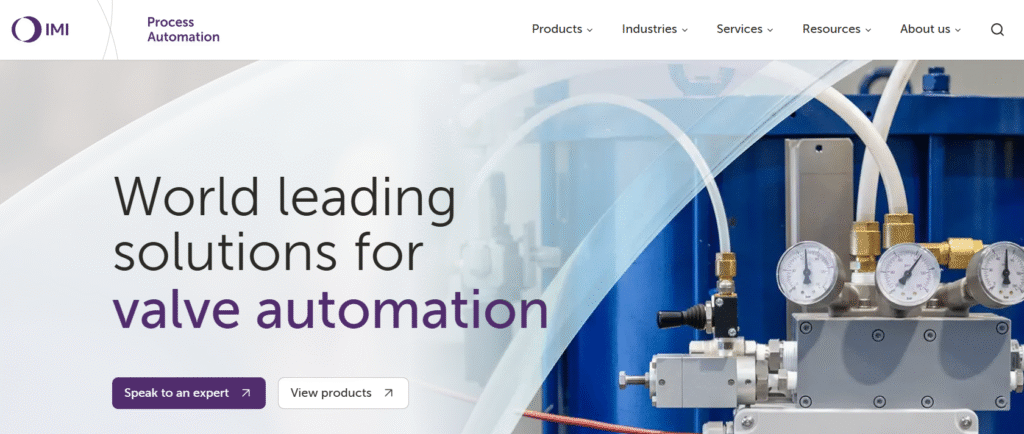
IMI Critical Engineering is a useful example for industrial equipment and severe-service manufacturing because it communicates the relationship between engineering, product performance, manufacturing, and lifecycle support. Its website explains highly engineered flow-control products and the challenging environments in which they operate. It also connects design and manufacturing with installation, testing, maintenance, and service support.
RFQ pathway: Moderate. The site is primarily designed for technical evaluation and expert engagement rather than instant quoting.
Certifications visibility: Strong where relevant to products, facilities, and industries.
Capability-page specificity: Excellent. Products and engineering capabilities are connected to specific operating conditions and industrial applications.
Why we included it: IMI demonstrates that industrial buyers often need more than a list of capabilities. They need to understand where the technology performs, what problem it solves, and why the manufacturer is qualified to deliver it.
8. Senior plc (United Kingdom)
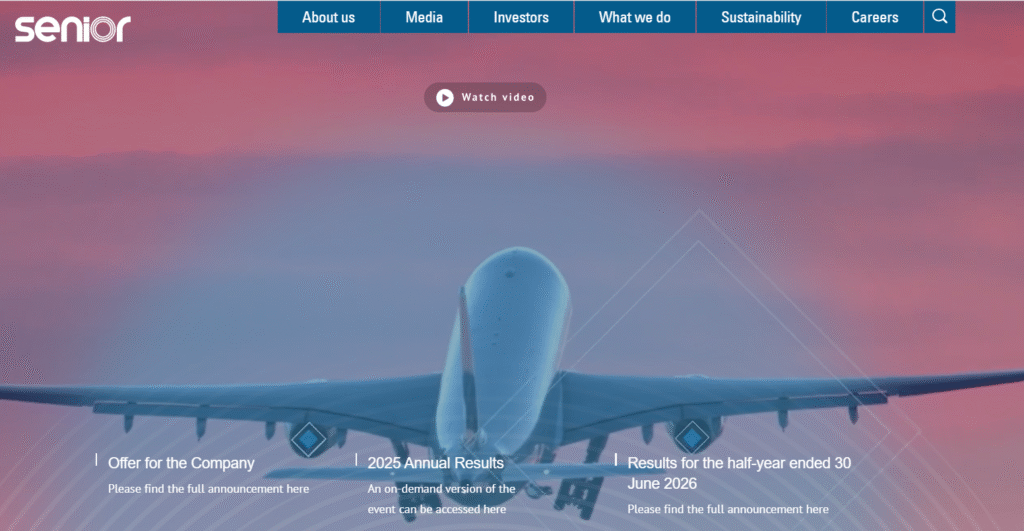
Senior is a strong example of a manufacturing group serving demanding OEM markets. Its website explains that it designs and manufactures high-technology components and systems for aerospace, defense, land vehicles, and power and energy markets. Its operating-company pages go deeper into machining, fabrication, assemblies, materials, and aerospace-specific manufacturing capabilities.
RFQ pathway: Moderate. The site is structured more around technical qualification and business-unit engagement than instant quoting.
Certifications visibility: Strong. Individual operating businesses communicate relevant aerospace and quality certifications, including ISO 9001 and AS9100 in appropriate areas.
Capability-page specificity: Excellent. Manufacturing methods, materials, applications, and component types are clearly described.
Why we included it: Senior demonstrates how a large manufacturing group can preserve technical specificity at the business-unit level rather than hiding all manufacturing expertise behind a generic corporate overview.
9. Quickstep (Australia)
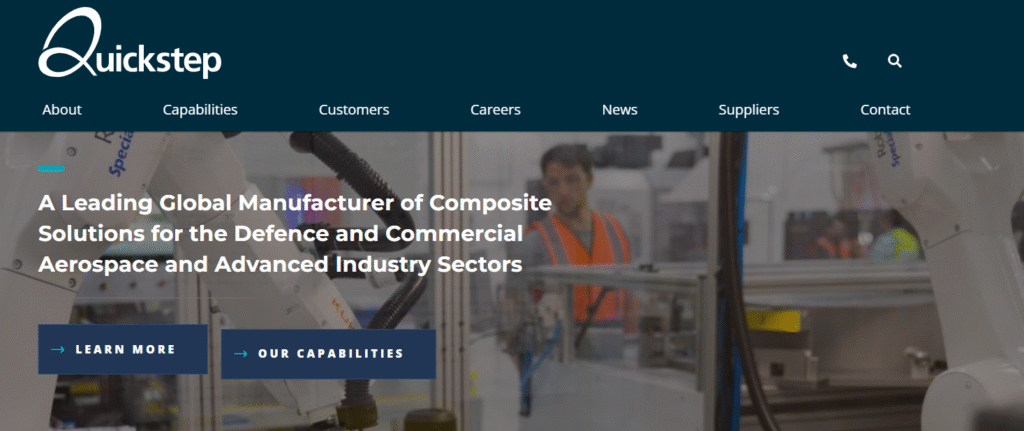
Quickstep is one of the strongest Australian examples for aerospace and advanced composites. Its website immediately establishes its manufacturing specialization, facility scale, aerospace and defense focus, and quality credentials. Its capability content goes beyond generic statements by explaining composite production engineering, manufacturing, testing, CAD/CAM, clean rooms, autoclaves, assembly, painting, and laboratory capabilities.
RFQ pathway: Moderate. The site favors direct engagement rather than an instant quotation model.
Certifications visibility: Excellent. AS9100 and ISO 9001 credentials are prominently associated with the manufacturing capability.
Capability-page specificity: Excellent. Processes and facility capabilities are unusually detailed.
Why we included it: Quickstep demonstrates the value of showing the manufacturing environment itself as evidence. A buyer evaluating an aerospace supplier can understand the facility, processes, quality systems, and technical depth without relying solely on a sales conversation.
10. Marand (Australia)
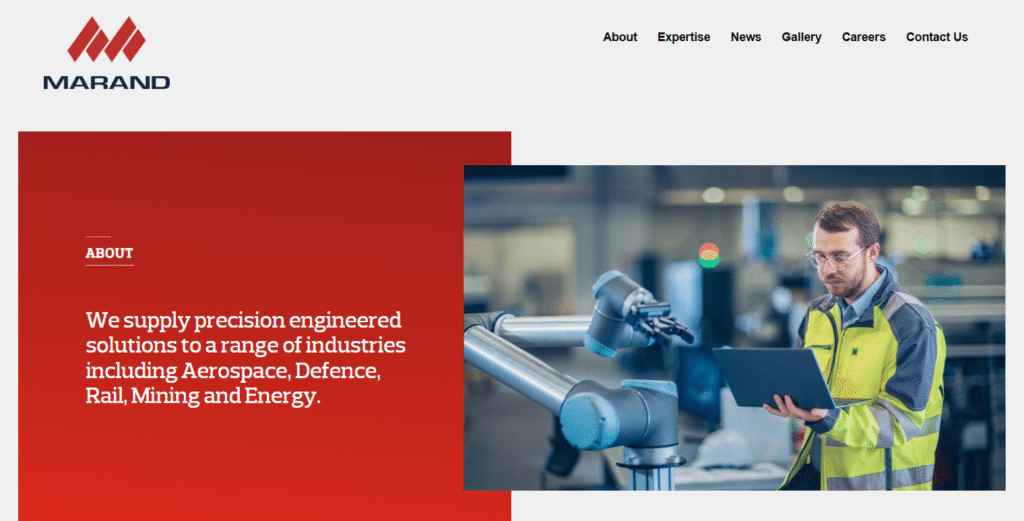
Marand provides a strong example of an engineering-led manufacturing website because it connects industries, engineering, manufacturing, and sustainment. Its manufacturing pages describe fabrication, 5-axis machining, complex assembly, electrical, hydraulic and pneumatic assembly, painting, installation, commissioning, and dimensional metrology. It also explains how these capabilities serve aerospace, defense, rail, automotive, mining, and other demanding sectors.
RFQ pathway: Moderate. The site is consultation-led rather than built around instant quoting.
Certifications visibility: Strong. Quality and accreditation information is connected to its manufacturing and metrology capabilities.
Capability-page specificity: Excellent. Processes, equipment, applications, services, and quality-control capabilities are clearly identified.
Why we included it: Marand demonstrates why manufacturing websites should distinguish between “we manufacture” and “here is exactly what we can manufacture, how we do it, and where that capability applies.”
11. Austal (Australia)
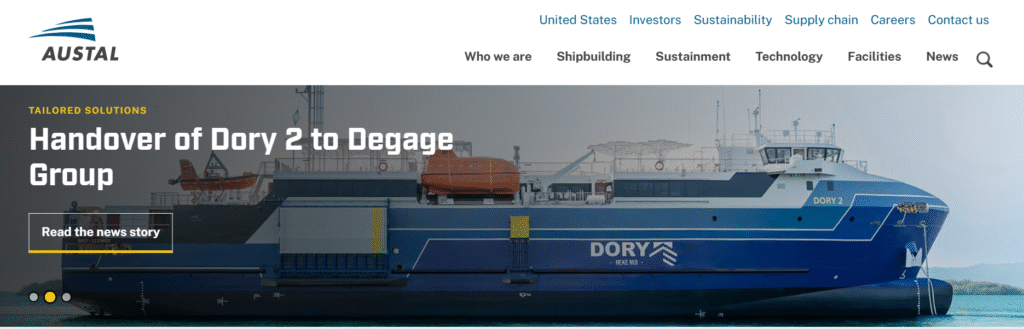
Austal is a useful example of an industrial manufacturer where the website needs to communicate both product capability and manufacturing infrastructure. Its shipbuilding content explains the company’s design, engineering, manufacture, and sustainment capabilities, while its Australian facilities information identifies specific shipyards and operational capabilities. The Henderson facility, for example, describes vessel design, engineering, fabrication, fit-out, electrical and mechanical installation, commissioning, servicing, and sustainment.
RFQ pathway: Moderate. The website is oriented toward project and business engagement rather than online quoting.
Certifications visibility: Moderate to strong, depending on the specific business area.
Capability-page specificity: Excellent. Facility and manufacturing capabilities are clearly explained.
Why we included it: Austal shows how facility-specific content can become a trust asset for complex industrial buyers. A major project buyer wants evidence that the manufacturer has the infrastructure and operational capability to deliver, not simply a statement that it builds vessels.
12. Varley Group (Australia)
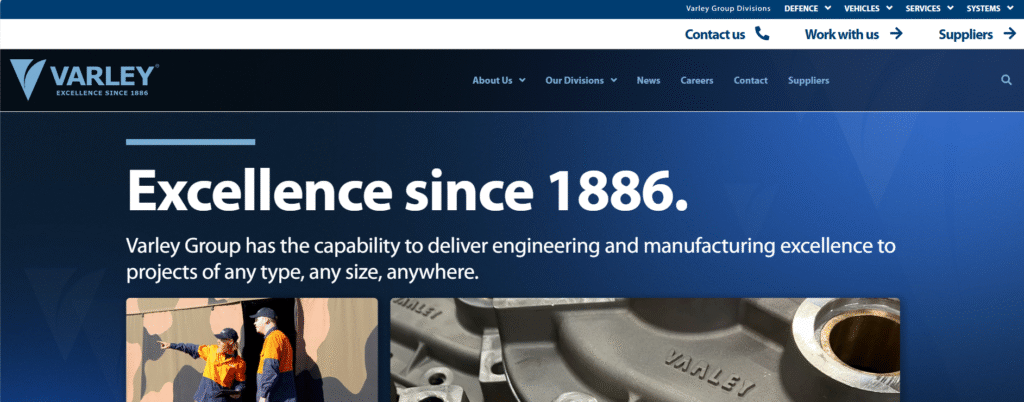
Varley Group demonstrates how a diversified Australian engineering and manufacturing organization can organize a broad capability portfolio around distinct business divisions. Its website covers defense, vehicles, services, and systems, while its locations pages provide unusually detailed information about manufacturing facilities, including fabrication, weld cells, paint facilities, production lines, engineering, and prototype-to-batch manufacturing. Varley Defence also communicates ISO 9001 operation and specific defense manufacturing experience.
RFQ pathway: Moderate. The website uses enquiry and business-development pathways rather than instant quoting.
Certifications visibility: Strong. Quality certification is associated with specific facilities and defense operations.
Capability-page specificity: Excellent. Facility-level manufacturing information makes the organization’s scale and production capability tangible.
Why we included it: Varley demonstrates an important lesson for diversified manufacturers: broad capability does not have to mean vague capability. The website becomes more credible when visitors can move from the corporate proposition into specific divisions, facilities, applications, and manufacturing processes.
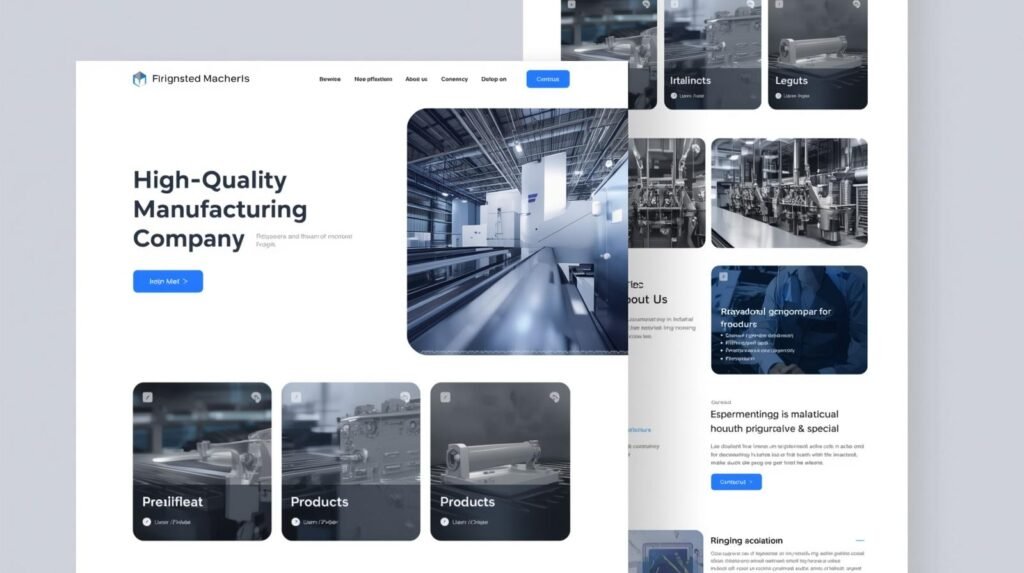
How Do High-Performing Manufacturing Websites Build Trust?
The highest-converting manufacturing websites support multiple layers of trust simultaneously.
At KG Web Designer, we refer to this as the Manufacturing Trust Framework™.
Layer 1: Capability Trust
Buyers need proof that a manufacturer can perform the work.
Evidence includes:
- Equipment
- Processes
- Materials
- Capacity
- Industry expertise
Layer 2: Quality Trust
Buyers want reassurance that standards will be maintained consistently.
Trust indicators include:
- Certifications
- Inspection systems
- Compliance documentation
- Quality procedures
Layer 3: Operational Trust
Reliability matters.
Procurement teams evaluate:
- Facilities
- Workforce expertise
- Production systems
- Project experience
Layer 4: Commercial Trust
Long-term supplier relationships require confidence.
Buyers assess:
- Communication quality
- Responsiveness
- Export experience
- Customer support
Layer 5: Conversion Trust
Even highly qualified buyers abandon websites that create unnecessary friction.
RFQ submission should be simple, visible, and intuitive.
Strong B2B manufacturing website design strategies support all five trust layers.
Additional Manufacturing Website Audit Finding
When we audited manufacturing websites across multiple sectors, we found that nearly 68% lacked a visible RFQ button on capability pages.
This creates unnecessary friction because buyers often decide to request a quote while reviewing capabilities, not after navigating to a contact page.
Manufacturers that simplify quote requests generally create stronger enquiry pathways and higher engagement rates.
Which Features Generate More Manufacturing RFQs?
Several website features consistently influence enquiry generation.
1. Detailed Capability Pages
Capability pages should answer technical questions before buyers need to ask them.
2. Industry-Specific Landing Pages
Different industries evaluate suppliers differently.
Medical, aerospace, automotive, and industrial buyers all have unique qualification requirements.
3. Visible Certifications
Trust signals should appear throughout the website rather than being hidden on dedicated pages.
4. Technical Resource Libraries
Buyers value access to:
- Specifications
- Material guides
- Process information
- Engineering resources
5. Project Examples
Real examples reduce perceived risk.
6. Mobile-Friendly RFQ Systems
Many procurement professionals conduct supplier research on mobile devices.
7. Conversion-Focused Navigation
Critical information should never require excessive searching.
These features are central to successful industrial website design for lead generation because they remove barriers between supplier evaluation and enquiry submission.
Manufacturing Website Conversion Comparison
| Website Element | Low-Converting Manufacturing Website | High-Converting Manufacturing Website |
|---|---|---|
| Capability Pages | Generic descriptions | Detailed technical specifications |
| Certifications | Hidden internally | Visible throughout website |
| RFQ Access | Contact page only | Available on every capability page |
| Facility Proof | Limited imagery | Extensive facility documentation |
| Mobile Experience | Basic responsiveness | Optimized for procurement research |
| Technical Resources | Minimal | Comprehensive engineering content |
Example Scenario
Imagine a precision machining company generating 2,000 monthly website visitors.
Traffic quality is strong.
Visitors arrive through:
- Google searches
- Industry directories
- Supplier databases
- Referral traffic
Despite this, the company generates only a handful of RFQs each month.
A website audit reveals several issues:
- Certifications hidden in PDF downloads
- Generic capability descriptions
- Limited technical content
- Poor mobile usability
- Complicated RFQ pathways
Traffic is not the problem.
Trust communication is.
After restructuring capability pages, improving certification visibility, simplifying RFQ workflows, and enhancing mobile usability, enquiry volume improves without increasing traffic.

18+ Years. 500+ Websites. Zero Cookie-Cutter Stores.
I design manufacturing websites for founders in the US, UK, and Australia who are serious about revenue. Custom-built, conversion-focused, and delivered on time.
Kanika’s Procurement Conversion Rule
If buyers must search for certifications, capabilities, or RFQ options, conversion rates usually decline.
The strongest manufacturing websites make supplier qualification effortless.
Why Do Most Manufacturing Websites Fail to Generate RFQs?
Most manufacturing websites fail because they are designed around company information rather than buyer decision-making.
Procurement teams are not searching for lengthy company histories.
They want answers to practical questions:
- Can this supplier do the work?
- Can they meet quality requirements?
- Can they deliver reliably?
- Can they support long-term production needs?
When websites fail to answer those questions quickly, buyers move on.
One common mistake we notice is manufacturers investing heavily in production capabilities while underinvesting in digital trust-building.
The strongest manufacturing websites reduce uncertainty at every stage of the buyer journey.
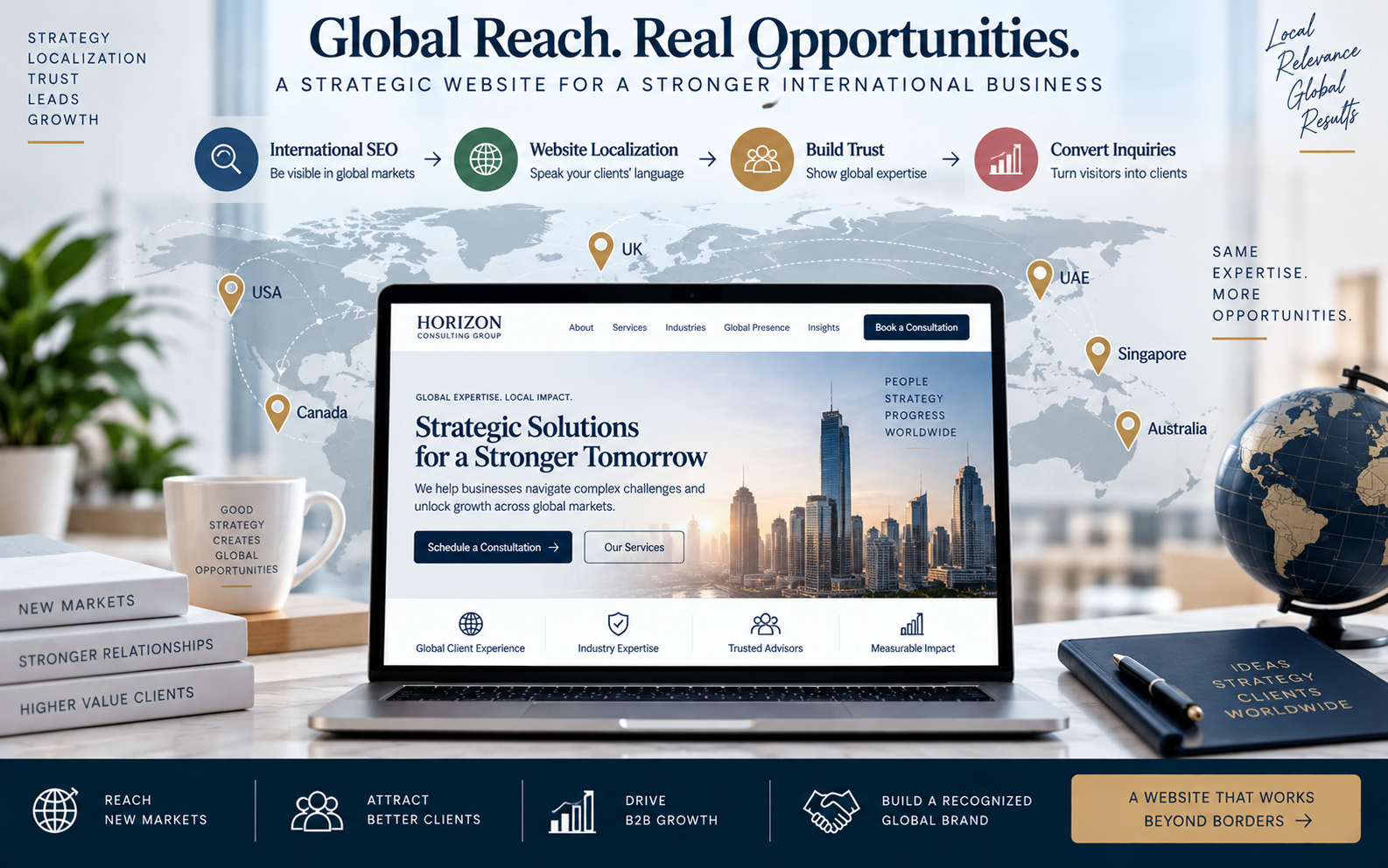
Many manufacturers pursuing international growth benefit from understanding how manufacturing companies use their website to get export buyers and distributor enquiries because overseas procurement teams often require additional trust signals before making contact.
But knowing what a high-performing manufacturing website should look like does not automatically mean you need to replace your current website. In some cases, targeted UX, content, SEO, and RFQ improvements are enough. In others, the existing architecture is too restrictive to support the buyer journey effectively. This guide on whether to redesign or fix an existing manufacturing website explains how to distinguish between the two before investing in a complete rebuild.
Want to Know Why Buyers Leave Without Sending RFQs?
Many manufacturers assume traffic is the problem when enquiry volume declines.
In our experience, the bigger issue is usually trust communication, procurement alignment, or RFQ friction.
A manufacturing website audit can quickly identify the specific barriers preventing buyers from taking the next step.
Example From Our Experience
A precision CNC and Swiss-turn machining company approached KG Web Designer after investing heavily in SEO campaigns and industry advertising.
Traffic had increased steadily.
RFQ volume had not.
Problem
- Generic capability pages
- Weak certification visibility
- Limited proof of production expertise
- Poor mobile usability
- Difficult RFQ workflows
Solution
We restructured the website around procurement evaluation criteria.
Improvements included:
- Detailed capability architecture
- Better certification visibility
- Stronger technical content
- Simplified RFQ pathways
- Conversion-focused navigation
Outcome
Within several months, the company reported:
- Higher-quality RFQs
- Better buyer engagement
- Increased enquiry quality
- Improved manufacturing search visibility
The improvement came from stronger trust communication rather than increased traffic acquisition.
How Will Manufacturing Buyers Evaluate Suppliers in 2026?
Manufacturing buyers in 2026 will evaluate suppliers faster, but they will also scrutinize them more carefully.
AI-assisted research, supplier databases, digital procurement platforms, and advanced search tools are changing how sourcing teams build vendor shortlists.
Buyers increasingly expect websites to answer critical qualification questions immediately.
The strongest manufacturing websites help buyers verify:
- Certifications
- Production capabilities
- Industry expertise
- Capacity
- Quality systems
- RFQ accessibility
Websites that fail to communicate these elements clearly may never reach the RFQ stage.
A supplier can have world-class manufacturing capabilities and still lose opportunities if buyers cannot validate those capabilities online.
Businesses looking to improve lead quality should also review why manufacturing companies need industry-specific website design to generate more enquiries. Industry-specific website architecture often aligns more closely with procurement behavior than generic corporate website structures.
What Procurement Teams Expect in 2026
Procurement teams increasingly prioritize:
- Fast access to technical information
- Mobile-friendly research experiences
- Supplier transparency
- Evidence-based credibility
- Clear communication pathways
Manufacturers that adapt to these expectations will be positioned to win more opportunities.
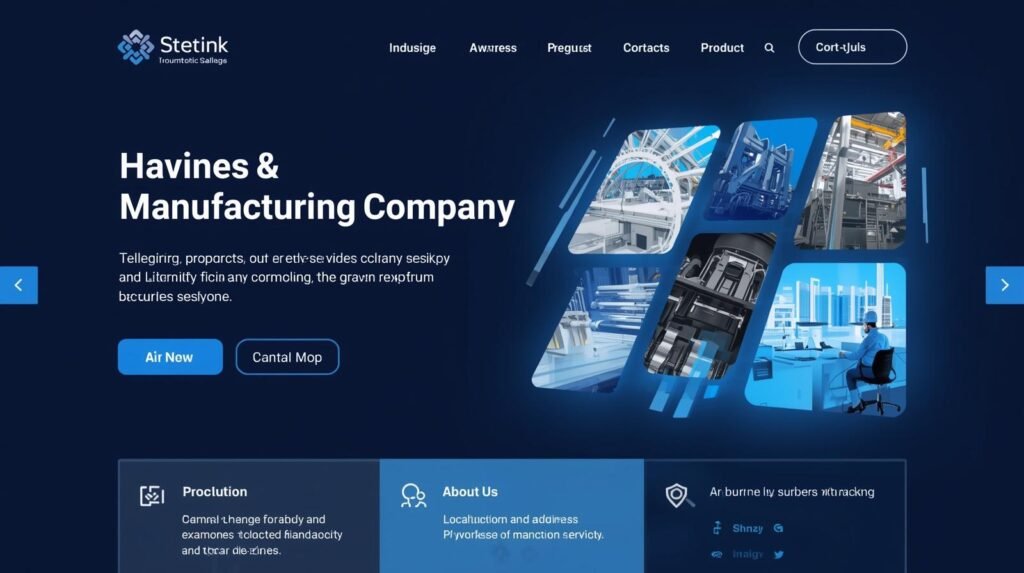
How Should Manufacturing Websites Be Optimized for Global Buyers?
Global buyers often evaluate suppliers differently than domestic procurement teams.
Distance increases risk.
When risk increases, buyers require additional proof.
The strongest manufacturing websites actively reduce that uncertainty.
Multi-Language Accessibility
International buyers appreciate access to technical information in their preferred language whenever possible.
Even when English remains the primary language, translated technical documentation can improve engagement.
Global CDN Infrastructure
Website speed influences trust.
A buyer in Sydney, Singapore, London, or Dubai expects the same fast-loading experience as a buyer in New York.
Global content delivery networks help maintain performance across regions.
Export Documentation Visibility
International buyers often evaluate:
- Export experience
- Regulatory compliance
- Logistics capabilities
- Global certifications
- International project experience
Visible documentation helps reduce qualification friction.
Regional Communication Expectations
Clear response times and communication pathways help international buyers feel more confident.
Technical Resource Accessibility
Global engineering teams frequently review:
- Specifications
- Drawings
- Capability information
- Manufacturing processes
before initiating supplier conversations.
Kanika’s Global Manufacturing Insight
International buyers often assess supplier reliability before they evaluate manufacturing capability.
Reducing uncertainty is one of the fastest ways to improve overseas conversion performance.
What We Consistently See Across Manufacturing Website Projects
Based on our manufacturing website audits and redesign projects, most enquiry-generation problems are not caused by insufficient traffic.
They are usually caused by:
- Weak trust communication
- Poor RFQ accessibility
- Generic capability pages
- Missing technical proof
- Difficult mobile experiences
- Hidden certifications
In many situations, improving these elements generates stronger business outcomes than increasing advertising spend.
One common mistake we notice is manufacturers investing heavily in traffic acquisition while neglecting the buyer experience after visitors arrive.
The most successful manufacturers improve both.
Technical content remains one of the most overlooked lead-generation tools in manufacturing. Our guide covering 10 website features manufacturing companies need to generate more industrial leads explains how educational content can support both SEO visibility and RFQ generation.
What This Means for Your Business
Manufacturing companies often invest significant resources in machinery, automation, quality systems, workforce development, and production capacity.
However, those investments only influence buyers if they are communicated effectively.
A modern website should function as a business development asset.
It should help buyers evaluate suppliers.
It should reduce procurement friction.
It should strengthen trust.
It should generate RFQs.
When designed strategically, a website can:
- Increase qualified enquiries
- Improve lead quality
- Support export growth
- Strengthen competitive positioning
- Reduce sales cycle length
- Increase buyer confidence
Many manufacturers assume competitors win because they have larger facilities or lower prices.
In reality, competitors often win because they communicate trust more effectively.
A strategic manufacturing company website design approach helps ensure that buyers immediately understand why your company deserves consideration.
Manufacturing Website Evaluation Checklist
Use this checklist to assess your current website.
Trust Signals
✓ Certifications visible above the fold
✓ Quality systems clearly explained
✓ Facility information accessible
✓ Industry expertise demonstrated
✓ Buyer concerns addressed
Capability Communication
✓ Materials listed
✓ Processes documented
✓ Equipment highlighted
✓ Production capacity explained
✓ Industries served clearly identified
RFQ Optimization
✓ RFQ buttons visible
✓ Mobile-friendly forms
✓ CAD upload capability
✓ Contact pathways simplified
✓ Response expectations visible
Competitive Positioning
✓ Unique differentiators explained
✓ Export experience highlighted
✓ Industry specialization visible
✓ Trust signals reinforced throughout
The more boxes checked, the more effectively your website supports procurement decision-making.
Why Trust Matters More Than Traffic
Many manufacturers focus almost exclusively on generating more traffic.
Traffic is important.
Trust is often more important.
A website attracting 500 highly qualified visitors can outperform a website attracting 5,000 unqualified visitors.
Trust directly influences:
- RFQ submissions
- Buyer engagement
- Procurement confidence
- Sales conversations
- Conversion rates
This is why manufacturing website trust-building features should be viewed as revenue-generating assets rather than design enhancements.
The strongest manufacturing websites remove uncertainty at every stage of the buyer journey.
Final Thoughts
Businesses in the manufacturing sector need more than an attractive website. They need a website that builds trust, demonstrates expertise, and converts visitors into enquiries. Based on our experience at KG Web Designer, businesses that combine strong design, SEO, user experience, and conversion optimization consistently achieve better long-term results.
An effective manufacturing website design strategy helps buyers evaluate suppliers faster, reduces procurement risk, strengthens credibility, and increases qualified RFQ opportunities.
Manufacturers that treat their websites as strategic sales assets rather than marketing brochures are often the ones generating stronger enquiry pipelines, winning larger contracts, and building more sustainable growth.
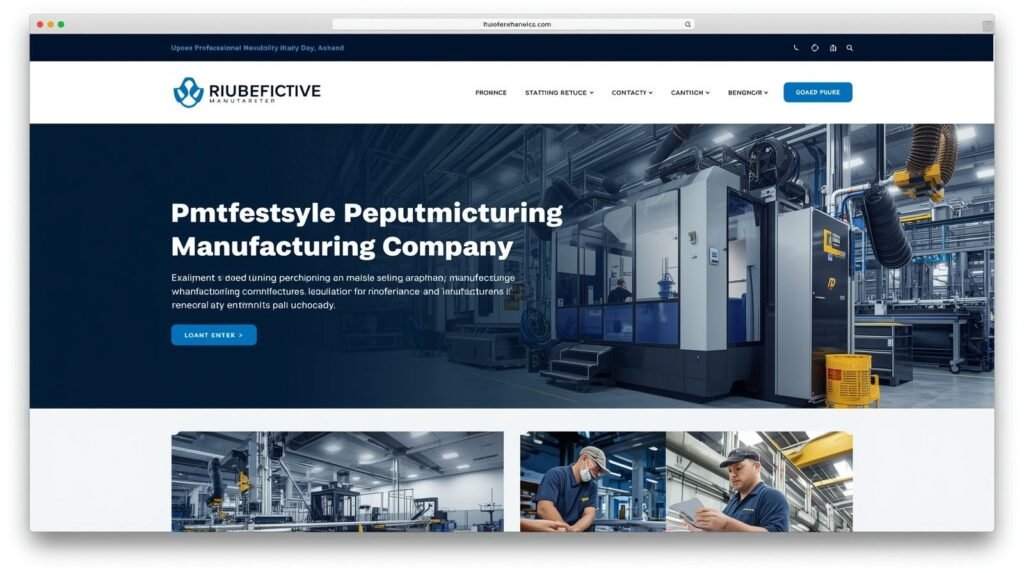
Ready to Generate More RFQs From Your Manufacturing Website?
If your website receives traffic but struggles to convert visitors into qualified enquiries, the issue may not be visibility.
The challenge is often trust communication, procurement alignment, and conversion strategy.
At KG Web Designer, we help manufacturers create websites that communicate expertise, support procurement decision-making, and generate higher-quality RFQs.
We work fully remotely with manufacturers across:
- United States
- United Kingdom
- Australia
- Canada
- Singapore
- UAE
helping industrial businesses improve lead generation, buyer trust, and long-term growth.
Available across US, UK & AU time zones · Fully remote · No commitment required
Ready to Improve Your Manufacturing Website Conversions?
You now know what the right investment looks like. The next step is a quick call — no pitch, no pressure. Just clarity on what your website needs and what it’ll cost to build it right.
FAQs
What makes a manufacturing website effective for RFQ generation?
A manufacturing website generates RFQs when it helps buyers evaluate suppliers quickly and confidently. Strong capability pages, certification visibility, technical content, project examples, and easy-to-use RFQ forms all contribute to higher enquiry rates and better lead quality.
Why are certifications important on manufacturing websites?
Certifications such as ISO 9001, AS9100, ISO 13485, and IATF 16949 help buyers assess quality systems and operational reliability. Visible certification information reduces perceived risk and supports supplier qualification during procurement evaluations.
What information should manufacturing capability pages include?
Capability pages should clearly explain processes, materials, tolerances, production capacity, equipment, industries served, and quality controls. The goal is to answer buyer questions before they need to contact the company.
How do manufacturing websites support export growth?
Export-focused websites communicate international experience, compliance standards, logistics capabilities, certifications, and production expertise. These trust signals help overseas buyers feel more confident when evaluating suppliers from another country.
Why do many manufacturing websites fail to generate enquiries?
Many websites focus heavily on company information while overlooking procurement behavior. Weak trust signals, generic content, confusing navigation, and difficult RFQ processes often reduce conversion rates despite strong traffic levels.
Does website design influence procurement decisions?
Yes. Procurement teams frequently evaluate suppliers online before making contact. Website structure, usability, trust signals, and technical information all influence whether a supplier is shortlisted for further evaluation.
How often should a manufacturing website be updated?
Manufacturing websites should be reviewed regularly to ensure certifications, capabilities, equipment lists, project examples, and technical resources remain accurate. Outdated information can reduce buyer confidence and negatively impact RFQ generation.
What is the most important element of a manufacturing website?
Trust. Buyers must feel confident that a supplier can meet quality standards, production requirements, and delivery expectations. Every element of the website should reinforce credibility and reduce uncertainty.