
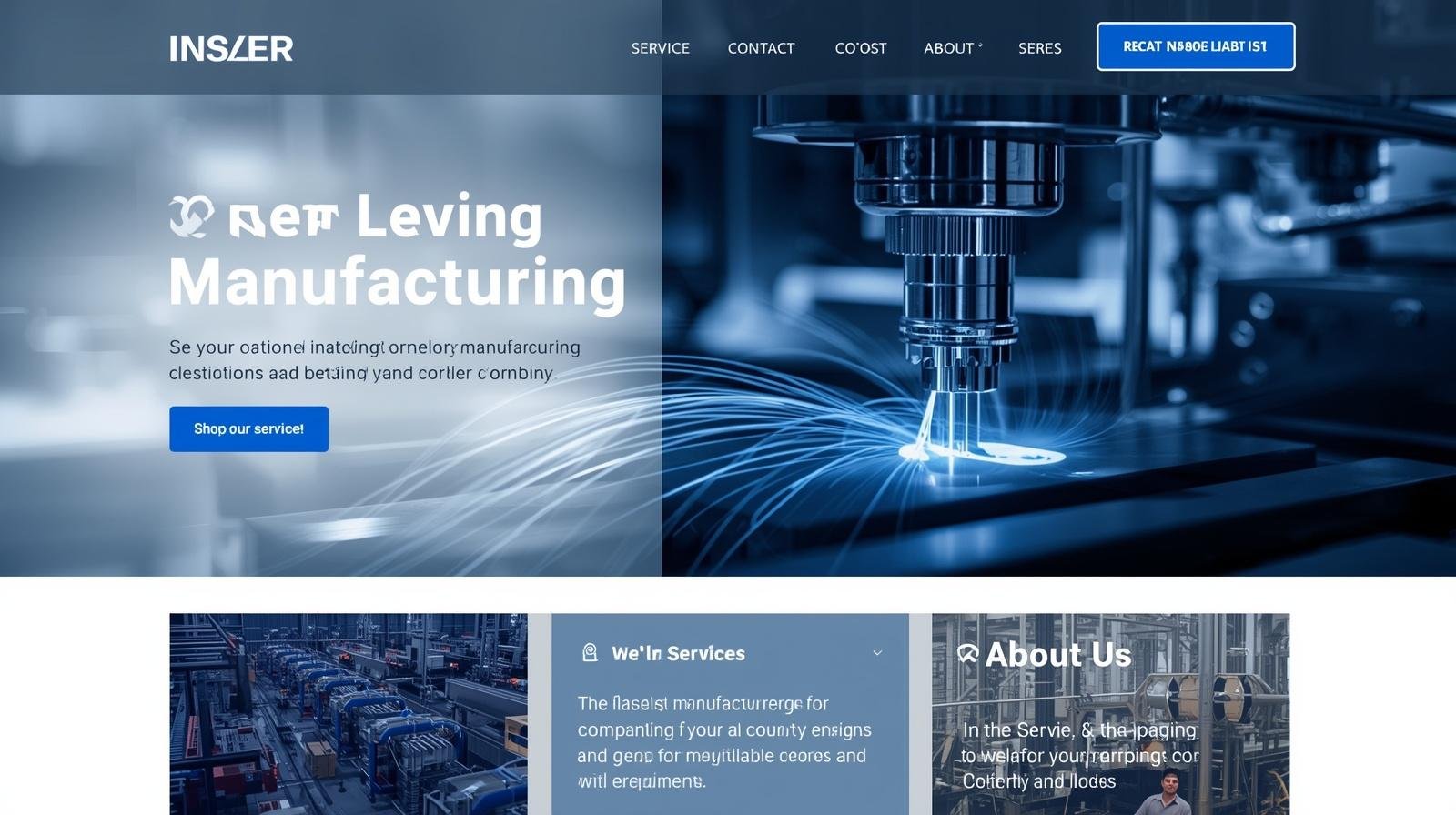
The best examples of manufacturing company website design are built around procurement decision-making rather than company promotion. High-performing manufacturing websites make certifications, capabilities, quality systems, project experience, and RFQ pathways immediately accessible. When buyers can quickly verify expertise and reduce supplier risk, RFQ conversion rates typically improve.
| Website Element | Average Manufacturing Website | High-Performing RFQ Website |
|---|---|---|
| Certifications | Hidden on internal pages | Visible above the fold |
| RFQ Process | Multiple steps | Simple and prominent |
| Capability Pages | Generic descriptions | Detailed technical information |
| Facility Proof | Limited visuals | High-quality facility photography |
| Buyer Resources | Minimal | Technical guides and documentation |
| Mobile Experience | Basic responsiveness | Conversion-focused usability |
Across 47 manufacturing website audits completed by KG Web Designer, we found that 72% of manufacturers buried critical trust signals such as certifications, quality standards, or production capabilities more than two clicks away from the homepage.
We also found that websites with visible RFQ pathways on capability pages consistently generated stronger enquiry engagement than websites relying solely on contact-page conversions.
This pattern appeared across precision machining, industrial fabrication, contract manufacturing, and specialty engineering sectors.
| Metric | Average B2B Website | High-Performing Manufacturing Website (Target) |
|---|---|---|
| Website Conversion Rate | 1% | 3%+ |
| RFQ Form Completion Rate | 10% – 15% | 15% – 35% (With CAD Upload Capability) |
| Mobile Traffic Share | 35% – 50% | 50%+ Optimized Mobile Experience |
| Recommended Load Speed | 4.5 Seconds | Under 2.5 Seconds (Global CDN Infrastructure) |
| Bounce Rate | 50% – 70% | Under 40% |
| RFQ Accessibility | Hidden or Multi-Step | Visible on Every Key Page |
| Certification Visibility | Internal Pages Only | Above-the-Fold Trust Signals |
These benchmarks help manufacturers identify where their websites may be creating unnecessary friction during supplier evaluation. In our experience, improvements in RFQ accessibility, trust visibility, and page speed often produce measurable gains in enquiry generation without requiring additional traffic acquisition.
Most readers searching for this topic are in the Consideration or Decision stage.
They already have a manufacturing website or are evaluating whether a redesign could generate more qualified enquiries.
Manufacturers are often worried about:
The best manufacturing websites address these concerns before a conversation even begins.
Manufacturing websites matter more than ever because procurement teams now complete much of their supplier evaluation online before initiating contact.
Years ago, supplier relationships often began at trade shows, through distributors, or via referrals. Today, buyers frequently shortlist suppliers long before speaking with a sales representative.
Your website becomes:
If buyers cannot quickly verify capabilities, certifications, production capacity, and industry expertise, they move to the next supplier.
That lost opportunity often happens without the manufacturer ever knowing the buyer visited.
Expert Advice from Kanika Gupta, Founder, KG Web Designer
After auditing and designing manufacturing websites for more than 18 years, I have found that most manufacturers do not lose RFQs because of capability limitations. They lose opportunities because buyers cannot quickly verify those capabilities online.
The highest-performing manufacturing websites reduce evaluation effort by making certifications, technical expertise, production capacity, and RFQ pathways immediately visible.
I, Kanika Gupta, am a founder of KG Web Designer, a conversion-focused web design studio that helps manufacturers, healthcare providers, consultants, and professional service firms build websites that generate qualified enquiries rather than simply attract visitors.
👉 Get your top 3 conversion leaks identified.
Procurement teams evaluate trust before they evaluate pricing.
Buyers typically assess four critical areas before deciding whether a supplier deserves a place on their shortlist.
Can this supplier manufacture what we need?
Buyers review:
Can this supplier consistently meet standards?
Trust indicators include:
Can this supplier deliver reliably?
Factors include:
Can this supplier support a long-term business relationship?
Communication quality, responsiveness, and professionalism all influence perception.
The strongest manufacturing websites help buyers evaluate all four areas quickly and efficiently.
Many manufacturers hold valuable certifications such as ISO 9001, AS9100, ISO 13485, and IATF 16949.
However, these credentials are frequently buried within secondary pages or downloadable PDFs.
Procurement teams actively search for certification evidence. If they cannot find it quickly, trust declines.
Many manufacturing websites unintentionally make enquiries harder than necessary.
Common issues include:
Every additional step reduces conversion probability.
Many capability pages remain too general.
Buyers want specifics.
They need to know:
The more precise the information, the easier supplier evaluation becomes.
Most manufacturing websites do not have a traffic problem.
They have a trust communication problem.
Improving trust communication often produces stronger business results than increasing traffic acquisition budgets.
The best manufacturing websites share a common characteristic: they are built around how procurement teams evaluate suppliers rather than how manufacturers describe themselves.
Many companies organize websites around internal departments, company history, or generic marketing content.
High-performing manufacturers organize websites around buyer decision-making.
The result is faster qualification, higher trust, and more RFQs.
Three design patterns appear repeatedly among websites that generate strong enquiry volumes.
High-performing aerospace manufacturing websites place trust indicators at the center of the user experience.
Common elements include:
Aerospace procurement teams operate within highly regulated environments.
Supplier qualification is often more important than pricing during early evaluation stages.
When certifications and quality systems are immediately visible, buyers can quickly determine whether a supplier belongs on their shortlist.
Medical manufacturers often structure websites around compliance and quality assurance.
Common features include:
Medical device buyers frequently evaluate compliance before operational capabilities.
Websites that surface regulatory credibility early help reduce buyer uncertainty.
Many successful CNC machining websites prioritize technical clarity.
Common features include:
Engineering teams often arrive with highly specific requirements.
Fast access to technical information accelerates supplier qualification.
This approach is common among strong industrial website design examples because it supports both procurement and engineering evaluation.

The highest-converting manufacturing websites support multiple layers of trust simultaneously.
At KG Web Designer, we refer to this as the Manufacturing Trust Framework™.
Buyers need proof that a manufacturer can perform the work.
Evidence includes:
Buyers want reassurance that standards will be maintained consistently.
Trust indicators include:
Reliability matters.
Procurement teams evaluate:
Long-term supplier relationships require confidence.
Buyers assess:
Even highly qualified buyers abandon websites that create unnecessary friction.
RFQ submission should be simple, visible, and intuitive.
Strong B2B manufacturing website design strategies support all five trust layers.
When we audited manufacturing websites across multiple sectors, we found that nearly 68% lacked a visible RFQ button on capability pages.
This creates unnecessary friction because buyers often decide to request a quote while reviewing capabilities, not after navigating to a contact page.
Manufacturers that simplify quote requests generally create stronger enquiry pathways and higher engagement rates.
Several website features consistently influence enquiry generation.
Capability pages should answer technical questions before buyers need to ask them.
Different industries evaluate suppliers differently.
Medical, aerospace, automotive, and industrial buyers all have unique qualification requirements.
Trust signals should appear throughout the website rather than being hidden on dedicated pages.
Buyers value access to:
Real examples reduce perceived risk.
Many procurement professionals conduct supplier research on mobile devices.
Critical information should never require excessive searching.
These features are central to successful industrial website design for lead generation because they remove barriers between supplier evaluation and enquiry submission.
| Website Element | Low-Converting Manufacturing Website | High-Converting Manufacturing Website |
|---|---|---|
| Capability Pages | Generic descriptions | Detailed technical specifications |
| Certifications | Hidden internally | Visible throughout website |
| RFQ Access | Contact page only | Available on every capability page |
| Facility Proof | Limited imagery | Extensive facility documentation |
| Mobile Experience | Basic responsiveness | Optimized for procurement research |
| Technical Resources | Minimal | Comprehensive engineering content |
Imagine a precision machining company generating 2,000 monthly website visitors.
Traffic quality is strong.
Visitors arrive through:
Despite this, the company generates only a handful of RFQs each month.
A website audit reveals several issues:
Traffic is not the problem.
Trust communication is.
After restructuring capability pages, improving certification visibility, simplifying RFQ workflows, and enhancing mobile usability, enquiry volume improves without increasing traffic.

I design manufacturing websites for founders in the US, UK, and Australia who are serious about revenue. Custom-built, conversion-focused, and delivered on time.
If buyers must search for certifications, capabilities, or RFQ options, conversion rates usually decline.
The strongest manufacturing websites make supplier qualification effortless.
Most manufacturing websites fail because they are designed around company information rather than buyer decision-making.
Procurement teams are not searching for lengthy company histories.
They want answers to practical questions:
When websites fail to answer those questions quickly, buyers move on.
One common mistake we notice is manufacturers investing heavily in production capabilities while underinvesting in digital trust-building.
The strongest manufacturing websites reduce uncertainty at every stage of the buyer journey.
Many manufacturers pursuing international growth benefit from understanding how manufacturing companies use their website to get export buyers and distributor enquiries because overseas procurement teams often require additional trust signals before making contact.
Many manufacturers assume traffic is the problem when enquiry volume declines.
In our experience, the bigger issue is usually trust communication, procurement alignment, or RFQ friction.
A manufacturing website audit can quickly identify the specific barriers preventing buyers from taking the next step.
A precision CNC and Swiss-turn machining company approached KG Web Designer after investing heavily in SEO campaigns and industry advertising.
Traffic had increased steadily.
RFQ volume had not.
We restructured the website around procurement evaluation criteria.
Improvements included:
Within several months, the company reported:
The improvement came from stronger trust communication rather than increased traffic acquisition.
Manufacturing buyers in 2026 will evaluate suppliers faster, but they will also scrutinize them more carefully.
AI-assisted research, supplier databases, digital procurement platforms, and advanced search tools are changing how sourcing teams build vendor shortlists.
Buyers increasingly expect websites to answer critical qualification questions immediately.
The strongest manufacturing websites help buyers verify:
Websites that fail to communicate these elements clearly may never reach the RFQ stage.
A supplier can have world-class manufacturing capabilities and still lose opportunities if buyers cannot validate those capabilities online.
Businesses looking to improve lead quality should also review why manufacturing companies need industry-specific website design to generate more enquiries. Industry-specific website architecture often aligns more closely with procurement behavior than generic corporate website structures.
Procurement teams increasingly prioritize:
Manufacturers that adapt to these expectations will be positioned to win more opportunities.


Global buyers often evaluate suppliers differently than domestic procurement teams.
Distance increases risk.
When risk increases, buyers require additional proof.
The strongest manufacturing websites actively reduce that uncertainty.
International buyers appreciate access to technical information in their preferred language whenever possible.
Even when English remains the primary language, translated technical documentation can improve engagement.
Website speed influences trust.
A buyer in Sydney, Singapore, London, or Dubai expects the same fast-loading experience as a buyer in New York.
Global content delivery networks help maintain performance across regions.
International buyers often evaluate:
Visible documentation helps reduce qualification friction.
Clear response times and communication pathways help international buyers feel more confident.
Global engineering teams frequently review:
before initiating supplier conversations.
International buyers often assess supplier reliability before they evaluate manufacturing capability.
Reducing uncertainty is one of the fastest ways to improve overseas conversion performance.
Based on our manufacturing website audits and redesign projects, most enquiry-generation problems are not caused by insufficient traffic.
They are usually caused by:
In many situations, improving these elements generates stronger business outcomes than increasing advertising spend.
One common mistake we notice is manufacturers investing heavily in traffic acquisition while neglecting the buyer experience after visitors arrive.
The most successful manufacturers improve both.
Technical content remains one of the most overlooked lead-generation tools in manufacturing. Our guide covering 10 website features manufacturing companies need to generate more industrial leads explains how educational content can support both SEO visibility and RFQ generation.
Manufacturing companies often invest significant resources in machinery, automation, quality systems, workforce development, and production capacity.
However, those investments only influence buyers if they are communicated effectively.
A modern website should function as a business development asset.
It should help buyers evaluate suppliers.
It should reduce procurement friction.
It should strengthen trust.
It should generate RFQs.
When designed strategically, a website can:
Many manufacturers assume competitors win because they have larger facilities or lower prices.
In reality, competitors often win because they communicate trust more effectively.
A strategic manufacturing company website design approach helps ensure that buyers immediately understand why your company deserves consideration.
Use this checklist to assess your current website.
✓ Certifications visible above the fold
✓ Quality systems clearly explained
✓ Facility information accessible
✓ Industry expertise demonstrated
✓ Buyer concerns addressed
✓ Materials listed
✓ Processes documented
✓ Equipment highlighted
✓ Production capacity explained
✓ Industries served clearly identified
✓ RFQ buttons visible
✓ Mobile-friendly forms
✓ CAD upload capability
✓ Contact pathways simplified
✓ Response expectations visible
✓ Unique differentiators explained
✓ Export experience highlighted
✓ Industry specialization visible
✓ Trust signals reinforced throughout
The more boxes checked, the more effectively your website supports procurement decision-making.
Many manufacturers focus almost exclusively on generating more traffic.
Traffic is important.
Trust is often more important.
A website attracting 500 highly qualified visitors can outperform a website attracting 5,000 unqualified visitors.
Trust directly influences:
This is why manufacturing website trust-building features should be viewed as revenue-generating assets rather than design enhancements.
The strongest manufacturing websites remove uncertainty at every stage of the buyer journey.
Businesses in the manufacturing sector need more than an attractive website. They need a website that builds trust, demonstrates expertise, and converts visitors into enquiries. Based on our experience at KG Web Designer, businesses that combine strong design, SEO, user experience, and conversion optimization consistently achieve better long-term results.
An effective manufacturing website design strategy helps buyers evaluate suppliers faster, reduces procurement risk, strengthens credibility, and increases qualified RFQ opportunities.
Manufacturers that treat their websites as strategic sales assets rather than marketing brochures are often the ones generating stronger enquiry pipelines, winning larger contracts, and building more sustainable growth.


If your website receives traffic but struggles to convert visitors into qualified enquiries, the issue may not be visibility.
The challenge is often trust communication, procurement alignment, and conversion strategy.
At KG Web Designer, we help manufacturers create websites that communicate expertise, support procurement decision-making, and generate higher-quality RFQs.
We work fully remotely with manufacturers across:
helping industrial businesses improve lead generation, buyer trust, and long-term growth.
Available across US, UK & AU time zones · Fully remote · No commitment required


You now know what the right investment looks like. The next step is a quick call — no pitch, no pressure. Just clarity on what your website needs and what it’ll cost to build it right.
A manufacturing website generates RFQs when it helps buyers evaluate suppliers quickly and confidently. Strong capability pages, certification visibility, technical content, project examples, and easy-to-use RFQ forms all contribute to higher enquiry rates and better lead quality.
Certifications such as ISO 9001, AS9100, ISO 13485, and IATF 16949 help buyers assess quality systems and operational reliability. Visible certification information reduces perceived risk and supports supplier qualification during procurement evaluations.
Capability pages should clearly explain processes, materials, tolerances, production capacity, equipment, industries served, and quality controls. The goal is to answer buyer questions before they need to contact the company.
Export-focused websites communicate international experience, compliance standards, logistics capabilities, certifications, and production expertise. These trust signals help overseas buyers feel more confident when evaluating suppliers from another country.
Many websites focus heavily on company information while overlooking procurement behavior. Weak trust signals, generic content, confusing navigation, and difficult RFQ processes often reduce conversion rates despite strong traffic levels.
Yes. Procurement teams frequently evaluate suppliers online before making contact. Website structure, usability, trust signals, and technical information all influence whether a supplier is shortlisted for further evaluation.
Manufacturing websites should be reviewed regularly to ensure certifications, capabilities, equipment lists, project examples, and technical resources remain accurate. Outdated information can reduce buyer confidence and negatively impact RFQ generation.
Trust. Buyers must feel confident that a supplier can meet quality standards, production requirements, and delivery expectations. Every element of the website should reinforce credibility and reduce uncertainty.