Quick Answer
For most new dropshipping businesses, Shopify is enough to launch, test products, connect suppliers, and validate demand without paying for a fully custom build. The better investment depends on your business model, product differentiation, supplier requirements, customer experience, and growth plans. Dropshipping website design should solve those commercial needs first. Consider custom development when a standard theme or available integration creates measurable limitations, not simply because a custom store sounds more premium.
TL;DR: Key Takeaways
- Shopify is a practical starting point for many dropshipping businesses because hosting, storefront tools, payments, and integrations are available within one platform.
- A custom store is not automatically more profitable. It makes sense when you need specific workflows, distinctive product experiences, advanced integrations, or greater control over the storefront.
- The platform subscription is only one part of the cost. Include themes, apps, development, payment processing, maintenance, testing, and ongoing optimization in your budget.
- Supplier reliability, delivery expectations, product quality, and return policies can influence customer confidence as much as the visual design.
- Before rebuilding anything, identify the actual constraint: traffic quality, product-page clarity, shipping concerns, pricing, checkout friction, or technical limitations.
Shopify vs. a Custom Store: What Is the Practical Difference?
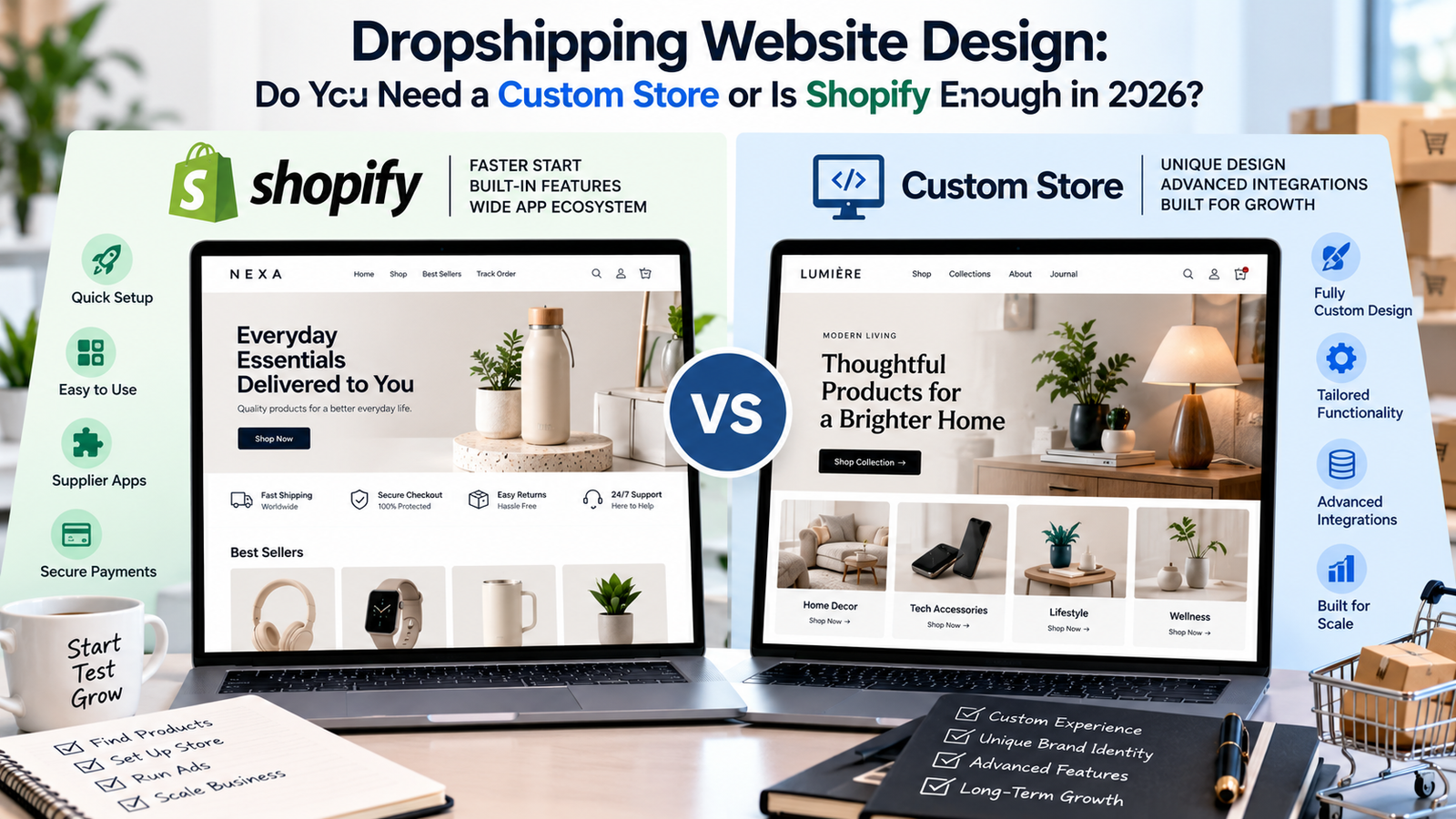
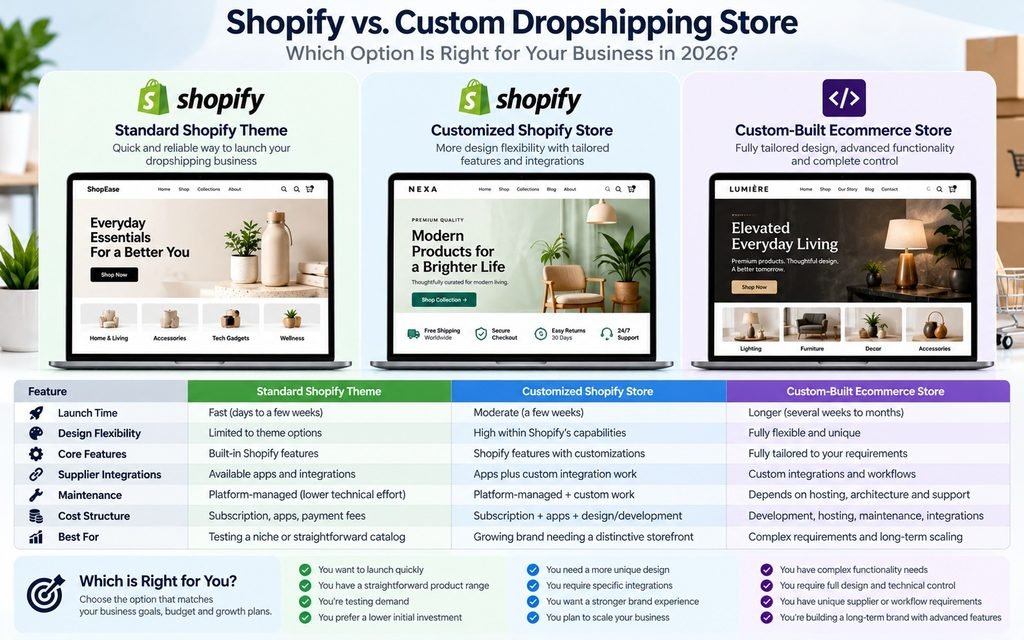
Shopify and custom development can both support a professional dropshipping business. The important distinction is how much flexibility you need, how quickly you need to launch, and how much ongoing technical responsibility you are prepared to manage.
| Decision factor | Shopify with a suitable theme | Customized Shopify store | Custom-built store |
|---|---|---|---|
| Initial launch | Generally faster | Moderate, depending on scope | Usually requires more planning and development |
| Technical maintenance | Much of the platform infrastructure is managed | Platform-managed, with custom components to maintain | Depends on architecture and development team |
| Design flexibility | Constrained by theme structure and platform capabilities | High within Shopify’s capabilities | Potentially very high |
| Supplier integrations | Available apps and supported integrations | Apps plus tailored development where appropriate | Depends on API availability and custom integration work |
| Checkout and commerce features | Platform features and plan-dependent capabilities | Shopify’s platform rules still apply | Greater architectural control, with more responsibility |
| Ongoing costs | Subscription, apps, payment processing, and optional services | Subscription plus apps and development | Hosting, maintenance, development, integrations, and payment processing |
| Best fit | Validating demand and standard commerce needs | A differentiated brand with specific storefront needs | Complex workflows or requirements that justify custom ownership |
A customized Shopify store is an important middle option. You do not necessarily have to choose between an untouched template and a completely separate ecommerce platform.
How Much Does Shopify Cost Compared With a Custom Store in 2026?
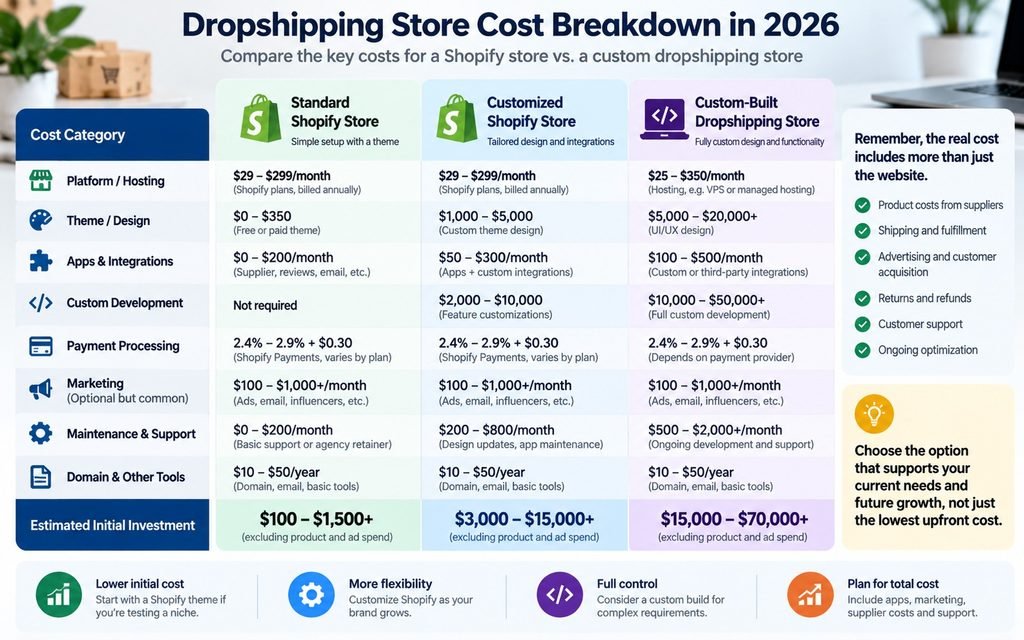
Shopify’s published US subscription prices provide a useful starting point, but they are not the total cost of operating a store. Shopify lists Basic at $29 per month when billed yearly or $39 month to month, Grow at $79 per month when billed yearly or $105 month to month, and Advanced at $299 per month when billed yearly or $399 month to month. Features, payment rates, and eligibility vary by plan. Shopify’s official pricing page is the best place to verify current terms before budgeting.
| Cost category | Shopify store | Custom Shopify store | Custom-built store |
|---|---|---|---|
| Platform or hosting | Shopify subscription | Shopify subscription | Hosting and infrastructure selected for the build |
| Storefront design | Theme and setup costs | Theme plus design and development | UX, visual design, and development |
| Supplier connections | App or integration fees may apply | Apps and potentially custom integration work | Custom integration work may be required |
| Ongoing maintenance | Platform updates plus store management | Platform updates plus maintenance of custom work | Technical maintenance and updates depend on the architecture |
| Payment processing | Payment-provider fees apply | Payment-provider fees apply | Payment-provider fees apply |
| Budget certainty | Relatively predictable platform fee, variable add-ons | Subscription plus project and app costs | Depends heavily on scope, architecture, and support arrangements |
WooCommerce, another option for businesses considering a more configurable build, describes its core platform as free and open source. It estimates hosting at $25 to $350 per month for many stores and extensions at $29 to $299 per year per extension. These are WooCommerce’s published estimates, not a guaranteed quote for your store.
The commercial lesson: compare the total cost of ownership, not just the monthly platform fee. A lower subscription can still lead to higher costs if you need numerous paid extensions, custom maintenance, or frequent developer support. Conversely, a custom build can be an unnecessary expense if a standard platform already meets your requirements.
Shopify or a Custom Store? Build Around Your Business Goals.
Not every dropshipping business needs a custom-built website. The right choice depends on your product range, supplier workflows, integrations, budget, and plans for growth.
Shopify Store
A practical starting point for launching quickly, testing products, and managing everyday store operations through an established platform.
Custom E-commerce
Worth exploring when your business needs specialised workflows, complex integrations, or functionality that standard platforms cannot easily support.
When Is Shopify Enough for a Dropshipping Business?
Shopify is usually enough when the business has a clear niche, a manageable product catalog, straightforward supplier connections, and a standard buying journey. Its built-in storefront features, theme options, order management, and app ecosystem can help a business launch without building core commerce functionality from scratch. Shopify also documents the dropshipping model and supplier considerations in its official dropshipping guidance.
A standard or lightly customized Shopify setup is a reasonable starting point when:
- You are testing whether a product category has sustained demand.
- Your supplier offers a reliable, compatible app or integration.
- Your catalog and product options do not require unusual configuration.
- Your shipping, returns, and customer support processes are relatively straightforward.
- Your immediate priority is validating acquisition channels and unit economics.
- You can create a clear, credible buying experience with available themes and features.
A dropshipping website builder can help reduce technical complexity, but it cannot validate your product-market fit or fix weak supplier performance. Before committing to a supplier, review processing and delivery times, order samples, examine product quality, and understand how tracking, returns, defects, and customer complaints will be handled.
For a new business, the strongest early investment is often a reliable product page, transparent shipping information, a clear returns policy, useful product photography, and a friction-conscious checkout. Build a more complex system only when the business has a specific need for it.
When Does Custom Dropshipping Store Design Make Sense?
Custom development becomes more compelling when a documented business requirement cannot be handled effectively through a theme, an available app, or a reasonable Shopify customization. It should be a response to a real constraint, not a design preference alone.
Consider a custom or more deeply customized build when:
- Your product experience is distinctive. Buyers need product configuration, compatibility tools, comparison experiences, guided selection, or complex bundles.
- Your supplier workflow is unusual. You need specialized data synchronization, custom order routing, or connections that existing apps cannot support reliably.
- Your brand needs a more considered buying journey. Standard layouts prevent you from explaining product differences, demonstrating value, or helping customers choose confidently.
- Your operating model is complex. You have multiple supplier rules, region-specific catalogs, differentiated shipping conditions, or intricate pricing logic.
- Your team needs specific functionality. Repeated workarounds are slowing operations, increasing errors, or making customer service harder.
The right decision should be based on the business impact of the limitation. For example, estimate how much manual work a custom integration would remove, whether it would reduce order errors, and whether the expected benefit justifies development and maintenance costs.
For a more detailed comparison of platform templates and custom development, read KG Web Designer’s guide to custom ecommerce website design vs. Shopify templates.
What Should a Dropshipping Store Include to Build Customer Confidence?
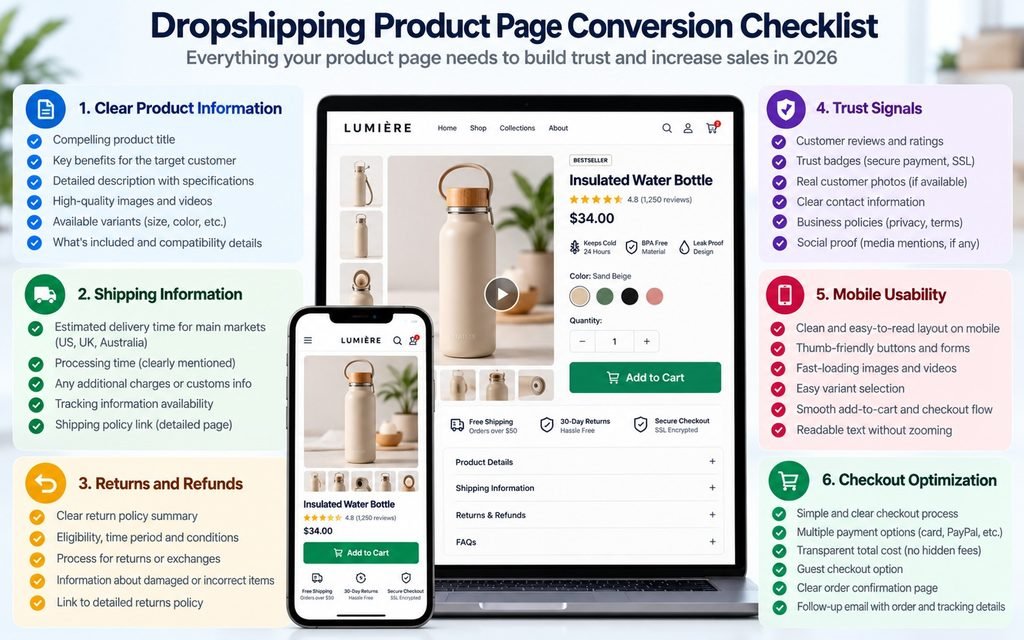
A dropshipping store should make it easy for shoppers to understand the product, evaluate the seller, and know what will happen after payment. This matters because customers are buying from your brand even when another business fulfills the order.
Prioritize these elements:
- Clear product information: explain dimensions, materials, compatibility, included items, limitations, and appropriate use.
- Credible product imagery: use accurate images and, where possible, original photography or demonstrations that help buyers assess the item.
- Transparent delivery information: state realistic processing and shipping estimates, relevant delivery restrictions, and any potential import or customs charges that apply.
- Accessible returns and support information: explain how customers can request help, report a problem, or initiate a return.
- Visible business identity: provide clear contact details, policies, and consistent brand information.
- Useful product-page structure: answer common objections near the product details and purchase action.
- Mobile-friendly checkout: ensure product options, forms, shipping information, and payment steps are easy to use on smaller screens.
Shopify’s guidance states that merchants should make processing and shipping information publicly available and communicate relevant additional charges before checkout. It also recommends ordering from suppliers to assess handling and delivery performance. Review the official Shopify guidance on dropshipping and shipping disclosures before finalizing your store policies.
Will Your Dropshipping Store Grow With Your Business?
As your product range and order volume increase, your website may need more than a new theme. Review your operational needs before investing in additional functionality.
Supplier Connections
Consider product syncing, stock updates, order routing, and the supplier tools your workflow requires.
Store Performance
Plan for smooth browsing, reliable checkout, mobile usability, and efficient product discovery.
Room to Expand
Assess new markets, product variants, marketing tools, and any specialised features you may need later.
What Does Ecommerce Research Say About Conversion and Checkout?
Research supports treating checkout usability as a business issue, but it does not prove that every store needs a redesign. Baymard Institute reports a global average cart abandonment rate of 70.19% and says its benchmark of 344 leading US and European ecommerce sites found 65% had checkout UX rated mediocre or worse. The figures describe broader ecommerce patterns, not the expected performance of a particular dropshipping store.
The practical takeaway is to investigate why shoppers are not completing purchases before investing in a new platform. Abandonment can reflect browsing behavior, unexpected costs, delivery concerns, comparison shopping, payment preferences, trust, or usability. Website changes should target the causes supported by your own analytics and customer feedback.
| Observed problem | What to investigate first | Likely first step |
|---|---|---|
| Visitors arrive but rarely view products | Traffic relevance, landing-page messaging, and navigation | Improve campaign-to-page alignment |
| Product views are healthy but add-to-cart activity is low | Price, product information, images, differentiation, and trust | Improve product-page clarity |
| Many carts do not become orders | Shipping cost, delivery timing, payment options, and checkout friction | Review checkout and delivery disclosures |
| Customers ask repeated delivery questions | Supplier information and unclear shipping policies | Publish realistic, easy-to-find delivery details |
| Orders require frequent manual corrections | Supplier data, variants, stock feeds, and order routing | Audit the integration before rebuilding the store |
If your store receives visitors but does not generate sales, start with the diagnosis in Why Your Shopify Store Gets Traffic but No Sales. If the store is already live, you may also find Shopify Redesign vs. Product Page Fixes useful before deciding on a wider rebuild.
Which Design Decisions Matter Most for Overseas Customers?
For businesses selling into the United States, United Kingdom, and Australia, the storefront needs to make the purchase feel clear and dependable in the buyer’s market. A polished visual identity is useful, but it cannot compensate for vague delivery estimates, unexpected fees, unfamiliar payment options, or unclear return arrangements.
Focus on these practical details:
- Currency and pricing: show the appropriate currency and make any applicable taxes, shipping charges, or additional fees clear before purchase.
- Delivery expectations: use supplier-backed estimates that reflect the destination market. Do not promise delivery times that your fulfillment partner cannot reliably meet.
- Returns and customer support: explain how customers in each served region can contact you and resolve a problem.
- Payment confidence: offer payment methods appropriate to your target markets and available through your chosen platform and payment provider.
- Language and spelling: use consistent, natural language for each market rather than mixing regional conventions without a reason.
- Mobile performance: check the experience on real mobile devices and typical network conditions, not only on a desktop preview.
- Trust and proof: use genuine product information, accurate policies, verified reviews where available, and real contact details.
A Shopify dropshipping website can support international sales, but selling across borders requires operational planning as well as storefront design. Check supplier locations, delivery routes, customs obligations, taxes, and return logistics for each market you intend to serve. Do not advertise a region as fully supported until the business can fulfill its promises there.
Your Dropshipping Store Should Do More Than Display Products.
Make it easier for shoppers to discover products, understand what they’re buying, trust your business, and complete checkout without unnecessary friction.
Explore E-commerce Website Design →Designed Around the Buyer
What Are the Most Useful Dropshipping Store Design Ideas?
The most effective dropshipping store design ideas are those that make a buyer’s decision easier. Design should help shoppers understand what the product does, why it is suitable for them, what it costs, and what to expect after ordering.
Try these practical improvements before adding decorative features:
- Use a clear headline that identifies the product’s purpose and intended buyer.
- Place the primary product image, price, key benefits, options, and purchase action in a logical order.
- Explain meaningful differences between variants rather than forcing buyers to guess.
- Add a concise delivery summary near the purchase area and link to full shipping details.
- Answer common objections close to the relevant product information.
- Use comparison tables when shoppers need to choose between similar products.
- Keep pop-ups and promotional banners from obscuring product information or the checkout.
- Make error messages specific and provide a straightforward way to correct mistakes.
- Test the full path from landing page through order confirmation on mobile and desktop.
The aim is not to make every page look unconventional. It is to remove unnecessary uncertainty and make the store feel consistent, credible, and easy to use.
Why Do Many Dropshipping Businesses Get This Decision Wrong?
Businesses often choose a platform based on what looks modern, what a competitor uses, or what a developer recommends. Those are weak decision criteria unless they connect to the store’s actual requirements, operating costs, and customer experience.
A template can be poorly implemented, just as a custom store can be confusing or difficult to maintain. Likewise, a technically impressive build cannot make an uncompetitive product, unreliable supplier, or unprofitable advertising model commercially sound.
Before committing to development, write down the problem you need to solve, the evidence that the problem exists, and the result that would justify the investment. If the problem is weak product positioning, a custom backend is unlikely to be the best first move. If the problem is repeated order errors caused by a missing integration, visual redesign alone will not solve it.
Example Scenario: When Should a Store Upgrade Beyond a Standard Theme?
Consider a hypothetical dropshipping business selling specialist home-office accessories in the United States. It launches with a standard Shopify theme, a small catalog, clear delivery information, and a supplier integration that reliably syncs inventory.
At first, a custom build would add cost without resolving a proven constraint. Later, the business introduces configurable bundles and compatibility requirements that customers struggle to understand, while staff spend hours correcting orders. The sensible next step is to evaluate a focused customization or integration, compare it with available apps, and estimate the cost of ongoing support. A full custom platform should be considered only if the smaller options cannot meet the requirements.
This is an illustrative scenario, not a KG Web Designer client case study or a claim about actual revenue results.
Example From Our Experience: What Can Be Claimed Responsibly?
A credible recommendation should distinguish general design principles from verified project evidence. No client-specific dropshipping case study, before-and-after conversion data, or proprietary audit findings were provided for this article, so no such results are claimed here.
At KG Web Designer, the relevant consulting principle is to connect the website decision to the buyer journey and the business requirement. For a real project, that means reviewing analytics, supplier workflows, customer questions, mobile usability, product-page performance, and the cost of maintaining the proposed solution before recommending a rebuild.
If a business wants to claim that a redesign improved conversion, average order value, or lead quality, it should retain comparable baseline and post-launch data, document other changes made during the period, and explain the measurement window. That makes the conclusion more useful to decision-makers and more credible to readers.
Expert Insight from Kanika Gupta
Kanika Gupta, Founder, KG Web Designer
The platform decision should follow the business strategy, not lead it. A store should first communicate product value clearly, set realistic expectations, and remove barriers to purchase. If Shopify supports those needs, a custom build may not be necessary. If evidence shows that a specific workflow or buying experience is being held back by the current setup, invest in the smallest reliable change that solves the problem and can be maintained over time.
What This Means for Your Business
Choose the solution that supports your next stage of growth without adding unnecessary complexity. If you are validating demand, begin with a reliable platform and focus on supplier quality, product positioning, transparent policies, and measurable customer behavior. If the store has established demand and a documented technical or customer-experience limitation, evaluate targeted customization before committing to a complete rebuild.
For a practical launch review, use KG Web Designer’s Shopify Pre-Launch Checklist. If you are still evaluating who should plan or build the store, read How to Choose the Right Ecommerce Website Designer for Your Startup Store.
For a business-specific recommendation, contact KG Web Designer to discuss your store, target markets, supplier requirements, and growth objectives.
Conclusion: Choose the Store That Fits the Business
The right platform is the one that helps customers buy confidently and lets your team operate reliably at a sustainable cost. Start with the simplest setup that meets your genuine requirements, measure where customers or operations encounter friction, and invest in customization when the evidence supports it.
Dropshipping website design is a business decision, not just a visual one. A clear product proposition, dependable supplier operations, transparent delivery information, and a well-tested buying journey are more important than choosing a custom build simply to appear established.
Frequently Asked Questions
Is Shopify enough for a dropshipping business in 2026?
Shopify is enough for many dropshipping businesses with standard product catalogs, compatible supplier integrations, and straightforward buying journeys. It provides storefront and commerce tools without requiring a fully custom platform. Whether it is sufficient depends on your product experience, operational workflows, target markets, and growth plans. Evaluate real limitations before investing in custom development.
Is a custom dropshipping store better than Shopify?
A custom store offers greater control over architecture and functionality, but that does not automatically make it better for sales or profitability. Custom development can add cost, maintenance requirements, and delivery time. Shopify may be the stronger choice when its existing features and integrations meet the business requirements. Compare options against specific needs and measurable outcomes.
How much does Shopify cost for a dropshipping store?
Shopify’s official US pricing lists Basic at $29 per month when billed yearly or $39 month to month. Your full cost may also include a theme, paid apps, payment processing, design, marketing, and support. Prices and features can change, so verify the current plan details and calculate total operating costs before choosing a plan.
When should I redesign a dropshipping store?
Consider a redesign when evidence points to problems with navigation, product comprehension, mobile usability, brand credibility, or the buying journey that smaller changes cannot adequately solve. First check traffic quality, product pricing, shipping costs, supplier performance, and product-page data. A redesign should have a defined objective and measurable success criteria rather than being based on appearance alone.
Can a Shopify store sell to customers in the US, UK, and Australia?
Shopify can support international selling, but serving multiple countries requires planning for currency, payment availability, taxes, customs, delivery estimates, customer support, and returns. Supplier location and fulfillment capabilities matter. Confirm that your operational arrangements support each market and communicate delivery conditions and additional charges clearly before customers place orders.
Does a custom store automatically improve conversion rates?
No. Conversion depends on multiple factors, including product-market fit, traffic quality, price, offer, trust, usability, delivery expectations, and checkout. Custom development can help when a specific limitation prevents customers from buying, but it can also introduce cost and complexity. Define the problem, establish a baseline, and test the proposed improvement before assuming it will increase sales.
What should I fix first if my dropshipping store gets traffic but no sales?
Start by examining the customer journey. Check whether visitors are relevant to the offer, whether product pages explain value and answer objections, whether shipping and returns are clear, and whether checkout introduces unexpected costs or friction. Use analytics and customer feedback to locate the largest problem. Fix the highest-impact issue first instead of assuming that a new platform is necessary.
What should I check before choosing a dropshipping supplier?
Review product quality, processing and delivery times, inventory accuracy, tracking updates, return arrangements, defect handling, communication, and the supplier’s ability to support your target markets. Place test orders where possible and document what happens from purchase through delivery. Your storefront’s promises should match what the supplier can consistently deliver.

Not Sure Whether Shopify Is Enough for Your Dropshipping Business?
Kanika Gupta at KG Web Designer helps businesses plan and build e-commerce websites around their products, customers, and growth goals. Discuss your requirements and explore whether Shopify, WooCommerce, or a more customised solution makes sense for your store.