Quick Answer
Export company website design should communicate how a trading business sources products, coordinates suppliers, verifies requirements, and supports international transactions. A factory website proves manufacturing capability. A trading company’s website must establish the value of its sourcing network, product knowledge, quality coordination, and commercial communication, helping international buyers understand why they should work with the trader rather than approach a factory directly.
TL;DR: Key Takeaways
- Trading companies need to communicate sourcing expertise and coordination services rather than present themselves as factories.
- Buyers need clear product information, supplier relationships, quality processes, documentation support, and delivery responsibilities.
- A trading website should distinguish the company’s own credentials from those of partner manufacturers and service providers.
- Product pages and quotation forms should help buyers share specifications, quantities, destination markets, and delivery requirements.
- International SEO should target relevant products, industries, and buyer needs instead of relying on broad claims about global reach.
- Website success should be measured through qualified inquiries and sales opportunities, not traffic alone.
How Is a Trading Company Website Different From a Factory Website?
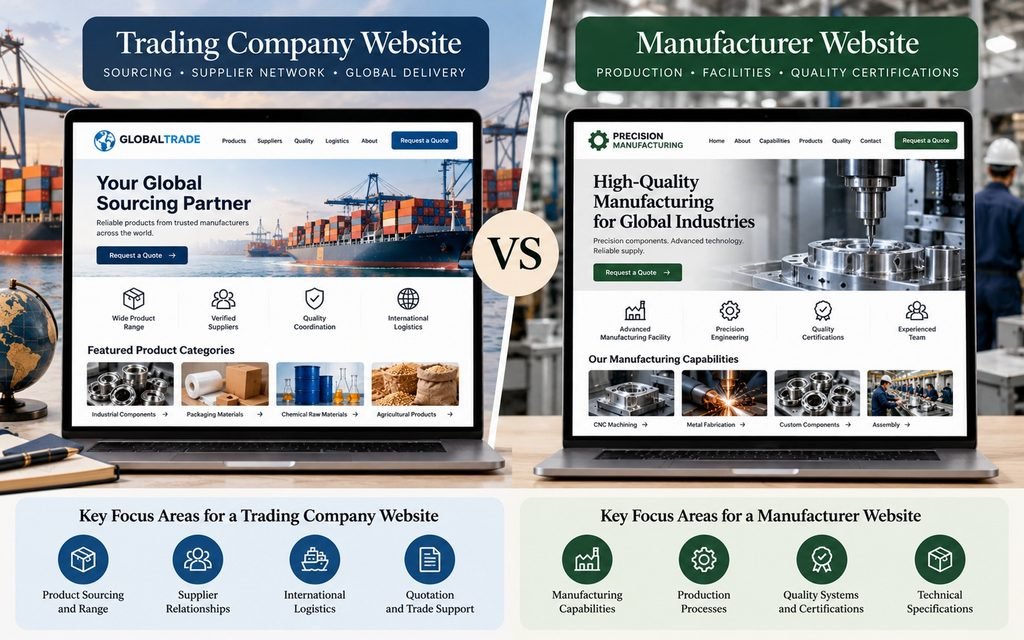
A trading company website must explain how the business creates value between suppliers and buyers, while a factory website demonstrates production capability and technical expertise. The difference affects the information architecture, trust signals, product pages, and calls to action.
| Website element | Manufacturer website | Export or import trading website |
|---|---|---|
| Main value proposition | Production capability, quality, and engineering | Sourcing access, supplier coordination, and supply management |
| Product information | Manufacturing specifications, materials, tolerances, and processes | Product range, grades, applications, availability, and sourcing options |
| Credibility | Facilities, production systems, quality certifications | Verified supplier relationships, inspection arrangements, trade experience, and documentation |
| Logistics | Production lead times and shipping readiness | Coordination of suppliers, shipments, documents, and delivery responsibilities |
| Buyer concerns | Can this factory make the product to specification? | Can this company source the right product and coordinate the transaction reliably? |
| Primary conversion | Request a manufacturing quotation | Request a sourcing quotation or discuss supply requirements |
| Supporting evidence | Factory photographs, technical files, quality procedures | Approved supplier information, actual inspection processes, product documentation, and clear responsibilities |
The distinction matters because buyers can misunderstand a trading company’s role if its website copies factory language. A trader may coordinate several specialist suppliers, consolidate communication, arrange inspections, or manage documentation. Those services can be valuable, but the website must explain which responsibilities the company actually undertakes.
For an industrial buyer, the commercial question is not simply whether a product exists. The buyer also needs to understand who supplies it, how specifications are confirmed, how quality concerns are handled, and who coordinates the next steps. A website that answers these questions gives the sales conversation a stronger starting point.
Why Does export company website design Need a Different Strategy?
A trading company’s website should be built around its sourcing model and the buyer’s decision process, not a factory template with a different logo. A manufacturer can show equipment, production lines, and technical processes. A trader needs to explain its product knowledge, supplier network, quality coordination, communication process, and role in the transaction.
This becomes especially important when a company supplies several product categories or works with multiple manufacturers. A long list of products does not explain why a buyer should use the trading company instead of approaching a supplier directly.
KG Web Designer is a conversion-focused website design studio specializing in custom websites for clinics, professional services, manufacturers, and growing businesses. For trading companies, the same conversion principle applies: the website should make the business model understandable, establish credibility, and help suitable prospects take the next step.
What should the homepage communicate first?
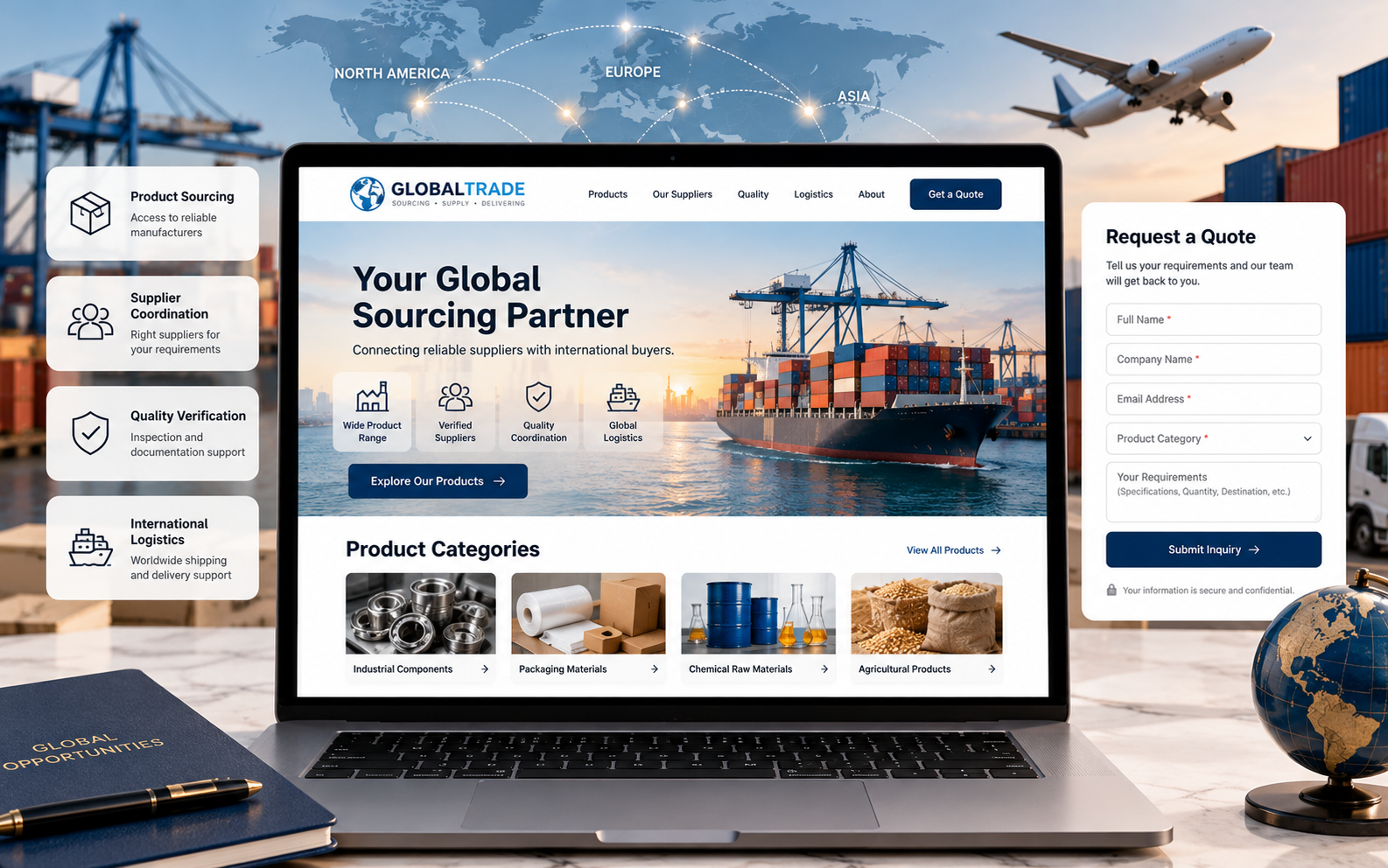
The homepage should answer four questions quickly:
- What products or product categories does the company supply?
- Which industries, buyer types, or markets does it serve?
- What does the company do beyond introducing a buyer to a supplier?
- How can a qualified buyer request a quotation or discuss a sourcing requirement?
Avoid broad statements such as “your global partner for every product” unless the business can substantiate that scope. Specific information about product categories, supplier selection, inspection arrangements, documentation, and actual market experience is more useful.
The company should also state its role accurately. If products are manufactured by partner facilities, explain that relationship. If inspection is handled by a third party, describe the arrangement. A trading company should never present a supplier’s factory, certification, or production capacity as its own.
A Trading Company Doesn’t Sell Its Capabilities the Same Way a Factory Does.
Manufacturers typically demonstrate production capabilities. Trading companies need to communicate sourcing expertise, supplier relationships, product coverage and international trade coordination.
Production-Led Presentation
Sourcing-Led Presentation
What Does Current Trade Data Mean for Trading Company Websites?
Current trade data reinforces the need for clear commercial information, but it does not prove that a website redesign will increase orders. On October 8, 2026, the World Trade Organization projected global merchandise trade volume growth of 3.9% for 2026, while noting that trade conditions and growth drivers vary across regions and sectors. Source: WTO, October 2026 trade outlook.
| Verified fact | Practical website implication |
|---|---|
| The WTO’s October 2026 forecast projects 3.9% merchandise trade volume growth for 2026. | Make the company’s product scope, sourcing role, and buyer relevance easy to assess. |
| International sales may involve multiple suppliers, specifications, shipping arrangements, and commercial documents. | Explain which parts of the transaction the company coordinates and which remain with the buyer or supplier. |
| The International Chamber of Commerce’s Incoterms rules clarify buyer and seller responsibilities for delivery, costs, and risks. | Explain relevant shipping terms accurately and avoid vague promises about delivery or customs responsibilities. |
| Google recommends helpful, reliable, people-first content that demonstrates experience and serves a real audience. | Publish detailed product and process information rather than generic international-trade claims. |
The business implication is straightforward: a website cannot eliminate trade risk or guarantee delivery, but it can help a buyer evaluate whether a company is relevant and understand how to begin a commercial discussion.
The International Chamber of Commerce explains that Incoterms® rules help clarify the allocation of costs, risks, and obligations between buyers and sellers. Trading companies should use these terms accurately and in the context of the transactions they support. ICC Incoterms® rules.
What Should a Trading Company Website Include to Generate Better Inquiries?
A trading website should give qualified buyers enough information to assess product fit, sourcing credibility, and the next step toward a quotation. It does not need to publish every commercial detail, but it should remove avoidable uncertainty before the buyer contacts sales.
1. Product categories organized around buyer needs
Create clear product categories and dedicated pages for important product groups. Depending on the industry, those pages may include specifications, grades, dimensions, materials, packaging, applications, and relevant standards.
If pricing depends on quantity, destination, specification, or supplier availability, explain how quotations are prepared. A quotation-based model is appropriate for many B2B products, but buyers should understand what information they need to provide.
2. A transparent sourcing model
Explain how the business identifies suppliers, confirms product requirements, coordinates communications, and manages orders. Where permitted, provide approved supplier profiles or explain the types of manufacturing partners involved.
Avoid claims such as “we own advanced manufacturing facilities” unless that is true. If the company works through a supplier network, its expertise may lie in supplier selection, coordination, product knowledge, and order management. Those capabilities should be described on their own merits.
3. Clear quality and inspection procedures
Buyers need to know what quality assurance means in practice. If the company arranges sample approval, pre-shipment inspections, document checks, or third-party testing, explain the actual process and who performs each activity.
“Highest quality guaranteed” is a weak substitute for a documented process. Describe how specifications are confirmed, how discrepancies are handled, and what evidence is shared with buyers.
4. International logistics and documentation
Explain the shipping arrangements and documentation support the company actually provides. Make clear whether freight coordination, customs brokerage, insurance, import compliance, and other services are handled internally, through partners, or by the buyer.
Where relevant, explain how the business works with agreed Incoterms® rules. Do not imply that one delivery term or logistics process applies to every order.
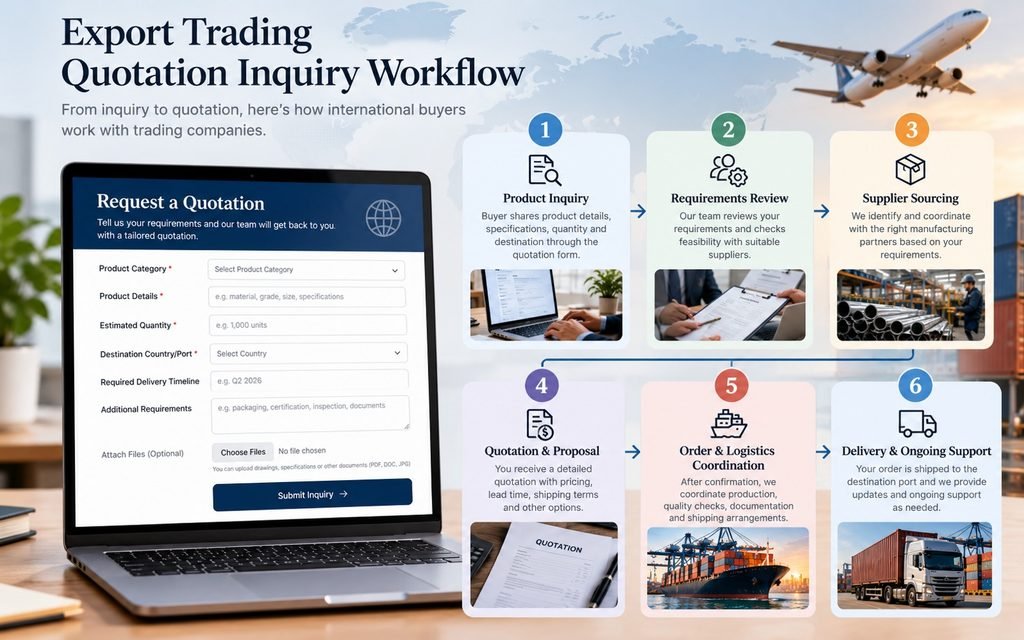
5. A useful quotation form
A good inquiry form collects enough information to begin a productive commercial conversation without making the buyer complete an unnecessarily long questionnaire.
Consider including:
- Company name, business email, and country
- Product or product category
- Required grade, material, or specification
- Estimated quantity and order frequency
- Destination country or port, where relevant
- Required delivery timeframe
- Supporting documents or product specifications
- Additional sourcing, packaging, or compliance requirements
Use conditional fields when product requirements differ. If buyers can upload drawings or specifications, protect those commercial documents and explain how the information will be used.
If your website presents a product catalog but does not explain why buyers should work with your trading business, review the structure before spending more on traffic. KG Web Designer can help assess the positioning, trust signals, and inquiry journey through a website project consultation.
How Can Trading Companies Build Trust Without Owning the Factories?
Trading companies build trust by making their own responsibilities visible and providing evidence buyers can verify. They do not need to pretend to be manufacturers; they need to show that their sourcing and coordination model is credible.
Three industry-specific issues deserve particular attention.
First, supplier relationships are not the same as manufacturing ownership. Use language such as “we source through manufacturing partners” only when that accurately describes the business. Explain the nature of the relationship without making unapproved claims about a partner’s production capacity or certifications.
Second, quality responsibility must be explicit. Buyers need to know whether the trader checks documents, arranges inspections, confirms samples, or simply passes specifications between parties. If the company does not perform a particular check, it should not imply otherwise.
Third, a broad catalog can create more doubt than confidence. Listing hundreds of unrelated products may make a company look like a general intermediary without specialist knowledge. Organize the range into meaningful categories and explain the company’s actual experience and sourcing process for each.
Useful trust signals include accurate company details, genuine team or operational photographs, clear service descriptions, documented procedures, and authorized supplier information. Testimonials, trade references, certifications, and case studies should appear only when they are genuine and approved for publication.
Manufacturing businesses face a related challenge when they need to communicate technical capabilities and supplier readiness. Our guide to how manufacturing companies use their websites to attract export buyers and distributor inquiries explores buyer qualification from the manufacturer’s perspective. A trading company should apply the same commitment to transparency while presenting its own sourcing and coordination capabilities.
Does Your Website Collect the Information You Need to Prepare a Useful Quote?
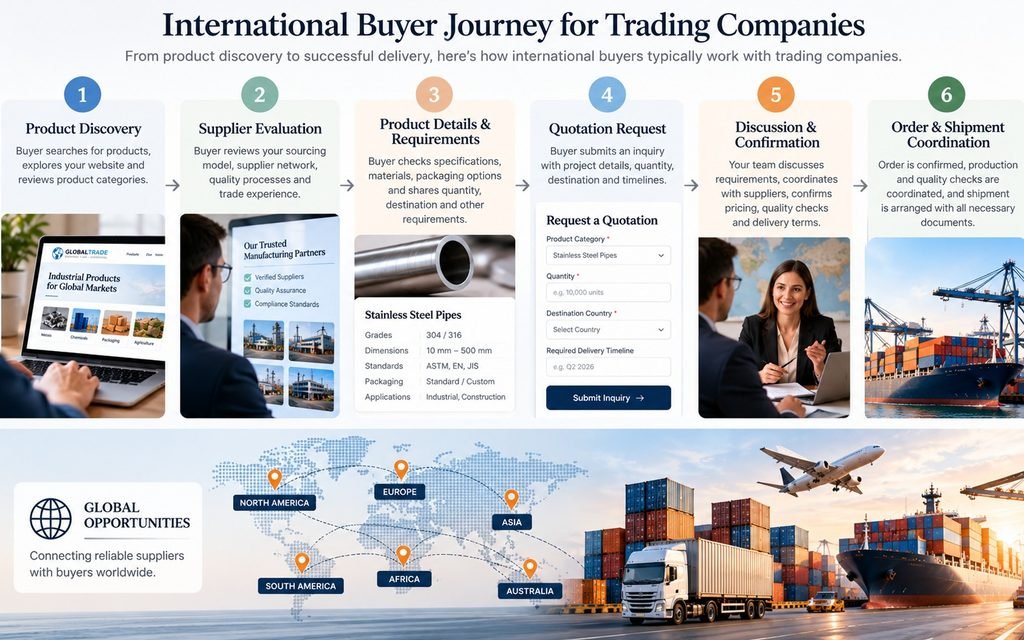
International buyers may need to specify product requirements, quantities and shipping destinations. A structured RFQ journey can help trading companies receive more actionable enquiries.
A better RFQ process can help your sales team understand buyer requirements before the first follow-up.
Improve My RFQ Experience →Original observation: What generic templates tend to miss
A qualitative observation from reviewing the structure of KG Web Designer’s published manufacturing-focused content is that buyer questions differ according to the company’s role in the supply chain. Manufacturers need to demonstrate production and technical capability. Traders need to clarify supplier relationships, sourcing responsibilities, product coordination, and the route from inquiry to delivery.
This is a strategic observation, not a measured audit result or a proprietary statistic. No percentage of trading websites is claimed to have these problems, and it should not be presented as a quantified industry study.
How Can International SEO Attract Relevant Buyers?
International SEO should connect the company’s real product range and sourcing expertise to searches made by relevant buyers. Broad phrases such as “global trading company” are rarely enough to communicate which products the business supplies, which industries it serves, or why a buyer should shortlist it.
A practical content structure includes:
- A homepage that explains the trading model and core product categories.
- Product-category pages that answer specification and application questions.
- Industry pages for genuine customer segments where the company has relevant products and expertise.
- Market-specific pages only where the company has meaningful service capability or evidence of serving that market.
- Sourcing, quality, documentation, and logistics pages that explain actual processes.
- FAQs addressing minimum order quantities, quotation requirements, samples, lead times, and documentation.
For example, a company supplying packaging materials to food manufacturers should not rely entirely on a generic page about international trade. A focused page can explain material types, packaging formats, specifications, sourcing arrangements, and the information needed for a quotation.
A well-built international trading website should also use descriptive page titles, clear internal links, mobile-friendly layouts, fast-loading pages, crawlable product content, and accurate image descriptions. If the business serves several language markets, translations should be professionally reviewed so product specifications and commercial terms remain consistent.
Our guide to international manufacturing website design explores how international buyers evaluate technical information, market relevance, and credibility. Trading companies can apply the same buyer-centered principles while adapting the content to their own role in the supply chain.
SEO should support the commercial strategy, not replace it. Rankings and impressions matter, but the more meaningful question is whether the website attracts the right buyers and helps them make informed inquiries.
Example Scenario
Consider a hypothetical trading company that sources industrial fasteners from several manufacturing partners and supplies distributors in North America and Europe. Its existing website has a company profile and a long list of products, but it does not explain how buyers can verify specifications, understand sourcing arrangements, or request a quotation.
A procurement manager looking for a particular grade and quantity cannot easily determine whether the company handles that product, whether samples are available, or what information is required to price a shipment. The manager may move on to another supplier before contacting the sales team.
A more useful website would create dedicated product-category pages, explain how specifications are confirmed, describe the actual inspection arrangements, and offer a structured quotation form. It would also state which shipping and documentation services the company coordinates rather than making broad promises about global delivery.
This is an illustrative scenario, not a documented client result. The expected benefit is a clearer buyer journey and a more useful initial inquiry. The actual commercial impact would need to be measured through analytics and sales records.
Example From Our Experience
KG Web Designer publishes manufacturing-focused guidance on how websites can help buyers assess supplier capability and submit more useful inquiries. One related example on the website describes a manufacturer whose site attracted international visitors but did not adequately surface the information procurement teams needed to evaluate the business. Read the published manufacturing website example.
Problem: The published example describes a gap between the company’s capabilities and the information presented to prospective buyers, including details relevant to supplier evaluation.
Solution: The article describes restructuring the website around buyer qualification, export capability information, compliance details, technical documentation, and inquiry pathways.
Outcome: The published article reports improved inquiry quality after the restructuring, but does not provide a quantified conversion uplift. This is a manufacturing example, not a trading-company case study, and its outcome should not be attributed to export or import traders.
The lesson for trading companies is that website structure should help buyers answer the questions that determine whether they are ready to make contact. For a manufacturer, those questions focus on production capability and technical fit. For a trader, they also involve sourcing transparency, supplier coordination, and responsibility across the transaction.
For additional guidance on industrial buyer requirements, review our article on industry-specific website design for manufacturing companies. The principle is relevant to trading businesses, but their own website evidence must reflect their actual services and responsibilities.
Would an Overseas Buyer Trust Your Trading Company Based on Your Website Alone?
Buyers assessing unfamiliar trading partners often look for evidence of business legitimacy, sourcing capabilities and clear communication before sending a serious enquiry.
Business location, company information and verifiable contact details.
Organised product ranges with useful specifications and sourcing details.
A clear explanation of how suppliers are selected and orders coordinated.
Accurate information about available inspection support and applicable documentation.
Relevant market experience and the trade coordination services actually offered.
An enquiry path that captures product, quantity and destination requirements.
What Should You Fix First, Second, and Third?
The best sequence is to clarify the business model first, strengthen the evidence buyers need second, and improve conversion and visibility third. Starting with visual redesign alone can leave the underlying commercial problem unresolved.
First: Clarify positioning and product structure. State whether the business operates as a sourcing partner, distributor, importer, exporter, agent, or another type of trading company. Organize products around the buyers and industries that matter commercially.
Second: Make the evidence visible. Review supplier claims, product specifications, quality processes, inspection arrangements, documentation support, and logistics information. Remove unsupported claims and distinguish the company’s services from those of its partners.
Third: Improve the inquiry journey and measurement. Reduce unnecessary form fields, add clear calls to action to important product pages, and track form submissions, qualified inquiries, quotation requests, and progression into sales conversations. Use the results to decide whether the next investment should go toward content, technical SEO, conversion improvements, or a broader redesign.
For businesses comparing a company-owned website with third-party trade platforms, our guide to owning a website versus relying on B2B marketplaces explains how a company website can play a different role from a marketplace profile. A website does not replace every useful channel, but it gives the business more control over positioning, content, and the inquiry experience.
Why Do Many Trading Businesses Get Their Websites Wrong?
Many trading businesses use a factory-style template because it appears familiar and easy to populate. The problem is that a template cannot resolve unclear positioning or prove a company’s sourcing and coordination capabilities.
Common mistakes include presenting partner factories as owned facilities, publishing catalogs without meaningful specifications, using generic quality claims, and hiding quotation requirements behind a basic contact form. Some websites also list markets they have not served or imply they can manage documentation and customs procedures without confirming the actual scope of service.
Successful trading businesses make their role explicit, show evidence they are authorized to share, and explain how a buyer’s order moves from product inquiry to quotation and delivery coordination. They also recognize that not every visitor is a qualified buyer. The website should help relevant prospects take the next step while making it easier to identify inquiries that do not fit the company’s product range or commercial terms.
A better website is not necessarily more complicated. It is one in which each important page answers a specific buyer question and moves the conversation forward.
What Does This Mean For Your Business?
A well-structured trading website can make the company’s value easier to understand before a sales conversation begins. Buyers can assess whether the product range is relevant, understand how sourcing and coordination work, and submit inquiries with more useful commercial information.
The revenue opportunity comes from reducing avoidable friction, not treating website design as a guaranteed source of orders. If the website attracts relevant visitors but does not convert them into meaningful inquiries, improving product information, trust, and the quotation journey may be more useful than simply increasing traffic.
A focused trading company website design strategy should reflect the way the business actually creates value. That means being clear about what the company supplies, what it coordinates, what evidence it can provide, and what happens after a buyer makes contact.
The website should also fit into a wider marketing plan. Our guide to manufacturing digital marketing strategy discusses how businesses can evaluate the relationship between visibility, website performance, and investment priorities. Trading companies should use the same discipline instead of assuming that publishing a new website will automatically create demand.
When Does Professional Website Help Make Sense?
Professional help makes sense when a business has a credible product range and sourcing model but its website does not communicate them clearly, or when inquiries are too vague to support efficient sales follow-up. It is also worth reviewing the website before entering new markets, adding significant product categories, or investing more heavily in search marketing.
A useful assessment should examine positioning, site architecture, product-page depth, international search visibility, mobile usability, trust signals, inquiry forms, and analytics. The recommendations should distinguish between issues that can be fixed on the current site and those that require a more substantial rebuild.
KG Web Designer’s approach is to connect website strategy, user experience, and conversion priorities rather than recommend a redesign simply because a site looks old. If you are evaluating a new site or restructuring an existing one, start with a website project consultation focused on your product range, buyer journey, and commercial objectives.
Expert Insight from Kanika Gupta
Kanika Gupta, Founder, KG Web Designer
My view is that a trading company’s website should make its role in the transaction unmistakable. Buyers do not need a trading business to pretend it is a factory. They need to understand what the business can source, how it evaluates or coordinates suppliers, what it is responsible for, and how it will communicate when specifications, quantities, or delivery requirements change.
One common mistake is treating a broad product catalog as proof of capability. A long list of products can weaken buyer confidence when the website does not explain supplier relationships, product knowledge, quality checks, or the process for obtaining an accurate quotation.
If this were my website, I would first make the sourcing model and core product categories clear, then build product pages around the questions qualified buyers ask before requesting a quote. I would not begin with animations, decorative features, or a large number of market pages. I would first make sure the website accurately communicates the company’s commercial value and provides evidence to support its claims.
That is the strategic judgment behind export company website design for a trading business: the website should reflect the company’s actual role in the supply chain, not imitate the factories it represents. The objective is to make its own contribution to the transaction clear, credible, and easy to evaluate.
Final Thoughts
A trading company should not copy a factory website and replace the logo. It needs a clear digital presentation of its own commercial role: sourcing the right products, coordinating supplier relationships, communicating quality responsibilities, and helping buyers move from product discovery to a useful quotation.
Strong export business website design makes these capabilities visible while keeping product information, trust signals, and inquiry steps aligned with how buyers evaluate a trading partner. The website should be honest about what the company controls, specific about what it offers, and practical about what happens after an inquiry arrives.
If your current website presents products but does not explain why buyers should work with your trading business, KG Web Designer can help evaluate the positioning, information architecture, and inquiry journey. Arrange a website project consultation to discuss a website strategy built around your actual products, buyer markets, and commercial goals.
Does Your Website Position You as a Reliable International Trading Partner?
Let’s review how your website presents your sourcing capabilities, product categories and international trade expertise. We’ll identify opportunities to improve buyer confidence, website navigation and the RFQ enquiry experience.
What We’ll Review
Website Strategist
FAQs
1. What is the difference between a trading company website and a manufacturer website?
A manufacturer website demonstrates production capability, equipment, technical processes, and quality systems. A trading company website explains product sourcing, supplier coordination, quality verification arrangements, logistics support, and the company’s role in the transaction. A trader should clearly identify partner capabilities rather than imply that it owns the factories or certifications of its suppliers.
2. What should an import export company website include?
An import export company website should include clear product categories, relevant specifications, company credentials, transparent sourcing information, quality and inspection procedures, international logistics details, and a quotation inquiry form. It should explain which services the business provides directly and which are managed by suppliers or external partners. The exact features depend on the products, markets, and transaction model.
3. How can an export trading company build trust with overseas buyers?
An export trading company can build trust by publishing accurate company information, explaining its supplier-selection process, providing authorized documentation, and clarifying quality-control responsibilities. Genuine references, approved partner profiles, and real operational photographs can support credibility. The website should avoid unsupported claims about factory ownership, certifications, export history, delivery guarantees, or relationships with named buyers.
4. Should a trading company display product prices on its website?
A trading company should display prices when they are accurate, commercially appropriate, and unlikely to mislead buyers. If pricing varies by quantity, specification, supplier availability, packaging, destination, or shipping terms, a quotation-based model may be more suitable. In that case, product pages should explain the information buyers need to provide for a meaningful quote.
5. How do I attract international buyers through my trading company website?
Start with product and industry pages that match the products you actually supply and the buyers you want to reach. Add detailed specifications, clear sourcing information, useful answers to common commercial questions, and a straightforward inquiry process. Technical SEO, market-specific content where justified, and a credible link strategy can improve discoverability, but rankings and international inquiries are not guaranteed.
6. What should a trading company quotation form ask buyers?
A quotation form should collect the buyer’s company and country, product, relevant specifications, estimated quantity, destination, required delivery timeframe, and supporting documents needed to assess the request. Add fields conditionally when requirements vary by product. The objective is to collect enough information for an informed response without making the initial inquiry unnecessarily difficult.
7. Do export and import trading companies need separate pages for every product?
Separate pages are useful when products have meaningfully different specifications, applications, buyer questions, or sourcing requirements. A well-organized category page may be sufficient for closely related products, while important product groups may deserve dedicated pages. Avoid generating large numbers of nearly identical pages with little useful information, because they make navigation harder and provide limited value to buyers.
8. How do I know whether my trading company needs a redesign or just conversion improvements?
A redesign is more likely to be justified when the site’s structure, positioning, product organization, or technical foundation prevents buyers from understanding the business. Conversion improvements may be enough when the website attracts relevant visitors but has unclear calls to action, incomplete product information, or a difficult inquiry process. Review analytics and actual sales inquiries before deciding which investment is appropriate.