
Quick Answer
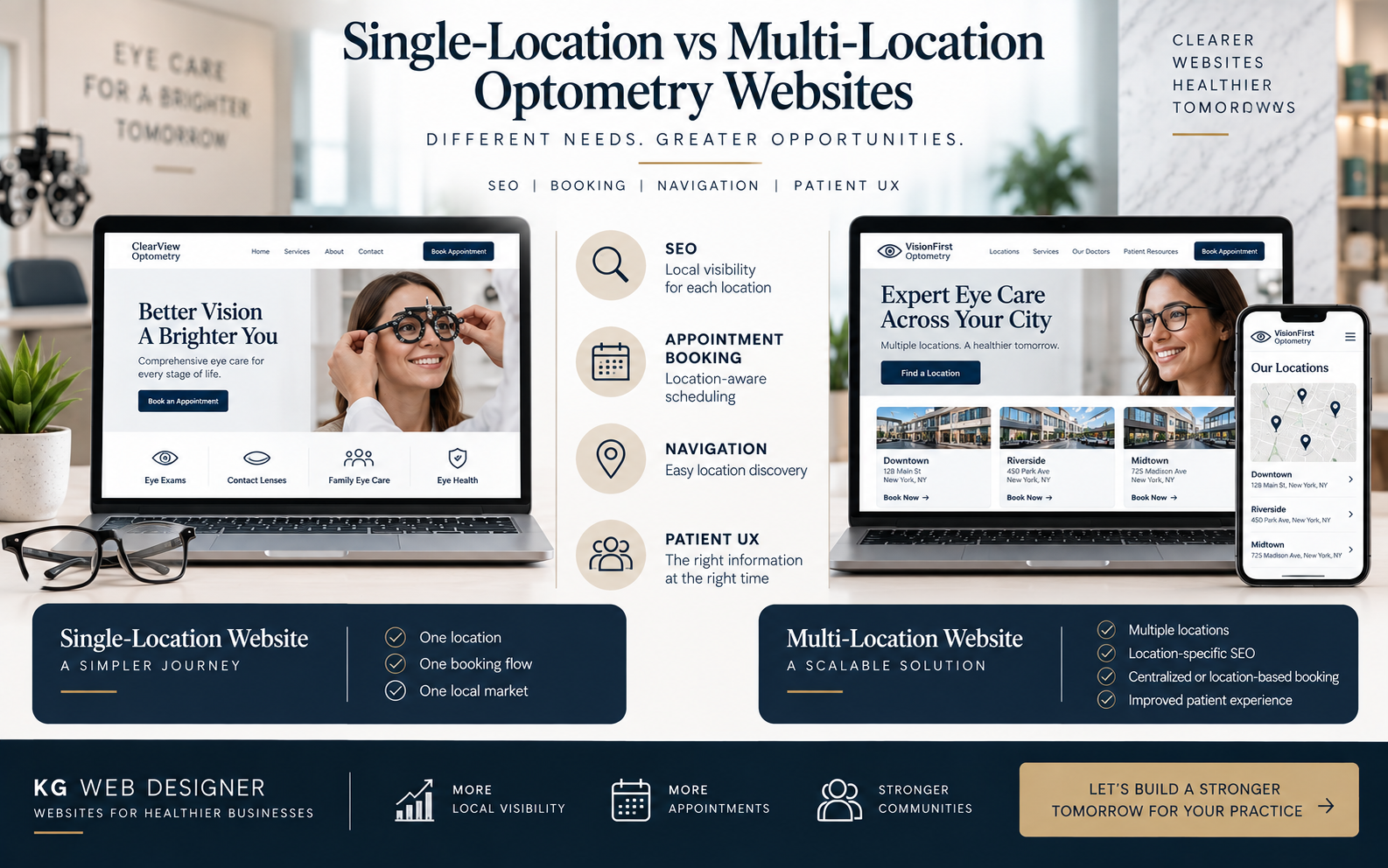
Yes. A single-location and multi-location optometry practice should not use exactly the same website architecture. Multi-Location Optometry Website Design needs dedicated location pages, location-specific local SEO signals, scalable appointment booking, provider information, and navigation that helps patients choose the right clinic quickly. A single-location practice can keep the journey simpler because patients are not deciding between multiple offices.
TL;DR: What Changes When an Optometry Practice Adds Locations?
- A single-location practice can optimize its website around one geographic market and one primary booking journey.
- A multi-location practice needs dedicated location pages, location-specific information, and a scalable structure that can support additional clinics.
- Google allows eligible physical locations to have their own Business Profiles, making accurate location information an important part of a multi-location search strategy.
- Appointment booking should help patients identify the correct clinic before they are asked to complete the scheduling process.
- Location pages should contain genuinely useful local information rather than simply repeating the same copy with different city names.
- A full redesign is not automatically necessary. The right investment depends on whether the existing architecture can support location growth, SEO, booking, and patient UX.
Why Generic Location Pages Can Cost Optometry Practices Patients
The financial issue is bigger than SEO. If a patient searches for an eye clinic near one of your locations and lands on a generic page that does not clearly identify the nearest office, you may lose a patient who was already showing local intent.
At KG Web Designer, we approach this as a website architecture problem first and a visual design problem second. KG Web Designer is a conversion-focused website design studio specializing in custom websites for clinics, professional services, manufacturers, and growing businesses.
Does a Multi-Location Practice Need a Different Website Structure?
Yes. A multi-location practice needs a website structure that allows patients and search engines to distinguish the overall organization from each individual clinic.
A single-location website can often organize its primary navigation around services, doctors, patient information, and booking. Once a practice operates several clinics, another decision layer appears: Where should I receive care?
That changes the information architecture.
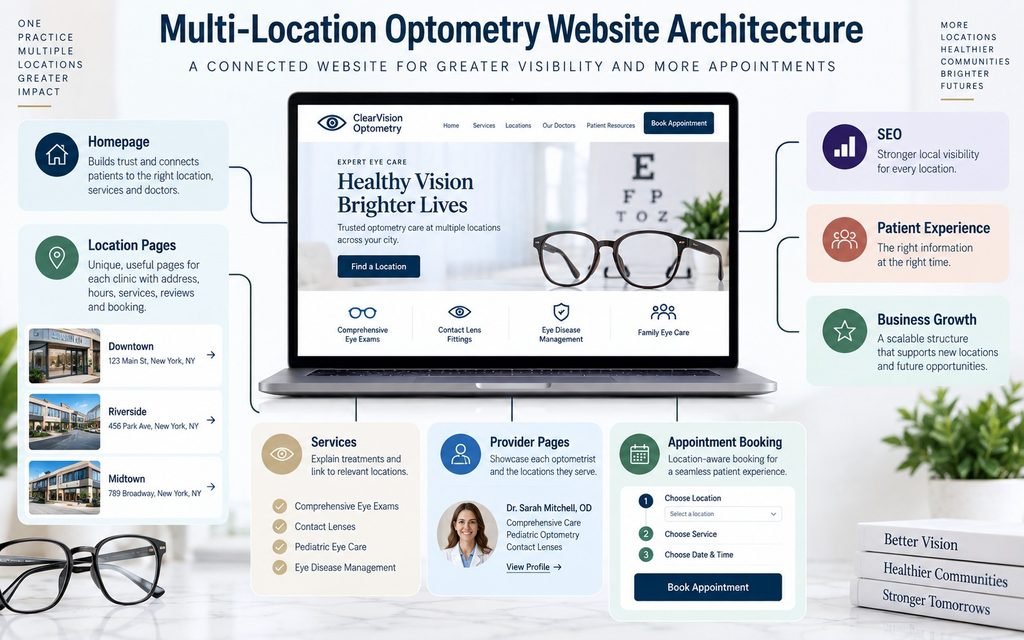
A scalable structure might look like:
- Homepage
- Services
- Locations
- Location A
- Location B
- Location C
- Doctors
- Doctor A
- Doctor B
- Patient Information
- Reviews
- Contact
- Appointment Booking
The location layer should not be buried in the footer. It should be part of the main patient journey.
This matters commercially because a patient searching for “optometrist in [city]” has already supplied geographic intent. The website should make it easy to confirm that the practice actually operates there, what services are available, who works at that location, and how to book.
Google’s LocalBusiness documentation also supports communicating specific business information such as addresses, telephone numbers, URLs, and other local details through structured data.
If you are evaluating whether the website itself is worth investing in before expanding, our guide on whether an eye clinic really needs a better website explains why the website can influence patients even when referrals remain a major source of demand.
Does Every Clinic Location Have a Clear Path to Search, Trust & Booking?
A multi-location website audit can help identify where SEO visibility, navigation or booking friction may be costing your practice appointments.
Request a Website Audit →Does Every Optometry Location Need Its Own Page?
Yes. Every genuine clinic location should normally have its own useful, location-specific page when the practice operates multiple physical offices.
The page should not simply say:
“Visit our [City] location.”
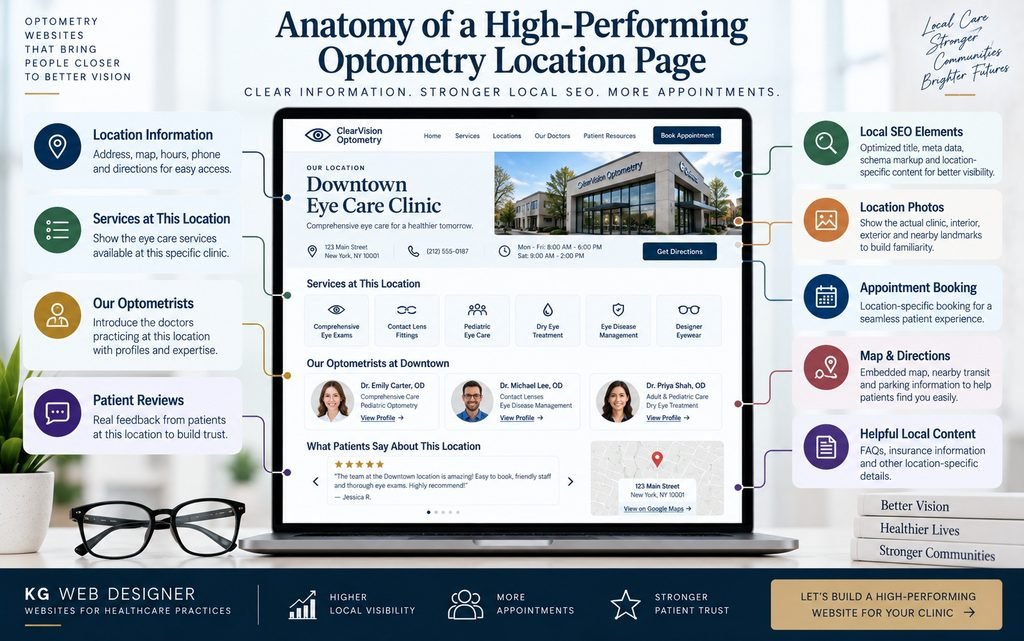
A useful location page should explain:
- Full address
- Phone number
- Opening hours
- Parking or access information where relevant
- Services available at that clinic
- Doctors or optometrists working there
- Location-specific reviews where appropriate
- Appointment options
- Directions or map information
- Relevant patient information
- Local FAQs
- Unique photographs where available
The objective is not to create pages simply because Google can index them. The objective is to create pages that patients genuinely need.
This distinction matters because Google explicitly warns against doorway abuse, including creating substantially similar pages targeted at different regions or cities that offer little unique value.
So the strategy should be:
One real location → one useful location experience.
Not:
One city keyword → one duplicated page.
This is one of the biggest differences between scalable local SEO and location-page spam.
Should Each Location Have Its Own Google Business Profile?
Yes, eligible physical locations should generally have their own Business Profile rather than trying to represent multiple physical offices through one location listing.
Google’s current Business Profile guidelines state that businesses should create a profile for an actual, real-world location and should not create more than one page for the same location. For businesses with different physical locations, Google allows a profile for each eligible location.
This creates an important connection between the website and local search.
If you operate five clinics, the website should make those five clinics easy to identify. Your Google presence should also accurately represent those physical locations.
The website location page and Business Profile should agree on important information such as:
- Business name
- Address
- Phone
- Hours
- Location URL
- Services
- Appointment options
Google also recommends that chains maintain consistent business names and categories across locations where appropriate.
For a growing practice, this is not just an SEO detail. It reduces patient confusion and makes the digital presence easier for staff to manage.
Can Multi-Location SEO Use the Same Content on Every Location Page?
No. Location pages should share a consistent framework but should not be clones of one another.
A scalable location template is useful. Repeating the same paragraph with only the city name changed is not.
For example, every clinic page may contain:
- Location overview
- Address and hours
- Available services
- Doctors
- Reviews
- Booking
- Patient information
- Directions
- Local FAQs
But the actual content should reflect what is true at that clinic.
One location may offer specialty contact lens services while another does not. One may have a particular optometrist. Another may have different hours, parking arrangements, equipment, or appointment types.
These differences create legitimate reasons for the page to exist.
Google’s current AI-search guidance also emphasizes foundational SEO, helpful content, internal links, page experience, textual information, and accurate structured data rather than creating large quantities of near-duplicate pages for search variations.
For multi-location practices, that means scale should come from a strong information architecture, not from mass-producing thin city pages.
Should Multi-Location Appointment Booking Start With the Location?
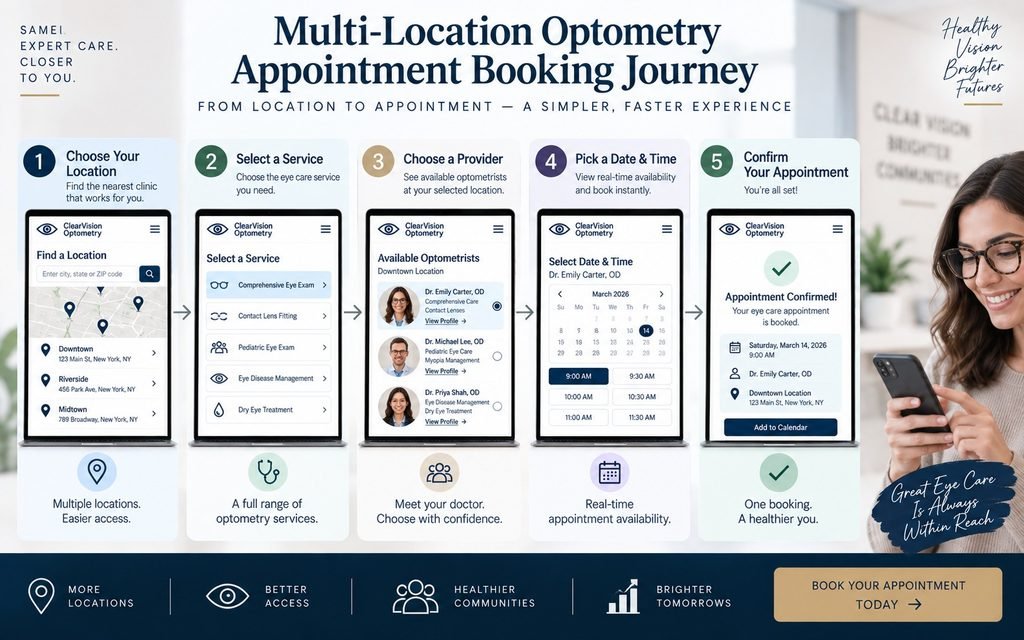
Yes. In most multi-location practices, the booking journey should make location selection obvious before the patient commits to an appointment path.
Imagine a patient clicks “Book an Appointment” and is immediately asked to select:
- Service
- Provider
- Date
- Insurance
- Appointment type
But there are six clinics.
The first question may actually be:
Which clinic do you want to visit?
That is why Multi-Location Appointment Booking should be designed around the actual scheduling logic of the practice.
Depending on the business, the journey might be:
Find a Location → Choose Service → Choose Provider → Choose Date → Confirm Appointment
Or:
Choose Service → Find Available Locations → Choose Location → Choose Provider → Book
There is no universal answer.
The correct flow depends on how appointments are allocated and whether providers work at multiple offices.
The important point is that the website should not force patients to understand the organization’s internal scheduling structure.
It should make the patient’s decision easy.
For practices evaluating the broader booking journey, our guide to choosing an optometry website designer who understands patient bookings and local search covers the website capabilities I would expect from a specialist partner.
Should Every Optometrist Have an Individual Profile Page?
Yes, when providers play a meaningful role in patient decision-making, individual provider pages can strengthen trust, UX, and search relevance.
A provider page can include:
- Name
- Credentials
- Areas of expertise
- Professional experience
- Languages spoken where relevant
- Locations served
- Services provided
- Professional memberships
- Educational background
- Appropriate professional photography
- Booking options
For a single-location practice, a provider page may simply reinforce personal trust.
For a multi-location organization, it can solve another problem: Where does this doctor actually see patients?
That information should connect directly to the relevant location pages.
A patient should not have to visit three pages to determine whether a particular optometrist works at the clinic closest to them.
This is where Optometry Patient Experience becomes an architectural issue. Good UX is not simply attractive design. It is the reduction of unnecessary decisions and uncertainty.
A provider page should therefore connect naturally to:
Provider → Location → Services → Appointment
That structure also gives the website a more useful internal linking system.
Adding Locations Changes More Than Your Website Navigation
A multi-location optometry website needs to help patients move confidently from local search to the right clinic, the right service and ultimately the right appointment.
Does Multi-Location Website Architecture Affect SEO?
Yes. The architecture affects how clearly search engines can understand the relationship between the brand, locations, services, and providers.
Google’s current documentation emphasizes crawlable internal links and clear site structure as foundational SEO practices. Its AI-search guidance specifically recommends making content easily findable through internal links and ensuring important information is available in textual form.
For a multi-location optometry practice, that means the internal linking structure should connect related entities.
For example:
Homepage → Locations → Location Page → Services → Provider → Booking
A service page might link to the locations where that service is actually available.
A provider page might link to the clinics where that provider practices.
A location page might link to the services offered there.
This is much more useful than having every page link randomly to every other page.
A practical internal-linking model
| Page type | Should link to |
|---|---|
| Homepage | Locations, major services |
| Location page | Services, providers, booking |
| Service page | Relevant locations, providers |
| Provider page | Locations, services, booking |
| Blog article | Relevant service and location pages |
| Booking page | Location and service context |
This creates a website that makes sense to patients and is easier for search engines to crawl.
Is Local SEO for Optometrists Different for Multi-Location Practices?
Yes. The fundamentals remain the same, but the complexity increases because each physical location has its own local relevance.
A single clinic can concentrate its local signals around one address.
A multi-location practice must maintain accurate information across multiple offices while avoiding duplication and inconsistency.
That includes:
- Location-specific landing pages
- Accurate Business Profiles
- Consistent business information
- Location-specific services
- Reviews and reputation management
- Local links and mentions
- Correct internal linking
- Location-specific appointment paths
- Appropriate structured data
BrightLocal’s 2025 Local Consumer Review Survey found that 81% of its U.S. respondents used Google to find reviews, while 74% said they used two or more sites when reading reviews before deciding on a local business.
That is not optometry-specific, so it should not be presented as an optometry statistic. But it is useful evidence for why reputation and location information cannot be treated as minor website details.
For a multi-location eye-care group, the practical goal is consistency without losing location-specific relevance.
Is Optometry Website SEO Mostly About Creating More Location Pages?
No. More pages do not automatically create better SEO.
A multi-location practice should create pages because they serve a real patient or business need, not simply because there is another city keyword to target.
The stronger strategy is to build depth around genuine entities:
Practice → Location → Service → Provider → Patient Need
For example, a clinic location page may explain that the office provides comprehensive eye exams, contact lens services, pediatric care, and a particular specialty service. The corresponding service pages can then explain those services in greater depth and link back to the locations where they are available.
This creates topical and geographic relationships rather than isolated landing pages.
Google’s guidance for AI features reinforces this approach: there are no special AI-only SEO requirements. The same foundational SEO principles remain relevant, including crawlability, internal links, useful content, page experience, and accurate structured data.
The goal is not to create hundreds of pages.
The goal is to make the important pages genuinely useful.
Can Multi-Location Design Improve Appointment Conversion?
Yes, when the website removes the extra decisions created by multiple clinics.
A patient looking for an appointment may need to answer several questions:
- Which location is closest?
- Does that location provide the service I need?
- Which provider works there?
- What appointment types are available?
- What time is available?
- How do I book?
If the website answers those questions in the correct order, the patient journey becomes easier.
This is where Optometry Website Conversion becomes more than a button-placement exercise.
A strong multi-location website should reduce:
- Location confusion
- Service confusion
- Provider uncertainty
- Booking friction
- Mobile navigation problems
- Repeated data entry
- Unnecessary phone calls
Google’s page-experience guidance emphasizes mobile usability, performance, security, and making the main content easy to distinguish.
For a healthcare website, those fundamentals matter because patients may already be uncertain or stressed when they arrive.
If the digital experience adds more uncertainty, the practice is creating friction at exactly the wrong moment.
Example Scenario
Consider an optometry group with six clinics across a metropolitan area.
The existing website has a strong brand, good doctors, positive reviews, and a functional booking system. But the homepage presents all six locations in a small footer menu, while the booking button sends everyone into the same generic scheduling interface.
A patient searching for the nearest clinic has to find the location manually.
Another patient wants a specific service but cannot immediately see which offices provide it.
The website technically contains the information.
The problem is that the information is not organized around the patient’s decision.
A better structure would allow the visitor to:
Find a location → see services available there → meet relevant providers → review practical details → book.
That does not require claiming a guaranteed percentage increase in appointments.
It creates a more rational conversion system.
At KG Web Designer, this is the type of distinction we look for during website reviews: is the practice actually missing information, or is the information already present but difficult for patients to use?
Why Most Businesses Get This Wrong
Most multi-location practices get this wrong because they scale the visual design before they scale the information architecture.
A practice may open its fourth clinic and simply add another address to the existing website. Then it adds a second location, then a third, then a fourth.
Eventually the navigation becomes crowded and the booking journey becomes ambiguous.
The common mistakes are:
- Treating all locations as one generic clinic.
- Creating thin location pages with almost identical content.
- Hiding location selection inside the booking system.
- Failing to connect services to the locations that actually provide them.
- Omitting provider-to-location relationships.
- Using outdated hours or location information.
- Creating inconsistent Business Profile information.
- Designing mobile navigation around the organization rather than the patient.
- Building location pages only for SEO rather than usefulness.
- Rebuilding the entire site without first identifying the actual bottleneck.
The successful approach is different.
It starts with the patient journey, then creates the architecture needed to support that journey.
What This Means For Your Business
A single-location practice can optimize for simplicity.
A multi-location practice has to optimize for clarity at scale.
That affects SEO, booking, content, navigation, provider profiles, local reputation, analytics, and future website maintenance.
The business benefits of getting the architecture right include:
- Easier expansion into new locations
- Stronger local relevance
- Better patient navigation
- Clearer appointment journeys
- More useful location pages
- Better internal linking
- Stronger provider visibility
- More consistent brand presentation
- Easier content management
- Lower risk of rebuilding the website every time the practice expands
The most important point is that a multi-location website should not feel like a collection of separate mini-websites.
It should feel like one trusted organization with clear, distinct local experiences.
Example From Our Experience
Problem: During website reviews for growing healthcare businesses, we frequently see a gap between organizational growth and website architecture. The business adds locations and providers faster than the website structure evolves.
Solution: We review the website around the actual relationships between locations, services, providers, patient needs, and appointment pathways. We then identify whether the existing structure can support those relationships or whether the underlying architecture needs to change.
Outcome: The immediate outcome is a clearer implementation plan. Sometimes the right answer is a complete redesign. Sometimes the existing website can be improved through better location architecture, content, navigation, booking UX, and internal linking.
That distinction matters financially because a practice should not pay for a full rebuild simply because the website has become complicated.
It should rebuild when the underlying system prevents meaningful improvement.
For practices deciding between a rebuild and targeted UX work, our guide on eye clinic redesign versus better booking UX provides a useful framework for deciding which problem actually needs to be solved.
Make Every Location Easy to Find — and Easier to Book
Whether you operate one clinic or a growing network of locations, your website should help patients quickly understand where to go, which services are available and how to book the right appointment.
Explore Eye Clinic Website Design →What Should You Fix First, Second, and Third?
The first step should be to map every location, provider, service, and booking relationship before changing the visual design.
First: Fix the architecture
Create a clear relationship between:
Locations → Services → Providers → Booking
Make sure every important location can be reached easily from the main navigation and relevant service pages.
Second: Fix location-level information
Make each location page genuinely useful.
Check:
- Address
- Hours
- Phone
- Services
- Providers
- Reviews
- Directions
- Parking/access information
- Appointment options
- Location-specific FAQs
Third: Fix the booking journey
Test booking on a phone as a real patient would.
Ask:
- Can I choose the correct location quickly?
- Can I understand which service to select?
- Can I identify an appropriate provider?
- Can I see what happens next?
- Can I complete the process without unnecessary steps?
Only after these fundamentals are working should the practice decide whether it needs additional SEO investment, paid acquisition, or a broader redesign.
Once the location architecture, patient journey, and booking foundation are understood, the next question is where additional marketing investment should go. Our guide on Local SEO, Google Ads or Website Redesign for an Eye Clinic explains how to distinguish a visibility problem from a conversion problem and determine whether local search, paid acquisition, or a strategic website redesign should come first.
Expert Insight from Kanika Gupta
Kanika Gupta, Founder, KG Web Designer
“If this were my website, I would never begin a multi-location project by asking how many location pages we can create. I would first map how patients actually choose a clinic. If location, service, provider, and booking decisions are disconnected, adding more SEO pages will only make the website more complicated.”
That is the distinction I believe matters most.
A multi-location website should not be built around the company’s internal org chart.
It should be built around the decisions patients need to make.
That is also why I would rather have 10 genuinely useful location and service relationships than 50 thin pages created simply to capture variations of city-based searches.
Is a Full Website Redesign Always Necessary for a Multi-Location Practice?
No. A full redesign is justified when the existing platform or architecture prevents the practice from solving its location, SEO, booking, UX, or content problems effectively.
A targeted intervention may be enough when:
- Location pages already exist.
- The navigation is fundamentally sound.
- The booking system works.
- Mobile UX is strong.
- Local information is accurate.
- Service architecture is clear.
- The CMS can support additional locations.
- The primary problems are content or conversion related.
A redesign becomes more compelling when:
- Locations are difficult to manage.
- The URL structure is poor.
- The CMS cannot scale.
- The booking journey is fundamentally confusing.
- Mobile UX is weak.
- Location and service relationships cannot be represented clearly.
- SEO changes require structural changes.
- The website is difficult for the internal team to maintain.
This is an important commercial distinction.
The best website partner should be willing to recommend less work when less work is the right answer.
When Does Professional Help Make Sense?
Professional help makes sense when the practice has enough locations, services, providers, or patient demand that website complexity is beginning to affect growth or operational efficiency.
I would especially consider specialist help when:
- The practice is opening multiple clinics.
- The current website was designed for only one location.
- SEO and location pages have become difficult to manage.
- Patients frequently call because they cannot find basic location information.
- Booking differs between clinics.
- Providers work across multiple offices.
- The website generates traffic but appointment behavior is difficult to understand.
- The organization is considering a major redesign.
If this were my website, I would ask the agency to show the proposed information architecture before approving the visual design.
I would want to see how a patient moves from search to location, from location to service, from service to provider, and from provider to appointment.
That is where the commercial value of the project becomes visible.
What Does a Strong Multi-Location Website Need to Deliver?
A strong multi-location website needs to make the organization understandable, the individual clinics findable, the relevant services clear, and the appointment path easy.
The website should work for four audiences simultaneously:
Patients: “Which clinic is right for me?”
Search engines: “What location, service, and entity does this page represent?”
Staff: “Can we maintain this information accurately?”
Leadership: “Can this website support expansion without requiring another rebuild?”
That is the real standard I would use.
Not whether the homepage looks modern.
Not how many pages the website has.
Not how many city keywords appear in the copy.
The better question is whether the website makes the practice easier to find, understand, trust, and book.
Final Thoughts
A single-location practice can keep its digital journey relatively simple because patients have one physical destination. A multi-location practice has a more complex decision system, and the website needs to reflect that reality.
Multi-Location Optometry Website Design should therefore be treated as an architecture and patient-experience challenge, not simply a larger version of a single-clinic website.
The strongest approach is to create useful location pages, maintain accurate local information, connect services with locations and providers, design booking around patient decisions, and build an internal-linking structure that helps both users and search engines understand the relationships between pages.
Google’s current guidance supports this fundamentals-first approach. There are no special AI-only requirements for AI Overviews or AI Mode; crawlability, useful content, internal links, page experience, textual information, and accurate structured data remain important.
If your practice is expanding from one clinic to several, the right question is not simply whether you need more location pages.
The right question is whether your website can support the way patients actually choose where, how, and with whom they receive care.
If it cannot, that is the point at which a strategic website redesign or architecture project becomes commercially justified.
At KG Web Designer, we approach healthcare websites around that patient decision journey rather than treating them as digital brochures. If you want to determine whether your current website needs structural changes, conversion improvements, or a complete redesign, you can request a website consultation focused on your locations, booking journey, SEO structure, and patient experience.
Simple Patient Journey
One clinic, one local search presence and one primary booking destination can keep the website structure relatively straightforward.
Growing Your Practice? Your Website Needs to Scale With It.
Let’s look at how your website should handle location pages, local SEO, services, practitioners and appointment booking as your practice expands.
Book a Free 30-Minute Call →Website strategy discussion · No pitch, no pressure
FAQs: What Do Practice Owners Ask About Multi-Location Optometry Websites?
Can all locations use the same appointment booking software?
Yes, provided the booking system can correctly identify location, service, provider, availability, and appointment type. A centralized system can work well for multi-location practices, but the website should make the location decision clear before patients enter a complex scheduling workflow.
Should location pages show the same reviews as the homepage?
No, not exclusively. A central testimonial section can support the overall brand, but location pages should provide relevant evidence about the specific clinic where possible. Location-specific reviews can help patients confirm that the office, staff, and experience they are considering match their expectations.
Should each location page have its own phone number?
Yes, when each clinic has a distinct phone number or direct line. The website should display the correct number for that location and keep it consistent with the corresponding Business Profile and other business listings. If calls are centrally routed, explain that clearly rather than creating misleading location information.
Should a provider who works at several clinics have several profile pages?
No. One strong provider profile is usually better than duplicating the same profile for every location. The provider page can clearly identify all locations where that optometrist practices and link to the relevant clinic pages. Location pages can then reference the provider without creating unnecessary duplicate content.
How often should a multi-location optometry website be audited?
Yes, regular audits are worthwhile because locations, providers, services, hours, booking rules, and technology can change independently. At minimum, review location information, booking paths, mobile UX, indexation, internal links, and important conversion paths whenever a clinic opens, closes, relocates, or changes its services.
Can one website support both single-location and multi-location growth?
Yes. The best time to design for scalability is before the practice becomes difficult to manage. A flexible architecture can begin with one location and later accommodate additional clinics through structured location pages, provider relationships, service availability, and scalable appointment workflows without requiring a completely separate website for every office.