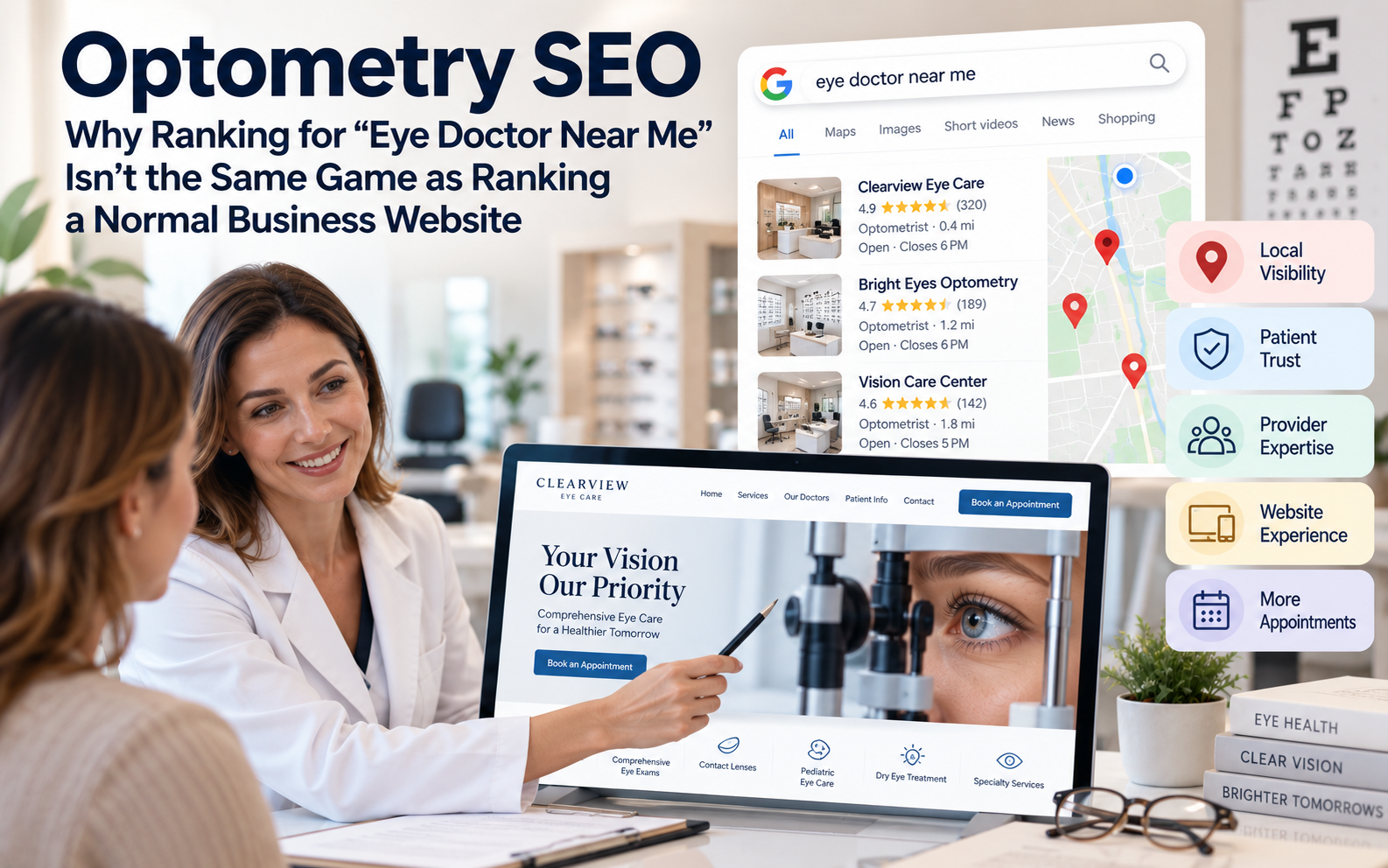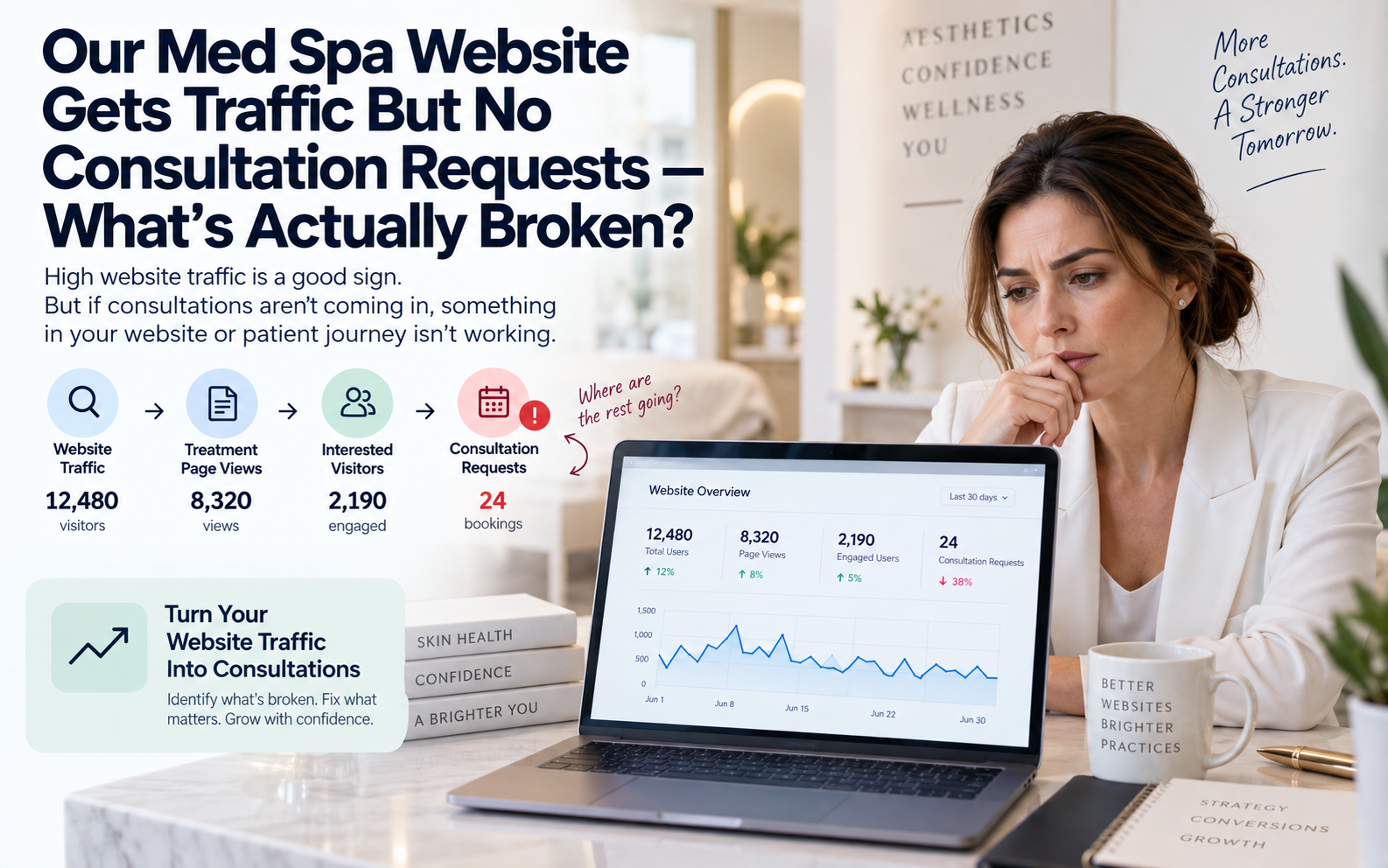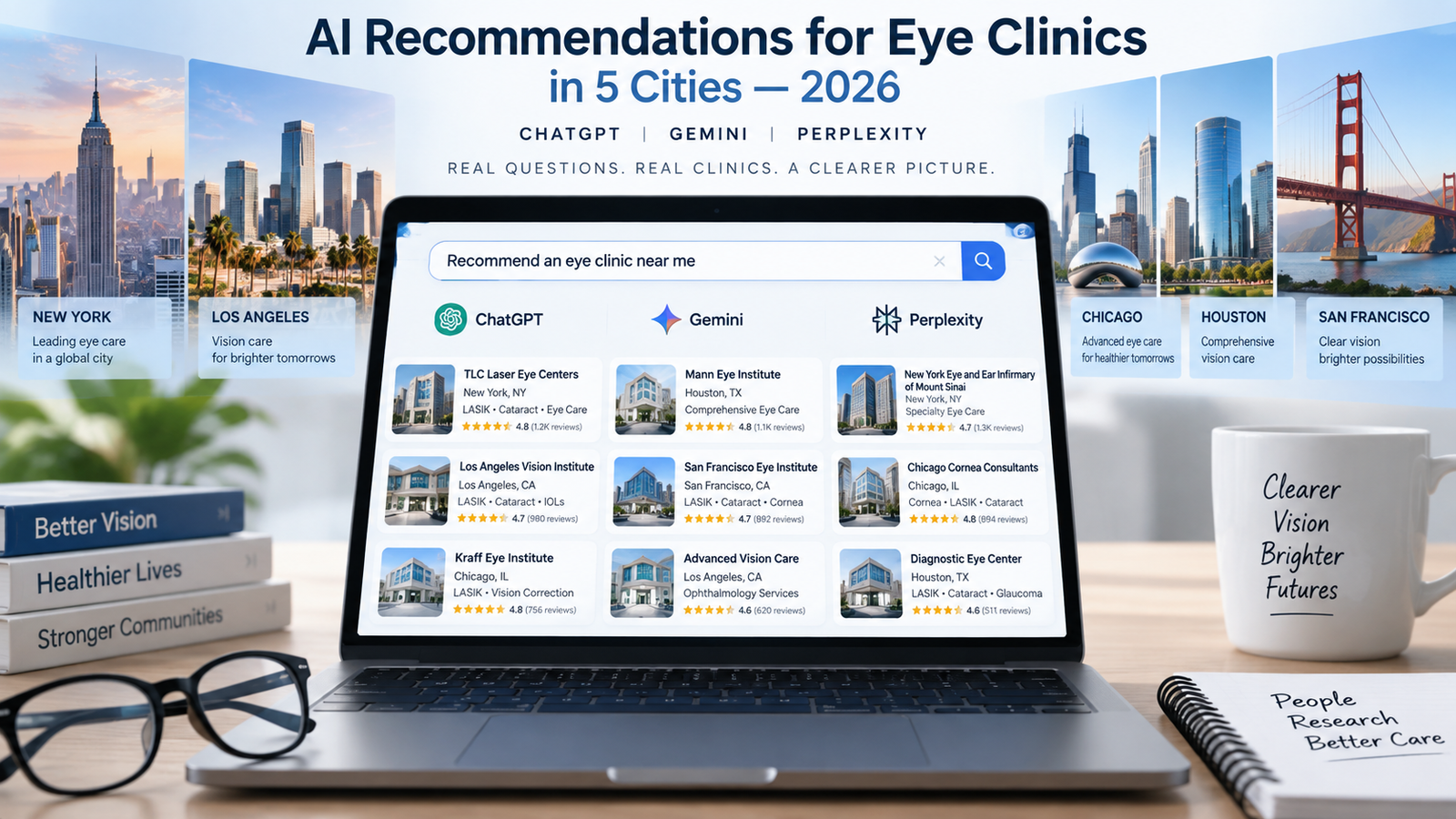
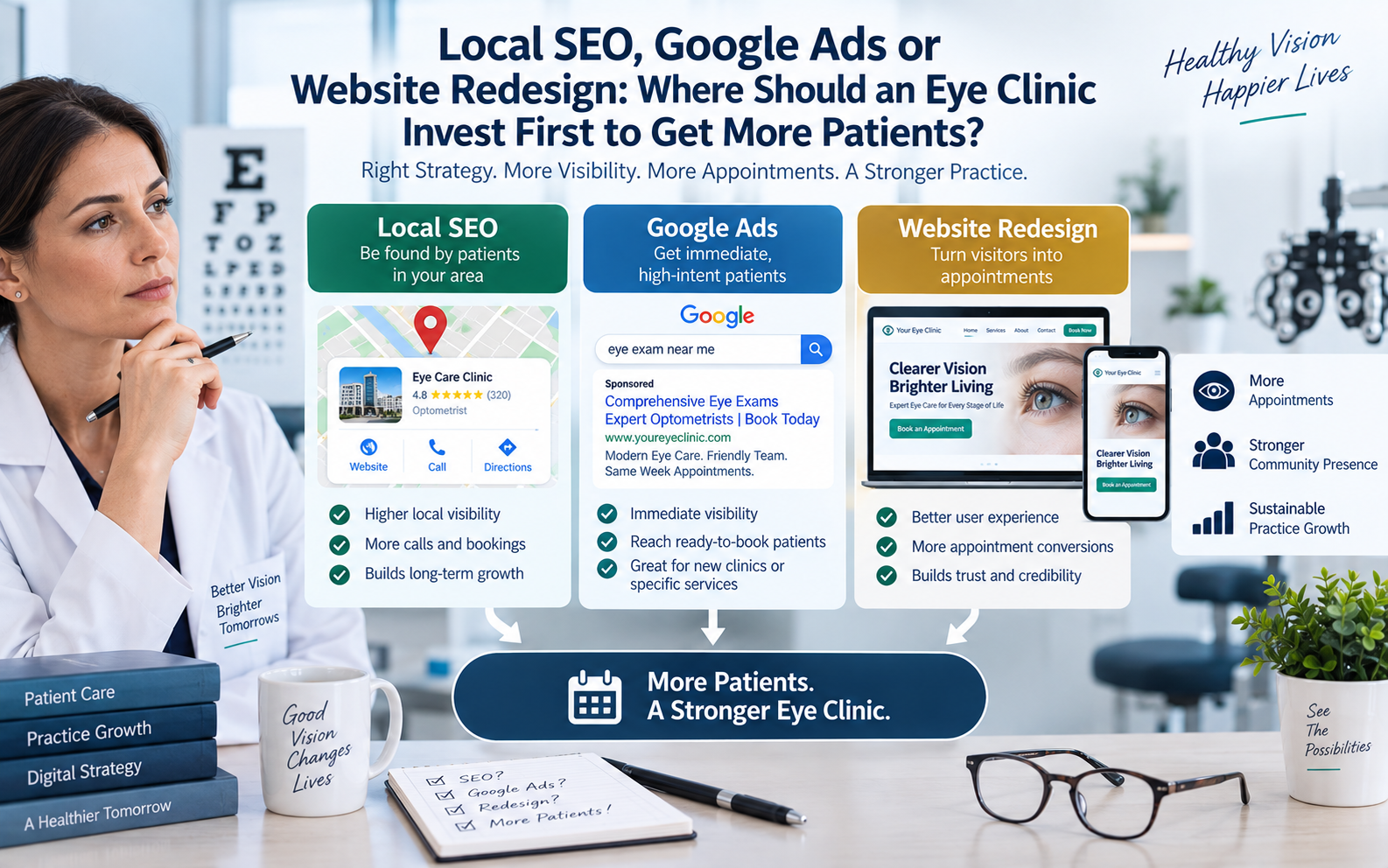
Quick Answer
A strong Eye Clinic Marketing Strategy starts with diagnosis, not channel preference. If your clinic is hard to find locally, fix local visibility first. If high-intent searchers already find you but appointments are weak, improve the website and booking journey. If you need immediate demand while longer-term visibility develops, use Google Ads with a conversion-ready landing experience.
TL;DR: What Should an Eye Clinic Fix First?
- Local visibility should be strengthened when qualified patients are not discovering the clinic through Google Search and Maps.
- Paid search can generate immediate demand, but its economics depend heavily on the quality of the landing page and appointment journey.
- A website redesign makes more sense when structural UX, mobile, content, trust, speed, or booking problems affect multiple patient journeys.
- Google Business Profile matters because local searchers use business information, reviews, proximity, and website content to decide which clinic to consider.
- The best investment sequence is usually diagnosis first, conversion foundation second, demand generation third, and continuous measurement afterward.
What Does the 2026 Data Say About Local Search and Eye Clinic Advertising?
The data suggests that an eye clinic should not treat search visibility, advertising, and its website as separate investments. They are different parts of the same patient acquisition journey, and the weakest part can limit the return from the others.
| Metric | Latest verified data | What it means for an eye clinic |
|---|---|---|
| Consumers who searched for a local business in the past 3 months | 84% | Local digital visibility is a major part of patient discovery |
| Local searches starting on mobile | 73% | Mobile UX should be treated as a booking issue, not just a design issue |
| Consumers using more than one channel | 75% | Patients may move between Google, Maps, reviews, social, AI and your website |
| Consumers using Google during a local search | 71% | Google remains central to local discovery |
| Ophthalmology search-ad conversion rate | 18.29% | Healthcare search advertising can convert strongly when intent and experience align |
| Ophthalmology average CPC | $4.95 | Paid search requires economic discipline |
| Healthcare search-ad average CPL | $66.02 | Cost per lead should be judged against actual patient value |
The local-search figures come from BrightLocal’s 2026 consumer research, while the healthcare advertising figures come from LocaliQ’s 2026 benchmark study of 3,542 US healthcare search-ad campaigns. The ophthalmology figures are useful as a healthcare specialty benchmark, but they should not be treated as an exact optometry benchmark.
That distinction matters. A clinic owner should compare these benchmarks with the clinic’s own qualified appointment rate, patient value, treatment mix, cancellation rate, and acquisition cost rather than treating an industry average as a target.
How Should an Eye Clinic Marketing Strategy Be Diagnosed Before Spending More?
An Eye Clinic Marketing Strategy should begin by identifying whether the primary constraint is visibility, demand, conversion, or the website itself. Spending more money before identifying the constraint can simply make an existing problem more expensive.
Start with four questions:
- Are enough qualified people finding the clinic?
- Are those visitors reaching the right service or treatment pages?
- Are visitors taking meaningful actions such as calling or booking?
- Does the website make the clinic feel credible and easy to choose?
The answers point toward the appropriate investment.
If impressions, local visibility, and qualified search demand are weak, advertising or local search optimization may be appropriate. If traffic is healthy but appointment actions are weak, the problem is more likely to be conversion, trust, information architecture, or booking friction.
This is where many clinic owners make an expensive mistake. They see fewer appointments and immediately increase advertising spend without checking what happens after the click.
A $5 click is not cheap or expensive by itself. Its value depends on whether the resulting visitor becomes a qualified appointment, whether that appointment shows up, and what that patient is worth to the practice over time.
A useful diagnostic split
- Low visibility: investigate local search, Google Business Profile, service-page relevance, reviews and local authority.
- Low qualified traffic: investigate search intent, keyword targeting and campaign structure.
- High traffic but low appointment activity: investigate website UX, trust, messaging and calls to action.
- Strong website traffic but poor mobile performance: investigate mobile UX and technical performance.
- Strong traffic and conversion but insufficient volume: consider scaling paid acquisition and organic visibility.
- Problems across the entire website: consider redesign rather than isolated page changes.
Google itself says local results are primarily influenced by relevance, distance and prominence, while complete and accurate Business Profile information helps Google understand which businesses are relevant to searches.
Where Is Your Patient Journey Breaking?
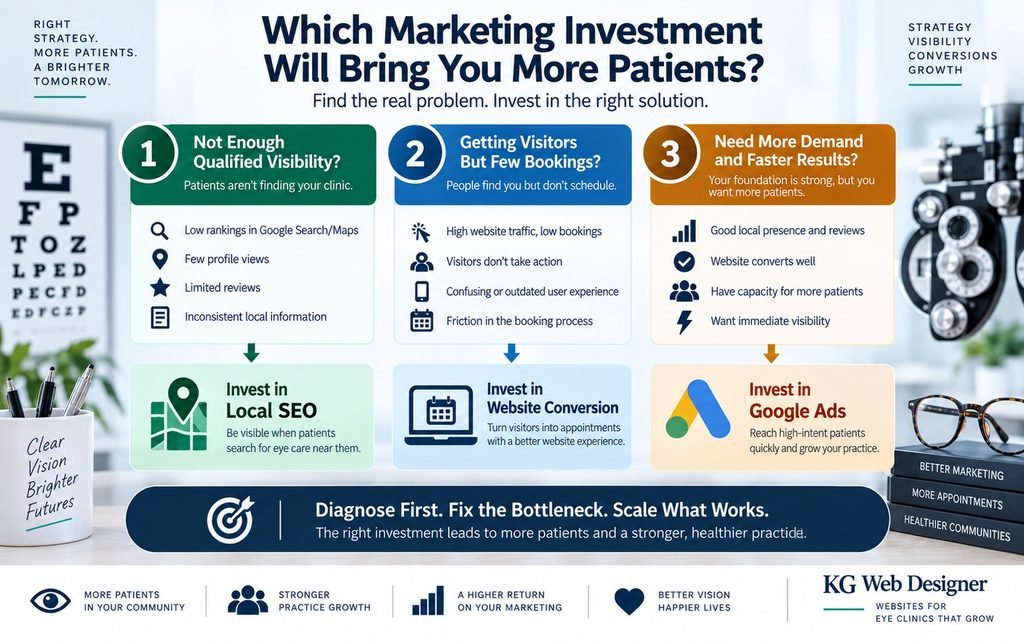
The right investment depends on the problem you’re trying to solve. Start with the bottleneck — not the marketing channel.
Local SEO
Patients are searching nearby, but your clinic isn’t appearing prominently in local search.
Visibility ProblemGoogle Ads
You need faster visibility for relevant, high-intent patient searches.
Traffic ProblemWebsite Redesign
Patients are finding you, but trust, UX or booking friction is stopping them from progressing.
Conversion ProblemNot sure which applies to your clinic? Start by reviewing the complete patient journey.
Request a Website Review →Is Local Search the First Investment When an Eye Clinic Is Hard to Find?
Yes, local search should usually come first when qualified patients are not finding the clinic at the moment they are looking for eye care. A beautiful website cannot compensate for being absent from the local discovery layer.
Google Business Profile is particularly important because patients can encounter a clinic through Search and Maps before they ever visit its website. Google allows eligible businesses to provide information such as services, website links, reviews, photos and appointment links directly through the profile.
BrightLocal’s 2026 research found that 71% of consumers used Google Search during their most recent local-business search, while 75% used more than one channel. Seventy-three percent started that local search on a mobile device.
That creates an important implication for eye clinics.
Your local presence needs to work before the visitor reaches your website.
That means reviewing:
- Business category and profile accuracy
- Clinic name, address and phone consistency
- Services listed on the profile
- Appointment links
- Recent reviews
- Review responses
- Clinic photography
- Location-specific website pages
- Service-specific landing pages
- Mobile usability
Google also allows appointment links on eligible Business Profiles, giving patients a direct route from local discovery toward booking.
What about local SEO specifically?
Eye Clinic Local SEO should not be reduced to adding a city name to a page title. It involves the entire local entity: Business Profile information, location relevance, service content, reviews, website architecture, local authority and the consistency of information across the web.
For practices with several locations, this becomes even more important because each location needs a useful, specific patient journey rather than a generic location page.
A strong local strategy creates demand that can continue generating visibility without paying for every click.
Local SEO should be evaluated as part of the complete patient acquisition system rather than as an isolated Google Business Profile exercise. If you want a broader framework covering local visibility, search intent, website structure, patient trust, AI search, and appointment conversion, our complete optometry SEO guide for 2026 brings these factors together into one practical strategy.
When Do Google Ads Make More Sense Than SEO?
Google Ads makes more sense when an eye clinic needs immediate visibility for high-intent searches and can support the resulting traffic with a strong conversion experience. Paid search can be particularly useful for competitive services, new locations, seasonal campaigns or treatments where immediate demand matters.
LocaliQ’s 2026 healthcare benchmark analyzed 3,542 US-based search advertising campaigns running from October 2024 through September 2025. Across healthcare search advertising, the average CPC was $5.64, average conversion rate was 8.09%, and average cost per lead was $66.02. Ophthalmology showed an 18.29% average conversion rate and $4.95 average CPC in that dataset.
Again, ophthalmology is not identical to optometry, so the number should be used as directional evidence rather than a promised result.
The financial question is more useful:
What is a qualified patient worth to your clinic?
If an eye exam produces a modest one-time revenue event, your acceptable acquisition cost will be different from a clinic that has strong downstream revenue from specialty lenses, surgical referrals, recurring care, premium treatments or multiple family members.
This is also why simply judging campaigns by clicks is dangerous.
Paid search should be evaluated through:
- Cost per qualified appointment
- Appointment-to-show rate
- New-patient percentage
- Treatment or service mix
- Revenue per acquired patient
- Phone-call quality
- Booking completion rate
- Geographic relevance
- Search-term quality
- Landing-page conversion
The right question is not “Are Google Ads working?”
It is “Are the patients we are paying to attract commercially valuable?”
A critical warning
If paid traffic lands on a slow, confusing or generic website, increasing the advertising budget can increase the number of people encountering the problem.
Google’s older but still widely cited mobile research found that 53% of mobile visitors abandoned a page when it took more than three seconds to load. The data is from 2016, so it should not be presented as a current benchmark, but it remains useful evidence for why mobile performance deserves attention.
That is why Google Ads for Eye Clinics should be considered a demand-generation layer, not a substitute for a functioning patient journey.
When Is a Website Redesign the Better Investment?
A website redesign becomes the better investment when the problem is structural rather than isolated. If the same weaknesses affect multiple services, locations, devices and patient journeys, repeatedly fixing individual pages can become less efficient than rebuilding the underlying experience.
An Eye Clinic Website Redesign is particularly worth considering when several of these conditions exist simultaneously:
- The website is difficult to use on mobile.
- Important treatments are buried inside the navigation.
- Appointment actions are difficult to find.
- Service pages do not answer patient questions.
- The clinic’s expertise is unclear.
- Location information is inconsistent or difficult to find.
- Trust signals are weak or poorly positioned.
- The site is slow or technically unstable.
- The CMS makes ongoing updates difficult.
- The website structure prevents effective SEO expansion.
A redesign should not be commissioned simply because the site looks old.
That is an aesthetic reason.
The stronger commercial reason is that the existing architecture prevents the clinic from communicating, qualifying and converting demand effectively.
Eye Clinic Website Design should therefore be evaluated around patient behavior, not visual preference. A modern interface that still hides booking options, creates uncertainty about treatments or fails to explain why patients should choose the practice is not a conversion improvement.
Google’s guidance also emphasizes helpful, reliable, people-first content and a good overall page experience rather than optimization for search engines alone.
How Can You Tell If the Website Is Leaking Appointments?
You can usually identify a website conversion problem by comparing the number and quality of visitors with the actions they take after arriving. High-intent traffic combined with weak calls, booking starts, form submissions or appointment completions is a strong signal that the website deserves investigation.
Look at the journey rather than one metric.
For example:
Google Search → Clinic Profile → Website → Treatment Page → Trust Evidence → Booking → Confirmation
A leak can occur at every stage.
A patient might find the clinic but see outdated hours. Another might reach the website and fail to understand which practitioner treats their concern. Someone else may find the correct treatment but encounter a booking system that requires unnecessary steps.
BrightLocal’s 2026 research found that 54% of consumers visit a business website after reading positive reviews, up from 32% in its 2019 research. The same study found that 66% of consumers conduct further research after reading positive reviews, showing that discovery does not necessarily equal immediate booking.
That matters for eye clinics because the website often becomes the verification stage.
Patients may already know the clinic exists. They are checking whether they trust it.
Five conversion questions worth auditing
- Can a patient understand the clinic’s main services within seconds?
- Is the next action obvious on mobile?
- Are practitioner credentials easy to verify?
- Does each important treatment have a dedicated, useful explanation?
- Can a patient book without unnecessary friction?
Eye Clinic Patient Acquisition is therefore not only a traffic problem. It is a trust, information and decision-friction problem.
Getting Found Is Only the Beginning of the Patient Journey
Local SEO and Google Ads can put your clinic in front of patients. Your website still has to turn that visibility into confidence and a clear next step.
If patients reach your website but don’t continue, spending more to generate traffic may not solve the underlying problem.
Explore Eye Clinic Website Design →What Should You Fix First, Second, and Third?
The most effective sequence is to fix the constraint closest to lost revenue first, then strengthen the conversion foundation, and only afterward scale demand. This prevents a clinic from paying to send more people into an experience that has not been prepared to convert them.
First: Diagnose visibility and demand
Check:
- Google Business Profile
- Local rankings
- Search Console
- Search demand by service
- Paid-search terms
- Geographic targeting
- Review profile
- Location pages
Second: Fix the conversion foundation
Review:
- Mobile navigation
- Treatment pages
- Practitioner information
- Trust signals
- Appointment CTAs
- Booking workflow
- Phone visibility
- Page speed
- Form friction
- Analytics tracking
Third: Scale what already works
Once the clinic knows which services generate qualified patients, it can increase investment in:
- Local SEO
- Google Ads
- High-intent service pages
- Location-specific content
- Retargeting where appropriate
- Review acquisition
- Referral and reputation channels
A practical Eye Clinic Marketing Strategy therefore looks less like “SEO versus ads versus redesign” and more like a sequence:
Diagnose → Repair → Validate → Scale.
If the website is fundamentally weak, redesign earlier.
If the website is sound but invisible, prioritize visibility.
If visibility is strong and the website converts, increase qualified traffic.
That sequence protects marketing ROI because every additional dollar is applied to a known constraint.
What Does a Conversion-Focused Eye Clinic Website Need?
A conversion-focused clinic website needs to answer the patient’s core questions quickly while making the next action obvious. It should combine clinical credibility with simple information architecture rather than forcing visitors to navigate through a corporate-style information maze.
At minimum, the website should make these elements easy to find:
- Clinic location and hours
- Phone number
- Online booking
- Key treatments
- Practitioner credentials
- Relevant experience
- Patient expectations
- Insurance or payment information where appropriate
- Reviews or other authentic trust evidence
- Accessibility information
- Emergency or urgent-care guidance where applicable
- Clear contact options
Eye Clinic Website Conversion improves when information architecture follows patient intent.
Someone searching for an eye exam should not have to navigate through five layers of corporate content. Someone researching cataract-related care should be able to find the relevant treatment information, practitioner expertise, expectations and booking path without returning to Google.
This is also where content quality becomes commercial.
A page that simply says “We provide comprehensive eye care” does very little to reduce uncertainty.
A useful page explains who the service is for, what the consultation involves, what patients should expect, who provides it, what questions commonly arise, and what the appropriate next step is.
Even when an eye clinic attracts qualified visitors, the booking mechanism can determine whether that demand turns into appointments. Patients who are ready to act should not have to navigate unnecessary steps or wait for a manual response. We examine this decision in more detail in our guide to online appointment booking vs. contact forms for eye clinics.
Why Most Businesses Get This Wrong
Most clinics get this wrong because they treat marketing channels as isolated purchases instead of parts of one patient acquisition system. They may hire an SEO provider, launch ads, or approve a redesign without first establishing which part of the patient journey is actually failing.
There are four common misconceptions.
First, more traffic must mean more patients. It does not. Unqualified traffic can inflate analytics without improving the appointment book.
Second, Google Ads can compensate for a weak website. It usually cannot. Paid traffic still encounters the clinic’s messaging, mobile experience and booking process.
Third, a redesign automatically improves conversions. It does not. A redesign without patient research, analytics and conversion planning can simply create a newer version of the same problem.
Fourth, local SEO is only about rankings. It is broader than rankings. Google says local results are influenced by relevance, distance and prominence, while consumers also evaluate proximity, reviews, complete information and pricing or offers when researching local businesses.
The strongest clinics connect these systems.
They know which services are commercially important, how patients search for them, what evidence patients need, where the website loses momentum, and which acquisition channel can profitably increase demand.
Example Scenario
A multi-location eye clinic has strong brand recognition but inconsistent appointment growth, so the first step should be diagnosis rather than immediately increasing advertising spend. The clinic may discover that one location has good visibility and booking performance while another has weak local information, outdated service content and a difficult mobile booking path.
In that situation, increasing the advertising budget across every location would hide the real issue.
A better sequence would be:
- Audit each location’s Google presence.
- Compare service-level organic and paid traffic.
- Review mobile landing experiences.
- Identify booking friction.
- Correct the highest-impact website issues.
- Reassess paid acquisition by location.
- Scale the services and locations producing qualified appointments.
This is a realistic example of why two clinics with similar traffic can have very different acquisition economics.
The constraint is not always traffic.
Sometimes it is what happens after the patient arrives.
What Does a Stronger Patient Journey Look Like?
A stronger patient journey reduces uncertainty at every stage instead of asking visitors to make decisions without enough information. This is particularly important for healthcare because the visitor is not simply comparing products. They are deciding whether they trust a provider with their care.
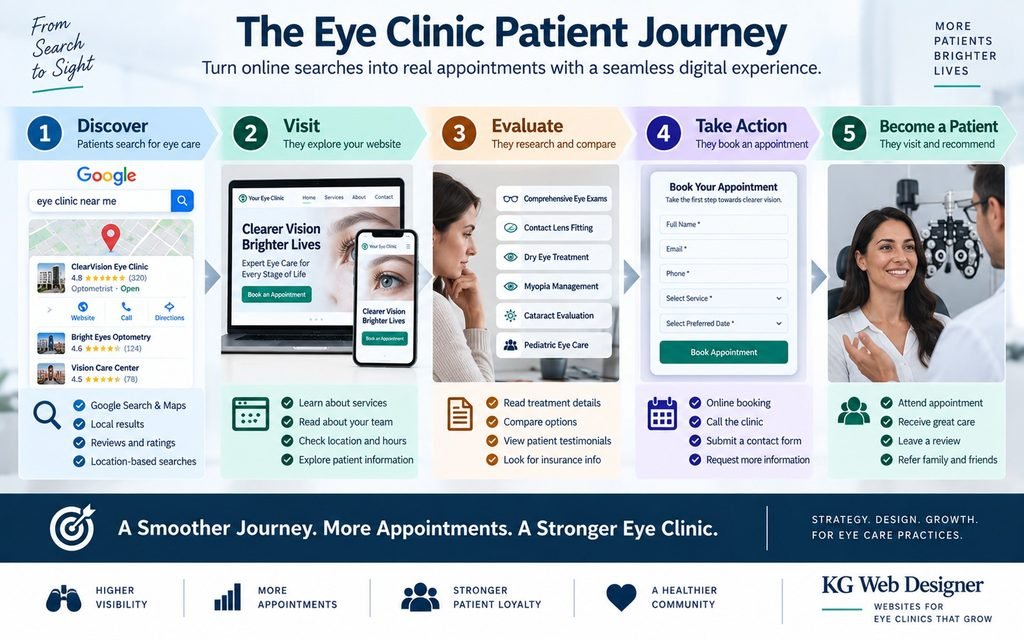
A useful journey might look like:
Discovery
Google Search, Maps, reviews, referral, social or AI recommendation.
↓
Verification
Clinic location, reviews, credentials, services and website.
↓
Evaluation
Treatment information, practitioner expertise, expectations and patient questions.
↓
Decision
Phone call, appointment booking or consultation request.
↓
Confirmation
Clear appointment details, reminders and expectations.
BrightLocal’s 2026 research found that 75% of consumers used multiple channels during their latest local-business search, reinforcing the need for consistency between Google, the website, reviews and other discovery channels.
This is why Local SEO for Optometrists should not be managed separately from website UX.
The patient does not experience “SEO,” “PPC,” and “web design” as separate departments.
They experience one decision journey.
PATIENT JOURNEY
Before Prescribing More Marketing, Diagnose the Patient Experience
If your clinic already receives search visibility and website traffic, the next investment may need to focus on what patients experience after they click.
Expert Insight from Kanika Gupta
The strongest recommendation I can make is simple: do not let the marketing channel become the diagnosis.
If an agency sells SEO, it may naturally see an SEO problem. If it sells advertising, it may see an advertising problem. If it specializes in redesigns, it may see a website problem.
I prefer to start with the patient journey.
Kanika Gupta, Founder, KG Web Designer
If this were my website, I would first open the clinic’s Google Business Profile on a phone, then search for the clinic’s highest-value services as a patient would, and follow the journey all the way to booking.
I would ask: Can I find the clinic? Can I understand what it offers? Do I trust the practitioner? Can I find the location and availability? Can I book without thinking too hard?
Only after answering those questions would I decide where the next marketing dollar should go.
That judgment is more valuable than automatically recommending another campaign or another redesign.
Original observation
At KG Web Designer, we frequently approach healthcare websites as connected conversion systems rather than isolated pages. One common issue is that clinics invest heavily in visibility while leaving the final decision stage underdeveloped, especially treatment explanations, practitioner proof, mobile CTAs and booking pathways.
I do not attach a fabricated conversion percentage to that observation. Clinic performance should be measured from the individual practice’s analytics, appointment system and revenue data.
Example From Our Experience
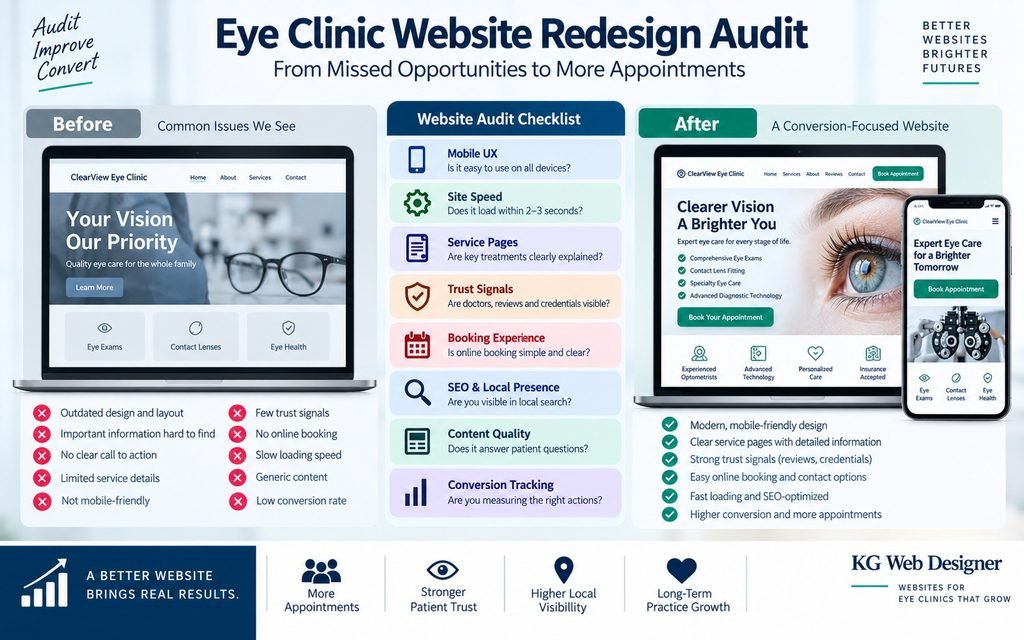
Problem: A clinic can have a professional-looking website but still make patients work too hard to understand the service, establish trust and reach the booking action.
Solution: Review the website as a patient journey rather than as a collection of pages. Map search intent to service pages, improve information hierarchy, strengthen practitioner and trust evidence, simplify calls to action, and make mobile booking easier to reach.
Outcome: The objective is not merely a prettier website. The measurable outcome to track should be qualified appointment actions, booking completion, phone calls, service-level engagement and acquisition cost before and after the intervention.
That is the standard I would expect before claiming that a redesign “increased patients.”
KG Web Designer’s approach is built around connecting website structure, UX, SEO and conversion rather than treating design as a cosmetic layer.
How Should a Multi-Location Eye Clinic Approach Its Website?
A multi-location clinic should create location-specific experiences when patients need location-specific information, rather than forcing every visitor through one generic clinic page. Each location should make its address, hours, services, practitioners, booking path and relevant local information easy to understand.
If your practice is expanding across locations, our guide to multi-location optometry website design is useful because the underlying challenge is not simply creating more location pages. The website needs an architecture that helps both patients and search engines understand which services belong to which location.
For a single-location clinic, the same principle applies at a smaller scale.
The homepage should establish the clinic.
Service pages should establish relevance.
Practitioner content should establish expertise.
The booking path should establish action.
What Should an Eye Clinic Measure Every Month?
An eye clinic should measure qualified patient actions rather than relying on traffic and rankings alone. The most useful dashboard connects discovery metrics with appointment behavior and ultimately with business value.
Track:
- Organic clicks by service
- Google Business Profile interactions
- Calls
- Appointment clicks
- Completed bookings
- New-patient appointments
- Paid-search conversion rate
- Cost per qualified appointment
- No-show rate
- Revenue by acquisition source
- Top landing pages
- Mobile versus desktop performance
- Conversion rate by location
Google now provides the ability to connect Business Profile data with Google Analytics, allowing businesses to analyze interactions such as website clicks, calls, directions, messages and bookings alongside website and app data.
That creates a much better measurement framework than asking, “How many visitors did we get?”
The financially meaningful question is:
Which acquisition source produced patients who were valuable to the clinic?
What This Means For Your Business
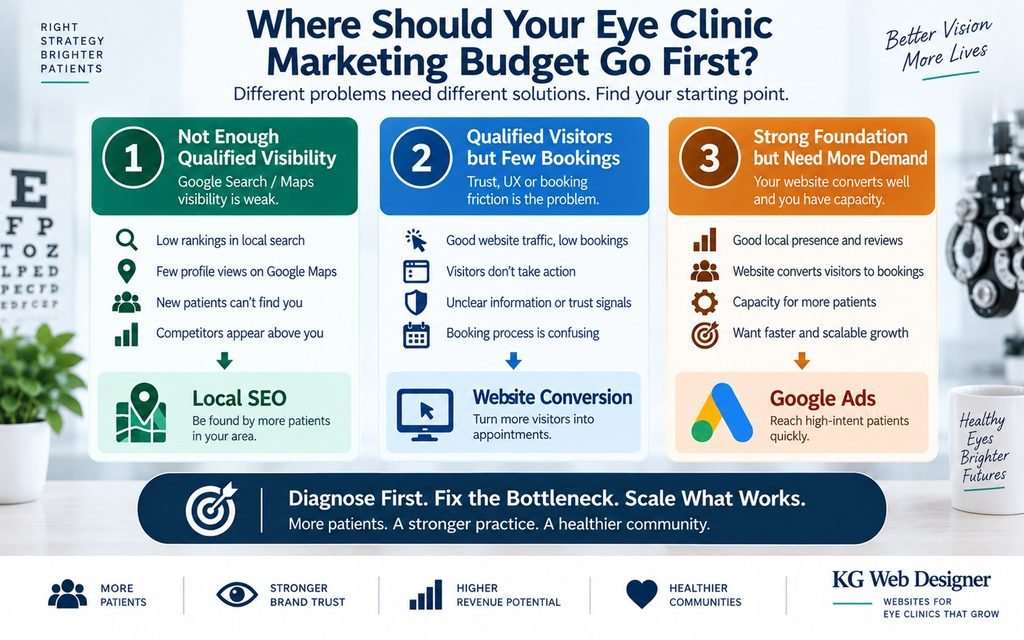
The correct investment depends on where your clinic is constrained today. There is no universal answer that says SEO always comes first, ads always come first, or redesign always comes first.
If visibility is weak, strengthen local discovery.
If demand exists but traffic volume is insufficient, test paid acquisition.
If visitors arrive but do not take action, improve conversion.
If the website has structural problems across content, UX, mobile experience and booking, redesign the foundation.
Increase Eye Clinic Appointments by fixing the bottleneck, not by automatically increasing the marketing budget.
That distinction matters financially.
If the website converts well, additional qualified traffic can create leverage.
If the website converts poorly, additional traffic creates more wasted opportunities.
If local visibility is weak, a beautifully designed website may remain underused.
And if the clinic already has strong visibility and conversion, the next opportunity may be scaling acquisition rather than rebuilding the website.
This is why the best strategy is diagnostic, measurable and sequential.
When Does Professional Help Make Sense?
Professional help makes sense when the clinic can no longer confidently identify whether its problem is visibility, conversion, website architecture, paid acquisition, or a combination of several factors. At that point, buying another isolated service can increase complexity rather than solve the underlying problem.
A qualified website or digital-growth partner should be able to explain:
- What evidence supports the diagnosis
- Which problem should be addressed first
- What should not be changed
- What should be measured
- How the website supports SEO and paid acquisition
- How the booking journey will be improved
- What risks exist during a redesign
- How success will be evaluated
This is where the difference between a generic website project and strategic Eye Clinic Website Design becomes significant.
The objective should be a patient acquisition system that supports the clinic’s commercial goals, not simply a new homepage.
At KG Web Designer, the strongest projects begin with understanding the business problem before deciding what should be designed, rebuilt or optimized.
If you are unsure whether your clinic needs more traffic, better conversion or a website rebuild, the most useful first step is a focused website and patient-journey review rather than immediately committing to a large marketing campaign.
You can discuss your clinic’s website and growth priorities and use the diagnosis to determine which investment should come first.
If the diagnosis points to a structural website problem rather than a simple marketing gap, the choice of web design partner becomes important. An eye clinic needs a designer who understands patient journeys, healthcare trust signals, local search, accessibility, booking behavior, and the commercial goals of the practice. Our guide on choosing an optometry website designer covers the criteria worth evaluating before starting a redesign.
How Does the SEO, Ads and Website Decision Change by Business Situation?
The correct answer changes according to the clinic’s starting position. A mature clinic with strong local visibility should not use the same investment sequence as a new location, while a clinic with excellent traffic but poor booking performance should not behave like a clinic that nobody can find.
| Clinic situation | First priority | Second priority | Third priority |
|---|---|---|---|
| Weak Google visibility | Local search foundation | Website/service content | Paid acquisition |
| Strong visibility, low bookings | Conversion audit | Website improvements | Paid scaling |
| New location | Google Business Profile + local presence | Paid search | Long-term SEO |
| Strong website, low traffic | SEO + paid acquisition | Content expansion | Conversion testing |
| Outdated website across all services | Website architecture | SEO migration/content | Paid acquisition |
| Strong bookings but limited volume | Acquisition scaling | Local SEO | CRO testing |
A clinic should also resist the temptation to treat a redesign as an automatic first step.
If the current website has sound architecture, good mobile performance and strong service content, focused improvements may produce more value than rebuilding everything.
Conversely, if every new SEO page or paid campaign has to work around an outdated CMS, poor navigation and weak templates, redesigning the foundation can be the more economical long-term decision.
Local SEO, Google Ads or Website Redesign — What Should Your Eye Clinic Fix First?
Let’s look at how patients currently discover, evaluate and contact your clinic — and identify where improving the journey could make the biggest difference.

Final Thoughts
The best Eye Clinic Marketing Strategy is not automatically SEO, Google Ads or a redesign. It is the investment that removes the biggest constraint between qualified patient intent and a completed appointment.
If patients cannot find you, fix visibility.
If they find you but hesitate, fix trust and conversion.
If the website itself is creating friction across multiple journeys, fix the foundation.
If the foundation is strong but demand is insufficient, scale qualified acquisition.
The most important principle is simple:
Diagnose first. Fix the bottleneck second. Scale third.
If this were my website, I would not approve another marketing campaign until I could clearly explain where patients are being lost and why.
If you want that diagnosis for your own clinic, talk to KG Web Designer about your website and patient acquisition priorities or book a strategy call with Kanika Gupta.
FAQs
How should an eye clinic choose the right marketing KPI?
An eye clinic should prioritize qualified appointment actions and acquisition economics rather than rankings or traffic alone. Useful KPIs include new-patient bookings, qualified calls, booking completion, cost per qualified appointment, show rate, revenue by acquisition source and service-level performance. Rankings and impressions still matter, but they are leading indicators rather than the final commercial outcome.
How much should an eye clinic spend on digital marketing each month?
There is no responsible universal monthly amount because the appropriate budget depends on location, competition, treatment mix, patient value, existing demand and growth objectives. A better approach is to establish an acceptable acquisition cost and then determine how much qualified demand the clinic can profitably support. The budget should follow economics rather than an arbitrary percentage.
Should an eye clinic advertise every treatment it offers?
No. Advertising every service can dilute budget and produce lower-intent traffic. Start with services that have clear search demand, commercial value, adequate capacity and a strong landing experience. Track performance by service rather than judging the entire campaign as one unit. High-value services may justify a different acquisition strategy from routine appointments.
How important are patient reviews for choosing an eye clinic?
Reviews are an important trust signal, but they are not the only factor. BrightLocal’s 2026 research found that 38% of consumers considered star rating and 37% considered review count when researching local businesses. Complete information, proximity, pricing, photos and service category also influenced decisions.
Should an eye clinic have separate pages for every treatment?
Separate pages are useful when treatments have different search intent, patient questions, practitioners, risks, expectations or conversion paths. Creating dozens of thin pages simply to target minor keyword variations is less useful. Each important treatment page should provide enough original information to help a patient understand whether the service is relevant and what the next step should be.
How can an eye clinic know whether a redesign is actually necessary?
A redesign is more defensible when multiple structural problems affect the website rather than one isolated issue. Review navigation, mobile UX, page templates, technical performance, service content, practitioner information, booking paths, analytics and CMS limitations. If several areas require fundamental changes, rebuilding the underlying experience may be more efficient than repeatedly patching individual pages.
How should an eye clinic handle AI search and local visibility?
Treat AI visibility as an extension of authority and information quality rather than as a separate trick. Maintain accurate business information, demonstrate real expertise, publish useful service information, build authentic reputation signals and keep the website technically accessible. BrightLocal’s 2026 research found that AI users frequently return to Google for verification, reinforcing the importance of a consistent presence across channels.